Bafeng Acupuncture Point (M-LE-8)
The Eight Winds in the Webs of the Toes: Anatomy, Nerve Supply, and Why This Extra Point Group Anchors Foot Swelling and Neuropathy Protocols
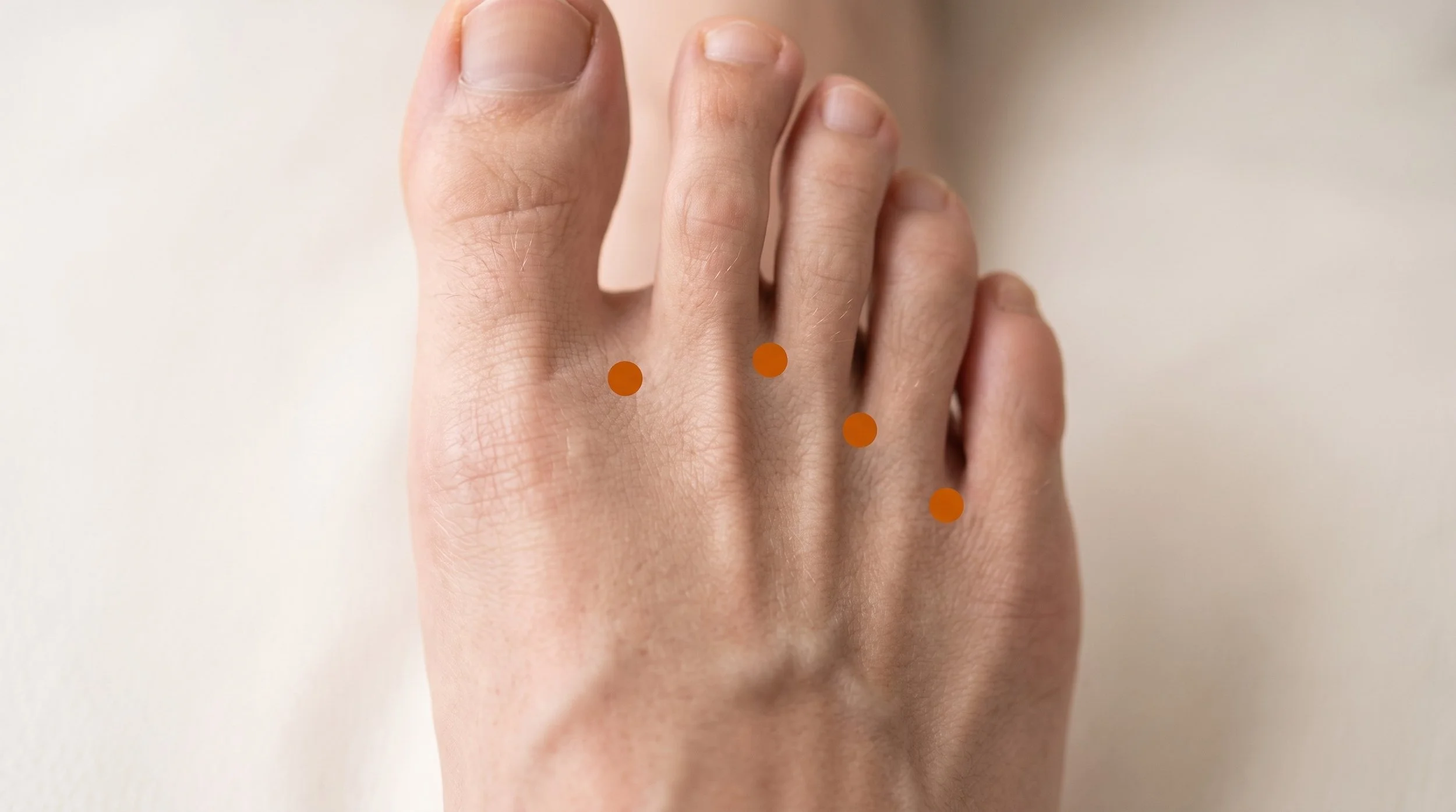
Bafeng (Eight Winds, M-LE-8) is not one point but a set of four small points on each foot, sitting in the soft web spaces between the toes about half a cun back from the free edge of each web. Because the toe webs are also where three regular channel points live, the Bafeng acupuncture point group overlaps with LV2, ST44 and GB43, which is one reason it shows up in so many different treatment plans.
Classical sources grouped these points for hot, swollen, painful feet and for what older texts called leg qi, while modern clinics reach for them when the top of the foot is puffy and sore after a sprain, when the forefoot aches from long days on hard pavement, or when the toes feel numb, buzzing or burning. The point group matters clinically because it puts a needle right where the terminal branches of the deep and superficial fibular nerves fan out, which is the most distal, most densely innervated real estate on the foot.
- Location and layers: four points per foot in the webs between the toes, roughly 0.5 cun proximal to the web margin, passing through thin dorsal skin and superficial fascia toward the dorsal interossei between the metatarsal heads (Deadman et al., 2009; O'Connor & Bensky, 1981).
- Traditional attribution: classical texts credit Bafeng with clearing heat and dispersing swelling, and list red, swollen, painful feet, leg qi, headache, malaria and irregular menstruation among its uses; these are historical categories, not physiological claims (Deadman et al., 2009).
- Mechanism: needling here recruits terminal digital branches of the deep and superficial fibular nerves, feeding segmental input into the lumbosacral cord where descending inhibitory pathways and endogenous opioid systems modulate pain signalling (Zhao, 2008).
- Local circulation: controlled studies of needling at other sites report measurable changes in skin and muscle perfusion, an effect that may matter in a cold, congested, poorly perfused forefoot, though the evidence base is small and mixed (Kim et al., 2016).
- Research picture: Bafeng appears repeatedly in the point prescriptions analysed in chemotherapy-induced peripheral neuropathy reviews, and trials of acupuncture for diabetic neuropathy symptoms have reported reductions in pain and numbness, with methodological limits that call for caution (Jin et al., 2020; Xu et al., 2022; Dietzel et al., 2023).
- De qi: patients usually report a tight, spreading fullness with a dull ache in the web, and often a numb or tingling wave that travels out to the toe tips, which is the sensation the Tang dynasty name Bachong (Eight Rushing) was describing (Deadman et al., 2009; O'Connor & Bensky, 1981).
Are Your Feet Swollen, Aching or Numb After Long Days on Your Feet?
New Yorkers walk more than almost anyone, and the forefoot pays for it. At Morningside Acupuncture we use the Bafeng points alongside ankle and lower leg points to address the puffy, tender top of the foot and the burning that shows up at the end of the day. Treatment is paired with dry needling of the intrinsic foot muscles and simple footwear and loading advice so results hold between sessions. Schedule a visit and we will map out what is driving your foot symptoms.
Schedule NowAnatomy of Bafeng: Why the Toe Webs Are Such an Important Location
The skin over the toe webs is thin and mobile, with very little fat between it and the structures underneath. A needle angled back up the foot passes through that skin and the loose superficial fascia carrying the dorsal venous network, then travels alongside the long and short extensor tendons toward the dorsal interossei filling the spaces between the metatarsal bones (O'Connor & Bensky, 1981).
This is a high-load zone: every push-off drives the metatarsal heads into the ground, and narrow shoes, hard city sidewalks, long standing shifts and forefoot-heavy running all compress the webs and the small muscles behind them. Swelling from a sprain or a bout of inflammatory joint pain also tracks forward into these spaces, which is why the tops of the toes and webs so often feel tight and tender when the ankle itself is the injured part.
The nerve geography is what makes this point group interesting. The web between the first and second toes is supplied by the terminal branch of the deep fibular nerve, while the second through fifth webs are served by branches of the superficial fibular nerve, with deeper plantar digital nerves running underneath (O'Connor & Bensky, 1981). All of these are L4 to S1 territory.
Needling here therefore delivers dense, well-localized afferent input from the very tissue that hurts, and that input converges in the dorsal horn with the nociceptive traffic from the joints, capsules and small muscles of the forefoot. Experimental work on acupuncture analgesia describes this segmental convergence, together with descending inhibitory control from the brainstem and the release of endogenous opioid peptides, as the core of the analgesic response (Zhao, 2008).
Local needling may also alter perfusion in the immediate area, an effect reported inconsistently across controlled microcirculation studies (Kim et al., 2016).
Sitting beside those nerves are the dorsal metatarsal arteries and veins and, deeper, branches of the plantar metatarsal vessels (O'Connor & Bensky, 1981). The vessels are small but superficial, so bruising is the most common minor event here. Standard practice is an oblique insertion angled proximally up the foot to about 0.5 to 1 cun, which keeps the needle in the soft tissue plane between the metatarsals rather than driving perpendicular into bone or joint (Deadman et al., 2009).
Some classical sources allow moxibustion at these points as well (Beijing College of Traditional Chinese Medicine et al., 1980). Because feet are sensitive and often edematous, we tend to use fine needles, gentle stimulation and careful skin inspection before treating.
Related Interossei Foot Trigger Points Related Pain Finder Leg Ankle FootBafeng at a Glance: Classification, Location, and Clinical Use
| Category | Detail |
|---|---|
| Traditional Name | Bafeng (Eight Winds), also recorded historically as Bachong (Eight Rushing) |
| Channel Classification | Extra point group, M-LE-8 (also numbered EX-LE-10 in some modern texts), four points per foot, eight in total |
| Point Categories | Extra (non-channel) point group whose members overlap three regular channel points: LV2 Xingjian, ST44 Neiting and GB43 Xiaxi; ST44 is classified as the ying-spring and water point of the Stomach channel, and LV2 and GB43 carry their own Liver and Gall Bladder channel designations (Deadman et al., 2009; Cunningham, 2000) |
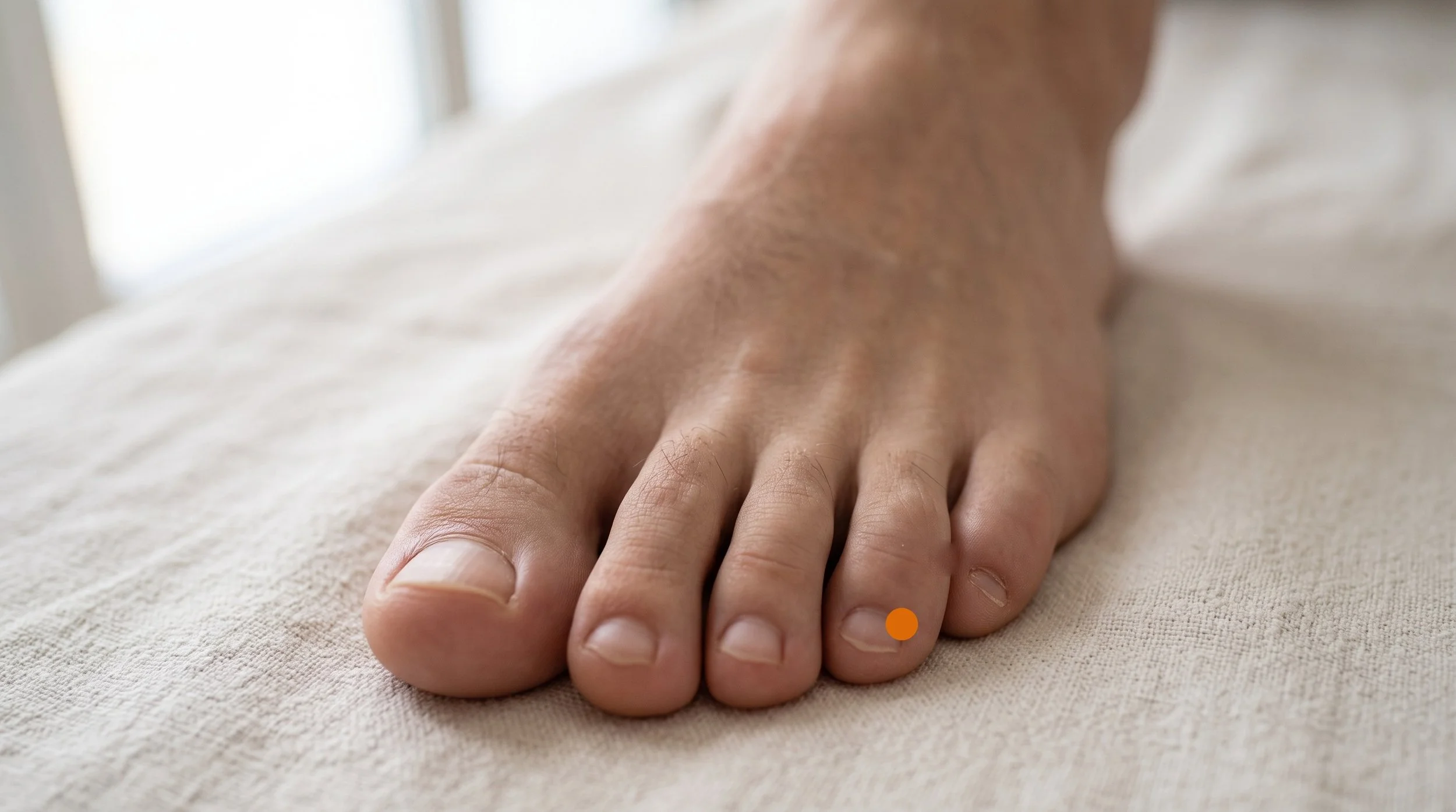
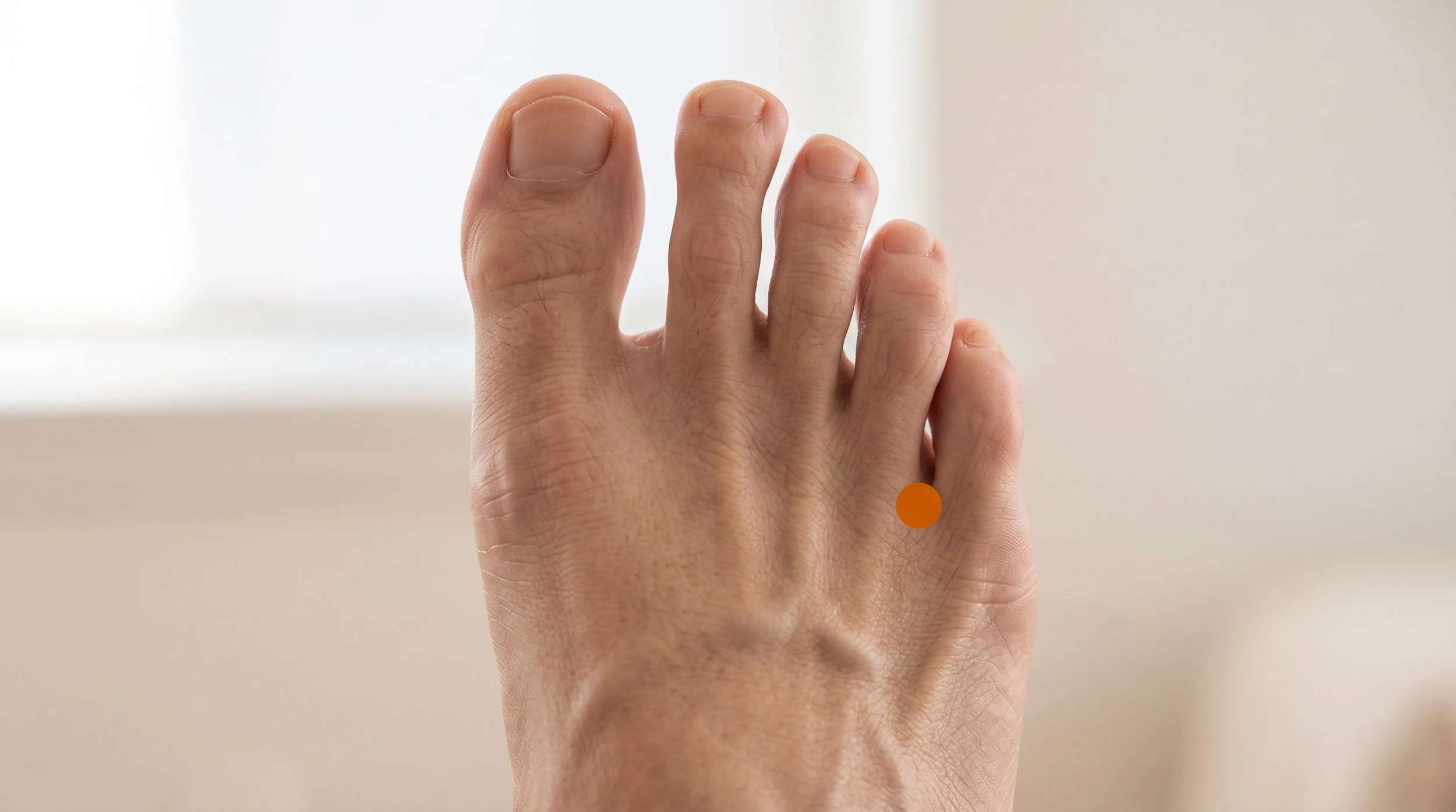
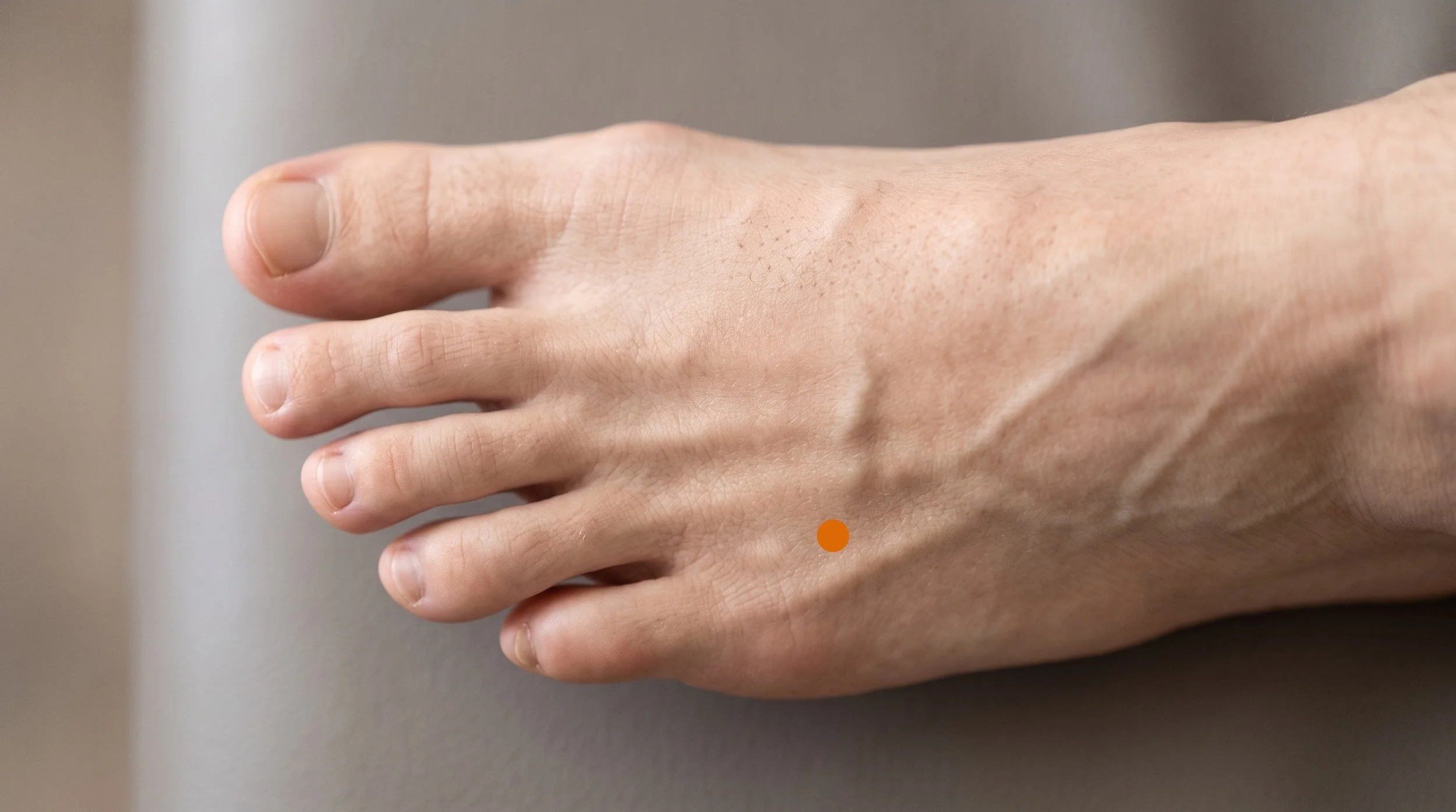
| Precise Location | On the dorsum of the foot in each of the four webs between the toes, approximately 0.5 cun proximal to the margin of the web, at the border of the darker and lighter skin |
| Tissue Stimulated | Dorsal web skin and superficial fascia, extensor digitorum longus and brevis tendon slips, and the dorsal interossei and other intrinsic foot muscles between the metatarsal heads |
| Needle Depth / Direction | Oblique insertion angled proximally up the foot, 0.5 to 1 cun (some texts allow up to 1.5 cun); moxibustion is described in classical sources |
| De Qi Sensation | Local distension and soreness with a dull ache, frequently accompanied by a numb or electric spreading sensation toward the tips of the toes |
| Primary Clinical Uses | Redness, swelling and pain across the top of the foot, toe pain and metatarsalgia, residual forefoot swelling after ankle sprain, and numbness or burning of the toes in peripheral neuropathy protocols; classical texts add leg qi, headache and irregular menstruation |
| Common Point Combinations |
|
According to Deadman, Al-Khafaji and Baker's A Manual of Acupuncture, the points that became Bafeng were referenced as early as the Essential Questions, but the name Eight Winds was not fixed until the Ming dynasty Great Compendium of Acupuncture and Moxibustion; Sun Si-miao's Thousand Ducat Formulas had earlier called them Bachong, or Eight Rushing, a name that reads as a description of the strong sensation these distal points produce.
Traditionally the group is credited with clearing heat and dispersing swelling, and the classical indication list runs from leg qi and hot, swollen, painful feet to malaria in the Essential Questions and irregular menstruation in the Compilation of Acupuncture and Moxibustion.
In practice, the manual notes, the group has always been used mainly for toe and forefoot disorders, functioning as the lower limb counterpart to the Baxie points of the hand, and three of the eight are simply channel points under another name.
What is striking about the classical record is the confidence with which distant, systemic complaints such as fevers, headaches and menstrual irregularity were assigned to eight small points in the toe webs, an early and consistent expression of the distal treatment logic that still shapes point selection today.
Why Bafeng Is Used for Numb and Burning Toes, Not Just Local Foot Pain
The toe webs are the end of the line for the nerves that supply the front of the foot. The deep fibular nerve terminates in the first web, and the superficial fibular nerve fans out through the others, all carrying information from L4 to S1 spinal levels. When those distal fibers are irritated, whether by swelling after a sprain, by pressure from footwear, or by a metabolic or drug-related insult to the small fibers, the dorsal horn neurons receiving their input can become sensitized, and the foot starts reporting pain or strange sensations out of proportion to what is happening in the tissue.
Needling into the same segmental territory delivers a strong, competing stream of afferent input to those same cord segments, which is the segmental convergence part of the story (Zhao, 2008).
The second part is descending inhibition. Afferent input from needling also engages brainstem and midbrain circuits that send inhibitory signals back down to the spinal cord, along with the release of endogenous opioid peptides, so the effect is not limited to the segment that was needled (Zhao, 2008). A third, more local element may be vascular: controlled studies using laser Doppler and related methods have documented changes in skin and muscle blood flow after needling, though the direction and size of the change varies between studies and the clinical significance is still unsettled (Kim et al., 2016). For a cold, congested, poorly perfused forefoot, that possibility is clinically interesting rather than proven.
This is also why Bafeng rarely appears alone. Because the problem often originates further up the chain, in the lumbar spine, the tibial or fibular nerve territory, or in systemic disease, the web points are usually combined with points on the lower leg and ankle so that the treatment covers the whole segmental pathway rather than just its endpoint.
What the Research Shows for Bafeng
There is no body of research that isolates the Eight Winds points on their own. What exists are trials and reviews of multi-point protocols in which Bafeng is one component, most often for peripheral neuropathy of the feet, plus broader evidence on acupuncture for chronic musculoskeletal pain. Reviews in this area consistently flag small samples, variable protocols, weak blinding and short follow-up, so the honest reading is that these points are a plausible and commonly used element of protocols that may help some patients, not an independently validated treatment.
| Study | Type | Focus | Key Finding |
|---|---|---|---|
| Jin et al., 2020 | Systematic review and meta-analysis (19 RCTs, 1174 patients) | Acupuncture for chemotherapy-induced peripheral neuropathy | Pooled results favored acupuncture over medication or sham for symptom response and nerve conduction measures, with Bafeng among the most frequently prescribed points, though the authors caution that methodological quality limits confidence. |
| Xu et al., 2022 | Systematic review and meta-analysis | Effectiveness and safety of acupuncture for chemotherapy-induced peripheral neuropathy | The review reported benefit for neuropathy symptoms with a favorable safety profile, while noting that the underlying mechanism remains incompletely understood. |
| Dietzel et al., 2023 | Randomized controlled clinical trial (62 patients) | Acupuncture for diabetic peripheral neuropathy-related complaints in the lower limbs | Twelve treatments over eight weeks were associated with a significant reduction in overall complaints on a visual analogue scale compared with a waitlist control, with improvements also seen in pain and neuropathic symptom scores. |
| Park et al., 2013 | Systematic review and meta-analysis (17 studies) | Acupuncture for ankle sprain | The pooled data suggested possible benefit for symptom improvement, but the authors judged the evidence insufficient for firm conclusions because of high risk of bias in the included trials. |
| Kim et al., 2016 | Systematic review of randomized trials | Local microcirculatory response to acupuncture needling | Most included studies detected a change in local blood flow after needling, most often an increase, but the small number of well-designed trials means the local vascular effect cannot yet be characterized reliably. |
| Vickers et al., 2018 | Individual patient data meta-analysis | Acupuncture for chronic musculoskeletal, headache and osteoarthritis pain | Acupuncture was associated with modest but statistically significant benefits over both sham and no-acupuncture controls, with effects that persisted over time. |
Living With Numb or Tingling Toes?
Peripheral neuropathy from chemotherapy, diabetes or nerve compression often lands hardest in the toes, and the toe webs are exactly where the affected nerve branches terminate. Our licensed acupuncturists use Bafeng within a broader lower limb protocol, adjusting needle depth and stimulation carefully for sensitive or insensate feet, and we coordinate with your medical team rather than replacing their care. Studies suggest acupuncture may reduce neuropathic symptoms for some patients, though results vary. Book a consultation to see whether this approach fits your situation.
Schedule NowBafeng in the Context of Trigger Point Work
The Eight Winds points sit directly over territory that trigger point practitioners already treat. The dorsal and plantar interossei occupy the spaces between the metatarsals, and taut bands in these small muscles refer pain along the corresponding toe and into the forefoot, a pattern well described in the myofascial literature (Simons et al., 1999). Adductor hallucis and the deeper intrinsic muscles contribute their own forefoot referral.
When a patient points to the top of the foot or to a specific web and calls the sensation deep and achy rather than sharp, palpating those interossei almost always reproduces part of the complaint, and the needle placement for Bafeng and the needle placement for the interossei end up being close neighbors.
At Morningside Acupuncture we treat this as one continuous approach rather than two competing ones, since acupuncture is defined by the use of an acupuncture needle and dry needling is one of the hundreds of styles that use it. A typical foot session might combine the Bafeng points angled proximally with dry needling of the dorsal interossei, adductor hallucis and the deep intrinsic foot muscles, then move up the chain to the tibialis anterior, fibularis group or calf if the mechanics point there.
Manual therapy, toe and arch loading exercises and footwear adjustments are layered on so the forefoot is not simply desensitized but is actually able to tolerate more load.
Bafeng Foot Pain and Neuropathy Treatment at NYC's Highest-Rated Acupuncture Clinic
Morningside Acupuncture is the highest-rated acupuncture and dry needling clinic in New York City with over 500 five-star Google reviews, and foot and ankle complaints are among the most common reasons patients find us. We combine classical point selection such as the Eight Winds points with modern orthopedic assessment, trigger point dry needling and rehab-informed guidance. Every plan is built around your specific pattern of swelling, pain or numbness. Schedule your appointment at our Upper West Side clinic today.
Schedule NowFrequently Asked Questions
What does Bafeng feel like when needled?
Most patients feel a brief pinch at the skin, since the toe webs are sensitive, followed by a heavy, spreading fullness or dull ache in the web itself. It is common for that sensation to run out to the tip of the adjacent toe as a tingling or numb wave, and classical texts described exactly this rushing quality. The feeling usually settles within a few seconds of the needle being placed, and the foot often feels lighter or warmer once the needles come out.
Why treat the toe webs when my pain is across the whole foot or coming from my ankle?
The nerves that report pain from the forefoot terminate in the toe webs, so needling there feeds strong input into the same L4 to S1 spinal segments that are processing the rest of your foot and ankle pain (Zhao, 2008). Swelling also tends to pool forward into these spaces after an ankle injury, which is why the group is traditionally paired with an ankle point such as ST41. In practice we rarely use Bafeng in isolation: it is the distal anchor of a treatment that usually includes lower leg and ankle points.
Can I press Bafeng myself between sessions?
Yes, and it is easy to reach. Sit with one foot resting on the opposite knee, slide a thumbnail or fingertip into a web space between two toes and move back about a finger's width from the free edge of the web. Press with firm but comfortable pressure, aiming slightly up toward the ankle, and hold for 30 to 60 seconds per web while breathing slowly, then work through all four webs on each foot. Two or three rounds a day is plenty. Gentle toe spreading and a slow massage along the grooves between the metatarsals afterward often helps as much as the point pressure itself. Skip any area with broken skin, an active infection, a healing wound or significant loss of sensation, and check with your clinician first if you have diabetes or a known neuropathy.
Is Bafeng safe to needle?
In trained hands it is a low-risk point group. The needles are inserted obliquely and shallowly into soft tissue, so the main considerations are the small dorsal veins and arteries that can cause bruising, and the fact that feet are sensitive and often ticklish. We take extra care with feet that are edematous, insensate, poorly perfused or affected by diabetes, since skin integrity and healing capacity matter more in those cases, and we avoid needling through any area with infection, ulceration or a rash. Clean needle technique is standard, and needles are single-use and sterile.
Where exactly is Bafeng located?
On the top of the foot, in each of the four webs between the toes, roughly 0.5 cun (about half a thumb width) back from the free margin of the web, at the junction of the darker skin of the foot's top and the lighter skin of the web. There are four points on each foot, eight in total, which is where the Eight Winds name comes from. Three of the eight are also standard channel points: LV2 in the first web, ST44 in the second and GB43 in the fourth.
References
- Deadman, P., Al-Khafaji, M., & Baker, K. (2009). A manual of acupuncture. Journal of Chinese Medicine Publications.
- O'Connor, J., & Bensky, D. (Eds. & Trans.). (1981). Acupuncture: A comprehensive text. Shanghai College of Traditional Medicine. Eastland Press.
- Cheng, X. (Ed.). (1999). Chinese acupuncture and moxibustion (Rev. ed.). Foreign Languages Press.
- Cunningham, P. M. (2000). Acupuncture points: A practical guide to classical and modern usage. Odyssey Press.
- Maciocia, G. (2006). The channels of acupuncture: Clinical use of the secondary channels and eight extraordinary vessels. Churchill Livingstone Elsevier.
- Kim, H. (2008). Handbook of Oriental medicine (3rd ed.). Harmony & Balance Press.
- Filshie, J., White, A., & Cummings, M. (Eds.). (2016). Medical acupuncture: A Western scientific approach (2nd ed.). Elsevier.
- Simons, D. G., Travell, J. G., & Simons, L. S. (1999). Travell & Simons' myofascial pain and dysfunction: The trigger point manual, Vol. 1: Upper half of body (2nd ed.). Williams & Wilkins.
- Zhao, Z. Q. (2008). Neural mechanism underlying acupuncture analgesia. Progress in Neurobiology, 85(4), 355-375. https://doi.org/10.1016/j.pneurobio.2008.05.004
- Vickers, A. J., Vertosick, E. A., Lewith, G., MacPherson, H., Foster, N. E., Sherman, K. J., Irnich, D., Witt, C. M., & Linde, K. (2018). Acupuncture for chronic pain: Update of an individual patient data meta-analysis. Journal of Pain, 19(5), 455-474. https://doi.org/10.1016/j.jpain.2017.11.005
- Jin, Y., Wang, Y., Zhang, J., Xiao, X., & Zhang, Q. (2020). Efficacy and safety of acupuncture against chemotherapy-induced peripheral neuropathy: A systematic review and meta-analysis. Evidence-Based Complementary and Alternative Medicine, 2020, 8875433. https://doi.org/10.1155/2020/8875433
- Xu, Z., Wang, X., Wu, Y., Wang, C., & Fang, X. (2022). The effectiveness and safety of acupuncture for chemotherapy-induced peripheral neuropathy: A systematic review and meta-analysis. Frontiers in Neurology, 13, 963358. https://doi.org/10.3389/fneur.2022.963358
- Dietzel, J., Habermann, I. V., Hörder, S., Hahn, K., Meyer-Hamme, G., Ortiz, M., Hua, K., Stöckigt, B., Bolster, M., Grabowska, W., Roll, S., Binting, S., Willich, S. N., Schröder, S., & Brinkhaus, B. (2023). Acupuncture in patients with diabetic peripheral neuropathy-related complaints: A randomized controlled clinical trial. Journal of Clinical Medicine, 12(6), 2103. https://doi.org/10.3390/jcm12062103
- Park, J., Hahn, S., Park, J. Y., Park, H. J., & Lee, H. (2013). Acupuncture for ankle sprain: Systematic review and meta-analysis. BMC Complementary and Alternative Medicine, 13, 55. https://doi.org/10.1186/1472-6882-13-55
- Kim, S. Y., Min, S., Lee, H., Cheon, S., Zhang, X., Park, J. Y., Song, T. J., & Park, H. J. (2016). Changes of local blood flow in response to acupuncture stimulation: A systematic review. Evidence-Based Complementary and Alternative Medicine, 2016, 9874207. https://doi.org/10.1155/2016/9874207
Disclaimer: This web site is intended for educational and informational purposes only. Reading this website does not constitute providing medical advice or any professional services. This information should not be used for diagnosing or treating any health issue or disease. Those seeking medical advice should consult with a licensed physician. Seek the advice of a medical doctor or other qualified health professional for any medical condition. If you think you have a medical emergency, call 911 or go to the emergency room. No acupuncturist-patient relationship is created by reading this website or using the information. Morningside Acupuncture PLLC and its employees and contributors do not make any express or implied representations with respect to the information on this site or its use. For any legal interpretation of scope of practice in your state, consult a licensed attorney or regulatory authority.
Read more from our blog