Baxie Acupuncture Point (M-UE-22)
The Eight Pathogens Points in the Finger Webs: Anatomy, Mechanism, and Why This Hand Grouping Anchors Treatment for Stiff, Swollen and Numb Fingers
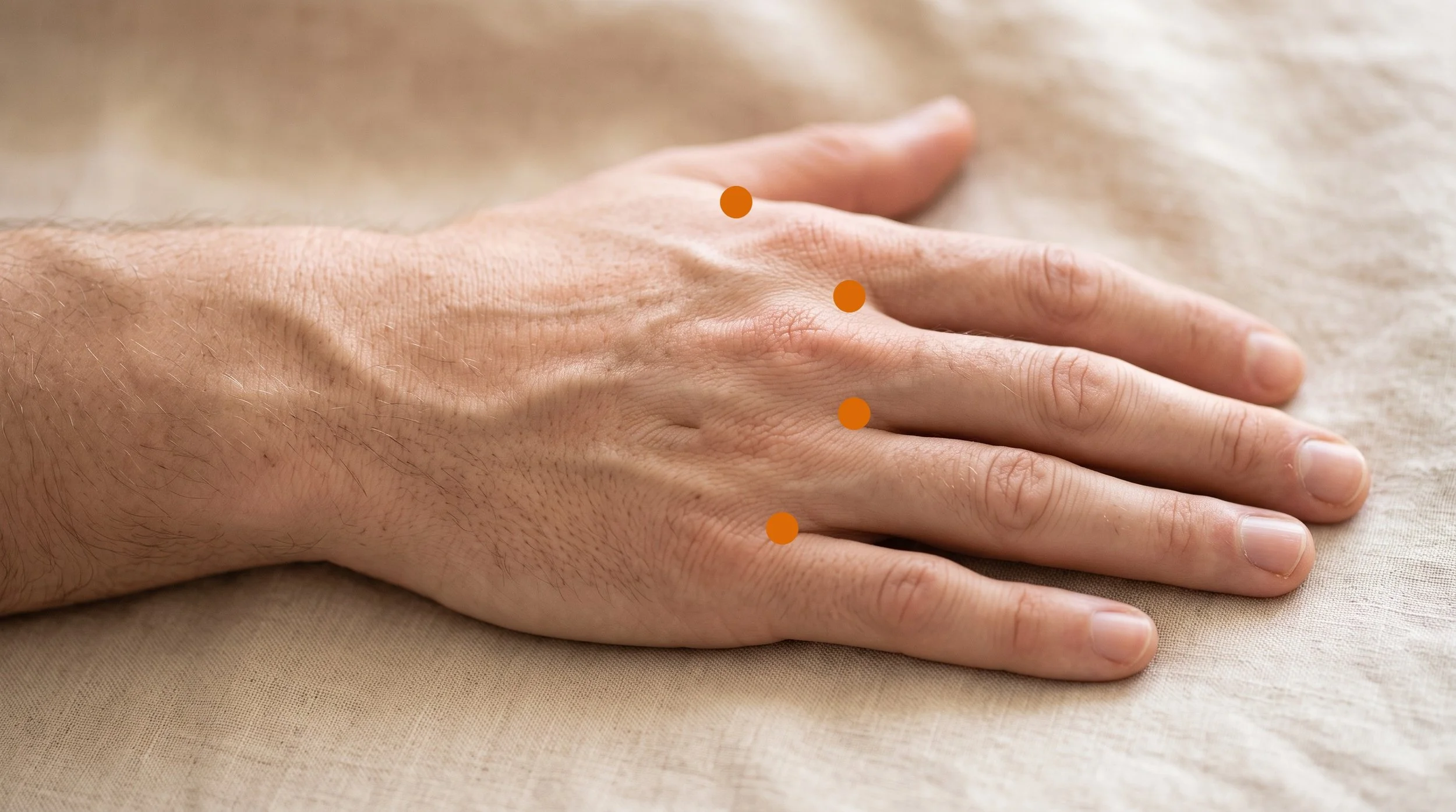
Baxie (M-UE-22), translated as Eight Pathogens or Eight Evils, isn't a single point but a set of four small points on the back of each hand, eight across both hands, sitting in the soft hollows between the metacarpal heads just behind the finger webs. You find them by having someone make a loose fist: the knuckles rise, and shallow valleys appear between them. In classical sources these points were bled and warmed for heat patterns and febrile disease, but in modern practice the baxie acupuncture point group is used almost entirely for the hand itself, for fingers that feel stiff, puffy, cramped, achy or numb.
Because a needle in each web reaches the terminal territory of every dorsal digital nerve, plus the small interosseous muscles that sit between the metacarpal shafts, baxie gives clinicians a fast, anatomically logical way to cover an entire hand in a few seconds of needling.
- Location and layers: the eight baxie hand points sit in the intermetacarpal hollows just proximal to the finger webs, passing through thin dorsal skin and fascia into the dorsal interossei, with the metacarpophalangeal joint capsules immediately distal and the extensor tendons on either side.
- Traditional attribution: the classical literature assigns these points the actions of clearing heat and reducing swelling, with indication lists covering finger and hand problems as well as heat signs at the head and throat, an inheritance from their early use as bleeding points.
- Mechanism: needling here recruits A-delta and group III afferents in the radial and ulnar dorsal digital nerve fields and in the deep ulnar supply to the interossei, feeding lower cervical segments (roughly C6 to C8) where hand afferents converge, and engaging descending inhibitory pathways that damp dorsal horn transmission (Zhao, 2008).
- Research picture: hand and wrist trials that include distal hand needling report mixed but generally favorable symptom outcomes, with a Cochrane review judging the carpal tunnel evidence uncertain and low in quality (Choi et al., 2018), while individual patient data pooling across chronic pain conditions supports modest, durable effects for acupuncture overall (Vickers et al., 2018).
- Clinical framing: baxie is a workhorse local grouping rather than a stand-alone protocol, and it's usually combined with a source point such as LI4, a forearm point such as TE5, and trigger point needling in the forearm extensors and intrinsic hand muscles (Simons, Travell, & Simons, 1999).
- De qi: patients typically feel a tight, spreading ache or fullness at the web, and a proportion feel a brief electric tingle running out toward the fingertip, which reflects direct engagement of the digital nerve territory rather than anything going wrong.
Stiff, Swollen or Aching Fingers That Are Worst in the Morning?
Fingers that won't fully close in the morning, that feel puffy after a long day at a keyboard, or that ache with grip are one of the most common upper limb complaints we see. At Morningside Acupuncture we needle the baxie web points alongside the forearm muscles that actually drive the fingers, then add gentle joint mobility work you can repeat at home. Treatment is quick, well tolerated, and easy to fit into a lunch break. Book a session and let's look at what your hand is doing under load.
Schedule NowAnatomy of BAXIE: Why the Finger Webs Are Such an Important Location
The skin on the back of the hand is thin and mobile, and just beneath it lies a loose layer of fascia carrying a visible network of veins. Deeper again, filling the gaps between the metacarpal shafts, are the dorsal interossei, small fan-shaped muscles that spread the fingers and assist the knuckle joints during grip. Immediately distal to each baxie point sits a metacarpophalangeal joint capsule with its collateral ligaments, and running along either side of the hollow are the extensor tendons and their linking bands.
This is the tissue that takes the load when you grip a barbell, hold a phone for hours, pinch a mouse, carry heavy bags, or work through inflammatory or degenerative joint change. Swelling here shows up first as a loss of the normal knuckle valleys, which is precisely why the classical texts describe the region in terms of fullness and swelling.
Nerve geography explains most of what baxie does. The radial nerve supplies dorsal digital branches to the thumb, index, middle and part of the ring finger, while the ulnar nerve supplies the dorsal branches to the little finger and the adjacent side of the ring finger, and the interossei themselves are driven by the deep branch of the ulnar nerve. A needle placed in the web therefore lands in a dense terminal sensory field, and the palmar digital branches of the median and ulnar nerves lie only a little deeper.
All of this afferent traffic returns to the lower cervical spinal cord, where input from skin, muscle and joint converges on shared dorsal horn neurons. Stimulating these fibers is thought to modulate that convergence and to recruit descending inhibitory control from the brainstem, along with segmental and humoral mechanisms described in the acupuncture analgesia literature (Zhao, 2008).
Imaging work in carpal tunnel syndrome adds a central layer to the story, since real acupuncture was associated with improved median nerve conduction and with changes in how adjacent fingers are represented in primary somatosensory cortex (Maeda et al., 2017).
The deep structures to respect are vascular rather than dangerous. The dorsal metacarpal arteries and a rich venous plexus run through this region, so bruising is the most common minor event, and clinicians usually needle beside a visible vein rather than through it. Standard technique is perpendicular insertion along the line between the metacarpal shafts, roughly 0.5 to 1 cun, with the hand held in a loose fist so the skin is taut. Some modern Chinese texts describe a shallower oblique angle, or superficial pricking to release a drop or two of blood, and note that moxibustion may be applied.
Needling should stay in the intermetacarpal space rather than driving into the joint capsule, and depth is reduced in thin, arthritic or swollen hands.
Related Pain Finder Forearm Hand Related Dorsal Interossei Trigger PointsBAXIE at a Glance: Classification, Location, and Clinical Use
| Category | Detail |
|---|---|
| Traditional Name | Baxie, Eight Pathogens (also translated Eight Evils or Eight Ghosts), M-UE-22 |
| Channel Classification | Extra point (miscellaneous point) of the upper limb, not on a regular channel; the hand counterpart of Bafeng on the feet |
| Point Categories | Grouped extra point set, four points per hand and eight in total. Traditional actions given in the Deadman text are clearing heat and dissipating swelling, with the Cunningham text adding resolving toxin. There's no five-shu, yuan-source, luo-connecting or hui-meeting designation and no extraordinary vessel intersection, since baxie sits outside the regular channel system; the Cunningham text does note that one of the eight overlaps with TE2. |
| Precise Location | On the dorsum of the hand with a loose fist. Six points lie in the depressions between the metacarpal heads, just proximal to the finger web margins, and the remaining two lie between the thumb and index metacarpals, again just behind the web. The Deadman text offers a helpful check: picture a small triangle between two knuckle prominences and the top of the web crease, and take the center of that triangle. |
| Tissue Stimulated | Dorsal skin and superficial fascia, the intertendinous fascial plane, and the dorsal interossei muscles, with the metacarpophalangeal joint capsules immediately distal and the radial and ulnar dorsal digital nerve fields throughout |
| Needle Depth / Direction | Perpendicular insertion along the line between the metacarpal shafts, 0.5 to 1 cun, hand held in a loose fist. Shallower oblique needling (about 0.3 to 0.5 cun) or superficial pricking to bleed is described in modern Chinese texts, and moxibustion is traditionally permitted. |
| De Qi Sensation | Local distension, tightness and a dull ache in the web, often with a soreness that spreads across the back of the hand; some patients report a brief numb, electric sensation traveling toward the fingertip |
| Primary Clinical Uses | Finger stiffness, swelling and spasm; arthritic finger and hand joint pain; hand numbness and finger neuropathy symptoms in modern practice; painful obstruction of the fingers; classically also headache, toothache, sore throat, red swollen eyes, stiff neck and febrile disease |
| Common Point Combinations |
|
According to the Deadman text, these points are discussed as far back as the Essential Questions, where bleeding them was recommended for malaria, although the name Baxie itself doesn't appear until the Great Compendium of Acupuncture and Moxibustion.
The traditional action attributed to the group is clearing heat and dissipating swelling, and the classical indication lists fall into two clusters: local hand problems (numbness, stiffness, redness, swelling, spasm, pain, and painful obstruction of the fingers) and heat signs further away (headache, toothache, sore and swollen throat, red swollen eyes, stiff neck, fever, and in some sources snakebite of the hand or arm). The Shanghai and Cunningham texts preserve much the same picture.
What's striking is the trajectory: a point group that entered the record as a place to let blood in fever became, over centuries of clinical use, the default local grouping for the hand itself, which is close to how it's used today.
Why BAXIE Is Used for Numbness and Tingling That Travels Into the Fingertips
Patients are often surprised that a needle in the web of the hand can change a symptom they feel in the fingertip. The reason is that the finger webs sit in the terminal branching zone of the dorsal digital nerves, so a small stimulus there produces a large volley of afferent input from exactly the territory the brain associates with the symptom. That input arrives at lower cervical spinal segments shared by skin, muscle, joint and, in the case of the hand, by the same nerve trunks that pass through the wrist and forearm. Where several inputs converge, modulating one can influence how the others are processed, which is the segmental part of the story.
The second layer is descending control. Sustained afferent stimulation of this kind has been shown to recruit brainstem and midbrain pathways that release endogenous opioids, serotonin and noradrenaline onto the spinal dorsal horn, reducing the transmission of nociceptive signals for a period well beyond the treatment itself (Zhao, 2008).
There's also a plausible central mapping effect: in carpal tunnel syndrome, patients receiving real acupuncture showed improved median nerve conduction and better separation of adjacent finger representations in primary somatosensory cortex, with those cortical changes predicting longer term symptom outcomes (Maeda et al., 2017). Blurred cortical finger maps are common in chronic hand conditions, and stimulating each web separately gives the nervous system distinct, digit-specific input.
Finally, there's a straightforward local effect. Needling in the intermetacarpal space produces a small axon reflex response with local vasodilation and changes in tissue perfusion, and it engages the dorsal interossei directly. For a hand that feels congested and stiff rather than sharply painful, that combination of local circulatory change, muscular release and segmental modulation is usually what patients notice first as easier finger closure and less morning tightness.
None of this is a fix for underlying joint disease, and we're clear with patients that the goal is symptom control and function alongside their medical care.
What the Research Shows for BAXIE
Baxie is rarely studied on its own. It appears inside multi-point protocols, so the honest reading of the literature is that we have evidence about acupuncture for particular hand conditions, with baxie as one component of the treatment being tested. The signal across hand and finger conditions is modest and uneven, the trials are often small, and blinding in needle research is genuinely hard. What follows is the most relevant work, presented with those limits in mind.
| Study | Type | Focus | Key Finding |
|---|---|---|---|
| Choi et al., 2018 | Cochrane systematic review | Acupuncture and related interventions for symptoms of carpal tunnel syndrome, 12 trials with 869 participants | The review found it uncertain whether acupuncture improves pain or overall symptoms, with most studies at unclear or high risk of bias and no serious adverse events reported. |
| Vickers et al., 2018 | Individual patient data meta-analysis | Acupuncture across chronic musculoskeletal pain conditions, roughly 20,000 patients | Acupuncture was associated with modest but statistically significant benefits over both sham and no-acupuncture controls, with effects persisting over about 12 months. |
| Maeda et al., 2017 | Randomized controlled trial with neuroimaging | Local and distal electroacupuncture in carpal tunnel syndrome | Real acupuncture improved median nerve conduction and somatosensory cortex finger separation more than sham, suggesting a neurophysiological component beyond expectation effects. |
| Seca et al., 2019 | Double-blind randomized clinical trial | Acupuncture for pain, functional disability and quality of life in rheumatoid arthritis of the hand | Verum point selection outperformed sham points and a waiting list on pain and hand function measures, though the sample was modest and follow-up short. |
| Iravani et al., 2020 | Pilot randomized, assessor-blinded controlled trial | Acupuncture using Baxie and Bafeng as local points for chemotherapy-induced peripheral neuropathy | Acupuncture was associated with reduced symptom severity compared with the medication control in this small pilot, which the authors treat as preliminary. |
| Zhao, 2008 | Narrative review of mechanisms | Neural mechanisms of acupuncture analgesia | Reviews evidence that needling engages segmental spinal inhibition, descending control and endogenous opioid systems, providing a plausible basis for distal and local point effects. |
Numbness and Tingling in the Hand That Wakes You at Night?
Hand numbness has several possible sources, from the neck and the thoracic outlet to the carpal tunnel and the small nerves in the fingers themselves, so we assess before we needle. Baxie covers the terminal digital nerve fields, and we pair it with wrist, forearm and lower cervical points depending on where your symptoms map. We'll also flag anything that belongs with your physician. Schedule an evaluation and get a clear plan instead of guesswork.
Schedule NowBAXIE in the Context of Trigger Point Work
The baxie points sit directly over the dorsal interossei, which are classic sources of referred pain into the adjacent fingers, and the first dorsal interosseous in particular can refer discomfort along the index finger and into the web of the thumb (Simons, Travell, & Simons, 1999). That anatomical overlap means the same insertion site can serve two purposes at once: a traditional extra point in the eight pathogens grouping and a myofascial target in a taut, tender intrinsic hand muscle. In practice we palpate each web before needling, and the point that reproduces a patient's familiar ache usually earns the needle.
Hands rarely fail in isolation, so at Morningside we treat baxie as the distal end of a chain. A typical session might combine the web points with dry needling of the adductor pollicis, the wrist and finger extensors in the forearm around LI10 and LI11, the flexor group for grip-dominant patients, and tender points in the lower neck and scalene region when symptoms suggest a proximal contribution. LI4 and TE5 often join the prescription, and where numbness affects the feet as well, Bafeng mirrors the hand approach. The needling is only part of it: we pair it with grip loading, nerve gliding and workstation changes so the hand keeps the gains between visits.
BAXIE Hand Pain Treatment at NYC's Highest-Rated Acupuncture Clinic
Morningside Acupuncture is the highest-rated acupuncture and dry needling clinic in New York City with over 500 five-star Google reviews, and hand, wrist and forearm complaints are among the conditions we treat most often. We combine classical point selection such as the eight pathogens points with modern trigger point needling and load management advice. Every plan is built around your work, your training and your hands. Schedule your first visit today.
Schedule NowFrequently Asked Questions
What does BAXIE feel like when needled?
Most people feel a quick pinch at the skin, then a spreading tightness or dull ache in the web of the hand that can fan out across the back of the hand toward the wrist. A minority feel a short buzz or numb, electric sensation running out to the fingertip, which reflects the density of digital nerve endings in this area and settles within a second or two. The hand can feel warm and slightly heavy afterward. It's a sensitive spot, so we tend to use fine needles and gentle stimulation, especially on a first visit.
Why needle the finger webs instead of the painful knuckle itself?
The webs give safer, more productive access to the same neurological territory. A needle placed between the metacarpal shafts reaches the dorsal digital nerve fields and the interosseous muscles that act on the knuckle, without entering the joint capsule or the tendon sheath, which we prefer to leave alone in inflamed or arthritic hands. Classical practice reflects the same logic: for a problem in the index, middle or ring finger, clinicians typically needle the web on each side of the affected digit rather than the finger itself.
Can I press BAXIE myself between sessions?
Yes, and it's one of the easier self-care points to find. Make a loose fist with the affected hand, then use the thumb and index finger of the other hand to pinch each web just behind the knuckle line, where you'll feel a soft hollow. Apply firm, steady pressure for 20 to 30 seconds per web, working through all four spots, then repeat with slow circles for another 20 seconds each. Two or three rounds a day is plenty, and it pairs well with opening and closing the hand fully after each round. Ease off if the area is hot, visibly swollen, bruised or numb, and don't press over broken skin or an acutely inflamed joint.
Is BAXIE safe to needle?
It's a low-risk location in trained hands, since there's no lung, major vessel or deep organ nearby. The realistic concerns are bruising from the dorsal vein network, brief post-needle soreness, and momentary nerve tingling. Clinicians angle along the space between the metacarpal shafts, avoid visible veins, and keep depth modest in thin, swollen or arthritic hands. Extra caution applies with anticoagulant use, lymphedema or a history of lymph node removal on that side, active joint infection, or poorly controlled diabetes with skin changes, and in those situations we adapt or choose a different approach.
Where exactly is BAXIE located?
On the back of the hand with a loose fist. Six of the eight points sit in the depressions between the metacarpal heads, just behind the margins of the finger webs, and the other two sit between the thumb and index metacarpals, again just proximal to that web. Four points per hand, eight across both hands. A useful check from the Deadman text is to imagine a small triangle formed by two adjacent knuckle prominences and the top of the visible web crease between them; the point lies at the middle of that triangle.
References
- Deadman, P., Al-Khafaji, M., & Baker, K. (2009). A manual of acupuncture. Journal of Chinese Medicine Publications.
- O'Connor, J., & Bensky, D. (Eds. & Trans.). (1981). Acupuncture: A comprehensive text. Shanghai College of Traditional Medicine. Eastland Press.
- Cheng, X. (Ed.). (1999). Chinese acupuncture and moxibustion (Rev. ed.). Foreign Languages Press.
- Cunningham, P. M. (2000). Acupuncture points: A practical guide to classical and modern usage. Odyssey Press.
- Filshie, J., White, A., & Cummings, M. (Eds.). (2016). Medical acupuncture: A Western scientific approach (2nd ed.). Elsevier.
- Simons, D. G., Travell, J. G., & Simons, L. S. (1999). Travell & Simons' myofascial pain and dysfunction: The trigger point manual, Vol. 1: Upper half of body (2nd ed.). Williams & Wilkins.
- Zhao, Z. Q. (2008). Neural mechanism underlying acupuncture analgesia. Progress in Neurobiology, 85(4), 355-375. https://doi.org/10.1016/j.pneurobio.2008.05.004
- Vickers, A. J., Vertosick, E. A., Lewith, G., MacPherson, H., Foster, N. E., Sherman, K. J., Irnich, D., Witt, C. M., & Linde, K. (2018). Acupuncture for chronic pain: Update of an individual patient data meta-analysis. Journal of Pain, 19(5), 455-474. https://doi.org/10.1016/j.jpain.2017.11.005
- Choi, G. H., Wieland, L. S., Lee, H., Sim, H., Lee, M. S., & Shin, B. C. (2018). Acupuncture and related interventions for the treatment of symptoms associated with carpal tunnel syndrome. Cochrane Database of Systematic Reviews, 2018(12), CD011215. https://doi.org/10.1002/14651858.CD011215.pub2
- Maeda, Y., Kim, H., Kettner, N., Kim, J., Cina, S., Malatesta, C., Gerber, J., McManus, C., Ong-Sutherland, R., Mezzacappa, P., Libby, A., Mawla, I., Morse, L. R., Kaptchuk, T. J., Audette, J., & Napadow, V. (2017). Rewiring the primary somatosensory cortex in carpal tunnel syndrome with acupuncture. Brain, 140(4), 914-927. https://doi.org/10.1093/brain/awx015
- Seca, S., Patrício, M., Kirch, S., Franconi, G., Cabrita, A. S., & Greten, H. J. (2019). Effectiveness of acupuncture on pain, functional disability, and quality of life in rheumatoid arthritis of the hand: Results of a double-blind randomized clinical trial. Journal of Alternative and Complementary Medicine, 25(1), 86-97. https://doi.org/10.1089/acm.2018.0297
- Iravani, S., Kazemi Motlagh, A. H., Emami Razavi, S. Z., Shahi, F., Wang, J., Hou, L., Sun, W., Afshari Fard, M. R., Aghili, M., Karimi, M., Rezaeizadeh, H., & Zhao, B. (2020). Effectiveness of acupuncture treatment on chemotherapy-induced peripheral neuropathy: A pilot, randomized, assessor-blinded, controlled trial. Pain Research and Management, 2020, 2504674. https://doi.org/10.1155/2020/2504674
Disclaimer: This web site is intended for educational and informational purposes only. Reading this website does not constitute providing medical advice or any professional services. This information should not be used for diagnosing or treating any health issue or disease. Those seeking medical advice should consult with a licensed physician. Seek the advice of a medical doctor or other qualified health professional for any medical condition. If you think you have a medical emergency, call 911 or go to the emergency room. No acupuncturist-patient relationship is created by reading this website or using the information. Morningside Acupuncture PLLC and its employees and contributors do not make any express or implied representations with respect to the information on this site or its use. For any legal interpretation of scope of practice in your state, consult a licensed attorney or regulatory authority.
Read more from our blog