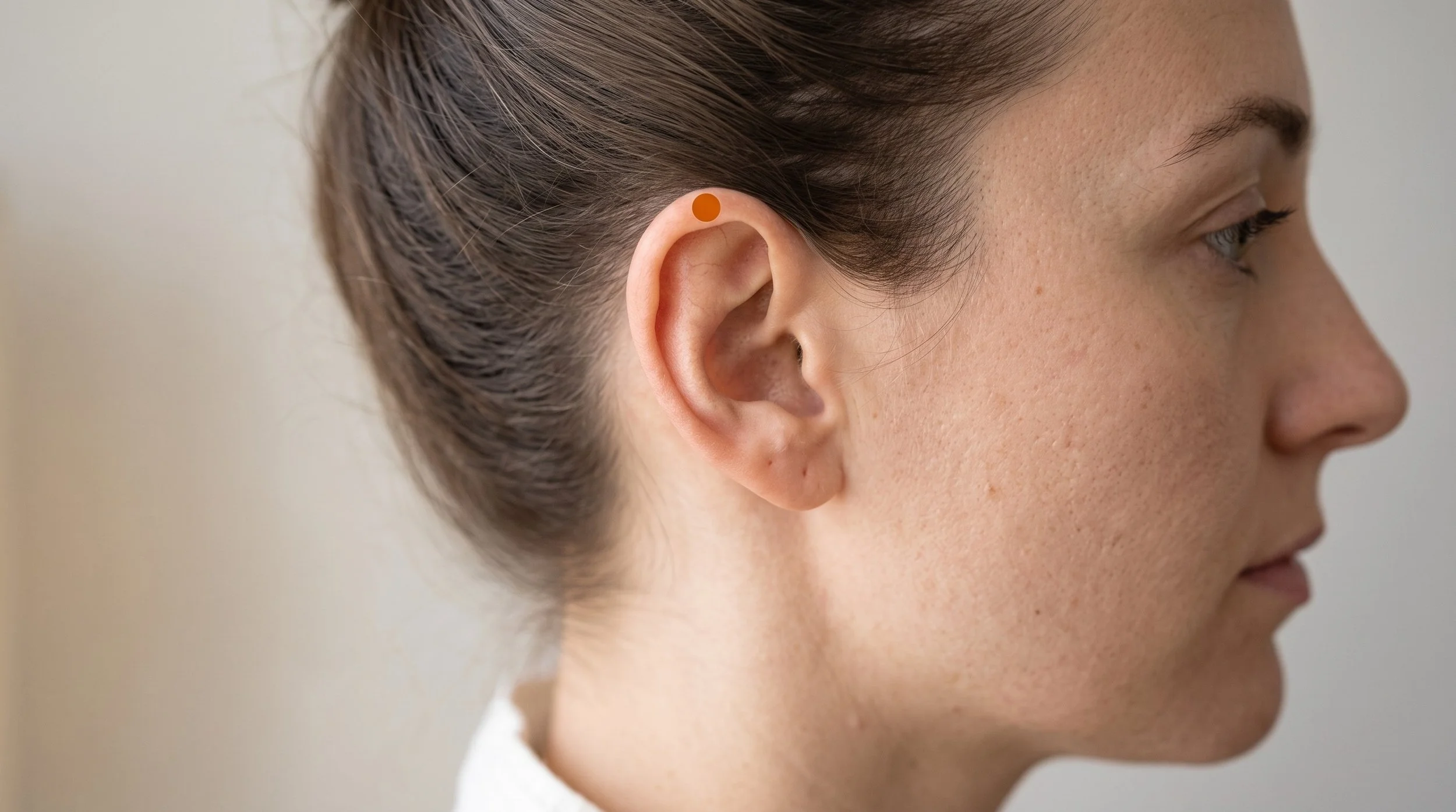
Erjian Acupuncture Point (M-HN-10)
The Tip of the Ear Point: Anatomy, Mechanism, and Why This Extra Point Is Needled or Bled for Red Eyes, Sore Throat, and One-Sided Headache
Erjian, translated as Tip of the Ear or Apex of the Ear, is an extra (extraordinary) point coded M-HN-10 in Deadman's system and listed as EX-HN 6 in modern nomenclature. You find it by folding the ear forward so the back of the upper helix lays over its front, then marking the highest point of that fold. It's one of the few points on the body defined by a movement rather than by a bone or tendon landmark, and it sits on thin skin over helix cartilage in territory supplied by the auriculotemporal and lesser occipital nerves.
Classically it was used to clear heat and reduce swelling, with indications centered on red, swollen, painful eyes, sore throat, one-sided headache, and high fever, and it remains one of the most commonly used bleeding points in modern East Asian practice.
Note that the pinyin name creates confusion: Erjian LI2 is a completely different point on the index finger, and the two are frequently mixed up in translated sources.
- Location and layers: with the ear folded forward, the point sits at the apex of that fold along the upper helix. A needle here passes epidermis and dermis, a very thin subcutaneous layer, and reaches perichondrium over elastic cartilage, which is why insertion is kept to roughly 0.1 cun or replaced entirely with a quick prick (Deadman et al., 2001).
- Traditional categories, translated: classical sources credit Erjian with clearing heat, dispersing swelling, and benefiting the eyes and throat, and the indication list runs to red and swollen eyes, visual obstruction, throat pain and swelling, mumps, one-sided headache, and high fever (Deadman et al., 2001). In neurophysiological terms, that's a small, high-density cutaneous stimulus applied in a cranial and upper cervical sensory field used for inflammatory and febrile presentations of the head.
- Nerve geography: cadaver dissection shows the auricle is supplied by a heterogeneous mix of the auriculotemporal branch of the trigeminal nerve, the auricular branch of the vagus, and the lesser occipital and great auricular nerves from the cervical plexus, with no region receiving triple innervation (Peuker & Filler, 2002). Vagal input concentrates in the concha rather than at the helix rim (He et al., 2012), so the apex is best understood as a trigeminal and cervical target, not a vagal one.
- Mechanism: stimulating a field shared by trigeminal (V3) and upper cervical (C2) afferents feeds the trigeminocervical complex, the same convergence zone implicated in one-sided head and periorbital pain, while needle-evoked afferent traffic engages descending inhibitory pathways and endogenous opioid systems (Zhao, 2008).
- Research picture: this point rarely gets tested alone. A Cochrane review of acupuncture for acute hordeolum (stye) found low-certainty evidence of possible benefit (Cheng et al., 2017), and pooled analyses of ear apex bloodletting for primary hypertension and for acute stroke report short-term signals from small, methodologically limited trial sets (Kwon et al., 2018; Kim & Han, 2024).
- De qi and practice: the ear is richly innervated, so patients feel a bright, sharp pinch rather than the dull ache typical of muscle points, often followed by a few seconds of warmth and a visible flush across the ear. When bled, only a few drops are expressed with a sterile single-use lancet, and clinicians screen carefully for bleeding disorders, anticoagulant use, and any sign of ear infection.
Dealing With Red, Irritated Eyes and Pressure Around the Brow?
Eye redness, itching, and a heavy feeling around the orbit often travel with sinus congestion, screen strain, and jaw and temple tension. At Morningside Acupuncture we use the ear apex alongside brow and temple points, and we treat the temporalis, masseter, and suboccipital muscles that keep referring into the eye region. Every session includes an exam so the plan matches what's actually driving your symptoms. Schedule a visit and we'll map it out together.
Schedule NowAnatomy of ERJIAN: Why the Apex of the Ear Is Such an Important Location
The ear apex is unusual among acupuncture points because it has no fixed skeletal landmark. You create it: fold the pinna forward so the posterior surface of the upper helix comes to rest over its anterior surface, taking care to fold only the upper ear rather than pushing the whole auricle forward, and the top of that fold is the point (Deadman et al., 2001). Anatomically you're at the rim of the helix, where skin is thin and closely adherent, the subcutaneous layer is minimal, and elastic cartilage covered by perichondrium sits immediately beneath.
There's no muscle here worth speaking of and no fascial plane to travel through, which is why the classical needling depth is about 0.1 cun and why many practitioners skip needle retention entirely in favor of a single quick prick.
The nerve supply is where this point gets interesting. Cadaver work mapping the complete course of auricular innervation found a heterogeneous arrangement of two cranial and two cervical nerves across the ear, with the great auricular nerve prevailing overall and no area receiving input from three nerves at once (Peuker & Filler, 2002).
At the upper helix, the auriculotemporal nerve (a branch of the mandibular division of the trigeminal nerve) and the lesser occipital nerve (from C2 and C3) dominate, while the auricular branch of the vagus is concentrated in the concha and around the external auditory meatus (He et al., 2012). That combination matters clinically: trigeminal and upper cervical afferents converge on second-order neurons in the trigeminocervical complex, which is the anatomical substrate for referred pain that crosses between the neck, temple, ear, and orbit.
Stimulating a small patch of skin that sits at this crossroads may modulate that convergence, and the resulting afferent volley also recruits descending inhibitory control from the brainstem along with endogenous opioid mechanisms (Zhao, 2008).
Vascular anatomy here is superficial and generous. Branches of the superficial temporal artery supply the anterior upper auricle and the posterior auricular artery supplies the back, with an extensive subdermal plexus that makes the apex bleed readily, which is precisely why the point became a bleeding site.
The safety considerations follow from the cartilage rather than from any deep structure: needling directly into cartilage is avoided, sterile single-use needles or lancets are mandatory, and any suspicion of perichondritis, cellulitis, active dermatitis, keloid tendency, or a recent piercing at the site rules out treatment. Bleeding techniques are used sparingly with patients on anticoagulants or with clotting disorders, and because ear stimulation can occasionally provoke a vasovagal response, we treat patients reclined and monitor them afterward.
Related Best Acupuncture Points For Headaches Related Pain Finder Head NeckERJIAN at a Glance: Classification, Location, and Clinical Use
| Category | Detail |
|---|---|
| Traditional Name | Erjian, Tip of the Ear, also translated as Apex of the Ear |
| Channel Classification | Extra (extraordinary) point of the head and neck, coded M-HN-10 in Deadman's numbering and EX-HN 6 in modern nomenclature; not a member of any of the twelve primary channels. The pinyin name is shared with LI2 Erjian on the index finger, which is a separate point entirely. |
| Point Categories | As an extra point, Erjian carries no five-shu, hui-meeting, front-mu, back-shu, or extraordinary vessel intersection designations. Classical sources describe it functionally rather than categorically: clearing heat, dissipating swelling, and benefiting the eyes and throat (Deadman et al., 2001). |
| Precise Location | Fold the ear forward so the posterior aspect of the upper helix covers its anterior aspect, folding only the upper ear rather than the whole auricle. The point lies at the highest tip of the resulting fold, on the helix rim. |
| Tissue Stimulated | Thin auricular skin and dermis with a dense subdermal vascular plexus, minimal subcutaneous tissue, and perichondrium over the elastic cartilage of the helix. Cutaneous supply comes from the auriculotemporal nerve (trigeminal V3) and the lesser occipital nerve (C2 to C3), with the great auricular nerve contributing across the auricle more broadly. |
| Needle Depth / Direction | Perpendicular insertion of about 0.1 cun into the folded apex, or a quick prick with a sterile lancet or three-edged needle to express a few drops of blood. Classical texts also describe moxibustion of 3 to 5 cones at this point. |
| De Qi Sensation | A bright, sharp, well-localized pinch rather than the deep ache felt at muscular points, often followed by brief warmth, throbbing, and a visible flush spreading across the ear. When bled, the sensation is a fast sting that fades within seconds. |
| Primary Clinical Uses | Traditionally used for red, swollen, painful eyes and superficial visual obstruction, sore and swollen throat, mumps, one-sided headache, and high fever. In modern practice it's most often selected as an ear apex bleeding point for acute eye redness, styes, and feverish or heat-type presentations, and as an adjunct in unilateral headache care. |
| Common Point Combinations |
|
Deadman, Al-Khafaji, and Baker note that this point enters the record relatively late, first appearing in the Great Compendium of Acupuncture and Moxibustion, where five cones of moxa were recommended for superficial visual obstruction of the eye. Traditional attribution credits it with clearing heat and dissipating swelling, and with benefiting the eyes and throat, and the indication list stays remarkably tight around that theme: red, swollen and painful eyes, visual obstruction, throat pain and swelling, mumps, one-sided headache, and high fever (Deadman et al., 2001).
What's striking is the coherence of the pattern. Nearly every listed condition is an acute, hot, swollen presentation in the head, and nearly every one of them sits in territory served by the trigeminal and upper cervical nerves that supply the ear itself. A tradition working without neuroanatomy arrived at a point whose indication list maps closely onto a single sensory neighborhood.
Why ERJIAN Is Used for Red, Irritated Eyes and One-Sided Headache
The obvious question is how a point on the rim of the ear ends up treating the eye. The answer starts with convergence. The upper helix is supplied mainly by the auriculotemporal nerve, a branch of the mandibular division of the trigeminal nerve, and by the lesser occipital nerve from the upper cervical roots (Peuker & Filler, 2002). Trigeminal afferents from the eye and periorbital region and cervical afferents from the upper neck converge on shared second-order neurons in the trigeminocervical complex in the brainstem and upper spinal cord.
Because these inputs pool, a strong, well-localized stimulus at the ear apex reaches the same processing neighborhood that handles orbital, temporal, and upper cervical sensation. That's a plausible reason why a small ear point turns up in classical lists for eye redness and one-sided headache rather than for something further away.
There's a second layer. Needle stimulation, including brief high-intensity input like a prick, generates activity in small-diameter afferents that engages descending inhibitory pathways from the periaqueductal grey and rostral ventromedial medulla and recruits endogenous opioid and monoaminergic mechanisms (Zhao, 2008). This is a general acupuncture mechanism rather than something specific to the ear, but it helps explain why patients often report a quick change in the quality of head pain after a single ear apex stimulation.
Local effects likely contribute too: pricking produces a small controlled micro-injury that triggers an axon reflex, transient vasodilation, and local mediator release in the skin, which may account for the visible flush and the traditional description of moving heat out of the head.
It's worth being clear about what the ear apex is not. Auricular vagal effects, the mechanism behind transcutaneous auricular vagus nerve stimulation, depend on the auricular branch of the vagus, which is concentrated in the concha rather than at the helix rim (He et al., 2012). So when clinicians describe ear apex work as vagal stimulation, that's likely an overreach. The apex is better framed as a trigeminal and cervical target, and the autonomic changes patients sometimes report may follow from general arousal and pain-modulation effects rather than from direct vagal afferent activation.
What the Research Shows for ERJIAN
Research on Erjian has an unusual shape. Because the ear apex bleeding technique is a discrete, standardized intervention, several trial sets have tested it more or less on its own, which is rare for a single point. The problem is that most of those trials are small, conducted in a limited number of settings, and rated at high or unclear risk of bias, so pooled estimates should be read as preliminary signals rather than conclusions.
Meanwhile the broader reviews relevant to this point's classical indications, such as acupuncture for stye or for migraine prevention, test multi-point protocols in which the ear apex might be one element among many. None of the studies below establish that Erjian is the active ingredient in any protocol, and no one should substitute acupuncture for medical evaluation of acute eye pain, vision changes, high fever, or stroke symptoms.
| Study | Type | Focus | Key Finding |
|---|---|---|---|
| Cheng et al., 2017 | Cochrane systematic review | Acupuncture for acute hordeolum (stye), a condition closely matching Erjian's classical eye indications | The review found low-certainty evidence that acupuncture, alone or added to conventional care, may improve resolution, with all included trials judged at high or unclear risk of bias. |
| Kim & Han, 2024 | Systematic review and meta-analysis of randomized controlled trials | Bloodletting at the ear apex as an add-on in acute stroke recovery | The authors pooled a small set of randomized trials and applied GRADE and risk-of-bias assessment, concluding that the available evidence base is limited and that better-designed trials are needed. |
| Kwon et al., 2018 | Systematic review and meta-analysis | Ear apex bloodletting for primary hypertension across eight randomized trials with 543 participants | Short-term blood pressure reductions were reported when the technique was used alone or alongside medication, though the trials were small and methodologically weak, so the findings are best treated as hypothesis-generating. |
| Linde et al., 2016 | Cochrane systematic review | Acupuncture for the prevention of episodic migraine, relevant to the one-sided headache indication | Acupuncture reduced headache frequency compared with no prophylaxis and appeared at least as effective as prophylactic medication, using multi-point protocols rather than any single point. |
| Peuker & Filler, 2002 | Cadaver anatomical study | Complete mapping of auricular nerve supply across 14 ears | Innervation is heterogeneous, involving two cranial and two cervical nerves, with the great auricular nerve prevailing and no region receiving triple innervation, which constrains how ear point mechanisms can reasonably be described. |
| He et al., 2012 | Narrative mechanistic review | Auricular stimulation, vagal afferents, and autonomic regulation | Vagal afferent projections to the nucleus of the solitary tract are concentrated in the concha, suggesting helix points like the ear apex work through somatic rather than vagal pathways. |
| Zhao, 2008 | Mechanistic review | Neural mechanisms of acupuncture analgesia | Needle-evoked afferent input activates descending inhibitory control and endogenous opioid systems, providing a general framework for pain changes after brief, intense point stimulation. |
One-Sided Headaches That Start Behind the Ear or in the Temple?
Unilateral head pain is one of Erjian's oldest listed indications, and it lines up neatly with the trigeminal and upper cervical nerve territory the ear apex sits in. Our licensed acupuncturists combine ear apex stimulation with neck and temple points and with dry needling of the upper trapezius, suboccipitals, and temporalis when exam findings call for it. Most patients notice changes in headache frequency or intensity within a handful of visits. Book an appointment to get started.
Schedule NowERJIAN in the Context of Trigger Point Work
There's no muscle at the ear apex, so Erjian is never a trigger point target itself. Its usefulness in a dry needling practice is as a companion to muscular work in the same referral neighborhood. Several muscles refer pain into the ear, temple, and eye: the temporalis refers along the side of the head and into the upper teeth, the sternal division of the sternocleidomastoid refers into the forehead and around the eye, the suboccipitals produce a deep cap-like head pain, and the upper trapezius refers up the side of the neck toward the temple (Simons et al., 1999).
When a patient's one-sided headache or periorbital heaviness reproduces on palpation of these muscles, that's the primary target, and the ear apex becomes a supplementary input in the shared trigeminocervical field.
In practice at Morningside, treatment usually starts with an exam of the cervical spine, jaw, and shoulder girdle. If taut bands in temporalis, masseter, suboccipitals, or upper trapezius reproduce the familiar pain, we needle those directly, then add points such as GB20 and LI4 for distal support. Erjian is added selectively, typically as a brief prick or shallow perpendicular insertion when the presentation involves acute redness, a hot flushed feeling in the face, or a headache with strong eye involvement.
Given that individual patient data pooling shows acupuncture produces real and durable effects for chronic pain conditions when delivered as a full course (Vickers et al., 2018), we plan a series rather than a single dramatic session, and we track whether headache frequency, intensity, and duration actually move.
ERJIAN Headache and Eye Treatment at NYC's Highest-Rated Acupuncture Clinic
Morningside Acupuncture is the highest-rated acupuncture and dry needling clinic in New York City with over 500 five-star Google reviews, and our Upper West Side team treats headache, eye irritation, and jaw and neck tension every day. We use sterile single-use needles, a careful screening process before any bleeding technique, and treatment plans built around your exam rather than a fixed point recipe. If you're ready to work on head and eye symptoms with a clinician who explains the reasoning, schedule your visit today.
Schedule NowFrequently Asked Questions
What does ERJIAN feel like when needled?
Sharper than most points. The skin at the apex of the ear is thin and densely innervated, so instead of the dull, spreading ache people associate with points in muscle, you get a quick bright pinch that peaks immediately and fades within a few seconds. Many patients then feel warmth or a light throbbing in the ear, and the ear often flushes visibly. If the point is pricked to bleed, the sensation is briefer still, more like a fingerstick, and only a few drops are expressed. Because ear stimulation is intense and can occasionally make people lightheaded, we treat you reclined and check in afterward.
Why treat the ear for a problem in the eye or throat?
Because of where the ear sits in the nervous system rather than where it sits on the face. The upper helix is supplied by the auriculotemporal branch of the trigeminal nerve and by the lesser occipital nerve from the upper cervical roots (Peuker & Filler, 2002). Trigeminal input from the eye and orbit and cervical input from the upper neck converge on the same second-order neurons in the trigeminocervical complex, so stimulating the ear apex delivers a strong signal into the region of the brainstem that also processes eye, temple, and neck sensation. Add the descending inhibitory and opioid mechanisms that follow needle stimulation generally (Zhao, 2008), and a distant-looking point starts to look regional.
Can I press ERJIAN myself between sessions?
Yes, acupressure at the ear apex is safe and easy to do at home, and it's a reasonable self-care option between visits. Fold the top of your ear forward so the back of the upper helix covers the front, and find the highest point of the fold. With clean hands, pinch that spot between your thumb and index finger using firm but tolerable pressure, hold for 20 to 30 seconds, release for 10 seconds, and repeat 3 to 5 times per ear. You can do this two or three times a day during a flare of eye irritation, temple pressure, or a one-sided headache. Expect warmth and mild redness, which is normal. Stop if you feel dizzy, and never try to prick or bleed the point yourself, since that requires sterile technique and clinical screening.
Is ERJIAN safe to needle?
In trained hands, yes, with specific precautions. The needle stays very shallow, about 0.1 cun, and we avoid driving it into cartilage, because cartilage has a poor blood supply and any infection there (perichondritis) is difficult to treat. Sterile single-use needles or lancets are non-negotiable, and the point is skipped entirely if there's active infection, dermatitis, a fresh piercing, or a keloid tendency at the site. Bleeding technique is used cautiously or avoided in people taking anticoagulants or with clotting disorders. Because ear stimulation can trigger a vasovagal response, we needle with the patient reclined. Erjian also isn't a treatment for acute vision loss, severe eye pain, high fever in an infant, or stroke symptoms, all of which need urgent medical evaluation.
Where exactly is ERJIAN located?
At the apex of the ear when the ear is folded forward. The key detail is how you fold: bring the posterior part of the upper helix forward so it lies directly over the anterior part of the upper helix, and take care not to push the entire auricle forward, which shifts the landmark (Deadman et al., 2001). The point is the very top of that fold, right on the helix rim. It's coded M-HN-10 in Deadman's extra point numbering and EX-HN 6 in modern nomenclature. Don't confuse it with LI2, also called Erjian, which is located on the radial side of the index finger just distal to the metacarpophalangeal joint.
References
- Deadman, P., Al-Khafaji, M., & Baker, K. (2009). A manual of acupuncture. Journal of Chinese Medicine Publications.
- Cunningham, P. M. (2000). Acupuncture points: A practical guide to classical and modern usage. Odyssey Press.
- Simons, D. G., Travell, J. G., & Simons, L. S. (1999). Travell & Simons' myofascial pain and dysfunction: The trigger point manual, Vol. 1: Upper half of body (2nd ed.). Williams & Wilkins.
- Peuker, E. T., & Filler, T. J. (2002). The nerve supply of the human auricle. Clinical Anatomy, 15(1), 35-37. https://doi.org/10.1002/ca.1089
- He, W., Wang, X., Shi, H., Shang, H., Li, L., Jing, X., & Zhu, B. (2012). Auricular acupuncture and vagal regulation. Evidence-Based Complementary and Alternative Medicine, 2012, 786839. https://doi.org/10.1155/2012/786839
- Cheng, K., Law, A., Guo, M., Wieland, L. S., Shen, X., & Lao, L. (2017). Acupuncture for acute hordeolum. Cochrane Database of Systematic Reviews, 2017(2), CD011075. https://doi.org/10.1002/14651858.CD011075.pub2
- Kim, M., & Han, C.-h. (2024). Bloodletting at the ear apex for acute stroke: A systematic review and meta-analysis of randomized controlled trials. Medicine, 103(49), e40694. https://doi.org/10.1097/MD.0000000000040694
- Kwon, C.-Y., Lee, B., & Lee, J. A. (2018). Efficacy and safety of bloodletting on ear apex for primary hypertension: A systematic review and meta-analysis. European Journal of Integrative Medicine, 23, 90-100. https://doi.org/10.1016/j.eujim.2018.09.011
- Linde, K., Allais, G., Brinkhaus, B., Fei, Y., Mehring, M., Vertosick, E. A., Vickers, A., & White, A. R. (2016). Acupuncture for the prevention of episodic migraine. Cochrane Database of Systematic Reviews, 2016(6), CD001218. https://doi.org/10.1002/14651858.CD001218.pub3
- Zhao, Z. Q. (2008). Neural mechanism underlying acupuncture analgesia. Progress in Neurobiology, 85(4), 355-375. https://doi.org/10.1016/j.pneurobio.2008.05.004
- Vickers, A. J., Vertosick, E. A., Lewith, G., MacPherson, H., Foster, N. E., Sherman, K. J., Irnich, D., Witt, C. M., & Linde, K. (2018). Acupuncture for chronic pain: Update of an individual patient data meta-analysis. Journal of Pain, 19(5), 455-474. https://doi.org/10.1016/j.jpain.2017.11.005
Disclaimer: This web site is intended for educational and informational purposes only. Reading this website does not constitute providing medical advice or any professional services. This information should not be used for diagnosing or treating any health issue or disease. Those seeking medical advice should consult with a licensed physician. Seek the advice of a medical doctor or other qualified health professional for any medical condition. If you think you have a medical emergency, call 911 or go to the emergency room. No acupuncturist-patient relationship is created by reading this website or using the information. Morningside Acupuncture PLLC and its employees and contributors do not make any express or implied representations with respect to the information on this site or its use. For any legal interpretation of scope of practice in your state, consult a licensed attorney or regulatory authority.
Read more from our blog



