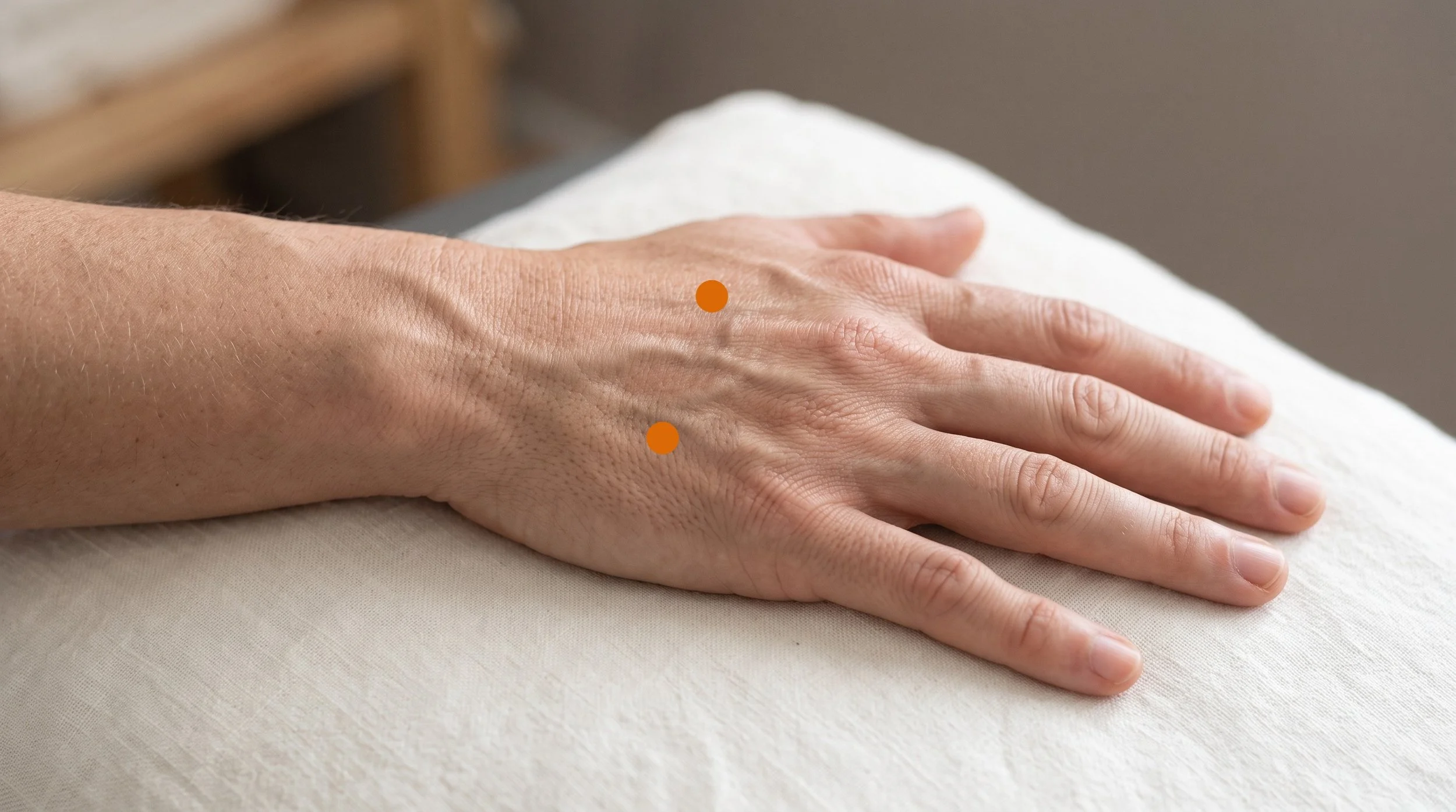
Yaotongxue Acupuncture Point (N-UE-19)
The Lumbar Pain Point on the Back of the Hand: Anatomy, Mechanism, and Why This Extra Point Is Needled While the Low Back Moves
Yaotongxue (N-UE-19), whose name is usually translated as Lumbar Pain Point, is a paired extra point on the back of the hand, and it may be the most single-minded point in the entire acupuncture repertoire: classical sources give it one job, acute lumbar sprain. You'll find it as two tender depressions on each hand, one in the groove between the second and third metacarpals and one between the fourth and fifth, sitting just past the bases of those bones toward the wrist.
It belongs to no channel, has no five-shu or command point status, and earns its place purely on empirical grounds. What makes the yaotongxue acupuncture point clinically distinctive isn't only where it sits, it's how it's used: the needles go into the hand, and the patient, rather than lying still, is guided to gently twist, turn and bend the low back while the points are stimulated. For someone who threw their back out yesterday and can't lie face down on a treatment table, that combination of a distant needling site and active movement is often exactly what the situation calls for.
- Location and layers: two paired depressions on the dorsum of each hand, between the second and third and the fourth and fifth metacarpals, just distal to the metacarpal bases. A needle here passes thin dorsal skin and the superficial venous network, slips beside the extensor tendons, and enters the dorsal interossei near the carpometacarpal junctions (Deadman et al., 2007; Simons et al., 1999).
- Traditional category, translated: A Manual of Acupuncture classifies Yaotongxue among the extra points and describes its traditional action as invigorating qi and blood in the lumbar region, with acute lumbar sprain as its listed indication (Deadman et al., 2007). In neurophysiological language, that describes strong distal sensory input paired with restored trunk movement rather than anything flowing down the arm.
- Nerve geography: the point pair lies in territory served by the superficial branch of the radial nerve and the dorsal cutaneous branch of the ulnar nerve, with deep ulnar innervation of the interossei, all rooted around C6 to T1. Those segments are nowhere near the lumbar cord, so relief here depends on extrasegmental mechanisms including descending inhibitory control and endogenous opioid signaling (Zhao, 2008).
- Research picture: reviews of acupuncture for acute low back pain suggest possible benefit over medication with inconsistent pain findings and mixed trial quality (Lee et al., 2013), while trials of needling combined with active movement report meaningful short-term improvements (Shin et al., 2013; Kwon et al., 2024). A published protocol for a systematic review focused specifically on this point (coded EX-UE 7 in modern lists) shows the primary literature is large enough to be worth pooling (Yue et al., 2021).
- Clinical framing: in practice this point is chosen when a back is too guarded to treat locally, when pain sits to one or both sides of the midline, and when a clinician wants to restore movement early in the episode rather than reinforce protective stiffness (Deadman et al., 2007; Lin et al., 2016).
- De qi here is emphatic. Patients usually describe a deep, spreading ache or pressure between the hand bones, sometimes with a brief electric line toward the fingers or wrist, and the sensation often intensifies noticeably during the moment the low back is asked to move.
Did You Just Throw Your Back Out in NYC?
Acute lumbar sprain has a short window where the right treatment can keep a bad week from becoming a bad month. At Morningside Acupuncture, we often start with distal points like Yaotongxue on the back of the hand precisely because they let us treat while you sit or stand, then add gentle guided movement and local work once your back tolerates it. Our licensed acupuncturists combine acupuncture, dry needling, cupping and movement coaching in the same visit. Schedule a session and let's get you moving again.
Schedule NowAnatomy of YAOTONGXUE: Why the Proximal Intermetacarpal Spaces Are Such an Important Location
Run a fingertip down the back of the hand along the valley between two metacarpal bones, heading toward the wrist, and it will drop into a small hollow just before the bones widen at their bases. That hollow is the target. Underneath the thin dorsal skin sit the superficial veins, then the extensor tendons running to the fingers, then fascia, and beneath that the dorsal interossei filling the spaces between the metacarpal shafts, anchored down at the carpometacarpal joints.
This tissue works constantly: gripping, typing, carrying groceries and bracing on the hands all load the interossei and the small joints at the bases of the metacarpals, which is one reason the depressions here are frequently tender even in people with no hand complaint at all (Deadman et al., 2007; Simons et al., 1999).
Sensory supply to this region comes from the superficial branch of the radial nerve on the thumb side and the dorsal cutaneous branch of the ulnar nerve on the little finger side, with the deep branch of the ulnar nerve running to the interossei themselves. All of that traffic enters the spinal cord around C6 to T1, which is the crux of the point's mechanism story: the hand and the lumbar spine do not share spinal segments. Pain relief from needling here therefore can't be explained by local segmental gating at the level of the injured tissue.
Instead, the plausible pathways are supraspinal: strong small-fiber input from a dense, richly innervated area recruits brainstem circuitry in the periaqueductal gray and rostral ventromedial medulla, engaging descending serotonergic, noradrenergic and opioid-mediated inhibition that dampens nociceptive transmission across many segments at once (Zhao, 2008). Autonomic and vasomotor shifts, plus the reduction in protective muscle guarding that follows a drop in pain intensity, add to the picture.
Vascular structures matter here mostly for comfort. The dorsal metacarpal arteries run in the intermetacarpal spaces and the dorsal venous network is often clearly visible, so careful practitioners look before they needle and angle around any prominent vein to limit bruising. Standard technique is a perpendicular insertion of roughly 0.5 to 1 cun into the depression (Deadman et al., 2007), while other classical manuals describe an oblique approach angled toward the wrist or toward the center of the hand.
Needles stay in soft tissue, avoiding the periosteum and the carpometacarpal joint capsules, and the point is treated on the affected side or bilaterally depending on the pain pattern. Western reference texts also list Yaotongxue among the extra points reserved for needling rather than moxibustion, so heat isn't applied directly here.
Related Acupuncture For Low Back Pain Related Best Acupuncture Points For Back PainYAOTONGXUE at a Glance: Classification, Location, and Clinical Use
| Category | Detail |
|---|---|
| Traditional Name | Yaotongxue, Lumbar Pain Point, also recorded as Yaotongdian (Lumbar Pain Spot) and coded EX-UE 7 in modern point lists |
| Channel Classification | Extra point (N-UE-19), not part of any of the twelve primary channels or the eight extraordinary vessels |
| Point Categories | No five-shu, yuan-source, luo-connecting, xi-cleft, hui-meeting or command point status, and no meeting or crossing designations. It's a paired, bilateral empirical extra point whose classification rests entirely on clinical use for acute lumbar sprain, with older sources subdividing it into two or three intermetacarpal locations that overlap the extra points Weiling and Jingling. |
| Precise Location | On the back of the hand, two points per hand: one in the depression between the second and third metacarpals and one between the fourth and fifth, immediately distal to the bases of the metacarpals. Slide a finger proximally along each groove toward the wrist until it settles into a tender hollow. |
| Tissue Stimulated | Dorsal skin and superficial venous network, extensor digitorum tendons, and the dorsal interossei overlying the proximal metacarpal shafts and carpometacarpal junctions |
| Needle Depth / Direction | Perpendicular insertion 0.5 to 1 cun into the depression, or oblique angling toward the wrist or the center of the hand; needled on the affected side or bilaterally, commonly with stimulation applied while the patient moves the low back. Needle only, no moxibustion. |
| De Qi Sensation | A strong, deep ache or spreading pressure between the metacarpals, sometimes with a brief electric flicker toward the fingers or wrist; sensation often sharpens during active lumbar movement |
| Primary Clinical Uses | Acute lumbar sprain and sudden low back pain to either side of the midline, especially when the back is too guarded for prone treatment; used as a distal point alongside movement, then followed by local work |
| Common Point Combinations |
|
In A Manual of Acupuncture, Deadman and colleagues present Yaotongxue as a modern addition to the extra point repertoire with a traditional action of invigorating qi and blood in the lumbar region and a single listed indication: acute lumbar sprain. Their commentary adds two practical details that define the point's reputation.
First, it's typically chosen when the pain lies to one or both sides of the midline rather than dead center. Second, the points on the affected side are manipulated while the patient actively twists, turns and bends the low back, which means the technique is inseparable from the point itself. Older Chinese sources add nuance: the Shanghai compilation records two or three separate intermetacarpal locations under this heading, with overlapping indications for injury pain in the back, chest and limbs, and notes that these sites coincide with the extra points Weiling and Jingling.
Chinese Acupuncture and Moxibustion likewise calls Yaotongxue an empirical point for lumbar sprain and pairs it with GV26 and local ashi points in traumatic low back pain. What's striking, from a traditional standpoint, is the narrowness: most points accumulate long indication lists over centuries, while this one stayed pinned to a single acute presentation and a single way of being used.
Why YAOTONGXUE Is Used for a Back That Has Suddenly Locked Up
The first question patients ask is fair: how can needling the back of the hand help a low back that seized up while lifting a box? The honest answer is that it doesn't work through the spine's local wiring. The hand reports to spinal segments in the neck and upper thorax, while the lumbar tissues report to segments far below, so this is deliberately extrasegmental treatment.
What a strongly stimulated distal point can do is generate a substantial burst of small-fiber input that the brain and brainstem read as significant, which in turn recruits pain-modulating circuits capable of turning down nociceptive traffic broadly rather than at one level (Zhao, 2008). Clinically, that often shows up as a few degrees of extra rotation, a slightly easier first step, or the ability to stand up straighter than before the needle went in.
The movement half matters just as much. Acute lumbar sprain produces protective muscle guarding, and guarding rapidly becomes its own problem: the more the trunk is held rigid, the more threatening ordinary movement feels. Needling that coincides with cautious, non-provocative movement gives the nervous system a different pairing to learn, motion accompanied by reduced pain rather than motion accompanied by a spike. This is the logic behind motion style acupuncture treatment, a Korean approach in which patients move while needles are retained.
In a multicenter comparative effectiveness trial, a single session of that approach produced greater immediate improvement in pain and function than a conventional analgesic injection in patients with acute low back pain and severe disability (Shin et al., 2013), and a later pragmatic randomized trial found added short-term benefit when movement-based needling was layered onto inpatient care (Kwon et al., 2024). A randomized trial of acupuncture combined with movement for acute lumbar sprain specifically reported favorable results as well (Lin et al., 2016).
None of that isolates Yaotongxue as the active ingredient, and it shouldn't be read that way. What the evidence supports is the treatment strategy this point embodies: needle away from the painful, guarded area, use enough stimulation to matter, and reintroduce movement early. Reviews of acupuncture for chronic pain more broadly find effects that exceed sham and no-acupuncture controls while remaining moderate in size (Vickers et al., 2018), which is a reasonable expectation to carry into an acute episode too.
What the Research Shows for YAOTONGXUE
A word of caution before the table. Almost no trial tests a single acupuncture point in isolation, and Yaotongxue is no exception: it usually appears inside a protocol that includes local points, manual therapy, or guided movement, so its individual contribution can't be separated cleanly. Much of the acute lumbar sprain literature also comes from smaller Chinese trials with variable methodological quality, which is why a dedicated systematic review protocol was registered for this point in the first place.
Read the findings below as support for the overall approach of distal needling plus early movement in acute low back pain, not as proof that one hand point resolves a sprain.
| Study | Type | Focus | Key Finding |
|---|---|---|---|
| Yue et al., 2021 | Protocol for a systematic review and meta-analysis | Acupuncture at Yaotongdian (EX-UE 7) for acute lumbar sprain | Documents that enough primary trials exist to justify pooled analysis of this specific point, though a protocol reports no efficacy results of its own. |
| Shin et al., 2013 | Multicenter randomized comparative effectiveness trial | One session of motion style acupuncture versus a conventional analgesic injection in acute low back pain with severe disability | Reported greater immediate improvement in pain and function with needling combined with movement, though a single-session design says nothing about longer term outcomes. |
| Kwon et al., 2024 | Pragmatic randomized controlled trial | Adding lumbar motion style acupuncture to inpatient care for acute low back pain after traffic collisions | Suggested additional short-term pain and disability improvement, with the single-center pragmatic design limiting how broadly results transfer. |
| Lin et al., 2016 | Randomized controlled clinical trial | Acupuncture combined with active movement for acute lumbar sprain | Reported favorable outcomes for the movement-based needling approach, though sample size and blinding constraints temper confidence. |
| Lee et al., 2013 | Systematic review | Acupuncture for acute and subacute nonspecific low back pain | Found acupuncture may improve overall symptoms compared with anti-inflammatory medication, while evidence for pain outcomes was inconsistent and trial quality mixed. |
| Vickers et al., 2018 | Individual patient data meta-analysis | Acupuncture for chronic pain conditions including back and neck pain | Found effects superior to both sham and no-acupuncture controls, supporting genuine but moderate treatment effects that persist over time. |
| Zhao, 2008 | Narrative review of mechanisms | Neural pathways underlying acupuncture analgesia | Describes spinal and supraspinal mechanisms, including descending inhibition and endogenous opioid signaling, that plausibly explain relief from distal points. |
Low Back Pain That Won't Let You Bend, Twist or Sit Comfortably?
Whether your pain started with a deadlift, a suitcase, or simply turning the wrong way, guarding and fear of movement tend to keep it going. We use Yaotongxue and other distal points to lower pain intensity first, then treat the quadratus lumborum, lumbar multifidus and gluteal muscles with precise needling to restore normal load sharing. Sessions are calm, efficient and built around what you actually need to do this week. Book an appointment at our Upper West Side clinic.
Schedule NowYAOTONGXUE in the Context of Trigger Point Work
Acupuncture and dry needling are both performed with an acupuncture needle, and at Morningside we treat them as one toolkit rather than two competing systems. In an acute lumbar sprain, the sequence often runs distal to local: Yaotongxue on the hand with guided trunk movement first, then, once the back tolerates positioning, careful trigger point needling of the muscles that are actually splinting.
Quadratus lumborum, lumbar multifidus, iliocostalis lumborum and gluteus medius are the usual suspects, and each has referral patterns that can mimic or amplify the sprain itself, sending pain into the flank, the sacroiliac region or the upper buttock (Simons et al., 1999). Treating those muscles too aggressively in the first day or two can increase soreness, which is another practical argument for opening with a distal point.
There's also a local consideration at the point site itself. Yaotongxue sits directly over the dorsal interossei, muscles that develop their own taut bands and tenderness in people who grip, climb, play instruments or spend long hours at a keyboard. That means a tender hollow between the metacarpals isn't automatically a diagnostic sign about the low back, and it's worth distinguishing point tenderness from a genuine hand complaint. When both are present, the same insertion can serve two purposes, and patients with recurring hand and forearm symptoms may benefit from a broader look at the extensor group as well.
YAOTONGXUE Low Back Pain Treatment at NYC's Highest-Rated Acupuncture Clinic
Morningside Acupuncture is the highest-rated acupuncture and dry needling clinic in New York City with over 500 five-star Google reviews, and low back pain is one of the most common reasons patients come to see us. We treat both the acute episode and the movement habits underneath it, using classical distal points such as Yaotongxue alongside evidence-informed dry needling. Every plan is individualized, explained in plain language, and adjusted as you improve. Schedule your visit today.
Schedule NowFrequently Asked Questions
What does YAOTONGXUE feel like when needled?
Expect a strong sensation. The back of the hand is thin skinned and densely innervated, so the initial insertion is often briefly sharp, followed by a deep, spreading ache or fullness between the metacarpal bones. Some patients feel a short electric line traveling toward the fingers or up toward the wrist, which is normal and settles quickly. Because this point is usually stimulated while you move your low back, the ache tends to swell during the moment of movement and then ease. Clinicians typically use enough stimulation to be clearly felt, since the strategy depends on generating meaningful sensory input, and we always calibrate to what you can tolerate comfortably rather than pushing through it.
Why treat the hand for a problem in the low back?
Because in an acute sprain the low back is often the worst place to start. Lying prone can be impossible, local tissue is irritable, and pressing on it reinforces the guarding you're trying to reduce. A distal point sidesteps all of that: it can be needled while you sit or stand, and it leaves your back free to move. Mechanistically, the hand and lumbar spine occupy very different spinal segments, so relief here relies on brainstem-mediated descending inhibition rather than local gating (Zhao, 2008). The clinical payoff is that pain intensity can drop enough for you to move, and early movement is what trials of motion-based needling associate with faster short-term improvement in acute low back pain (Shin et al., 2013; Kwon et al., 2024).
Can I press YAOTONGXUE myself between sessions?
Yes, this is one of the easier points to self-treat because you can reach both sides with your opposite thumb. Rest the hand palm down, slide your thumb down the groove between the second and third metacarpals toward the wrist until it drops into the tender hollow, and press firmly straight down for 30 to 60 seconds. Repeat in the groove between the fourth and fifth metacarpals, then switch hands. Do two or three rounds per side, several times a day during a flare. The technique works better if you add movement: while pressing, slowly rock your pelvis, shift your weight side to side, or gently rotate your trunk through a range that feels safe. Pressure should feel deeply achy, not sharp or numbing, so ease off if you get pins and needles, and skip it entirely over broken skin, a rash or a bruise.
Is YAOTONGXUE safe to needle?
It's a low-risk point in trained hands. Insertion is shallow, roughly 0.5 to 1 cun, in soft tissue between the metacarpals, with no organs or major vessels at risk. The realistic concerns are minor: the dorsal veins are superficial here, so practitioners look before inserting to reduce the chance of a small bruise, and the area can feel tender for a day afterward. Occasional brief nerve zings toward the fingers happen and resolve on their own. Reference texts list this among the extra points used with needling only, not moxibustion. Separately, acute back pain deserves a medical evaluation if you have leg weakness, numbness in the groin or saddle area, changes in bladder or bowel control, unexplained fever or weight loss, or pain after significant trauma. Those are reasons to see a physician promptly rather than reaching for a needle.
Where exactly is YAOTONGXUE located?
There are two points on each hand, both on the dorsal surface. Place your hand palm down and find the long grooves between the metacarpal bones. Starting near the knuckles, run a fingertip proximally along the groove between the second and third metacarpals, heading toward the wrist. Just before the bones flare into their bases you'll feel your finger settle into a small depression, usually tender under pressure. That's the first point. Repeat in the groove between the fourth and fifth metacarpals for the second. Both sit in the proximal half of the back of the hand, well behind the knuckles and short of the wrist crease. Older Chinese sources describe slightly different variants, including a site between the third and fourth metacarpals, so palpation for the most tender depression is the practical way to confirm the location.
References
- Deadman, P., Al-Khafaji, M., & Baker, K. (2009). A manual of acupuncture. Journal of Chinese Medicine Publications.
- Cheng, X. (Ed.). (1999). Chinese acupuncture and moxibustion (Rev. ed.). Foreign Languages Press.
- O'Connor, J., & Bensky, D. (Eds. & Trans.). (1981). Acupuncture: A comprehensive text. Shanghai College of Traditional Medicine. Eastland Press.
- Cunningham, P. M. (2000). Acupuncture points: A practical guide to classical and modern usage. Odyssey Press.
- Simons, D. G., Travell, J. G., & Simons, L. S. (1999). Travell & Simons' myofascial pain and dysfunction: The trigger point manual, Vol. 1: Upper half of body (2nd ed.). Williams & Wilkins.
- Yue, P., Zhong, J., Huang, J., Lan, Z., & Zhong, S. (2021). The effectiveness of acupuncture at Yaotongdian (EX-UE 7) for acute lumbar sprain: A protocol for a systematic review and meta-analysis. Medicine, 100(4), e24440. https://doi.org/10.1097/MD.0000000000024440
- Shin, J. S., Ha, I. H., Lee, J., Choi, Y., Kim, M. R., Park, B. Y., Shin, B. C., & Lee, M. S. (2013). Effects of motion style acupuncture treatment in acute low back pain patients with severe disability: A multicenter, randomized, controlled, comparative effectiveness trial. Pain, 154(7), 1030-1037. https://doi.org/10.1016/j.pain.2013.03.013
- Kwon, O. B., Hwang, D. W., Kang, D. H., Yoo, S. J., Lee, D. H., Kwon, M., Jang, S. W., Cho, H. W., Kim, S. D., Park, K. S., Kim, E. S., Lee, Y. J., Kim, D., & Ha, I. H. (2024). Effectiveness of lumbar motion style acupuncture treatment on inpatients with acute low back pain: A pragmatic, randomized controlled trial. Complementary Therapies in Medicine, 82, 103035. https://doi.org/10.1016/j.ctim.2024.103035
- Lin, R., Zhu, N., Liu, J., Li, X., Wang, Y., Zhang, J., & Xi, C. (2016). Acupuncture-movement therapy for acute lumbar sprain: A randomized controlled clinical trial. Journal of Traditional Chinese Medicine, 36(1), 19-25. https://doi.org/10.1016/s0254-6272(16)30003-6
- Lee, J. H., Choi, T. Y., Lee, M. S., Lee, H., Shin, B. C., & Lee, H. (2013). Acupuncture for acute low back pain: A systematic review. The Clinical Journal of Pain, 29(2), 172-185. https://doi.org/10.1097/AJP.0b013e31824909f9
- Vickers, A. J., Vertosick, E. A., Lewith, G., MacPherson, H., Foster, N. E., Sherman, K. J., Irnich, D., Witt, C. M., & Linde, K. (2018). Acupuncture for chronic pain: Update of an individual patient data meta-analysis. Journal of Pain, 19(5), 455-474. https://doi.org/10.1016/j.jpain.2017.11.005
- Zhao, Z. Q. (2008). Neural mechanism underlying acupuncture analgesia. Progress in Neurobiology, 85(4), 355-375. https://doi.org/10.1016/j.pneurobio.2008.05.004
Disclaimer: This web site is intended for educational and informational purposes only. Reading this website does not constitute providing medical advice or any professional services. This information should not be used for diagnosing or treating any health issue or disease. Those seeking medical advice should consult with a licensed physician. Seek the advice of a medical doctor or other qualified health professional for any medical condition. If you think you have a medical emergency, call 911 or go to the emergency room. No acupuncturist-patient relationship is created by reading this website or using the information. Morningside Acupuncture PLLC and its employees and contributors do not make any express or implied representations with respect to the information on this site or its use. For any legal interpretation of scope of practice in your state, consult a licensed attorney or regulatory authority.
Read more from our blog



