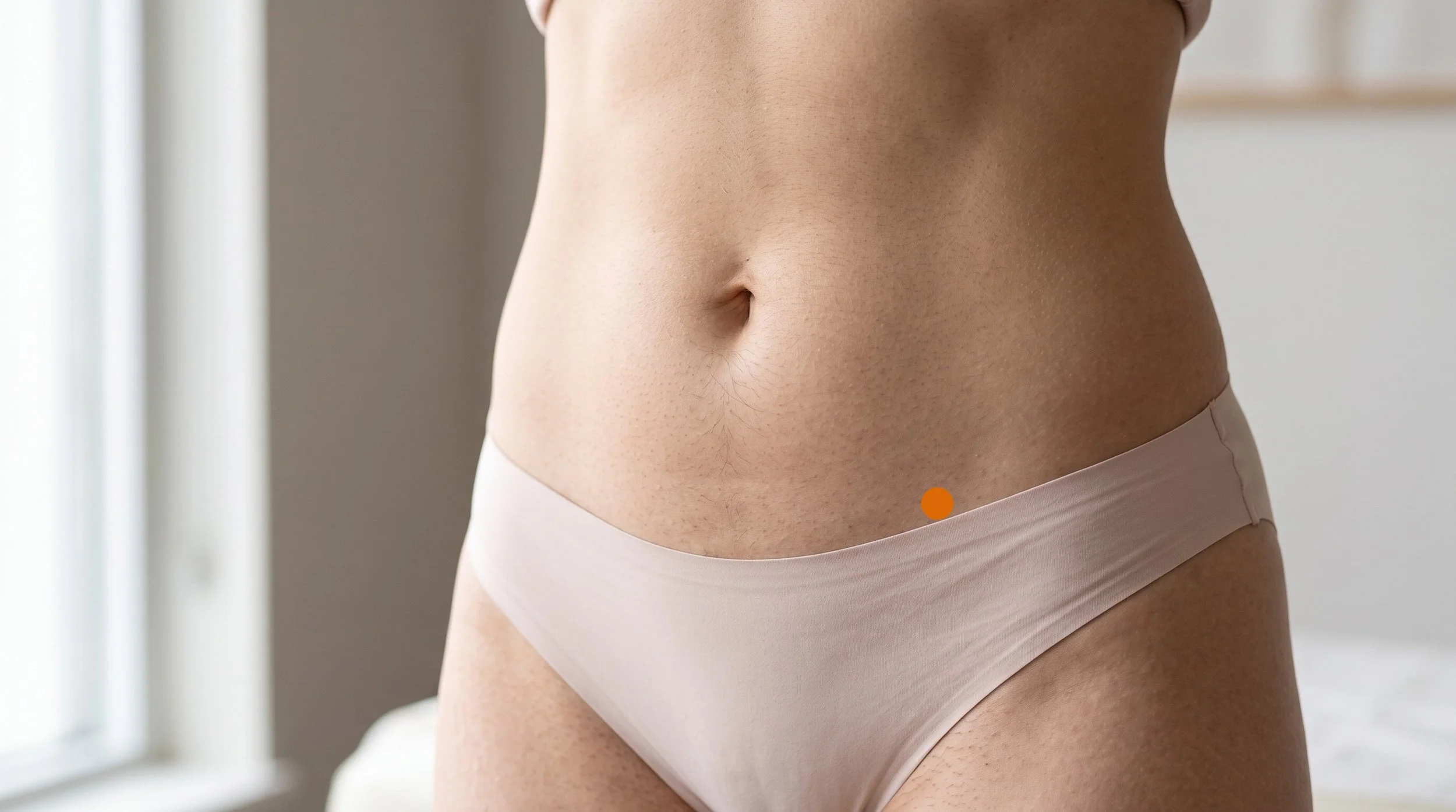
Tituo Acupuncture Point (N-CA-4)
Lift and Support at the Edge of the Lower Abdomen: Anatomy, Mechanism, and Why This Modern Extra Point Anchors Pelvic Support Protocols
TITUO (N-CA-4), whose name is usually rendered in English as Lift and Support, is a modern extra point on the lower abdomen rather than a point of the twelve primary channels. You find it low and lateral: level with CV4 (three cun below the navel), four cun out from the midline, just inside the bony bump of the anterior superior iliac spine. It sits in the layered sheet of the external oblique, internal oblique, and transversus abdominis in territory supplied by the iliohypogastric nerve (Ellis, Wiseman, & Boss, 1989).
Clinically it matters because it is one of the few points added to the acupuncture repertoire specifically for pelvic support complaints, and it is listed in the classical literature as a primary point for uterine prolapse alongside dysmenorrhea and lower abdominal distention (Deadman, Al-Khafaji, & Baker, 2007). The tituo acupuncture point is best understood as an abdominal wall point with a strong local mechanical and neurological story, used inside a protocol rather than on its own.
- Location and layers: TITUO lies four cun lateral to the midline at the level of CV4, medial to the ASIS, where the needle passes through skin, subcutaneous fat, and the external and internal oblique aponeuroses toward transversus abdominis (Ellis, Wiseman, & Boss, 1989). This is the same lateral abdominal wall that loads with coughing, lifting, and prolonged standing.
- Traditional attribution, translated: classical sources describe the actions of n-ca-4 as lifting and supporting and as raising and regulating qi, with indications for uterine prolapse, painful periods, and abdominal distention and pain (Deadman, Al-Khafaji, & Baker, 2007). In modern language, that maps onto a point that alters abdominal wall tone and modulates the lower abdominal segments rather than physically holding an organ up.
- Nerve geography: the point sits in iliohypogastric territory, which carries T12 to L1 input, and the pelvic viscera share overlapping thoracolumbar and sacral spinal levels, giving a plausible route for segmental convergence between abdominal wall stimulation and pelvic symptoms (Zhao, 2008).
- Mechanism beyond the segment: needling recruits A delta and C fiber signaling that engages descending inhibitory pathways and central opioid and monoaminergic systems, which is the general model used to explain acupuncture analgesia (Zhao, 2008), and pooled patient level data across chronic pain conditions show effects that persist beyond the treatment course (Vickers et al., 2018).
- The research picture is indirect and modest: acupuncture and acupressure for period pain have been reviewed by Cochrane with low quality evidence and uncertain conclusions (Smith et al., 2016), while pelvic floor and continence trials have tested electroacupuncture protocols at other points rather than TITUO specifically (Liu et al., 2017; Tang et al., 2023).
- Practice framing: the classical prolapse technique for the tituo prolapse point involves directing the needle toward CV2 through the muscle layer, engaging the fibers, and holding the tissue in a raised position for twenty to thirty minutes (Deadman, Al-Khafaji, & Baker, 2007). That method belongs in trained professional hands only, and prolapse always deserves a gynecologic evaluation first.
- De qi here is usually a heavy, spreading distention that travels across the side of the lower abdomen, and some patients describe a drawing or lifting feeling deeper in the pelvis (Ellis, Wiseman, & Boss, 1989).
Dealing With Pelvic Heaviness, Dragging, or Period Pain in NYC?
Low abdominal heaviness and cramping are rarely a single tissue problem, so we assess the abdominal wall, the pelvic floor, the low back, and your daily loading patterns before we needle anything. At Morningside Acupuncture we use TITUO as a local lower abdominal point inside a broader plan that may include SP6, ST36, and sacral points, along with breathing and load management coaching. Everything is coordinated with your gynecologist or pelvic floor physical therapist when one is involved. Schedule a visit and we'll build the plan around your history, not a template.
Schedule NowAnatomy of TITUO: Why the Lower Lateral Abdominal Wall Near the ASIS Is Such an Important Location
From the surface down, TITUO passes through skin and a variable layer of subcutaneous fat before reaching the three flat abdominal muscles stacked in this corner of the wall: external oblique, internal oblique, and transversus abdominis (Ellis, Wiseman, & Boss, 1989). This is not passive tissue. The obliques and transversus modulate intra-abdominal pressure with every cough, sneeze, laugh, lift, and forced exhale, and they are part of the pressure system that the pelvic floor works against.
Patients who describe low abdominal heaviness late in the day, or a dragging sensation that worsens with prolonged standing, are often describing a pressure and support problem rather than a single injured structure. Because the point sits just medial to the ASIS, it also lives near the attachment zone where the abdominal wall meets the iliac crest and where the inguinal region begins, an area that gets loaded by hip flexion, twisting, and heavy carrying.
The nerve supply at this site is the iliohypogastric nerve, with contributions running from the lower thoracic and upper lumbar levels (Ellis, Wiseman, & Boss, 1989). That matters for mechanism. Somatic input from the lower abdominal wall converges in the spinal cord with visceral afferents from the pelvic organs, which travel through thoracolumbar and sacral pathways, so stimulating the wall can plausibly influence how the nervous system processes pelvic sensation.
Needling at this level recruits small diameter afferents that activate spinal segmental gating and descending inhibitory control from brainstem structures, along with central opioid and monoaminergic signaling (Zhao, 2008). Across chronic pain conditions, individual patient data pooled from high quality trials suggest real if moderate effects that are not fully explained by placebo and that persist for months after treatment ends (Vickers et al., 2018). Practically, that gives a reasonable model for why a lower abdominal point may reduce cramping and pressure sensitivity without invoking anything mystical.
Deeper structures are the reason technique discipline matters here. Beneath the transversus lies the transversalis fascia and peritoneum, with bowel below, and a distended bladder can rise above the pubic bone into the lower abdomen. The deep circumflex iliac vessels track along the inner lip of the iliac crest not far from this location. Standard needling is perpendicular at roughly 0.8 to 1.2 cun, with some texts describing slightly deeper insertion in larger patients (Deadman, Al-Khafaji, & Baker, 2007; Ellis, Wiseman, & Boss, 1989).
We ask patients to empty the bladder first, we adjust depth for body habitus, and we avoid deep abdominal needling in pregnancy, over hernias, over surgical mesh or scars, and in anyone with undiagnosed abdominal pain. The specialist prolapse technique, which directs the needle toward CV2 through the muscle layer and holds the tissue lifted, is a professional level method that should never be attempted outside licensed practice (Deadman, Al-Khafaji, & Baker, 2007).
Related Internal Obliques Trigger Points Related Pelvic Floor Trigger PointsTITUO at a Glance: Classification, Location, and Clinical Use
| Category | Detail |
|---|---|
| Traditional Name | Tituo (Lift and Support), also transcribed as Tituoxue |
| Channel Classification | Extra point (non-channel), coded N-CA-4 in the extra point system |
| Point Categories | Modern addition to the extraordinary or extra points. No five-shu, luo, xi-cleft, front-mu, back-shu, hui-meeting, or extraordinary vessel confluent designation is attributed to it, and no channel crossing or meeting status is recorded; the reference texts classify it purely as a modern extra point of the lower abdomen (Deadman, Al-Khafaji, & Baker, 2007). |
| Precise Location | Lower abdomen, 4 cun lateral to the anterior midline, level with CV4 Guanyuan (3 cun below the umbilicus and 2 cun above the pubic symphysis), just medial to the anterior superior iliac spine. |
| Tissue Stimulated | External oblique, internal oblique, and transversus abdominis of the lateral lower abdominal wall, in iliohypogastric nerve territory; functionally related to the pelvic floor through the intra-abdominal pressure system. |
| Needle Depth / Direction | Perpendicular insertion, roughly 0.8 to 1.2 cun in most patients, with some texts describing up to about 1.5 cun. A specialist prolapse method directs the needle from TITUO toward CV2 through the muscular layer, engages the muscle fibers, and maintains a sustained lifted position for about 20 to 30 minutes; this is reserved for experienced professional care. |
| De Qi Sensation | Heavy local distention and soreness that often spreads across the side of the lower abdomen; some patients report a deeper drawing or lifting feeling toward the pelvis. |
| Primary Clinical Uses | Traditionally used for uterine prolapse as a primary modern point, dysmenorrhea, lower abdominal distention and pain, and dragging or heavy pelvic support complaints in contemporary practice. |
| Common Point Combinations |
|
Deadman, Al-Khafaji, and Baker's A Manual of Acupuncture presents TITUO as a recent arrival in the extra point literature rather than an inheritance from the early classics, and traditionally attributes to it the paired actions of lifting and supporting and of raising and regulating qi. Its listed indications are compact: uterine prolapse first, then painful menstruation and abdominal distention with pain.
The text singles it out as one of the leading points used for uterine prolapse, and pairs that reputation with an unusual manual technique in which the needle is angled through the muscle layer toward CV2, rotated until it engages the fibers, then drawn upward and secured so the tissue is held in a raised position for a set time.
What is striking about this classical pattern is how literal it is. Most point names describe an image or a landscape feature; here the name, the traditional action, and the physical maneuver all say the same thing, which is unusual in the point literature and tells you the point was named for what practitioners were actually doing with their hands.
Why TITUO Is Used for Dragging Pelvic Heaviness That Worsens by the End of the Day
The complaint that brings people to points like TITUO is often not sharp pain but heaviness: a low, dragging pressure that is mild in the morning and noticeable after hours on your feet, or that flares with coughing, straining, and heavy lifting. Part of that experience is mechanical, and part of it is how the nervous system reads pressure signals from the region. The lower abdominal wall and the pelvic organs feed into overlapping spinal segments, so sensory input from one is not processed in isolation from the other.
Needling into iliohypogastric territory delivers a strong, well localized afferent volley into those same segments, which can change how the spinal cord weights incoming signals from the area (Zhao, 2008). Patients frequently describe the immediate effect as a settling or an easing of pressure rather than a dramatic change, which fits a modulation model better than a structural one.
Beyond the segment, acupuncture stimulation engages descending inhibitory control from the midbrain and brainstem along with central opioid, serotonergic, and noradrenergic signaling, and it produces measurable autonomic shifts that can reduce guarding in the abdominal wall (Zhao, 2008). Reduced guarding matters practically: an abdominal wall that is chronically braced changes how pressure is distributed through the pelvis and can make cramping feel worse.
Across chronic pain conditions, the pooled individual patient data show that acupuncture outperforms both no acupuncture and sham controls by modest margins, with benefits that decline only slowly over twelve months (Vickers et al., 2018).
It's worth being clear about limits. Needling does not tighten ligaments or physically reposition an organ, and no responsible clinician should suggest otherwise. What the tituo acupuncture point may offer is symptom modulation: less cramping, less dragging discomfort, and a more relaxed abdominal wall, achieved within a treatment plan that also addresses pelvic floor strength and coordination, breathing mechanics, constipation, chronic cough, and lifting habits.
For structural prolapse, gynecologic evaluation and pelvic floor physical therapy remain the foundation, and randomized work on electroacupuncture for prolapse symptoms is still in progress rather than settled (Chen et al., 2022).
What the Research Shows for TITUO
There is no clean way to isolate a single point in clinical research, and TITUO is no exception. Nearly every trial in this area tests a multi-point protocol, often with electroacupuncture, and reports the effect of that whole package. That means the honest summary is indirect: the conditions TITUO is traditionally used for have been studied, with mixed and often low certainty results, and TITUO is one plausible component of the kinds of protocols involved rather than a proven active ingredient.
Readers should also note that most of these trials were run in China, that sham acupuncture controls in pelvic protocols are imperfect, and that positive findings for one pelvic condition do not transfer automatically to another.
| Study | Type | Focus | Key Finding |
|---|---|---|---|
| Smith et al., 2016 | Cochrane systematic review | Acupuncture and acupressure for primary dysmenorrhea | The review found the evidence too low in quality and too inconsistent to draw firm conclusions about benefit for period pain. |
| Liu et al., 2017 | Multicenter randomized clinical trial (JAMA) | Electroacupuncture versus sham for stress urinary incontinence in women | Electroacupuncture at lumbosacral points was associated with less urinary leakage than sham after six weeks, though longer term effects and mechanism were left unresolved. |
| Tang et al., 2023 | Multicenter randomized clinical trial | Electroacupuncture added to pelvic floor muscle training for stress urinary incontinence | Adding electroacupuncture to pelvic floor muscle training was described by the authors as a promising combined approach, which supports pairing needling with rehabilitation rather than replacing it. |
| Chen et al., 2022 | Randomized controlled trial protocol (BMJ Open) | Electroacupuncture for symptoms of stage II to III female pelvic organ prolapse | The authors note that existing evidence for electroacupuncture in prolapse is not robust, which is precisely why the trial was designed. |
| Vickers et al., 2018 | Individual patient data meta-analysis | Acupuncture across chronic pain conditions | Acupuncture showed modest but statistically significant effects over both sham and no-acupuncture controls, with benefit persisting over about a year. |
| Zhao, 2008 | Narrative review of mechanism research | Neural mechanisms of acupuncture analgesia | Analgesic effects are attributed to segmental spinal modulation plus descending inhibitory pathways and central opioid and monoaminergic signaling. |
Want a Lower Abdominal Treatment That Respects the Whole Pelvis?
The lateral lower abdominal wall near the ASIS is a busy neighborhood: oblique muscle layers, the iliohypogastric nerve, and referral patterns that can mimic pelvic or groin pain. We palpate that region carefully, use conservative depths, and pair the tituo acupuncture point with distal leg points so the treatment is not purely local. Sessions are unhurried, and we explain each step before the first needle. Book an appointment and see what a thorough abdominal assessment feels like.
Schedule NowTITUO in the Context of Trigger Point Work
Because acupuncture is defined by the use of an acupuncture needle rather than by a single tradition, the same filiform needle that treats a classical extra point can also treat a myofascial target, and at TITUO the two frequently overlap.
The lift and support point sits directly over the oblique layer of the lateral lower abdominal wall, and taut bands in the external oblique, internal oblique, and lower rectus abdominis are well documented sources of referred pain into the groin, lower abdomen, testicle or labia, and low back, sometimes accompanied by visceral-feeling symptoms such as bloating, nausea, or urinary urgency (Simons, Travell, & Simons, 1999). That overlap is clinically useful and clinically humbling: abdominal wall trigger points can convincingly imitate pelvic or gynecologic pain, so palpation before needling is not optional.
At Morningside Acupuncture we palpate the abdominal wall systematically before deciding what to needle, and we use a simple in-office check for wall versus visceral origin: if tenderness stays the same or increases when the patient tenses the abdominal muscles in a partial curl, the wall itself is more likely involved. When it is, we may treat TITUO along with dry needling of the obliques and, where appropriate, coordinate with pelvic floor physical therapy for internal work we do not perform.
Depths stay conservative over the abdomen, and we favor shorter, well-controlled techniques rather than aggressive needling. Distal points such as ST36 and SP6 are typically added so the treatment is not concentrated in one anxious region, which most patients find easier to tolerate.
TITUO Pelvic Support Treatment at NYC's Highest-Rated Acupuncture Clinic
Morningside Acupuncture is the highest-rated acupuncture and dry needling clinic in New York City with over 500 five-star Google reviews, and our Upper West Side practice sees a steady stream of patients with menstrual pain, postpartum pelvic complaints, and abdominal wall discomfort. We combine classical point selection like TITUO with modern trigger point needling of the obliques and careful, evidence-informed expectations. You'll get a clear plan, a realistic timeline, and honest referrals when another specialty should lead. Schedule your first session and let's get started.
Schedule NowFrequently Asked Questions
What does TITUO feel like when needled?
Most people describe a dull, heavy distention at the point that spreads sideways across the lower abdomen, sometimes with a mild soreness or a pulling feeling. A smaller number report a deeper drawing or lifting sensation toward the pelvis, which the classical texts also mention (Ellis, Wiseman, & Boss, 1989). It should not be sharply painful, and it should not be electric. Abdominal points feel more diffuse than points on the arms and legs, and the sensation usually fades within a minute or two of insertion, often replaced by a warm, settled feeling. Tell your acupuncturist right away if the sensation is sharp, radiating, or unpleasant, since the needle can simply be adjusted.
Why treat the abdominal wall for a pelvic problem instead of the pelvis itself?
Two reasons, one mechanical and one neurological. Mechanically, the oblique and transversus layer at TITUO helps regulate intra-abdominal pressure, and that pressure system is what the pelvic floor works against every time you cough, lift, or strain, so wall tone and pelvic symptoms are genuinely linked. Neurologically, sensory input from the lower abdominal wall converges in the spinal cord with input from the pelvic organs, which gives a route by which needling the wall can influence how pelvic sensations are processed (Zhao, 2008). That said, we don't treat the wall exclusively. In practice TITUO is used inside a plan that also includes distal points like ST36 and SP6, and often sacral points, with pelvic floor rehabilitation running alongside.
Can I press TITUO myself between sessions?
Yes, gentle acupressure here is reasonable for most people. Lie on your back with your knees bent so the abdominal wall softens. Find your navel, measure about three cun down (roughly four finger widths using your own hand), then move sideways toward the bony point of your hip until you're just inside that bump. Use two flat fingerpads, not a nail or a knuckle, and press straight in with slow, moderate pressure until you feel a dull heaviness rather than pain. Hold for 30 to 60 seconds, release, and repeat two or three times per side, once or twice daily. Total time of two to three minutes per side is plenty. Pair it with slow diaphragmatic breathing, exhaling as you press. Skip it if you're pregnant, if you have a hernia, recent abdominal surgery, or a suspected mass, if the area is sharply tender, or if you have new, severe, or unexplained abdominal pain, which needs medical evaluation rather than self-treatment.
Is TITUO safe to needle?
In trained hands, yes, with the usual abdominal precautions. The main considerations are depth and patient factors: the peritoneum and bowel lie beneath the muscle layer, a full bladder can rise into the lower abdomen, and the deep circumflex iliac vessels run near the inner rim of the iliac crest. Standard perpendicular insertion of roughly 0.8 to 1.2 cun keeps the needle in the muscular layer (Deadman, Al-Khafaji, & Baker, 2007). We ask patients to empty the bladder before treatment, adjust depth for body size, and avoid the area in pregnancy, over hernias, over surgical mesh or fresh scars, and in anyone with undiagnosed abdominal pain. The sustained lifting technique described for prolapse is a specialist method for experienced practitioners and is never something to attempt at home.
Where exactly is TITUO located?
On the lower abdomen, four cun lateral to the front midline, level with CV4 Guanyuan. To find CV4, measure three cun straight down from the center of the navel, which also sits about two cun above the top of the pubic bone. From there, move four cun directly out to the side; the point lands just medial to the anterior superior iliac spine, the bony prominence at the front of your pelvis. A practical shortcut is to slide your fingers inward from that hip bone until you're on soft abdominal wall rather than bone. Because cun measurements are proportional to your own body, the exact spot varies from person to person, and palpation for tenderness helps confirm it (Deadman, Al-Khafaji, & Baker, 2007).
References
- Deadman, P., Al-Khafaji, M., & Baker, K. (2009). A manual of acupuncture. Journal of Chinese Medicine Publications.
- O'Connor, J., & Bensky, D. (Eds. & Trans.). (1981). Acupuncture: A comprehensive text. Shanghai College of Traditional Medicine. Eastland Press.
- Maciocia, G. (2005). The foundations of Chinese medicine: A comprehensive text for acupuncturists and herbalists (2nd ed.). Elsevier Churchill Livingstone.
- Simons, D. G., Travell, J. G., & Simons, L. S. (1999). Travell & Simons' myofascial pain and dysfunction: The trigger point manual, Vol. 1: Upper half of body (2nd ed.). Williams & Wilkins.
- Smith, C. A., Armour, M., Zhu, X., Li, X., Lu, Z. Y., & Song, J. (2016). Acupuncture for dysmenorrhoea. Cochrane Database of Systematic Reviews, 2016(4), CD007854. https://doi.org/10.1002/14651858.CD007854.pub3
- Liu, Z., Liu, Y., Xu, H., He, L., Chen, Y., Fu, L., Li, N., Lu, Y., Su, T., Sun, J., Wang, J., Yue, Z., Zhang, W., Zhao, J., Zhou, Z., Wu, J., Zhou, K., Ai, Y., Zhou, J., ... Liu, B. (2017). Effect of electroacupuncture on urinary leakage among women with stress urinary incontinence: A randomized clinical trial. JAMA, 317(24), 2493-2501. https://doi.org/10.1001/jama.2017.7220
- Tang, K., Su, T., Fu, L., Chen, Z., Liu, G., Hou, W., Ming, S., Song, Q., Feng, S., Liu, X., Wang, R., Liu, B., & Chen, Y. (2023). Effect of electroacupuncture added to pelvic floor muscle training in women with stress urinary incontinence: A randomized clinical trial. European Urology Focus, 9(2), 352-360. https://doi.org/10.1016/j.euf.2022.10.005
- Chen, H., Liu, X., Yan, Y., Shi, H., & Liu, Z. (2022). Effect of electroacupuncture on symptoms of female pelvic organ prolapse (stage II-III) (EAPOP study): Protocol of a randomised controlled trial. BMJ Open, 12(6), e051249. https://doi.org/10.1136/bmjopen-2021-051249
- Vickers, A. J., Vertosick, E. A., Lewith, G., MacPherson, H., Foster, N. E., Sherman, K. J., Irnich, D., Witt, C. M., & Linde, K. (2018). Acupuncture for chronic pain: Update of an individual patient data meta-analysis. Journal of Pain, 19(5), 455-474. https://doi.org/10.1016/j.jpain.2017.11.005
- Zhao, Z. Q. (2008). Neural mechanism underlying acupuncture analgesia. Progress in Neurobiology, 85(4), 355-375. https://doi.org/10.1016/j.pneurobio.2008.05.004
Disclaimer: This web site is intended for educational and informational purposes only. Reading this website does not constitute providing medical advice or any professional services. This information should not be used for diagnosing or treating any health issue or disease. Those seeking medical advice should consult with a licensed physician. Seek the advice of a medical doctor or other qualified health professional for any medical condition. If you think you have a medical emergency, call 911 or go to the emergency room. No acupuncturist-patient relationship is created by reading this website or using the information. Morningside Acupuncture PLLC and its employees and contributors do not make any express or implied representations with respect to the information on this site or its use. For any legal interpretation of scope of practice in your state, consult a licensed attorney or regulatory authority.
Read more from our blog



