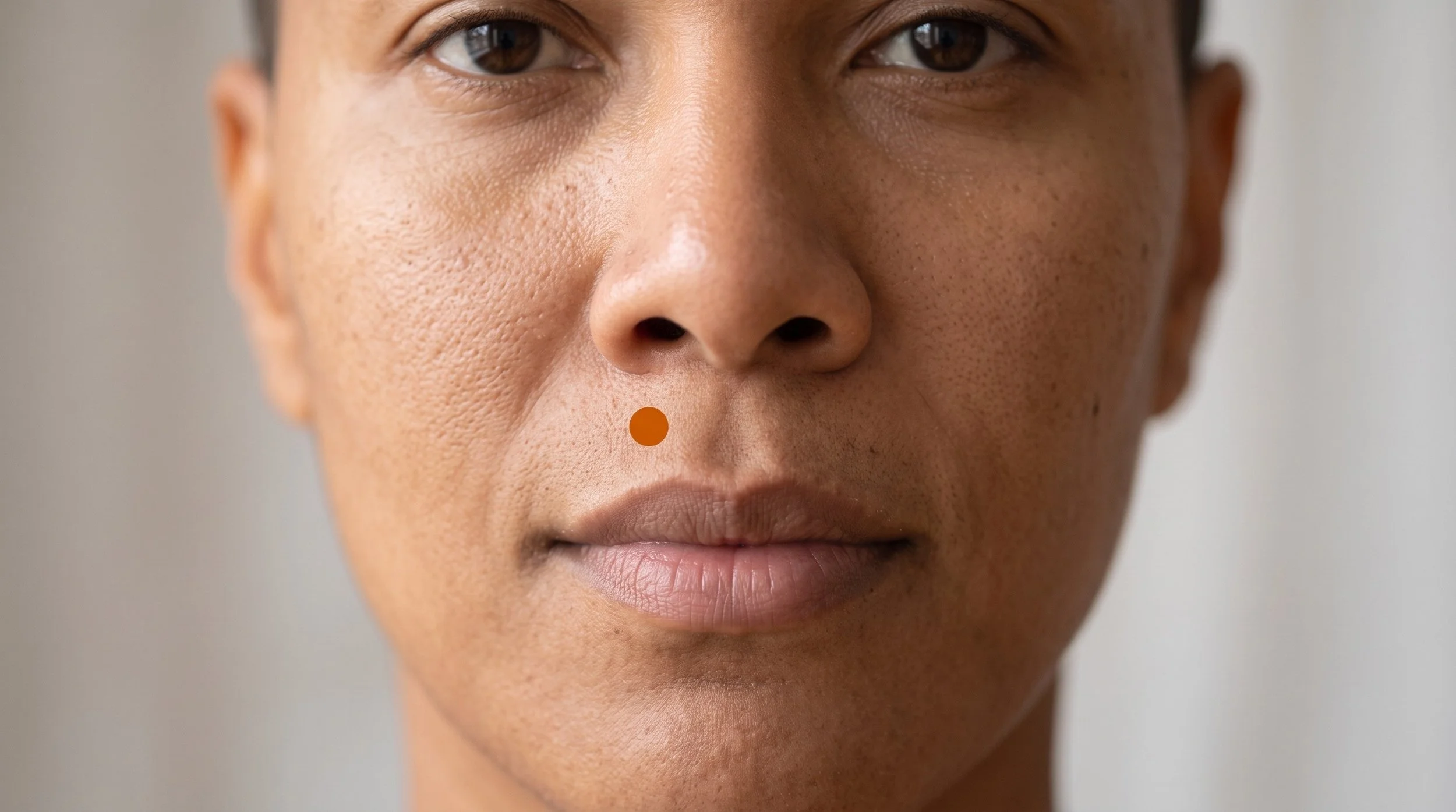
LI19 Acupuncture Point (Kouheliao)
The Mouth Grain Crevice Beside the Philtrum: Anatomy, Trigeminal Mechanism, and Why This Small Face Point Belongs in Nasal and Facial Palsy Work
LI19, known in Chinese as Kouheliao and usually translated as Mouth Grain Crevice, is the second to last point on the Large Intestine channel. You find it on the face directly below the outer edge of the nostril, half a cun to the side of GV26, which sits where the upper third of the philtrum meets the lower two thirds (Deadman et al., 2001). That places the li19 acupuncture point in a tiny but busy piece of real estate: the skin over the upper lip, at the base of the nasal ala, in territory supplied by the maxillary division of the trigeminal nerve.
Clinically it matters because the same nerve that reports sensation from this patch of lip also carries sensation from the nasal cavity, which is why a point on the lip has been used for centuries for a blocked nose, nosebleed, a dulled sense of smell, and a drooping mouth.
- Location and layers: LI19 sits below the lateral margin of the nostril, 0.5 cun lateral to GV26, over thin skin, sparse subcutaneous fat, and the upper fibers of orbicularis oris where nasalis and levator labii superioris alaeque nasi blend into the alar base (Deadman et al., 2001; Kim, 2013).
- Traditional framing translated: classical sources credit LI19 with eliminating wind and opening the nasal passages, which in modern terms describes a local point used to change nasal airflow, secretion, and mucosal congestion rather than a literal movement of energy (Deadman et al., 2001).
- Mechanism: the needle stimulates superior labial branches of the infraorbital nerve, part of the maxillary division of the trigeminal nerve, whose central terminals converge with afferents from the nasal mucosa, giving a plausible route for segmental modulation and descending inhibition (Zhao, 2008).
- Autonomic angle: nasal patency is governed largely by sympathetic and parasympathetic control of mucosal blood vessels and glands, and needling in this trigeminal region has been shown in controlled work to shift measured nasal airway resistance and neuropeptide Y levels (Wang et al., 2016).
- Research picture: reviews of acupuncture for allergic rhinitis and chronic rhinosinusitis report symptom and quality of life improvements with cautious certainty, while the Cochrane review on Bell's palsy found trial quality too poor for firm conclusions (He et al., 2022; Lee et al., 2022; Chen et al., 2010).
- Sensation and technique: LI19 is needled obliquely and shallowly, roughly 0.2 to 0.5 cun depending on the source, and de qi here is usually a brief pinch followed by mild pressure spreading toward the nostril, sometimes with watering eyes or an urge to sneeze (Deadman et al., 2001; Kim, 2013).
Stuffy Nose That Never Fully Clears?
Chronic congestion, post nasal drip, and a muted sense of smell wear people down long before they think about acupuncture. At Morningside Acupuncture we use LI19 alongside LI20, GV23, and distal points like LI4 in short, comfortable face treatments aimed at nasal airflow and sinus pressure. Treatment is paired with a plain assessment of triggers, breathing habits, and what your ENT or allergist has already found. Schedule a visit and let's see how your nose responds over a few sessions.
Schedule NowAnatomy of LI19: Why the Alar Base Above the Upper Lip Is Such an Important Location
Surface to deep, LI19 is one of the shallowest points on the body. Under the fingertip there is thin, mobile skin, a very thin layer of subcutaneous fat, and then the upper fibers of orbicularis oris, the sphincter muscle of the lips. Just above and lateral to the point, the nasalis and the levator labii superioris alaeque nasi anchor into the alar base and the upper lip, which is why the tissue here feels tethered rather than loose.
These muscles work all day during speech, chewing, smiling, and nose blowing, and they are also loaded by things people rarely think about, including mask straps, CPAP interfaces, habitual mouth breathing, and the repeated wiping that comes with weeks of rhinitis.
The nerve geography is the reason this point is interesting. Sensation here travels through superior labial branches of the infraorbital nerve, part of the maxillary division of the trigeminal nerve, while the surrounding muscles are driven by buccal and zygomatic branches of the facial nerve. Afferents from the nasal mucosa and the lateral nasal wall reach the same trigeminal sensory complex, so input from the skin below the nostril arrives in the same central neighborhood as input from the nose itself.
That convergence is the standard neurophysiological explanation for why local facial needling can influence nasal symptoms, and needle stimulation is also understood to recruit descending inhibitory pathways from the brainstem that dampen the ongoing traffic in those segments (Zhao, 2008). Controlled work on needling in this trigeminal territory has recorded measurable shifts in nasal airway resistance and in neuropeptide Y in nasal secretions, which points toward autonomic modulation of mucosal vessels rather than any mechanical opening of the airway (Wang et al., 2016).
Deeper structures set the safety rules. Branches of the facial artery, including the superior labial artery and the lateral nasal branch, run in this region, so bruising is the most realistic complication and the reason clinicians press briefly after withdrawal. Standard technique is oblique insertion of about 0.3 to 0.5 cun, with some texts recommending an even shallower 0.2 to 0.3 cun, angled along the tissue rather than into it so the needle never enters the nostril (Deadman et al., 2001; Kim, 2013).
Sources also disagree about heat: several classical and modern texts treat LI19 as a point to avoid with moxibustion, while others permit it, and in practice most clinicians simply skip moxa on a cosmetically sensitive part of the face (Deadman et al., 2001).
Related Large Intestine Channel Related Facial AcupunctureLI19 at a Glance: Classification, Location, and Clinical Use
| Category | Detail |
|---|---|
| Traditional Name | Kouheliao (Mouth Grain Crevice), also rendered Mouth Grain Seam |
| Channel Classification | Large Intestine channel of Hand Yangming, the nineteenth and penultimate point of the channel |
| Point Categories | The reference sources list no meeting, crossing, five-shu, hui-meeting, or extraordinary vessel designations for this point. It is classified by function rather than category, as a local face point traditionally said to eliminate wind and open the nasal passages, and it belongs to the nose-focused cluster at the end of the channel with LI20. |
| Precise Location | On the face, directly below the lateral margin of the nostril, 0.5 cun lateral to GV26; GV26 lies on the midline of the philtrum at the junction of its upper third and lower two thirds |
| Tissue Stimulated | Skin and thin subcutaneous tissue over the upper fibers of orbicularis oris, near the alar attachments of nasalis and levator labii superioris alaeque nasi; mid-face myofascial work at Morningside may also involve neighboring muscles such as the orbicularis oculi and the lateral pterygoid |
| Needle Depth / Direction | Oblique insertion, roughly 0.3 to 0.5 cun in Deadman and 0.2 to 0.3 cun in other texts, angled along the lip away from the nostril; several sources advise against moxibustion here |
| De Qi Sensation | A brief sharp pinch on insertion, then a mild dull pressure or fullness that can spread toward the nostril and upper lip; watering eyes or a short-lived urge to sneeze is common and settles quickly |
| Primary Clinical Uses | Nasal congestion and discharge, reduced sense of smell, nasal sores and polyps in classical use, nosebleed, and facial paralysis involving the mouth and nose; classical texts also list lockjaw and loss of consciousness |
| Common Point Combinations |
|
Deadman, Al-Khafaji and Baker summarize LI19 in one tight traditional statement: it eliminates wind and opens the nose. The indications that follow all cluster around the nasal cavity and the mouth, covering blockage and discharge, an impaired sense of smell, sores and polyps inside the nose, and rhinitis accompanied by bleeding, together with clenched jaw, a deviated mouth, and even collapse (Deadman et al., 2001). These are traditional attributions, recorded within a symptom framework rather than a physiological one, and they should be read that way.
What stands out is how tightly the classical picture matches the anatomy discovered later. Almost every listed complaint belongs to structures fed by the maxillary trigeminal branches and moved by the facial nerve, both of which pass within millimeters of a point defined only by a nostril and a crease in the lip.
Why LI19 Is Used for a Blocked Nose and a Dulled Sense of Smell
The short answer is convergence. The skin below the nostril and the lining of the nasal cavity report to overlapping parts of the trigeminal system, so a needle in the lip is not as far from the nose as it looks. Stimulating those fibers changes the input arriving at the trigeminal sensory nuclei, and that input feeds reflex circuits that help regulate mucosal blood vessels and glands. When congestion is driven by swollen erectile tissue in the nose rather than by a fixed structural blockage, small changes in that vascular tone can translate into a noticeable difference in how much air moves.
Needling also engages more general modulatory machinery. Zhao (2008) describes how needle stimulation recruits brainstem and midbrain descending pathways that dampen nociceptive transmission at the segmental level, which is relevant to the facial pressure and dull ache that often accompany a stuffy nose.
On the autonomic side, a randomized study in healthy volunteers found that needling in this trigeminal region improved self-reported nasal ventilation and objective measures of nasal patency, along with a rise in neuropeptide Y in nasal secretions, a marker the authors interpreted as increased sympathetic activity (Wang et al., 2016). Sympathetic tone constricts the nasal venous sinusoids, so that pattern fits the clinical observation that some patients feel their nose open during treatment.
Expectations should stay measured. Objective imaging studies have not always confirmed a decongestant effect: one controlled trial using optical rhinometry found faster changes in nasal blood flow with true points, yet could not demonstrate a measurable reduction in turbinate swelling compared with sham needling (Albrecht et al., 2015). In other words, symptoms often improve more reliably than instruments record, and LI19 is best understood as one contributor to a multi-point nasal protocol rather than a switch that clears the airway on its own.
What the Research Shows for LI19
No trial has isolated LI19. Like nearly every point, it is studied inside protocols, and in the nasal literature it appears as one member of a local face cluster with LI20, GV23, Yintang, and BL2, usually supported by distal points such as LI4. That means the research below tells you how the protocols perform, not how much of the effect belongs to this particular point. The evidence for allergic rhinitis and chronic rhinosinusitis is reasonably encouraging but limited by heterogeneous trials and modest methodological quality, while the evidence for facial palsy remains genuinely inconclusive. Read the table as context for a clinical decision, not as proof about one needle below the nostril.
| Study | Type | Focus | Key Finding |
|---|---|---|---|
| He et al., 2022 | Systematic review and meta-analysis | Acupuncture for allergic rhinitis, 30 trials and 4,413 participants | Pooled results suggested improvement in nasal symptom scores and rhinitis-related quality of life in adults, with the usual caveats about trial quality and heterogeneity. |
| Lee et al., 2022 | Systematic review and meta-analysis | Acupuncture for chronic rhinosinusitis, 10 randomized trials | Acupuncture used alone or added to conventional care was associated with better symptom scores and quality of life, though the authors rated the evidence moderate to low and noted high clinical heterogeneity. |
| Chen et al., 2010 | Cochrane systematic review | Acupuncture for Bell's palsy, six studies and 537 participants | Design and reporting flaws prevented reliable conclusions about efficacy, and no harmful side effects were reported in the included trials. |
| Wang et al., 2016 | Randomized controlled study in healthy volunteers | Needling in the trigeminal region of the mid-face and nasal ventilation | Active needling improved self-reported ventilation and objective nasal patency measures and raised neuropeptide Y, which the authors linked to increased sympathetic activity. |
| Albrecht et al., 2015 | Prospective randomized controlled study | Nasal congestion from inferior turbinate hypertrophy, assessed by optical rhinometry | True points changed nasal blood flow faster than sham, but a decongestant effect on the turbinate could not be demonstrated with this measurement method. |
| Zhao, 2008 | Narrative review of mechanisms | Neural pathways underlying acupuncture effects | Describes segmental spinal and supraspinal descending inhibitory mechanisms that are commonly invoked to explain local point effects such as those attributed to LI19. |
Facial Weakness, Numbness, or a Drooping Mouth?
Classical texts list LI19 for deviation of the mouth, and it still earns a place in modern mid-face work because it sits right where the lip elevators and orbicularis oris meet. Our clinicians combine it with points such as ST3 and ST4, gentle electrical stimulation when appropriate, and coordination exercises between visits. We work alongside your neurologist rather than replacing medical care, and we are clear about what acupuncture may and may not add. Book an evaluation to get a realistic plan for your recovery timeline.
Schedule NowLI19 in the Context of Trigger Point Work
The li 19 face point sits in muscle, not just skin, and that gives it a second identity in a dry needling practice. Orbicularis oris, nasalis, and levator labii superioris alaeque nasi can develop taut, tender bands in people who clench, mouth breathe, play wind instruments, or have spent months straining through a congested nose. Trigger points in the facial and masticatory muscles are described as referring pain into the mid-face, upper lip, nose, and teeth, patterns that overlap almost exactly with the complaints LI19 was traditionally used for (Simons et al., 1999).
Because acupuncture is defined by the use of an acupuncture needle, treating a tender band beside the nostril with a fine needle is the same act whether the chart calls the target Kouheliao or the alar fibers of nasalis.
At Morningside, needling large intestine 19 is rarely a standalone move. When facial pressure and jaw tension travel together, we combine gentle superficial needling at LI19 and LI20 with dry needling of the masseter, the lateral pterygoid, and the orbicularis oculi region, then reassess mouth opening, nasal breathing, and tenderness at the alar base. Face muscles are small and richly vascular, so the technique is deliberately conservative: fine gauge needles, shallow oblique angles, brief retention, and firm pressure after withdrawal to limit bruising. Patients who are needle sensitive can get much of the same input from acupressure or light electrical stimulation applied over the point instead.
LI19 Nasal and Facial Treatment at NYC's Highest-Rated Acupuncture Clinic
Morningside Acupuncture is the highest-rated acupuncture and dry needling clinic in New York City with over 500 five-star Google reviews. Our licensed acupuncturists use fine needles, precise anatomy, and clear explanations, so you always know why a point below your nostril is part of the plan. Whether you are dealing with seasonal congestion, sinus pressure headaches, or lingering facial weakness, we build treatment around your exam findings. Schedule your session in Manhattan and start with a thorough first visit.
Schedule NowFrequently Asked Questions
What does LI19 feel like when needled?
Most people feel a quick pinch as the needle passes the skin, then a mild dull pressure or fullness under the nostril. The face is sensitive, so the initial sensation can be sharper than at points on the arm or leg, but it usually fades within seconds. It is common for one eye to water or for a brief sneeze reflex to appear, both of which settle quickly. Because the point is needled shallowly and obliquely, strong grabbing or aching de qi is neither expected nor necessary here.
Why needle a point on the lip for a problem in the nose?
Because the two areas share a nerve supply. The skin below the nostril is served by superior labial branches of the infraorbital nerve, part of the maxillary division of the trigeminal nerve, and afferents from the nasal lining reach the same trigeminal sensory complex. Input at LI19 therefore arrives in the same central territory as input from the nose, giving a plausible route for segmental modulation and for reflex effects on mucosal blood vessels (Zhao, 2008). Studies of needling in this region have recorded changes in objective nasal patency measures and in nasal neuropeptides, which fits the clinical picture (Wang et al., 2016).
Can I press LI19 myself between sessions?
Yes, and it is one of the easier points to self-treat. Find GV26 in the groove of your upper lip, at the upper third of the philtrum, then slide about half a thumb width sideways until you are directly beneath the outer edge of your nostril. Use the pad of your index finger and apply light, steady pressure or small circles for 30 to 60 seconds per side, at a firmness that is noticeable but never painful. Repeat two or three rounds, and combine it with pressure at LI20 beside the nostril for another 30 to 60 seconds. Two or three short sessions a day during a congested stretch is plenty, and you should stop if the skin becomes sore or irritated.
Is LI19 safe to needle?
In trained hands, yes. The point is needled obliquely and shallowly, roughly 0.2 to 0.5 cun depending on the text, angled along the lip so the needle never enters the nostril (Deadman et al., 2001; Kim, 2013). Branches of the facial artery run through this region, so brief bruising is the most likely side effect, and clinicians usually apply pressure after withdrawal. Several classical and modern sources advise avoiding moxibustion at this point. Tell your acupuncturist if you take blood thinners, have had recent facial filler or surgery, or have active skin lesions in the area, since any of those may change the plan.
Where exactly is LI19 located?
On the face, directly below the outer edge of the nostril, 0.5 cun lateral to GV26. GV26 sits on the midline of the philtrum, at the junction between its upper third and lower two thirds (Deadman et al., 2001). A practical way to locate the mouth grain crevice is to drop a vertical line from the outer border of the nostril and find where it meets the level of GV26, right at the top of the upper lip. LI20 lies just above and lateral, in the crease beside the nose, and the two are frequently used together.
References
- Deadman, P., Al-Khafaji, M., & Baker, K. (2009). A manual of acupuncture. Journal of Chinese Medicine Publications.
- Kim, H. (2008). Handbook of Oriental medicine (3rd ed.). Harmony & Balance Press.
- Cheng, X. (Ed.). (1999). Chinese acupuncture and moxibustion (Rev. ed.). Foreign Languages Press.
- Simons, D. G., Travell, J. G., & Simons, L. S. (1999). Travell & Simons' myofascial pain and dysfunction: The trigger point manual, Vol. 1: Upper half of body (2nd ed.). Williams & Wilkins.
- He, M., Qin, W., Qin, Z., & Zhao, C. (2022). Acupuncture for allergic rhinitis: A systematic review and meta-analysis. European Journal of Medical Research, 27(1), 58. https://doi.org/10.1186/s40001-022-00682-3
- Lee, B., Kwon, C. Y., & Park, M. Y. (2022). Acupuncture for the treatment of chronic rhinosinusitis: A PRISMA-compliant systematic review and meta-analysis. Evidence-Based Complementary and Alternative Medicine, 2022, 6429836. https://doi.org/10.1155/2022/6429836
- Chen, N., Zhou, M., He, L., Zhou, D., & Li, N. (2010). Acupuncture for Bell's palsy. Cochrane Database of Systematic Reviews, 2010(8), CD002914. https://doi.org/10.1002/14651858.CD002914.pub5
- Wang, K., Chen, L., Wang, Y., Wang, C., & Zhang, L. (2016). Sphenopalatine ganglion acupuncture improves nasal ventilation and modulates autonomic nervous activity in healthy volunteers: A randomized controlled study. Scientific Reports, 6, 29947. https://doi.org/10.1038/srep29947
- Albrecht, T., Wu, S., Baumann, I., Plinkert, P. K., & Sertel, S. (2015). Measurable impact of acupuncture on mucosal swelling of inferior turbinates: A prospective, randomized, controlled study. Acta Oto-Laryngologica, 135(2), 169-176. https://doi.org/10.3109/00016489.2014.973533
- Zhao, Z. Q. (2008). Neural mechanism underlying acupuncture analgesia. Progress in Neurobiology, 85(4), 355-375. https://doi.org/10.1016/j.pneurobio.2008.05.004
Disclaimer: This web site is intended for educational and informational purposes only. Reading this website does not constitute providing medical advice or any professional services. This information should not be used for diagnosing or treating any health issue or disease. Those seeking medical advice should consult with a licensed physician. Seek the advice of a medical doctor or other qualified health professional for any medical condition. If you think you have a medical emergency, call 911 or go to the emergency room. No acupuncturist-patient relationship is created by reading this website or using the information. Morningside Acupuncture PLLC and its employees and contributors do not make any express or implied representations with respect to the information on this site or its use. For any legal interpretation of scope of practice in your state, consult a licensed attorney or regulatory authority.
Read more from our blog



