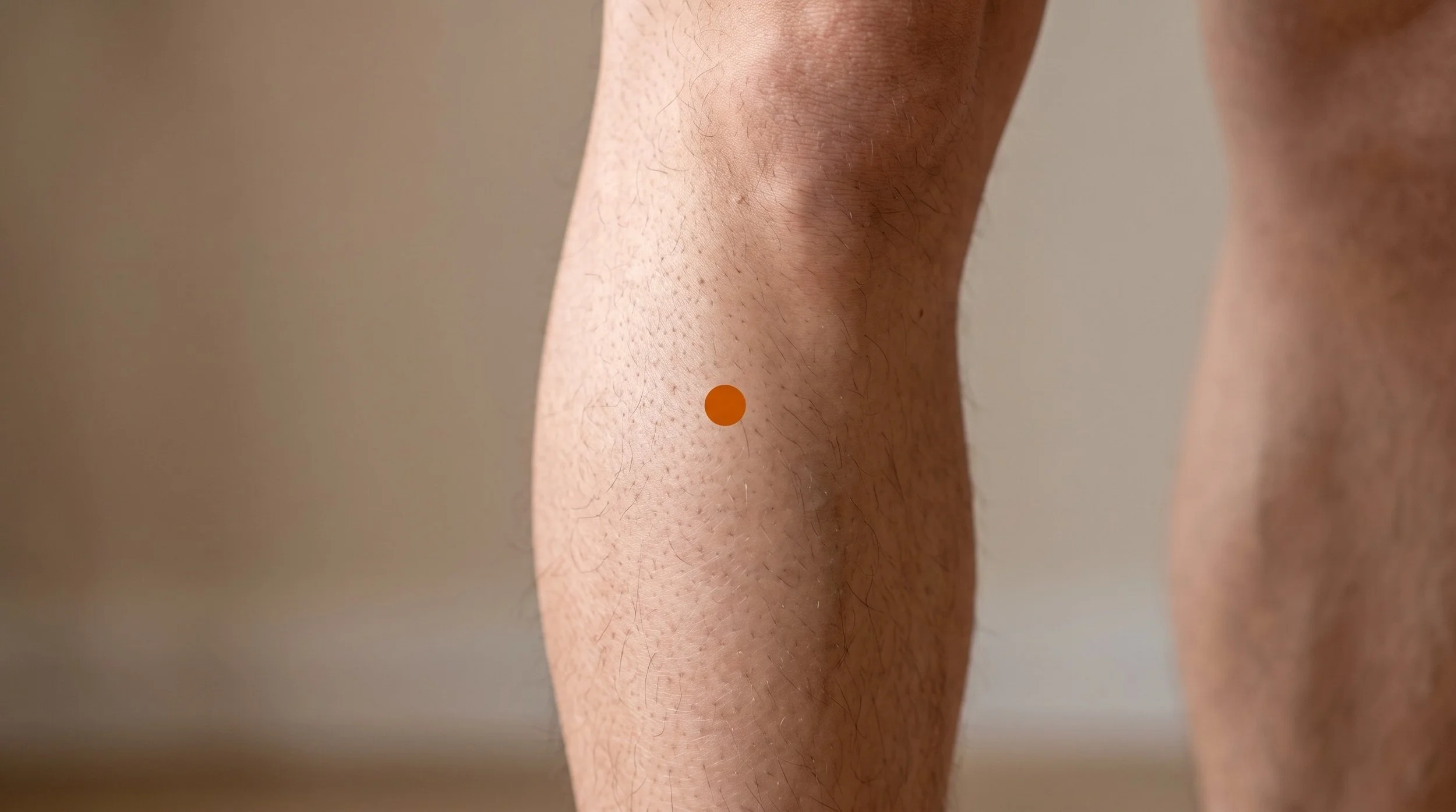
Lanweixue Acupuncture Point (M-LE-13)
The Appendix Point on the Right Shin: Anatomy, Somato-Autonomic Mechanism, and Why This One-Sided Extra Point Still Earns Its Place in Clinical Practice
Lanweixue (M-LE-13, the Appendix Point) is an extra point on the right lower leg, sitting roughly 2 cun below ST36 in the belly of tibialis anterior, just lateral to the sharp front edge of the shin bone. It's unusual for two reasons: it's one of the very few points described as existing on one side of the body only, and its exact position isn't fixed, since practitioners find it by pressing along that stretch of muscle until the most tender spot appears (Deadman et al., 2009).
Classically it was needled for acute and chronic appendicitis and used as a tenderness sign that might point toward an inflamed appendix, and it's also listed for lower limb weakness, drop foot, and indigestion. In a modern clinic the Lanweixue acupuncture point is best understood as a lower leg reflex point in deep fibular nerve territory, useful alongside medical care rather than in place of it, and never as a reason to delay urgent evaluation of abdominal pain.
- Location and layers: Lanweixue lies about 2 cun distal to ST36 on the right leg, in tibialis anterior lateral to the tibial crest, and the precise spot is confirmed by palpating for maximum tenderness rather than by measuring alone (Deadman et al., 2009). Needling is perpendicular, typically 1 to 1.5 cun.
- Traditional category translated: the classical texts describe the appendix point as moving qi and blood and clearing heat and toxic accumulation from the Large Intestine (Deadman et al., 2009). In neurophysiological language that reads as somatic afferent input from the lower leg feeding spinal and brainstem circuits that influence gut motility, blood flow, and inflammatory tone.
- Nerve story: the tissue under the needle is supplied by the deep fibular nerve and the L4 to S1 segments, and hindlimb points in this region can drive vagal and sympathetic reflexes with a level of body-region specificity that has now been traced to particular sensory neuron populations in deep fascia (Liu et al., 2021; Liu et al., 2020).
- Reflex point logic: Lanweixue belongs to the family of reactive points that become sore when a related organ is irritated, which is why classical diagnosis included pressing it and why texts pair it with the standard abdominal exam (Maciocia, 2005; Deng and Gan, 2016).
- Research picture: the two published prospective diagnostic studies disagree in emphasis, with one reporting only modest accuracy for a tender lanwei point and the other finding tenderness a poor stand-alone indicator, so it's a supporting observation at best (Alt-Epping et al., 2002; Levy and Texidor, 1988). Broader work on lower leg points supports effects on gut recovery after abdominal surgery (Chen et al., 2024).
- De qi and practice framing: because the point is chosen for tenderness, patients often feel a sharp initial soreness that settles into a heavy, spreading ache in the shin, sometimes travelling toward the ankle. Morningside uses it as an adjunct for digestive complaints and anterior shin work, and always alongside medical assessment when abdominal pain is the reason for the visit.
Struggling With Sluggish Digestion, Bloating, or Post-Surgical Gut Recovery?
Lower leg points like Lanweixue and ST36 are among the most studied sites for influencing gut motility through somato-autonomic pathways, and we use them as part of a broader digestive treatment plan rather than as isolated needles. Your visit starts with a full history, abdominal and lower leg palpation, and a clear discussion of what acupuncture may and may not help with. If anything in your presentation suggests a condition that needs medical or surgical evaluation, we say so directly and help you get there. Schedule a visit at Morningside Acupuncture to build a plan that fits your case.
Schedule NowAnatomy of Lanweixue: Why the Tibialis Anterior Just Below ST36 Is Such an Important Location
Run a finger down the front of the right shin from just below the knee and you'll feel the tibial crest, a hard ridge of bone. Slide about a thumb's width lateral to it and you're on tibialis anterior, the thick strap muscle that lifts the forefoot during walking and controls the foot's landing. Lanweixue sits in that muscle belly roughly 2 cun below ST36, which places it a little above the midpoint between the knee and ankle in most adults (Deadman et al., 2009). Above the muscle are skin, subcutaneous fat, and the crural fascia, a tough sleeve that binds the anterior compartment.
This region absorbs a great deal of repetitive eccentric load in runners, walkers, and anyone in stiff shoes, which is one reason tenderness here is so common and why the point must be confirmed by palpation rather than assumed from measurement alone.
Sensory supply to this area comes from the L4 to S1 spinal segments, with deeper motor and sensory innervation of the compartment carried by the deep fibular nerve. Stimulating those afferents does two things worth separating. Locally, needling appears to alter nociceptive processing in the dorsal horn and to recruit descending inhibitory pathways involving endogenous opioids and monoamines, which is the general framework used to explain acupuncture analgesia (Zhao, 2008).
Systemically, afferents from hindlimb sites can drive autonomic reflexes, and laboratory work has mapped how stimulation intensity and body region determine whether sympathetic or vagal pathways are engaged, with deep fascial sensory neurons in the lower leg playing a specific role in the vagal branch (Liu et al., 2020; Liu et al., 2021). Animal experiments on gastric motility after stimulation near ST36 point in the same direction, implicating vagal circuitry in the brainstem (Gao et al., 2012).
The structures to respect sit deeper. The anterior tibial artery and vein and the deep fibular nerve travel together on the interosseous membrane between tibialis anterior and the toe extensors, well below the usual working depth, and the tibia itself is immediately medial. A perpendicular insertion of 1 to 1.5 cun into the muscle belly, angled away from the bone rather than into periosteum, keeps the needle in the target tissue (Deadman et al., 2009).
Practitioners generally avoid heavy stimulation in anyone with anterior compartment symptoms, significant swelling, or anticoagulation, and switch to gentler technique or acupressure instead.
Related Tibialis Anterior Trigger Points Related ST36 Acupuncture PointLanweixue at a Glance: Classification, Location, and Clinical Use
| Category | Detail |
|---|---|
| Traditional Name | Lanweixue (Appendix Point), Extra Point M-LE-13, also catalogued as EX-LE 7 in some modern texts |
| Channel Classification | Extra point of the lower leg, off the primary channel system, though it sits on the tibialis anterior line shared with nearby Stomach channel points |
| Point Categories | Extraordinary (extra) point rather than a channel point, so it carries no five-shu, meeting, or hui-meeting designation; one of the very few points described as existing on one side of the body only, on the right leg; functions as a reactive, palpation-defined reflex point with a traditional diagnostic role; traditionally credited with moving qi and blood and clearing heat and toxic accumulation from the Large Intestine (Deadman et al., 2009) |
| Precise Location | Right lower leg only, approximately 2 cun distal to ST36 in the tibialis anterior muscle just lateral to the tibial crest, with the working spot confirmed as the site of maximum tenderness on palpation |
| Tissue Stimulated | Skin, crural fascia, and the belly of tibialis anterior, tissue also targeted in Tibialis Anterior Trigger Points work; deep fibular nerve territory, L4 to S1 segments |
| Needle Depth / Direction | Perpendicular insertion 1 to 1.5 cun into the muscle belly, angled away from the tibial periosteum; gentler depth for lean legs or sensitive patients |
| De Qi Sensation | Often a sharp initial soreness because the site is chosen for tenderness, giving way to a heavy, distending ache that can spread down the shin toward the ankle or foot dorsum; occasional twitch response in tibialis anterior |
| Primary Clinical Uses | Traditionally needled in acute and chronic appendicitis alongside medical care, used as a tenderness observation when appendix irritation is suspected, and listed for lower limb weakness, drop foot, and indigestion; modern clinical use leans toward digestive support and anterior shin complaints |
| Common Point Combinations |
|
In Deadman, Al-Khafaji and Baker's A Manual of Acupuncture, the appendix point is presented as a famous empirical addition to the point repertoire, known chiefly for its use in acute and chronic appendicitis. The commentary makes two claims that are traditional attributions rather than modern findings: that the point tends to become sore when the appendix is inflamed, which gave it a secondary role in diagnosis, and that it exists only on the right side, unlike the paired points that make up nearly all of the acupuncture map.
Its traditional actions are described in the language of moving qi and blood and clearing heat and toxic accumulation from the Large Intestine, with indications extending beyond the abdomen to lower limb paralysis, drop foot, and indigestion. Other classical and modern texts reinforce the diagnostic angle, noting that a sore spot found between ST36 and ST37 was read as a sign of appendix irritation while a quiet spot suggested otherwise (Maciocia, 2005; Deng and Gan, 2016).
What's striking about the classical pattern isn't the claim itself so much as the reasoning behind it: centuries before anyone described viscerosomatic convergence, practitioners were mapping a specific patch of shin to a specific abdominal organ and treating the correspondence as clinically actionable.
Why Lanweixue Is Used for Abdominal Symptoms When It Sits Halfway Down the Shin
The obvious question about the lanwei point is how a needle in the shin has anything to do with the right lower abdomen. The workable answer is convergence. Sensory fibers from viscera and from the body wall and limbs feed overlapping populations of neurons in the spinal cord, so an irritated organ can produce referred soreness at a distant somatic site, and stimulating that somatic site can in turn influence the spinal and brainstem circuits handling visceral input.
That two-way relationship is the reason reactive points on the limbs became part of traditional diagnosis in the first place (Deng and Gan, 2016; Maciocia, 2005). It also explains why the point behaves as an area rather than a fixed dot: referred zones vary between people.
The second layer is autonomic. Laboratory research over the past several years has shown that stimulating hindlimb sites near ST36 can engage the vagal side of the autonomic nervous system in ways that abdominal stimulation does not, and that the effect depends on stimulation intensity and on a distinct population of sensory neurons that innervate deep fascia in the leg (Liu et al., 2021; Liu et al., 2020). Related work has traced enhanced gastric motility after hindlimb stimulation to synaptic changes in the dorsal motor nucleus of the vagus in the brainstem (Gao et al., 2012).
None of that research was performed on Lanweixue specifically, and it would be overreaching to transfer the findings wholesale, but the point sits in the same tissue and the same nerve territory, which makes it a plausible member of that group rather than an outlier.
Alongside the visceral story runs a straightforward musculoskeletal one. Needling into tibialis anterior recruits the descending inhibitory systems that underpin acupuncture analgesia generally (Zhao, 2008), and individual patient data pooled across chronic pain trials show effects that persist beyond the treatment period, which is the pattern you'd expect from a real physiological response rather than short-lived expectation alone (Vickers et al., 2018). For patients who come in with shin pain, tight anterior compartments, or weak dorsiflexion, that's the mechanism doing most of the work.
What the Research Shows for Lanweixue
Research on this point falls into two very different piles, and it's worth being blunt about both. The first pile tests Lanweixue as a diagnostic sign for appendicitis, and the results are mixed to unimpressive: a tender point on the right shin adds little to a careful clinical exam, imaging, and bloodwork, and should never be used to rule appendicitis in or out.
The second pile tests lower leg points, mostly ST36 and its neighbors, as part of multi-point protocols for gut function, particularly recovery after abdominal surgery, and here the signal is more encouraging. In every case the trials study bundles of points rather than this one point in isolation, so any claim about Lanweixue's individual contribution is an inference rather than a finding.
| Study | Type | Focus | Key Finding |
|---|---|---|---|
| Alt-Epping et al., 2002 | Prospective diagnostic accuracy study (116 patients) | Tenderness at the lanwei point as a clinical sign in suspected appendicitis, compared against histology | A positive lanwei sign showed modest sensitivity and specificity and ranked in the middle of the clinical signs assessed, suggesting it may add a little context but can't stand alone. |
| Levy and Texidor, 1988 | Prospective clinical study (50 patients) | Presence or absence of lanwei tenderness before appendectomy under standard Western diagnostic criteria | The authors reported that tenderness at the point was not a statistically useful indicator of appendicitis in their sample. |
| Chen et al., 2024 | Systematic review and meta-analysis (16 RCTs, 1562 patients) | Electroacupuncture, typically including lower leg points, for postoperative ileus after colorectal surgery | Pooled data suggested faster return of bowel function, though trial quality and blinding varied and results should be read cautiously. |
| Liu et al., 2021 | Mechanistic laboratory study (Nature) | Neuroanatomical basis for hindlimb electroacupuncture driving the vagal-adrenal axis | A specific population of sensory neurons innervating deep hindlimb fascia proved necessary for the anti-inflammatory vagal response, offering one explanation for site specificity. |
| Liu et al., 2020 | Mechanistic laboratory study (Neuron) | Somatotopic organization and intensity dependence of sympathetic pathways driven by electroacupuncture | Body region and stimulation intensity determined which autonomic pathway was recruited, supporting the idea that point location genuinely matters. |
| Gao et al., 2012 | Animal mechanistic study | Gastric motility changes after stimulation at ST36 and brainstem vagal circuitry | Increased intragastric pressure was linked to receptor-dependent synaptic activity in the dorsal motor nucleus of the vagus, implicating a vagal reflex. |
| Vickers et al., 2018 | Individual patient data meta-analysis (~20,800 patients) | Acupuncture for chronic musculoskeletal, headache, and osteoarthritis pain | Acupuncture outperformed sham and no-acupuncture controls with effects that persisted over time, supporting its use for the shin and limb pain side of this point's indications. |
Shin Pain, Anterior Compartment Tightness, or Weak Dorsiflexion?
The tissue that holds Lanweixue is tibialis anterior, the muscle that lifts your foot with every step and takes a beating from running, hill work, and long days on hard city sidewalks. We combine acupuncture at this stretch of the shin with dry needling of tibialis anterior and its neighbors, then add loading and gait work so the change holds. Sessions are unhurried and every technique gets explained before it happens. Book an appointment and let's look at what's driving the shin.
Schedule NowLanweixue in the Context of Trigger Point Work
The appendix point sits squarely in tibialis anterior, a muscle with a well-described referral pattern that travels down the front of the shin into the ankle and the big toe, and which commonly develops taut bands in runners, hikers, and people who spend long hours walking on concrete (Simons et al., 1999). That overlap is clinically useful and also a caution. A tender spot in this location may reflect nothing more exotic than an overworked dorsiflexor, which is one reason the diagnostic value of lanwei tenderness has held up poorly under formal testing (Levy and Texidor, 1988; Alt-Epping et al., 2002).
When we palpate the area we're asking what kind of tenderness it is: a discrete nodular band that reproduces a familiar shin ache reads very differently from diffuse soreness in someone with abdominal symptoms.
In practice, Morningside treats this stretch of leg with the same needle either way, since acupuncture is defined by the tool rather than the theoretical frame, and dry needling is one of the hundreds of needling styles under that umbrella. For shin complaints we typically needle tibialis anterior at and around the Lanweixue location, often adding extensor digitorum longus, fibularis longus, and tibialis posterior when the deep posterior compartment contributes, then follow with eccentric dorsiflexion loading and footwear or gait adjustments.
For digestive cases we use the point more gently, alongside ST36, ST37, ST25 and abdominal work, with the goal of autonomic modulation rather than local muscle release.
Lanweixue Digestive and Shin Treatment at NYC's Highest-Rated Acupuncture Clinic
Morningside Acupuncture is the highest-rated acupuncture and dry needling clinic in New York City with over 500 five-star Google reviews, and our Upper West Side practice blends classical point selection with modern pain science. We use the appendix point as one piece of a considered plan for digestive complaints, anterior leg symptoms, and post-surgical recovery support, always coordinated with your medical care. You'll get a licensed acupuncturist's full attention, single-use sterile needles, and honest expectations. Schedule your first session today.
Schedule NowFrequently Asked Questions
What does Lanweixue feel like when needled?
Because the point is deliberately chosen at the sorest spot in the muscle, the first moment is often sharper than at a routine point, sometimes a distinct pinch or a quick ache. That usually settles within a few seconds into the heavy, full, slightly spreading sensation practitioners call de qi, which many patients describe as a deep pressure moving down the shin toward the ankle or the top of the foot. If tibialis anterior is holding taut bands, you may feel a brief involuntary twitch. Some soreness in the shin for a day afterward is normal, similar to what you'd feel after a hard hill workout.
Why treat a point on the shin for a problem in the abdomen?
Sensory nerves from the gut and from the body wall and limbs converge on shared neurons in the spinal cord, which is why an irritated organ can produce soreness at a distant somatic site and why stimulating that site can feed back into the circuits handling visceral input (Maciocia, 2005). On top of that, laboratory work has shown that stimulating hindlimb sites in this general region can recruit vagal and sympathetic pathways in ways that depend on both location and intensity (Liu et al., 2021; Liu et al., 2020). That's the modern reading of what classical texts described as a reflex point for the Large Intestine.
Can I press Lanweixue myself between sessions?
Yes, with one firm rule first: if you have new, worsening, or right lower abdominal pain, especially with fever, nausea, or pain that hurts more when pressure is released, skip the self-care and seek urgent medical evaluation. For routine use, sit with the right knee bent and find ST36 one hand's width below the kneecap, one finger's width lateral to the shin bone, then move about three finger widths further down and a thumb's width off the bony ridge into the muscle. Probe until you find the tenderest spot, then press with your thumb at a firm but tolerable pressure for 30 to 60 seconds, release, and repeat two or three times. Two or three rounds a day is plenty, and small circular massage over the muscle belly works just as well for shin tightness. Stop if pressing sharpens or spreads any abdominal symptom.
Is Lanweixue safe to needle?
In trained hands it's a straightforward and well-tolerated point, needled perpendicularly 1 to 1.5 cun into the tibialis anterior belly and angled away from the bone to avoid periosteal contact (Deadman et al., 2009). The anterior tibial vessels and deep fibular nerve run deeper, on the membrane between the shin bones, so standard depths keep clear of them. Temporary soreness or a small bruise is the most common side effect. The bigger safety issue isn't the needle at all: appendicitis is a surgical emergency, and neither needling nor a tender spot on the leg should ever substitute for imaging, bloodwork, and a physician's assessment. We treat this point as supportive care that runs alongside medical management, and we'll tell you plainly when your symptoms belong in an emergency department.
Where exactly is Lanweixue located?
On the right lower leg only, roughly 2 cun below ST36, in the tibialis anterior muscle just lateral to the sharp front ridge of the tibia (Deadman et al., 2009). Practically, find ST36 first, drop about two thumb widths down the same line, then slide slightly off the bone into muscle. The measurement is only an orientation, because the working location is defined by palpation: the practitioner presses along that short stretch and treats the point of greatest tenderness, which is why one Chinese literature review concluded the appendix point functions more as a small reactive zone than a fixed coordinate. If the area is completely non-tender, most classical sources would say there's no reaction to treat.
References
- Deadman, P., Al-Khafaji, M., & Baker, K. (2009). A manual of acupuncture. Journal of Chinese Medicine Publications.
- Maciocia, G. (2005). The foundations of Chinese medicine: A comprehensive text for acupuncturists and herbalists (2nd ed.). Elsevier Churchill Livingstone.
- Maciocia, G. (2006). The channels of acupuncture: Clinical use of the secondary channels and eight extraordinary vessels. Churchill Livingstone Elsevier.
- Simons, D. G., Travell, J. G., & Simons, L. S. (1999). Travell & Simons' myofascial pain and dysfunction: The trigger point manual, Vol. 1: Upper half of body (2nd ed.). Williams & Wilkins.
- Alt-Epping, S., Ostermann, T., Schmidt, J., & Zirngibl, H. (2002). Diagnostik der Appendizitis unter besonderer Berücksichtigung des Akupunkturpunktes Lanwei: eine prospektive Studie [Diagnosis of appendicitis with particular consideration of the acupuncture point Lanwei: a prospective study]. Forschende Komplementärmedizin und Klassische Naturheilkunde, 9(6), 338-345. https://doi.org/10.1159/000069233
- Levy, J. H., & Texidor, M. S. (1988). The lack of importance of Lanwei point in the diagnosis of acute appendicitis. Pain, 33(1), 79-80. https://doi.org/10.1016/0304-3959(88)90207-2
- Chen, H. T., Hung, K. C., Huang, Y. T., Wu, J. Y., Hsing, C. H., Lin, C. M., Chen, I. W., & Sun, C. K. (2024). Efficacy of electroacupuncture in improving postoperative ileus in patients receiving colorectal surgery: A systematic review and meta-analysis. International Journal of Surgery, 110(2), 1113-1125. https://doi.org/10.1097/JS9.0000000000000848
- Liu, S., Wang, Z., Su, Y., Qi, L., Yang, W., Fu, M., Jing, X., Wang, Y., & Ma, Q. (2021). A neuroanatomical basis for electroacupuncture to drive the vagal-adrenal axis. Nature, 598(7882), 641-645. https://doi.org/10.1038/s41586-021-04001-4
- Liu, S., Wang, Z. F., Su, Y. S., Ray, R. S., Jing, X. H., Wang, Y. Q., & Ma, Q. (2020). Somatotopic organization and intensity dependence in driving distinct NPY-expressing sympathetic pathways by electroacupuncture. Neuron, 108(3), 436-450. https://doi.org/10.1016/j.neuron.2020.07.015
- Gao, X., Qiao, Y., Jia, B., Jing, X., Cheng, B., Wen, L., Tan, Q., Zhou, Y., Zhu, B., & Qiao, H. (2012). NMDA receptor-dependent synaptic activity in dorsal motor nucleus of vagus mediates the enhancement of gastric motility by stimulating ST36. Evidence-Based Complementary and Alternative Medicine, 2012, 438460. https://doi.org/10.1155/2012/438460
- Zhao, Z. Q. (2008). Neural mechanism underlying acupuncture analgesia. Progress in Neurobiology, 85(4), 355-375. https://doi.org/10.1016/j.pneurobio.2008.05.004
- Vickers, A. J., Vertosick, E. A., Lewith, G., MacPherson, H., Foster, N. E., Sherman, K. J., Irnich, D., Witt, C. M., & Linde, K. (2018). Acupuncture for chronic pain: Update of an individual patient data meta-analysis. Journal of Pain, 19(5), 455-474. https://doi.org/10.1016/j.jpain.2017.11.005
Disclaimer: This web site is intended for educational and informational purposes only. Reading this website does not constitute providing medical advice or any professional services. This information should not be used for diagnosing or treating any health issue or disease. Those seeking medical advice should consult with a licensed physician. Seek the advice of a medical doctor or other qualified health professional for any medical condition. If you think you have a medical emergency, call 911 or go to the emergency room. No acupuncturist-patient relationship is created by reading this website or using the information. Morningside Acupuncture PLLC and its employees and contributors do not make any express or implied representations with respect to the information on this site or its use. For any legal interpretation of scope of practice in your state, consult a licensed attorney or regulatory authority.
Read more from our blog



