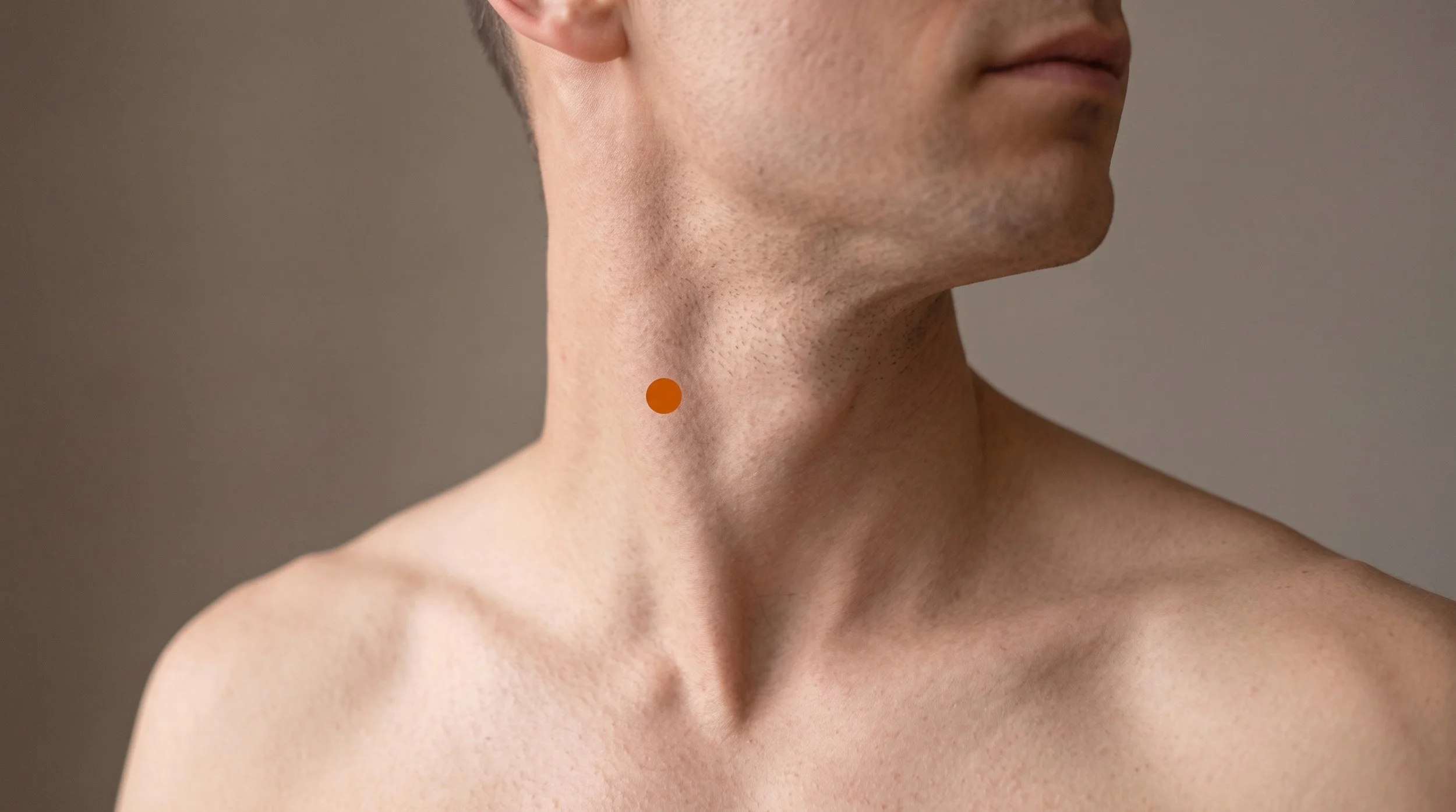
LI18 Acupuncture Point (Futu)
Support the Prominence Beside the Larynx: Anatomy, Mechanism, and Why This Window of Heaven Point Serves the Throat, the Voice, and the Side of the Neck
LI18, called Futu in pinyin and usually translated as Support the Prominence, sits on the side of the neck at the same height as the tip of the laryngeal prominence (the Adam's apple), tucked into the small gap between the sternal and clavicular heads of the sternocleidomastoid muscle. It's the eighteenth point of the Large Intestine channel and one of the classical Window of Heaven points, a small group of neck and upper-body points that traditional texts reserved for problems of the throat, voice, head, and senses.
Clinically, the li18 acupuncture point matters for two reasons that rarely appear in the same sentence: it's one of the few points that sits directly over the segmental territory of the larynx and thyroid region, and it's also right on top of the sternocleidomastoid, a muscle that generates a large share of the neck tightness, jaw referral, and headache patterns we see in a busy Manhattan practice. Because the carotid artery and internal jugular vein lie deep to this area, LI18 is a precision point: shallow, deliberate, and never rushed.
- Location and layers: LI18 sits level with the tip of the laryngeal prominence in the groove between the two heads of the sternocleidomastoid, with skin, platysma, and superficial cervical fascia above the muscle and the carotid sheath well below it (Deadman et al., 2001). Turning the head away from the treated side against gentle resistance makes the two muscular heads stand out for accurate palpation.
- Traditional categories, translated: classical sources group LI18 among the Window of Heaven points and traditionally credit it with benefiting the throat and voice and easing cough and wheezing (Deadman et al., 2001; Kim, 2008). In modern terms, those attributions describe a point positioned over the sensory and motor territory of the throat and anterior neck rather than a claim about energy flowing anywhere.
- Mechanism: the region is supplied by cervical plexus branches from roughly C2 to C4, including the great auricular and transverse cervical nerves, and those segments overlap with the innervation of the larynx, thyroid region, and anterior neck muscles, giving a plausible route for segmental modulation in the cervical dorsal horn (Zhao, 2008).
- Point-specific physiology: in rodent models of neck incision pain, electroacupuncture at LI18 raised local pain thresholds and increased spinal GABA and GABA receptor expression in the cervical dorsal horn, with segmental points outperforming distant leg points (Wang et al., 2020). Related work found similar GABAergic changes in cervical dorsal root ganglia (Qiao et al., 2019).
- The research picture: Cochrane reviewers found moderate-quality evidence that acupuncture may help chronic neck pain compared with sham in the short term (Trinh et al., 2016), and individual patient data across chronic pain conditions show modest, durable effects (Vickers et al., 2018). Human evidence specific to LI18 is limited to small perioperative and case-level reports (Zhang et al., 2021).
- De qi and practice framing: patients often describe a heavy, spreading fullness on the side of the throat, and older Chinese surgical-analgesia reports noted a distinctive sensation of the neck feeling thicker under stimulation at this point (Shanghai College of Traditional Chinese Medicine, 1981). LI18 is rarely used alone; it usually joins midline throat points, distal upper-limb points, and, where appropriate, dry needling of the neck musculature.
Hoarseness, Throat Tightness, or a Neck That Feels Constantly Braced?
At Morningside Acupuncture, LI18 is one of the points we consider when a patient's neck complaint sits in the front and side of the neck rather than the back: voice fatigue, a persistent globus-like tightness, or sternocleidomastoid tension that keeps pulling on the jaw and temples. We needle it shallowly and precisely, always after palpating and clearing the vascular structures, and we pair it with distal points and targeted muscle work rather than treating it as a standalone fix.
Our licensed acupuncturists will also look at posture, breathing pattern, and voice use, since those inputs often keep the region loaded. Schedule a visit and we'll map out what's actually driving your symptoms.
Schedule NowAnatomy of LI18: Why the Split Between the Two Heads of Sternocleidomastoid Is Such an Important Location
Working from the surface inward, LI18 passes through thin skin, the sheet-like platysma, and superficial cervical fascia before reaching the small interval where the sternal and clavicular heads of the sternocleidomastoid separate. That gap sits at the level of the thyroid cartilage, which is why the tip of the laryngeal prominence is the standard landmark (Deadman et al., 2001). In people whose laryngeal prominence is subtle, the depression between the lower edge of the hyoid bone and the top of the thyroid cartilage can be found at the midline first, with the prominence just beneath it.
The sternocleidomastoid at this level is loaded by almost everything modern life asks of the neck: sustained forward head position at a laptop, phone cradling, heavy voice use, chronic coughing, breath-holding under stress, and the guarding that follows whiplash or neck surgery.
The nerve geography here is dense and unusually relevant. Cutaneous supply comes from cervical plexus branches, chiefly the transverse cervical and great auricular nerves arising from roughly C2 to C3, while deeper structures of the anterior neck draw on C1 to C4 through the ansa cervicalis, and the sternocleidomastoid itself receives motor supply from the spinal accessory nerve with proprioceptive input from the upper cervical roots.
Those same upper cervical segments receive input from the laryngeal region, so needling at LI18 delivers afferent signaling into a spinal level shared with the structures patients describe as sore, tight, or hoarse. Convergence of that kind is the standard explanation for why a point can influence sensation in a region it doesn't physically touch, alongside the descending inhibitory pathways from the brainstem that acupuncture stimulation appears to recruit (Zhao, 2008).
Animal work using this exact point supports the segmental logic: electroacupuncture at LI18 in neck-incision models increased inhibitory GABA signaling in the cervical dorsal horn and produced better analgesia than stimulation of distant leg points (Wang et al., 2020).
Deep to the point lies the carotid sheath with the common carotid artery, internal jugular vein, and vagus nerve, and the carotid bifurcation with its baroreceptors sits near this level in many people. That anatomy sets the rules. Classical needling guidance keeps LI18 shallow, at roughly 0.3 to 0.5 cun perpendicular or 0.5 to 0.8 cun oblique, with an explicit caution that deeper insertion risks the artery or vein (Deadman et al., 2001).
In practice we palpate for the arterial pulse first, angle away from it, keep the needle within the muscular interval rather than driving medially toward the trachea, and avoid aggressive manipulation. Handled that way, LI18 is a comfortable point; handled casually, it isn't a point to improvise with.
Related Acupuncture for Neck Pain Related Sternocleidomastoid Trigger PointsLI18 at a Glance: Classification, Location, and Clinical Use
| Category | Detail |
|---|---|
| Traditional Name | Futu (Support the Prominence), Large Intestine 18 |
| Channel Classification | Large Intestine channel (Hand Yang Ming), eighteenth point, on the lateral neck |
| Point Categories | Window of Heaven point, listed among the five original Window of Heaven points in Chapter 21 of the Spiritual Pivot; no five-shu, luo-connecting, xi-cleft, or extraordinary vessel designations are attributed to this point in the standard references |
| Precise Location | On the side of the neck, level with the tip of the laryngeal prominence, in the interval between the sternal and clavicular heads of the sternocleidomastoid; roughly three cun lateral to the laryngeal prominence. Turning the head away from the side to be needled while light resistance is applied at the chin makes both heads easy to identify. |
| Tissue Stimulated | Skin, platysma, superficial cervical fascia, and the interval between the two heads of the sternocleidomastoid, with cervical plexus cutaneous branches crossing the muscle; the carotid sheath lies deep and is avoided |
| Needle Depth / Direction | Perpendicular 0.3 to 0.5 cun, or oblique 0.5 to 0.8 cun along the muscular interval. Shallow only: deeper insertion risks the carotid artery or internal jugular vein. Palpate and avoid the arterial pulse before insertion. |
| De Qi Sensation | A heavy, warm, spreading fullness across the side of the throat, sometimes with a sense that the neck feels thicker or fuller; sharp, electric, or pulsing sensations mean the needle should be withdrawn and repositioned |
| Primary Clinical Uses | Traditionally used for throat swelling and pain, sudden loss of voice and hoarseness, difficulty swallowing, and cough or wheezing; in modern practice, sternocleidomastoid-related neck tension, anterior neck stiffness, and adjunctive care around voice and swallowing complaints |
| Common Point Combinations |
|
Deadman, Al-Khafaji and Baker's A Manual of Acupuncture presents LI18 as one of the five points named in Chapter 21 of the Spiritual Pivot as Windows of Heaven, a grouping traditionally understood to govern the neck as a passage between body and head. The traditional indications attributed to the point cluster tightly around that region: swelling and pain of the throat, sudden loss of voice, a rattling quality in the throat, difficulty swallowing, goitre and scrofula, plus cough and wheezing.
Classically these were explained as qi and phlegm binding where the neck acts as the body's pivot, and as rebellious qi rising into the throat, and the Spiritual Pivot passage specifically pairs the point with bleeding the root of the tongue for sudden voice loss. The same text notes that contemporary practitioners often use LI18 in place of or together with ST9 for swallowing difficulty, particularly after stroke, and for long-standing vocal cord problems.
What's striking is how consistent the classical picture is with the anatomy: nearly every traditional indication describes a structure that sits within a few centimeters of the needle or shares its spinal segments.
Why LI18 Is Used for Hoarseness, Swallowing Trouble, and Post-Surgical Neck Pain
The simplest explanation for LI18's clinical range is segmental. The skin and muscle at this point are supplied by upper cervical nerve roots, and the larynx, pharynx, thyroid region, and anterior neck muscles draw on overlapping levels. When afferent input from a needle enters the dorsal horn at the same segments that receive input from an irritated throat or a guarded strap muscle, it can modulate how that traffic is processed before it ever reaches the brain (Zhao, 2008).
This is the same reasoning that explains why upper-limb points have long been favored over leg points for neck and chest procedures in Chinese surgical practice, where segmental proximity was treated as a practical selection rule (Shanghai College of Traditional Chinese Medicine, 1981).
There's also point-specific laboratory evidence, which is unusual for a lesser-known point. In rat models of neck incision pain, electroacupuncture at LI18 raised local thermal pain thresholds and increased expression of GABA and its A and B receptors in the cervical dorsal horn, and blocking those receptors reduced the analgesic effect (Wang et al., 2020). Earlier work from the same group found comparable GABAergic changes in cervical dorsal root ganglia (Qiao et al., 2019).
Animal data don't translate directly to patient outcomes, but they describe a concrete inhibitory mechanism that fits both the segmental story and the broader picture of descending pain control (Zhao, 2008).
Clinically, this is why LI18 shows up in cases that don't look like typical neck pain: hoarseness that lingers after an upper respiratory infection, throat tightness in heavy voice users, stiffness and hypersensitivity along a thyroidectomy scar, and swallowing difficulty in stroke rehabilitation where acupuncture is used as an adjunct to speech therapy (Xu et al., 2025).
It's also worth being direct: the point isn't a treatment for thyroid disease, nodules, or any structural throat pathology, and anyone with a new lump, persistent hoarseness beyond a few weeks, or progressive swallowing difficulty needs a medical workup first.
What the Research Shows for LI18
Almost no clinical trial isolates a single acupuncture point, and LI18 is no exception. The trials and reviews below test multi-point protocols in which LI18 may or may not appear, so the honest framing is that they tell us something about acupuncture for neck pain, swallowing, and perioperative comfort as a whole, while the point-specific evidence comes mainly from animal physiology and small clinical reports. Read this table as context for a clinical decision, not as proof that one point produces a particular outcome.
| Study | Type | Focus | Key Finding |
|---|---|---|---|
| Trinh et al., 2016 | Cochrane systematic review | Acupuncture for acute, subacute, and chronic neck disorders | Reviewers reported moderate-quality evidence that acupuncture may relieve chronic neck pain better than sham immediately after treatment, while noting variable trial quality and uncertainty about longer-term benefit. |
| Vickers et al., 2018 | Individual patient data meta-analysis | Chronic pain, including neck and shoulder pain, across nearly 21,000 patients | Acupuncture was associated with modest but statistically significant improvements over both sham and no-acupuncture control, with effects that persisted over about a year. |
| Wang et al., 2020 | Controlled animal study | Electroacupuncture at LI18 versus LI4 with PC6 versus ST36 with GB34 in neck incision pain | Stimulation at LI18 raised local pain thresholds and upregulated spinal GABA signaling, with segmental neck and upper-limb points outperforming distant leg points. |
| Qiao et al., 2019 | Controlled animal study | GABAergic modulation in cervical dorsal root ganglia after electroacupuncture in neck incision pain | The authors reported that GABA-related changes in cervical dorsal root ganglia appeared to contribute to the analgesic effect, supporting a peripheral as well as spinal component. |
| Zhang et al., 2021 | Case report | Endoscopic partial thyroidectomy performed with acupuncture-assisted anesthesia using LI18 | A single documented case describes the procedure completed with acupuncture assistance, which is suggestive at best and cannot establish efficacy. |
| Xu et al., 2025 | Overview of systematic reviews and meta-analyses | Acupuncture as an adjunct for post-stroke dysphagia | Pooled reviews generally favor acupuncture added to rehabilitation, though the authors flag methodological limitations that keep confidence in the estimates low to moderate. |
| Zhao, 2008 | Narrative review of mechanisms | Neural pathways underlying acupuncture analgesia | Describes segmental dorsal horn modulation and descending inhibitory control as the principal documented mechanisms, providing the framework for interpreting point-specific findings. |
Neck Pain That Standard Care Hasn't Touched?
Anterior and lateral neck pain gets overlooked because most treatment focuses on the upper traps and the base of the skull. We assess the sternocleidomastoid, scalenes, and suprahyoid muscles alongside the classical channel points, and LI18 gives us access to a region most protocols skip. Treatment blends acupuncture, dry needling, cupping, and movement guidance so the change holds between visits. Book an evaluation and let's find the layer that's been missed.
Schedule NowLI18 in the Context of Trigger Point Work
The li 18 neck location sits directly over the sternocleidomastoid, one of the most clinically important muscles in the head and neck. Trigger points in its sternal and clavicular divisions are described as referring pain to the cheek, jaw, ear, forehead, and top of the head, and as contributing to dizziness, altered balance, and eye symptoms rather than to local neck pain alone (Simons et al., 1999). Because LI18 lies in the interval between the two heads, it gives a clinician a reliable handle on the muscle at a level most people never treat.
The needling technique differs, though: classical LI18 insertion is shallow and stationary within the muscular interval, while dry needling of the sternocleidomastoid is typically done with the muscle pinched and lifted away from the underlying vessels, which changes the risk profile entirely.
In our clinic, we usually build the treatment in layers. LI18 anchors the anterior-lateral neck, dry needling addresses the sternocleidomastoid, anterior and middle scalenes, and upper trapezius where taut bands and reproducible referral are found, and distal points such as LI4 support the segmental work from the arm. Acupuncture, in the sense we use the term, is the use of an acupuncture needle, and dry needling is one style among hundreds, so these aren't competing techniques so much as different intentions for the same tool.
We then add breath work and postural cueing, since a sternocleidomastoid recruited as an accessory breathing muscle will keep resetting after every session unless the breathing pattern changes too.
LI18 Neck and Throat Treatment at NYC's Highest-Rated Acupuncture Clinic
Morningside Acupuncture is the highest-rated acupuncture and dry needling clinic in New York City with over 500 five-star Google reviews, and our approach to points like LI18 reflects that standard: careful anatomy, conservative depth, and a clear explanation of what we're doing and why. We treat neck pain, jaw and headache patterns, voice-related tension, and post-surgical neck stiffness in a calm Upper West Side setting. Every plan is individualized rather than pulled from a template. Schedule your first session and see what precise, evidence-informed needling feels like.
Schedule NowFrequently Asked Questions
What does LI18 feel like when needled?
Most people feel a brief pinch at the skin followed by a heavy, warm, spreading fullness across the side of the throat, sometimes with a mild sense that the neck feels thicker or fuller on that side. Because the needle is shallow, the sensation is usually mild rather than intense. Sharp, electrical, or pulsing sensations are not the goal at this point and mean the needle should be withdrawn and repositioned, which your acupuncturist will do immediately.
Why needle the side of the neck for a voice or throat problem instead of the throat itself?
The skin and muscle at LI18 share spinal segments with the larynx, pharynx, and thyroid region, so needling here delivers input into the same dorsal horn levels that process signals from those structures, which is the standard convergence explanation for segmental point selection (Zhao, 2008). It also happens to be far safer and more comfortable than needling directly over the airway. Traditional texts arrived at a similar conclusion by different reasoning, listing LI18 among the Window of Heaven points specifically for throat, voice, and cough complaints (Deadman et al., 2001).
Can I press LI18 myself between sessions?
Yes, with real caution, because the carotid artery runs deep to this area. First, find the tip of your Adam's apple, then slide your fingers about three to four finger widths laterally onto the sternocleidomastoid, and turn your head away from that side to feel the muscle stand out. Before applying any pressure, check that you don't feel a pulse under your fingertips; if you do, move slightly and try again, and never press on both sides at once. Use light to moderate pressure with one or two fingertips for 20 to 30 seconds at a time, repeating two or three times, and stop entirely if you feel lightheaded, dizzy, nauseated, or notice your heart rate change. Gentle massage along the length of the muscle is often more useful than sustained point pressure here. Skip self-pressure altogether if you have carotid artery disease, a history of stroke or fainting, a thyroid mass, or recent neck surgery, and ask your provider instead.
Is LI18 safe to needle?
In trained hands it is, but it's a point that demands respect. The carotid artery, internal jugular vein, and vagus nerve sit deep to the needling site, which is why the standard references limit insertion to about 0.3 to 0.5 cun perpendicular or 0.5 to 0.8 cun oblique and caution explicitly against deeper needling (Deadman et al., 2001). A qualified acupuncturist palpates for the arterial pulse first, angles away from it, keeps the needle within the muscular interval, and avoids vigorous manipulation. Tell your practitioner if you have carotid disease, a bleeding disorder, are taking anticoagulants, have a thyroid nodule or goitre, or have had neck surgery or radiation, since any of those may change the approach or rule the point out.
Where exactly is LI18 located?
Large intestine 18 is on the side of the neck, level with the tip of the laryngeal prominence, in the small interval between the sternal and clavicular heads of the sternocleidomastoid, roughly three cun (about one handbreadth) lateral to the midline prominence. To find it, turn your head away from the side you're locating while someone applies light resistance at your chin, which makes the two heads of the muscle visible and the groove between them palpable. If the laryngeal prominence is hard to identify, which is common in women, locate the dip between the lower edge of the hyoid bone and the upper edge of the thyroid cartilage at the midline first; the prominence lies just below that (Deadman et al., 2001).
References
- Deadman, P., Al-Khafaji, M., & Baker, K. (2009). A manual of acupuncture. Journal of Chinese Medicine Publications.
- Maciocia, G. (2006). The channels of acupuncture: Clinical use of the secondary channels and eight extraordinary vessels. Churchill Livingstone Elsevier.
- Kim, H. (2008). Handbook of Oriental medicine (3rd ed.). Harmony & Balance Press.
- O'Connor, J., & Bensky, D. (Eds. & Trans.). (1981). Acupuncture: A comprehensive text. Shanghai College of Traditional Medicine. Eastland Press.
- Simons, D. G., Travell, J. G., & Simons, L. S. (1999). Travell & Simons' myofascial pain and dysfunction: The trigger point manual, Vol. 1: Upper half of body (2nd ed.). Williams & Wilkins.
- Trinh, K., Graham, N., Irnich, D., Cameron, I. D., & Forget, M. (2016). Acupuncture for neck disorders. Cochrane Database of Systematic Reviews, 2016(5), CD004870. https://doi.org/10.1002/14651858.CD004870.pub4
- Vickers, A. J., Vertosick, E. A., Lewith, G., MacPherson, H., Foster, N. E., Sherman, K. J., Irnich, D., Witt, C. M., & Linde, K. (2018). Acupuncture for chronic pain: Update of an individual patient data meta-analysis. Journal of Pain, 19(5), 455-474. https://doi.org/10.1016/j.jpain.2017.11.005
- Wang, J. Y., Bai, W. Z., Gao, Y. H., Zhang, J. L., Duanmu, C. L., & Liu, J. L. (2020). GABAergic inhibition of spinal cord dorsal horns contributes to analgesic effect of electroacupuncture in incisional neck pain rats. Journal of Pain Research, 13, 1629-1645. https://doi.org/10.2147/JPR.S242330
- Qiao, L. N., Yang, Y. S., Liu, J. L., Zhu, J., Tan, L. H., Shi, Y. N., Zhang, J. L., & Wang, J. Y. (2019). Contribution of GABAergic modulation in DRGs to electroacupuncture analgesia in incisional neck pain rats. Journal of Pain Research, 12, 405-416. https://doi.org/10.2147/JPR.S180165
- Zhang, X. W., Liu, G., Zhang, H., Sha, L., Du, L., & Huang, J. P. (2021). Endoscopic partial thyroidectomy with acupuncture-assisted anesthesia in Futu point (LI 18): An innovative case. Chinese Journal of Integrative Medicine, 27(11), 854-857. https://doi.org/10.1007/s11655-021-3456-9
- Xu, F., Wang, X., Dai, F., Ye, Y., Su, X., Hu, P., & Cheng, H. (2025). The efficacy of acupuncture for post-stroke dysphagia: An overview of systematic reviews and meta-analyses. Frontiers in Neuroscience, 19, 1640471. https://doi.org/10.3389/fnins.2025.1640471
- Zhao, Z. Q. (2008). Neural mechanism underlying acupuncture analgesia. Progress in Neurobiology, 85(4), 355-375. https://doi.org/10.1016/j.pneurobio.2008.05.004
Disclaimer: This web site is intended for educational and informational purposes only. Reading this website does not constitute providing medical advice or any professional services. This information should not be used for diagnosing or treating any health issue or disease. Those seeking medical advice should consult with a licensed physician. Seek the advice of a medical doctor or other qualified health professional for any medical condition. If you think you have a medical emergency, call 911 or go to the emergency room. No acupuncturist-patient relationship is created by reading this website or using the information. Morningside Acupuncture PLLC and its employees and contributors do not make any express or implied representations with respect to the information on this site or its use. For any legal interpretation of scope of practice in your state, consult a licensed attorney or regulatory authority.
Read more from our blog



