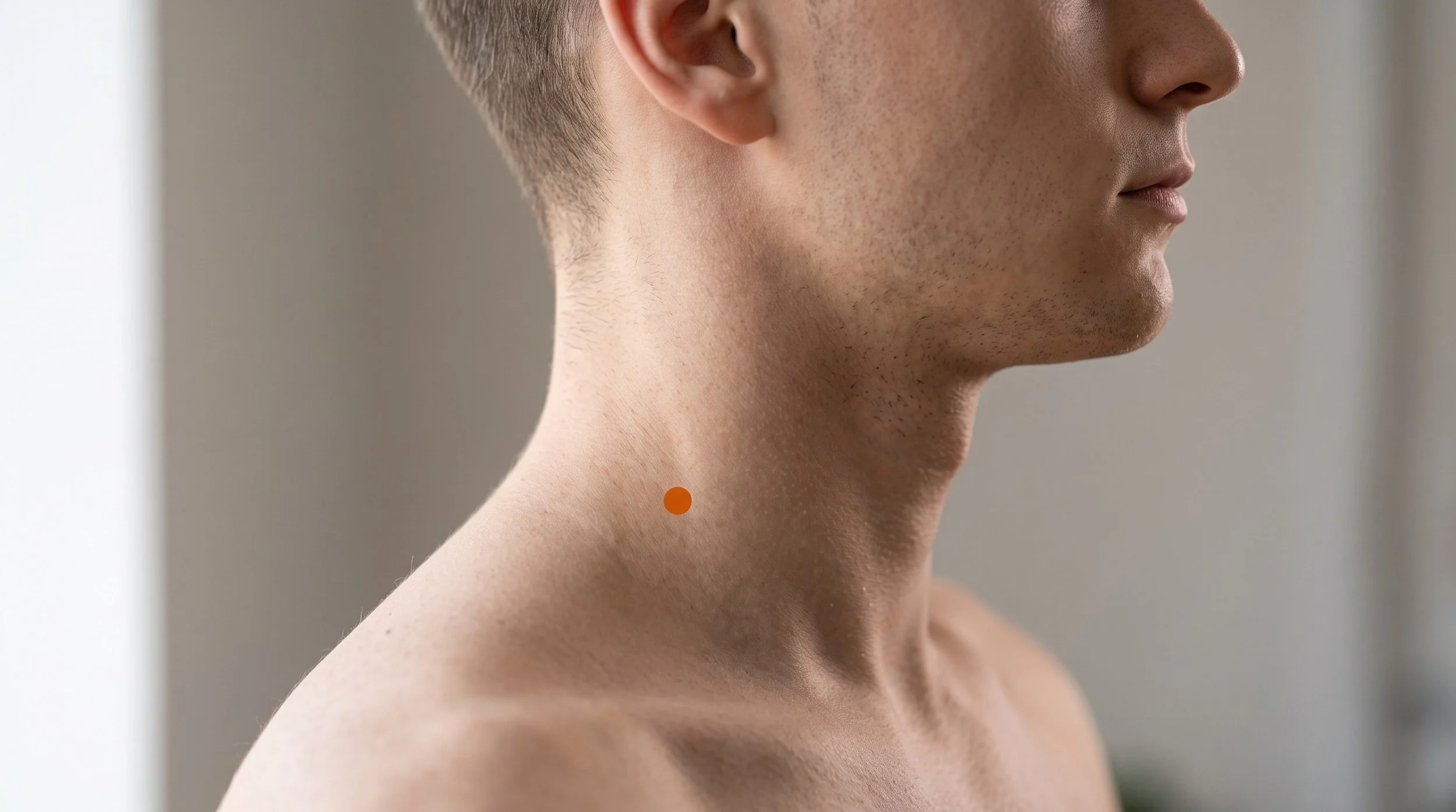
LI17 Acupuncture Point (Tianding)
Heaven's Tripod on the Side of the Neck: Anatomy, Mechanism, and Why This Sternocleidomastoid Border Point Belongs to Throat, Voice, and Neck Tension Treatment
LI17, known in Chinese as Tianding and usually translated as Heaven's Tripod, is the seventeenth point of the Large Intestine channel and one of only a handful of points on that channel that sit on the side of the neck.
In plain terms, you find it on the lateral neck along the back edge of the sternocleidomastoid, one cun below LI18 and roughly partway down toward the hollow above the collarbone. Classical sources describe a narrow but consistent job for this point: it was traditionally used for the throat and the voice, especially sudden hoarseness, painful swallowing, and swellings in the front of the neck.
Modern clinicians tend to reach for the li17 acupuncture point for a slightly different reason, because the tissue under the needle is the lower sternocleidomastoid border and the fascial plane where the cervical plexus branches emerge, a region that often holds tension in people with chronic neck pain, forward head posture, and voice strain.
- Location and layers: LI17 lies on the lateral neck at the posterior border of the sternocleidomastoid, one cun inferior to LI18, in a corridor that older texts place roughly midway between LI18 and the supraclavicular fossa. Under the needle sit skin, platysma, the fascial edge of the sternocleidomastoid, and, at greater depth, the scalene group and major vessels.
- Traditional category, translated: Deadman assigns this point a single classical action, benefiting the throat and the voice, with indications that cluster into voice loss and hoarseness, painful or obstructed swallowing, noisy or labored breathing, and palpable neck swellings (Deadman, 2000). Read in modern terms, that list describes segmental input into the same cervical levels that serve the larynx, pharynx, and anterior neck muscles.
- Nerve geography: superficial branches of the cervical plexus (C2 to C4) emerge at this exact border, the accessory nerve supplies the sternocleidomastoid above it, and the phrenic nerve descends on scalenus anterior just deep and lateral, which is why depth control matters more here than needle quantity.
- Mechanism: needling recruits small-diameter afferents that converge with visceral and deep somatic input in the cervical dorsal horn and engage descending inhibitory pathways from the brainstem, alongside local vascular and autonomic changes (Zhao, 2008). Nothing about this requires an energetic explanation.
- Research picture: acupuncture for neck disorders showed pain and disability benefits in a Cochrane review whose conclusions were later flagged as needing update (Trinh et al., 2016), dry needling of neck-related trigger points shows short-term pain and pressure pain threshold changes (Navarro-Santana et al., 2020), and individual patient data pooling supports a modest but persistent effect for chronic pain generally (Vickers et al., 2018). Voice-specific trials have used protocols of throat and neck points rather than LI17 alone (Yiu et al., 2016a).
- De qi and practice framing: patients usually report a dull, slightly heavy ache with a mild spreading quality toward the throat or collarbone, sometimes a brief electric tingle if a supraclavicular cutaneous branch is brushed. LI17 is almost never used by itself; it earns its place inside a neck or throat protocol, needled shallowly and with the vascular anatomy in mind.
Hoarse Voice, Throat Tightness, or a Neck That Won't Turn?
At Morningside Acupuncture we treat the neck as one continuous system rather than a list of separate complaints. LI17 gives us access to the lower sternocleidomastoid border, a region that ties together voice strain, swallowing discomfort, and restricted rotation, and we pair it with points and muscle work chosen for your presentation. Every session includes an exam, so needle placement follows what we actually find in your tissue. Schedule a visit and we'll map out a plan for your neck.
Schedule NowAnatomy of LI17: Why the Posterior Border of the Sternocleidomastoid Is Such an Important Location
Start by finding the sternocleidomastoid, the rope of muscle that runs from behind the ear down to the collarbone and sternum. LI18 sits level with the laryngeal prominence between that muscle's two heads, and LI17 sits one cun lower, on the back edge of the muscle belly rather than on top of it. The tissue stack there is thin and layered: skin, subcutaneous fat, the flat sheet of platysma, then the investing fascia wrapping the sternocleidomastoid border. This region loads constantly.
Sustained forward head posture, long hours at a screen, phone cradling, heavy voice use, and habitual upper chest breathing all keep the sternocleidomastoid and the scalenes working, and the fascial border where LI17 sits is where that tension tends to be palpable.
The nerve story here is unusually rich for such a small area. The superficial branches of the cervical plexus, carrying C2 to C4 fibers, wrap around the posterior border of the sternocleidomastoid at roughly this level and fan out to supply skin over the neck, jaw angle, ear, and upper chest. The muscle itself is supplied by the accessory nerve with sensory contributions from the cervical plexus, and the phrenic nerve descends nearby on the anterior scalene.
Those same cervical segments receive input from deep structures of the throat and upper neck, which means afferent traffic from the skin, muscle, larynx, and pharynx converges in overlapping territory in the cervical dorsal horn. Needling here generates a burst of small-fiber activity that can modulate that shared segmental pool and recruit descending inhibitory control from the brainstem, one of the better-characterized components of acupuncture analgesia (Zhao, 2008). It's a plausible reason a lateral neck point was traditionally credited with effects on the voice and throat rather than only on local stiffness.
Depth discipline is the whole game at LI17. Deep to the sternocleidomastoid lie the carotid artery and internal jugular vein, with the external jugular crossing the muscle more superficially and the apex of the lung sitting lower and more medially near the supraclavicular fossa. Classical needling guidance is correspondingly conservative: perpendicular insertion of about 0.3 to 0.5 cun, or oblique insertion of 0.5 to 0.8 cun along the muscle border, with an explicit caution that deeper needling risks the vessels (Deadman, 2000).
In practice we palpate for the carotid pulse first, angle away from it, keep the needle shallow and tangential, and never manipulate aggressively. Practitioners who aren't confident with lateral neck anatomy should choose a different point.
Related Sternocleidomastoid Trigger Points Related Best Acupuncture Points For Neck PainLI17 at a Glance: Classification, Location, and Clinical Use
| Category | Detail |
|---|---|
| Traditional Name | Tianding (Heaven's Tripod), also rendered as Celestial Cooking Pot or Heaven's Vessel |
| Channel Classification | Seventeenth point of the Large Intestine channel (Hand Yangming), one of the channel's neck points between LI16 at the shoulder and LI18 higher on the sternocleidomastoid |
| Point Categories | No five-shu, meeting, crossing, hui-meeting, or extraordinary vessel designation is recorded for this point in the standard references. Deadman lists a single classical action, benefiting the throat and voice, and Maciocia notes that Large Intestine channel points as a group were traditionally used to affect the neck and head and to dissipate nodules and goitre. |
| Precise Location | On the lateral neck, 1 cun inferior to LI18, on the posterior border of the sternocleidomastoid muscle, roughly along the line between LI18 and the supraclavicular fossa |
| Tissue Stimulated | Skin and platysma over the posterior border of the sternocleidomastoid, the investing fascia at that border, and the emerging superficial branches of the cervical plexus; the scalenes and neurovascular bundle lie deeper and are not targets |
| Needle Depth / Direction | Perpendicular 0.3 to 0.5 cun, or oblique 0.5 to 0.8 cun along the muscle border, angled away from the carotid pulse; deeper insertion is contraindicated because of the carotid artery and jugular vein |
| De Qi Sensation | Dull local heaviness or a mild ache with a spreading quality toward the throat or clavicle; occasional brief tingling if a cutaneous cervical plexus branch is contacted |
| Primary Clinical Uses | Traditionally used for sudden voice loss, hoarseness, sore or obstructed throat, difficult swallowing, and neck swellings; in modern practice most often used for sternocleidomastoid border tension, voice strain in heavy voice users, and as an adjunct in neck pain protocols |
| Common Point Combinations |
|
Deadman's Manual of Acupuncture gives LI17 an unusually tight classical profile. It records one action for the point, benefiting the throat and voice, and an indication list that falls into four groups as traditionally attributed: abrupt loss of the voice, obstructed and painful throat with a rattling quality of breathing, palpable swellings in the neck of the kind older texts called goitre and scrofula, and difficulty getting food down.
Other point compendia add tonsillitis, laryngitis, and hiccups to the same territory, and one traditional commentary even notes a link with blood pressure that likely reflects nothing more than the point's neighborhood near the carotid region. What makes the classical pattern striking is its restraint. Most channel points accumulate sprawling indication lists over the centuries, but Tianding stayed narrow, essentially serving as a throat and voice point on a channel otherwise known for the face, sinuses, and arm. That consistency suggests the classical authors were describing something they observed repeatedly at this specific patch of neck.
Why LI17 Is Used for Hoarseness and Voice Loss, Not Just Neck Stiffness
The link between a point on the side of the neck and the sound of your voice makes more sense once you look at where sensation from the neck actually goes. Skin and muscle at the sternocleidomastoid border send afferent traffic through the cervical plexus into the upper cervical spinal cord. Deep structures of the throat, the strap muscles, and parts of the laryngeal region feed into overlapping cervical segments, and the vagus and its branches interact with that same upper cervical and brainstem territory.
When several inputs converge on shared second-order neurons, stimulating one of them can change how the whole neighborhood behaves. That's the standard convergence explanation for why local needling sometimes affects functions that seem anatomically unrelated to the needle site (Zhao, 2008).
There's a second, more mechanical layer. Many people described clinically as having a hoarse or effortful voice are working with excessive extrinsic laryngeal muscle tension rather than a damaged vocal fold. The sternocleidomastoid, scalenes, and suprahyoid group all participate in holding the larynx in a high, braced position during effortful speech. Needling into that fascial border can reduce local muscle tone and pressure sensitivity, which is the same mechanism that supports dry needling for neck complaints (Navarro-Santana et al., 2020).
Beyond the local effect, needling engages descending inhibitory pathways that dampen pain signaling more broadly, which is part of why acupuncture protocols produce effects that outlast the session (Zhao, 2008; Vickers et al., 2018).
Point-specific physiology in the throat region is thin but interesting. In a placebo-controlled study of people with vocal fold lesions, needling a set of voice-related points was followed by changes in inflammatory mediators sampled directly from the laryngeal surface, which the authors interpreted as an anti-inflammatory shift favoring wound healing (Yiu et al., 2016b). That work used a multi-point protocol, not LI17 in isolation, so it can't tell us what this single point contributes. It does suggest that needling in and around the neck produces measurable local biological changes rather than purely subjective ones.
What the Research Shows for LI17
It's worth being straightforward about the state of the evidence. No trial has isolated LI17 and measured what it does on its own, and that's true of nearly every individual acupuncture point. What we have instead are reviews and trials of multi-point protocols for neck pain, myofascial neck complaints, and voice disorders, within which a lateral neck point like this one may or may not have been included. The reasonable interpretation is that LI17 is a plausible component of protocols with reasonable supporting evidence, not an independently validated intervention. Below are the studies that frame how we think about it.
| Study | Type | Focus | Key Finding |
|---|---|---|---|
| Trinh et al., 2016 | Cochrane systematic review | Acupuncture for acute, subacute, and chronic neck disorders across 27 trials | Reported moderate-quality evidence of pain and disability benefit over sham or inactive controls with mostly minor adverse effects, though the review was later withdrawn pending update, so the conclusions should be read cautiously. |
| Vickers et al., 2018 | Individual patient data meta-analysis | Chronic pain conditions including neck pain, close to 21,000 patients | Found modest effects favoring acupuncture over both sham and no-acupuncture controls, with benefits that persisted over roughly a year rather than dissipating immediately. |
| Navarro-Santana et al., 2020 | Systematic review and meta-analysis | Dry needling of myofascial trigger points associated with neck pain symptoms across 28 trials | Reported short-term improvements in pain intensity and pressure pain thresholds, with effects on disability and range of motion less consistent and study quality variable. |
| Yiu et al., 2016a | Randomized controlled trial | 123 dysphonic patients with vocal nodules, polyps, or chronic laryngitis, comparing genuine acupuncture, sham needling, and no treatment | Needling of voice-related points was associated with improved vocal function and lesion appearance relative to controls, though the protocol used nine points together rather than any single point. |
| Yiu et al., 2016b | Randomized placebo-controlled cytokine study | Laryngeal secretion sampling before and after needling in patients with vocal nodules | Suggested a shift in inflammatory mediators consistent with an anti-inflammatory response, in a very small sample that needs replication. |
| Zhao, 2008 | Narrative review of mechanism research | Neural pathways underlying acupuncture analgesia | Describes segmental spinal modulation, descending inhibitory control, and endogenous opioid involvement as the main documented mechanisms, providing the framework used throughout this article. |
Chronic Neck Tension That Massage Keeps Loosening and Life Keeps Tightening?
Persistent neck tension usually reflects load, posture, and nervous system sensitivity rather than a single stubborn knot. We combine channel points like LI17 and LI18 with precise dry needling of the sternocleidomastoid, scalenes, and upper trapezius, then add movement and breathing strategies so the change holds between visits. Our clinicians are licensed acupuncturists trained in both classical point selection and orthopedic needling. Book an appointment and let's get your neck moving again.
Schedule NowLI17 in the Context of Trigger Point Work
The li 17 neck location sits directly over territory that trigger point clinicians already know well. The sternocleidomastoid is a notorious source of referred symptoms, sending pain into the forehead, around the eye, behind the ear, and into the jaw, and it's also associated with dizziness and a general sense of head heaviness in some patients (Simons et al., 1999). Its clavicular and sternal divisions carry distinct referral patterns, which is why we palpate both heads carefully rather than treating the muscle as one unit.
Because acupuncture is defined by the use of an acupuncture needle rather than by any single theoretical framework, treating this region with a classical point like LI17 and treating it with trigger point technique are two styles of the same intervention, and we move between them based on what the exam shows.
In a typical Morningside session for lateral neck complaints, we might use LI17 and LI18 along the sternocleidomastoid border with shallow, precise insertions, then add pincer-grip needling of the sternocleidomastoid itself, plus the anterior and middle scalenes, levator scapulae, and upper trapezius depending on findings. The scalenes deserve particular attention in voice users and in anyone who breathes predominantly through the upper chest, since they load continuously and refer into the shoulder and arm.
All of this work stays conservative in depth in the lower neck given the vascular structures and the lung apex, and we follow needling with breathing retraining and postural cueing so the tissue isn't simply reloaded on the walk home.
LI17 Neck and Throat Treatment at NYC's Highest-Rated Acupuncture Clinic
Morningside Acupuncture is the highest-rated acupuncture and dry needling clinic in New York City with over 500 five-star Google reviews, and patients come to us specifically for careful, anatomy-led needling in sensitive regions like the lateral neck. We use LI17 as part of broader protocols for neck pain, voice strain, and throat tightness, always with conservative depth and clear communication about what you'll feel. If you're a singer, teacher, attorney, or anyone whose voice and neck take a daily beating, this work is built for you. Schedule your first session and we'll start with a thorough assessment.
Schedule NowFrequently Asked Questions
What does LI17 feel like when needled?
Most patients describe a dull, slightly heavy ache right at the muscle border, sometimes with a mild spreading sensation toward the throat or down toward the collarbone. Because superficial cervical plexus branches emerge here, a brief tingle or a small zing across the skin is not unusual, and it fades quickly. The needle stays shallow, so this point usually feels less intense than needling into a thick muscle like the upper trapezius. If you feel a sharp or pulsing sensation, tell your practitioner immediately so the needle can be adjusted.
Why needle the side of the neck for a voice problem instead of the throat itself?
Two reasons. First, sensation from the lateral neck enters the same upper cervical segments that receive input from deep throat structures, so needling here can influence that shared neural neighborhood without touching the airway. Second, a great deal of hoarseness in heavy voice users comes from excessive tension in the muscles surrounding the larynx rather than from the vocal folds themselves, and the sternocleidomastoid border is a practical, accessible place to address that tension. Classical texts arrived at a similar conclusion empirically, listing this point specifically for the throat and voice (Deadman, 2000).
Can I press LI17 myself between sessions?
Light acupressure is reasonable if you're careful about what you're pressing. Turn your head slightly away from the side you're working on, find the back edge of the sternocleidomastoid low in the neck, and stay on the muscle border rather than pressing forward into the soft hollow where you can feel a pulse. If you feel a pulse under your fingers, move your hand back toward the muscle. Use light to moderate pressure with a fingertip for about 30 to 60 seconds, breathe normally, and repeat two or three times per side, once or twice a day. Never press both sides at once, never press hard, and stop right away if you feel lightheaded, nauseated, or if your vision changes. Gentle chin tucks and slow nasal breathing afterward tend to help more than harder pressure does.
Is LI17 safe to needle?
In trained hands, yes, but it demands respect. The carotid artery and internal jugular vein lie deep to the sternocleidomastoid in this region, the external jugular crosses the muscle more superficially, and the phrenic nerve runs on the anterior scalene nearby, which is why the standard guidance limits insertion to roughly 0.3 to 0.5 cun perpendicular or 0.5 to 0.8 cun oblique and explicitly warns against going deeper (Deadman, 2000). We palpate for the pulse before inserting, angle away from it, and keep manipulation gentle. Patients on anticoagulants, those with carotid disease or a history of carotid surgery, and anyone with significant local swelling should tell their practitioner, since a different point selection is often the better call.
Where exactly is LI17 located?
For tianding point location, first identify LI18, which sits level with the laryngeal prominence between the two heads of the sternocleidomastoid. From there, drop one cun straight down and move to the posterior border of that muscle. Older texts describe the same spot as lying roughly midway between LI18 and the supraclavicular fossa at ST12, which is a useful cross-check. Turning your head gently to the opposite side makes the muscle stand out and the border easier to trace with a fingertip.
References
- Deadman, P., Al-Khafaji, M., & Baker, K. (2009). A manual of acupuncture. Journal of Chinese Medicine Publications.
- Cunningham, P. M. (2000). Acupuncture points: A practical guide to classical and modern usage. Odyssey Press.
- Kim, H. (2008). Handbook of Oriental medicine (3rd ed.). Harmony & Balance Press.
- Maciocia, G. (2005). The foundations of Chinese medicine: A comprehensive text for acupuncturists and herbalists (2nd ed.). Elsevier Churchill Livingstone.
- O'Connor, J., & Bensky, D. (Eds. & Trans.). (1981). Acupuncture: A comprehensive text. Shanghai College of Traditional Medicine. Eastland Press.
- Simons, D. G., Travell, J. G., & Simons, L. S. (1999). Travell & Simons' myofascial pain and dysfunction: The trigger point manual, Vol. 1: Upper half of body (2nd ed.). Williams & Wilkins.
- Trinh, K., Graham, N., Irnich, D., Cameron, I. D., & Forget, M. (2016). Acupuncture for neck disorders. Cochrane Database of Systematic Reviews, 2016(5), CD004870. https://doi.org/10.1002/14651858.CD004870.pub4
- Vickers, A. J., Vertosick, E. A., Lewith, G., MacPherson, H., Foster, N. E., Sherman, K. J., Irnich, D., Witt, C. M., & Linde, K. (2018). Acupuncture for chronic pain: Update of an individual patient data meta-analysis. Journal of Pain, 19(5), 455-474. https://doi.org/10.1016/j.jpain.2017.11.005
- Navarro-Santana, M. J., Sanchez-Infante, J., Fernandez-de-las-Penas, C., Cleland, J. A., Martin-Casas, P., & Plaza-Manzano, G. (2020). Effectiveness of dry needling for myofascial trigger points associated with neck pain symptoms: An updated systematic review and meta-analysis. Journal of Clinical Medicine, 9(10), 3300. https://doi.org/10.3390/jcm9103300
- Yiu, E. M. L., Chan, K. M. K., Kwong, E., Li, N. Y. K., Ma, E. P. M., Tse, F. W., Lin, Z., Verdolini Abbott, K., & Tsang, R. (2016a). Is acupuncture efficacious for treating phonotraumatic vocal pathologies? A randomized control trial. Journal of Voice, 30(5), 611-620. https://doi.org/10.1016/j.jvoice.2015.07.004
- Yiu, E. M. L., Chan, K. M. K., Li, N. Y. K., Tsang, R., Verdolini Abbott, K., Kwong, E., Ma, E. P. M., Tse, F. W., & Lin, Z. (2016b). Wound-healing effect of acupuncture for treating phonotraumatic vocal pathologies: A cytokine study. The Laryngoscope, 126(1), E18-E22. https://doi.org/10.1002/lary.25483
- Zhao, Z. Q. (2008). Neural mechanism underlying acupuncture analgesia. Progress in Neurobiology, 85(4), 355-375. https://doi.org/10.1016/j.pneurobio.2008.05.004
Disclaimer: This web site is intended for educational and informational purposes only. Reading this website does not constitute providing medical advice or any professional services. This information should not be used for diagnosing or treating any health issue or disease. Those seeking medical advice should consult with a licensed physician. Seek the advice of a medical doctor or other qualified health professional for any medical condition. If you think you have a medical emergency, call 911 or go to the emergency room. No acupuncturist-patient relationship is created by reading this website or using the information. Morningside Acupuncture PLLC and its employees and contributors do not make any express or implied representations with respect to the information on this site or its use. For any legal interpretation of scope of practice in your state, consult a licensed attorney or regulatory authority.
Read more from our blog



