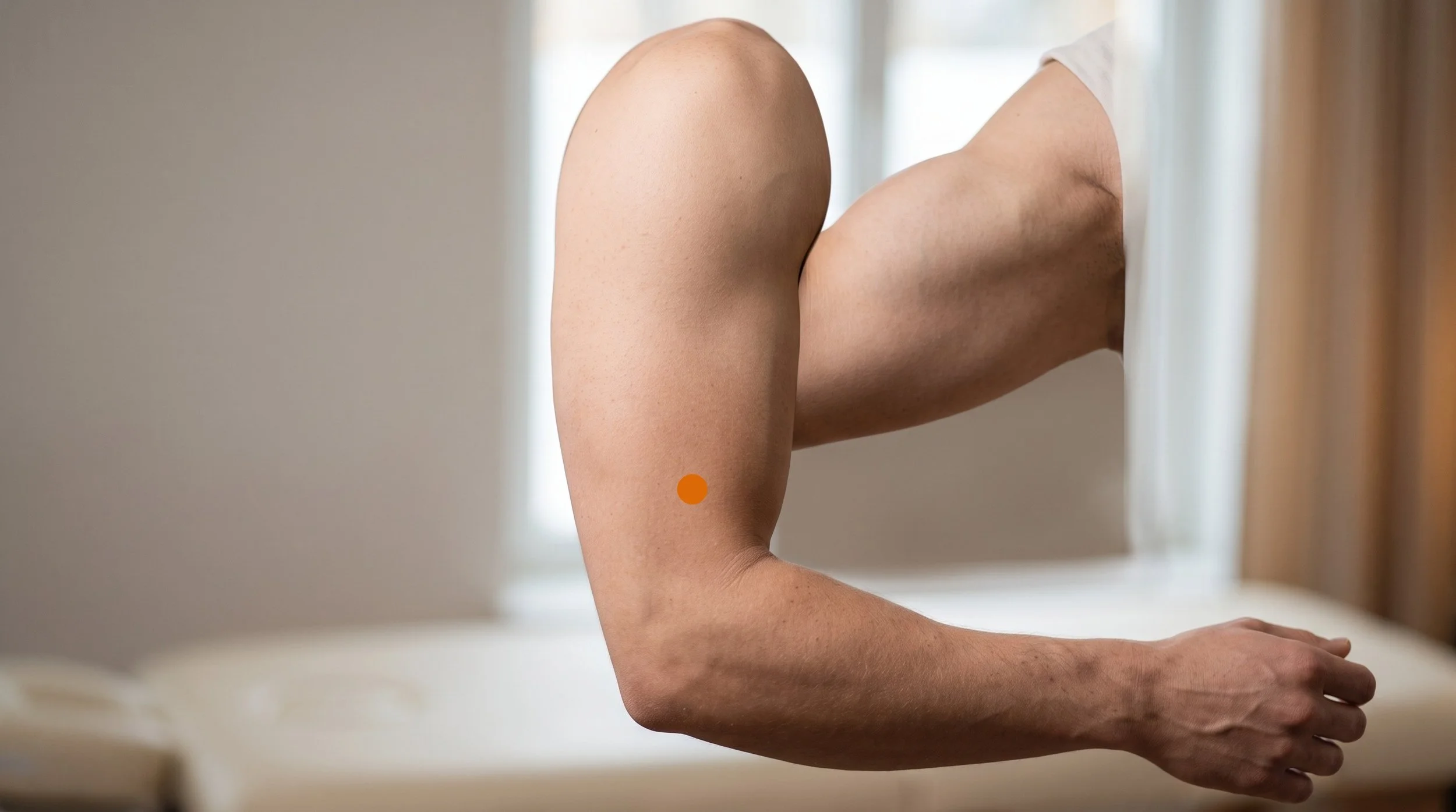
LI13 Acupuncture Point (Shouwuli)
Arm Five Miles on the Lateral Upper Arm: Anatomy, Mechanism, and Why This Quiet Point Belongs in Elbow and Arm Pain Treatment
LI13 (Shouwuli, often translated as Arm Five Miles or Arm Five Li) sits on the outer upper arm, roughly a handbreadth above the elbow crease, in the soft groove between the outer edge of the biceps and the shaft of the humerus. It is the thirteenth point of the Large Intestine channel, placed on the line that runs from LI11 at the elbow up to LI15 at the shoulder, which makes it a useful midpoint when pain and weakness span both joints rather than sitting neatly at one end.
Classical texts group it with the channel points used for pain, contraction, and numbness of the elbow and upper arm, and for difficulty raising the arm (Deadman et al., 2007). Modern anatomy explains a good deal of that reputation: the needle enters near the lateral intermuscular septum, where brachialis, triceps, and the spiraling radial nerve share close quarters, so the li13 acupuncture point offers direct access to tissue that commonly refers pain down the radial side of the arm.
- Location and layers: large intestine 13 lies 3 cun proximal to LI11 on the LI11 to LI15 line, in the depression between the lateral border of biceps brachii and the humerus (Deadman et al., 2007). The needle passes skin and superficial fascia into the septum region between brachialis and the lateral head of triceps.
- Traditional categories, restated: classical sources credit Shouwuli with activating the channel and relieving pain, easing cough, and regulating qi while draining damp and transforming phlegm (Deadman et al., 2007). In physiological terms, the first of those maps onto local and segmental modulation of nociceptive input from the arm, while the rest reflect historical pattern language rather than measurable respiratory mechanisms.
- Nerve geography: the radial nerve winds from the back of the arm toward the front near this level, and the point sits close to that transition (Kim, 2013). Needling here recruits deep somatic afferents whose input converges in the cervical cord segments that also serve the elbow, forearm, and hand, one plausible route for the referred relief patients describe (Zhao, 2008).
- Research picture: no trial has isolated the li 13 arm point on its own, so the evidence comes from multi-point protocols. Individual patient data pooling across chronic pain conditions found modest but persistent benefit over sham and usual care (Vickers et al., 2018), while the Cochrane review of acupuncture for lateral elbow pain judged the trial base too small to support firm conclusions (Green et al., 2002).
- Clinical framing: at Morningside we use LI13 as a bridging point when someone cannot lift the arm comfortably and tenderness runs from the lateral elbow into the deltoid insertion, often paired with LI11 below and LI14 or LI15 above (Deadman et al., 2007). Needling frequently overlaps with brachialis and triceps trigger point targets described in the myofascial literature (Simons et al., 1999).
- De qi: patients usually report a deep, spreading ache or heaviness in the outer arm, sometimes traveling toward the elbow or the shoulder. A brief electrical flick can occur if the needle nears the radial nerve, which is a signal to withdraw slightly and redirect rather than to press on.
Struggling to Lift Your Arm Without a Catch or Ache?
Difficulty raising the arm rarely comes from one structure, which is why we assess the elbow, upper arm, and shoulder as a single chain before needling. LI13 is one of the points we reach for when tenderness sits in the outer upper arm between the elbow and the deltoid. We combine it with local shoulder points, dry needling of brachialis and triceps, and graded loading you can do at home. Schedule an evaluation and we will map exactly where your pain is coming from.
Schedule NowAnatomy of LI13: Why the Groove Between Biceps and Humerus Is Such an Important Location
Run a thumb up the outer arm from the elbow crease and you will find a soft channel where the outer border of biceps brachii lifts away from the humerus. LI13 sits in that groove, about a handbreadth above LI11 on the line to LI15 (Deadman et al., 2007). Beneath skin and superficial fascia the needle meets the lateral intermuscular septum, with brachialis in front and the lateral head of triceps behind. Brachialis is a pure elbow flexor that works hard during carrying, lifting, and repeated gripping tasks, and triceps absorbs load during pressing, pushing, and any activity that stabilizes the elbow overhead.
Desk workers, climbers, racquet sport players, and anyone who hauls bags around Manhattan tend to load this exact interval, which is why it so often palpates thick or tender.
The nerve story is what makes this location interesting. The radial nerve travels behind the humerus in the spiral groove and then crosses forward through the lateral intermuscular septum at roughly this level before diving between brachialis and brachioradialis, and standard point references place it deep to LI13 (Kim, 2013). Superficially the region is served by the posterior antebrachial cutaneous nerve (Cheng, 2010).
Stimulating deep somatic tissue here activates A-delta and group III afferents that enter the cervical cord and converge with input from the elbow and forearm, which is a widely proposed basis for segmental pain modulation and for the descending inhibitory activity documented in acupuncture analgesia research (Zhao, 2008). That convergence is also why a needle in the upper arm can change how the lateral elbow feels, even though the tender spot is several inches away.
Safety here is straightforward but not casual. The radial collateral artery and its accompanying veins run in the same neighborhood, and classical Chinese texts specifically caution against injuring the vessel at this point (Cheng, 2010). Needle depth conventions vary by source, from a conservative 0.5 to 1 cun in some texts to 1 to 1.5 cun perpendicular in others (Deadman et al., 2007; Kim, 2013).
We favor perpendicular insertion with slow advancement, palpating first for pulsation and stopping immediately if a sharp electrical sensation shoots toward the hand, which suggests the needle is too close to the radial nerve. Practitioners trained in clean needle technique and regional anatomy can needle this area safely, and moxibustion is traditionally considered appropriate as an alternative when a patient prefers less needling.
Related Pain Finder Upper Back Shoulder Arm Related Large Intestine ChannelLI13 at a Glance: Classification, Location, and Clinical Use
| Category | Detail |
|---|---|
| Traditional Name | Shouwuli (Arm Five Miles, also translated Arm Five Li) |
| Channel Classification | Large Intestine channel (Hand Yangming), thirteenth point, on the upper arm |
| Point Categories | No five-shu, luo-connecting, xi-cleft, or hui-meeting designation and no extraordinary vessel intersection is recorded for this point in the standard references. It is classified simply as a Large Intestine channel point of the upper arm. Traditional actions attributed to it include activating the channel and relieving pain, easing cough, and regulating qi while draining damp and transforming phlegm (Deadman et al., 2007). |
| Precise Location | On the lateral upper arm, 3 cun proximal to LI11 on the line connecting LI11 with LI15, in the depression between the lateral border of biceps brachii and the humerus, superior to the lateral epicondyle. An alternate method places it at one third of the distance from LI11 to the axillary fold. |
| Tissue Stimulated | Lateral intermuscular septum with brachialis anteriorly and triceps brachii posteriorly, with the lateral border of biceps brachii forming the anterior landmark |
| Needle Depth / Direction | Perpendicular insertion, commonly 0.5 to 1.5 cun depending on the source and on patient size; advance slowly and avoid the radial collateral vessels and the radial nerve. Moxibustion is traditionally applied. |
| De Qi Sensation | Deep, dull, spreading ache or heaviness in the outer upper arm, sometimes traveling toward the elbow or shoulder; a brief electrical sensation toward the hand means the needle should be withdrawn and redirected |
| Primary Clinical Uses | Upper arm and elbow pain, contraction or stiffness of the arm, difficulty raising the arm, numbness along the radial side of the limb; classically also listed for cough and for swollen glands (scrofula) |
| Common Point Combinations |
|
Deadman, Al-Khafaji, and Baker's A Manual of Acupuncture presents Shouwuli as a channel point first and foremost, with traditional actions of freeing the channel and easing pain, calming cough, and regulating qi while draining damp and transforming phlegm.
The classical indication lists cluster into three groups: arm complaints (pain, numbness, contraction of the elbow and upper arm, inability to raise the arm, shoulder pain), chest and respiratory complaints (cough, labored breathing, coughing blood), and a broader miscellany that includes neck lumps described as scrofula, heaviness and sleepiness, low energy, limbs that will not move, fever patterns, blurred vision, fullness below the heart, and states of fear and fright.
These are traditional attributions recorded in premodern sources rather than modern clinical claims. What stands out is the pairing of a plainly local musculoskeletal point with treatments for glandular swelling, including a moxibustion protocol at LI13 with ST9 from the Thousand Ducat Formulas and a needling pair with LI14 from the One Hundred Symptoms text. That combination of the ordinary and the systemic is a good reminder that classical point indications were built from observed clinical habit rather than from anatomy alone.
Why LI13 Is Used for Cough and Swollen Neck Glands in Classical Texts
Patients are often surprised that a point on the outer arm appears in classical lists for cough and for lumps in the neck. Part of the answer is channel logic: the Large Intestine channel is paired with the Lung in traditional theory, and points along it were commonly credited with actions on the chest. That is a historical framework, not a physiological one, and we present it as such.
What we can say in modern terms is that needling deep somatic tissue in the arm sends afferent traffic into the cervical spinal cord, where it converges with input from other structures served by the same segments, and this convergence is one of the accepted mechanisms behind acupuncture's effects on pain perception (Zhao, 2008).
For the arm complaints that dominate modern use, the mechanism is more direct. Stimulating the lateral intermuscular septum near the radial nerve produces both a local tissue response, including changes in blood flow and mechanical release of a taut band, and a central response involving descending inhibitory pathways that dampen how strongly the cord relays nociceptive signals (Zhao, 2008).
Pooled patient-level data across chronic musculoskeletal pain conditions found that acupuncture outperformed both sham needling and no-acupuncture control, with effects that persisted over months rather than fading immediately (Vickers et al., 2018). That is a treatment-level finding, not a point-level one, but it is the reasonable frame for what a point like Shouwuli contributes inside a protocol.
Practically, the arm five miles point earns its place when the tender territory refuses to stay at the elbow. Brachialis and triceps trigger points refer pain in patterns that overlap the outer arm and the lateral elbow region, and needling into those bands often reproduces a patient's familiar ache before it settles (Simons et al., 1999). When someone tells us their tennis elbow feels like it starts higher up, that is the presentation where LI13 is most likely to be on the treatment plan.
What the Research Shows for LI13
There is no randomized trial that tests LI13 in isolation, and it would be misleading to suggest otherwise. Nearly all clinical research on acupuncture for arm, elbow, and shoulder problems tests multi-point protocols, sometimes with electrical stimulation, sometimes alongside exercise or physical therapy. The honest reading is that this point is a plausible and traditionally supported component of those protocols rather than an independently validated intervention.
Study quality also varies widely across this literature, and the elbow evidence in particular remains thin. The table below summarizes the reviews most relevant to how we use this point.
| Study | Type | Focus | Key Finding |
|---|---|---|---|
| Vickers et al., 2018 | Individual patient data meta-analysis | Chronic musculoskeletal, headache, and osteoarthritis pain | Acupuncture was superior to both sham and no-acupuncture control for chronic pain, with effects that were modest in size but largely sustained over 12 months. |
| Green et al., 2002 | Cochrane systematic review | Acupuncture for lateral elbow pain (tennis elbow) | The available trials were too few and too small to support or refute acupuncture for lateral elbow pain, with only short-term pain benefit suggested. |
| Liu et al., 2015 | Systematic review and meta-analysis | Dry needling of trigger points in neck and shoulder pain | Dry needling of myofascial trigger points appeared helpful for pain in the short and medium term, though comparisons with other active treatments were mixed. |
| Kietrys et al., 2013 | Systematic review and meta-analysis | Dry needling for upper quarter myofascial pain | Dry needling reduced pain compared with sham or no treatment immediately after treatment and at four weeks, based on a limited number of trials. |
| Lee & Lim, 2016 | Systematic review and meta-analysis | Acupuncture for post-stroke shoulder pain and arm function | Acupuncture added to rehabilitation looked more effective than rehabilitation alone, but the authors called the results inconclusive given study quality. |
| Zhao, 2008 | Narrative review of mechanisms | Neural basis of acupuncture analgesia | Needling activates deep somatic afferents and engages spinal and supraspinal inhibitory circuits, offering a mechanism for effects distant from the needle site. |
Elbow Pain That Keeps Creeping Up the Arm?
Lateral elbow pain that spreads proximally often involves more than the common extensor tendon, and treating only the elbow can leave you plateaued. Our clinicians treat the li13 acupuncture point alongside LI11 and forearm points, then add manual therapy and tendon loading to make the change stick. Sessions are unhurried, and we explain every needle placement as we go. Book a visit and let us build you a plan rather than a one-off treatment.
Schedule NowLI13 in the Context of Trigger Point Work
The territory around LI13 is prime myofascial real estate. Brachialis lies just anterior to the point and develops taut bands that refer pain toward the base of the thumb and into the front of the elbow, while the lateral head of triceps sits immediately posterior and refers into the outer arm and lateral elbow (Simons et al., 1999). Because acupuncture is defined by the use of an acupuncture needle across hundreds of styles, including dry needling, treating a classical point and treating a trigger point in the same tissue are not competing procedures. They are the same needle in overlapping anatomy, described in two different vocabularies.
In practice we palpate before we needle. If the tenderness sits in the septum itself, LI13 is needled perpendicularly at conservative depth. If a taut band is clearly in brachialis or in triceps, we angle toward that band and use a technique aimed at a local twitch response, then follow with cupping or soft tissue work and simple loading such as isometric elbow flexion and extension. We often combine this with LI11 at the elbow, LI14 and LI15 higher up, and posterior shoulder points when the scapula is involved, so the whole chain from grip to shoulder blade gets addressed in one session.
LI13 Arm and Elbow Pain Treatment at NYC's Highest-Rated Acupuncture Clinic
Morningside Acupuncture is the highest-rated acupuncture and dry needling clinic in New York City with over 500 five-star Google reviews, and our focus is orthopedic and myofascial care. We use Shouwuli within a full upper limb treatment that may include channel points, trigger point dry needling, cupping, and movement retraining. Every plan is built around your history, your imaging if you have it, and your goals. Schedule your first session and start working on the arm rather than around it.
Schedule NowFrequently Asked Questions
What does LI13 feel like when needled?
Most people feel a deep, dull ache or a sense of pressure and heaviness in the outer upper arm, which may spread toward the elbow or up toward the shoulder. That spreading sensation is called de qi and is generally a sign the needle has reached the right tissue depth. If the muscle holds an active trigger band, you may feel a brief twitch and a short-lived reproduction of your familiar pain before it eases. A sharp, electric zing traveling toward the hand is different: it suggests proximity to the radial nerve, and your practitioner should adjust the needle immediately. Tell them right away if you feel it.
Why needle the upper arm when my pain is at the elbow?
Pain location and pain source often differ. Brachialis and triceps trigger points in the upper arm refer pain into the elbow region, so treating only the elbow can miss the tissue actually driving the symptoms (Simons et al., 1999). There is also a neurological reason: input from the upper arm enters the same cervical spinal segments that serve the elbow and forearm, and this convergence lets stimulation at one site modulate perception at another (Zhao, 2008). LI13 also sits on the Large Intestine channel line that runs directly through the lateral elbow, which is why classical sources list it for elbow pain and contraction in the first place (Deadman et al., 2007).
Can I press LI13 myself between sessions?
Yes, acupressure here is simple and low risk. Find the outer upper arm about a handbreadth above the elbow crease, then slide your thumb into the soft groove between the outer edge of the biceps and the bone. Press with steady, moderate pressure for 30 to 60 seconds, breathing normally, then release; repeat two or three times per arm, once or twice a day. Small circular motions or slow strokes along the groove work well too. Keep pressure firm but comfortable, stop if you feel any tingling or electrical sensation running toward the hand, and skip the area entirely if there is broken skin, a rash, recent injury, or unexplained swelling. Acupressure is a useful supplement between visits rather than a replacement for treatment.
Is LI13 safe to needle?
In trained hands, yes. The main considerations are the radial collateral artery and vein and the radial nerve as it crosses toward the front of the arm at about this level, and standard references explicitly caution against injuring the vessel (Cheng, 2010; Kim, 2013). Practitioners palpate for pulsation first, insert perpendicularly, and advance slowly, keeping within conventional depth ranges of roughly 0.5 to 1.5 cun depending on the source and the patient's build (Deadman et al., 2007). Expected side effects are minor: brief soreness, a small bruise, or a passing ache in the arm. Tell your clinician if you take anticoagulants, have a bleeding disorder, or have had prior surgery or nerve injury in the arm.
Where exactly is LI13 located?
Bend your elbow to about 90 degrees and find LI11 at the outer end of the elbow crease. From there, measure 3 cun (roughly one handbreadth, about the width of your four fingers) straight up the outer arm along the line toward LI15 at the front of the shoulder. LI13 sits in the depression between the lateral border of the biceps and the humerus, just above the lateral epicondyle. A second locating method places it at about one third of the distance from LI11 to the front of the armpit fold (Deadman et al., 2007). Sliding your thumb along that groove usually finds a distinctly tender spot when the arm is symptomatic.
References
- Deadman, P., Al-Khafaji, M., & Baker, K. (2009). A manual of acupuncture. Journal of Chinese Medicine Publications.
- Cheng, X. (Ed.). (1999). Chinese acupuncture and moxibustion (Rev. ed.). Foreign Languages Press.
- Kim, H. (2008). Handbook of Oriental medicine (3rd ed.). Harmony & Balance Press.
- Cunningham, P. M. (2000). Acupuncture points: A practical guide to classical and modern usage. Odyssey Press.
- Simons, D. G., Travell, J. G., & Simons, L. S. (1999). Travell & Simons' myofascial pain and dysfunction: The trigger point manual, Vol. 1: Upper half of body (2nd ed.). Williams & Wilkins.
- Vickers, A. J., Vertosick, E. A., Lewith, G., MacPherson, H., Foster, N. E., Sherman, K. J., Irnich, D., Witt, C. M., & Linde, K. (2018). Acupuncture for chronic pain: Update of an individual patient data meta-analysis. Journal of Pain, 19(5), 455-474. https://doi.org/10.1016/j.jpain.2017.11.005
- Zhao, Z. Q. (2008). Neural mechanism underlying acupuncture analgesia. Progress in Neurobiology, 85(4), 355-375. https://doi.org/10.1016/j.pneurobio.2008.05.004
- Green, S., Buchbinder, R., Barnsley, L., Hall, S., White, M., Smidt, N., & Assendelft, W. J. J. (2002). Acupuncture for lateral elbow pain. Cochrane Database of Systematic Reviews, 2002(1), CD003527. https://doi.org/10.1002/14651858.CD003527
- Liu, L., Huang, Q. M., Liu, Q. G., Ye, G., Bo, C. Z., Chen, M. J., & Li, P. (2015). Effectiveness of dry needling for myofascial trigger points associated with neck and shoulder pain: A systematic review and meta-analysis. Archives of Physical Medicine and Rehabilitation, 96(5), 944-955. https://doi.org/10.1016/j.apmr.2014.12.015
- Kietrys, D. M., Palombaro, K. M., Azzaretto, E., Hubler, R., Schaller, B., Schlussel, J. M., & Tucker, M. (2013). Effectiveness of dry needling for upper-quarter myofascial pain: A systematic review and meta-analysis. Journal of Orthopaedic & Sports Physical Therapy, 43(9), 620-634. https://doi.org/10.2519/jospt.2013.4668
- Lee, S. H., & Lim, S. M. (2016). Acupuncture for poststroke shoulder pain: A systematic review and meta-analysis. Evidence-Based Complementary and Alternative Medicine, 2016, 3549878. https://doi.org/10.1155/2016/3549878
Disclaimer: This web site is intended for educational and informational purposes only. Reading this website does not constitute providing medical advice or any professional services. This information should not be used for diagnosing or treating any health issue or disease. Those seeking medical advice should consult with a licensed physician. Seek the advice of a medical doctor or other qualified health professional for any medical condition. If you think you have a medical emergency, call 911 or go to the emergency room. No acupuncturist-patient relationship is created by reading this website or using the information. Morningside Acupuncture PLLC and its employees and contributors do not make any express or implied representations with respect to the information on this site or its use. For any legal interpretation of scope of practice in your state, consult a licensed attorney or regulatory authority.
Read more from our blog



