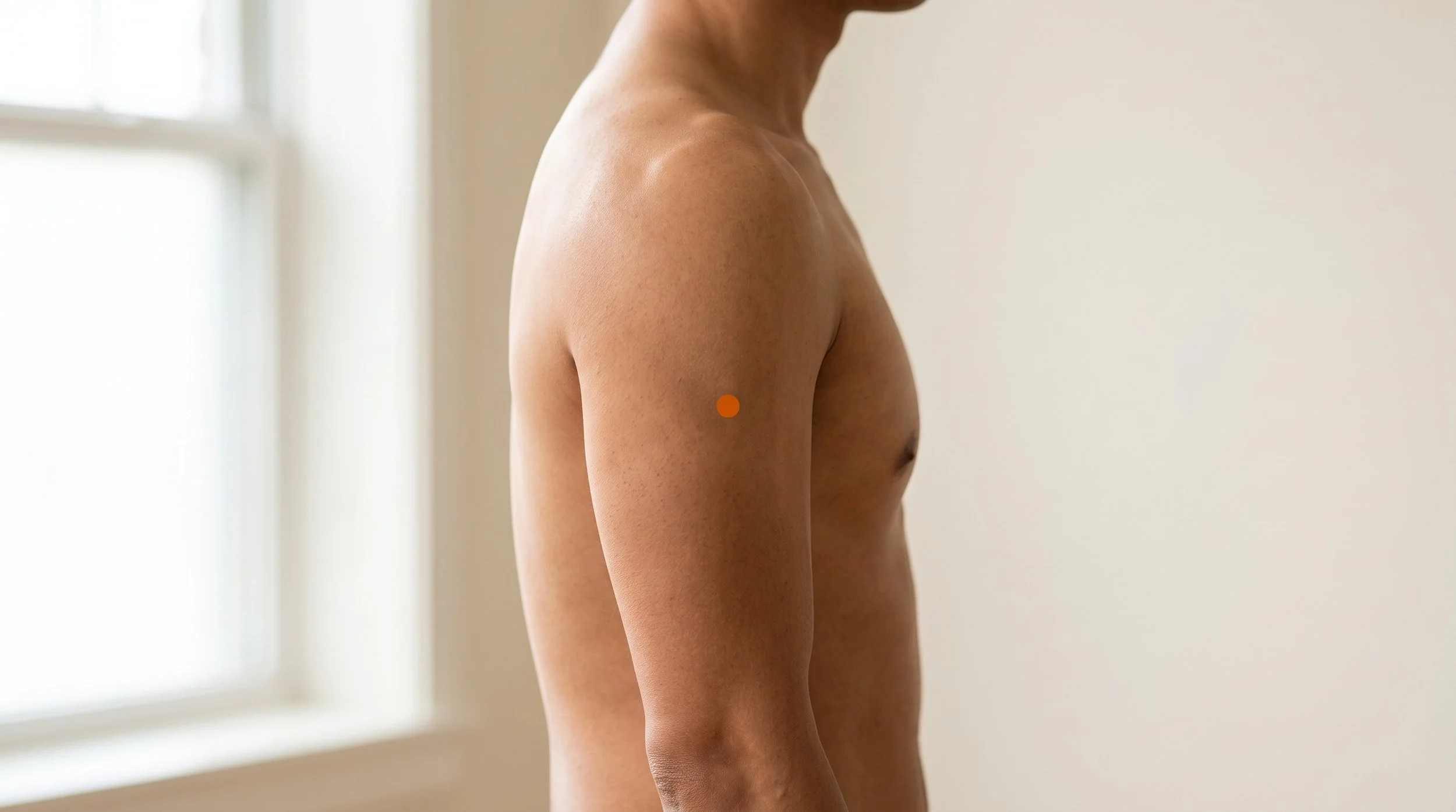
LI14 Acupuncture Point (Binao)
The Upper Arm Point at the Deltoid Insertion: Anatomy, Mechanism, and Why LI14 Anchors Shoulder, Deltoid, and Radiating Arm Pain Treatment
LI14 (Binao), whose name is usually rendered as Upper Arm, sits on the outer arm in the small dip where the lower tip of the deltoid meets the brachialis, roughly three fifths of the way along the line from LI11 at the elbow crease to LI15 at the shoulder. It is easiest to find when the arm is tensed, because the deltoid's V-shaped insertion becomes visible and the depression under it becomes tender in most people with shoulder or overhead-loading complaints.
Classical texts do not treat it as a headline point, yet it earns its place in almost every shoulder protocol we run: it lands directly on a hard-working tendon insertion, it lies along the radial nerve's territory as that nerve emerges from the spiral groove, and it gives clinicians a way to treat pain that travels between the shoulder and the elbow rather than staying in one spot.
This guide covers the li14 acupuncture point in detail: binao point location, layered anatomy, the neurophysiology behind its effects, traditional attributions, and what the clinical research on acupuncture and dry needling for shoulder pain actually supports.
- Location and layers: large intestine 14 sits at the distal deltoid insertion on the lateral humerus, in the palpable groove between deltoid and brachialis, about three fifths of the way from LI11 toward LI15. The needle passes through skin and subcutaneous fascia into the tendinous end of the deltoid and the upper edge of brachialis, which is exactly where repetitive overhead load concentrates.
- Traditional categories, read anatomically: A Manual of Acupuncture classes LI14 as a meeting point of the Large Intestine channel with the Small Intestine and Bladder channels, and other texts add the Yang Linking Vessel. Those crossings describe a shared referral and functional territory across the shoulder girdle rather than any measurable flow of energy.
- Nerve story: the radial nerve winds around the posterior humerus in the spiral groove and reaches the lateral arm near this level, while the axillary nerve supplies the deltoid above it, so needling here recruits deep somatic afferents from the same C5 to C7 segments that serve the shoulder joint and lateral arm (Zhao, 2008).
- Mechanism: needle stimulation at loaded muscle and tendon tissue engages segmental spinal inhibition and descending pain control, with local vasodilation and reduced motor endplate activity contributing to the change patients notice in the first few minutes (Zhao, 2008). Research on people with unilateral shoulder pain has also documented lowered pressure pain thresholds at shoulder region acupoints, consistent with peripheral and central sensitization (Yan et al., 2017).
- Research picture: shoulder-specific reviews remain cautious, with the Cochrane review finding limited evidence and possible short-term benefit (Green et al., 2005), while a later sham-controlled trial in subacromial impingement reported better pain, function, and range of motion outcomes with real acupuncture added to exercise (Karamanlioglu et al., 2024). Larger individual patient data work supports a modest but persistent effect of acupuncture across chronic musculoskeletal pain conditions (Vickers et al., 2018).
- De qi and practice framing: patients usually describe a heavy, spreading ache at the deltoid that may travel toward the shoulder tip or down toward the elbow. LI14 is rarely used alone; it works as a local anchor in combinations with shoulder points, distal channel points, and dry needling of the deltoid and brachialis.
Struggling to Raise Your Arm Overhead in NYC?
If reaching a high shelf, throwing, or putting on a jacket has become a negotiation, the deltoid insertion at LI14 is one of the first places we palpate. Our acupuncturists combine precise needling at this tender junction with shoulder girdle points, distal channel points, and movement retraining so the arm feels usable again, not just numbed for an hour. Treatment is tailored to whether your pattern looks like tendon overload, impingement, or a stiff capsule. Schedule a visit at Morningside Acupuncture and let us assess the shoulder properly.
Schedule NowAnatomy of LI14: Why the Deltoid Insertion Is Such an Important Location
Start at the shoulder tip and slide your fingers down the outer arm until the bulk of the deltoid narrows into a point. That narrowing is the deltoid's insertion onto the deltoid tuberosity of the humerus, and LI14 sits in the tender depression just at its lower edge, where the muscle meets the upper fibers of brachialis. Under the needle there is skin, a thin subcutaneous layer, then dense tendinous and myotendinous tissue that absorbs load every time the arm abducts, reaches forward, or decelerates.
This is why the site is so reliably sore in swimmers, climbers, throwers, desk workers with rounded shoulder posture, and anyone who has recently done more overhead work than usual. Tendon insertions are mechanically busy and richly innervated, so they become tender early in an overuse presentation and often stay tender after the joint itself has calmed down.
The nerve geography here is what makes LI14 more than a sore spot. The deltoid above it is supplied by the axillary nerve, while the radial nerve travels around the back of the humerus in the spiral groove and emerges toward the lateral arm at roughly this level before continuing toward the elbow. Both nerves carry fibers from the same mid-cervical segments that supply the glenohumeral joint, the rotator cuff, and the lateral arm, so afferent input from needling at LI14 arrives in the dorsal horn alongside input from the painful structures themselves.
That segmental convergence is the plainest explanation for why a needle at the deltoid insertion can change how the whole shoulder feels. Needle-evoked activity in deep somatic afferents also recruits descending inhibitory pathways from the brainstem and modulates endogenous opioid systems, which is the best-characterized mechanism for acupuncture analgesia in the experimental literature (Zhao, 2008).
Adding to that picture, people with one-sided shoulder pain show measurably lower pressure pain thresholds at acupoints in the affected region, which fits a sensitized system rather than a purely local tissue problem (Yan et al., 2017).
Safety at this point is mostly a matter of staying lateral and staying oblique. The major neurovascular bundle of the upper arm, including the brachial artery, runs on the medial side, well away from LI14, and the radial nerve lies deep and posterior in its groove. Standard technique is oblique insertion of about 1 to 1.5 cun angled upward toward the shoulder for shoulder problems, or angled downward from the shoulder when the complaint travels toward the elbow, keeping the needle within the muscle and tendon plane rather than driving it perpendicular into bone.
Kim's atlas describes perpendicular or upward oblique insertion in a similar depth range, and clinicians typically stop advancing at the periosteum. As always, needling should be performed by a licensed practitioner using sterile single-use needles.
Related Acupuncture For Deltoid Pain Related Large Intestine ChannelLI14 at a Glance: Classification, Location, and Clinical Use
| Category | Detail |
|---|---|
| Traditional Name | Binao (Upper Arm), LI14, also written Large Intestine 14 or L.I.-14 |
| Channel Classification | Large Intestine channel of Hand Yangming, on the lateral upper arm between LI13 and LI15 |
| Point Categories | Meeting point of the Large Intestine channel with the Small Intestine and Bladder channels (A Manual of Acupuncture); also listed as an intersection point of the Yang Linking Vessel (Yang Wei Mai) in Maciocia and Cunningham. Not a five-shu point and not a hui-meeting point. |
| Precise Location | Lateral upper arm, in the visible tender depression at the lower end of the deltoid where it meets brachialis, about three fifths of the distance along the line from LI11 to LI15 (approximately 7 cun above LI11). Tensing the arm makes the landmark far easier to find. |
| Tissue Stimulated | Distal deltoid tendon and insertion, upper fibers of brachialis, and the overlying fascia; frequently overlaps myofascial targets described on our Deltoid Trigger Points and Brachialis Trigger Points pages |
| Needle Depth / Direction | Oblique insertion 1 to 1.5 cun, angled upward toward the shoulder for shoulder and eye indications, or downward from the shoulder when pain radiates toward the elbow; Kim describes perpendicular or upward oblique insertion at 0.8 to 1.5 cun |
| De Qi Sensation | A deep, heavy, spreading ache at the deltoid insertion, often traveling up toward the shoulder tip or down the lateral arm; a brief muscle twitch is common when the tissue is taut |
| Primary Clinical Uses | Shoulder and upper arm pain, pain that radiates along the arm, difficulty raising the arm, weakness and wasting of the upper arm, neck stiffness with arm involvement, and in classical texts red, swollen, or painful eyes and neck nodules |
| Common Point Combinations |
|
In A Manual of Acupuncture, Binao LI14 is presented as a useful rather than a major point, valued mainly for clearing obstruction along the channel and easing pain in the upper arm, especially when the discomfort travels between shoulder and elbow rather than sitting still. The traditional indication list gathers into three groups: arm and shoulder complaints (pain, numbness, painful obstruction, weakness and wasting, inability to lift the arm, and stiffness of the neck), nodular swellings of the neck described in the older vocabulary as scrofula and goitre, and eye disorders involving redness, swelling, and heat.
Deadman's commentary explains the nodule indications by geography rather than by any special phlegm-transforming property: the Large Intestine channel travels up the side of the neck, so points along its upper arm segment were traditionally recruited for problems in that territory. What is genuinely striking is that this cluster of arm, neck lump, and eye indications repeats across a whole set of upper arm points on the Large Intestine and Sanjiao channels while the more distal points on the same channels do not share it, a pattern the classical literature records without ever explaining.
Why LI14 Is Used for Neck Stiffness and Classical Eye Complaints as Well as Shoulder Pain
The shoulder use is intuitive: the needle goes where the tissue is loaded. The less obvious uses make sense once you think in terms of shared nerve segments rather than separate body parts. The lateral arm, the deltoid, the shoulder capsule, and the lower cervical spine draw their innervation from an overlapping set of mid-cervical nerve roots, so a persistent neck problem can present as arm pain and a persistent shoulder problem can leave the neck stiff and guarded.
Needling at LI14 sends a strong volley of deep afferent input into those same segments, where it competes with and dampens the nociceptive traffic arriving from the irritated structures (Zhao, 2008). That is also why the point is worth palpating even when the patient's main complaint sounds cervical.
Beyond the segment, needle stimulation activates brainstem descending inhibitory pathways and opioid, serotonergic, and noradrenergic systems that reduce pain sensitivity more broadly, which helps explain relief in areas that are not directly under the needle (Zhao, 2008). Sensitization research in shoulder pain patients supports treating the system rather than only the sore tendon: people with one-sided shoulder pain show reduced pressure pain thresholds at acupoints in the region, indicating that the surrounding tissue has become easier to provoke (Yan et al., 2017).
Locally, needling also produces vasodilation and a small inflammatory healing response at the insertion, and it can reduce the tone of taut fibers pulling on the tendon.
The classical eye indications are a different matter, and we present them as traditional attributions rather than as claims we can explain mechanistically. Nothing in the anatomy of the deltoid insertion connects it to the orbit. What we can say is that older texts consistently directed the needle upward toward the shoulder for these uses, and that modern clinical practice for red or irritated eyes relies on other approaches. We include the classical material because it is part of the point's documented history, not because we treat eye disease with it.
What the Research Shows for LI14
A note on how to read the evidence: almost no trial isolates a single point. Shoulder studies test multi-point protocols in which LI14 usually appears alongside LI15, TE14, SI9, SI11, and a distal point or two, so the honest framing is that LI14 is a common component of protocols that have been studied, not a point with its own evidence base. Reviews in this area also tend to pool small trials with varied diagnoses and needling techniques, which is why conclusions are stated cautiously.
With that caveat, the overall direction of the literature suggests modest short-term benefit for pain and function, with the strongest signal appearing when needling is combined with exercise.
| Study | Type | Focus | Key Finding |
|---|---|---|---|
| Green et al., 2005 | Cochrane systematic review | Acupuncture for shoulder pain in adults | The reviewers concluded that the small and methodologically varied trial pool left the question largely unresolved, while noting possible short-term benefit for pain and function. |
| Karamanlioglu et al., 2024 | Randomized sham-controlled trial | Acupuncture plus exercise versus sham acupuncture plus exercise in subacromial impingement syndrome | Real acupuncture added to exercise was reported to outperform sham acupuncture plus exercise for pain, function, range of motion, and quality of life in this single-center trial. |
| Heo et al., 2022 | Systematic review and meta-analysis | Electroacupuncture for frozen shoulder | The authors reported improvements in pain and function compared with control treatments and no reported adverse effects, while noting the evidence base is limited. |
| Liu et al., 2015 | Systematic review and meta-analysis | Dry needling of myofascial trigger points in the neck and shoulder region | Dry needling appeared helpful for trigger point pain in the neck and shoulders over the short and medium term, based on trials of modest quality. |
| Vickers et al., 2018 | Individual patient data meta-analysis | Acupuncture across chronic pain conditions including musculoskeletal pain | Acupuncture was associated with better outcomes than both sham and no-acupuncture controls, with effects that persisted over roughly a year. |
| Yan et al., 2017 | Cross-sectional matched case-control study | Pressure pain thresholds at acupoints in people with unilateral shoulder pain | Lowered thresholds at shoulder region acupoints suggested both peripheral and central sensitization, supporting assessment by palpation rather than by map alone. |
Shoulder Pain That Radiates Down the Arm?
Pain that travels between the shoulder and elbow often responds better to points along the arm than to needling the sore spot alone, which is exactly the role LI14 plays. We map where your pain refers, check the neck as a contributor, and needle along the involved line rather than guessing. Sessions typically pair local work at the deltoid with LI4, LI11, and neck points when the cervical spine is feeding the problem. Book an appointment and we will build the plan around your presentation.
Schedule NowLI14 in the Context of Trigger Point Work
LI14 sits directly on territory that trigger point clinicians know well. The deltoid harbors taut bands that refer pain into the shoulder and upper arm rather than into the hand, and the middle and anterior fibers converge toward the insertion where the point is located; brachialis, immediately below and slightly anterior, refers toward the front of the shoulder and the base of the thumb (Simons et al., 1999).
Because acupuncture is defined by the use of an acupuncture needle rather than by any single tradition, a practitioner working at LI14 and a practitioner dry needling the distal deltoid are often stimulating the same tissue with the same tool, arriving from different maps.
In practice we palpate before we needle. If the deltoid insertion is tender and the taut bands reproduce the patient's familiar pain, we treat LI14 as both a channel point and a myofascial target, sometimes eliciting a local twitch response and sometimes using quieter retained needling when the tissue is highly irritable. That local work is then paired with the rest of the picture: supraspinatus and infraspinatus for cuff-related pain, upper trapezius and levator scapulae when the neck is contributing, and distal points such as LI4 or LI11 to add segmental and descending inhibition.
Needling is followed by loading, because tendon insertions respond to graded exercise, and the needle mainly buys the window in which that exercise becomes tolerable.
LI14 Shoulder and Arm Pain Treatment at NYC's Highest-Rated Acupuncture Clinic
Morningside Acupuncture is the highest-rated acupuncture and dry needling clinic in New York City with over 500 five-star Google reviews, and shoulder complaints are among the most common reasons patients come to us. We treat LI14 as one tool inside a full assessment that includes the rotator cuff, scapular mechanics, and the cervical spine. Every session pairs needling with practical loading advice you can use between visits. Schedule your appointment today and get a clear plan for your shoulder.
Schedule NowFrequently Asked Questions
What does LI14 feel like when needled?
Most people feel a firm, heavy ache at the deltoid insertion that spreads either up toward the shoulder tip or down the outer arm, which is the classic de qi sensation. If the tissue is holding a taut band, you may feel a brief involuntary twitch or a short cramp-like grab that settles within seconds. Sharp, electric, or shooting sensations are not the goal, and you should tell your practitioner right away if you feel one so the needle can be adjusted. Mild soreness at the site for a day afterward is common, similar to how a muscle feels after unfamiliar exercise.
Why needle the upper arm instead of the sore shoulder joint itself?
Because pain location and pain source are often different things. The deltoid insertion is where load concentrates when you reach, lift, or throw, and it frequently becomes the sensitized structure even when the discomfort is felt at the shoulder tip or down the arm. LI14 also lies within the same nerve segments that supply the shoulder joint and lateral arm, so needling there feeds inhibitory input into the exact spinal levels handling the painful signals (Zhao, 2008). In classical terms, A Manual of Acupuncture frames the same idea as activating the channel and easing pain that travels along the arm, and it is the point clinicians reach for when the complaint moves between shoulder and elbow.
Can I press LI14 myself between sessions?
Yes, and it is one of the easier points to self-treat. Tense your arm briefly so the deltoid's lower tip becomes visible, then let it relax and find the tender dip just below that point on the outer arm, roughly two thirds of the way up from the elbow crease toward the shoulder. Press with the pad of your opposite thumb at an intensity you would rate around 4 to 6 out of 10, hold steady for 30 to 60 seconds, then release, and repeat two or three times per side. Small slow circles or a gentle sustained hold while you slowly raise and lower the arm often works better than aggressive digging. Two or three short sessions a day is plenty, and you should stop if pressure produces numbness, tingling down the forearm, or sharp pain.
Is LI14 safe to needle?
In trained hands, yes. The point sits on the lateral arm, well away from the brachial artery and the main neurovascular bundle of the medial upper arm, and the standard oblique angle of 1 to 1.5 cun keeps the needle within the muscle and tendon plane rather than heading toward deeper structures. Practitioners keep in mind that the radial nerve runs behind the humerus in the spiral groove and avoid deep posterior angling. Typical side effects are limited to brief soreness or a small bruise. People taking blood thinners, people with bleeding disorders, and anyone with local skin infection, an open wound, or recent shoulder surgery should tell their practitioner so technique can be adjusted, and all needling should be performed by a licensed acupuncturist or trained clinician using sterile single-use needles.
Where exactly is LI14 located?
Draw an imaginary line on the outer arm from LI11, at the lateral end of the elbow crease with the elbow bent, up to LI15, in the hollow at the front of the shoulder tip when the arm is raised. LI14 lies about three fifths of the way along that line from the elbow, which is roughly 7 cun above LI11, in the tender depression where the pointed lower end of the deltoid meets the brachialis on the lateral side of the humerus. The most reliable way to find binao point location is to tense the arm so the deltoid's V-shaped insertion stands out, then relax and palpate just under the tip for the sore spot. On most people with shoulder or arm complaints, that spot announces itself.
References
- Deadman, P., Al-Khafaji, M., & Baker, K. (2009). A manual of acupuncture. Journal of Chinese Medicine Publications.
- Kim, H. (2008). Handbook of Oriental medicine (3rd ed.). Harmony & Balance Press.
- Cunningham, P. M. (2000). Acupuncture points: A practical guide to classical and modern usage. Odyssey Press.
- Maciocia, G. (2005). The foundations of Chinese medicine: A comprehensive text for acupuncturists and herbalists (2nd ed.). Elsevier Churchill Livingstone.
- Simons, D. G., Travell, J. G., & Simons, L. S. (1999). Travell & Simons' myofascial pain and dysfunction: The trigger point manual, Vol. 1: Upper half of body (2nd ed.). Williams & Wilkins.
- Green, S., Buchbinder, R., & Hetrick, S. (2005). Acupuncture for shoulder pain. Cochrane Database of Systematic Reviews, 2005(2), CD005319. https://doi.org/10.1002/14651858.CD005319
- Karamanlioglu, D. S., Kaysin, M. Y., Begoglu, F. A., Akpinar, P., Ozkan, F. U., & Aktas, I. (2024). Effects of acupuncture on pain and function in patients with subacromial impingement syndrome: A randomized sham-controlled trial. Integrative Medicine Research, 13(2), 101049. https://doi.org/10.1016/j.imr.2024.101049
- Heo, J.-W., Jo, J.-H., Lee, J.-J., Kang, H., Choi, T.-Y., Lee, M. S., & Kim, J.-I. (2022). Electroacupuncture for the treatment of frozen shoulder: A systematic review and meta-analysis. Frontiers in Medicine, 9, 928823. https://doi.org/10.3389/fmed.2022.928823
- Liu, L., Huang, Q.-M., Liu, Q.-G., Ye, G., Bo, C.-Z., Chen, M.-J., & Li, P. (2015). Effectiveness of dry needling for myofascial trigger points associated with neck and shoulder pain: A systematic review and meta-analysis. Archives of Physical Medicine and Rehabilitation, 96(5), 944-955. https://doi.org/10.1016/j.apmr.2014.12.015
- Yan, C., Zhang, S., Li, Q., Zhang, Y., Wang, D., Zhang, Y., Sun, N., & Zhang, J. (2017). Detection of peripheral and central sensitisation at acupoints in patients with unilateral shoulder pain in Beijing: A cross-sectional matched case-control study. BMJ Open, 7(1), e014438. https://doi.org/10.1136/bmjopen-2016-014438
- Vickers, A. J., Vertosick, E. A., Lewith, G., MacPherson, H., Foster, N. E., Sherman, K. J., Irnich, D., Witt, C. M., & Linde, K. (2018). Acupuncture for chronic pain: Update of an individual patient data meta-analysis. Journal of Pain, 19(5), 455-474. https://doi.org/10.1016/j.jpain.2017.11.005
- Zhao, Z. Q. (2008). Neural mechanism underlying acupuncture analgesia. Progress in Neurobiology, 85(4), 355-375. https://doi.org/10.1016/j.pneurobio.2008.05.004
Disclaimer: This web site is intended for educational and informational purposes only. Reading this website does not constitute providing medical advice or any professional services. This information should not be used for diagnosing or treating any health issue or disease. Those seeking medical advice should consult with a licensed physician. Seek the advice of a medical doctor or other qualified health professional for any medical condition. If you think you have a medical emergency, call 911 or go to the emergency room. No acupuncturist-patient relationship is created by reading this website or using the information. Morningside Acupuncture PLLC and its employees and contributors do not make any express or implied representations with respect to the information on this site or its use. For any legal interpretation of scope of practice in your state, consult a licensed attorney or regulatory authority.
Read more from our blog



