GB39 Acupuncture Point (Xuanzhong)
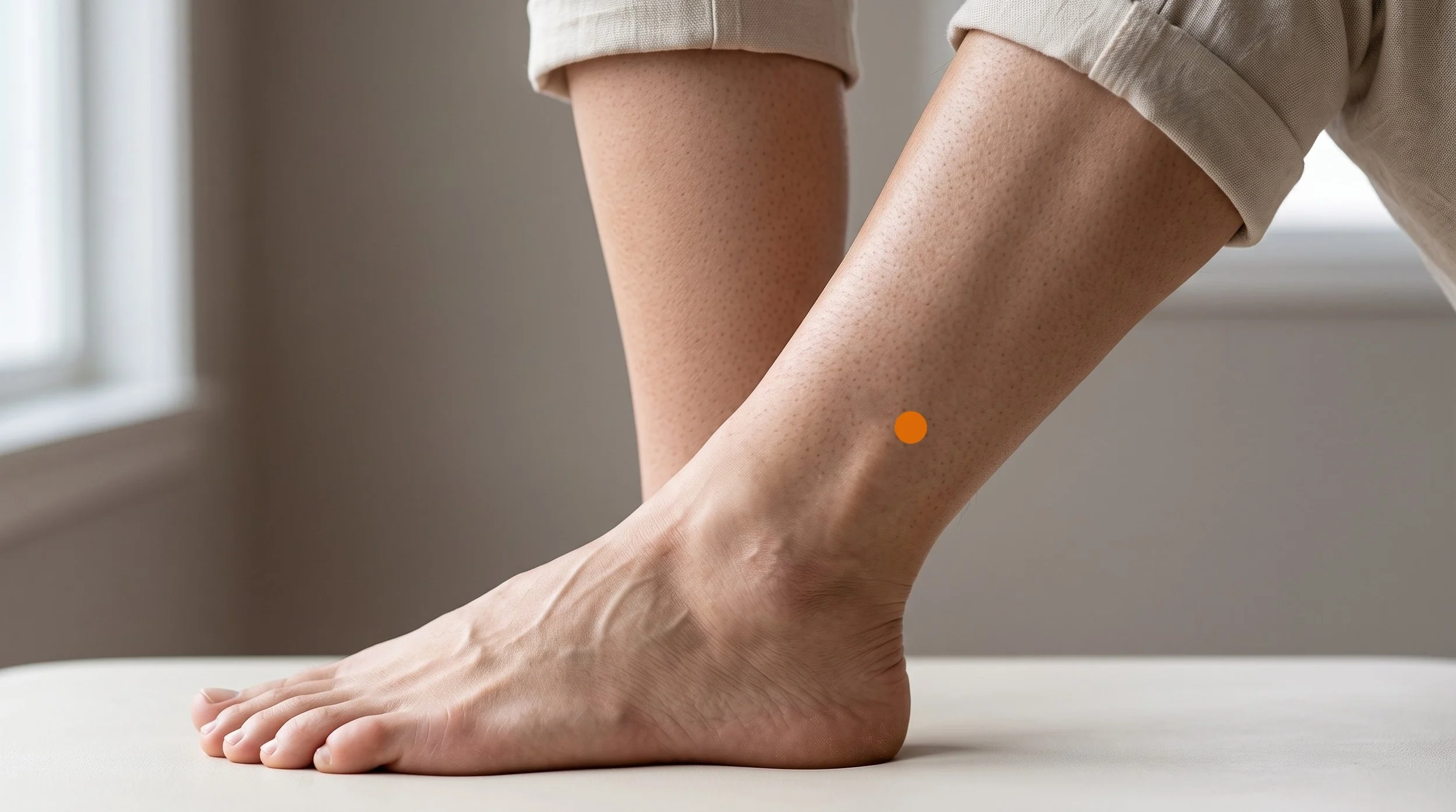
GB39 Acupuncture Point
The Suspended Bell Above the Ankle: Anatomy, Mechanism, and Why a Point on the Lateral Lower Leg Is Traditionally Tied to Bone, Sinew, and Neck Stiffness
GB39 (Xuanzhong, often translated as Suspended Bell or Hanging Bell) sits on the outer lower leg about a handbreadth above the bony bump of the ankle, tucked into the narrow groove between the back edge of the fibula and the peroneal tendons that run behind it. In classical texts it carries an unusual title: the hui-meeting point of the marrow, which traditionally links a small spot near the ankle to the health of bone, sinew, and the spine. Clinically, the gb39 acupuncture point earns its place for much more ordinary reasons. It sits in tissue that gets loaded hard by walking, running, cutting sports, and repeated ankle sprains, and it is one of the most commonly chosen distal points on the Gallbladder channel when someone walks in with a stiff, guarded neck.
- Location and layers: GB39 lies 3 cun above the prominence of the lateral malleolus, in the depression between the posterior border of the fibula and the tendons of peroneus longus and brevis. A needle here passes through skin and subcutaneous tissue into crural fascia and the peroneal muscle and tendon layer, with the fibula immediately deep and medial.
- Traditional categories, read in modern terms: the point manuals classify GB39 as the hui-meeting point of the marrow and credit it with benefiting sinew and bone, dispelling wind-damp, clearing Gallbladder fire, and moving the channel to relieve pain. Those are traditional attributions, and the clinically testable part of them is straightforward: strong stimulation of a lateral-compartment site that changes how the lower leg, ankle, and neck feel and move.
- Nerve geography: the region is served by the superficial peroneal nerve and neighboring cutaneous branches from the common peroneal system, with segmental input around L4 to S1. Convergence of these afferents in the lumbosacral dorsal horn helps explain local effects on lateral leg and ankle pain, while broader analgesia depends on brainstem descending control rather than segmental overlap (Zhao, 2008).
- The research picture is about protocols, not single points: individual patient data meta-analysis supports modest, persisting benefits of acupuncture for chronic musculoskeletal pain (Vickers et al., 2018), a Cochrane review of neck disorders found low to moderate quality evidence favoring acupuncture over sham or inactive comparators for short-term pain (Trinh et al., 2016), and the Cochrane review of acute ankle sprain trials found the evidence too heterogeneous to draw firm conclusions (Kim et al., 2014).
- Point-specific findings are mixed and worth stating plainly: in a randomized comparison for primary dysmenorrhea, electroacupuncture at SP6 outperformed GB39 and an adjacent non-channel site for immediate pain relief, which the authors read as evidence of relative point specificity (Ma et al., 2010). Imaging work pairing HT5 with GB39 found that GB39 did not add language-area activation in healthy volunteers (Liu et al., 2017). Both results argue for using GB39 where its regional and distal effects make sense.
- De qi and practice framing: patients usually report a dull, spreading ache or heaviness along the outer lower leg, sometimes running toward the outer ankle or up toward the knee. Because ankle motion can bend a needle in this groove, GB39 is often needled last, and the leg is kept still for the retention period.
Struggling With Outer Ankle Pain or Lateral Leg Tightness?
Lateral lower leg pain rarely stays put, and a history of ankle sprains often leaves the peroneal muscles guarding for months. At Morningside Acupuncture we needle GB39 in the groove behind the fibula, then pair it with dry needling of peroneus longus and brevis and a short movement sequence so the ankle relearns confident loading. Treatment is built around your history, your sport, and how your foot actually behaves on stairs and uneven pavement. Schedule a visit and let's get the outer leg quiet again.
Schedule NowAnatomy of GB39: Why the Groove Behind the Fibula Is Such an Important Location
Find the tip of the outer ankle bone, then measure roughly one handbreadth up the leg. At that height, run a fingertip forward until you feel the sharp back edge of the fibula, then let the finger settle just behind it. That small trough is GB39. From the surface inward, a needle passes through thin skin and subcutaneous fat, then the crural fascia, then the muscular and tendinous layer of peroneus brevis and peroneus longus, with the fibula sitting immediately deep. This is working tissue: the peroneals evert the foot and stabilize the ankle against inversion, they fire hard during single-leg loading and direction changes, and they tend to stay overactive after lateral ankle sprains. Runners, dancers, basketball players, and anyone with a history of rolled ankles frequently palpate tender, ropey bands right through this zone.
The nerve story here is mostly peroneal. The superficial peroneal nerve descends in the lateral compartment and typically pierces the fascia in the lower third of the leg near this level to become the cutaneous supply for the lateral leg and dorsum of the foot, and neighboring sural cutaneous branches share the territory. Segmentally, that traffic enters the cord around L4 to S1. Needling a site whose afferents converge with those from the ankle joint capsule, lateral ligaments, and peroneal muscle spindles gives a plausible route for changing how the region is being reported and guarded. Effects felt far from the leg, such as a neck that turns more easily, are better explained by heterosegmental mechanisms: needle-evoked afferent input recruits brainstem descending inhibitory pathways and endogenous opioid signaling, which can lower pain sensitivity well outside the stimulated segment (Zhao, 2008). That same logic underlies trials showing that needling distant points can improve motion-related neck pain and range of motion (Irnich et al., 2002).
Safety at GB39 is mostly about bone and about needle position. The fibula is the nearby hard structure, so practitioners commonly use the index finger to push the peroneal tendons back off the bone, exaggerating the groove, then direct the needle slightly posteriorly for the first half inch before advancing perpendicularly to 1 to 1.5 cun. Point manuals such as Deadman's Manual of Acupuncture also flag a practical hazard: if the patient moves the ankle after insertion, the needle can bend in this narrow corridor. That is why GB39 is often needled last in a treatment and why patients are asked to keep the leg still. The deeper vascular structures of the leg, including the peroneal artery, lie in the posterior compartment well away from a correctly angled needle, and normal clean-needle technique and cautious depth keep the procedure uneventful.
Related Pain Finder Leg Ankle Foot Related Peroneus Longus Trigger PointsGB39 at a Glance: Classification, Location, and Clinical Use
| Category | Detail |
|---|---|
| Traditional Name | Xuanzhong (Suspended Bell or Hanging Bell) |
| Channel Classification | Gallbladder channel of the foot Shaoyang, point 39, on the lateral lower leg |
| Point Categories | Hui-meeting (influential) point of the marrow, a designation tied traditionally to both bone marrow and the brain as the sea of marrow; a channel point of the foot Shaoyang, and one that later authors such as Li Shizhen added to the Yang Qiao Mai trajectory (Sterman) |
| Precise Location | 3 cun (about one handbreadth) superior to the prominence of the lateral malleolus, in the depression between the posterior border of the fibula and the tendons of peroneus longus and brevis |
| Tissue Stimulated | Skin, subcutaneous tissue, crural fascia, and the peroneal muscle and tendon layer overlying the fibula, including peroneus longus and peroneus brevis; superficial peroneal nerve territory |
| Needle Depth / Direction | Perpendicular insertion 1 to 1.5 cun into the groove, commonly angled slightly posteriorly for the first 0.5 cun to stay off the fibula; moxibustion is described in the classical literature |
| De Qi Sensation | Dull, spreading ache, heaviness, or fullness in the outer lower leg, sometimes traveling toward the lateral ankle or proximally toward the knee |
| Primary Clinical Uses | Lateral ankle pain and post-sprain guarding, lateral lower leg and peroneal pain, leg heaviness and weakness, sciatic-type leg pain along the lateral line, and neck stiffness treated distally |
| Common Point Combinations |
|
In Deadman's Manual of Acupuncture, GB39 is presented as the hui-meeting point of the marrow, a title that traditionally reaches in two directions at once: toward bone marrow and toward the brain, described in classical physiology as the sea of marrow. The commentary is candid that the brain half of that claim has thin classical support, and that indications like headache and dizziness are later additions rather than old ones. What the older sources do lean on heavily is the musculoskeletal side. Traditionally the point is used for weakness, wasting, contracture, and deep aching of the limbs, for chronic painful obstruction understood as long-retained wind-damp that eventually depletes Liver and Kidney and therefore marrow, and for stiffness and pain of the neck, where the Gallbladder primary and sinew channels are said to pass. A second traditional thread has GB39 easing stagnant Liver and Gallbladder qi and clearing Gallbladder fire, hence the older listings for chest and flank fullness, poor appetite, irritability and anger, dry nose, nosebleed, and hemorrhoids. Maciocia's channel text adds a practical wrinkle: the nearby extra point Juegu is sometimes preferred for acute neck sprain. What makes the classical pattern striking is the ambition assigned to one small groove above the ankle, a single site made responsible for bone, sinew, and the neck.
Why GB39 Is Used for Neck Stiffness You Feel Nowhere Near the Ankle
Patients are often surprised when a needle goes into the outer lower leg for a neck that will not turn. The traditional rationale is channel-based: the Gallbladder primary and sinew channels are described as running through the side of the neck, so a point far down that line is treated as a lever on it. The modern rationale is different but not incompatible. Needling GB39 generates a barrage of afferent input from skin, fascia, and muscle in the L4 to S1 territory. That input does not share a spinal segment with the cervical spine, so any effect on the neck cannot be segmental. It has to travel through the brain.
That is exactly the mechanism the basic science literature describes for needling at a distance. Sustained afferent stimulation engages brainstem structures including the periaqueductal gray and rostral ventromedial medulla, recruits descending inhibitory pathways, and mobilizes endogenous opioid and monoaminergic signaling, which reduces pain sensitivity in regions remote from the needle (Zhao, 2008). Clinically, that translates into a window in which guarded movement feels safer to attempt. In a randomized, sham-controlled crossover trial in chronic neck pain, needling at distant points produced a meaningful immediate reduction in motion-related pain and improved cervical range of motion compared with sham, and outperformed dry needling of local trigger points on the pain measure (Irnich et al., 2002). That study did not isolate GB39, so it supports the strategy rather than the single point.
In our clinic this is why GB39 usually goes in before we touch the neck. The needle is retained while the patient gently rotates and side-bends, so the nervous system gets fresh, non-threatening movement input during the analgesic window. Then we work locally with dry needling and manual techniques. Neither piece is a stand-alone answer, and neither is a promise of a fixed number of sessions. The point-specificity literature also cautions against treating GB39 as universally interchangeable: when it was tested against SP6 for immediate relief of menstrual pain, it did not perform equivalently (Ma et al., 2010), and adding it to HT5 did not amplify language-area activation in healthy volunteers (Liu et al., 2017). Points appear to matter, which is a good reason to choose them for regional and channel logic rather than habit.
What the Research Shows for GB39
A fair reading of the evidence starts with a caveat: almost no trial tests GB39 by itself. Reviews evaluate multi-point protocols for a condition, so the honest claim is that GB39 is a plausible and traditionally supported component of protocols that have been studied, not that it has been validated in isolation. Two point-specific studies do exist, and both are useful precisely because they are mixed. The table below summarizes the most relevant sources for the conditions GB39 is typically used to address.
| Study | Type | Focus | Key Finding |
|---|---|---|---|
| Vickers et al., 2018 | Individual patient data meta-analysis | Chronic musculoskeletal, headache, and osteoarthritis pain across nearly 21,000 patients | Acupuncture was associated with modest but statistically significant benefits over sham and no-acupuncture controls, with effects that persisted over time rather than dissipating immediately. |
| Trinh et al., 2016 | Cochrane systematic review | Acupuncture for acute, subacute, and chronic neck disorders | The review found low to moderate quality evidence of short-term pain relief compared with sham or inactive controls, with the authors emphasizing methodological limitations across trials. |
| Kim et al., 2014 | Cochrane systematic review | Acupuncture for acute ankle sprain in adults, 20 trials and about 2,000 participants | Results tended to favor acupuncture on recovery-rate outcomes, but the trials were highly heterogeneous and imprecise, so the reviewers judged the evidence insufficient for firm conclusions. |
| Irnich et al., 2002 | Randomized, double-blind, sham-controlled crossover trial | Immediate effects of distal-point acupuncture versus local dry needling in chronic neck pain | Needling at distant points reduced motion-related neck pain by roughly a third compared with sham and improved range of motion, supporting the distal-point strategy GB39 belongs to. |
| Ma et al., 2010 | Randomized controlled trial | Electroacupuncture at SP6 versus GB39 versus an adjacent non-channel point in primary dysmenorrhea | SP6 produced significantly greater immediate pain reduction than GB39 or the non-channel site, which the authors interpreted as preliminary evidence of point specificity. |
| Liu et al., 2017 | Task-based fMRI study in healthy volunteers | Brain activation with needling at HT5 alone and HT5 combined with GB39 | Language-related activation was seen with HT5 stimulation, and the addition of GB39 did not enhance it, suggesting that the traditional marrow and brain association should not be assumed to translate directly. |
Neck Stiffness That Locks Up When You Turn Your Head?
Distal points like GB39 are traditionally used for stiff, restricted necks, and in practice they give us something valuable: a way to reduce guarding before touching an irritable neck. Our clinicians needle GB39 and other distal Gallbladder channel points, ask you to gently turn and tilt while the needles are retained, and then treat local trapezius, levator scapulae, and cervical multifidus tissue with precise dry needling. Most patients notice that rotation feels less protective within the first session. Book an appointment and we'll assess what your neck is actually defending.
Schedule NowGB39 in the Context of Trigger Point Work
GB39 sits in tissue that trigger point clinicians treat constantly. The peroneus longus and peroneus brevis are classic sources of lateral lower leg and outer ankle complaints, and Travell and Simons describe referral patterns from these muscles that spread down the lateral leg toward and around the lateral malleolus, sometimes onto the dorsum of the foot, along with the ankle weakness and instability patients describe as a foot that keeps folding under them (Simons et al., 1999). Because the classical gb 39 location and the belly-tendon junction of the peroneals overlap so closely, a needle placed at GB39 is frequently in the same neighborhood a dry needling protocol would target. The vocabulary differs, the needle does not, which is why we describe both approaches as acupuncture performed with an acupuncture needle.
In practice, we use them as complements. Gallbladder 39 goes in as a channel point, often with GB34 for the lateral line, while palpation guides separate needles into taut bands in peroneus longus, peroneus brevis, and sometimes tibialis anterior or the lateral gastrocnemius depending on findings. For chronic ankle instability there is direct support for the myofascial side of that plan: a systematic review and meta-analysis of needling therapies in chronic ankle instability reported improvements in pain, proprioception, balance, and self-reported function, while noting modest trial quality (Luan et al., 2023). We then add loading and balance work, because needles reduce guarding and exercise rebuilds capacity. Neither one substitutes for the other.
GB39 Ankle and Neck Pain Treatment at NYC's Highest-Rated Acupuncture Clinic
Morningside Acupuncture is the highest-rated acupuncture and dry needling clinic in New York City with over 500 five-star Google reviews, and our approach blends classical point selection with modern pain science and orthopedic assessment. GB39 shows up in our plans for lateral ankle pain, peroneal overload, and stubborn neck stiffness, always as one part of a full treatment rather than a standalone trick. You'll leave with a clear picture of what we found and what to do between sessions. Schedule your appointment today.
Schedule NowFrequently Asked Questions
What does GB39 feel like when needled?
Most people feel a brief pinch at the skin, then a dull, spreading ache or heaviness in the outer lower leg as the needle reaches the peroneal layer. That fullness is de qi, and it may travel toward the outer ankle or up toward the knee. Occasionally patients report a quick, electric flicker if the needle brushes a cutaneous nerve branch, which we adjust away from immediately. Sharp, burning pain is not the goal and should always be reported, since a small change in angle usually resolves it.
Why would you needle a point above the ankle for a stiff neck?
Traditionally, the Gallbladder channel and its sinew pathway are described as passing through the side of the neck, so GB39 is treated as the main distal lever on that line. Physiologically, the needle input from the lower leg cannot reach the neck segmentally, so any effect travels through brainstem descending inhibition and endogenous opioid mechanisms that reduce pain sensitivity in remote regions (Zhao, 2008). The practical value is the window it opens: with distal needles retained, gentle rotation and side-bending usually feel less protective, and trials of distal-point needling in chronic neck pain support that immediate change in motion-related pain and range of motion (Irnich et al., 2002).
Can I press GB39 myself between sessions?
Yes, acupressure at GB39 is simple and low risk. Sit with the knee bent, measure about one handbreadth up from the tip of your outer ankle bone, then slide your thumb forward until you feel the back edge of the fibula and settle just behind it. Press straight in with your thumb at a firm but tolerable intensity, around a 5 or 6 out of 10, and hold for 30 to 60 seconds. Repeat two or three times per leg, once or twice daily, and try slow ankle circles or gentle neck turns during the last 20 seconds so the pressure is paired with movement. Skip it over broken skin, fresh bruising, or an acutely swollen ankle, and stop if pressure produces numbness or shooting pain into the foot.
Is GB39 safe to needle?
In trained hands, yes. The main considerations are the fibula sitting just deep to the point and the narrow corridor the needle occupies. Clinicians typically push the peroneal tendons back off the bone to open the groove, angle slightly posteriorly for the first half inch, and keep depth within 1 to 1.5 cun to avoid striking periosteum, which is uncomfortable rather than dangerous. Because ankle movement can bend a needle here, GB39 is often inserted last and the leg is kept still during retention. Expected side effects are limited to brief soreness or a small bruise. Anyone with peripheral neuropathy, poor sensation, anticoagulant use, an open wound, or a suspected fracture should mention it so the plan can be adjusted.
Where exactly is GB39 located?
GB39 is on the lateral lower leg, 3 cun superior to the prominence of the lateral malleolus, in the depression between the posterior border of the fibula and the tendons of peroneus longus and brevis. The fastest field method is to place four fingers together as one handbreadth above the outer ankle bone, then palpate forward to the sharp back edge of the fibula and drop just behind it into the groove. On most legs the spot is tender to firm pressure, especially after a history of ankle sprains, which helps confirm gallbladder 39 before needling.
References
- Deadman, P., Al-Khafaji, M., & Baker, K. (2009). A manual of acupuncture. Journal of Chinese Medicine Publications.
- Maciocia, G. (2005). The foundations of Chinese medicine: A comprehensive text for acupuncturists and herbalists (2nd ed.). Elsevier Churchill Livingstone.
- Maciocia, G. (2006). The channels of acupuncture: Clinical use of the secondary channels and eight extraordinary vessels. Churchill Livingstone Elsevier.
- Cunningham, P. M. (2000). Acupuncture points: A practical guide to classical and modern usage. Odyssey Press.
- Cecil-Sterman, A. (2012). Advanced acupuncture: A clinic manual. Classical Wellness Press.
- Simons, D. G., Travell, J. G., & Simons, L. S. (1999). Travell & Simons' myofascial pain and dysfunction: The trigger point manual, Vol. 1: Upper half of body (2nd ed.). Williams & Wilkins.
- Zhao, Z. Q. (2008). Neural mechanism underlying acupuncture analgesia. Progress in Neurobiology, 85(4), 355-375. https://doi.org/10.1016/j.pneurobio.2008.05.004
- Vickers, A. J., Vertosick, E. A., Lewith, G., MacPherson, H., Foster, N. E., Sherman, K. J., Irnich, D., Witt, C. M., & Linde, K. (2018). Acupuncture for chronic pain: Update of an individual patient data meta-analysis. Journal of Pain, 19(5), 455-474. https://doi.org/10.1016/j.jpain.2017.11.005
- Trinh, K., Graham, N., Irnich, D., Cameron, I. D., & Forget, M. (2016). Acupuncture for neck disorders. Cochrane Database of Systematic Reviews, 2016(5), CD004870. https://doi.org/10.1002/14651858.CD004870.pub4
- Kim, T. H., Lee, M. S., Kim, K. H., Kang, J. W., Choi, T. Y., & Ernst, E. (2014). Acupuncture for treating acute ankle sprains in adults. Cochrane Database of Systematic Reviews, 2014(6), CD009065. https://doi.org/10.1002/14651858.CD009065.pub2
- Irnich, D., Behrens, N., Gleditsch, J. M., Stor, W., Schreiber, M. A., Schops, P., Vickers, A. J., & Beyer, A. (2002). Immediate effects of dry needling and acupuncture at distant points in chronic neck pain: Results of a randomized, double-blind, sham-controlled crossover trial. Pain, 99(1-2), 83-89. https://doi.org/10.1016/S0304-3959(02)00062-3
- Ma, Y. X., Ma, L. X., Liu, X. L., Ma, Y. X., Lv, K., Wang, D., Liu, J. P., Xing, J. M., Cao, H. J., Gao, S. Z., & Zhu, J. (2010). A comparative study on the immediate effects of electroacupuncture at Sanyinjiao (SP6), Xuanzhong (GB39) and a non-meridian point, on menstrual pain and uterine arterial blood flow, in primary dysmenorrhea patients. Pain Medicine, 11(10), 1564-1575. https://doi.org/10.1111/j.1526-4637.2010.00949.x
- Liu, S., Li, M., Tang, W., Wang, G., & Lv, Y. (2017). An fMRI study of the effects on normal language areas when acupuncturing the Tongli (HT5) and Xuanzhong (GB39) acupoints. Journal of International Medical Research, 45(6), 1961-1975. https://doi.org/10.1177/0300060517720344
- Luan, L., Zhu, M., Adams, R., Witchalls, J., Pranata, A., & Han, J. (2023). Effects of acupuncture or similar needling therapy on pain, proprioception, balance, and self-reported function in individuals with chronic ankle instability: A systematic review and meta-analysis. Complementary Therapies in Medicine, 77, 102983. https://doi.org/10.1016/j.ctim.2023.102983
Disclaimer: This web site is intended for educational and informational purposes only. Reading this website does not constitute providing medical advice or any professional services. This information should not be used for diagnosing or treating any health issue or disease. Those seeking medical advice should consult with a licensed physician. Seek the advice of a medical doctor or other qualified health professional for any medical condition. If you think you have a medical emergency, call 911 or go to the emergency room. No acupuncturist-patient relationship is created by reading this website or using the information. Morningside Acupuncture PLLC and its employees and contributors do not make any express or implied representations with respect to the information on this site or its use. For any legal interpretation of scope of practice in your state, consult a licensed attorney or regulatory authority.
Read more from our blog