CV22 Acupuncture Point (Tiantu)
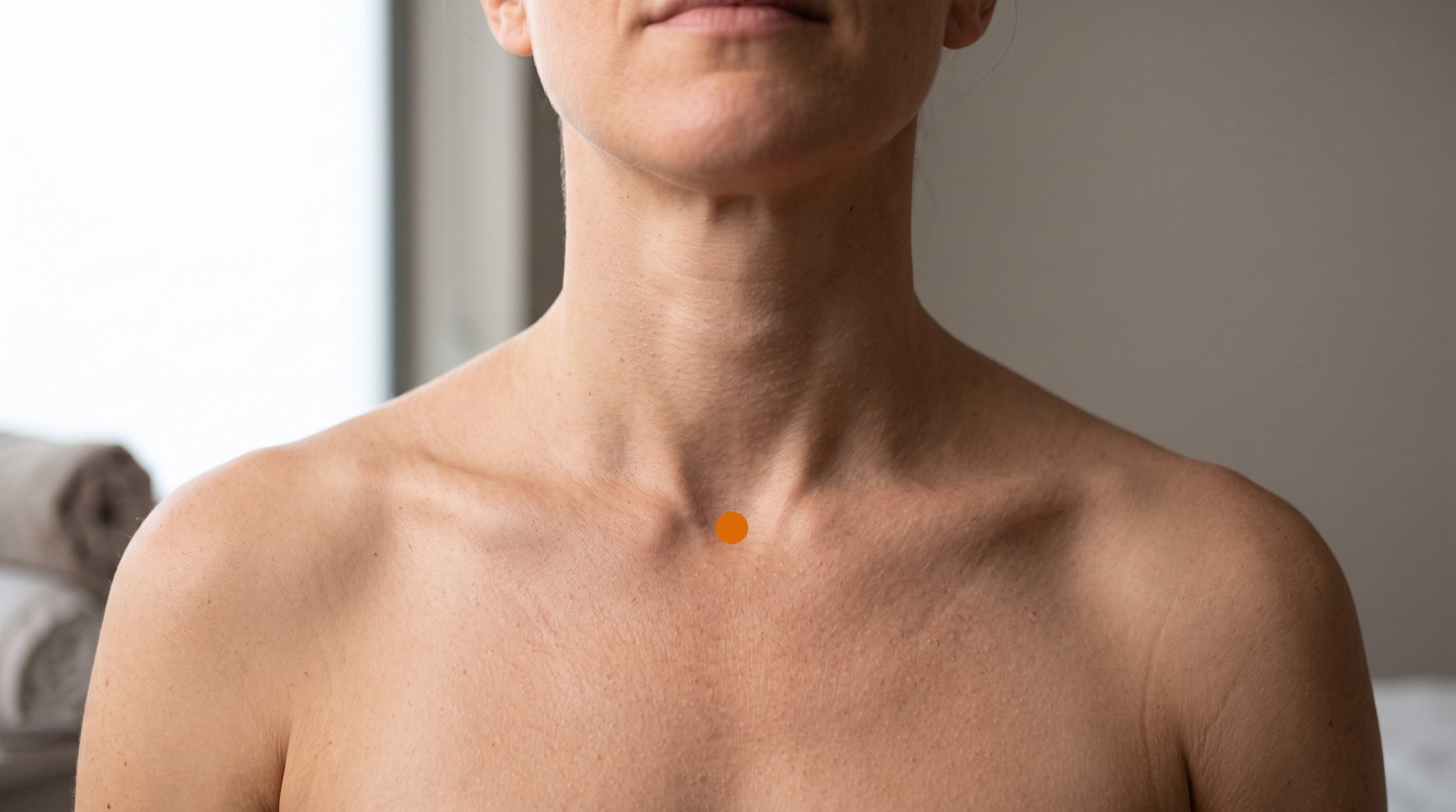
CV22 Acupuncture Point
The Point in the Hollow of the Throat: Anatomy, Mechanism, and Why Conception Vessel 22 Anchors Treatment for Cough, Voice Strain, and Throat Tightness
CV22 (Tiantu, often translated as Heavenly Prominence or Celestial Chimney) is the point in the small hollow at the base of the front of the neck, on the midline in the centre of the suprasternal fossa, roughly half a cun above the top edge of the sternum. Also written as Ren 22 or Conception Vessel 22, it sits directly over the laryngotracheal junction, which is exactly why the classical literature loaded it with throat, voice, and cough indications.
In modern practice this cv 22 throat point is used cautiously and shallowly for cough and throat irritation, hoarseness and voice strain, and the persistent sensation of phlegm or a lump in the throat, and it is one of the few points whose traditional reputation lines up almost perfectly with the anatomy underneath it.
- Location and layers: the cv22 acupuncture point sits on the anterior midline in the suprasternal notch hollow, between the sternal heads of the sternocleidomastoids, with skin, platysma, and the interclavicular ligament above and the trachea immediately deep (Deadman et al., 2007).
- Traditional categories translated: Tiantu is described in the classical literature as a meeting point of the Conception vessel with the Yin Linking vessel and as one of the Window of Heaven points, a small group associated with rebellious qi moving upward into the head and throat (Deadman et al., 2007; Cunningham, 2014). In neurophysiological terms these are cervical points that engage upper cervical and vagal territory rather than points that move energy.
- Mechanism: the overlying skin is supplied by transverse cervical branches of the cervical plexus around C3, while the deeper field contains vagal and recurrent laryngeal structures, so stimulation here converges with the same segmental levels that carry laryngeal and tracheal afferents, and non-segmental descending inhibitory pathways add a broader modulating effect (Zhao, 2008).
- Research picture: a randomized single-blind crossover trial found that transcutaneous electroacupuncture at CV22 produced greater improvement in globus symptom scores than sham, with the authors suggesting a direct local action on the throat (Zhou et al., 2020), and a 2025 systematic review of 30 trials reported improvements in cough severity and cough-related quality of life when acupuncture-related therapy was added to conventional care, with moderate certainty evidence (Lee et al., 2025).
- Clinical practice framing: CV22 is almost never used alone; it is a local point layered onto distal work, and deeper needle techniques described in stroke rehabilitation research are hospital protocols carried out by specialists, not routine office practice (Li et al., 2024).
- De qi at CV22 is distinctive: patients usually report a mild constricted or full feeling in the throat, sometimes an urge to swallow or a brief tickle, rather than the heavy ache typical of limb points. Serious adverse events from acupuncture are rare overall, but the safety margin at this point depends entirely on shallow, midline technique (White, 2004).
Struggling With a Cough or Throat Tightness That Will Not Settle?
At Morningside Acupuncture, CV22 is one of the points we consider when a cough lingers after the infection has cleared, or when the throat feels tight, scratchy, or blocked without a clear structural cause. We use it shallowly and combine it with distal points and, where relevant, dry needling of the neck and upper chest muscles that add to the sensation of throat pressure. Our practitioners are licensed acupuncturists trained in both classical point theory and modern anatomy, so treatment is planned around your exam, not a template. Schedule a visit and let's map out what is driving the symptom.
Schedule NowAnatomy of CV22: Why the Suprasternal Fossa Is Such an Important Location
Run a finger down the front of your neck and it drops into a soft hollow just above the breastbone. That hollow is the suprasternal fossa, bounded on either side by the sternal heads of the sternocleidomastoid muscles and floored by the interclavicular ligament and a thin layer of investing fascia. CV22 is placed in the centre of this depression, about 0.5 cun above the top edge of the manubrium (Deadman et al., 2007).
What loads this region is not lifting or twisting but breathing and speaking: forward head posture, chronic throat clearing, accessory-muscle breathing during asthma or anxiety, and prolonged voice use all pull the sternocleidomastoids and scalenes into a shortened, guarded state, and patients often describe the resulting feeling as pressure sitting exactly in that notch.
The skin over the fossa is supplied by the transverse cervical nerves of the cervical plexus, arising around the C3 level, and the deeper field contains structures related to the vagus nerve and its recurrent laryngeal branch, which serve the larynx and trachea. Needle stimulation here therefore feeds into the same spinal and brainstem territory that receives afferent traffic from the airway and voice box, which is the plain-language version of segmental convergence.
Beyond that local effect, acupuncture stimulation recruits descending inhibitory pathways from the brainstem that damp incoming signals more broadly, a mechanism that has been mapped in considerable detail in analgesia research (Zhao, 2008). Animal work on electroacupuncture and swallowing has also implicated brainstem circuitry, specifically the nucleus tractus solitarii, which is the same relay that handles airway and cough reflex input (Yao et al., 2023).
Depth discipline matters more here than at almost any other point on the Conception vessel. The trachea lies directly beneath the fossa, the brachiocephalic vessels and the jugular venous arch sit in the immediate neighbourhood, and the apices of the lungs are not far laterally. Standard practice is a shallow perpendicular insertion of roughly 0.3 cun.
The classical deeper method (needle perpendicularly a short distance, then redirect inferiorly along the back of the manubrium with the neck extended) is described in the textbooks with an explicit warning that it should not be attempted without supervised experience (Deadman et al., 2007). Lateral angling is avoided entirely. Serious acupuncture complications are uncommon in prospective safety data, and trauma-related events in particular are considered largely preventable through technique (White, 2004), which is exactly why CV22 is treated as a shallow point in ordinary clinical work.
Related Conception Vessel Related Lung ChannelCV22 at a Glance: Classification, Location, and Clinical Use
| Category | Detail |
|---|---|
| Traditional Name | Tiantu (Heavenly Prominence, also translated Celestial Chimney) |
| Channel Classification | Conception Vessel (Ren Mai), point 22; also written Ren 22 or Conception Vessel 22 |
| Point Categories | Meeting point of the Conception vessel with the Yin Linking vessel (Yin Wei Mai); one of the Window of Heaven points listed in Chapter 2 of the Spiritual Pivot |
| Precise Location | On the anterior midline, in the centre of the suprasternal fossa, 0.5 cun superior to the suprasternal notch, between the sternal heads of the sternocleidomastoid muscles |
| Tissue Stimulated | Skin and superficial fascia of the suprasternal fossa, platysma and interclavicular ligament, with the sternal heads of the sternocleidomastoid forming the borders; the trachea, jugular venous arch, and vagal and recurrent laryngeal structures lie deeper and are avoided |
| Needle Depth / Direction | Shallow perpendicular insertion approximately 0.3 cun is the standard method. The classical deep technique (perpendicular 0.2 to 0.3 cun, then redirected inferiorly along the posterior border of the manubrium 0.5 to 1 cun with the neck extended) is a supervised specialist procedure. Lateral angling is not used. |
| De Qi Sensation | A local fullness or mildly constricted feeling in the throat, often with an urge to swallow or a brief tickle; sensation should stay superficial and comfortable, and any sharpness, coughing fit, or breathlessness means the needle is withdrawn |
| Primary Clinical Uses | Cough and throat irritation, the sensation of phlegm or a lump in the throat, hoarseness and voice strain, and chest oppression in the classical listings |
| Common Point Combinations |
|
The classical record for Tiantu, as compiled by Deadman and colleagues, is unusually consistent. The point is credited with descending rebellious qi to ease cough and wheezing and with benefiting the throat and voice, and its indication lists run from rattling and accumulation in the throat, plumstone qi (the traditional name for a lump-like sensation), swelling, dryness, and painful obstruction, through to cracked voice, sudden voice loss, and inability to speak, alongside chest oppression, breathlessness, and heart-region pain.
Its status as a meeting point with the Yin Linking vessel is offered as the traditional explanation for the chest and heart indications, and its inclusion among the Window of Heaven points is linked to sudden-onset problems and to symptoms described as rising upward, including goitre and swelling of the neck. These are traditional attributions rather than physiological claims, but what is striking is how tightly the whole list clusters around one anatomical corridor: everything the classics ask of this point happens within a few centimetres of the larynx, trachea, and upper mediastinum that lie beneath it.
Why CV22 Is Used for the Sensation of a Lump in the Throat
The feeling that something is stuck in the throat when nothing is there, called globus, is one of the most frustrating complaints in clinic. It is frequently associated with muscular guarding in the anterior neck, reflux irritation, heightened laryngeal sensitivity, and stress-driven breathing patterns. CV22 sits directly over the region where those inputs converge, and stimulation of the skin and superficial fascia there feeds into cervical plexus territory around C3 that shares spinal levels with laryngeal and upper airway afferents.
This is the segmental convergence story: sensory input from a needle at the surface enters the same neural neighbourhood as the irritating signal from below, and the nervous system's processing of that region shifts.
A second mechanism operates above the spinal cord. Needling recruits descending inhibitory pathways from brainstem structures that reduce the gain on incoming sensory signals, a system studied most thoroughly in the context of pain but relevant wherever a symptom is amplified by central sensitivity (Zhao, 2008).
Airway reflexes are relayed through the nucleus tractus solitarii, and experimental work on electroacupuncture and swallowing has shown activation of circuitry converging on that nucleus (Yao et al., 2023), which offers a plausible route by which throat and cough symptoms could be modulated rather than merely masked.
There is also point-specific clinical data, which is unusual. In a randomized single-blind crossover trial of 80 patients with globus, transcutaneous electroacupuncture at CV22 improved throat symptom and visual analogue scores significantly more than sham stimulation, and the investigators proposed that the effect at this location was a direct one on the throat itself (Zhou et al., 2020).
That is a small acute study using surface stimulation rather than needles, so it should be read as supportive rather than conclusive, but it is a rare case of a single point being isolated and tested for the symptom the classics assigned to it.
What the Research Shows for CV22
Setting expectations honestly: almost no clinical trial tests CV22 by itself. Reviews evaluate multi-point protocols in which Tiantu is one component among several, usually alongside back shu points and distal Lung channel points, so the evidence tells us about the treatment package rather than about this point in isolation. The chronic cough literature is dominated by trials conducted in China with methodological limitations, certainty of evidence is generally moderate at best, and effect sizes vary widely.
The globus trial below is the closest thing to point-specific data. Read together, the research supports acupuncture as a reasonable adjunct for throat and cough complaints rather than as a replacement for medical evaluation, and none of it should delay the workup of a persistent cough, hoarseness lasting more than a few weeks, or any swallowing difficulty.
| Study | Type | Focus | Key Finding |
|---|---|---|---|
| Lee et al., 2025 | Systematic review and meta-analysis (30 RCTs, 2,835 participants) | Acupuncture-related therapy for chronic cough of any cause | Adding acupuncture-related therapy to conventional care was associated with improvements in cough severity and cough-related quality of life without an increase in adverse events, with certainty of evidence generally moderate because of risk of bias. |
| Zhou et al., 2020 | Randomized single-blind crossover trial (n = 80) | Transcutaneous electroacupuncture at CV22, LI3, LU11, and ST36 for globus pharyngeus | Stimulation at CV22 improved throat symptom and visual analogue scores significantly more than sham, with the authors suggesting a direct local effect on the throat. |
| Li et al., 2024 | Systematic review and meta-analysis | Acupuncture for aspiration related to post-stroke dysphagia | Acupuncture added to rehabilitation was associated with better swallowing-related outcomes, though study quality limits confidence and these are inpatient protocols rather than routine outpatient care. |
| Vickers et al., 2018 | Individual patient data meta-analysis (~20,800 patients) | Acupuncture for chronic pain conditions | Acupuncture outperformed both sham and no-acupuncture controls with effects persisting over time, supporting a genuine treatment effect beyond expectation alone in pain populations. |
| White, 2004 | Cumulative safety review of prospective surveys | Range and incidence of significant adverse events associated with acupuncture | Serious adverse events were estimated at roughly 0.05 per 10,000 treatments, and trauma-related events were judged largely preventable with careful technique. |
Voice Strain, Hoarseness, or a Lump-in-the-Throat Feeling?
Singers, teachers, attorneys, and podcasters all come to us with the same complaint: the voice tires early and the throat feels gripped by the end of the day. We use Conception Vessel 22 alongside points on the Lung and Kidney channels and manual work on the anterior neck to reduce that guarding pattern. Nothing we do replaces an ENT evaluation, and we will tell you plainly when you need one first. Book an appointment to start with a careful assessment.
Schedule NowCV22 in the Context of Trigger Point Work
Patients who describe throat pressure, a choking sensation, or a cough that feels mechanical often have significant myofascial involvement in the anterior and lateral neck. The sternocleidomastoid, the scalenes, and the sternalis are classic contributors to referred sensations in the front of the neck and upper chest, and the serratus posterior superior is a well-known source of deep, hard-to-localize discomfort in patients with chronic cough and heavy accessory breathing (Simons et al., 1999).
At Morningside we assess these muscles by palpation before deciding whether needling should be local, distal, or both, because a throat that feels gripped from muscular guarding responds differently than one irritated primarily by reflux or postnasal drainage.
In practice, CV22 is treated as a delicate midline point layered onto broader work rather than as a dry needling target in the usual sense. A typical session might include shallow needling at CV22 for the throat and cough component, dry needling of the sternocleidomastoid, scalenes, or upper thoracic paraspinals for the mechanical drivers, and distal points such as LU7 or ST40 for the phlegm-sensation pattern.
Because acupuncture is defined by the use of an acupuncture needle across hundreds of styles, dry needling and channel-based point selection sit comfortably in the same treatment plan, and our practitioners choose between them based on findings rather than allegiance.
CV22 Throat and Cough Treatment at NYC's Highest-Rated Acupuncture Clinic
Morningside Acupuncture is the highest-rated acupuncture and dry needling clinic in New York City with over 500 five-star Google reviews, and our Upper West Side office treats throat, breathing, and neck complaints every week. We integrate traditional point selection with modern neuroanatomy, so you get a clear explanation of why each needle is placed where it is. Sessions are unhurried, sterile single-use needles are always used, and technique at sensitive points like CV22 stays conservative by design. Schedule your first session and see the difference a careful, anatomy-led approach makes.
Schedule NowFrequently Asked Questions
What does CV22 feel like when needled?
Most patients feel a light pressure at the base of the throat, then a mild fullness or gently constricted sensation, sometimes with the urge to swallow or a passing tickle. It is a subtler feeling than the heavy, spreading ache people associate with points like LI4 or ST36, because the needle stays shallow and the tissue there is thin. Talking and swallowing are kept to a minimum while the needle is in place. Sharp pain, coughing, or any sense of breathlessness is not expected, and your practitioner should remove the needle immediately if it occurs.
Why needle the throat directly instead of using a distal point?
Both approaches are used, and usually together. Distal points on the arms and legs work through non-segmental pathways, recruiting descending inhibition from the brainstem that damps sensory processing broadly (Zhao, 2008). CV22 works the other way, as a local point whose sensory input enters the same cervical segments that carry laryngeal and tracheal afferents, which is why the globus trial found a symptom effect at this specific location (Zhou et al., 2020). Local input targets the region; distal input changes how the nervous system handles it. Combining the two is standard clinical practice, and it is exactly what the classical formulas were doing when they paired Tiantu with points on the Lung and Kidney channels.
Can I press CV22 myself between sessions?
Yes, with a light touch and a clear understanding that acupressure here is gentler than anywhere else you might self-treat. Find the soft hollow at the base of the front of your neck, just above the top edge of the breastbone, and place the pad of your index finger flat in the centre of the depression. Press straight back toward the spine with very light pressure, no more than you would use on a closed eyelid, and never angle sideways or downward behind the sternum. Hold for 15 to 20 seconds while breathing slowly through your nose, release, and repeat two or three times, once or twice a day. Stop immediately if you feel light-headed, if it triggers coughing or gagging, or if your pulse feels odd. Skip this entirely if you have a carotid or vascular condition, a thyroid mass, a pacemaker or implanted device in the area, or any recent neck surgery, and check with your physician first if you are unsure.
Is CV22 safe to needle?
It is safe when needled shallowly on the midline by a trained practitioner, and it is not a point for casual or aggressive technique. The trachea sits directly beneath, the brachiocephalic vessels and jugular venous arch are nearby, and the lung apices are not far laterally, so standard practice is a shallow perpendicular insertion of around 0.3 cun with no lateral angling. The classical deep method along the back of the manubrium is described in the textbooks with an explicit caution that it requires supervised experience (Deadman et al., 2007). Across prospective safety surveys covering more than a million treatments, serious adverse events from acupuncture were rare and trauma-related events were judged largely preventable through careful technique (White, 2004). Tell your practitioner about any thyroid condition, recent neck surgery, or implanted device in the region.
Where exactly is CV22 located?
On the anterior midline of the neck, in the centre of the suprasternal fossa, the soft hollow bounded on each side by the sternal heads of the sternocleidomastoid muscles. Measured formally, it sits about 0.5 cun above the suprasternal notch, meaning just above the upper border of the manubrium of the sternum. To find it, slide a fingertip down the front of your throat past the Adam's apple until it drops into the depression at the base of the neck; the centre of that dip is Tiantu, also written as Ren 22 or Conception Vessel 22.
References
- Deadman, P., Al-Khafaji, M., & Baker, K. (2009). A manual of acupuncture. Journal of Chinese Medicine Publications.
- Cunningham, P. M. (2000). Acupuncture points: A practical guide to classical and modern usage. Odyssey Press.
- Maciocia, G. (2006). The channels of acupuncture: Clinical use of the secondary channels and eight extraordinary vessels. Churchill Livingstone Elsevier.
- Simons, D. G., Travell, J. G., & Simons, L. S. (1999). Travell & Simons' myofascial pain and dysfunction: The trigger point manual, Vol. 1: Upper half of body (2nd ed.). Williams & Wilkins.
- Zhou, W., Deng, Q., Jia, L., Zhao, H., Yang, M., Dou, G., He, Z., & Guo, W. (2020). Acute effect of transcutaneous electroacupuncture on globus pharyngeus: A randomized, single-blind, crossover trial. Frontiers in Medicine, 7, 179. https://doi.org/10.3389/fmed.2020.00179
- Lee, B., Kwon, C.-Y., Jeong, Y. K., Ha, N.-Y., Kim, K.-I., Lee, B.-J., & Lee, J.-H. (2025). Acupuncture-related therapy for chronic cough: A systematic review and meta-analysis. Integrative Medicine Research, 14(1), 101121. https://doi.org/10.1016/j.imr.2025.101121
- Li, H., Li, J., Wang, X., & Zhang, Z. (2024). A systematic review and meta-analysis of acupuncture in aspiration caused by post-stroke dysphagia. Frontiers in Neurology, 15, 1305056. https://doi.org/10.3389/fneur.2024.1305056
- Yao, L., Ye, Q., Liu, Y., Yao, S., Yuan, S., Xu, Q., Deng, B., Tang, X., Shi, S., Luo, J., Nie, B., Chen, S., Xu, N., Mo, Y., & Wang, S. (2023). Electroacupuncture improves swallowing function in a post-stroke dysphagia mouse model by activating the motor cortex inputs to the nucleus tractus solitarii through the parabrachial nuclei. Nature Communications, 14, 810. https://doi.org/10.1038/s41467-023-36448-6
- White, A. (2004). A cumulative review of the range and incidence of significant adverse events associated with acupuncture. Acupuncture in Medicine, 22(3), 122-133. https://doi.org/10.1136/aim.22.3.122
- Zhao, Z. Q. (2008). Neural mechanism underlying acupuncture analgesia. Progress in Neurobiology, 85(4), 355-375. https://doi.org/10.1016/j.pneurobio.2008.05.004
- Vickers, A. J., Vertosick, E. A., Lewith, G., MacPherson, H., Foster, N. E., Sherman, K. J., Irnich, D., Witt, C. M., & Linde, K. (2018). Acupuncture for chronic pain: Update of an individual patient data meta-analysis. Journal of Pain, 19(5), 455-474. https://doi.org/10.1016/j.jpain.2017.11.005
Disclaimer: This web site is intended for educational and informational purposes only. Reading this website does not constitute providing medical advice or any professional services. This information should not be used for diagnosing or treating any health issue or disease. Those seeking medical advice should consult with a licensed physician. Seek the advice of a medical doctor or other qualified health professional for any medical condition. If you think you have a medical emergency, call 911 or go to the emergency room. No acupuncturist-patient relationship is created by reading this website or using the information. Morningside Acupuncture PLLC and its employees and contributors do not make any express or implied representations with respect to the information on this site or its use. For any legal interpretation of scope of practice in your state, consult a licensed attorney or regulatory authority.
Read more from our blog