CV24 Acupuncture Point (Chengjiang)
The Container of Fluids in the Chin Crease: Anatomy, Mechanism, and Why the Last Point of the Conception Vessel Anchors Facial and Jaw Treatment
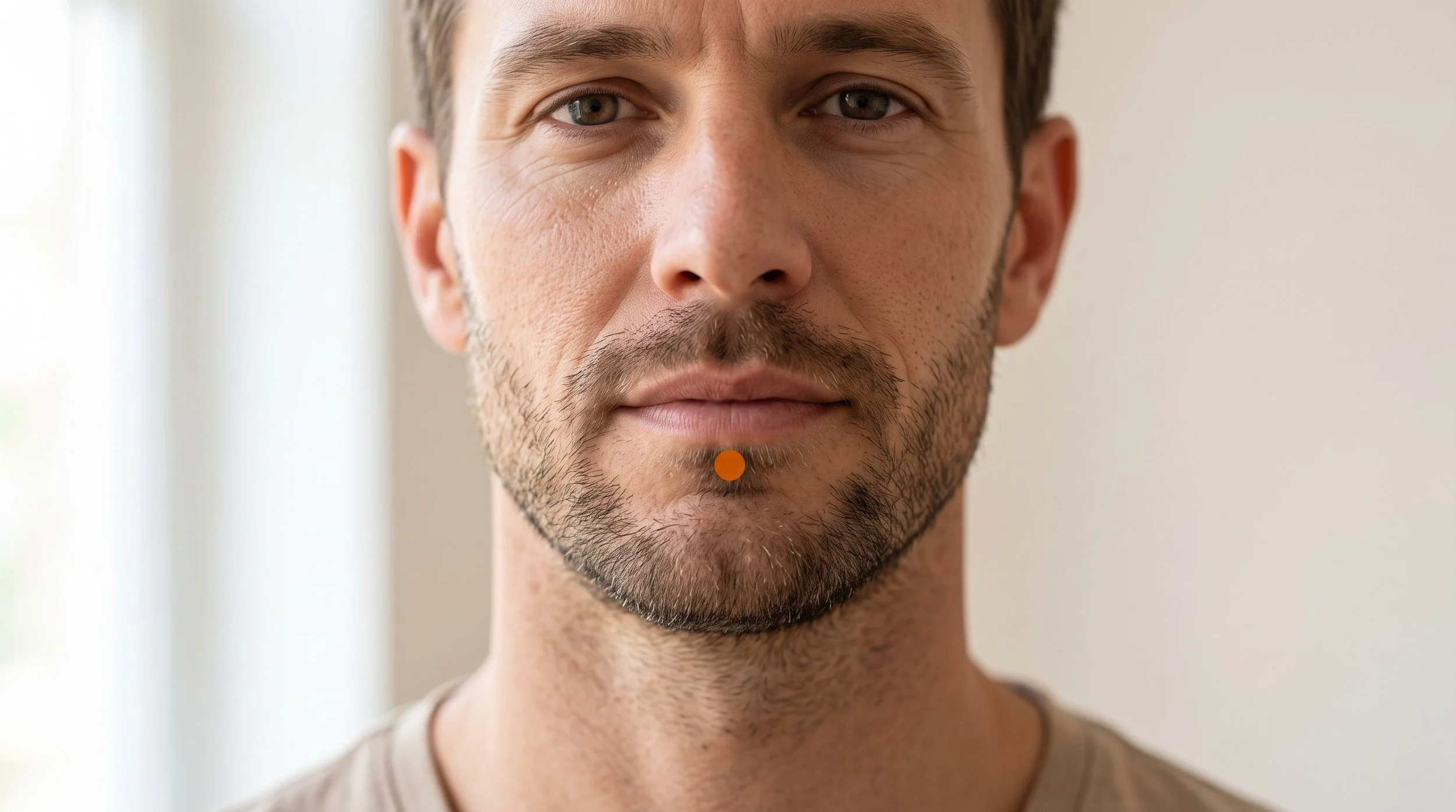
CV24 (Chengjiang, often translated as Container of Fluids or Saliva Receiver), also written Ren 24, is the final point of the Conception vessel, sitting in the small horizontal dimple of the mentolabial groove, roughly midway between the lower lip and the tip of the chin. It is a tiny target in a busy neighborhood: the mentalis muscle, the sensory territory of the mental nerve, and the motor field of the facial nerve all meet here, which is why the CV24 acupuncture point has been used for centuries for deviation of the mouth, facial numbness, lower tooth and gum pain, and disorders of saliva and dry mouth.
Classical texts also treat it as a crossing point where the Conception vessel meets the Governing vessel and both yangming channels, and that traditional attribution maps neatly onto how clinicians actually use it today: threaded along the lower lip toward ST4 in facial paralysis work, or paired with midline neck points for a stiff, hard to turn neck.
- Location and layers: Chengjiang lies in the center of the mentolabial groove, with the needle passing through thin chin skin into superficial fascia and the upper fibers of the mentalis, a muscle that elevates the chin pad and protrudes the lower lip during speech, clenching, and expressive grimacing.
- Traditional categories translated: the Deadman text lists conception vessel 24 as a meeting point of the Conception and Governing vessels with the hand and foot yangming (Large Intestine and Stomach) channels, and as one of Sun Si-miao's ghost points under the alternative name Ghost Market (Deadman et al., 2009). In neurophysiological terms, those crossings describe a point that shares innervation and reflex territory with the entire lower face and jaw.
- Mechanism: needling here recruits mental nerve afferents (a terminal branch of the mandibular division of the trigeminal nerve) whose second order neurons sit in the spinal trigeminal nucleus, a column that blends with the upper cervical dorsal horn, and this input may modulate pain through segmental gating and descending inhibitory pathways (Zhao, 2008).
- Research picture: reviews of acupuncture for Bell's palsy have been limited by trial quality rather than clearly negative (Chen et al., 2010; Li et al., 2015), while reviews in trigeminal neuralgia and temporomandibular disorders suggest pain benefit with low certainty (Ang et al., 2023; Di Francesco et al., 2024), and individual patient data across chronic pain conditions support effects beyond sham and no acupuncture (Vickers et al., 2018).
- Clinical framing: this is a supporting local point rather than a standalone treatment. At Morningside we use the Ren 24 chin point inside a face and jaw protocol that usually includes distal points such as LI4 and manual or dry needling work on masseter, medial pterygoid, and suboccipital muscles.
- De qi here is modest and precise: a small, dull, slightly heavy ache in the chin crease that may spread across the lower lip, sometimes with a brief tingle along the lip border because of the mental nerve. Because facial skin is vascular and richly innervated, thin needles, shallow angles, and firm pressure after removal keep the experience comfortable.
Struggling With Facial Palsy, Jaw Pain, or Numbness Around the Mouth?
Facial and jaw complaints rarely respond to one point or one technique. Our acupuncturists combine gentle local needling at CV24 and the surrounding yangming points with distal points and targeted dry needling of the chewing muscles, then adjust week to week based on how your face moves and feels. If chewing, smiling, or speaking has become effortful, an evaluation is the fastest way to know what is treatable. Schedule a visit and we will build the plan around your exam.
Schedule NowAnatomy of CV24: Why the Mentolabial Groove Is Such an Important Location
The mentolabial groove is the horizontal crease that separates the lower lip from the chin pad, and CV24 sits at its midpoint on the anterior midline. Under the thin skin of this crease lies a loose superficial fascial layer and then the upper edge of the mentalis, a small paired muscle running from the mandible into the skin of the chin. Mentalis and its neighbors (depressor labii inferioris laterally and orbicularis oris just above) get loaded constantly by speech, chewing, lip pursing, and the low-grade clenching that comes with stress and long screen hours.
In patients recovering from facial nerve injury, this region is also where compensatory tightening and asymmetry tend to show up first, which makes the Chengjiang face point a useful window into how the lower face is behaving.
The sensory supply to the chin and lower lip comes from the mental nerve, the terminal branch of the inferior alveolar nerve and therefore part of the mandibular division of the trigeminal nerve, while the muscles themselves are driven by the marginal mandibular and buccal branches of the facial nerve. That anatomy explains the classical pairing of numbness with weakness in this territory: one nerve carries the sensation, another carries the movement, and both are affected in different lower face conditions.
Trigeminal afferents from the chin synapse in the spinal trigeminal nucleus, a long column that extends caudally to blend with the dorsal horn of the upper cervical segments. Needle stimulation of this region therefore feeds into a relay that also receives input from the neck, and repeated afferent volleys of this kind are associated with segmental inhibition and with activation of descending pain modulating pathways from the midbrain and brainstem (Zhao, 2008).
Vascularly, the region is supplied by branches of the inferior labial and mental arteries, and the mental foramen (the exit for the mental neurovascular bundle) sits below the second premolar on each side, lateral to the midline, which matters most when a needle is threaded sideways toward ST4. Because the face bruises easily, standard technique is conservative: transverse-oblique insertion directed superiorly about 0.2 to 0.3 cun, or a shallow transverse thread along the lower lip toward ST4 when treating facial paralysis (Deadman et al., 2009).
Fine needles, no deep perpendicular insertion, gentle rotation rather than vigorous lifting and thrusting, and firm pressure with a clean cotton ball on withdrawal are the practical rules. Patients on blood thinners, or those with active oral herpes lesions or broken skin in the area, need the technique modified or the point avoided.
Related Conception Vessel Related LI4 Acupuncture PointCV24 (Ren 24) at a Glance: Classification, Location, and Clinical Use
| Category | Detail |
|---|---|
| Traditional Name | Chengjiang, commonly rendered as Container of Fluids or Saliva Receiver (also recorded under the alternative name Guishi, Ghost Market) |
| Channel Classification | Conception Vessel, point 24 (REN-24), the terminal point of the channel (also called the Ren Mai or Ren channel) |
| Point Categories | Meeting point of the Conception vessel with the Governing vessel and with the Large Intestine and Stomach (hand and foot yangming) channels; one of Sun Si-miao's thirteen ghost points; final point of the Conception vessel |
| Precise Location | On the anterior midline of the face, above the chin, in the small depression at the center of the mentolabial groove, roughly midway between the lower lip and the chin |
| Tissue Stimulated | Chin skin and superficial fascia of the mentolabial crease, the upper fibers of the mentalis, with depressor labii inferioris and orbicularis oris immediately adjacent; sensory territory of the mental nerve and motor territory of the marginal mandibular branch of the facial nerve. Related myofascial work often extends to the jaw and neck muscles covered in our Acupuncture Muscle Pain resources. |
| Needle Depth / Direction | Transverse-oblique insertion angled superiorly 0.2 to 0.3 cun, or shallow transverse insertion threaded laterally along the lower lip toward ST4; no deep perpendicular needling, and rotation only rather than strong lift and thrust |
| De Qi Sensation | A small, dull, mildly heavy or aching sensation in the chin crease, sometimes spreading across the lower lip or producing a brief tingle along the lip border; sharpness should be transient, and the point should never feel electric or radiating into the teeth |
| Primary Clinical Uses | Facial paralysis and deviation of the mouth, facial pain and numbness of the lower face, lower tooth and gum pain, jaw and TMJ discomfort, drooling or dry mouth complaints, and classically stiffness of the head and nape |
| Common Point Combinations |
|
In the Deadman, Al-Khafaji and Baker text, CV24 is presented as a point that extinguishes wind in the face and regulates the Conception vessel, and the commentary explains the logic in traditional terms: the yangming channels govern the face, this point sits just below the mouth where those channels cross the midline, and so its main classical job is treating facial pain, facial numbness, and deviation of the mouth and eye.
The same source notes that classical medicine distinguished facial paralysis from exterior wind attacking the channels of the face from paralysis due to interior wind stirring upward, a split that corresponds loosely to what modern medicine calls peripheral versus central facial palsy.
Its name, traditionally read as containing or receiving fluid, accounts for the classical indications around excess watery saliva, dry mouth, and wasting and thirsting disorder with great thirst, and because the point is also described as meeting the Governing vessel, which runs up the back of the neck, several classics recommend it for stiffness and pain of the nape (Deadman et al., 2009).
What is striking is the coherence of the pattern: a single midline chin point was assigned to the mouth, the lower face, the fluids of the mouth, and the opposite side of the same horizontal plane at the neck.
Why CV24 Is Used for Stiff Necks and Jaw Pain, Not Just the Chin
The classical recommendation of a chin point for a neck that will not rotate looks strange until you follow the wiring. Sensory information from the chin, lower lip, and lower teeth travels in the trigeminal nerve to the spinal trigeminal nucleus, and the lower end of that nucleus is continuous with the dorsal horn of the upper cervical spinal cord. Nerve fibers from the upper neck and fibers from the face converge onto many of the same second order neurons.
That convergence is the accepted explanation for why neck problems can produce facial and jaw symptoms, and why input from the face can influence how the neck feels. Needling at the chin is not moving anything through the neck; it is feeding a relay that the neck already shares.
The second half of the story is descending inhibition. Needle stimulation strong enough to produce de qi generates small fiber input that engages brainstem and midbrain circuits releasing endogenous opioids, serotonin, and norepinephrine at the spinal and trigeminal level, which reduces the responsiveness of pain transmitting neurons in the region (Zhao, 2008). This is a systemic mechanism, not a local one, which is why a single small point at the chin is almost always combined with distal points and with treatment of the muscles that actually generate jaw and neck symptoms.
Locally, there is also a straightforward tissue effect. Needling in the face produces axon reflex vasodilation and a small inflammatory signaling cascade that increases local blood flow, and clinicians treating facial paralysis rely on repeated gentle stimulation of the affected territory during the recovery window. The evidence that this speeds nerve recovery is not strong (Chen et al., 2010), so we frame it honestly with patients: local needling may help comfort, muscle tone, and awareness of the affected side while the nerve does its own healing.
What the Research Shows for CV24 (Ren 24)
One note on naming before the evidence: in the research literature this point is almost always listed as CV24, the WHO standard code, while many textbooks and Chinese sources write Ren 24 or RN24, so it is worth searching those as well if you want to read the studies below in full.
There is no trial that isolates CV24 by itself, and there almost certainly never will be. Facial and jaw research tests multi-point protocols in which this point is one member of a group, usually alongside ST4, ST6, LI4, and GB points, so the honest reading is that CV24 sits inside protocols with mixed but generally encouraging evidence rather than carrying an evidence base of its own. Trial quality in this literature is a recurring problem, particularly in facial palsy, where small samples, unclear randomization, and outcome reporting have limited what reviewers can conclude. The table below summarizes the reviews most relevant to the conditions for which this point is chosen.
| Study | Type | Focus | Key Finding |
|---|---|---|---|
| Chen et al., 2010 | Cochrane systematic review | Acupuncture for Bell's palsy | Reviewers concluded that the quality of the included trials was too low to determine whether acupuncture helps recovery from Bell's palsy. |
| Li et al., 2015 | Systematic review and meta-analysis | Acupuncture compared with other therapies in Bell's palsy | Pooled results favored acupuncture on recovery measures, but the authors cautioned that methodological weaknesses limit confidence in the estimate. |
| Ang et al., 2023 | Systematic review and meta-analysis | Acupuncture for trigeminal neuralgia across 30 randomized trials | Acupuncture reduced pain and attack frequency with a favorable safety profile compared with carbamazepine, though the certainty of evidence was rated low. |
| Di Francesco et al., 2024 | Systematic review and meta-analysis | Acupuncture and laser acupuncture for temporomandibular disorders | Both approaches outperformed placebo control on pain outcomes, supporting acupuncture as a reasonable option within TMD care. |
| Ni et al., 2020 | Systematic review and meta-analysis | Acupuncture for radiation-induced xerostomia in cancer patients | Symptoms of dry mouth improved with acupuncture, while objective salivary flow measures did not clearly change, and evidence quality was low. |
| Vickers et al., 2018 | Individual patient data meta-analysis | Acupuncture across chronic pain conditions including head and neck pain | Acupuncture outperformed both sham and no-acupuncture controls, with effects persisting over time, supporting a genuine treatment effect beyond expectation alone. |
| Zhao, 2008 | Narrative review of mechanisms | Neural pathways underlying acupuncture analgesia | Analgesic effects are attributed to afferent-driven segmental inhibition and descending modulation involving endogenous opioid and monoamine systems. |
Neck Stiffness That Travels Into the Jaw and Face?
The chin and the upper neck share more nervous system real estate than most people expect, which is why classical formulas paired this chin point with midline neck points for necks that will not rotate. We assess cervical mobility, jaw mechanics, and trigger points together rather than treating them as separate problems. Most patients notice changes in range of motion within the first few sessions. Book an appointment and let us map the pattern.
Schedule NowCV24 in the Context of Trigger Point Work
Acupuncture, in our definition, means the use of an acupuncture needle, and that includes dry needling of myofascial trigger points. In face and jaw cases, CV24 is usually the smallest part of the session.
The muscles that generate most lower face and jaw symptoms are the masseter, the temporalis, the medial and lateral pterygoids, the digastric, and the platysma, and their referral patterns overlap directly with the region this point serves: deep masseter and anterior digastric can send pain into the mandible and lower teeth, while platysma tension produces a prickling, crawling quality across the chin and jawline (Simons et al., 1999). Treating those muscles usually changes symptoms more than any single facial point does.
Practically, a session might combine shallow needling at CV24 and neighboring yangming points on the affected side, intraoral or extraoral needling of masseter and medial pterygoid if jaw opening is limited, suboccipital and upper trapezius work when the neck is contributing, and distal points such as LI4 to add a systemic analgesic input. The mentalis itself can be palpated for a tight, gritty band in chronic clenchers and lip-pursers, and when it is tender the chin point doubles as a local myofascial target rather than only a channel point. We reassess jaw opening, lip symmetry, and neck rotation between sessions to decide what to keep and what to drop.
CV24 Facial Pain Treatment at NYC's Highest-Rated Acupuncture Clinic
Morningside Acupuncture is the highest-rated acupuncture and dry needling clinic in New York City with over 500 five-star Google reviews, and facial pain, TMJ, and post-palsy recovery are among the cases we see most. Every session pairs classical point selection with modern orthopedic assessment, so you understand what we are needling and why. Treatment is precise, hygienic, and paced to your comfort. Schedule your first visit today.
Schedule NowFrequently Asked Questions
Is CV24 the same point as Ren 24?
Yes. CV24 and Ren 24 are two codes for the same point, Chengjiang. CV stands for Conception Vessel and is the WHO standard abbreviation, the one you will see in most research papers. Ren comes from Ren Mai, the Chinese name of the vessel, and it is the form used in many textbooks and acupuncture schools. You will also come across it written as REN-24, RN24, or Conception Vessel 24. Whichever code is used, the location and the uses are the same.
What does CV24 feel like when needled?
Most people feel a brief pinch as the needle passes the skin of the chin, then a small dull ache or heaviness sitting right in the crease. Because the mental nerve supplies this territory, the sensation often spreads across the lower lip or gives a short tingling flash along the lip border, which is normal and settles quickly. The needle is inserted shallowly and at a slant, so there is very little depth involved. Sharp, electric, or radiating pain into the teeth is not expected, and you should tell your acupuncturist immediately if you feel it so the needle can be adjusted or removed.
Why would an acupuncturist needle my chin for jaw pain or a stiff neck?
Because of how the nervous system is organized rather than anything mysterious. Sensation from the chin, lower lip, and lower teeth travels in the trigeminal nerve into the spinal trigeminal nucleus, whose lower portion merges with the dorsal horn of the upper cervical spinal cord, so face and neck inputs share the same second order neurons. Stimulating one territory can influence how the other is processed, and needling also recruits descending pain inhibitory pathways that act broadly rather than only where the needle sits (Zhao, 2008). Classical texts arrived at the same pairing empirically, recommending this chin point together with midline neck points for necks that could not rotate (Deadman et al., 2009).
Can I press CV24 myself between sessions?
Yes, and acupressure here is easy to self-administer. Find the small horizontal dimple in the middle of the crease between your lower lip and your chin, then press straight in with the pad of your index finger using light to moderate pressure, enough to feel a dull ache but not enough to blanch or bruise the skin. Hold for 30 to 60 seconds, release, and repeat two or three times, then add small circular strokes along the crease and out toward the corners of the mouth for another 30 seconds per side. Two or three rounds a day is plenty, and it pairs well with squeezing LI4 in the web of the hand for 60 seconds. Stop if the area feels raw, if there is a cold sore or broken skin, or if pressure reproduces sharp or electric pain, and see a clinician instead of pressing harder.
Is CV24 safe to needle?
In trained hands it is a safe point, and the technique conventions exist for good reason. Insertion is transverse-oblique and shallow, usually 0.2 to 0.3 cun, or threaded sideways along the lower lip toward ST4 in facial paralysis work, and deep perpendicular needling is not used (Deadman et al., 2009). The face is vascular, so small bruises are the most common side effect and are minimized with fine needles and firm pressure on withdrawal. We modify or skip the point for patients on anticoagulants, for anyone with active oral herpes, dermatitis, or broken skin in the area, and for people with recent dental procedures or implants in the anterior mandible. Sterile single-use needles and clean technique are standard at every visit.
Where exactly is CV24 located?
Run your finger down from the center of your lower lip and you will drop into a horizontal groove before the chin pad rises up: that groove is the mentolabial sulcus, and CV24 sits at its midpoint on the body's front midline, approximately halfway between the lower lip and the chin. It is the last point of the Conception vessel, sitting almost directly opposite the base of the skull on the same horizontal plane, and it is the only point of the channel that lies on the face. A small extra point called Jiachengjiang is located about one cun to either side of it and is used for facial pain and facial spasm (Kim, 2008).
References
- Deadman, P., Al-Khafaji, M., & Baker, K. (2009). A manual of acupuncture. Journal of Chinese Medicine Publications.
- Maciocia, G. (2005). The foundations of Chinese medicine: A comprehensive text for acupuncturists and herbalists (2nd ed.). Elsevier Churchill Livingstone.
- Cunningham, P. M. (2000). Acupuncture points: A practical guide to classical and modern usage. Odyssey Press.
- Kim, H. (2008). Handbook of Oriental medicine (3rd ed.). Harmony & Balance Press.
- Simons, D. G., Travell, J. G., & Simons, L. S. (1999). Travell & Simons' myofascial pain and dysfunction: The trigger point manual, Vol. 1: Upper half of body (2nd ed.). Williams & Wilkins.
- Chen, N., Zhou, M., He, L., Zhou, D., & Li, N. (2010). Acupuncture for Bell's palsy. Cochrane Database of Systematic Reviews, 2010(8), CD002914. https://doi.org/10.1002/14651858.CD002914.pub5
- Li, P., Qiu, T., & Qin, C. (2015). Efficacy of acupuncture for Bell's palsy: A systematic review and meta-analysis of randomized controlled trials. PLOS ONE, 10(5), e0121880. https://doi.org/10.1371/journal.pone.0121880
- Ang, L., Kim, H.-J., Heo, J.-W., Choi, T.-Y., Lee, H. W., Kim, J. I., & Lee, M. S. (2023). Acupuncture for the treatment of trigeminal neuralgia: A systematic review and meta-analysis. Complementary Therapies in Clinical Practice, 52, 101763. https://doi.org/10.1016/j.ctcp.2023.101763
- Di Francesco, F., Minervini, G., Siurkel, Y., Cicciù, M., & Lanza, A. (2024). Efficacy of acupuncture and laser acupuncture in temporomandibular disorders: A systematic review and meta-analysis of randomized controlled trials. BMC Oral Health, 24(1), 174. https://doi.org/10.1186/s12903-023-03806-1
- Ni, X., Tian, T., Chen, D., Liu, L., Li, X., Li, F., Liang, F., & Zhao, L. (2020). Acupuncture for radiation-induced xerostomia in cancer patients: A systematic review and meta-analysis. Integrative Cancer Therapies, 19, 1534735420980825. https://doi.org/10.1177/1534735420980825
- Vickers, A. J., Vertosick, E. A., Lewith, G., MacPherson, H., Foster, N. E., Sherman, K. J., Irnich, D., Witt, C. M., & Linde, K. (2018). Acupuncture for chronic pain: Update of an individual patient data meta-analysis. Journal of Pain, 19(5), 455-474. https://doi.org/10.1016/j.jpain.2017.11.005
- Zhao, Z. Q. (2008). Neural mechanism underlying acupuncture analgesia. Progress in Neurobiology, 85(4), 355-375. https://doi.org/10.1016/j.pneurobio.2008.05.004
Disclaimer: This web site is intended for educational and informational purposes only. Reading this website does not constitute providing medical advice or any professional services. This information should not be used for diagnosing or treating any health issue or disease. Those seeking medical advice should consult with a licensed physician. Seek the advice of a medical doctor or other qualified health professional for any medical condition. If you think you have a medical emergency, call 911 or go to the emergency room. No acupuncturist-patient relationship is created by reading this website or using the information. Morningside Acupuncture PLLC and its employees and contributors do not make any express or implied representations with respect to the information on this site or its use. For any legal interpretation of scope of practice in your state, consult a licensed attorney or regulatory authority.
Read more from our blog