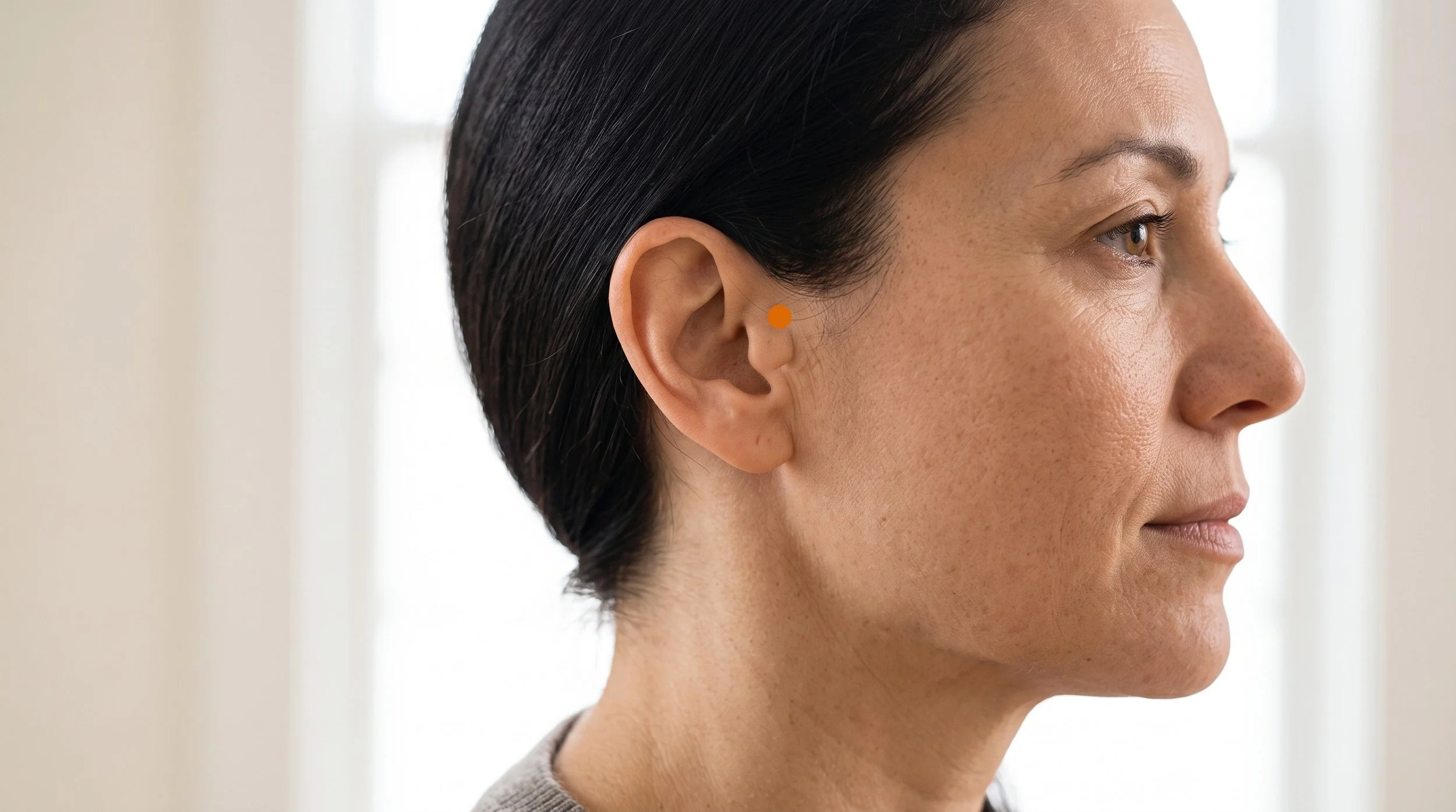
SJ21 Acupuncture Point (Ermen)
The Ear Gate in Front of the Tragus: Anatomy, Mechanism, and Why This Preauricular Point Serves Both the Ear and the Jaw Joint
SJ21 (Ermen, "Ear Gate"), also written TE21, is the twenty-first point of the Triple Burner channel, sitting in the small hollow directly in front of the notch above the tragus, just above the rounded head of the jawbone. It is the uppermost of three points stacked in front of the ear, with SI19 below it and GB2 lowest of the three, and it is one of the few points on the body that only fully appears when the patient opens the mouth, since that motion slides the mandibular condyle forward and opens the depression.
Traditionally the te21 acupuncture point was used to benefit the ears and clear heat, which in practice meant tinnitus, reduced hearing, earache and ear discharge, along with toothache and stiff lips. In a modern clinic its position over the temporomandibular joint and along the auriculotemporal nerve makes it equally useful for jaw pain, clicking and the ear fullness that so often travels with clenching.
- SJ21 sits in a shallow preauricular hollow: thin skin, loose subcutaneous tissue, then the capsule of the temporomandibular joint and the condyle of the mandible immediately deep, which is why the point is located and needled with the mouth open and the needle angled slightly downward and back.
- Traditional sources credit Ermen with benefiting the ears and clearing heat, listing tinnitus, deafness, earache, ear discharge, toothache and stiffness of the lips; read neurophysiologically, these are all territories fed by the trigeminal system and its convergence with upper cervical input.
- The auriculotemporal nerve, a branch of the mandibular division of the trigeminal nerve, runs with the superficial temporal vessels at this point and supplies the jaw joint, the tragus and part of the ear canal, which explains why ear symptoms and jaw symptoms so often present together.
- Needling here recruits the same descending inhibitory pathways described for acupuncture analgesia in general, involving endogenous opioid and monoaminergic systems in the brainstem (Zhao, 2008), and individual patient data pooled across chronic pain trials show effects that persist beyond the treatment visit (Vickers et al., 2018).
- Contemporary literature analysis of acupuncture prescriptions for idiopathic tinnitus found SJ21 among the five most frequently prescribed points, with SJ21, SI19, GB2 and SJ17 emerging as the core cluster (Huang et al., 2024), while reviews of tinnitus outcomes remain cautious and inconclusive (Huang et al., 2021).
- De qi at SJ21 is usually a firm, spreading ache or pressure right at the ear opening, sometimes traveling into the ear canal or across the jaw joint and cheek; sharpness or a pulsing sensation means the needle is too close to the superficial temporal artery and should be adjusted.
Ringing Ears or a Jaw That Clicks and Aches?
Ear symptoms and jaw symptoms are frequently the same problem wearing two different hats, and SJ21 sits exactly where those two stories overlap. At Morningside Acupuncture we assess your bite, chewing muscles and neck before choosing whether the ear-front points, the masticatory muscles, or both should be treated. Sessions may combine gentle needling at SJ21, SI19 and GB2 with trigger point work in the masseter and temporalis. Schedule a visit and we'll map out where your symptoms are actually coming from.
Schedule NowAnatomy of SJ21: Why the Hollow in Front of the Tragus Is Such an Important Location
Run a fingertip forward from the small notch above the tragus and you land in a shallow dip that deepens the moment the mouth opens. Under the skin here there is very little muscle, just thin subcutaneous tissue and fascia over the capsule of the temporomandibular joint, with the condyle of the mandible sliding forward and back directly beneath. That is why the classical location instruction insists on an open mouth: with the jaw closed, the condyle fills the space.
The tissue at this spot is loaded by everything the jaw does, so chewing tough food, gum habits, daytime clenching, nighttime grinding and long dental appointments all leave their mark on the joint capsule and the surrounding muscle attachments.
The nerve geography is what makes SJ21 clinically interesting. The auriculotemporal nerve, a branch of the mandibular division of the trigeminal nerve, passes through this region along with branches of the facial nerve, and it carries sensation from the jaw joint, the tragus, part of the external ear canal and the skin of the temple. Because a single nerve serves both the joint and the ear, irritation in the joint is frequently experienced as ear pain, blocked ear or ringing, and patients often arrive convinced the problem is an ear infection.
Needling at this location stimulates that same afferent field, and stimulation of this kind engages descending inhibitory control from the brainstem, involving endogenous opioid and monoaminergic mechanisms that dampen pain transmission at the segmental level (Zhao, 2008). Pooled individual patient data across chronic pain conditions suggests effects that outlast the needle session itself rather than fading immediately (Vickers et al., 2018).
The structure that governs technique here is vascular. The superficial temporal artery and vein climb just behind and above the point, and the parotid gland lies below and in front, so SJ21 is a shallow, controlled point rather than an aggressive one. Standard practice is oblique insertion with the mouth open, directed slightly downward and backward, roughly 0.5 to 1 cun, after which the mouth can be closed comfortably; if the needle is retained with the mouth open, a safe bite block is used (Deadman et al., 2007; Cunningham, 2001).
Palpating for the temporal pulse before insertion and redirecting away from it is a simple habit that avoids bruising. Classical sources also prohibit moxibustion at this point when pus is discharging from the ear, and modern practice treats active ear infection as a reason for medical evaluation first (Deadman et al., 2007; O'Connor & Bensky, 1981).
Related Best Acupuncture Points For Headaches Related Best Acupuncture Points For Neck PainSJ21 (TE21) at a Glance: Classification, Location, and Clinical Use
| Category | Detail |
|---|---|
| Traditional Name | Ermen (Ear Gate or Ear Door) |
| Channel Classification | Triple Burner (Sanjiao) channel of Hand Shaoyang, point 21, also written TE21 or TB-21 (also called the Triple Energizer, the Triple Heater or Triple Warmer) |
| Point Categories | No five-shu, hui-meeting, or extraordinary vessel designation is recorded for SJ21 in the standard point texts. It is classified as a local ear and jaw point, the uppermost of the three preauricular points (above SI19 and GB2), and in the arrangement of Sanjiao channel points in the Great Compendium of Acupuncture and Moxibustion it appears as the last point of the channel. |
| Precise Location | In front of the ear, in the depression immediately anterior to the supratragic notch and slightly above the condyloid process of the mandible. The depression opens when the patient opens the mouth, which is how the point is located. |
| Tissue Stimulated | Thin preauricular skin and subcutaneous fascia over the capsule of the temporomandibular joint and the mandibular condyle, with the auriculotemporal nerve and superficial temporal vessels alongside; functionally linked to the masseter, temporalis and lateral pterygoid muscles addressed in dry needling for jaw and neck pain |
| Needle Depth / Direction | Mouth open, oblique insertion angled slightly downward and posteriorly, 0.5 to 1 cun; the mouth may close after insertion, or a bite block is used if the needle is retained with the mouth open. Palpate and avoid the superficial temporal artery. Classical sources prohibit moxibustion when there is discharge of pus from the ear. |
| De Qi Sensation | A firm, distending ache or pressure at the ear opening, often spreading into the ear canal or across the jaw joint and cheek; some patients notice a brief sense of fullness or change in the ear. Sharp or pulsatile sensation calls for repositioning. |
| Primary Clinical Uses | Tinnitus and reduced hearing, earache and ear discharge, temporomandibular joint pain, clicking and limited mouth opening, jaw-related headache, and toothache in classical use |
| Common Point Combinations |
|
In the commentary of A Manual of Acupuncture, Deadman and colleagues describe Ermen SJ21 as the highest of the three points arranged in front of the ear, above Tinggong SI19 and Tinghui GB2, and note that all three were traditionally used for essentially the same range of ear complaints: ringing, hearing loss, pain, itching and discharge. Because they sit within a fingerbreadth of one another and carry overlapping indications, the text observes that separating them on clinical grounds is difficult, and it offers the practical suggestion that they be alternated when the ear region needs to be needled repeatedly.
Like its neighbor SJ20, Ermen also carried indications for toothache, decayed teeth and stiff lips, and classical formulas extended it to swelling and pain under the jaw, headache, lockjaw and neck pain. Standard texts summarize the traditional actions as benefiting the ears and clearing heat, and both Deadman and Chinese Acupuncture and Moxibustion record the caution against moxibustion when the ear is discharging pus.
What is striking about the classical pattern is how neatly it prefigures the anatomy: a point sitting on the jaw joint, in the field of a nerve that serves the joint, the ear canal and the teeth, was assigned exactly those three symptom territories centuries before that nerve was described.
Why SJ21 Is Used for Jaw Pain and Clicking, Not Only for Ear Symptoms
The simplest explanation is anatomical adjacency. SJ21 sits directly over the temporomandibular joint, and the auriculotemporal nerve that supplies that joint also supplies the tragus, part of the ear canal and the skin of the temple. Sensory fibers from all of these converge on the same brainstem territory, the spinal trigeminal nucleus, where input from the upper cervical spine arrives as well. That convergence is why a patient with an inflamed jaw joint may describe an earache, why neck tension can amplify jaw pain, and why treating one region often changes the other. Needling the preauricular tissue delivers a strong, well-localized afferent volley into precisely this shared pathway.
Beyond the segmental level, needle stimulation recruits descending inhibitory control from the periaqueductal gray and rostral ventromedial medulla, mediated by endogenous opioid and monoaminergic systems, which reduces the gain on incoming nociceptive signals (Zhao, 2008). Local effects matter too: needling produces measurable changes in local circulation and in the sensitivity of muscle and capsular tissue, which may be part of why patients often report easier mouth opening in the minutes after treatment.
Pooled trial data in chronic pain conditions suggests that these effects are not purely a placebo response and that some benefit persists over time (Vickers et al., 2018).
For ear symptoms specifically, the mechanism is less settled and the honest answer is that we do not fully know. Prescription analyses show SJ21 is among the most commonly chosen points for idiopathic tinnitus, clustering tightly with SI19, GB2 and SJ17 (Huang et al., 2024), but frequency of use reflects tradition and convention as much as demonstrated effect. Where a patient's tinnitus varies with jaw position, clenching or neck movement, the case for local needling is stronger, since a musculoskeletal contribution is plausible. Where hearing loss is sudden or progressive, audiology and ENT evaluation come first.
What the Research Shows for SJ21 (TE21)
One note on naming before the evidence: in the research literature this point appears as TE21, the WHO standard code, and also as SJ21 or TB21 depending on the authors, so it is worth searching all three if you want to read the studies below in full.
It is worth being clear about what the research can and cannot tell us. No trial has isolated SJ21 on its own; reviews test whole protocols in which this point is one of several, usually alongside SI19, GB2, SJ17 and distal points, and the trials themselves vary in quality, session count and outcome measures. That means the evidence below describes the company SJ21 keeps rather than the point in isolation, and the tinnitus literature in particular remains unsettled while the jaw pain literature is modestly more encouraging in the short term.
| Study | Type | Focus | Key Finding |
|---|---|---|---|
| Huang et al., 2021 | Systematic review and meta-analysis | Acupuncture for tinnitus across eight randomized trials | No significant difference was found on the primary visual analogue scale outcome, with some positive signals on tinnitus handicap and severity scores, and the authors judged the overall evidence insufficient for firm conclusions. |
| Huang et al., 2024 | Data mining analysis of clinical prescriptions | Point selection patterns across 221 acupuncture prescriptions for primary idiopathic tinnitus | SJ21 ranked among the five most frequently used points, and SJ21 with SI19, GB2 and SJ17 emerged as the core combination, which reflects prescribing convention rather than proven efficacy. |
| Di Francesco et al., 2024 | Systematic review and meta-analysis | Acupuncture and laser acupuncture for temporomandibular disorders across 11 randomized trials | Acupuncture appeared helpful for short-term reduction of muscle-origin TMD pain, though the authors described the overall evidence base as limited. |
| Al-Moraissi et al., 2023 | Network meta-analysis of randomized trials | Acupuncture and dry needling for masticatory muscle pain | Needling therapies compared favorably with control interventions for jaw muscle pain, with differences between needling styles less important than the act of needling itself. |
| Khayamzadeh et al., 2025 | Systematic review | Dry needling of masseter, temporalis and other masticatory muscles for temporomandibular disorders | Across ten randomized trials, dry needling of the chewing muscles was reported as a useful minimally invasive option, with study heterogeneity limiting how strongly this can be stated. |
| Vickers et al., 2018 | Individual patient data meta-analysis | Acupuncture across chronic pain conditions including head and neck pain | Acupuncture was superior to both sham and no-acupuncture controls, with effects that declined only modestly over twelve months. |
Why Clenching Deserves More Than a Night Guard?
A night guard protects your teeth, but it does not address the overloaded muscles and irritated joint capsule that keep generating pain. Our practitioners use SJ21 as a local point over the temporomandibular joint, paired with distal points on the arm and hand and with targeted dry needling of the jaw and neck muscles. Most patients also leave with jaw-relaxation and posture strategies to use between visits. Book an appointment to start a plan that works on the muscles, not just the enamel.
Schedule NowSJ21 in the Context of Trigger Point Work
Because acupuncture is defined by the tool rather than the tradition, the same filiform needle used at SJ21 can also be directed into specific myofascial targets, which is what dry needling describes. In jaw cases we commonly pair SJ21 with needling of the masseter and temporalis, and where indicated and within scope, the lateral pterygoid region. Trigger points in these muscles are documented to refer pain into the teeth, the temple, the jaw joint and the ear itself, and masseter trigger points in particular can produce a deep ear ache or a sense of blockage with no otologic finding (Simons et al., 1999).
Sternocleidomastoid and upper trapezius are checked in the same visit, since both refer into the head and both influence the trigeminocervical convergence described earlier.
The practical sequencing matters. SJ21 is a shallow, superficial point over a joint capsule, while masseter and temporalis needling is intramuscular, so we usually address the muscles first, reassess mouth opening and tenderness, then place SJ21, SI19 or GB2 as a light finishing local point rather than stacking heavy stimulation over the joint. Needling therapies for masticatory muscle pain compare favorably with control interventions, and the differences between styles appear smaller than the difference between needling and not needling (Al-Moraissi et al., 2023; Khayamzadeh et al., 2025). Patients typically feel a twitch and a brief cramp-like ache in the muscle work and something much gentler at the ear-front point.
SJ21 Tinnitus and TMJ Treatment at NYC's Highest-Rated Acupuncture Clinic
Morningside Acupuncture is the highest-rated acupuncture and dry needling clinic in New York City with over 500 five-star Google reviews, and jaw, ear and headache complaints are among the concerns we see most. Treatment is built around a clear evaluation, careful point selection including SJ21 and its neighbors, and honest expectations about what needling may and may not change. We coordinate with your dentist, ENT or physical therapist when that makes sense. Schedule your first session and let's get to work.
Schedule NowFrequently Asked Questions
Is SJ21 the same point as TE21 or TB21?
Yes. SJ21, TE21, and TB21 are all codes for the same point, Ermen. SJ stands for San Jiao, the Chinese name of the channel. TE (Triple Energizer) is the WHO standard abbreviation and the one you will see in most Western textbooks and research papers. TB (Triple Burner) and TW (Triple Warmer) are older English renderings of the same name that still appear in many books. You will also come across it written as San Jiao 21 or Triple Energizer 21. Whichever code is used, the location and the uses are the same.
What does SJ21 feel like when needled?
Most patients describe a firm, spreading ache or a sense of pressure right at the opening of the ear, sometimes drifting into the ear canal or along the jaw joint toward the cheek. Some notice a brief change in ear fullness. The insertion itself is quick and the depth is modest, usually 0.5 to 1 cun on an oblique downward and backward angle with the mouth open. Sharp, hot or pulsing sensation is not the goal and simply means the needle should be repositioned slightly away from the superficial temporal artery.
Why needle in front of the ear for jaw pain instead of directly on the sore muscle?
We often do both, but SJ21 offers something the muscle belly cannot: direct access to the joint capsule region and to the auriculotemporal nerve that supplies the joint, the tragus and part of the ear canal. That shared innervation is why jaw problems masquerade as ear problems and vice versa. Stimulating this convergent territory recruits segmental and descending inhibitory mechanisms that reduce pain signaling from the whole region (Zhao, 2008). Distal points on the arm, such as SJ5 or LI4, are usually added because they act on the same channel and pain pathways from a distance.
Can I press SJ21 myself between sessions?
Yes, and it is one of the easier points to self-treat. Open your mouth slightly and slide a fingertip forward from the small notch just above the tragus until it drops into a hollow. Apply steady, moderate pressure with the pad of your index or middle finger for 30 to 60 seconds, breathing slowly, then release and repeat two or three times per side. Small circular motions with the jaw relaxed and the teeth slightly apart often feel better than static pressure. Two or three rounds per day is plenty. Stop if you feel a pulse under your finger, if the pressure produces sharp pain, or if there is any active ear infection, drainage or recent ear surgery.
Is SJ21 safe to needle?
In trained hands, yes. The main considerations are the superficial temporal artery and vein just behind and above the point, which is why practitioners palpate first and use a shallow oblique angle, and the parotid gland below. Minor bruising is the most common side effect in this well-vascularized area. If the needle is retained while the mouth stays open, a safe bite block is used so the jaw is not held under strain. Moxibustion is traditionally avoided here when pus is discharging from the ear, and in modern practice an actively infected, draining or newly deafened ear should be evaluated medically before local needling is considered.
Where exactly is SJ21 located?
Find the tragus, the small flap in front of the ear canal, then find the notch at its upper edge. SJ21 lies in the depression immediately in front of that notch and slightly above the rounded head of the jawbone. Ask the patient to open the mouth and the depression deepens noticeably as the condyle slides forward, which is the standard way of confirming the location. SJ21 is the highest of the three points in this vertical line, with SI19 next below it and GB2 lowest, all within roughly a fingerbreadth of one another.
References
- Deadman, P., Al-Khafaji, M., & Baker, K. (2009). A manual of acupuncture. Journal of Chinese Medicine Publications.
- Cheng, X. (Ed.). (1999). Chinese acupuncture and moxibustion (Rev. ed.). Foreign Languages Press.
- O'Connor, J., & Bensky, D. (Eds. & Trans.). (1981). Acupuncture: A comprehensive text. Shanghai College of Traditional Medicine. Eastland Press.
- Cunningham, P. M. (2000). Acupuncture points: A practical guide to classical and modern usage. Odyssey Press.
- Simons, D. G., Travell, J. G., & Simons, L. S. (1999). Travell & Simons' myofascial pain and dysfunction: The trigger point manual, Vol. 1: Upper half of body (2nd ed.). Williams & Wilkins.
- Huang, K., Liang, S., Chen, L., & Grellet, A. (2021). Acupuncture for tinnitus: A systematic review and meta-analysis of randomized controlled trials. Acupuncture in Medicine, 39(4), 264-271. https://doi.org/10.1177/0964528420938380
- Huang, L., Fan, Y., Lin, R., Zhao, Y., Mo, Y., Luo, S., & Li, Z. (2024). Investigating acupoint selection and combinations of acupuncture for primary idiopathic tinnitus using data mining. Medicine, 103(12), e37107. https://doi.org/10.1097/MD.0000000000037107
- Di Francesco, F., Minervini, G., Siurkel, Y., Cicciù, M., & Lanza, A. (2024). Efficacy of acupuncture and laser acupuncture in temporomandibular disorders: A systematic review and meta-analysis of randomized controlled trials. BMC Oral Health, 24(1), 174. https://doi.org/10.1186/s12903-023-03806-1
- Al-Moraissi, E. A., Goddard, G., & Christidis, N. (2023). Are acupuncture and dry needling effective in the management of masticatory muscle pain: A network meta-analysis of randomised clinical trials. Journal of Oral Rehabilitation, 50(1), 87-97. https://doi.org/10.1111/joor.13382
- Khayamzadeh, M., et al. (2025). Dry needling in treatment of temporomandibular joint disorders: A systematic review. Clinical and Experimental Dental Research, 11, 1-9. https://doi.org/10.1002/cre2.70214
- Vickers, A. J., Vertosick, E. A., Lewith, G., MacPherson, H., Foster, N. E., Sherman, K. J., Irnich, D., Witt, C. M., & Linde, K. (2018). Acupuncture for chronic pain: Update of an individual patient data meta-analysis. Journal of Pain, 19(5), 455-474. https://doi.org/10.1016/j.jpain.2017.11.005
- Zhao, Z. Q. (2008). Neural mechanism underlying acupuncture analgesia. Progress in Neurobiology, 85(4), 355-375. https://doi.org/10.1016/j.pneurobio.2008.05.004
Disclaimer: This web site is intended for educational and informational purposes only. Reading this website does not constitute providing medical advice or any professional services. This information should not be used for diagnosing or treating any health issue or disease. Those seeking medical advice should consult with a licensed physician. Seek the advice of a medical doctor or other qualified health professional for any medical condition. If you think you have a medical emergency, call 911 or go to the emergency room. No acupuncturist-patient relationship is created by reading this website or using the information. Morningside Acupuncture PLLC and its employees and contributors do not make any express or implied representations with respect to the information on this site or its use. For any legal interpretation of scope of practice in your state, consult a licensed attorney or regulatory authority.
Read more from our blog



