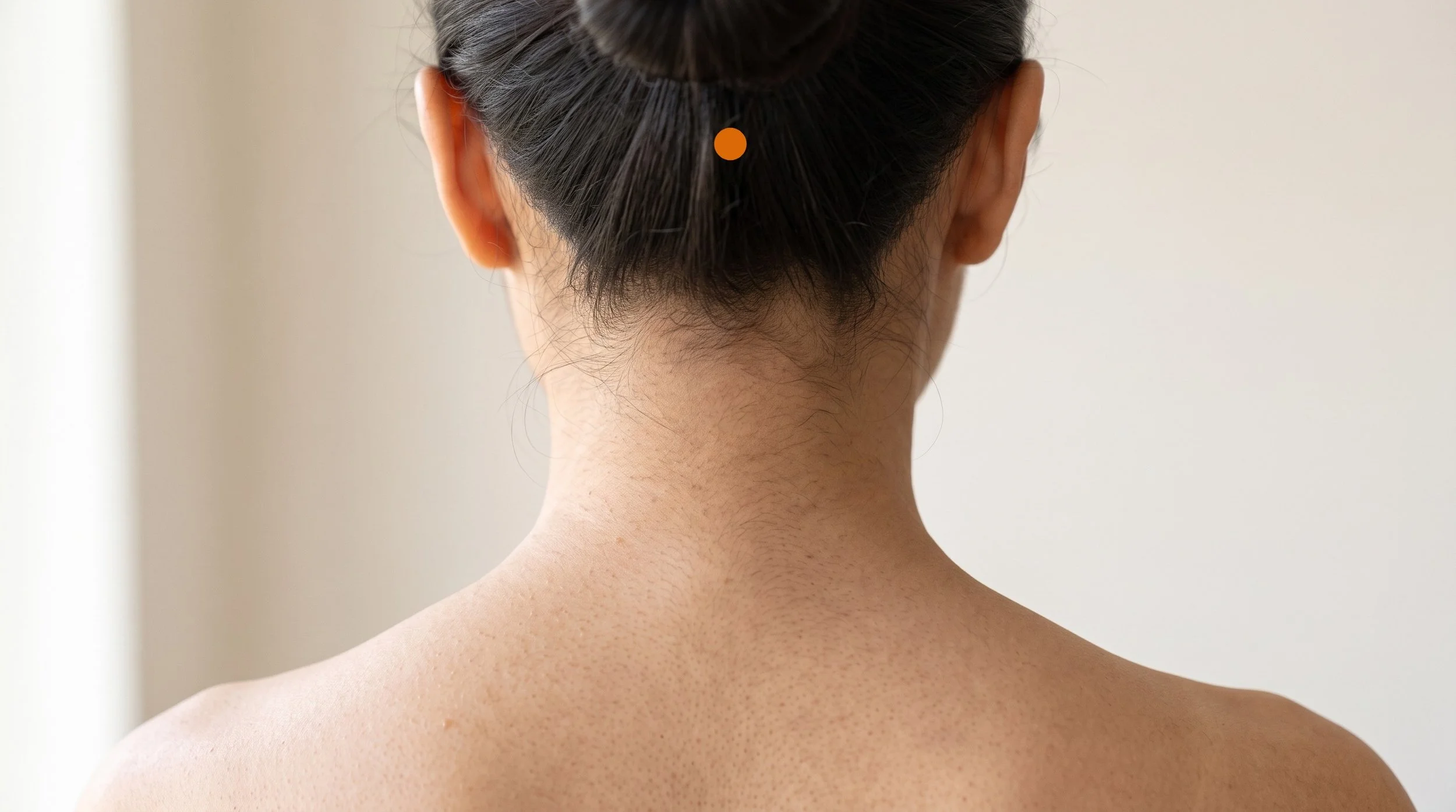
DU16 Acupuncture Point (Fengfu)
The Palace of Wind Below the Occiput: Anatomy, Mechanism, and Why This Midline Point Anchors Headache, Stiff Neck, and Dizziness Treatment
DU16 (also written GV16), known in Chinese as Fengfu and usually translated as Palace of Wind, sits on the midline at the very top of the neck, in the soft hollow you can feel directly below the bony bump at the back of your skull (the external occipital protuberance), roughly a thumb's width above the hairline. As the sixteenth point of the Governing Vessel, the GV16 acupuncture point sits at the junction between head and neck, where the deep suboccipital tissues, the upper cervical nerve roots, and the vascular supply to the back of the brain all crowd into a small space.
That geography is exactly why governing vessel 16 has been used for centuries for headaches at the back of the head, stiff and painful necks, and dizziness, and it is also why the DU 16 neck region demands conservative needling: depth and angle here are not stylistic preferences, they are hard limits.
- Location and layers: DU16 lies on the midline in the depression under the occipital bump, about 1 cun above the posterior hairline, over the ligamentum nuchae between the medial attachments of trapezius and semispinalis capitis, with the deep suboccipital tissues and the atlanto-occipital interval underneath.
- Traditional categories, translated: classical sources list Fengfu as a meeting point of the Governing and Yang Linking vessels, a point of the Sea of Marrow, and one of the Window of Heaven points (Deadman et al., 2009; Cunningham, 2000). In modern terms those designations describe a site that influences the head, the upper neck, and the transition zone where cranial and cervical sensory traffic meets.
- Mechanism: upper cervical (C1 to C3) afferents and trigeminal afferents converge on the same second-order neurons in the trigeminocervical complex, which is the accepted anatomical basis for pain felt at the back of the head being referred forward toward the eye and temple (Bartsch & Goadsby, 2002). Needling here targets that convergence zone directly.
- Systemic effects: needle stimulation recruits descending inhibitory pathways involving the periaqueductal gray and rostral ventromedial medulla, along with endogenous opioid signaling (Zhao, 2008), so the Fengfu wind point is rarely used alone but as part of a segmental plus distal protocol.
- Research picture: Cochrane reviews support acupuncture as a reasonable preventive option for tension-type headache and episodic migraine (Linde et al., 2016a; Linde et al., 2016b), and individual patient data pooling shows modest but persisting effects for chronic pain including neck pain (Vickers et al., 2018). One point-specific study of Governing Vessel points reported that needling DU16 produced changes across more cerebral hemodynamic indices than the trunk points tested, although the design was uncontrolled (Kim et al., 2018).
- De qi: patients typically report a deep, heavy, slightly aching fullness that spreads up over the back of the head, sometimes toward the crown or behind the eyes. Sharp, electric, or radiating sensations are not the goal here and mean the needle should be withdrawn and repositioned.
Headaches That Start at the Base of Your Skull?
Occipital headaches, cervicogenic headaches, and tension-type headaches often share one feature: a tight, tender upper neck. At Morningside Acupuncture we use DU16 with GB20, BL10, and dry needling of the suboccipital and semispinalis muscles to reduce input from exactly that region. Treatment is paired with posture and breathing strategies so the change holds between visits. Schedule a session and let us assess where your headache actually starts.
Schedule NowAnatomy of DU16: Why the Hollow Below the External Occipital Protuberance Is Such an Important Location
Run a finger up the midline of your neck and you will meet a bony ridge at the base of the skull, then a small depression just below it. That depression is DU16. Beneath the skin and a thin subcutaneous layer lies the ligamentum nuchae, the tough midline sheet where the trapezius and semispinalis capitis attach on either side. Deeper still sit the small suboccipital muscles, including rectus capitis posterior minor, which has fibrous connections to the posterior atlanto-occipital membrane.
This midline seam absorbs load every time the head is held forward over a laptop or phone, and it is a frequent site of tenderness in people with chronic neck tension.
The sensory geography explains most of the clinical usefulness. The greater occipital nerve (a C2 branch), the third occipital nerve (C3), and the suboccipital nerve (C1) all supply tissues within a few centimeters of this point. Those upper cervical afferents synapse in the trigeminocervical complex, the same pool of neurons that receives input from the dura and the ophthalmic division of the trigeminal nerve, and experimental work has shown that stimulating the greater occipital nerve increases the excitability of dural input onto those shared neurons (Bartsch & Goadsby, 2002).
Practically, that means irritation at the back of the head can be felt behind the eye, and that reducing nociceptive drive from this region may quiet a sensitized headache system. Needling also engages spinal and supraspinal inhibitory circuits and opioid-mediated analgesia rather than acting only on local tissue (Zhao, 2008).
Safety is not optional at this point. Directly deep to DU16 lies the atlanto-occipital interval, and the spinal canal with the medulla sits roughly 1.5 to 2 cun below the skin depending on body build. Standard practice is a shallow perpendicular insertion angled slightly downward, 0.5 to 1 cun at most, with deep perpendicular needling and any upward oblique angling toward the skull strictly avoided. Several classical texts also list Fengfu as contraindicated to moxibustion.
The vertebral arteries pass laterally through the suboccipital triangle rather than at the midline, which is another reason the needle stays on the midline and stays shallow. This is a point for trained hands only.
Related Best Acupuncture Points For Headaches Related Acupuncture For Neck PainDU16 (GV16) at a Glance: Classification, Location, and Clinical Use
| Category | Detail |
|---|---|
| Traditional Name | Fengfu (Palace of Wind), also recorded under the alternative names Xingxing (Clear Headedness) and Guizhen (Ghost Pillow) |
| Channel Classification | Governing Vessel, point 16 (DU16, GV16) (also called the Du Mai or Du channel) |
| Point Categories | Meeting point of the Governing vessel and the Yang Linking vessel; point of the Sea of Marrow; Window of Heaven point; listed among Sun Si-miao's thirteen ghost points |
| Precise Location | On the posterior midline at the nape, in the depression immediately below the external occipital protuberance, approximately 1 cun above the posterior hairline, between the medial borders of the trapezius muscles |
| Tissue Stimulated | Skin and subcutaneous tissue, ligamentum nuchae, medial attachments of trapezius and semispinalis capitis, with the deeper suboccipital layer (including rectus capitis posterior minor) nearby; sensory territory of the C1 to C3 upper cervical nerves |
| Needle Depth / Direction | Perpendicular insertion angled slightly inferiorly, 0.5 to 1 cun only. Deep perpendicular needling and superior oblique needling toward the skull are contraindicated because the spinal canal lies roughly 1.5 to 2 cun deep. Classical texts also contraindicate moxibustion here. |
| De Qi Sensation | Deep, heavy, aching fullness that often spreads upward over the occiput and sometimes toward the vertex or behind the eyes; sharp or electric sensation is not sought and warrants repositioning |
| Primary Clinical Uses | Occipital and cervicogenic headache, tension-type headache, stiff and painful neck with limited rotation, dizziness and visual fog, and in classical listings windstroke sequelae with sudden loss of voice |
| Common Point Combinations |
|
In the Deadman clinical manual, Fengfu is presented as the pre-eminent Governing Vessel point for what the tradition calls wind, a category covering both externally contracted illness with chills, shivering, sweating, and body heaviness, and internally generated disturbance that rises to the head with headache, dizziness, blurred vision, and windstroke.
The commentary traces this back to the Essential Questions, where wind is named as the origin of countless illnesses and this point is given as the needling response, and to the Treatise on Injury by Cold, which pairs it with GB20 when an initial herbal prescription provokes agitation.
Because the Governing Vessel is described as entering the brain here, and because the Spiritual Pivot names Fengfu as the lower pole of the Sea of Marrow, classical authors also assigned it to conditions of the brain and spirit, from dizziness and impaired vision to mania and fright, and Sun Si-miao included it among his ghost points under the name Ghost Pillow (Deadman et al., 2009). Its listing among the Window of Heaven points adds another traditional layer: sudden-onset problems, throat and voice disorders, and rebellious upward movement of qi (Cunningham, 2000).
What is striking is how tightly that classical picture maps onto one anatomical fact, namely that this small patch of tissue sits at the doorway where cervical and cranial sensory systems meet.
Why DU16 Is Used for Dizziness and Visual Fog, Not Just Neck Pain
Patients are often surprised that a point on the back of the neck is used for symptoms felt in the eyes or in the head as a whole. The explanation is convergence. Sensory fibers from the upper cervical segments and from the trigeminal nerve terminate on shared second-order neurons, and experimental stimulation of the greater occipital nerve has been shown to increase the responsiveness of those neurons to dural input (Bartsch & Goadsby, 2002).
When the suboccipital region is chronically loaded and tender, that shared pool becomes easier to trigger, which is why upper neck tension so often shows up as pressure behind the eyes, a band around the head, or a foggy, heavy-headed feeling.
Needling in this segment does two things at once. Locally, it changes input from tissues that are feeding the system, and centrally it appears to recruit descending inhibition from the periaqueductal gray and brainstem along with opioid and adenosine-related mechanisms (Zhao, 2008). Those pathways are not point-specific, but the segmental match between DU16 and the occipital and upper cervical territory is what makes it a sensible choice rather than an arbitrary one.
There is also a small vascular literature. In an observational study of patients with chronic cerebral circulation insufficiency, needling individual Governing Vessel points produced varying hemodynamic changes, with DU16 showing significant shifts across more indices than the trunk points assessed, and head and neck points generally outperforming those on the trunk (Kim et al., 2018). That study had no sham comparison and no blinding, so it should be read as generating hypotheses about local autonomic and vascular effects rather than as proof of them. It does, however, sit comfortably alongside the traditional attribution of Fengfu to dizziness and blurred vision.
What the Research Shows for DU16 (GV16)
One note on naming before the evidence: in the research literature this point is almost always listed as GV16, the WHO standard code, so GV16 is the term to search if you want to read the studies below in full.
There is no body of trials isolating DU16 on its own, and any claim otherwise would misrepresent the literature. What exists is evidence for multi-point acupuncture protocols in headache and neck pain, protocols in which suboccipital and upper cervical points like DU16 and GB20 appear regularly. The reasonable reading is that DU16 is one contributing element of a treatment package with modest, real, and reasonably durable benefits for these conditions, plus one small point-specific physiological study suggesting local vascular effects worth investigating further.
| Study | Type | Focus | Key Finding |
|---|---|---|---|
| Linde et al., 2016a | Cochrane systematic review | Acupuncture for prevention of tension-type headache | Acupuncture added to routine care may reduce headache frequency, with a small additional benefit over sham in the pooled trials. |
| Linde et al., 2016b | Cochrane systematic review | Acupuncture for prevention of episodic migraine | Moderate quality evidence suggests acupuncture is at least comparable to prophylactic drug treatment for reducing migraine frequency, with fewer dropouts for adverse effects. |
| Vickers et al., 2018 | Individual patient data meta-analysis | Chronic pain including neck pain and headache across 39 trials | Acupuncture outperformed both sham and no-acupuncture controls, with effects that persisted over about 12 months rather than dissipating quickly. |
| Trinh et al., 2016 | Cochrane systematic review (subsequently withdrawn pending update) | Acupuncture for neck disorders | Moderate quality evidence suggested short-term pain relief for chronic mechanical neck pain compared with sham, though the review was later withdrawn for revision, so it should be weighted cautiously. |
| Liu et al., 2024 | Meta-analysis of randomized trials | Acupuncture for cervicogenic headache | Pooled results favored acupuncture for headache outcomes, though most included trials were small and conducted in single regions, limiting confidence. |
| Kim et al., 2018 | Observational clinical study | Cerebral hemodynamic indices after needling individual Governing Vessel points | DU16 was associated with significant change across more hemodynamic indices than trunk points, but the uncontrolled design means this is preliminary. |
Stiff Neck, Limited Rotation, or Dizziness With Head Movement?
A neck that will not turn comfortably is one of the oldest documented uses of Fengfu, and it is still one of the most common reasons we needle it. We combine DU16 with local cervical points, careful trigger point work, and graded mobility drills to restore rotation without provoking symptoms. If dizziness accompanies your neck stiffness, we screen carefully first and adjust the plan accordingly. Book an evaluation to get a clear picture of what is driving your symptoms.
Schedule NowDU16 in the Context of Trigger Point Work
The tissue around DU16 is prime territory for myofascial referral. Trigger points in the suboccipital muscles, semispinalis capitis, splenius cervicis, and the upper trapezius are classically described as producing head pain that wraps over the occiput toward the temple, eye, or vertex, patterns that overlap almost exactly with the headache complaints for which Fengfu has traditionally been chosen (Simons et al., 1999). When a patient's headache reproduces on palpation of the upper neck, that is a strong signal that this region deserves attention.
At Morningside we generally treat DU16 as the midline anchor and work outward from it. A shallow, carefully angled needle at the point itself is combined with dry needling of the suboccipital group, semispinalis capitis, and the upper trapezius, plus GB20 and BL10 as needed. Because acupuncture is defined by the use of an acupuncture needle across hundreds of styles, including dry needling, there is no conflict between the classical point and the trigger point target: they are two descriptions of the same tissue, approached with the same tool. Manual therapy, deep neck flexor activation, and workstation adjustments then follow, so that the tissue we just calmed is not immediately reloaded.
DU16 Headache and Neck Pain Treatment at NYC's Highest-Rated Acupuncture Clinic
Morningside Acupuncture is the highest-rated acupuncture and dry needling clinic in New York City with over 500 five-star Google reviews, and precision at sensitive points like DU16 is a large part of why. Every session blends classical point selection with orthopedic assessment, myofascial dry needling, and clear home strategies. You will always know what we are needling, why, and what to expect. Schedule your appointment today.
Schedule NowFrequently Asked Questions
Is DU16 the same point as GV16?
Yes. DU16 and GV16 are two codes for the same point, Fengfu. DU comes from Du Mai, the Chinese name of the Governing Vessel, and it is the code used in most Chinese texts and many acupuncture schools. GV is the WHO standard abbreviation and the one you will see in most Western textbooks and research papers. You will also come across it written as Du 16, GV-16, or Governing Vessel 16. Whichever code is used, the location and the uses are the same.
What does DU16 feel like when needled?
Most people feel a dull, heavy, spreading ache at the base of the skull that may travel upward over the back of the head, occasionally toward the crown or behind the eyes. Some describe a wave of relaxation or a warm heaviness through the whole neck. Because the point is shallow and midline, the initial skin sensation is usually brief. Sharp, shooting, or electric sensations are not part of a normal response at DU16, and a clinician will withdraw and reangle the needle immediately if you report them.
Why needle a midline neck point for pain felt in my forehead or behind my eye?
Because the nervous system does not respect the tidy boundaries of the scalp. Upper cervical nerve fibers from the C1 to C3 levels and trigeminal fibers from the front of the head converge on the same second-order neurons in the brainstem and upper cord, and stimulating occipital afferents can change how those shared neurons respond to input from the dura (Bartsch & Goadsby, 2002). That convergence is why occipital tightness commonly presents as frontal or retro-orbital pressure, and why treating the upper neck can influence pain felt at the front of the head.
Can I press DU16 myself between sessions?
Yes, gentle self-acupressure is reasonable. Sit or stand upright, run a fingertip up the midline of your neck until you meet the bony bump at the base of the skull, then slide just below it into the soft hollow. Use the pad of your index or middle finger and apply steady, moderate pressure straight forward and slightly upward for 30 to 60 seconds, breathing slowly. Repeat two or three times, and you can add small circular movements or a gentle chin tuck while holding. Keep total time to a few minutes and use a comfortable pressure rather than a forceful one. Stop if you feel lightheaded, nauseated, or if pressure provokes dizziness, tingling into the arms, or a spike in headache pain, and mention any of those responses to your clinician. Self-pressure is safe in a way that self-needling never is: never attempt to needle this area yourself.
Is DU16 safe to needle?
It is safe in trained hands and only in trained hands. The spinal canal lies roughly 1.5 to 2 cun deep at this location, so needling is limited to 0.5 to 1 cun with a slight downward angle, and deep perpendicular or upward oblique insertion toward the skull is strictly avoided. Classical texts additionally contraindicate moxibustion here. We take extra caution with patients who have known craniocervical instability, inflammatory arthritis affecting the upper cervical spine, prior posterior fossa or cervical surgery, hardware in the area, or who are on anticoagulants. Anyone with a new, severe, or rapidly changing headache, neurological deficits, or unexplained dizziness should be medically evaluated before treatment.
Where exactly is DU16 located?
On the posterior midline of the neck, in the depression immediately below the external occipital protuberance, about 1 cun (roughly one thumb width) above the posterior hairline, in the gap between the trapezius muscles of each side. The occipital bump is easy to feel in most people but faint in some, in which case the hairline measurement and the distinctly soft, tender hollow on the midline are the practical guides. DU15 sits just below it, and GB20 lies to either side in the hollows between the muscle attachments.
References
- Deadman, P., Al-Khafaji, M., & Baker, K. (2009). A manual of acupuncture. Journal of Chinese Medicine Publications.
- Cunningham, P. M. (2000). Acupuncture points: A practical guide to classical and modern usage. Odyssey Press.
- Simons, D. G., Travell, J. G., & Simons, L. S. (1999). Travell & Simons' myofascial pain and dysfunction: The trigger point manual, Vol. 1: Upper half of body (2nd ed.). Williams & Wilkins.
- Bartsch, T., & Goadsby, P. J. (2002). Stimulation of the greater occipital nerve induces increased central excitability of dural afferent input. Brain, 125(7), 1496-1509. https://doi.org/10.1093/brain/awf166
- Kim, Y. I., Kim, S. S., Sin, R. S., Pu, Y. J., Ri, G., & Rim, K. S. (2018). Study on the cerebral blood flow regulatory features of acupuncture at acupoints of the Governor Vessel. Medical Acupuncture, 30(4), 192-197. https://doi.org/10.1089/acu.2018.1285
- Linde, K., Allais, G., Brinkhaus, B., Fei, Y., Mehring, M., Shin, B.-C., Vickers, A., & White, A. R. (2016a). Acupuncture for the prevention of tension-type headache. Cochrane Database of Systematic Reviews, 2016(4), CD007587. https://doi.org/10.1002/14651858.CD007587.pub2
- Linde, K., Allais, G., Brinkhaus, B., Fei, Y., Mehring, M., Vertosick, E. A., Vickers, A., & White, A. R. (2016b). Acupuncture for the prevention of episodic migraine. Cochrane Database of Systematic Reviews, 2016(6), CD001218. https://doi.org/10.1002/14651858.CD001218.pub3
- Liu, Z., Gao, X., Zhang, X., & Qu, Y. (2024). Meta-analysis of acupuncture treatment for cervicogenic headache. World Neurosurgery, 189, 166-173. https://doi.org/10.1016/j.wneu.2024.05.084
- Trinh, K., Graham, N., Irnich, D., Cameron, I. D., & Forget, M. (2016). Acupuncture for neck disorders. Cochrane Database of Systematic Reviews, 2016(5), CD004870. https://doi.org/10.1002/14651858.CD004870.pub4
- Vickers, A. J., Vertosick, E. A., Lewith, G., MacPherson, H., Foster, N. E., Sherman, K. J., Irnich, D., Witt, C. M., & Linde, K. (2018). Acupuncture for chronic pain: Update of an individual patient data meta-analysis. Journal of Pain, 19(5), 455-474. https://doi.org/10.1016/j.jpain.2017.11.005
- Zhao, Z. Q. (2008). Neural mechanism underlying acupuncture analgesia. Progress in Neurobiology, 85(4), 355-375. https://doi.org/10.1016/j.pneurobio.2008.05.004
Disclaimer: This web site is intended for educational and informational purposes only. Reading this website does not constitute providing medical advice or any professional services. This information should not be used for diagnosing or treating any health issue or disease. Those seeking medical advice should consult with a licensed physician. Seek the advice of a medical doctor or other qualified health professional for any medical condition. If you think you have a medical emergency, call 911 or go to the emergency room. No acupuncturist-patient relationship is created by reading this website or using the information. Morningside Acupuncture PLLC and its employees and contributors do not make any express or implied representations with respect to the information on this site or its use. For any legal interpretation of scope of practice in your state, consult a licensed attorney or regulatory authority.
Read more from our blog



