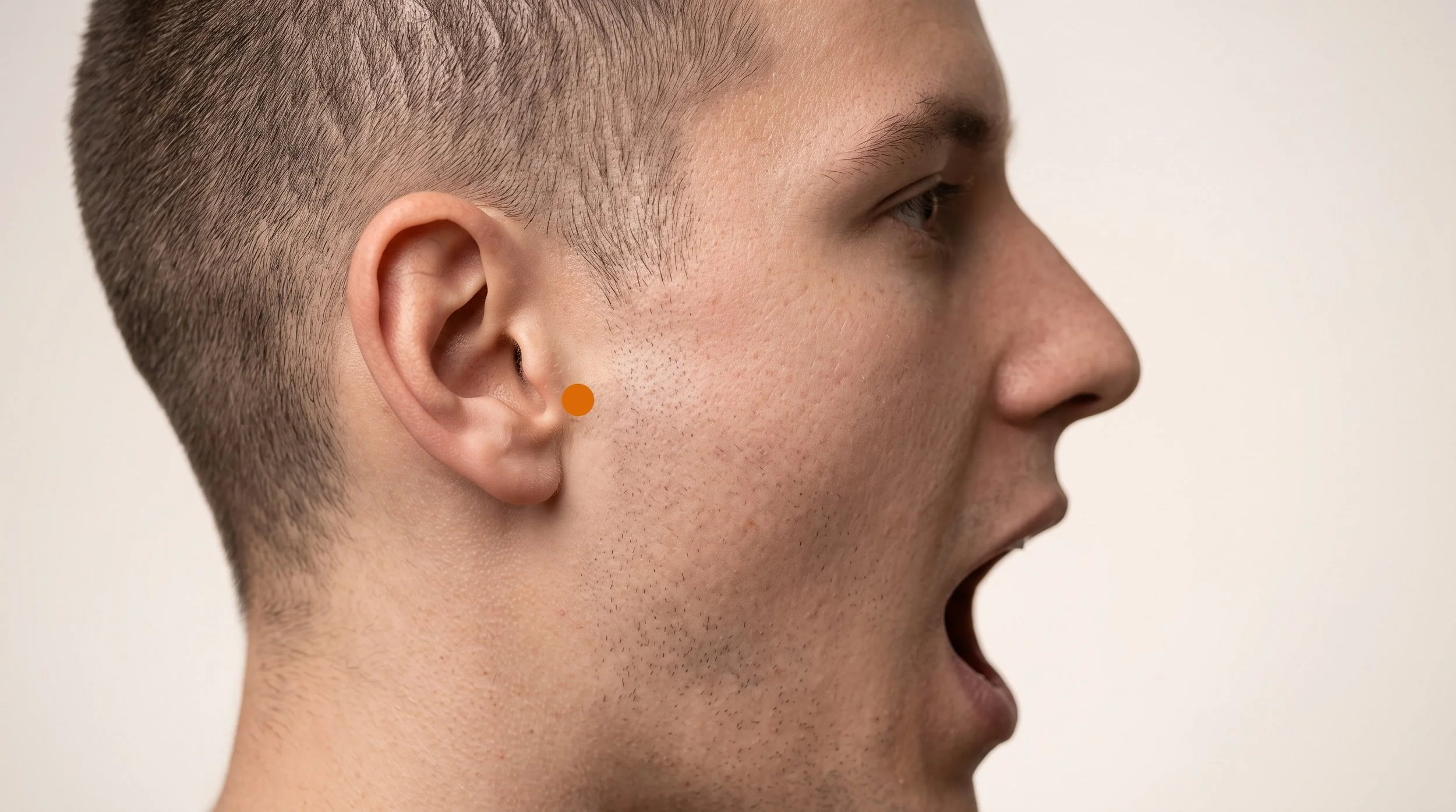
GB2 Acupuncture Point (Tinghui)
Meeting of Hearing at the Edge of the Jaw Joint: Anatomy, Mechanism, and Why This Ear-Front Point Sits at the Crossroads of Tinnitus and TMJ Care
GB2 (Tinghui), usually translated as Meeting of Hearing or Hearing Convergence, is the lowest of the three classical points that sit in a vertical line just in front of the ear. You find it by asking the patient to open the mouth wide: as the jaw slides forward, a soft depression opens between the notch below the tragus and the back edge of the mandibular condyle, and that hollow is the gallbladder 2 point. The location explains the clinical personality of the point.
It sits directly over the auriculotemporal nerve, a few millimeters from the temporomandibular joint capsule, and within reach of the sensory supply to the ear canal, which is why the same small hollow has been used for hearing complaints and for jaw complaints for well over a thousand years. In a modern clinic, the GB2 acupuncture point tends to appear in two very different treatment plans: tinnitus and hearing-related protocols, and TMJ pain that clicks, aches, and limits chewing.
- Location and layers: GB2 sits below SI19 and SJ21 in the ear-front trio, in the hollow that appears anterior to the intertragic notch when the mouth is open (Deadman et al., 2009). The needle passes through thin skin and subcutaneous tissue near the superficial lobe of the parotid gland, alongside the posterior border of the condylar process and the lateral capsule of the jaw joint (Kim, 2008).
- Traditional attributions, translated: classical sources credit Tinghui with benefiting the ears, dispelling wind, clearing heat, and freeing the local channel (Deadman et al., 2009; Kim, 2008). In neurophysiological terms, these are local and segmental effects on trigeminal and upper cervical afferents that share the same second-order neurons as the ear and jaw (Zhao, 2008).
- Nerve story: the auriculotemporal branch of the mandibular division of the trigeminal nerve supplies the jaw joint capsule, part of the ear canal, and the skin at this exact spot, which is the simplest reason ear symptoms and jaw symptoms keep showing up in the same classical indication list (Deadman et al., 2009).
- Research picture: reviews of acupuncture for tinnitus report improvements on handicap questionnaires but weaker or inconsistent effects on loudness ratings, and the trials are small and often at risk of bias (Huang et al., 2021; Liu et al., 2016). Evidence for painful temporomandibular disorders is more encouraging for short-term pain relief, though still limited (La Touche et al., 2010; Di Francesco et al., 2024).
- Clinical framing: because SI19, SJ21 and GB2 are within a fingerbreadth of one another and share indications, many practitioners rotate among them across sessions rather than needling all three every visit (Deadman et al., 2009). At Morningside, GB2 is typically one local point inside a broader plan that also treats the masticatory muscles and the neck.
- De qi: patients usually report a dull, spreading fullness or a deep ache around the ear and jaw hinge rather than a sharp sensation, and some notice a brief change in the quality of ear pressure. Needling is done with the mouth wide open, and the mouth can close once the needle is placed (Deadman et al., 2009).
Jaw Pain, Clicking, or Trouble Chewing?
TMJ pain rarely comes from the joint alone, so we assess the jaw hinge, the masseter and temporalis, the pterygoids, and the upper neck before choosing points. GB2 and ST7 bracket the joint itself, and we often pair them with dry needling of the chewing muscles that reproduce your pain on palpation. Most patients notice easier opening and less end-of-day clenching soreness within a few visits. Schedule an evaluation and we will map out a plan for your jaw.
Schedule NowAnatomy of GB2: Why the Hollow in Front of the Ear Is Such an Important Location
The tissue under GB2 is thin and busy. Beneath skin and a shallow layer of subcutaneous fat lies the fascia over the superficial part of the parotid gland, and just deep to that is the posterior border of the mandibular condyle with the lateral capsule and ligament of the temporomandibular joint. Below and behind, the point sits at the level of the intertragic notch, close to the entrance of the external auditory canal (Deadman et al., 2009; Kim, 2008).
What loads this small area is everyday jaw work: clenching and grinding, long phone calls, chewing gum, side-sleeping with pressure on the joint, and the sustained low-grade contraction of masseter and temporalis that comes with stress. Because the depression only opens when the jaw translates forward, the point is located and needled with the mouth wide open, a detail the classical texts insist on (Deadman et al., 2009).
The sensory geography here is what makes GB2 clinically interesting. The auriculotemporal nerve, a branch of the mandibular division of the trigeminal nerve, runs behind the condyle and supplies the jaw joint capsule, the skin in front of the ear, and part of the ear canal and eardrum. Because one nerve serves both the joint and the ear, symptoms in either structure can be reported as coming from the other, which is the modern reading of the traditional pairing of hearing complaints with jaw complaints at this point.
Needling in this territory generates afferent input that converges with jaw and upper cervical signals in the trigeminocervical region of the brainstem, and this segmental convergence, along with the release of endogenous opioids and the recruitment of descending inhibitory pathways, is the best-supported explanation for the analgesic effects of needling (Zhao, 2008). Individual patient data from large chronic pain trials suggest the effects of acupuncture are more than expectation alone, while remaining modest in size (Vickers et al., 2018).
The structure to respect at GB2 is vascular. The superficial temporal artery ascends just in front of the ear, and its pulse is often palpable in this exact area, which classical channel diagnosis actually used as a Gallbladder assessment site (Maciocia, 2006). Branches of the facial nerve also emerge through the parotid nearby. For that reason, the point is palpated before insertion, the needle is angled slightly posteriorly, and depth is kept in the range of 0.5 to 1 cun with gentle technique (Deadman et al., 2009).
Some texts describe a shallower perpendicular insertion of roughly 0.5 to 0.7 cun (Kim, 2008). Vigorous manipulation and deep aggressive thrusting are not appropriate here, and clinicians should be prepared for the small bruises that facial points occasionally produce.
Related Gall Bladder Channel Related Best Acupuncture Points For HeadachesGB2 at a Glance: Classification, Location, and Clinical Use
| Category | Detail |
|---|---|
| Traditional Name | Tinghui (Meeting of Hearing, also translated Hearing Convergence), GB2 on the Gallbladder channel |
| Channel Classification | Foot Shaoyang Gallbladder channel, second point of the channel, a local point of the ear and jaw region |
| Point Categories | The reference sources assign GB2 no five-shu, extraordinary vessel, or hui-meeting role. It is classified as the lowest of the three points anterior to the tragus, sitting below SI19 Tinggong and SJ21 Ermen, with traditional actions of benefiting the ears, dispelling wind, clearing heat, activating the channel and relieving pain (Deadman et al., 2009; Kim, 2008). Classical channel diagnosis also treats the area around GB2, where the superficial temporal artery can be felt, as a palpation site for the Gallbladder channel (Maciocia, 2006). |
| Precise Location | In front of the ear, in the depression between the intertragic notch behind and the condylar process of the mandible in front. Ask the patient to open the mouth wide: the condyle slides forward and the hollow becomes obvious. It is the lowest of the three ear-front points, below SI19 and SJ21. |
| Tissue Stimulated | Skin and subcutaneous tissue over the parotid fascia, the posterior aspect of the mandibular condyle, and the lateral capsule of the temporomandibular joint, in auriculotemporal nerve territory. Adjacent myofascial targets in clinical practice include the masseter, temporalis and lateral pterygoid, along with the upper cervical muscles addressed in Best Acupuncture Points For Neck Pain. |
| Needle Depth / Direction | Insert with the mouth held wide open, angled slightly posteriorly, 0.5 to 1 cun; the patient may close the mouth after insertion (Deadman et al., 2009). A shallower perpendicular insertion of about 0.5 to 0.7 cun is also described (Kim, 2008). Palpate for the superficial temporal artery first and use gentle technique. |
| De Qi Sensation | A dull, heavy fullness or deep ache at the jaw hinge, often spreading toward the ear canal or along the temple. Sharp or electric sensation means the needle should be withdrawn and redirected. |
| Primary Clinical Uses | Tinnitus and reduced hearing, ear pain and ear fullness, TMJ pain with clicking and difficulty chewing, and, in classical use, mumps, toothache, and facial deviation after windstroke (Deadman et al., 2009). |
| Common Point Combinations |
|
Deadman, Al-Khafaji and Baker describe three points stacked in front of the tragus, with SJ21 at the top, SI19 in the middle and GB2 at the bottom, and note that all three were used across a wide span of ear complaints: ringing, hearing loss, pain, itching and discharge. Their commentary makes an unusually candid point, that the indications overlap so heavily and the points sit so close together that separating them on clinical grounds is difficult, and that practitioners tend to develop personal preferences while alternating among the three when the ear region is treated often.
Alongside the ear list, the traditional attributions for Tinghui include dispelling wind and freeing the local channel, which is how the classical literature framed its use for mumps, toothache, difficulty chewing, jaw dislocation, and facial deviation after windstroke. What stands out is the internal logic of that pairing: centuries before anyone mapped the auriculotemporal nerve, the ear and the jaw hinge had already been grouped together at a single hollow the width of a fingertip, and modern anatomy explains exactly why they belong together.
Why GB2 Is Used for Jaw Pain and Chewing Problems, Not Just for the Ears
Most people meet GB2 as an ear point, so it can be surprising to find jaw complaints sitting right beside tinnitus in its classical indication list. The anatomy resolves the puzzle. The auriculotemporal nerve supplies both the temporomandibular joint capsule and part of the ear canal, so nociceptive traffic from an irritated joint and from the ear enters the trigeminal system through overlapping channels.
Signals from the jaw, the ear, and the upper neck converge on shared second-order neurons in the brainstem, which is why jaw dysfunction so often presents as ear fullness or ear pain with a normal otoscopic exam, and why treating the jaw sometimes changes how the ear feels (Zhao, 2008).
Needling at this location produces strong local afferent input that engages segmental inhibition at the level of that convergence and also recruits descending pain-modulating pathways from the midbrain and brainstem, along with endogenous opioid mechanisms (Zhao, 2008). Locally, needling in a tender, guarded region is associated with changes in blood flow and reduced resting muscle activity in the chewing muscles, which matters when the driver of the pain is sustained clenching rather than joint pathology (García-de la-Banda-García et al., 2023).
Pooled data from chronic pain trials suggest that these effects are real but moderate, and that they persist beyond the treatment period rather than disappearing immediately (Vickers et al., 2018).
On the hearing side, the mechanism story is less settled and should be described cautiously. Imaging work in chronic tinnitus has found that a course of acupuncture was followed by reduced temporal variability in dynamic functional connectivity between limbic and parietal regions, with the change tracking symptom improvement (Wei et al., 2022). That is a plausible signal that needling influences central networks involved in how a tinnitus percept is amplified and attended to, but it is a small study rather than proof of effectiveness.
In practice, we treat GB2 as one local input into a system that includes the jaw, the neck, the autonomic state, and the patient's sleep and stress load.
What the Research Shows for GB2
No trial has isolated GB2 by itself, and it is important to be clear about that. What exists are studies of multi-point protocols in which Tinghui usually appears alongside SI19, SJ17, SJ21, GB20 and distal points such as SJ3, SJ5 and LI4, so the evidence below tells you about the protocols the point belongs to rather than about the point in isolation. The tinnitus literature is genuinely mixed, with better results on handicap and distress questionnaires than on loudness ratings, and with quality concerns across the trial pool.
The temporomandibular literature is somewhat more favorable for short-term pain relief, but still limited by small samples and short follow-up. Read the table as a reasonable case for a time-limited trial with clear outcome measures, not as a promise.
| Study | Type | Focus | Key Finding |
|---|---|---|---|
| Huang et al., 2021 | Systematic review and meta-analysis of RCTs | Acupuncture for tinnitus, eight trials with 504 participants | No significant advantage over controls on the primary loudness rating, though tinnitus handicap and severity questionnaire scores favored acupuncture. |
| Liu et al., 2016 | Systematic review and meta-analysis | Acupuncture, including electroacupuncture, for tinnitus | Results diverged sharply by region of publication, which the authors treat as a serious caution when interpreting pooled effects. |
| Wei et al., 2022 | Resting-state fMRI study | Central connectivity changes after acupuncture in chronic tinnitus | Reduced temporal variability of dynamic functional connectivity after treatment correlated with reported tinnitus improvement in a small sample. |
| La Touche et al., 2010 | Systematic review and meta-analysis of RCTs | Acupuncture for pain in temporomandibular disorders | Suggested acupuncture is a reasonable adjunct for short-term analgesia in painful TMD, with the caveat that substantial bias was present. |
| Di Francesco et al., 2024 | Systematic review and meta-analysis of RCTs | Acupuncture and laser acupuncture for TMD, 11 trials | Reported short-term benefit for muscle-origin TMD pain versus placebo while concluding that the overall evidence base remains limited. |
| García-de la-Banda-García et al., 2023 | Single-blind randomized controlled trial | Dry needling versus manual therapy for myofascial TMD | Both approaches improved pain, mouth opening and pressure pain thresholds, supporting needling of masticatory trigger points as one reasonable option. |
| Vickers et al., 2018 | Individual patient data meta-analysis | Acupuncture for chronic pain across roughly 20,000 patients | Found modest but statistically robust effects over both sham and no-acupuncture controls, with benefits largely sustained over twelve months. |
| Zhao, 2008 | Narrative review of mechanisms | Neural basis of acupuncture analgesia | Describes segmental spinal inhibition, descending modulation, and endogenous opioid release as the principal documented mechanisms. |
Ringing Ears and Ear Fullness That Will Not Settle?
Tinnitus deserves a medical workup first, and we ask that you see an ENT or audiologist for anything sudden, one-sided, or paired with hearing loss. When the evaluation is clear and the symptom persists, acupuncture around the ear, including GB 2 ear points such as Tinghui, SI19 and SJ17, can be combined with neck and jaw work as a conservative option worth trying. Research here is mixed and we will say so honestly, then set a clear trial period with measurable check-ins. Book a consultation to see whether you are a reasonable candidate.
Schedule NowGB2 in the Context of Trigger Point Work
GB2 is a joint-line point, not a muscle belly point, so in our clinic it functions as the local anchor around which myofascial work is organized. A typical jaw session includes GB2 and ST7 at the joint, then dry needling of the muscles that reproduce the patient's familiar pain when pressed: masseter, anterior and middle temporalis, the lateral pterygoid when access and comfort allow, and frequently the sternocleidomastoid and upper trapezius, since neck referral patterns are part of many jaw presentations (Simons et al., 1999).
Randomized work comparing needling of masticatory trigger points with manual therapy has found improvements in pain, mouth opening, and pressure pain thresholds with both, which supports using them together rather than choosing between them (García-de la-Banda-García et al., 2023).
There is one overlap worth naming for patients who describe ear symptoms with a normal ear exam. Trigger points in the deep masseter and in the clavicular division of the sternocleidomastoid have long been documented to refer sensation into and around the ear, including reports of ear pain and, in some descriptions, ear noise (Simons et al., 1999). That is the same territory the auriculotemporal nerve serves and the same territory GB2 sits in.
When we find those muscles reproduce a patient's ear symptom on palpation, treating them alongside the ear-front points is a sensible strategy, and it is also a reminder that persistent ear complaints should be evaluated medically before being attributed to muscle.
GB2 TMJ and Tinnitus Treatment at NYC's Highest-Rated Acupuncture Clinic
Morningside Acupuncture is the highest-rated acupuncture and dry needling clinic in New York City with over 500 five-star Google reviews, and our practitioners treat jaw and ear complaints every week. We combine precise point work at the meeting of hearing point with hands-on assessment, myofascial dry needling, and practical advice about clenching, posture, and stress load. Every plan is explained in plain language, with realistic expectations about what should change and how quickly. Schedule your visit and let us take a careful look at your jaw and ears.
Schedule NowFrequently Asked Questions
What does GB2 feel like when needled?
Most patients report a dull, heavy fullness right at the jaw hinge, sometimes spreading toward the ear canal or up into the temple. Because the point is needled with the mouth held wide open, there can be a brief stretch sensation as the jaw is positioned, and the mouth can be closed once the needle is in place. The sensation is usually mild, and it should not be sharp or electric. Facial points can occasionally bruise, since the skin here is thin and vascular, so we tell patients about that possibility in advance.
Why needle a point in front of the ear for a jaw problem instead of just the sore muscle?
Because the joint and the muscles are different parts of the same problem. GB2 sits directly over the auriculotemporal nerve as it passes behind the mandibular condyle, and that nerve supplies the joint capsule itself, so needling there delivers input from the joint region rather than from the chewing muscles. Input from the jaw, ear and upper neck converges on shared brainstem neurons, so treatment at one site can influence pain reported at another (Zhao, 2008). In practice we use both, pairing GB2 and ST7 at the joint with dry needling of masseter and temporalis where those muscles reproduce the pain.
Can I press GB2 myself between sessions?
Yes, and it is one of the easier points to self-treat. Open your mouth wide and slide a fingertip forward from the notch just below the little flap of cartilage in front of your ear canal until it drops into a soft hollow; that hollow is Tinghui, and it disappears when you close your mouth. Use light to moderate pressure with the pad of your index finger, hold for 30 to 60 seconds, and repeat two or three times per side, once or twice a day. Keep the pressure comfortable rather than deep, ease off if you feel a pulse under your finger, since the superficial temporal artery runs nearby, and stop if pressing increases ear pain, dizziness or jaw pain.
Is GB2 safe to needle?
In trained hands, yes, with specific precautions. The main structures to respect are the superficial temporal artery, the parotid gland, and branches of the facial nerve that pass through the region, so the point is palpated first, needled with the mouth open at a slight backward angle, and kept to a depth of roughly 0.5 to 1 cun with gentle technique (Deadman et al., 2009). Minor bruising is the most common side effect. GB2 is not a point for aggressive manipulation, and anyone with an ear infection, recent facial surgery, a bleeding disorder, or anticoagulant use should tell their practitioner before treatment.
Where exactly is GB2 located?
GB2 is in front of the ear, in the depression between the intertragic notch behind it and the condylar process of the mandible in front of it. The reliable way to find it is to open the mouth wide: the condyle glides forward and a distinct hollow appears, which closes again when you shut your jaw (Deadman et al., 2009). It is the lowest of the three ear-front points, with SI19 directly above it and SJ21 above that, and all three sit within roughly a fingerbreadth of one another.
References
- Deadman, P., Al-Khafaji, M., & Baker, K. (2009). A manual of acupuncture. Journal of Chinese Medicine Publications.
- Kim, H. (2008). Handbook of Oriental medicine (3rd ed.). Harmony & Balance Press.
- Maciocia, G. (2006). The channels of acupuncture: Clinical use of the secondary channels and eight extraordinary vessels. Churchill Livingstone Elsevier.
- Simons, D. G., Travell, J. G., & Simons, L. S. (1999). Travell & Simons' myofascial pain and dysfunction: The trigger point manual, Vol. 1: Upper half of body (2nd ed.). Williams & Wilkins.
- Huang, K., Liang, S., Chen, L., & Grellet, A. (2021). Acupuncture for tinnitus: A systematic review and meta-analysis of randomized controlled trials. Acupuncture in Medicine, 39(4), 264-271. https://doi.org/10.1177/0964528420938380
- Liu, F., Han, X., Li, Y., & Yu, S. (2016). Acupuncture in the treatment of tinnitus: A systematic review and meta-analysis. European Archives of Oto-Rhino-Laryngology, 273(2), 285-294. https://doi.org/10.1007/s00405-014-3341-7
- Wei, Y., Zhang, W., Li, Y., Liu, X., Zha, B., Hu, S., Wang, Y., Wang, X., Yu, X., Yang, J., & Qiu, B. (2022). Acupuncture treatment decreased temporal variability of dynamic functional connectivity in chronic tinnitus. Frontiers in Neuroscience, 15, 737993. https://doi.org/10.3389/fnins.2021.737993
- La Touche, R., Goddard, G., De-la-Hoz, J. L., Wang, K., Paris-Alemany, A., Angulo-Diaz-Parreno, S., Mesa, J., & Hernandez, M. (2010). Acupuncture in the treatment of pain in temporomandibular disorders: A systematic review and meta-analysis of randomized controlled trials. The Clinical Journal of Pain, 26(6), 541-550. https://doi.org/10.1097/AJP.0b013e3181e2697e
- Di Francesco, F., Minervini, G., Siurkel, Y., Cicciu, M., & Lanza, A. (2024). Efficacy of acupuncture and laser acupuncture in temporomandibular disorders: A systematic review and meta-analysis of randomized controlled trials. BMC Oral Health, 24(1), 174. https://doi.org/10.1186/s12903-023-03806-1
- Garcia-de la-Banda-Garcia, R., Cortes-Perez, I., Ibancos-Losada, M. D. R., Lopez-Ruiz, M. D. C., Obrero-Gaitan, E., & Osuna-Perez, M. C. (2023). Effectiveness of dry needling versus manual therapy in myofascial temporomandibular disorders: A single-blind randomized controlled trial. Journal of Personalized Medicine, 13(9), 1415. https://doi.org/10.3390/jpm13091415
- Vickers, A. J., Vertosick, E. A., Lewith, G., MacPherson, H., Foster, N. E., Sherman, K. J., Irnich, D., Witt, C. M., & Linde, K. (2018). Acupuncture for chronic pain: Update of an individual patient data meta-analysis. Journal of Pain, 19(5), 455-474. https://doi.org/10.1016/j.jpain.2017.11.005
- Zhao, Z. Q. (2008). Neural mechanism underlying acupuncture analgesia. Progress in Neurobiology, 85(4), 355-375. https://doi.org/10.1016/j.pneurobio.2008.05.004
Disclaimer: This web site is intended for educational and informational purposes only. Reading this website does not constitute providing medical advice or any professional services. This information should not be used for diagnosing or treating any health issue or disease. Those seeking medical advice should consult with a licensed physician. Seek the advice of a medical doctor or other qualified health professional for any medical condition. If you think you have a medical emergency, call 911 or go to the emergency room. No acupuncturist-patient relationship is created by reading this website or using the information. Morningside Acupuncture PLLC and its employees and contributors do not make any express or implied representations with respect to the information on this site or its use. For any legal interpretation of scope of practice in your state, consult a licensed attorney or regulatory authority.
Read more from our blog



