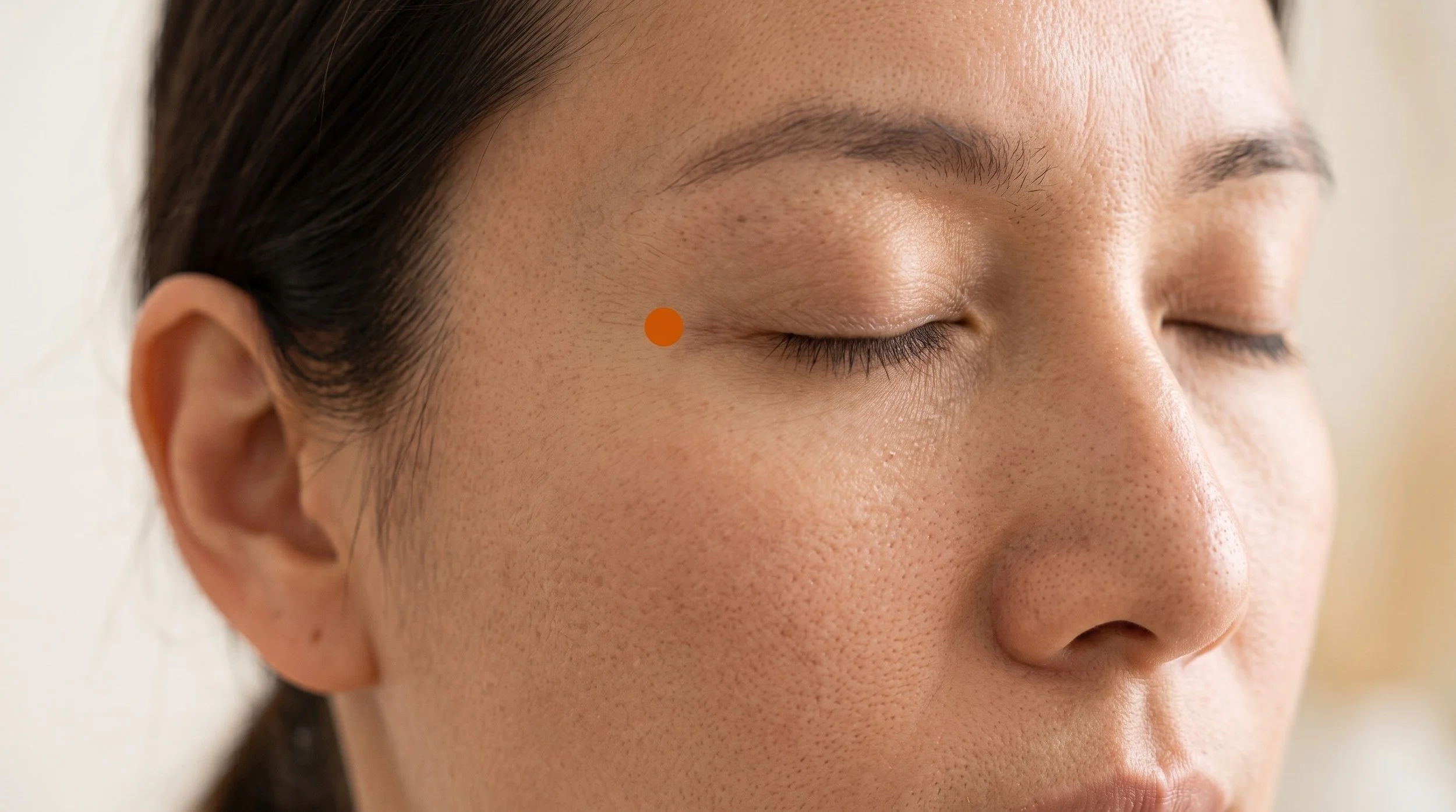
GB1 Acupuncture Point (Tongziliao)
The Pupil Crevice Beside the Outer Eye Corner: Anatomy, Mechanism, and Why the First Gallbladder Point Anchors Eye Strain and Temple Headache Care
GB1, known in Chinese as Tongziliao and usually translated as Pupil Crevice, is the first point of the Gallbladder channel and sits in the small bony hollow just outside the eye, roughly a half thumb-width (0.5 cun) lateral to the outer corner of the eyelids, right where the orbital rim can be felt under the fingertip. It is the point most acupuncturists reach for when the complaint is centered at the outer eye: tired, red, watery or itchy eyes after long screen days, tightness that runs from the outer canthus back into the temple, and the crow's-feet region in modern facial work.
Classical texts group it as a meeting point where the Gallbladder, Small Intestine and Triple Burner (Sanjiao) channels converge, and modern anatomy explains its reach in plainer terms, since the needle sits in thin, richly innervated tissue supplied by branches of the trigeminal nerve that share processing with the same brainstem circuits involved in headache. If you have ever pressed the bone at the edge of your eye socket after a long day of reading, you have already found the GB1 acupuncture point.
- Location and layers: GB1 lies in the depression on the lateral orbital margin about 0.5 cun lateral to the outer canthus, with the needle passing through thin skin and subcutaneous tissue into the orbital part of orbicularis oculi, immediately over bone where the frontal, zygomatic and sphenoid bones meet.
- Traditional categories, translated: classical sources describe Tongziliao as a crossing point of the Gallbladder, Small Intestine and Triple Burner channels that brightens the eyes and disperses wind-heat; in modern language, that overlap simply describes a facial zone where several channel pathways and several sensory nerve territories converge.
- Mechanism: needling here recruits zygomaticofacial and lacrimal branches of the trigeminal nerve, and trigeminal input converges with upper cervical input in the trigeminocervical complex, which is a plausible route by which a local eye-region point may influence temple and periorbital pain (Zhao, 2008).
- Research picture: no trial isolates GB1, but Cochrane reviews of acupuncture for migraine and tension-type headache report reductions in headache days compared with usual care, with smaller and less certain differences over sham (Linde et al., 2016a; Linde et al., 2016b), and individual patient data from chronic pain trials suggest effects persist beyond the treatment course (Vickers et al., 2018).
- Eye-specific evidence: systematic reviews of acupuncture for dry eye report modest improvements in tear film measures and symptoms using protocols built around periorbital points (Na et al., 2021), and a randomized study in open-angle glaucoma found a short-term rise in pulsatile ocular blood flow after eye-specific needling (Leszczynska et al., 2018).
- Practice framing and de qi: GB1 is needled shallowly and transversely, often threaded back toward Taiyang, so the sensation is mild, usually a light spreading fullness or dull warmth toward the temple rather than the deep ache felt at limb points, and several modern texts list the point as contraindicated to moxibustion.
Screen Fatigue, Tired Eyes, and Tension Behind the Temple?
Long hours on monitors load the small muscles around the eye and the temporalis just behind them, and that combination shows up as gritty eyes, squinting, and a band of pressure at the temple. At Morningside Acupuncture we use GB1 as a local anchor beside the outer eye, then add distal points and, when appropriate, dry needling of the temporalis and jaw muscles. Most patients notice the eye region soften within the first few sessions. Schedule a visit and we will build a plan around your specific pattern.
Schedule NowAnatomy of GB1: Why the Lateral Orbital Rim Is Such an Important Location
Slide a fingertip laterally from the outer corner of your eye and you will drop into a shallow hollow on the bony rim of the eye socket. That hollow is GB1. Under the fingertip the layers are unusually thin: eyelid-grade skin, a sparse subcutaneous layer, then the orbital portion of orbicularis oculi, the ring-shaped muscle that closes the eye, all lying directly over the lateral orbital margin where the frontal, zygomatic and sphenoid bones meet. Just posterior sits the anterior edge of the temporalis and its fascia.
What loads this small area is repetitive and modern: squinting at screens and in glare, reduced blink rate during focused near work, sustained frowning, contact lens irritation, allergy-driven rubbing, and clenching that recruits the temporalis and pulls on the same lateral facial fascia.
The sensory supply is the reason a point this superficial can matter clinically. The tissue at GB1 sits in the territory of the zygomaticofacial branch of the maxillary division and the lacrimal branch of the ophthalmic division of the trigeminal nerve, while the temporal branches of the facial nerve drive the muscle itself. Trigeminal afferents from the periorbital region converge with upper cervical afferents in the trigeminocervical complex, the brainstem hub implicated in migraine and referred head pain, so stimulating this zone provides input to circuits shared with the temple, forehead and upper neck.
Needling is also understood to engage descending inhibitory pathways involving endogenous opioid and monoaminergic signaling, which helps explain why effects are not limited to the millimeters around the needle (Zhao, 2008). Pooled patient-level data from chronic pain trials show acupuncture outperforming both no-acupuncture and sham controls, with modest but durable differences (Vickers et al., 2018).
Vascular anatomy shapes technique here. The lateral orbital region is crossed by the zygomatico-orbital and transverse facial branches, small superficial vessels that bruise easily, which is why bruising is the most common (and most cosmetically annoying) side effect at this point. The orbit itself is the structure to respect: the needle is directed away from the globe, not toward it. Standard practice is transverse insertion aimed posteriorly, roughly 0.2 to 0.3 cun, or a longer threading technique that carries the needle across the temple toward Taiyang, always staying superficial and bone-adjacent.
Several modern texts list GB1 as contraindicated to moxibustion, and deep or perpendicular needling is not used. Practitioners typically apply gentle pressure after withdrawal to limit bruising, particularly in patients on anticoagulants.
Related Gall Bladder Channel Related Orbicularis Oculi Trigger PointsGB1 at a Glance: Classification, Location, and Clinical Use
| Category | Detail |
|---|---|
| Traditional Name | Tongziliao (Pupil Crevice), Gallbladder 1, GB-1 |
| Channel Classification | First point of the Gallbladder channel of Foot Shaoyang |
| Point Categories | Meeting (crossing) point of the Gallbladder, Small Intestine and Triple Burner (Sanjiao) channels; entry point of the Gallbladder channel and one of the periorbital points classically associated with the Eye System |
| Precise Location | In the hollow on the lateral side of the orbital rim, approximately 0.5 cun lateral to the outer corner of the eye (outer canthus), on bone |
| Tissue Stimulated | Thin facial skin and subcutaneous tissue over the orbital part of orbicularis oculi, directly on the lateral orbital margin, with the anterior border of the temporalis just behind |
| Needle Depth / Direction | Transverse insertion directed posteriorly 0.2 to 0.3 cun, or threaded across the temple toward Taiyang; superficial and bone-adjacent only, never toward the globe; several modern texts contraindicate moxibustion at this point |
| De Qi Sensation | Mild by comparison with limb points: a light spreading fullness, faint pressure or dull warmth radiating from the outer eye toward the temple, occasionally a brief watering of the eye |
| Primary Clinical Uses | Eye strain with redness, itching or tearing; temple-side headache with eye involvement; outer eye corner pain in classical use; periorbital facial work including fine lines at the outer eye |
| Common Point Combinations |
|
In A Manual of Acupuncture, Deadman and colleagues present Tongziliao as the eye point of the Gallbladder channel, and the reasoning behind that traditional attribution is worth following. The Gallbladder channel and its divergent branch reach the eye, and the Liver, paired interiorly and exteriorly with the Gallbladder, was said in classical theory to open into the eyes, so the first point of the channel, sitting a fingerbreadth outside the eye, became the natural place to treat eye complaints.
Its listed indications cluster into recognizable groups: irritation and inflammation of the eye (pain, redness, swelling, itching at the inner or outer corner), watering including tearing in wind, disturbances of vision from dimness to night blindness, and pain that spans the temple and brow ridge. Traditional texts framed most of these under Liver channel wind-heat, a pattern in which an internal tendency toward heat meets an external trigger, which is a reasonably good description of how allergy, glare, wind and fatigue actually stack up in a patient's week.
What stands out most is the outlier: a classical prescription pairing GB1 with SI1 for breast swelling, justified by the course of the Gallbladder sinew channel to the chest, a reminder that the classical system reasoned along pathways rather than along regions.
Why GB1 Is Used for Headaches That Sit at the Temple and Press Behind the Eye
Patients are often surprised that a point beside the eye helps a headache felt deeper in the head. The explanation is convergence. Sensory fibers from the periorbital skin, the eye's outer structures and the temple all feed into the trigeminal system, and those trigeminal signals share second-order neurons in the brainstem with input from the upper neck. Pain generated in one of those territories can be felt in another, which is why a stiff upper neck can produce pain behind the eye and why eye-region input can influence temple pain.
Needling GB1 delivers a precise, controlled sensory signal into that shared circuit at the exact spot where patients tend to press with their own fingers.
Beyond the segmental story, needling engages descending inhibitory control, the brain's own pain-dampening machinery, through endogenous opioid and monoaminergic pathways that reduce the responsiveness of these convergent neurons (Zhao, 2008). This is the mechanism that best fits the clinical evidence, since acupuncture's benefits in chronic pain persist for months after treatment ends rather than fading immediately, a pattern documented in pooled individual patient data (Vickers et al., 2018).
Cochrane reviews of migraine and tension-type headache prevention found fewer headache days with acupuncture compared with usual care, with narrower differences against sham needling (Linde et al., 2016a; Linde et al., 2016b).
There may also be a local circulatory component at the eye. A randomized study in patients with primary open-angle glaucoma reported a short-term increase in pulsatile ocular blood flow following an eye-specific needling protocol, with no change after a protocol using unrelated points (Leszczynska et al., 2018). That study did not test GB1 in isolation and does not establish a treatment for glaucoma, but it does support the broader idea that periorbital needling can produce measurable, region-specific vascular and autonomic effects rather than purely subjective ones.
What the Research Shows for GB1
A realistic word about evidence: no clinical trial has tested GB1 by itself, and it is unlikely one ever will. Acupuncture research evaluates whole protocols, typically five to fifteen points chosen for the condition, and GB1 appears inside eye and head protocols alongside points such as BL1, BL2, SJ23, Taiyang, GB20 and distal limb points. The studies below therefore tell you how the protocols GB1 belongs to have performed, not what GB1 contributes on its own. Read them as context for point selection rather than as proof of any single needle's effect.
| Study | Type | Focus | Key Finding |
|---|---|---|---|
| Linde et al., 2016a | Cochrane systematic review | Acupuncture for prevention of episodic migraine | Acupuncture was associated with fewer migraine days than usual care and appeared at least comparable to prophylactic drugs, though differences from sham needling were small. |
| Linde et al., 2016b | Cochrane systematic review | Acupuncture for prevention of tension-type headache | Adding acupuncture to routine care reduced headache frequency in most included trials, with modest advantages over sham and generally low reported harms. |
| Vickers et al., 2018 | Individual patient data meta-analysis | Chronic pain including headache and musculoskeletal pain | Acupuncture outperformed both sham and no-acupuncture controls, and most of the benefit persisted at twelve-month follow-up. |
| Na et al., 2021 | Systematic review and meta-analysis | Acupuncture for typical dry eye syndrome | Protocols built around periorbital points showed improvements in tear break-up time and symptom scores versus artificial tears, though trial quality varied. |
| Leszczynska et al., 2018 | Randomized clinical study | Ocular blood flow in primary open-angle glaucoma | Pulsatile ocular blood flow increased modestly after an eye-specific needling protocol, with no significant change in intraocular pressure. |
| Haghir et al., 2025 | Randomized waitlist-controlled trial | Facial and body acupuncture for glabellar frown lines | Participants receiving combined facial and body acupuncture reported greater satisfaction with their frown lines than untreated controls, with few adverse effects. |
| Zhao, 2008 | Mechanistic review | Neural mechanisms of acupuncture analgesia | Needle stimulation activates segmental spinal and descending inhibitory pathways involving opioid and monoaminergic signaling. |
Migraine and Temple-Side Headaches: A Targeted Approach?
Headaches that sit at the temple and press behind the eye often respond well to treatment that addresses both the local tissue and the nervous system driving the pain. GB1 is frequently combined with Taiyang, GB8, GB20 and distal Gallbladder channel points in our headache protocols, alongside manual therapy where indicated. Reviews of acupuncture for migraine prevention support this style of multi-point care. Book an evaluation and we will map your headache pattern before needle one goes in.
Schedule NowGB1 in the Context of Trigger Point Work
Acupuncture, as we define it, is the use of an acupuncture needle, and that includes the hundreds of styles practiced worldwide as well as dry needling. At Morningside we rarely treat GB1 in isolation. When a patient describes pressure at the temple with aching behind the eye, the muscular contributors usually include the temporalis, the masseter, the upper trapezius and the suboccipital group, all of which are documented to refer pain into the temple and periorbital region (Simons et al., 1999).
A session might combine shallow needling at GB1 and Taiyang with dry needling of the temporalis and, when jaw involvement is clear, the lateral pterygoid, then finish with cervical points to address the upper neck contribution.
The point location itself overlaps a myofascial target. The orbital fibers of orbicularis oculi lie directly under GB1, and this muscle can develop taut, tender tissue in people who squint through long screen days or against bright light, with referral that spreads across the outer eye and cheek. Needling here is deliberately gentle: a fine needle, shallow transverse angle, minimal manipulation, and firm pressure afterward to limit bruising in a thin, well-vascularized area.
Patients who arrive for facial or cosmetic acupuncture often receive the same location with a different intent, using superficial threading across the crow's-feet region rather than the deeper mechanical release used elsewhere in the body.
GB1 Eye Strain and Headache Treatment at NYC's Highest-Rated Acupuncture Clinic
Morningside Acupuncture is the highest-rated acupuncture and dry needling clinic in New York City with over 500 five-star Google reviews, and our Upper West Side practice treats eye strain, temple headaches and facial tension every week. Treatment blends classical point selection (GB1, Taiyang, periorbital points) with orthopedic dry needling of the temporalis, masseter and cervical muscles. Everything is explained in plain terms before we begin, and needling at the eye is done with fine needles and careful technique. Schedule your first session and see how quickly the outer eye region can settle.
Schedule NowFrequently Asked Questions
What does GB1 feel like when needled?
Mild, and much lighter than most body points. Because the needle stays superficial and travels sideways along the bone rather than downward, the usual report is a brief pinch at insertion followed by a light spreading fullness or dull warmth that drifts toward the temple. Some people notice the eye water for a moment, which is a normal reflex response in this area and settles quickly. If GB1 is threaded across the temple toward Taiyang, the sensation is often described as a thin band of pressure under the skin. Sharp or radiating pain is not expected, and telling your acupuncturist immediately lets them adjust the angle.
Why needle beside the eye for a headache that feels deeper in the head?
Because the nerves that supply the skin and muscle at the outer eye feed into the same brainstem circuits that process pain from the temple, forehead and upper neck. Trigeminal input from the periorbital region converges with upper cervical input in the trigeminocervical complex, so a signal delivered at the eye's outer corner reaches the network involved in temple and behind-the-eye pain. Needling also recruits descending inhibitory pathways that reduce the excitability of those convergent neurons (Zhao, 2008). In practice we pair this local point with distal points on the limbs, since headache protocols tested in Cochrane reviews consistently combine both (Linde et al., 2016a).
Can I press GB1 myself between sessions?
Yes, and it is one of the easier points to self-treat because you can feel the landmark. With clean hands, close your eyes and slide a fingertip laterally from the outer corner of the eye until you feel the bony edge of the eye socket and the shallow dip on it, roughly a half thumb-width out. Press into the bone with light to moderate pressure using the pad of your index or middle finger, never toward the eyeball itself, and hold for 30 to 60 seconds or make small circles for the same duration. Repeat two or three times per side, and pair it with a temple point about a thumb-width further back for screen fatigue. Two to three rounds a day is plenty, and you should stop if the area becomes tender, if the skin is broken, or if you have an active eye infection.
Is GB1 safe to needle?
It is safe in trained hands, with two practical cautions. First, bruising: the skin here is thin and the region is well supplied by small superficial vessels, so a small bruise is the most common side effect and is more likely in patients taking blood thinners or aspirin. Practitioners reduce that risk with fine needles and firm pressure on withdrawal. Second, direction: the needle is inserted transversely along the orbital rim, never perpendicular or aimed toward the globe, and deep insertion is not used. Several modern texts also list GB1 as contraindicated to moxibustion. Tell your practitioner about eye conditions, recent eye surgery, contact lenses or anticoagulant use before treatment.
Where exactly is GB1 located?
GB1 (Tongziliao) sits in the small depression on the outer side of the bony orbital rim, approximately 0.5 cun (about a half thumb-width) lateral to the outer corner of the eye. To find the Tongziliao point location on yourself, close the eye and trace outward from the outer canthus with a fingertip until you meet firm bone and drop into a shallow hollow; that hollow, on the bone rather than in soft tissue, is the point. It sits above the orbital fibers of orbicularis oculi at the junction of the frontal, zygomatic and sphenoid bones, and it is roughly a thumb-width in front of the Taiyang temple point, which the two are often threaded together across.
References
- Deadman, P., Al-Khafaji, M., & Baker, K. (2009). A manual of acupuncture. Journal of Chinese Medicine Publications.
- Cunningham, P. M. (2000). Acupuncture points: A practical guide to classical and modern usage. Odyssey Press.
- Maciocia, G. (2006). The channels of acupuncture: Clinical use of the secondary channels and eight extraordinary vessels. Churchill Livingstone Elsevier.
- Simons, D. G., Travell, J. G., & Simons, L. S. (1999). Travell & Simons' myofascial pain and dysfunction: The trigger point manual, Vol. 1: Upper half of body (2nd ed.). Williams & Wilkins.
- Linde, K., Allais, G., Brinkhaus, B., Fei, Y., Mehring, M., Vertosick, E. A., Vickers, A., & White, A. R. (2016a). Acupuncture for the prevention of episodic migraine. Cochrane Database of Systematic Reviews, 2016(6), CD001218. https://doi.org/10.1002/14651858.CD001218.pub3
- Linde, K., Allais, G., Brinkhaus, B., Fei, Y., Mehring, M., Shin, B. C., Vickers, A., & White, A. R. (2016b). Acupuncture for the prevention of tension-type headache. Cochrane Database of Systematic Reviews, 2016(4), CD007587. https://doi.org/10.1002/14651858.CD007587.pub2
- Vickers, A. J., Vertosick, E. A., Lewith, G., MacPherson, H., Foster, N. E., Sherman, K. J., Irnich, D., Witt, C. M., & Linde, K. (2018). Acupuncture for chronic pain: Update of an individual patient data meta-analysis. Journal of Pain, 19(5), 455-474. https://doi.org/10.1016/j.jpain.2017.11.005
- Na, J. H., Jung, J. H., Park, J. G., Song, P. H., & Song, C. H. (2021). Therapeutic effects of acupuncture in typical dry eye: A systematic review and meta-analysis. Acta Ophthalmologica, 99(5), 489-498. https://doi.org/10.1111/aos.14651
- Leszczynska, A., Ramm, L., Spoerl, E., Pillunat, L. E., & Terai, N. (2018). The short-term effect of acupuncture on different ocular blood flow parameters in patients with primary open-angle glaucoma: A randomized, clinical study. Clinical Ophthalmology, 12, 1285-1291. https://doi.org/10.2147/OPTH.S170396
- Haghir, H., Yazdanpanah, M. J., Khadem-Rezaiyan, M., Bidouei, F., & Azizi, H. (2025). Is acupuncture effective in diminishing frown lines? Evidence from a randomized controlled trial. Journal of Cosmetic Dermatology, 24(4), e70144. https://doi.org/10.1111/jocd.70144
- Zhao, Z. Q. (2008). Neural mechanism underlying acupuncture analgesia. Progress in Neurobiology, 85(4), 355-375. https://doi.org/10.1016/j.pneurobio.2008.05.004
Disclaimer: This web site is intended for educational and informational purposes only. Reading this website does not constitute providing medical advice or any professional services. This information should not be used for diagnosing or treating any health issue or disease. Those seeking medical advice should consult with a licensed physician. Seek the advice of a medical doctor or other qualified health professional for any medical condition. If you think you have a medical emergency, call 911 or go to the emergency room. No acupuncturist-patient relationship is created by reading this website or using the information. Morningside Acupuncture PLLC and its employees and contributors do not make any express or implied representations with respect to the information on this site or its use. For any legal interpretation of scope of practice in your state, consult a licensed attorney or regulatory authority.
Read more from our blog



