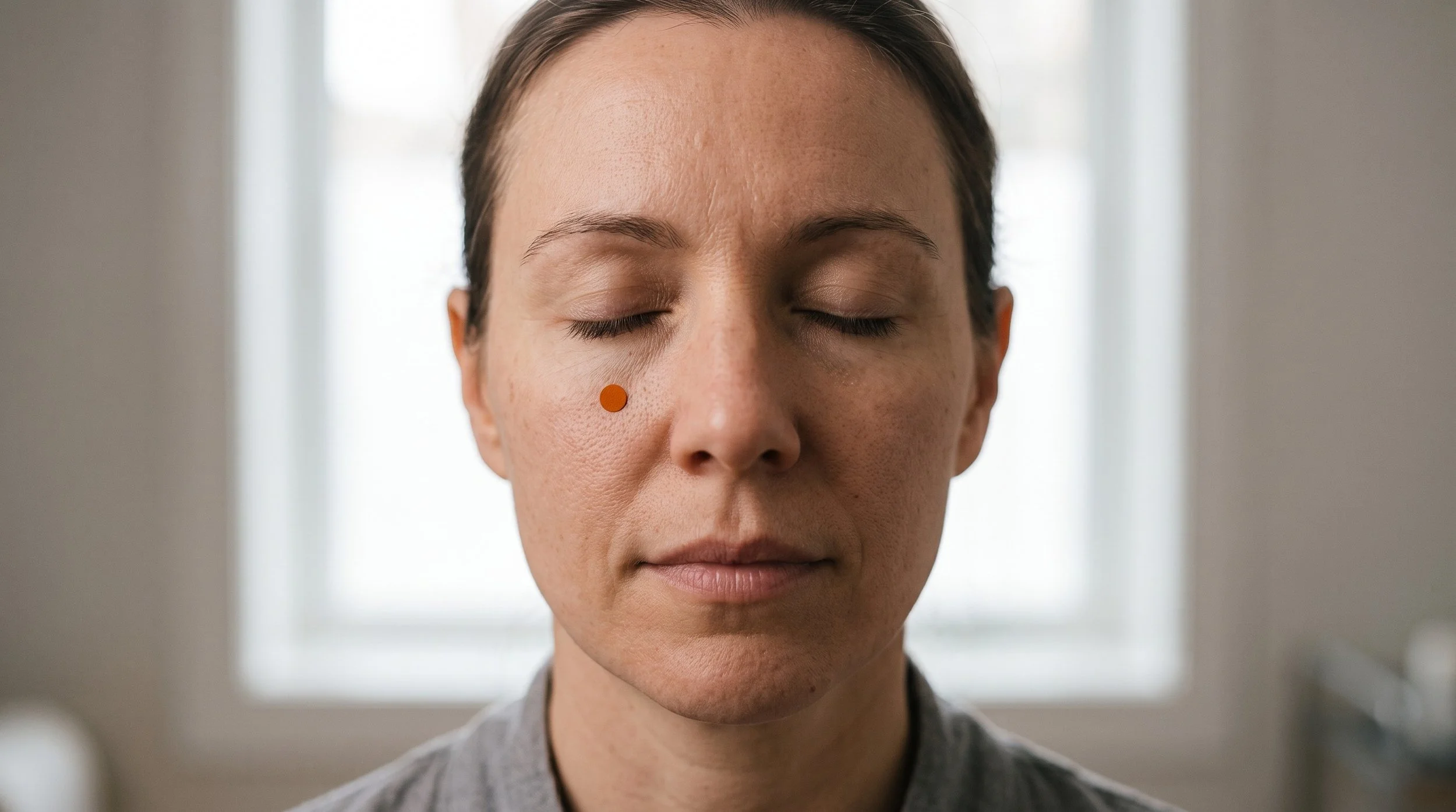
ST2 Acupuncture Point (Sibai)
Four Whites at the Infraorbital Foramen: Anatomy, Mechanism, and Why This Small Cheek Point Anchors Eye and Facial Nerve Treatment
ST2, known in Chinese as Sibai and usually translated as Four Whites, is the second point of the Stomach channel and sits in a small depression on the cheek, roughly one finger's width below the pupil when you're looking straight ahead. It's one of the few points on the body that lies directly over a named nerve exit, the infraorbital foramen, where the maxillary division of the trigeminal nerve surfaces to supply the lower eyelid, the side of the nose, the cheek and the upper lip.
That anatomy is the whole story of this point: traditional texts list Sibai for red, itchy, watering eyes, twitching eyelids and facial paralysis, and modern practitioners reach for it when pain, numbness or muscle dysfunction maps onto that same infraorbital territory. It's a shallow, gentle, precision point rather than a strong one, and knowing exactly where the foramen is matters more here than needle depth.
- Location and layers: the st2 acupuncture point sits about 1 cun below the pupil, roughly 0.3 cun below the lower rim of the orbit, in the palpable dip of the infraorbital foramen; the needle passes through thin facial skin, a shallow fat layer and the fibers of orbicularis oculi and levator labii superioris before reaching the periosteal rim of the foramen (Deadman et al., 2007).
- Traditional categories, restated: classical sources credit Sibai with dispelling wind, clearing heat and brightening the eyes, and some texts also list it as a crossing point of the Yang Motility (Yang Qiao) vessel (Deadman et al., 2007; Kim, 2007). In neurophysiological terms those descriptions all point to the same thing: stimulation of a superficial branch point of the trigeminal nerve that shares a segmental home with the eye, nose and cheek.
- Mechanism: the infraorbital nerve carries sensation from the lower lid, nasal side wall, cheek and upper lip into the trigeminal nucleus, where afferents from skin, mucosa, teeth and dura converge; needling in this field is thought to modulate that convergent input and to recruit descending inhibitory control from the brainstem (Zhao, 2008).
- Research picture: reviews of acupuncture for Bell's palsy and for trigeminal neuralgia consistently include periorbital and cheek points such as ST2 within larger protocols, and while several report favorable results, the reviewers themselves flag weak trial design and low certainty (Chen et al., 2010; Li et al., 2015; Ang et al., 2023).
- Clinical framing: dry eye reviews that analyzed which points were used found ST2 among the periocular points appearing most often in trial protocols, so the evidence supports it as a component of a protocol rather than as a standalone intervention (Kim et al., 2018; Wei et al., 2020). For pain generally, the largest individual patient data analysis supports acupuncture as more than a placebo response while keeping effect sizes modest (Vickers et al., 2018).
- De qi and safety: correct stimulation feels like a dull, spreading fullness across the cheek toward the upper lip or nose, not a sharp electric jolt. Because the nerve trunk is right there, lifting and thrusting is avoided, insertion stays shallow, and classical texts contraindicate moxibustion at this point (Deadman et al., 2007).
Dealing With Cheek Pain, Eyelid Twitching, or Eye Strain?
Pain and irritation that sit under the eye or across the cheekbone often trace back to the infraorbital nerve territory, and ST2 is the most direct surface access we have to it. Our licensed acupuncturists combine gentle needling at Sibai with distal points and, when appropriate, dry needling of the jaw and neck muscles that refer into the same region. Every treatment starts with an exam so we can tell muscular referral from nerve-driven pain before a needle goes anywhere near your face. Schedule a visit and we'll map your symptoms before we treat them.
Schedule NowAnatomy of ST2: Why the Infraorbital Foramen Is Such an Important Location
Run a fingertip down from the bony rim beneath your eye and you'll drop into a small hollow a short distance below the edge. That hollow is the infraorbital foramen, and ST2 sits right on it. The tissue stack here is thin: facial skin, a shallow layer of subcutaneous fat, then the interlacing fibers of orbicularis oculi above and levator labii superioris below, all resting on the maxilla. There's no thick muscle belly to bury a needle in, which is exactly why the technique is measured in fractions of a cun.
What loads this area isn't heavy mechanical stress but sustained low-grade activity: squinting at screens, chronic sinus congestion and pressure, jaw clenching that recruits the mid-face muscles, and the guarding posture people adopt when one side of the face hurts.
The nerve geography is what makes this location clinically interesting. The infraorbital nerve, the terminal continuation of the maxillary division of the trigeminal nerve, emerges from the foramen and fans out to the lower eyelid, the side of the nose, the cheek and the upper lip. Deeper in the brainstem, second-order neurons in the trigeminal nucleus receive input not only from that skin territory but also from the teeth, the sinus lining, the dura and the upper cervical segments, which is one reason facial pain so rarely respects tidy anatomical borders.
Needling into a field this richly innervated generates a well-defined afferent barrage that appears to engage segmental modulation and descending inhibitory pathways involving endogenous opioid and monoaminergic systems (Zhao, 2008). Local vascular effects matter too, since needle stimulation is associated with small increases in microcirculation in the treated tissue, which may be relevant to the puffiness and congestion patients often describe under the eye.
Deep to the point sit the infraorbital artery and vein, which exit alongside the nerve, and the orbit itself lies just above. Both facts drive the conventions here. Standard technique is perpendicular insertion of about 0.2 to 0.4 cun, or transverse threading toward neighboring points such as SI18 or LI20; some texts describe a careful supero-lateral oblique insertion along the foramen of 0.3 to 0.5 cun, which is where the risk of reaching the eyeball comes from (Deadman et al., 2007).
Lifting and thrusting manipulation is contraindicated because it risks trauma to the nerve trunk, and several classical sources also list ST2 as a point not to be treated with moxibustion. Small-gauge needles, a slow insertion, and bruising precautions (facial capillaries bleed readily) are standard practice, and patients on anticoagulants should say so before facial needling.
Related reading: our overview of the Stomach channel and our post on LI4, a frequent partner point in classical facial and eye formulas.
Related Stomach Channel Related LI4 Acupuncture PointST2 at a Glance: Classification, Location, and Clinical Use
| Category | Detail |
|---|---|
| Traditional Name | Sibai (Four Whites) |
| Channel Classification | Second point of the Stomach channel of Foot Yangming |
| Point Categories | Local facial and eye point at the infraorbital foramen; listed in some texts as a crossing point of the Yang Motility (Yang Qiao) vessel; traditionally described as eliminating wind, clearing heat and benefiting the eyes, with some sources adding the spreading of Liver qi and benefit to the Gall Bladder |
| Precise Location | With the eyes looking straight ahead, 1 cun directly below the pupil, in the depression at the infraorbital foramen, roughly 0.3 cun below the lower rim of the eye socket. Palpate down from the orbital edge until you feel the small dip. |
| Tissue Stimulated | Facial skin and thin subcutaneous fat over orbicularis oculi and levator labii superioris, directly above the infraorbital foramen and the emerging infraorbital nerve and vessels. Frequently combined with myofascial work on nearby chewing muscles such as the temporalis. |
| Needle Depth / Direction | Perpendicular 0.2 to 0.4 cun into the depression, or transverse threading toward points such as SI18 or LI20 in facial protocols. Deep insertion along the foramen risks the eyeball, and lifting and thrusting is avoided because of the nerve trunk. Classical texts contraindicate moxibustion here. |
| De Qi Sensation | A dull, contained fullness or ache over the cheek, sometimes spreading toward the upper lip, nose or lower eyelid. Sharp, electric or shooting sensations mean the needle is irritating the nerve and it should be withdrawn and repositioned. |
| Primary Clinical Uses | Red, itchy or watering eyes and eye strain; facial paralysis with deviation of the mouth and eye; eyelid twitching; cheek and maxillary pain in trigeminal territory; headache with visual disturbance |
| Common Point Combinations |
|
In A Manual of Acupuncture, Deadman and colleagues are refreshingly plain about Sibai: it isn't treated as a major point, and they describe three practical situations where it earns its place. First, it serves as a stand-in for ST1, the point just above it, for practitioners who haven't mastered the more demanding technique that point requires in eye conditions.
Second, it works as a local point for facial pain and paralysis, usually threaded toward its neighbors rather than needled straight in. Third, and much more surprising to modern readers, classical practice extended it to roundworm in the bile duct, an indication it shares with LI20.
Traditional actions listed for the point involve eliminating wind, clearing heat and benefiting the eyes, with classical indications clustering into three groups: eye complaints (redness, pain, itching, blurred or obstructed vision, excessive tearing), facial motor problems (deviation of the mouth and eye, twitching lids), and headache. What's striking is how tightly that traditional list overlaps the modern map of infraorbital nerve territory, described centuries before anyone drew that nerve.
Why ST2 Is Used for Cheek Pain, Eyelid Twitching, and Sinus Pressure Below the Eye
Patients are often surprised that a point on the cheek helps with symptoms they'd describe as coming from the eye, the sinus or even the upper teeth. The explanation is convergence. All of those structures send sensory information into the same trigeminal relay in the brainstem, so the nervous system doesn't keep them in separate filing cabinets. When one input becomes persistently irritating, whether from sinus inflammation, jaw overuse or nerve sensitization, neighboring territories can start reporting discomfort that has no local pathology of its own.
Needling into the infraorbital field delivers a clear, well-localized signal into that same relay, and the segmental modulation that follows is a plausible reason patients often notice the pressure under the eye softening within a session (Zhao, 2008).
Above the segmental level, needle stimulation is associated with activation of descending inhibitory pathways from the midbrain and brainstem that dampen incoming nociceptive traffic through opioid and monoaminergic mechanisms (Zhao, 2008). That's a systemic effect rather than a local one, which is part of why facial protocols usually pair ST2 with distal points instead of relying on cheek needling alone.
The trial evidence in facial pain conditions is encouraging but not settled: pooled analyses in trigeminal neuralgia report reductions in pain intensity and attack frequency compared with standard drug therapy, while the reviewers rate the certainty of that evidence as low because of methodological problems in the underlying studies (Ang et al., 2023).
For eyelid twitching and tired, irritated eyes, the reasoning is similar but with a motor and secretory component. ST2 sits within the field innervating the lower lid, adjacent to the muscles that produce the fluttering patients notice, and periocular points appear repeatedly in trial protocols for dry eye and eye strain (Kim et al., 2018; Wei et al., 2020). We frame these as supportive measures. If eye symptoms are progressive, painful or accompanied by vision change, ophthalmology comes first and acupuncture takes a supporting role.
What the Research Shows for ST2
A caveat before the table: no clinical trial has tested ST2 by itself. The studies below evaluate multi-point protocols in which Sibai is one component alongside other periorbital, facial and distal points, so they tell us something about whether these treatment packages help, not about the specific contribution of one point on the cheek. Several of the reviews also grade their own evidence as low certainty because of small samples, unclear randomization and inconsistent outcome measures. Read them as reasons to consider acupuncture as part of a plan, not as proof of a point-specific effect.
| Study | Type | Focus | Key Finding |
|---|---|---|---|
| Chen et al., 2010 | Cochrane systematic review | Acupuncture for Bell's palsy | The reviewers concluded that the quality of the included trials was too poor to allow any firm conclusion about whether acupuncture helps recovery from Bell's palsy. |
| Li et al., 2015 | Systematic review and meta-analysis | Acupuncture for Bell's palsy across 14 randomized trials | Pooled results favored acupuncture-based treatment, though the authors cautioned that methodological limitations in the source trials temper the conclusion. |
| Ang et al., 2023 | Systematic review and meta-analysis | Acupuncture for trigeminal neuralgia, the nerve territory ST2 sits within | Acupuncture was associated with reduced pain and attack frequency compared with carbamazepine, but the evidence was graded low certainty due to substantial risk of bias. |
| Kim et al., 2018 | Systematic review with acupoint subgroup analysis | Optimizing acupuncture protocols for dry eye syndrome, with subgroups by point selection including ST2 | Acupuncture protocols compared favorably with artificial tears on several measures, and the analysis identified which periocular points appear most often in effective protocols. |
| Wei et al., 2020 | Systematic review and meta-analysis of acupoint selection | Which points are chosen in dry eye trials | Periocular points dominated the protocols reviewed, supporting local point selection near the orbit as a common clinical pattern rather than proving individual point effects. |
| Vickers et al., 2018 | Individual patient data meta-analysis | Acupuncture for chronic pain, including head and neck pain | Acupuncture outperformed both sham and no-acupuncture controls with modest but persistent effect sizes, supporting more than a placebo response. |
Recovering From Bell's Palsy or Facial Nerve Weakness?
Facial paralysis protocols traditionally thread shallow needles between neighboring facial points, and ST2 is one of the standard anchors in that pattern, often joined toward ST4 or LI20. We pair that local work with distal points and with education about facial retraining, and we coordinate with your neurologist or ENT rather than replacing them. Treatment is deliberately gentle, since irritated facial nerves don't respond well to aggressive stimulation. Book an appointment to talk through where you are in recovery and what a realistic course looks like.
Schedule NowST2 in the Context of Trigger Point Work
Pain felt under the eye and across the cheekbone frequently isn't generated there. Myofascial trigger points in the masseter, the temporalis, the lateral pterygoid and the sternal division of the sternocleidomastoid all project referred pain into the mid-face, the maxillary region and around the eye, and patients regularly point to the ST2 area when describing where a masseter or SCM referral lands (Simons et al., 1999).
At Morningside we sort this out on the table: if firm pressure on a taut band in the jaw or neck reproduces the patient's cheek symptoms, the driver is muscular and the treatment plan leads with dry needling of those muscles rather than with facial points.
When we do use ST2 in that context, it's as a finishing local point rather than the main event. A typical session might involve dry needling of the masseter and temporalis, cervical work if the neck is contributing, and then shallow needling or transverse threading at Sibai to address the residual infraorbital field. Because acupuncture is defined by the use of an acupuncture needle rather than by any single theoretical framework, the classical point and the trigger point approach are simply two ways of choosing where to put it, and combining them is routine practice.
Facial needling stays shallow and gentle regardless of the framing, and we always warn patients about the possibility of a small bruise in this thin-skinned, vascular region.
ST2 Facial Pain Treatment at NYC's Highest-Rated Acupuncture Clinic
Morningside Acupuncture is the highest-rated acupuncture and dry needling clinic in New York City with over 500 five-star Google reviews, and facial pain, TMJ-related complaints and headache are among the most common reasons patients find us. We use ST2 as one precise piece of a broader plan that may include periorbital points, cervical and masticatory dry needling, and self-care you can do between visits. You'll always know why each point is chosen and what we expect it to do. Schedule your first session and let's build the plan together.
Schedule NowFrequently Asked Questions
What does ST2 feel like when needled?
Most people feel a brief pinch at the skin, then a dull, spreading fullness or heaviness over the cheek that can travel toward the upper lip, the side of the nose or the lower eyelid. That contained ache is the de qi sensation practitioners are looking for. What you should not feel is a sharp, electric or shooting sensation, which suggests the needle is contacting the infraorbital nerve directly; tell your acupuncturist right away and the needle will be withdrawn and repositioned. Needling here is shallow, so the sensation is usually milder than at points in thicker muscle.
Why needle the cheek for eye symptoms instead of the eye area itself?
Two reasons. Anatomically, ST2 sits within the same trigeminal territory that serves the lower eyelid and periorbital region, so stimulating it reaches the relevant nerve pathways without needling immediately beside the eyeball. Practically, the classical literature explicitly frames Sibai as a safer alternative to ST1, the point directly under the eye, which requires a more demanding technique (Deadman et al., 2007). For many eye-area complaints, ST2 offers most of the segmental reach with considerably less risk, and it's usually combined with distal points such as LI4 rather than used alone.
Can I press ST2 myself between sessions?
Yes, and it's one of the easier points to self-treat because you can feel the landmark. Look straight ahead, find the bony rim under your eye, then slide your fingertip down about a finger's width until it drops into a small hollow directly below the pupil. Use the pad of your index or middle finger and apply gentle, steady pressure straight into the depression, no more than a firm but comfortable level. Hold for 30 to 60 seconds, or make small circles, and repeat two or three times per side. One to three sessions a day is plenty. Keep the pressure light: this is a nerve exit, so if you get a zinging or numbing sensation, ease off immediately. Never press with a fingernail, and skip self-massage entirely if the skin is broken, infected or recently injured.
Is ST2 safe to needle?
In trained hands, yes, with specific precautions. The two structural concerns are the eyeball above and the infraorbital nerve and vessels directly beneath, so insertion stays shallow (roughly 0.2 to 0.4 cun perpendicular, or transverse threading toward neighboring points), and lifting-and-thrusting manipulation is avoided (Deadman et al., 2007). Several classical texts also list this point as contraindicated for moxibustion. Bruising is the most common side effect because facial tissue is thin and vascular, so let your practitioner know if you take blood thinners or bruise easily. This is not a point for self-needling under any circumstances.
Where exactly is ST2 located?
On the face, with your eyes looking straight forward, ST2 lies 1 cun directly below the pupil, in the depression at the infraorbital foramen, which sits about 0.3 cun below the lower rim of the eye socket. The reliable way to find the Sibai point location is by palpation rather than measurement: trace along the bony orbital margin below the eye, then move your fingertip slowly downward until it settles into a small dip, often slightly tender. That dip is the foramen. For the st 2 face landmark to be accurate, keep the eyes level and forward, since looking up or down shifts the pupil and throws off the vertical reference line.
References
- Deadman, P., Al-Khafaji, M., & Baker, K. (2009). A manual of acupuncture. Journal of Chinese Medicine Publications.
- Kim, H. (2008). Handbook of Oriental medicine (3rd ed.). Harmony & Balance Press.
- O'Connor, J., & Bensky, D. (Eds. & Trans.). (1981). Acupuncture: A comprehensive text. Shanghai College of Traditional Medicine. Eastland Press.
- Simons, D. G., Travell, J. G., & Simons, L. S. (1999). Travell & Simons' myofascial pain and dysfunction: The trigger point manual, Vol. 1: Upper half of body (2nd ed.). Williams & Wilkins.
- Chen, N., Zhou, M., He, L., Zhou, D., & Li, N. (2010). Acupuncture for Bell's palsy. Cochrane Database of Systematic Reviews, 2010(8), CD002914. https://doi.org/10.1002/14651858.CD002914.pub5
- Li, P., Qiu, T., & Qin, C. (2015). Efficacy of acupuncture for Bell's palsy: A systematic review and meta-analysis of randomized controlled trials. PLOS ONE, 10(5), e0121880. https://doi.org/10.1371/journal.pone.0121880
- Ang, L., Kim, H. J., Heo, J. W., Choi, T. Y., Lee, H. W., Kim, J. I., et al. (2023). Acupuncture for the treatment of trigeminal neuralgia: A systematic review and meta-analysis. Complementary Therapies in Clinical Practice, 52, 101763. https://doi.org/10.1016/j.ctcp.2023.101763
- Kim, B. H., Kim, M. H., Kang, S. H., & Nam, H. J. (2018). Optimizing acupuncture treatment for dry eye syndrome: A systematic review. BMC Complementary and Alternative Medicine, 18, 145. https://doi.org/10.1186/s12906-018-2202-0
- Wei, Q. B., Ding, N., Wang, J. J., Wang, W., & Gao, W. P. (2020). Acupoint selection for the treatment of dry eye: A systematic review and meta-analysis of randomized controlled trials. Experimental and Therapeutic Medicine, 19(4), 2851-2860. https://doi.org/10.3892/etm.2020.8561
- Vickers, A. J., Vertosick, E. A., Lewith, G., MacPherson, H., Foster, N. E., Sherman, K. J., Irnich, D., Witt, C. M., & Linde, K. (2018). Acupuncture for chronic pain: Update of an individual patient data meta-analysis. Journal of Pain, 19(5), 455-474. https://doi.org/10.1016/j.jpain.2017.11.005
- Zhao, Z. Q. (2008). Neural mechanism underlying acupuncture analgesia. Progress in Neurobiology, 85(4), 355-375. https://doi.org/10.1016/j.pneurobio.2008.05.004
Disclaimer: This web site is intended for educational and informational purposes only. Reading this website does not constitute providing medical advice or any professional services. This information should not be used for diagnosing or treating any health issue or disease. Those seeking medical advice should consult with a licensed physician. Seek the advice of a medical doctor or other qualified health professional for any medical condition. If you think you have a medical emergency, call 911 or go to the emergency room. No acupuncturist-patient relationship is created by reading this website or using the information. Morningside Acupuncture PLLC and its employees and contributors do not make any express or implied representations with respect to the information on this site or its use. For any legal interpretation of scope of practice in your state, consult a licensed attorney or regulatory authority.
Read more from our blog



