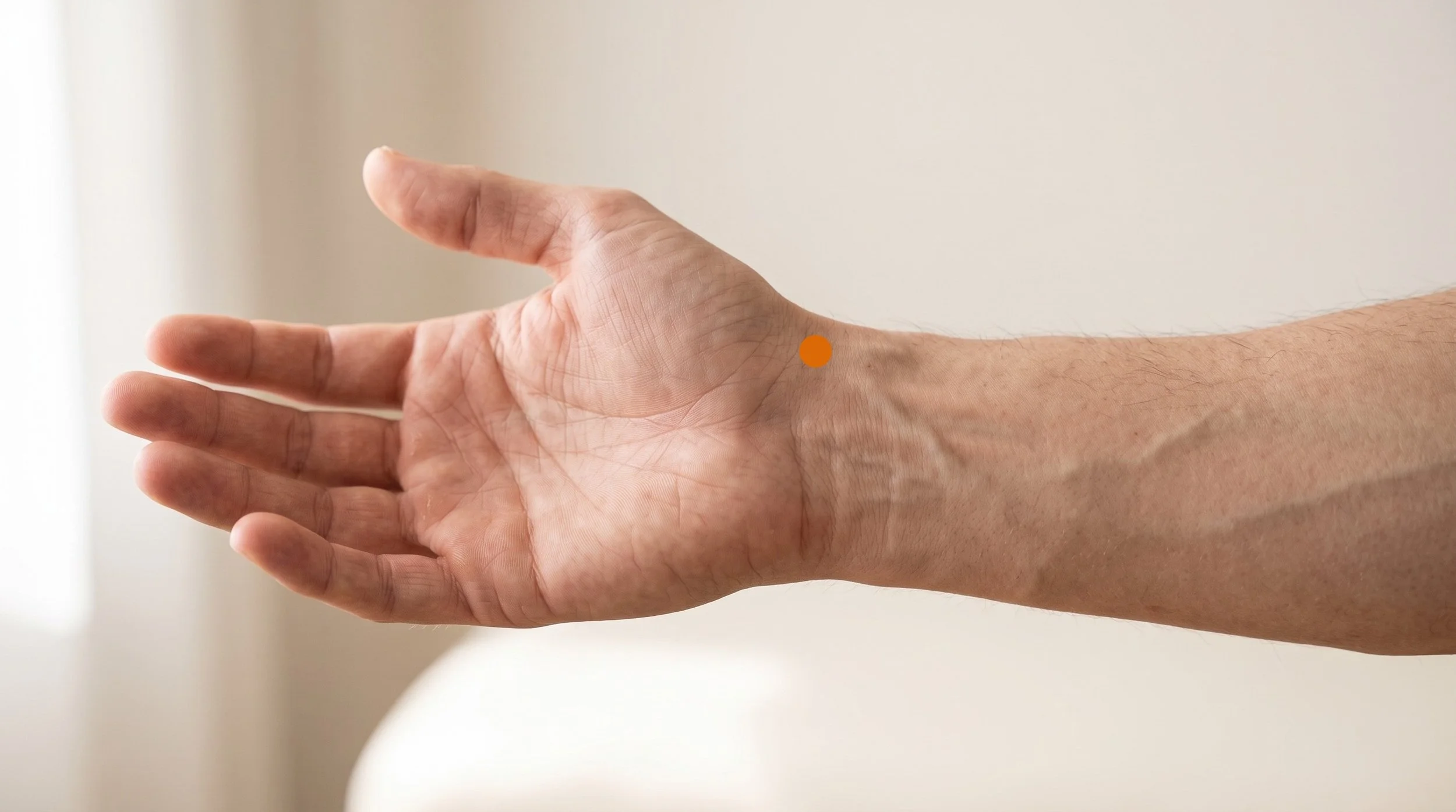
SJ23 Acupuncture Point (Sizhukong)
The Silken Bamboo Hollow at the Outer Eyebrow: Anatomy, Mechanism, and Why the Final Triple Burner Point Anchors Headache, Brow, and Eye Treatment
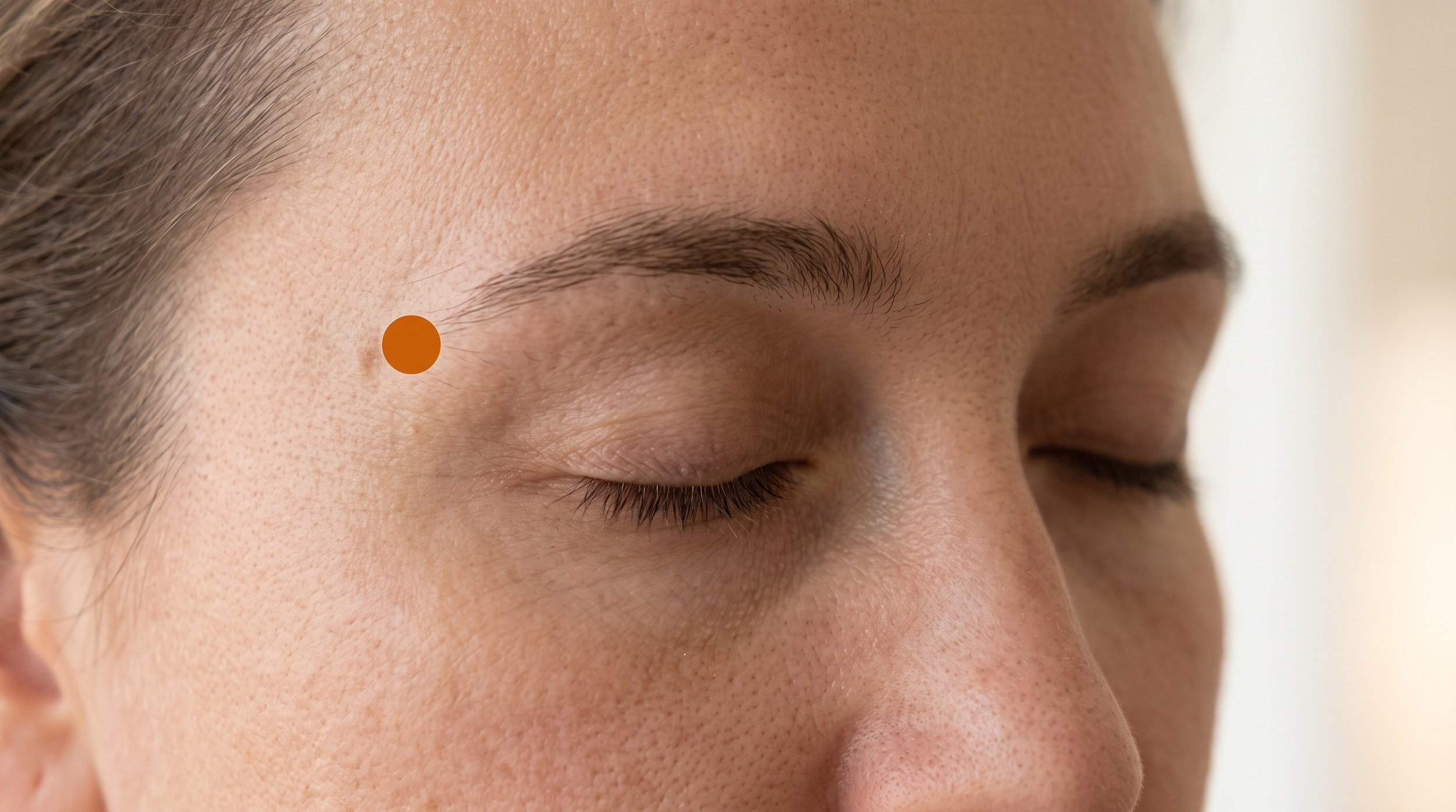
SJ23 (also written TE23), called Sizhukong in pinyin and usually translated as Silken Bamboo Hollow, is the last point of the Triple Burner channel, and you'll also see it written as Triple Burner 23 or TB-23 depending on which text you're reading. It sits in the small depression you can feel on the bony rim above the eye, right at the outer tip of the eyebrow, where the brow hairs thin out and the forehead starts curving back toward the temple.
That single fingertip of real estate is where forehead muscle, the outer ring of the eyelid muscle, and the leading edge of the temple all converge over a palpable bony ledge, which is exactly why the sj 23 eyebrow location shows up so often in treatment plans for one-sided headache, brow and eye ache, twitching lids, and the gritty, strained eyes that follow long screen days. Classical sources treat it as a local point for the head, brow, and eye; modern practice treats it as a precise way to stimulate trigeminal branches that share a central relay with the nerves carrying head pain.
- Location and layers: SJ23 lies in the depression on the supraorbital margin at the lateral end of the eyebrow, and because there's very little soft tissue there, the needle stays in skin, subcutaneous tissue, and the lateral fibers of orbicularis oculi rather than going deep (Deadman et al., 2007).
- Traditional attributions, translated: classical texts credit the te23 acupuncture point with dispelling wind, easing pain, and benefiting the eyes, a description that maps onto what we'd now call local sensory modulation over the brow ridge combined with reduced sensitivity in the trigeminal pathways serving the forehead and eye (Deadman et al., 2007).
- Nerve story: the point sits in territory supplied by the zygomaticotemporal branch of the maxillary nerve and the lateral branch of the supraorbital nerve, with the temporal branch of the facial nerve running nearby to the brow and lid muscles, so stimulation here feeds directly into first and second division trigeminal input (Deadman et al., 2007).
- Research picture: reviews of acupuncture for headache generally test multi-point protocols rather than single points, and they suggest modest but real reductions in migraine and tension-type headache frequency compared with usual care or sham (Linde et al., 2016a; Linde et al., 2016b), with individual patient data pooling supporting effects on chronic pain that persist beyond the treatment course (Vickers et al., 2018).
- Eye-side evidence: SJ23 is one of the periorbital points examined in subgroup analyses of dry eye trials, though the review authors treated the acupoint comparisons as exploratory rather than definitive (Kim et al., 2018), and a small randomized study found short-term changes in ocular blood flow after eye-focused needling protocols (Leszczynska et al., 2018).
- Practice framing and de qi: needling is transverse, either medially along the eyebrow or backward toward the temple, and most people feel a mild pressure, a spreading tightness under the skin along the brow, and a dull heaviness that can travel toward the temple or behind the eye; the sensation is usually gentler than at thicker muscular points.
Stuck With One-Sided Headaches That Settle Behind the Eye?
Headaches that park themselves over one brow and drag on the eye rarely respond to a single approach, so we treat the whole pattern: SJ23 at the outer eyebrow for local brow and orbital input, upper neck and temple points for the referral pathway, and distal points to support broader pain modulation. Your acupuncturist also checks the neck, jaw, and temple muscles that keep feeding the cycle. Most patients notice changes in headache intensity and frequency over a short series rather than after one visit. Schedule an appointment and let's map your headache pattern properly.
Schedule NowAnatomy of SJ23: Why the Outer End of the Eyebrow Is Such an Important Location
Run your finger along the top of your eye socket toward the outer corner and you'll feel the bone rise slightly, then dip, right where the eyebrow tapers off. That dip is SJ23. The tissue stack there is thin: skin, a sparse layer of subcutaneous fat, the lateral fibers of orbicularis oculi (the ring muscle that closes the eye), the outer edge of frontalis where it blends into the temporal fascia, and then periosteum over the lateral supraorbital margin.
Because this spot is a crossroads between the muscle that squints, the muscle that lifts the brow, and the fascia covering the temple, it takes on load from a very ordinary set of habits: staring at a monitor in glare, reading small print, driving into the sun, raising the brow to compensate for a heavy lid, and clenching the jaw, which tugs on the temporalis and the fascia running up past the outer brow.
The nerve geography is what makes SJ23 clinically interesting. The area is supplied by the zygomaticotemporal branch of the maxillary division of the trigeminal nerve and by the lateral branch of the supraorbital nerve from the ophthalmic division, with the zygomaticofacial branch and the temporal branch of the facial nerve close by (Deadman et al., 2007).
In plain terms, needling here stimulates the same two trigeminal divisions that carry sensation from the forehead, the eye and its surrounding structures, and part of the temple. Those fibers converge with input from the upper cervical segments in the brainstem, which is one reason brow pain, eye ache, and upper neck tension so often travel together, and why a needle at the eyebrow can influence perceived pain in a wider head region.
Repeated stimulation of somatic afferents also recruits descending inhibitory control from the midbrain and brainstem along with endogenous opioid and monoamine signaling, mechanisms mapped out in detail in the acupuncture analgesia literature (Zhao, 2008), and pooled clinical data suggest these effects are more than short-lived (Vickers et al., 2018).
The vascular neighbors matter for technique. Frontal branches of the superficial temporal artery and vein and the zygomaticoorbital vessels run near this point, and periorbital tissue is loose and bruises easily, so precision counts. Standard practice is a transverse, subcutaneous insertion of roughly 0.5 to 1 cun, directed either medially along the eyebrow or posteriorly toward the temple, never angled downward into the orbit (Deadman et al., 2007).
Practitioners typically palpate and slide the needle just under the skin, apply gentle pressure on withdrawal to limit bruising, and warn patients that a small bruise near the eye is the most common side effect. Several classical texts also list this point as contraindicated to moxibustion, a caution most modern practitioners still observe given the proximity to the eye (Deadman et al., 2007).
Related Best Acupuncture Points For Headaches Related Pain Finder Head NeckSJ23 (TE23) at a Glance: Classification, Location, and Clinical Use
| Category | Detail |
|---|---|
| Traditional Name | Sizhukong (Silken Bamboo Hollow), also written Silk Bamboo Hole; SJ23, TB-23, or TE23 depending on the text |
| Channel Classification | Triple Burner (Sanjiao) channel of Hand Shaoyang; the final point of the channel, where the pathway ends at the outer end of the eyebrow near the outer canthus and connects superficially with the start of the Gall Bladder channel (SJ23, also written TE23 or TB23; also called the Triple Energizer, the Triple Heater or Triple Warmer) |
| Point Categories | Terminal point of the Triple Burner channel. The reference sources list no five-shu, luo-connecting, xi-cleft, hui-meeting, or extraordinary vessel designation for this point; it's classified functionally as a local point for the head, brow, and eye, and grouped with the periorbital points relevant to the Eye System. Several classical texts consider it contraindicated to moxibustion. |
| Precise Location | In the depression on the supraorbital margin at the lateral end of the eyebrow, on the bony rim above the outer corner of the eye |
| Tissue Stimulated | Skin and subcutaneous tissue over the lateral supraorbital margin, lateral fibers of orbicularis oculi, the outer edge of frontalis, and the superficial temporal fascia just lateral to the brow; clinically related myofascial territory includes temporalis and the deeper jaw muscles such as the lateral pterygoid |
| Needle Depth / Direction | Transverse (subcutaneous) insertion, 0.5 to 1 cun, directed medially along the eyebrow or posteriorly toward the temple; never angled into the orbit. Fine needles, careful pressure on withdrawal, and no moxibustion by classical convention. |
| De Qi Sensation | A light pressure at insertion, then a spreading tightness or tugging under the skin along the brow, often with dull heaviness moving toward the temple or a vague ache behind the eye; watering of the eye is common and harmless |
| Primary Clinical Uses | One-sided and generalized headache, brow and temple pain, eye redness, ache, and blurred or strained vision, twitching of the eyelids and eyebrows, dizziness, and facial and periorbital tension patterns |
| Common Point Combinations |
|
In A Manual of Acupuncture, Deadman and colleagues present SJ23 primarily as a local point for the head, eye, eyelid, and eyebrow, with traditional actions described as dispelling wind, relieving pain, and benefiting the eyes.
The classical indication list they compile falls into three loose groups: head pain of the one-sided and wind types along with dizziness and sensitivity to wind and cold; eye and lid complaints including redness, pain, blurred vision, upward staring, deviation of the face and eye, and twitching of the brow and eyelid; and a more dramatic set of convulsive and disturbed-mind presentations such as tetany, epilepsy, and mania.
They also note the Investigation Into Points Along the Channels credited the point with a sweeping range over disorders of the head, face, eyebrows, and eyes, whether swollen, red, itchy, or numb. What's striking is the reach claimed for one small hollow at the end of the eyebrow: a strictly local landmark asked to handle both an irritated eye and a whole-head convulsive pattern, which tells you how much importance the classical tradition placed on this trigeminal border zone.
Why SJ23 Is Used for Screen Strain, Twitching Eyelids, and Headaches That Wrap Around the Temple
The short answer is convergence. Sensation from the forehead, eyebrow, eye, and part of the temple travels along the first and second divisions of the trigeminal nerve, and SJ23 sits precisely where branches of both are accessible just under the skin (Deadman et al., 2007). Those trigeminal fibers relay into a brainstem region that also receives input from the upper neck, which is why a patient with a stiff upper cervical spine and a clenched jaw can experience the pain as brow and eye ache, and why treating the brow, the temple, and the neck together tends to work better than treating any one of them alone.
Stimulating the point creates a strong, well-localized afferent volley into that shared relay, which can shift how the whole region is being processed.
There's also a systemic layer. Needle stimulation reliably engages descending inhibitory pathways from the midbrain and brainstem, releasing endogenous opioids and other neurotransmitters that dampen pain signaling at the spinal and brainstem level (Zhao, 2008). That's the mechanism most likely responsible for the effects seen in headache trials, where courses of acupuncture reduced migraine and tension-type headache frequency compared with routine care, with smaller differences against sham needling (Linde et al., 2016a; Linde et al., 2016b).
Pooled individual patient data across chronic pain conditions found benefits that didn't disappear as soon as treatment ended, which supports thinking about a series rather than a single visit (Vickers et al., 2018).
For the eye-side complaints, the plausible story is local and autonomic rather than mystical. Needling around the orbit produces local vasodilation through axon reflex mechanisms and appears able to influence periocular circulation, with one small randomized study reporting short-term increases in pulsatile ocular blood flow after an eye-focused needling protocol (Leszczynska et al., 2018). Reviews of acupuncture for dry eye have included SJ23 among the periorbital points examined, though the acupoint-level comparisons remain exploratory and the overall quality of evidence is modest (Kim et al., 2018).
Twitching lids and brows are usually driven by fatigue, caffeine, stress, and sustained visual effort, and reducing tension in the orbicularis and frontalis region may help, though we frame that as reasonable clinical practice rather than proven mechanism.
What the Research Shows for SJ23 (TE23)
One note on naming before the evidence: in the research literature this point appears as TE23, the WHO standard code, and also as SJ23 or TB23 depending on the authors, so it is worth searching all three if you want to read the studies below in full.
A fair caveat before the table: almost no clinical trial isolates a single acupuncture point, and SJ23 is no exception. The reviews below tested full protocols in which SJ23 might have been one of six to twelve points, or might not have been used at all. What the research supports is the broader claim that acupuncture courses can reduce headache frequency and chronic pain intensity, and that periorbital needling protocols show some measurable local physiological effects.
What it can't tell us is how much of that belongs to this point specifically. Treat the evidence as support for the treatment approach that includes SJ23, not as proof of the point on its own.
| Study | Type | Focus | Key Finding |
|---|---|---|---|
| Linde et al., 2016a | Cochrane systematic review | Acupuncture for the prevention of episodic migraine | Acupuncture courses reduced migraine frequency compared with no prophylactic treatment and compared reasonably well with prophylactic drugs, with smaller effects over sham needling. |
| Linde et al., 2016b | Cochrane systematic review | Acupuncture for the prevention of tension-type headache | The review concluded that a course of at least six sessions may be a worthwhile option for people with frequent tension-type headache, though effects over sham were modest. |
| Vickers et al., 2018 | Individual patient data meta-analysis | Acupuncture for chronic pain, including chronic headache | Acupuncture was associated with greater pain reduction than sham and no-acupuncture controls, with benefits that declined only gradually after treatment ended. |
| Kim et al., 2018 | Systematic review with subgroup analysis | Acupuncture protocols for dry eye syndrome, including periorbital points such as SJ23 | Acupuncture compared favorably with artificial tears in pooled analyses, but acupoint-level subgroup findings were exploratory and limited by trial quality. |
| Leszczynska et al., 2018 | Randomized clinical study | Short-term ocular blood flow after eye-specific versus eye-unspecific needling in open-angle glaucoma | Pulsatile ocular blood flow increased significantly after the eye-specific protocol, suggesting periorbital needling may produce short-term vascular effects. |
| Zhao, 2008 | Narrative review of neurophysiology | Mechanisms of acupuncture analgesia | Needle stimulation activates descending inhibitory pathways and endogenous opioid signaling, providing a plausible mechanism for pain modulation from points like SJ23. |
Tired, Dry, Screen-Strained Eyes After Long Workdays?
New Yorkers spend hours locked onto screens with a squint they don't notice until the brow starts aching, and the sizhukong eye point is one of our go-to local choices for that presentation. We combine SJ23 with other periorbital and neck points, plus gentle work on the temple and forehead muscles that tighten with sustained visual focus. Treatment is calm, the needles are thin, and sessions are designed to fit around a workday. Book a visit and see how your eyes and brow feel afterward.
Schedule NowSJ23 in the Context of Trigger Point Work
At Morningside, SJ23 is rarely the whole treatment for a head pain pattern. It's the local piece, and it works best paired with needling of the muscles that refer pain into the brow, temple, and eye region. Temporalis is the most frequent partner, since its trigger points can refer into the temple, the eyebrow, and the upper teeth, and clenching or grinding keeps it loaded. Sternocleidomastoid and the suboccipital group are also common targets, because their referral patterns reach the forehead and behind the eye, and upper trapezius contributes to the temple and occiput (Simons et al., 1999).
The order tends to be: release the muscular drivers with dry needling, then use SJ23 and other periorbital and neck points to address the local sensitivity that's left over.
There's no significant muscle belly at SJ23 itself, so this isn't a trigger point location in the usual sense. What overlaps is the fascial and neural continuity between the brow, the outer canthus, and the temple. When we needle temporalis or the deeper jaw muscles like the lateral pterygoid, patients often report that the ache over the outer eyebrow eases too, which is consistent with shared referral territory rather than separate problems.
Because acupuncture simply means the therapeutic use of an acupuncture needle across many styles, including dry needling, we treat the classical point and the myofascial target as tools in the same toolbox and choose based on what your exam shows.
SJ23 Headache and Eye Strain Treatment at NYC's Highest-Rated Acupuncture Clinic
Morningside Acupuncture is the highest-rated acupuncture and dry needling clinic in New York City with over 500 five-star Google reviews, and our licensed acupuncturists use points like SJ23 as part of structured, evidence-informed plans rather than one-size-fits-all protocols. Every session starts with an assessment of your headache pattern, posture, jaw, and visual habits, then combines acupuncture with dry needling of the muscles feeding your symptoms. You get clear expectations, a defined treatment course, and home strategies between visits. Schedule your appointment today.
Schedule NowFrequently Asked Questions
Is SJ23 the same point as TE23 or TB23?
Yes. SJ23, TE23, and TB23 are all codes for the same point, Sizhukong. SJ stands for San Jiao, the Chinese name of the channel. TE (Triple Energizer) is the WHO standard abbreviation and the one you will see in most Western textbooks and research papers. TB (Triple Burner) and TW (Triple Warmer) are older English renderings of the same name that still appear in many books. You will also come across it written as San Jiao 23 or Triple Energizer 23. Whichever code is used, the location and the uses are the same.
What does SJ23 feel like when needled?
Most people feel a small pinch at insertion, then a spreading tightness or a light tugging under the skin along the eyebrow, since the needle is threaded flat rather than pushed in deeply. Some feel a dull heaviness that travels toward the temple or a vague pressure behind the eye. The eye on that side may water briefly, which is normal. Sensation here is usually milder than at thick muscular points, and the needle is typically retained for 15 to 25 minutes.
Why needle at the eyebrow instead of directly where my headache hurts?
Often the eyebrow is exactly where it hurts, which makes SJ23 a local point for brow, temple, and orbital pain. But even when the pain sits deeper, the area supplies trigeminal branches that share a central relay with the nerves carrying pain from the forehead, the eye, and the upper neck (Deadman et al., 2007). Stimulating an accessible spot in that network can influence a wider region than the needle physically touches. That's also why treatment plans usually combine SJ23 with neck points and distal points rather than relying on any one location.
Can I press SJ23 myself between sessions?
Yes, and it's an easy one to find. Trace along the top edge of your eye socket toward the outer corner until your fingertip drops into the small hollow at the end of the eyebrow, on the bone rather than on the soft eyelid tissue. Use your index or middle fingertip and apply steady, moderate pressure straight into the bony rim for 30 to 60 seconds, then add small circular motions for another 30 seconds. Repeat on both sides, two or three rounds, several times a day during a screen-heavy stretch or when a brow ache starts building. Keep pressure firm but comfortable, never press on the eyeball itself, and stop if it produces sharp pain, visual changes, or dizziness.
Is SJ23 safe to needle?
In trained hands, yes. The main considerations are technique and bruising: insertion is transverse and subcutaneous, 0.5 to 1 cun, angled medially along the brow or backward toward the temple, and never directed down into the orbit (Deadman et al., 2007). Small vessels run near the point and periorbital tissue bruises easily, so a practitioner will apply pressure after withdrawal, and a temporary bruise near the eye is the most common side effect. Several classical texts also list this point as contraindicated to moxibustion. Tell your acupuncturist if you're on blood thinners, have had recent eye surgery, or bruise readily, and this point should only be needled by a licensed practitioner rather than at home.
Where exactly is SJ23 located?
SJ23 sits in the depression on the supraorbital margin at the lateral end of the eyebrow. To find it, place a fingertip on the bony ridge above your eye and slide outward toward the temple until the eyebrow hairs run out; you'll feel a slight dip in the bone right there. It's on the bone, not on the soft tissue of the lid, and it lines up roughly with the outer corner of the eye. BL2 sits at the opposite, inner end of the same eyebrow, and the two are often used together.
References
- Deadman, P., Al-Khafaji, M., & Baker, K. (2009). A manual of acupuncture. Journal of Chinese Medicine Publications.
- Cheng, X. (Ed.). (1999). Chinese acupuncture and moxibustion (Rev. ed.). Foreign Languages Press.
- Maciocia, G. (2005). The foundations of Chinese medicine: A comprehensive text for acupuncturists and herbalists (2nd ed.). Elsevier Churchill Livingstone.
- Simons, D. G., Travell, J. G., & Simons, L. S. (1999). Travell & Simons' myofascial pain and dysfunction: The trigger point manual, Vol. 1: Upper half of body (2nd ed.). Williams & Wilkins.
- Linde, K., Allais, G., Brinkhaus, B., Fei, Y., Mehring, M., Vertosick, E. A., Vickers, A., & White, A. R. (2016a). Acupuncture for the prevention of episodic migraine. Cochrane Database of Systematic Reviews, 2016(6), CD001218. https://doi.org/10.1002/14651858.CD001218.pub3
- Linde, K., Allais, G., Brinkhaus, B., Fei, Y., Mehring, M., Shin, B. C., Vickers, A., & White, A. R. (2016b). Acupuncture for the prevention of tension-type headache. Cochrane Database of Systematic Reviews, 2016(4), CD007587. https://doi.org/10.1002/14651858.CD007587.pub2
- Vickers, A. J., Vertosick, E. A., Lewith, G., MacPherson, H., Foster, N. E., Sherman, K. J., Irnich, D., Witt, C. M., & Linde, K. (2018). Acupuncture for chronic pain: Update of an individual patient data meta-analysis. Journal of Pain, 19(5), 455-474. https://doi.org/10.1016/j.jpain.2017.11.005
- Kim, B. H., Kim, M. H., Kang, S. H., & Nam, H. J. (2018). Optimizing acupuncture treatment for dry eye syndrome: A systematic review. BMC Complementary and Alternative Medicine, 18, 145. https://doi.org/10.1186/s12906-018-2202-0
- Leszczynska, A., Ramm, L., Spoerl, E., Pillunat, L. E., & Terai, N. (2018). The short-term effect of acupuncture on different ocular blood flow parameters in patients with primary open-angle glaucoma: A randomized, clinical study. Clinical Ophthalmology, 12, 1285-1291. https://doi.org/10.2147/OPTH.S170396
- Zhao, Z. Q. (2008). Neural mechanism underlying acupuncture analgesia. Progress in Neurobiology, 85(4), 355-375. https://doi.org/10.1016/j.pneurobio.2008.05.004
Disclaimer: This web site is intended for educational and informational purposes only. Reading this website does not constitute providing medical advice or any professional services. This information should not be used for diagnosing or treating any health issue or disease. Those seeking medical advice should consult with a licensed physician. Seek the advice of a medical doctor or other qualified health professional for any medical condition. If you think you have a medical emergency, call 911 or go to the emergency room. No acupuncturist-patient relationship is created by reading this website or using the information. Morningside Acupuncture PLLC and its employees and contributors do not make any express or implied representations with respect to the information on this site or its use. For any legal interpretation of scope of practice in your state, consult a licensed attorney or regulatory authority.
Read more from our blog