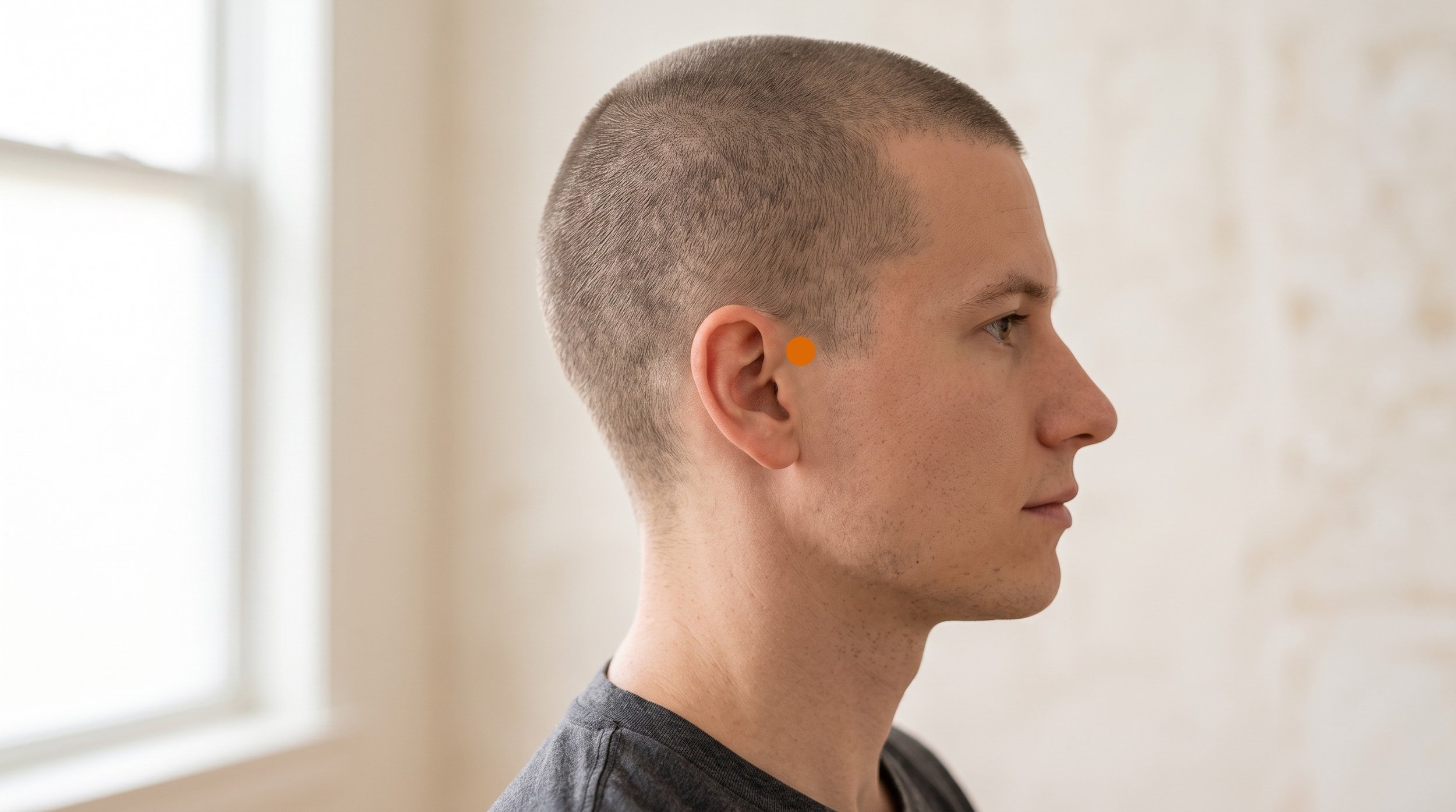
SJ22 Acupuncture Point (Erheliao)
The Ear Harmony Crevice at the Temple Hairline: Anatomy, Mechanism, and Why a Small Point in Front of the Ear Matters for Tinnitus, Headache, and Jaw Tension
SJ22 (Erheliao, often translated as Ear Harmony Crevice), also written TE22, sits at the back edge of the temple hairline, roughly half a thumb-width in front of where the top of the ear meets the scalp. It's the second-to-last point on the Triple Burner channel, and classical texts describe it as a place where the Triple Burner, Gallbladder and Small Intestine channels meet, which is one reason so much ear, temple and jaw work converges here (Deadman et al., 2007).
In plain anatomical terms, this is a thin, highly innervated patch of scalp directly over the auriculotemporal nerve and immediately behind the pulse of the superficial temporal artery. That combination of dense sensory supply, palpable vessel and proximity to the temporalis muscle makes the te22 acupuncture point clinically useful for tinnitus, temporal headache, and jaw tension, and it also makes careful needle technique non-negotiable.
- Location and layers: SJ22 lies about 0.5 cun anterior to the upper border of the root of the ear, in a shallow depression along the posterior temple hairline, just behind the palpable superficial temporal artery (Deadman et al., 2007). Beneath thin hair-bearing skin sit the superficial temporal vessels, the auriculotemporal nerve, the small anterior and superior auricular muscles, and the fascia over the anterior temporalis.
- Traditional categories, read neurophysiologically: erheliao is classed as a crossing point of the Triple Burner, Gallbladder and Small Intestine channels and is traditionally said to expel wind and relieve pain (Deadman et al., 2007). Modern reading: it's a regional point whose three-channel status reflects the convergence of trigeminal, cervical and facial nerve territory across the temple, ear and jaw.
- Nerve story: the auriculotemporal nerve is a branch of the mandibular division of the trigeminal nerve, and the temporal branch of the facial nerve runs nearby, which is why needling here can influence sensation around the ear, temple and jaw (Chinese Acupuncture and Moxibustion). Trigeminal and upper cervical afferents converge centrally, which helps explain why one small point can affect symptoms felt some distance away (Zhao, 2008).
- Research picture: reviews of acupuncture for migraine and tension-type headache report modest but real reductions in headache days compared with usual care, with smaller differences versus sham (Linde et al., 2016a; Linde et al., 2016b), while tinnitus reviews are mixed and limited by small, low-quality trials (Huang et al., 2021; Liu et al., 2016).
- Clinical framing: at Morningside we use sj 22 ear work as one element of a regional plan, usually with points in front of the tragus, jaw muscle needling, and distal points, rather than as a standalone fix. Individual patient data show acupuncture effects for chronic pain persist over months, which supports treating in a short series rather than judging a single visit (Vickers et al., 2018).
- De qi here is usually mild: a dull, spreading heaviness or a stretched, tugging feeling under the skin around the ear and temple, sometimes drifting toward the jaw hinge or behind the eye. Because insertion is transverse and shallow, most people report pressure rather than depth.
Ringing Ears, Temple Headaches, or a Jaw That Won't Let Go?
SJ22 is one of the points we reach for when symptoms cluster around the ear, temple and jaw hinge rather than staying in one tidy place. Our licensed acupuncturists palpate the temple hairline, the temporalis, and the upper cervical region before deciding what to needle, so the plan matches what your tissue is actually doing. Treatment may combine shallow needling at erheliao with jaw muscle work and distal points, plus practical advice on clenching, sleep position and screen setup. Schedule a visit and we'll map out where your symptoms are coming from.
Schedule NowAnatomy of SJ22: Why the Temple Hairline in Front of the Ear Is Such an Important Location
Run a fingertip up from the front of your ear canal to the level where the top of the ear attaches to the head, then slide forward a short distance onto the hairline. That shallow dip is SJ22. The tissue here is unusually thin: hair-bearing skin, a mobile subcutaneous layer holding vessels and nerves, small vestigial auricular muscles, then the tough temporalis fascia and the front edge of the temporalis muscle over the squamous temporal bone. What loads this region is rarely dramatic.
Sustained jaw clenching and bruxism, long hours of chewing gum, glasses or headset pressure, and a habitually protruded head posture all keep temporalis and the surrounding fascia under low-grade tension, and patients often describe the resulting sensation as a tight band or a helmet across the temples rather than as jaw pain.
The nerve geography is the reason this point punches above its size. The auriculotemporal nerve, a branch of the mandibular division of the trigeminal nerve, ascends here with the superficial temporal vessels and supplies the skin of the temple, part of the external ear and the tissues around the temporomandibular joint; the temporal branch of the facial nerve also travels through this territory (Chinese Acupuncture and Moxibustion).
Trigeminal afferents and upper cervical afferents converge on shared second-order neurons in the brainstem, which is why ear, temple, jaw and upper neck symptoms so often travel together and why a stimulus in one zone can change perception in another. Needling produces a barrage of A-delta and C-fiber input that engages spinal and supraspinal inhibitory circuits, including opioid, serotonergic and noradrenergic descending pathways (Zhao, 2008). Point compendia also note that SJ22 lies over the temporalis and is used clinically for temporal headache and jaw pain of muscular origin (Cunningham).
The safety structure here is vascular, not visceral. The superficial temporal artery is palpable immediately in front of the point, and classical and modern texts agree that the needle should stay clear of it (Deadman et al., 2007; Chinese Acupuncture and Moxibustion). Standard technique is transverse (subcutaneous) insertion of roughly 0.3 to 0.5 cun, angled posteriorly or superiorly away from the pulse, though some texts describe a shallower oblique insertion. Practically, that means palpating the artery first, marking the vessel mentally, then threading the needle under the skin on the far side of it.
Scalp and temple points bleed and bruise more readily than most body points, so slow withdrawal and firm brief pressure afterward are standard. Anyone on anticoagulants should mention it, and new, marked tenderness over the temporal artery in an older adult, especially with jaw fatigue on chewing or visual change, needs medical evaluation before any local needling.
Related Best Acupuncture Points For Headaches Related Acupuncture Tension Headache ResearchSJ22 (TE22) at a Glance: Classification, Location, and Clinical Use
| Category | Detail |
|---|---|
| Traditional Name | Erheliao (Ear Harmony Crevice), Triple Burner 22, also written TE22 or TE-22 |
| Channel Classification | Twenty-second point of the Triple Burner (Sanjiao, hand shaoyang) channel (SJ22, also written TE22 or TB22; also called the Triple Energizer, the Triple Heater or Triple Warmer) |
| Point Categories | Meeting (crossing) point of the Triple Burner, Gallbladder and Small Intestine channels; listed in some modern point compendia as the exit point of the Triple Burner channel toward GB1. No five-shu, front-mu, hui-meeting or extraordinary vessel designations are attributed to this point. |
| Precise Location | Approximately 0.5 cun anterior to the upper border of the root of the ear, in a slight depression on the posterior border of the temple hairline, just behind the palpable pulse of the superficial temporal artery |
| Tissue Stimulated | Thin scalp and subcutaneous tissue at the temple hairline, anterior and superior auricular muscles, temporalis fascia and the anterior fibers of temporalis, in auriculotemporal nerve territory with the temporal branch of the facial nerve nearby |
| Needle Depth / Direction | Transverse (subcutaneous) insertion 0.3 to 0.5 cun, angled away from the superficial temporal artery; some texts use a shallower oblique insertion of 0.1 to 0.3 cun. Palpate the arterial pulse before insertion. Moxibustion is described as applicable in classical sources. |
| De Qi Sensation | A mild dull ache, heaviness or stretched tugging under the skin that may spread around the ear, across the temple, toward the jaw hinge or behind the eye; usually pressure-like rather than deep |
| Primary Clinical Uses | Tinnitus and ear fullness, temporal and one-sided headache, heaviness of the head, jaw tension and restricted opening, facial and nasal symptoms in classical listings |
| Common Point Combinations |
|
Deadman's Manual of Acupuncture presents Erheliao as a meeting point of the Triple Burner, Gallbladder and Small Intestine channels whose traditional action is to expel wind and relieve pain, and the indication list it records is tightly regional: ringing in the ears, headache with a heavy or oppressed quality, so-called head wind, swelling and pain at the tip of the nose with nasal discharge, deviation of the mouth, clamped jaw, swelling under the jaw and along the neck, and spasm.
These are traditional attributions rather than modern diagnoses, but the pattern is worth noticing. Every item on that list falls within the sensory and motor territory served by the trigeminal and facial nerves and the vessels of the temple, which is a strikingly consistent map for a description written long before anyone had traced those nerves.
Why SJ22 Is Used for Tinnitus and Ear Fullness When the Problem Seems to Sit Deeper Inside the Ear
Patients are often puzzled that a needle placed on the hairline, outside the ear entirely, might change how the ear feels. The explanation is convergence. Sensory fibers from the outer ear, temple, jaw joint and upper neck feed into overlapping regions of the brainstem, so the nervous system does not process these areas as separate compartments. Somatosensory input from the jaw and cervical region can measurably alter how some people perceive tinnitus, and a substantial subgroup of tinnitus sufferers can modulate their sound by clenching, moving the jaw, or turning the head. Needling in auriculotemporal territory is one way of feeding organized input into that same convergent system.
The second layer is descending inhibition. Needle stimulation recruits ascending pathways that activate midbrain and brainstem structures, which then send signals back down to dampen incoming nociceptive traffic, with endogenous opioid, serotonergic and noradrenergic transmitters all involved (Zhao, 2008). Locally, the same input drives an axon-reflex vasodilation and a shift in autonomic tone around the temple and jaw, which is likely part of why a tight, congested-feeling temple often softens within a few minutes.
None of this makes triple burner 22 a treatment for hearing loss or for the underlying cochlear changes that frequently accompany tinnitus, and we're careful to say so.
Realistically, the ear symptoms most likely to respond are the ones with a mechanical or muscular flavor: fullness and pressure that shifts with jaw position, tinnitus that spikes during high-clenching weeks, and ear-adjacent ache accompanying temporal headache. Reviews of acupuncture for tinnitus report improvements on symptom questionnaires but not consistently on loudness ratings, and the trials are small and methodologically weak (Huang et al., 2021; Liu et al., 2016). We treat that as a reason for a short, honest trial with clear reassessment, not a promise.
What the Research Shows for SJ22 (TE22)
One note on naming before the evidence: in the research literature this point appears as TE22, the WHO standard code, and also as SJ22 or TB22 depending on the authors, so it is worth searching all three if you want to read the studies below in full.
No trial has isolated SJ22. Like nearly all acupuncture research, the studies below test whole protocols in which this point may or may not appear, so the honest framing is that SJ22 is one component of treatment approaches that have been studied, not a validated intervention in its own right. The strongest evidence relevant to this point sits in the headache literature; the ear and jaw evidence is thinner and less consistent. Results also vary depending on whether acupuncture is compared with usual care, sham needling, or an active treatment, and sham comparisons in particular narrow the difference considerably.
| Study | Type | Focus | Key Finding |
|---|---|---|---|
| Linde et al., 2016a | Cochrane systematic review | Acupuncture for the prevention of tension-type headache | Adding acupuncture to usual care was associated with fewer headache days, with a smaller advantage over sham needling. |
| Linde et al., 2016b | Cochrane systematic review | Acupuncture for the prevention of episodic migraine | Acupuncture reduced migraine frequency compared with usual care and was at least comparable to prophylactic drug treatment, though the sham comparison was modest. |
| Vickers et al., 2018 | Individual patient data meta-analysis | Chronic pain conditions including chronic headache | Effects were statistically significant against both sham and no-acupuncture controls and appeared to persist over roughly a year. |
| Huang et al., 2021 | Systematic review and meta-analysis | Acupuncture for tinnitus | Loudness ratings did not differ significantly from controls, while tinnitus questionnaire scores improved; the authors judged the evidence too weak for firm conclusions. |
| Liu et al., 2016 | Systematic review and meta-analysis | Acupuncture for tinnitus across English and Chinese literature | Results diverged sharply by region of publication, which the authors flagged as a serious limitation on interpreting benefit. |
| Park et al., 2023 | Systematic review and meta-analysis | Acupuncture for temporomandibular disorders | Pain outcomes generally favored acupuncture, particularly as an add-on to usual care, but certainty of evidence was low. |
| Zhao, 2008 | Narrative review of mechanisms | Neural pathways of acupuncture analgesia | Needle stimulation engages segmental inhibition and descending opioid, serotonergic and noradrenergic control systems. |
Why Precision Matters at the Temple Hairline
The superficial temporal artery runs right beside erheliao acupuncture territory, so this is a point that rewards experience and punishes guesswork. We locate the pulse first, angle the needle transversely away from the vessel, and keep depth shallow, which keeps the treatment comfortable and reduces bruising risk. That same care carries into how we combine points, since head and jaw cases usually need a few well-chosen locations rather than a crowded map. Book an evaluation and see what a careful, anatomy-first approach feels like.
Schedule NowSJ22 in the Context of Trigger Point Work
SJ22 sits at the anterior upper margin of the temporalis, and temporalis trigger points refer pain across the temple, into the eyebrow, behind the eye and down into the upper teeth, which overlaps closely with the classical indication list for this point (Simons et al., 1999).
In practice we often find that a patient who reports a band of temple pressure has taut, tender bands in the anterior and middle temporalis, restricted jaw opening, and reproducible tenderness within a centimeter or two of the SJ22 location. Because acupuncture is defined by the use of an acupuncture needle rather than by the reasoning behind it, the same filiform needle can be used to treat the classical point transversely and then to address adjacent temporalis bands with short, precise insertions, all within one treatment.
A typical head and jaw session at Morningside might include shallow transverse needling at SJ22 and SJ21, dry needling of the temporalis and masseter, attention to the suboccipitals and upper trapezius when neck-driven referral is present, and one or two distal points to support the overall response. Vessel awareness governs everything in this area: we palpate the superficial temporal artery before each insertion, keep needles superficial and angled away from it, and apply pressure on withdrawal because the temple bruises easily. Patients usually feel a heavy, spreading ache during needling and a looser, less compressed sensation across the temple afterward.
SJ22 Tinnitus and Headache Treatment at NYC's Highest-Rated Acupuncture Clinic
Morningside Acupuncture is the highest-rated acupuncture and dry needling clinic in New York City with over 500 five-star Google reviews, and head, ear and jaw complaints are among the most common reasons patients find us. We blend traditional point selection, including triple burner 22 and its classical partners, with trigger point dry needling of the temporalis, masseter and upper cervical muscles. Each plan is built around your history, your exam findings, and how your symptoms behave across a week. Schedule your first session and let's get started.
Schedule NowFrequently Asked Questions
Is SJ22 the same point as TE22 or TB22?
Yes. SJ22, TE22, and TB22 are all codes for the same point, Erheliao. SJ stands for San Jiao, the Chinese name of the channel. TE (Triple Energizer) is the WHO standard abbreviation and the one you will see in most Western textbooks and research papers. TB (Triple Burner) and TW (Triple Warmer) are older English renderings of the same name that still appear in many books. You will also come across it written as San Jiao 22 or Triple Energizer 22. Whichever code is used, the location and the uses are the same.
What does SJ22 feel like when needled?
Most people feel a brief prickle as the needle passes through the thin skin of the hairline, then a mild dull ache, heaviness or stretching sensation under the skin. Because insertion is transverse and shallow, the sensation tends to stay superficial and may spread around the ear, across the temple, or toward the jaw hinge. Some patients notice a warm or throbbing quality, which reflects the rich local blood supply. It should not be sharply painful; tell your acupuncturist if it is, since the needle can be adjusted or repositioned.
Why needle a point on the temple for tinnitus or jaw pain instead of the ear or jaw itself?
We usually do both, but SJ22 offers something the ear and jaw points don't. It sits in auriculotemporal nerve territory, which supplies the temple, part of the outer ear and the tissues around the jaw joint, and it lies over the anterior temporalis, a muscle that refers pain into exactly those regions (Simons et al., 1999). Because trigeminal and upper cervical inputs converge centrally, stimulating this small area can influence how the whole ear, temple and jaw region is processed (Zhao, 2008). Classical texts arrived at a similar conclusion by a different route, calling it a meeting point of three channels that all traverse the side of the head (Deadman et al., 2007).
Can I press SJ22 myself between sessions?
Yes, acupressure here is simple and safe when done gently. Find the top of your ear where it attaches to your head, slide forward about half a thumb-width onto the hairline, and feel for a slight dip. First locate your pulse in that area with a light touch, then move just behind it so you're not compressing the artery. Use a fingertip with light to moderate pressure and small circles for 30 to 60 seconds per side, breathing slowly, and repeat two or three times a day. Never press hard on a pulsating vessel, keep total time short, and stop if you feel lightheaded, if the area throbs, or if pressing makes symptoms worse. Combining this with a gentle jaw-relaxation cue, tongue resting on the palate and teeth slightly apart, usually helps more than pressure alone.
Is SJ22 safe to needle?
In trained hands, yes. The main consideration is the superficial temporal artery, which lies immediately in front of the point and must be palpated and avoided; needling is done transversely at 0.3 to 0.5 cun, angled away from the vessel (Deadman et al., 2007; Chinese Acupuncture and Moxibustion). The temple bruises more readily than most areas, so a small bruise or a spot of bleeding on withdrawal is the most common side effect. Let your acupuncturist know if you take blood thinners or bruise easily. New, unusual tenderness over the temporal artery in an adult over 50, especially with jaw fatigue while chewing, headache change, or any visual symptom, should be evaluated by a physician promptly before local needling.
Where exactly is SJ22 located?
SJ22 is roughly 0.5 cun anterior to the upper border of the root of the ear, in a small depression along the posterior edge of the temple hairline, at about the level where the ear attaches to the head (Deadman et al., 2007). It sits above and in front of SJ21 (Ermen), which is the point in the notch just in front of the ear canal. The most reliable landmark is the pulse of the superficial temporal artery: the point lies immediately behind where you can feel it beating. If you're uncertain, palpate for a tender, slightly boggy spot at the hairline while gently clenching and releasing your jaw, since the anterior temporalis will tighten right underneath it.
References
- Deadman, P., Al-Khafaji, M., & Baker, K. (2009). A manual of acupuncture. Journal of Chinese Medicine Publications.
- Cheng, X. (Ed.). (1999). Chinese acupuncture and moxibustion (Rev. ed.). Foreign Languages Press.
- Cunningham, P. M. (2000). Acupuncture points: A practical guide to classical and modern usage. Odyssey Press.
- Simons, D. G., Travell, J. G., & Simons, L. S. (1999). Travell & Simons' myofascial pain and dysfunction: The trigger point manual, Vol. 1: Upper half of body (2nd ed.). Williams & Wilkins.
- Linde, K., Allais, G., Brinkhaus, B., Fei, Y., Mehring, M., Shin, B. C., Vickers, A., & White, A. R. (2016a). Acupuncture for the prevention of tension-type headache. Cochrane Database of Systematic Reviews, 2016(4), CD007587. https://doi.org/10.1002/14651858.CD007587.pub2
- Linde, K., Allais, G., Brinkhaus, B., Fei, Y., Mehring, M., Vertosick, E. A., Vickers, A., & White, A. R. (2016b). Acupuncture for the prevention of episodic migraine. Cochrane Database of Systematic Reviews, 2016(6), CD001218. https://doi.org/10.1002/14651858.CD001218.pub3
- Vickers, A. J., Vertosick, E. A., Lewith, G., MacPherson, H., Foster, N. E., Sherman, K. J., Irnich, D., Witt, C. M., & Linde, K. (2018). Acupuncture for chronic pain: Update of an individual patient data meta-analysis. Journal of Pain, 19(5), 455-474. https://doi.org/10.1016/j.jpain.2017.11.005
- Huang, K., Liang, S., Chen, L., & Grellet, A. (2021). Acupuncture for tinnitus: A systematic review and meta-analysis of randomized controlled trials. Acupuncture in Medicine, 39(4), 264-271. https://doi.org/10.1177/0964528420938380
- Liu, F., Han, X., Li, Y., & Yu, S. (2016). Acupuncture in the treatment of tinnitus: A systematic review and meta-analysis. European Archives of Oto-Rhino-Laryngology, 273(2), 285-294. https://doi.org/10.1007/s00405-014-3341-7
- Park, E. Y., Cho, J. H., Lee, S. H., Kim, K. W., Ha, I. H., & Lee, Y. J. (2023). Is acupuncture an effective treatment for temporomandibular disorder? A systematic review and meta-analysis of randomized controlled trials. Medicine, 102(38), e34950. https://doi.org/10.1097/MD.0000000000034950
- Zhao, Z. Q. (2008). Neural mechanism underlying acupuncture analgesia. Progress in Neurobiology, 85(4), 355-375. https://doi.org/10.1016/j.pneurobio.2008.05.004
Disclaimer: This web site is intended for educational and informational purposes only. Reading this website does not constitute providing medical advice or any professional services. This information should not be used for diagnosing or treating any health issue or disease. Those seeking medical advice should consult with a licensed physician. Seek the advice of a medical doctor or other qualified health professional for any medical condition. If you think you have a medical emergency, call 911 or go to the emergency room. No acupuncturist-patient relationship is created by reading this website or using the information. Morningside Acupuncture PLLC and its employees and contributors do not make any express or implied representations with respect to the information on this site or its use. For any legal interpretation of scope of practice in your state, consult a licensed attorney or regulatory authority.
Read more from our blog



