Acupuncture for Basketball Players
Ankle Sprains, Patellar Tendinopathy, Hip Flexor Overload, and the Musculoskeletal Demands of Basketball Addressed With Dry Needling and Sports Acupuncture
Basketball's combination of explosive jumping, rapid deceleration, lateral cutting, and physical contact produces a predictable set of overuse and acute injuries. Acupuncture and dry needling address the trigger points and soft tissue conditions that accumulate across a basketball season, targeting the muscles most heavily loaded by the sport's specific movement demands.
- Lateral ankle sprains are the most common acute injury in basketball, and they consistently generate peroneal trigger points that maintain post-sprain instability even after the ligament heals; dry needling these trigger points restores peroneal activation speed and reduces the risk of recurrent sprain (Simons et al., 1999).
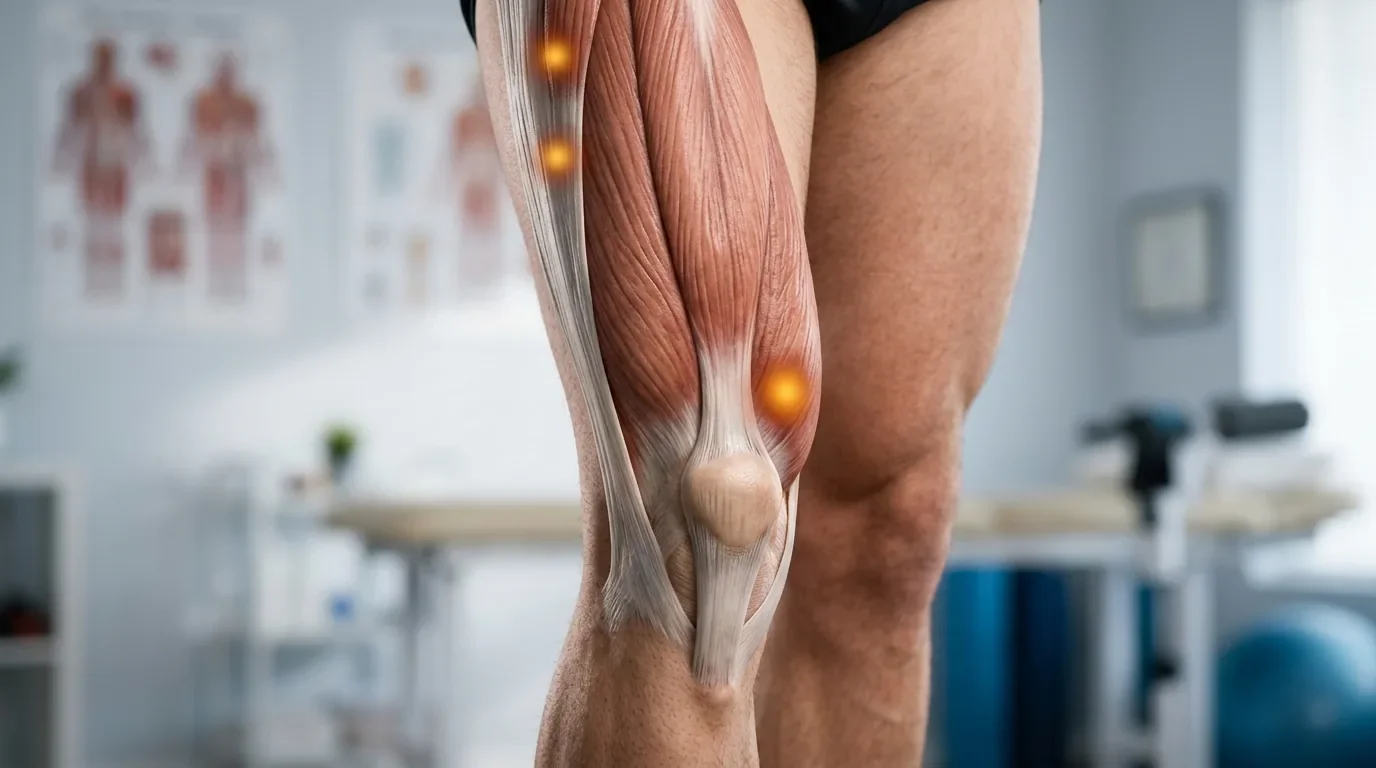
- Patellar tendinopathy (jumper's knee) is the most common overuse condition in basketball due to the repetitive eccentric knee loading of jumping and landing; the vastus lateralis, rectus femoris, and vastus medialis trigger points sensitize the patellar tendon through biochemical diffusion and must be addressed alongside the tendon itself (Shah et al., 2008).
- Hip flexor trigger points from the sustained hip flexion demands of low defensive stance cause reciprocal inhibition of the gluteal muscles, reducing explosive hip extension power in jumping and contributing to lower back pain in basketball players who carry the game load across a long season.
- Dry needling and acupuncture have consistent evidence for reducing musculoskeletal pain and improving function in athletes, with meta-analytic support for both lower extremity and upper extremity conditions (Vickers et al., 2018; Kietrys et al., 2013).
- The repetitive overhead demands of shooting and rebounding generate shoulder trigger points in the rotator cuff, pectoralis minor, and biceps brachii that reduce shooting accuracy and power over the course of a long season and become symptomatic in the same muscles that MRI attributes to impingement or tendinopathy.
- In-season trigger point maintenance between games prevents the accumulation of overuse injury that compounds over a season; treating developing trigger points before they become symptomatic keeps players on the court and performing at their highest level.
Ankle Instability, Knee Pain, or Hip Tightness Limiting Your Basketball Performance?
Basketball's specific movement demands generate predictable injury patterns that respond well to targeted trigger point dry needling and sports acupuncture. At Morningside Acupuncture on the Upper West Side, the assessment identifies the specific muscles driving your symptoms so that treatment goes to the source rather than the symptom location. Schedule for a sports acupuncture assessment.
Schedule NowThe Basketball Injury Landscape
Basketball's physical demands are exceptionally diverse: explosive vertical jump, lateral sprint and cut, rapid deceleration from full speed, sustained low defensive posture, and the overhead mechanics of shooting, passing, and rebounding. Each of these demands loads specific muscle groups repetitively across a practice and game schedule that, at the competitive level, may involve three to five sessions per week across a seven-month season.
The injury patterns that emerge from this loading profile are well-characterized. Lateral ankle sprains account for approximately 15 to 20 percent of all basketball injuries, making them by far the most common acute event. Patellar tendinopathy affects up to 40 percent of elite basketball players at some point in their career, reflecting the extreme eccentric quadriceps loading of repetitive jumping. Hamstring strains, groin adductor injuries, and low back pain are common at all playing levels. Shoulder and elbow conditions accumulate in players with high shooting volume or aggressive rebounding demands.
| Injury | Key Contributing Trigger Points | How Acupuncture Helps |
|---|---|---|
| Lateral ankle sprain and instability | Peroneus longus, peroneus brevis | Deactivating peroneal trigger points restores the peroneal reflex speed from the delayed post-sprain 100-150ms to the protective 50-80ms, reducing recurrent sprain risk |
| Patellar tendinopathy (jumper's knee) | Vastus lateralis, rectus femoris, vastus medialis, vastus intermedius | Quadriceps trigger points sensitize the patellar tendon through biochemical diffusion; deactivating them removes the tendon sensitization component and restores full quadriceps recruitment |
| IT band syndrome / lateral knee pain | Tensor fasciae latae (TFL), vastus lateralis, gluteus medius | TFL and gluteus medius trigger points increase IT band tension; dry needling these muscles reduces lateral knee compression and addresses the source of IT band syndrome more directly than foam rolling |
| Hip flexor pain and anterior hip tightness | Iliacus, psoas major, rectus femoris | Hip flexor trigger points from low defensive stance maintain hip flexion posture and inhibit gluteal activation; deactivating them restores hip extension power and reduces lumbar loading |
| Hamstring strain and chronic tightness | Biceps femoris, semimembranosus, semitendinosus | Hamstring trigger points reduce the muscle's available length and increase injury risk during the sprint-to-jump deceleration; dry needling normalizes resting tension and restores normal muscle length |
| Low back pain | Quadratus lumborum, multifidus, gluteus medius | The sustained forward lean and rotation of basketball generates QL and multifidus trigger points that produce local and referred back pain; dry needling these deep paraspinal muscles addresses the source more directly than stretching |
| Shoulder impingement / shooting arm fatigue | Infraspinatus, supraspinatus, pectoralis minor, biceps brachii | Rotator cuff trigger points reduce cuff force production and scapular stabilization during overhead shooting mechanics; deactivating them restores cuff strength and reduces impingement loading |
Patellar Tendinopathy in Basketball: The Jumper's Knee Problem
Patellar tendinopathy, the chronic pain at the inferior patellar pole generated by repetitive eccentric loading of the patellar tendon, is the signature overuse injury of basketball and volleyball. The mechanism is straightforward: each landing from a jump requires the quadriceps to decelerate the body's downward momentum through an eccentric contraction, placing high tensile load on the patellar tendon. Across hundreds of jumps per practice session, the tendon accumulates microdamage faster than it can remodel, producing the characteristic pain at the inferior patellar pole that worsens with loading and eases with rest.
The component of patellar tendinopathy that standard loading protocols most consistently miss is the trigger point contribution to tendon sensitization. The Shah biochemical milieu at trigger points in the vastus lateralis, rectus femoris, and vastus medialis contains sensitizing substances including substance P and CGRP that diffuse outward to the patellar tendon, making it hyperalgesic beyond whatever structural tendon changes are present. A player with patellar tendinopathy whose quadriceps carry active trigger points has both a structural tendon problem and a sensitization problem; treating only the tendon with load management and eccentric exercise leaves the sensitization source unaddressed.
Dry needling the quadriceps trigger points, combined with progressive tendon loading rehabilitation, produces faster and more complete resolution of patellar tendinopathy than tendon loading alone, because both the structural and the biochemical sensitization components are addressed concurrently.
Jumper's Knee That Has Persisted Through Multiple Seasons or Standard Rehabilitation?
Patellar tendinopathy that does not respond adequately to eccentric loading protocols and rest typically has a significant trigger point sensitization component that standard tendon rehabilitation does not address. At Morningside, dry needling the quadriceps trigger points alongside tendon loading produces faster and more complete improvement than loading alone. Schedule for a full assessment of the quadriceps and patellar region.
Schedule NowAnkle Sprains, Peroneal Inhibition, and Recurrent Instability
Every basketball player who has rolled an ankle understands the anxiety that accompanies returning to play after a sprain. The worry is not unfounded: the recurrence rate for lateral ankle sprains without trigger point treatment is high, because the peroneal inhibition cycle that develops after the initial injury is not addressed by standard rehabilitation. Dry needling the peroneal trigger points is the specific intervention for restoring peroneal activation speed and breaking the instability cycle that perpetuates recurring sprains.
Related Peroneus Longus Trigger Points: Lateral Ankle Pain and Chronic InstabilitySports Acupuncture for Basketball Players in New York City
At Morningside Acupuncture, we are the highest-rated acupuncture and dry needling clinic in New York City with over 500 five-star Google reviews. Basketball's combination of explosive lower extremity demands and overhead mechanics generates a specific injury profile that responds well to the targeted trigger point dry needling and sports acupuncture approach at Morningside. Whether you are managing a current injury, dealing with in-season accumulating soreness, or addressing a chronic condition from years of playing, schedule for a sports acupuncture assessment.
Schedule NowFrequently Asked Questions
Can I play basketball while receiving acupuncture treatment?
In most cases, yes. Sports acupuncture is designed to be integrated with an active training and competition schedule. Sessions are ideally scheduled on rest or lighter days when the 12-to-24-hour post-treatment muscle soreness has minimal impact on performance. For acute injuries where training load should be modified, Morningside provides guidance on appropriate activity levels during treatment rather than blanket rest recommendations.
How does dry needling help with ankle sprains specifically?
Dry needling the peroneus longus and brevis deactivates the trigger points that were activated during the ankle sprain and are maintaining the post-sprain peroneal inhibition. By removing the inhibitory biochemical signal that the trigger points generate, dry needling allows the peroneal muscles to return to their normal rapid activation speed on an inversion perturbation. This restoration of peroneal reflex speed is the specific mechanism that reduces functional ankle instability and recurrent sprain risk, and it is the treatment step that standard ankle rehabilitation most consistently omits.
How many acupuncture sessions do basketball players typically need?
Acute conditions from specific injuries typically respond within 3 to 6 sessions. Chronic overuse conditions like patellar tendinopathy that have been present across multiple seasons usually require 6 to 10 sessions for sustained improvement. Many basketball players use Morningside on an in-season maintenance schedule of every 2 to 3 weeks to address accumulating trigger points before they become symptomatic and affect performance.
Can acupuncture help with basketball-related back pain?
Yes. The repetitive loaded rotation and forward lean of basketball generates trigger points in the quadratus lumborum, multifidus, gluteus medius, and thoracolumbar paraspinal muscles that produce the lower back pain many basketball players experience in-season. Dry needling these trigger points addresses the muscular source directly and typically produces faster and more durable relief than rest and stretching alone. The deep paraspinal muscles, particularly the multifidus, are especially important in basketball players because they are the segmental stabilizers of the lumbar spine under the rotational forces the sport generates.
References
- Simons, D. G., Travell, J. G., & Simons, L. S. (1999). Travell & Simons' Myofascial Pain and Dysfunction: The Trigger Point Manual (2nd ed.). Williams & Wilkins.
- Vickers, A. J., Vertosick, E. A., Lewith, G., MacPherson, H., Foster, N. E., Sherman, K. J., Irnich, D., Witt, C. M., & Linde, K. (2018). Acupuncture for chronic pain: Update of an individual patient data meta-analysis. Journal of Pain, 19(5), 455-474. https://doi.org/10.1016/j.jpain.2017.11.005
- Kietrys, D. M., Palombaro, K. M., Azzaretto, E., Hubler, R., Schaller, B., Schlussel, J. M., & Tucker, M. (2013). Effectiveness of dry needling for upper-quarter myofascial pain: A systematic review and meta-analysis. Journal of Orthopaedic & Sports Physical Therapy, 43(9), 620-634. https://doi.org/10.2519/jospt.2013.4668
- Shah, J. P., Danoff, J. V., Desai, M. J., Parikh, S., Nakamura, L. Y., Phillips, T. M., & Gerber, L. H. (2008). Biochemicals associated with pain and inflammation are elevated in sites near to and remote from active myofascial trigger points. Archives of Physical Medicine and Rehabilitation, 89(1), 16-23. https://doi.org/10.1016/j.apmr.2007.10.018
- Zhao, Z. Q. (2008). Neural mechanism underlying acupuncture analgesia. Progress in Neurobiology, 85(4), 355-375. https://doi.org/10.1016/j.pneurobio.2008.05.004
Disclaimer: This web site is intended for educational and informational purposes only. Reading this website does not constitute providing medical advice or any professional services. This information should not be used for diagnosing or treating any health issue or disease. Those seeking medical advice should consult with a licensed physician. Seek the advice of a medical doctor or other qualified health professional for any medical condition. If you think you have a medical emergency, call 911 or go to the emergency room. No acupuncturist-patient relationship is created by reading this website or using the information. Morningside Acupuncture PLLC and its employees and contributors do not make any express or implied representations with respect to the information on this site or its use. For any legal interpretation of scope of practice in your state, consult a licensed attorney or regulatory authority.
Read more from our blog