GB8 Acupuncture Point (Shuaigu)
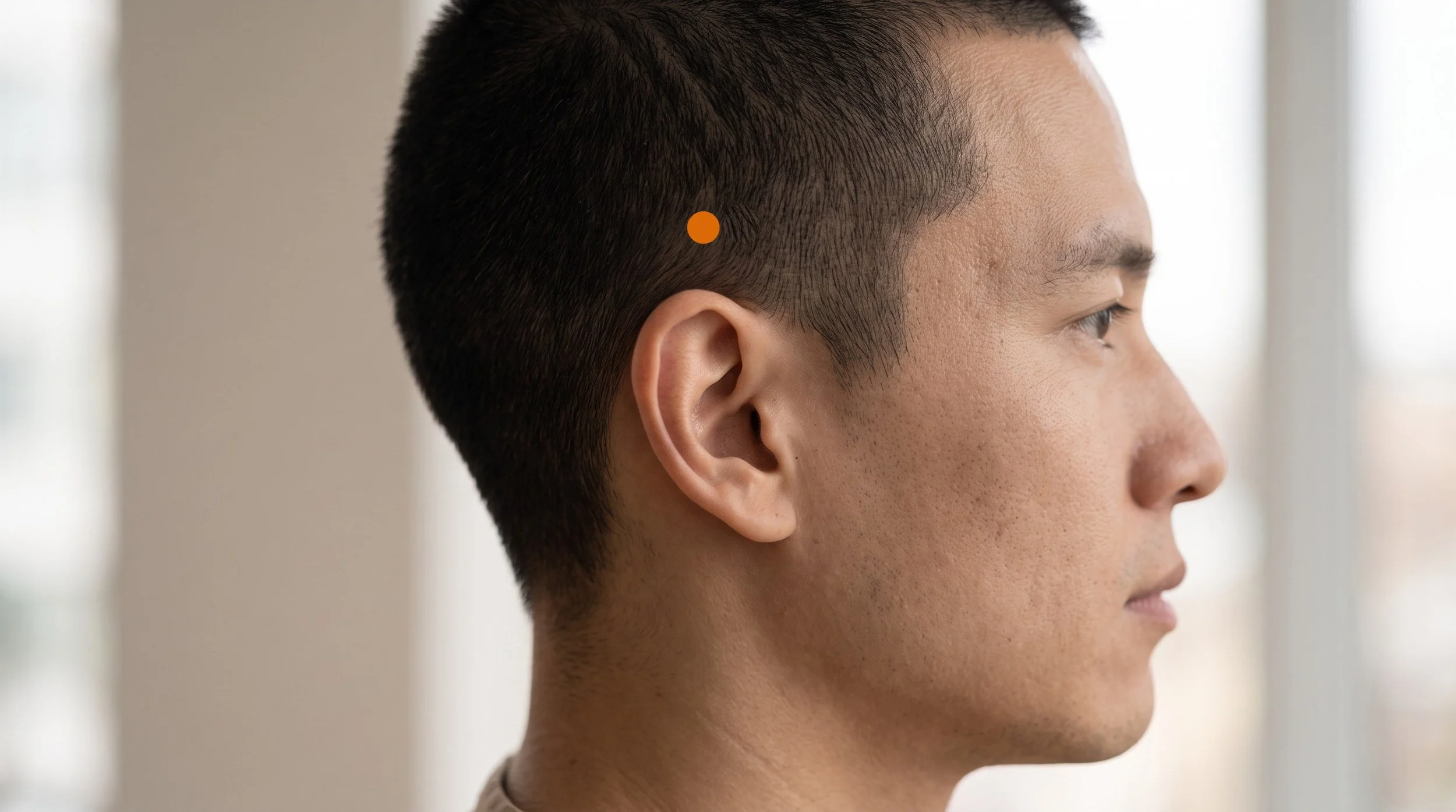
GB8 Acupuncture Point
The Leading Valley Above the Ear: Anatomy, Mechanism, and Why This Temporal Scalp Point Anchors One-Sided Headache Treatment
GB8 (Shuaigu, often translated as Leading Valley) sits in the temporal region about one cun directly above the apex of the ear, in the shallow dip you can feel when you slide a fingertip up from the top of the ear and clench your teeth. It belongs to the Gallbladder channel and is classically listed as a meeting point of the Gallbladder and Bladder channels, which places it at a crossroads of the side of the head.
Clinically, the gb8 acupuncture point matters because it lies directly over the temporalis muscle and the auriculotemporal nerve territory, the exact zone that patients point to when they describe one-sided, temple-centered, or migraine-pattern head pain. It is one of the points we palpate first when someone walks in holding the side of their head.
- Gallbladder 8 is a scalp point, not a deep one. Under the needle there's skin, a thin fat layer, the galea and temporal fascia, and then the temporalis muscle over the temporal bone, so needling is done flat along the scalp rather than perpendicular.
- Classical texts list Shuaigu as a meeting point of the Gallbladder and Bladder channels and credit it with dispersing wind, benefiting the head, easing pain, settling the diaphragm and stomach, and calming vomiting. Read neurophysiologically, that cluster describes a point that modulates trigeminal input to the head and the autonomic reflexes that ride along with severe headache.
- The territory is supplied by the auriculotemporal branch of the mandibular division of the trigeminal nerve, with overlap from upper cervical afferents. Trigeminal and upper cervical fibers converge on shared second-order neurons in the trigeminocervical complex, which is a well-described substrate for referred and spreading head pain (Bartsch & Goadsby, 2002).
- Needling stimulates A-delta and C fibers that recruit spinal and brainstem inhibitory circuits, including endogenous opioid and monoaminergic descending pathways (Zhao, 2008), which offers a plausible mechanism for why local temporal needling may reduce headache intensity rather than simply distracting from it.
- Cochrane reviews suggest acupuncture may reduce the frequency of episodic migraine and tension-type headache when added to usual care, with effects comparable to standard preventive drugs in some comparisons (Linde et al., 2016a; Linde et al., 2016b), and a randomized trial reported benefits that persisted months after treatment ended (Zhao et al., 2017). GB8 appears inside these multi-point protocols, never alone.
- De qi at GB8 tends to be a spreading, slightly heavy ache or a tugging pressure that fans forward toward the temple and eyebrow. Because the needle threads under the skin, patients usually feel movement across the scalp rather than a deep muscular grip.
Struggling With One-Sided Headaches or Temple Pain?
At Morningside Acupuncture we treat temporal and migraine-pattern headaches with a combination of local scalp points like GB8, suboccipital work at the base of the skull, and distal points that address the whole pattern. We palpate the temple and jaw first, because tender temporalis fibers and a reactive GB8 often tell us where to start. Treatment plans are built around your headache frequency, triggers, and neck findings rather than a one-size protocol. Schedule a visit and we'll map out where your head pain is actually coming from.
Schedule NowAnatomy of GB8: Why the Temporal Region Above the Ear Is Such an Important Location
Run a finger from the top of your ear straight upward and you'll cross a series of layers in a very short distance: thin scalp skin, a sparse fat layer, the galea and temporal fascia, then the fibers of the temporalis muscle spreading over the temporal bone. GB8 sits in this narrow sandwich, roughly one cun above the ear apex where a subtle depression can often be felt.
Because the tissue here is shallow, everything that loads the region loads it in the same plane: clenching and grinding, prolonged screen posture with a forward head, chewing on one side, and the sustained low-grade contraction that comes with stress. Patients with recurring one-sided headache frequently have a tender, slightly thickened feel at this above ear acupuncture point, and that tenderness is one of the most useful pieces of information we gather.
The nerve geography is what makes this location clinically interesting. Sensation over the temple and the scalp just above the ear is carried mainly by the auriculotemporal nerve, a branch of the mandibular division of the trigeminal nerve, with contributions from upper cervical afferents traveling with the greater occipital nerve as the two territories overlap.
Experimental work shows that trigeminal afferents from the dura and cervical afferents converge onto the same second-order neurons in the trigeminocervical complex, and that stimulating one input can raise the excitability of the other (Bartsch & Goadsby, 2002). That convergence explains why headaches rarely respect tidy anatomical borders, why neck problems can present as temple pain, and why needling a temporal scalp point may influence a headache that seems to live deeper inside the head.
Needling here also recruits descending inhibitory pathways that dampen nociceptive transmission through opioid and monoaminergic mechanisms (Zhao, 2008).
Vascular structures are the main safety consideration. Parietal branches of the superficial temporal artery and vein run through the temporal scalp, and the scalp bleeds easily because its vessels are tethered to connective tissue and don't retract well. For that reason GB8 is needled transversely, threading the needle just under the skin along the scalp for roughly 0.5 to 1.5 cun, never perpendicular toward bone. Classical practice threads GB8 toward TE23 or Taiyang for stubborn one-sided headache, a technique that keeps the needle in the same superficial plane while covering more of the painful territory.
Practitioners typically avoid visible vessels, use gentle pressure after withdrawal, and warn patients that a small bruise at the temple is possible and harmless.
Related Best Acupuncture Points For Headaches Related Acupuncture For Temporalis Muscle PainGB8 at a Glance: Classification, Location, and Clinical Use
| Category | Detail |
|---|---|
| Traditional Name | Shuaigu (Leading Valley), Gallbladder 8, GB-8 |
| Channel Classification | Gallbladder channel of Foot Shaoyang, temporal region |
| Point Categories | Meeting (crossing) point of the Gallbladder and Bladder channels |
| Precise Location | In the temporal region, in the slight depression 1 cun directly above the apex of the ear. To find the apex reliably, fold the ear forward so the back of the upper helix covers the front, without pushing the whole ear forward. Some modern texts describe the gb 8 location as roughly 1.5 cun above the hairline superior to the ear apex, which lands in the same small area. |
| Tissue Stimulated | Scalp skin, galea and temporal fascia, and the superficial fibers of the temporalis over the temporal bone; the region overlaps common temporalis trigger points |
| Needle Depth / Direction | Transverse (subcutaneous) insertion along the scalp, approximately 0.5 to 1.5 cun; often threaded toward Taiyang or TE23. Never needled perpendicular toward bone. |
| De Qi Sensation | A spreading dull ache, heaviness, or tugging pressure across the temple, sometimes traveling forward toward the eyebrow or downward toward the jaw |
| Primary Clinical Uses | One-sided and temporal headache, migraine-pattern head pain, heaviness of the head, dizziness, headache accompanied by nausea or vomiting, temple pain associated with clenching |
| Common Point Combinations |
|
In the Deadman point manual, Shuaigu GB-8 is presented as a leading choice for one-sided pain and heaviness at the temple and parietal region, and the text notes that the point is often tender in exactly those cases. The traditional attributions are unusually specific: besides head wind, dizziness, and pain at the corner of the forehead, the classical indication lists include relentless vomiting, an inability to eat or drink, fullness and agitation after eating, and headache brought on by alcohol.
Deadman cites the Illustrated Classic of Acupuncture Points on the Bronze Man for a description of severe stubborn pain at both corners of the head accompanied by nausea and an inability to eat, and reads it as a recognizable portrait of migraine. Framed traditionally, the point was said to disperse wind, benefit the head, and harmonize the diaphragm and stomach, which is why classical authors reached for it when head pain and digestive upset arrived together.
What's striking is how closely a list assembled centuries before modern neurology maps onto the clinical picture we still see: one-sided throbbing, sensitivity, nausea, vomiting, and an alcohol trigger.
Why GB8 Is Used for Headaches That Arrive With Nausea and Dizziness
Patients are often surprised that a point on the side of the scalp gets used for a headache that also brings queasiness, light sensitivity, and a foggy, heavy feeling in the head. The anatomy makes it less surprising. GB8 sits in auriculotemporal (trigeminal) territory with upper cervical overlap, and afferents from both regions funnel onto shared neurons in the trigeminocervical complex, where input from one territory can amplify or modulate input from the other (Bartsch & Goadsby, 2002).
Migraine-pattern headache involves sensitization within this same relay, which is why the scalp and temple can become tender to touch during an attack and why local needling in that zone may act on the network generating the pain rather than only on the skin.
Beyond the segmental story, needling recruits descending inhibitory control. Stimulation of small-diameter afferents activates brainstem circuits that release endogenous opioids, serotonin, and noradrenaline onto dorsal horn and trigeminal relay neurons, reducing the gain of incoming nociceptive signals (Zhao, 2008). There are also local effects worth mentioning: needling in muscle and fascia is associated with changes in local blood flow and reduced mechanical sensitivity, which may matter when the temporalis has been clenched for hours at a time.
None of this means one needle at the temple resolves a migraine. In practice we're using GB8 as part of a broader plan that usually includes the upper neck, the jaw musculature, distal points, and attention to sleep, hydration, caffeine, and trigger patterns. Trials of acupuncture for migraine and tension-type headache test exactly this kind of multi-point approach, and their results suggest that regular courses of treatment may reduce headache days for many people (Linde et al., 2016a; Linde et al., 2016b; Zhao et al., 2017).
What the Research Shows for GB8
There is no clinical trial of GB8 by itself, and it's worth saying that plainly. Headache research tests whole protocols in which a temporal point like Shuaigu is one component alongside neck, hand, and foot points, so the evidence below speaks to acupuncture as a treatment package rather than to any single location. The reviews are also mixed in quality, with sham comparisons producing smaller differences than comparisons with usual care. Read the table as a picture of reasonable expectations rather than a promise.
| Study | Type | Focus | Key Finding |
|---|---|---|---|
| Linde et al., 2016a | Cochrane systematic review | Acupuncture for the prevention of episodic migraine | The review found that adding acupuncture to usual care may reduce migraine frequency, with effects at least comparable to prophylactic drug treatment in the trials available. |
| Linde et al., 2016b | Cochrane systematic review | Acupuncture for the prevention of tension-type headache | Acupuncture appeared to reduce headache frequency compared with usual care and produced modest additional benefit over sham needling, though trial quality varied. |
| Vickers et al., 2018 | Individual patient data meta-analysis | Acupuncture for chronic pain, including chronic headache | Pooled patient-level data suggested acupuncture is superior to sham and to no-acupuncture control for chronic pain conditions, with benefits that persisted over follow-up. |
| Zhao et al., 2017 | Randomized clinical trial | Long-term acupuncture prophylaxis for migraine without aura | True acupuncture was associated with fewer migraine attacks and migraine days than sham acupuncture or a waiting list, with differences maintained through 24 weeks. |
| Bartsch & Goadsby, 2002 | Experimental neurophysiology study | Convergence of cervical and trigeminal (dural) afferents in the trigeminocervical complex | Stimulating the greater occipital nerve increased the excitability of neurons receiving dural trigeminal input, supporting a shared relay for head and upper neck pain. |
| Zhao, 2008 | Narrative review of mechanisms | Neural mechanisms of acupuncture analgesia | Needle stimulation engages spinal and supraspinal inhibitory pathways involving endogenous opioid and monoamine systems, offering a mechanism for sustained analgesic effects. |
Jaw Clenching, Temple Tightness, and Headaches That Won't Let Go?
Clenching and grinding load the temporalis all day, and that muscle sits directly under the gb8 acupuncture point. We combine gentle threading at GB8 with dry needling of temporalis and masseter trigger points, plus manual work and simple jaw habit changes you can carry between sessions. Many patients notice the pressure at the side of the head easing before the headache count drops. Book an evaluation and let's take the load off your temples.
Schedule NowGB8 in the Context of Trigger Point Work
GB8 sits squarely over the temporalis, and that overlap is not a coincidence in clinical practice. Trigger points in the temporalis are classically described as referring pain into the temple, the eyebrow region, and the upper teeth, patterns that patients often describe as a headache rather than a muscle problem (Simons et al., 1999). When we palpate a taut band in the temporal fossa and the patient recognizes the referred pain, we're looking at a myofascial contributor that sits in the same tissue plane the needle passes through at Shuaigu.
At Morningside, treatment for one-sided head pain commonly pairs threading at GB8 or between GB8 and Taiyang with dry needling of temporalis, masseter, and the suboccipital group, since jaw clenching and upper cervical tension travel together. Because acupuncture simply means the use of an acupuncture needle across hundreds of styles, moving between a classical channel point and a trigger point target during the same session is not a change of method, only a change of intent. Needle depth stays shallow across the temporal scalp, and we stay conservative with technique in a region that bruises easily.
GB8 Headache Treatment at NYC's Highest-Rated Acupuncture Clinic
Morningside Acupuncture is the highest-rated acupuncture and dry needling clinic in New York City with over 500 five-star Google reviews. Our licensed acupuncturists use GB8 alongside GB20, Taiyang, LI4, and targeted trigger point needling to address one-sided headache, temple pain, and migraine patterns. Every session blends classical point selection with modern pain science, so you understand what we're doing and why. Schedule your appointment and start working on your headaches with a team that treats them every single day.
Schedule NowFrequently Asked Questions
What does GB8 feel like when needled?
Because the needle is threaded flat under the scalp rather than pushed downward, most people feel a brief pinch at the entry point followed by a tugging or stretching sensation along the temple. De qi here usually reads as spreading heaviness or dull pressure rather than a deep ache, and it may travel forward toward the eyebrow or down toward the jaw. If the temporalis is very tender, the point can be more sensitive than usual, which is useful information rather than a problem. Any sharp or burning feeling should be reported so the needle can be adjusted.
Why needle a point on the scalp when my headache feels deep inside my head?
Head pain doesn't stay in tidy anatomical lanes. The scalp above the ear is supplied by the auriculotemporal branch of the trigeminal nerve with upper cervical overlap, and both streams converge on shared neurons in the trigeminocervical complex, where activity in one territory can influence the other (Bartsch & Goadsby, 2002). Needling in that convergence zone may modulate the same relay that carries the deeper pain, and it also recruits descending inhibitory pathways that reduce nociceptive gain more broadly (Zhao, 2008). That's also why we usually combine GB8 with points on the neck, hand, and foot rather than treating the temple alone.
Can I press GB8 myself between sessions?
Yes, and it's an easy point to find. Fold your ear forward to locate the apex, then slide a fingertip straight up about one thumb-width until you feel a slight dip; clenching your teeth lightly will make the temporalis pop up under your finger and confirm you're in the right zone. Use the pad of your index or middle finger with light to moderate pressure, small circles or steady hold, for 30 to 60 seconds per side, repeated two or three times. Keep pressure gentle enough that it feels like a satisfying ache rather than a jab, and stop if it aggravates the headache. Many people find it helps to add gentle jaw relaxation, letting the teeth part slightly with the tongue resting on the palate, while they hold the point.
Is GB8 safe to needle?
In trained hands it's a low-risk point, but the technique matters. GB8 is needled transversely just under the skin along the scalp, roughly 0.5 to 1.5 cun, and never perpendicular toward the bone. The main practical cautions are the branches of the superficial temporal artery and vein in the temporal region, which mean a small bruise is possible, so practitioners avoid visible vessels and apply pressure after removing the needle. People taking blood thinners should mention it, since bruising is more likely. As with any point, clean needle technique and single-use sterile needles are standard.
Where exactly is GB8 located?
GB8 is in the temporal region, in the slight depression 1 cun directly above the apex of the ear. To define the apex accurately, fold the ear forward so the back of the upper helix covers the front of the upper helix, without pushing the whole ear forward. Some modern texts give the gb 8 location as approximately 1.5 cun above the hairline directly over the ear apex, which lands in the same small area. It sits over the temporalis muscle, and gentle clenching of the teeth helps confirm the landmark.
References
- Deadman, P., Al-Khafaji, M., & Baker, K. (2009). A manual of acupuncture. Journal of Chinese Medicine Publications.
- Cheng, X. (Ed.). (1999). Chinese acupuncture and moxibustion (Rev. ed.). Foreign Languages Press.
- Cunningham, P. M. (2000). Acupuncture points: A practical guide to classical and modern usage. Odyssey Press.
- Maciocia, G. (2005). The foundations of Chinese medicine: A comprehensive text for acupuncturists and herbalists (2nd ed.). Elsevier Churchill Livingstone.
- Simons, D. G., Travell, J. G., & Simons, L. S. (1999). Travell & Simons' myofascial pain and dysfunction: The trigger point manual, Vol. 1: Upper half of body (2nd ed.). Williams & Wilkins.
- Linde, K., Allais, G., Brinkhaus, B., Fei, Y., Mehring, M., Vertosick, E. A., Vickers, A., & White, A. R. (2016a). Acupuncture for the prevention of episodic migraine. Cochrane Database of Systematic Reviews, 2016(6), CD001218. https://doi.org/10.1002/14651858.CD001218.pub3
- Linde, K., Allais, G., Brinkhaus, B., Fei, Y., Mehring, M., Shin, B.-C., Vickers, A., & White, A. R. (2016b). Acupuncture for the prevention of tension-type headache. Cochrane Database of Systematic Reviews, 2016(4), CD007587. https://doi.org/10.1002/14651858.CD007587.pub2
- Vickers, A. J., Vertosick, E. A., Lewith, G., MacPherson, H., Foster, N. E., Sherman, K. J., Irnich, D., Witt, C. M., & Linde, K. (2018). Acupuncture for chronic pain: Update of an individual patient data meta-analysis. Journal of Pain, 19(5), 455-474. https://doi.org/10.1016/j.jpain.2017.11.005
- Zhao, L., Chen, J., Li, Y., Sun, X., Chang, X., Zheng, H., Gong, B., Huang, Y., Yang, M., Wu, X., Li, X., & Liang, F. (2017). The long-term effect of acupuncture for migraine prophylaxis: A randomized clinical trial. JAMA Internal Medicine, 177(4), 508-515. https://doi.org/10.1001/jamainternmed.2016.9378
- Bartsch, T., & Goadsby, P. J. (2002). Stimulation of the greater occipital nerve induces increased central excitability of dural afferent input. Brain, 125(7), 1496-1509. https://doi.org/10.1093/brain/awf166
- Zhao, Z. Q. (2008). Neural mechanism underlying acupuncture analgesia. Progress in Neurobiology, 85(4), 355-375. https://doi.org/10.1016/j.pneurobio.2008.05.004
Disclaimer: This web site is intended for educational and informational purposes only. Reading this website does not constitute providing medical advice or any professional services. This information should not be used for diagnosing or treating any health issue or disease. Those seeking medical advice should consult with a licensed physician. Seek the advice of a medical doctor or other qualified health professional for any medical condition. If you think you have a medical emergency, call 911 or go to the emergency room. No acupuncturist-patient relationship is created by reading this website or using the information. Morningside Acupuncture PLLC and its employees and contributors do not make any express or implied representations with respect to the information on this site or its use. For any legal interpretation of scope of practice in your state, consult a licensed attorney or regulatory authority.
Read more from our blog