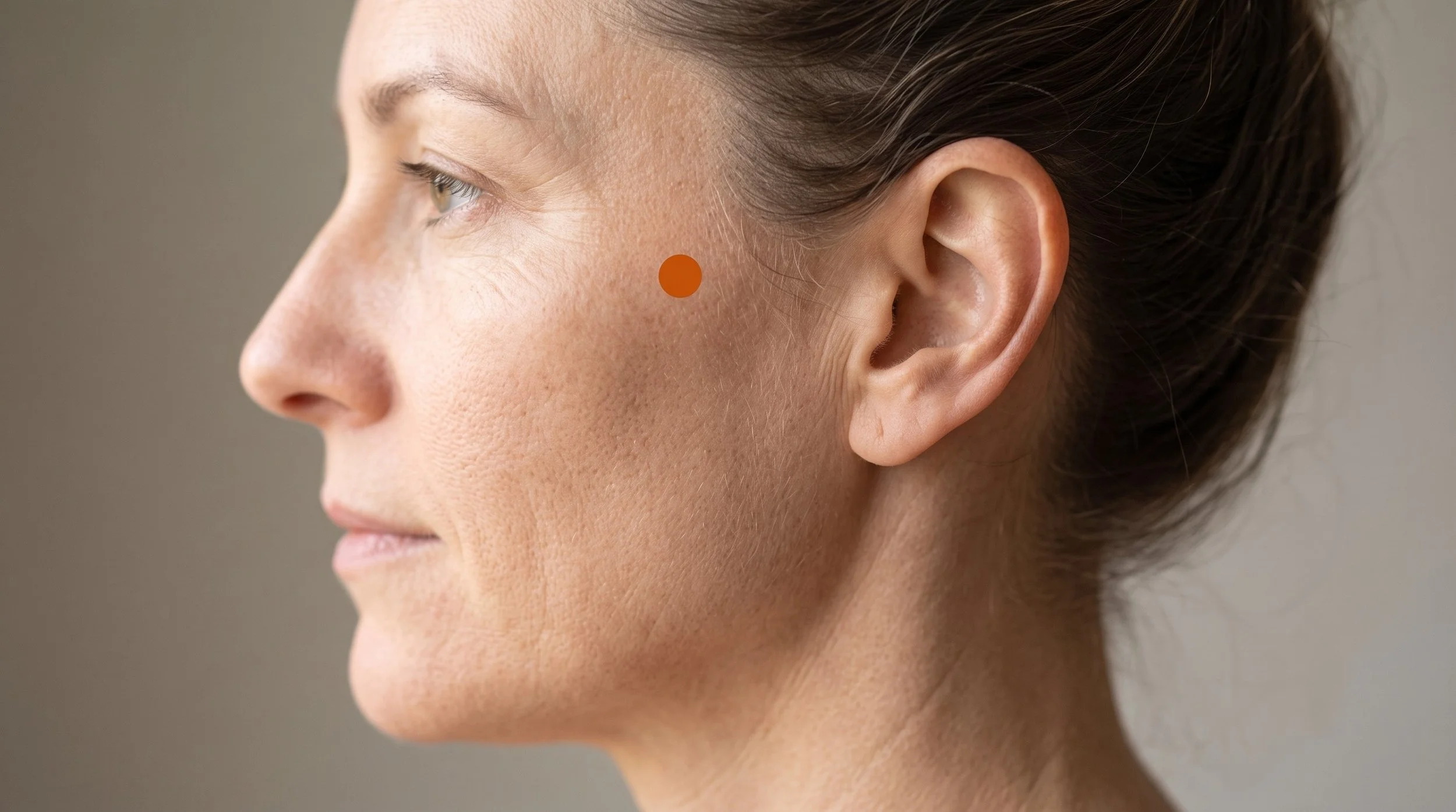
GB3 Acupuncture Point (Shangguan)
The Point Above the Jaw Joint: Anatomy, Mechanism, and Why This Small Hollow Over the Cheekbone Earns Its Place in Jaw, Ear, and One-Sided Headache Care
GB3 (Shangguan, often translated as Above the Joint or Upper Hinge) is the third point of the Gallbladder channel and sits in a small hollow just in front of the ear, on top of the cheekbone, directly above the more familiar jaw point ST7. If you place a fingertip in front of the ear canal, slide it forward until you feel the bony ridge of the zygomatic arch, then step up over that ridge into the soft dip above it, you are on the GB3 acupuncture point.
Classical texts list it as a meeting place of the Gallbladder, Triple Burner and Stomach channels, which is a traditional way of saying that three named pathways converge on one crowded patch of skull. Anatomically that hollow overlies the temporalis muscle and its tendon, sits in territory shared by the auriculotemporal branch of the trigeminal nerve and the temporal branches of the facial nerve, and lies a fingerbreadth from the jaw joint itself, which is why Shangguan acupuncture shows up so often in work for jaw pain, temple headache, upper tooth and facial pain, and ear symptoms.
- Location and layers: GB3 lies above the upper border of the zygomatic arch, directly superior to ST7, with skin, superficial temporal fascia, and the temporalis muscle and its tendon under the needle. The temporalis is a common source of temple, eyebrow and upper tooth referral in clenchers and grinders (Simons et al., 1999).
- Traditional categories, translated: the classical designation as a crossing point of the Gallbladder, Triple Burner and Stomach channels, and traditional actions such as eliminating wind, benefiting the ears and freeing the channel to relieve pain, describe in older language what modern practice frames as a regional point for the temple, jaw, ear and upper face.
- Nerve story: this patch of scalp and cheek is supplied by the auriculotemporal nerve (a V3 branch that also innervates the temporomandibular joint and part of the ear) and crossed by facial nerve temporal branches, which places GB3 in the same neural neighborhood as the structures patients complain about (Zhao, 2008).
- Mechanism: needling in this region recruits A-delta and C fiber input that engages spinal and trigeminal segmental gating plus descending inhibition from the periaqueductal gray and rostral ventromedial medulla, alongside local vascular and inflammatory changes in the needled tissue (Zhao, 2008).
- Research picture: needling protocols for jaw disorders and headache show promising but modestly certain results, with meta-analytic support for acupuncture and dry needling in masticatory muscle pain (Al-Moraissi et al., 2020; Park et al., 2023) and Cochrane reviews supporting acupuncture for migraine and tension-type headache prevention (Linde et al., 2016a; Linde et al., 2016b).
- What it feels like: because the needle is shallow and lies over a tendinous muscle, de qi at gallbladder 3 tends to be a dull, spreading ache or pressure that fans toward the ear, temple and jaw, sometimes with a brief squeeze that eases as the muscle lets go.
Jaw Pain, Clicking, or Morning Tightness in the Temples?
Jaw problems rarely stay in the jaw, and most of our patients arrive describing some mix of temple pressure, ear fullness, and a tired face by mid afternoon. At Morningside Acupuncture we use GB3 alongside ST7, local ashi points, and dry needling of the temporalis and masseter to calm the muscles that load the joint. Treatment is paired with simple jaw mechanics and stress coaching so the change holds between sessions. Schedule a visit and we'll map out where your jaw pain is actually coming from.
Schedule NowAnatomy of GB3: Why the Hollow Above the Zygomatic Arch Is Such an Important Location
GB3 occupies a genuinely thin piece of real estate. Under the skin and a layer of superficial fascia lies the temporalis, a broad fan-shaped jaw closer whose fibers converge into a strong tendon that dives beneath the zygomatic arch to attach on the coronoid process of the mandible. The point sits right where that muscle narrows toward its tendon, which is exactly the zone that becomes tender, ropey and sensitive in people who clench, grind, chew gum heavily, or hold their jaw braced under stress.
Clench your teeth with a fingertip on GB3 and you can feel the tissue bunch under your finger. Because the temporalis refers pain to the temple, eyebrow, and upper teeth, tenderness here often reproduces the very symptoms patients describe (Simons et al., 1999).
The nerve geography is what makes this location clinically interesting. The auriculotemporal nerve, a branch of the mandibular division of the trigeminal nerve, ascends just in front of the ear to supply the temple, part of the external ear, and the temporomandibular joint itself, while temporal branches of the facial nerve cross the arch to drive the muscles of facial expression.
Sensory information from the jaw joint, the masticatory muscles, the ear, and the upper teeth all funnels into the trigeminal system and converges in the brainstem with input from the upper cervical segments, which is one plausible reason a local needle here may influence symptoms that feel spread out across the side of the head.
Needling stimulates small-diameter afferents that engage segmental inhibition and descending pain control pathways involving the periaqueductal gray, the rostral ventromedial medulla, and endogenous opioid and monoamine systems (Zhao, 2008), while the mechanical stimulus itself produces local blood flow and tissue responses at the needled site.
Below and deep to this point the anatomy becomes less forgiving, which is why classical sources are unusually direct about depth. The superficial temporal artery and vein run nearby in front of the ear, the squamous portion of the temporal bone is thin, and deep to the arch sits the infratemporal region with the lateral pterygoid and its dense vascular supply. Standard needling at GB3 is therefore perpendicular and shallow, roughly 0.3 to 0.5 cun, and the older texts specifically caution against deep insertion here.
In practice this means a fine needle, light technique, careful palpation to avoid the pulsating vessel, and attention to the fact that facial tissue bruises easily. Skilled shallow needling at a well-chosen spot generally does more than aggressive depth at this location.
Related Acupuncture For Temporalis Muscle Pain Related Temporalis Trigger PointsGB3 at a Glance: Classification, Location, and Clinical Use
| Category | Detail |
|---|---|
| Traditional Name | Shangguan (Above the Joint, also rendered as Upper Hinge) |
| Channel Classification | Gallbladder channel, third point (Gallbladder 3) |
| Point Categories | Meeting (crossing) point of the Gallbladder, Triple Burner (Sanjiao) and Stomach channels. No five-shu, extraordinary vessel or hui-meeting designation is attributed to this point in the source texts consulted. |
| Precise Location | Anterior to the ear, in the hollow immediately above the upper border of the zygomatic arch, directly superior to ST7. Find ST7 first in the depression below the arch in front of the mandibular condyle, then slide the palpating finger up and over the bone into the dip above it. |
| Tissue Stimulated | Skin, superficial temporal fascia, and the temporalis muscle near its tendon, a frequent target in Temporalis Trigger Points work. Nearby structures include the auriculotemporal nerve, temporal branches of the facial nerve, and the superficial temporal vessels. |
| Needle Depth / Direction | Perpendicular insertion 0.3 to 0.5 cun with a fine needle. Deep needling is traditionally avoided at this point. For facial pain presentations the point is sometimes needled about half a cun anterior to its textbook site, guided by palpation. |
| De Qi Sensation | A dull, heavy ache or pressure that spreads toward the ear, temple and jaw. Some patients feel a brief tightening as the temporalis responds, then a softening. Sharp or electric sensation is not the goal and prompts repositioning. |
| Primary Clinical Uses | Jaw pain and temporomandibular complaints, one-sided temple headache, facial pain and upper jaw toothache, and ear symptoms such as tinnitus, reduced hearing and ear discharge in classical listings. Older texts also list deviation of the mouth and eye and lockjaw. |
| Common Point Combinations |
|
Deadman's A Manual of Acupuncture presents GB3 as a useful but secondary local point, less prominent than its neighbor ST7 below the arch, and traditionally used across the whole surrounding district: ears, eyes, face, teeth, jaw, lips and head.
The traditional actions attributed to it are to dispel wind and benefit the ears, and to free the channel and relieve pain, with classical indications spanning hearing loss and ringing, discharge from the ear, blurred vision, facial pain, toothache in the upper jaw, and stiffness of the lips, along with older entries for headache with sensitivity to wind and cold, one-sided facial paralysis, and clamped jaw. The manual also notes that in facial neuralgia work practitioners sometimes needle slightly forward of the textbook spot.
What is striking about the classical pattern is how tightly it clusters around one anatomical crossroads: every indication on that list belongs to a structure supplied by nerves that pass within a couple of centimeters of the point, which is a fair example of ancient regional observation lining up with modern neuroanatomy.
Why GB3 Is Used for Ear Fullness, Tinnitus, and Headaches That Sit Above One Ear
Patients are often surprised that a point on the cheekbone is used for the ear. The reason is convergence. The auriculotemporal nerve carries sensation from the temple, part of the external ear and canal, and the temporomandibular joint, and it travels right past this location.
Meanwhile the jaw joint and the ear share a developmental and mechanical neighborhood, so a jaw that is loaded, guarded, or asymmetrically overworked can produce ear fullness, muffled hearing, and ringing that has nothing wrong with the inner ear itself. Needling into this territory feeds strong input into the trigeminal system, which converges in the brainstem with upper cervical input and with the descending controls that turn pain sensitivity up or down (Zhao, 2008).
The second half of the story is central rather than local. Needle stimulation reliably engages descending inhibitory pathways and endogenous opioid signaling, which is why effects are not limited to the square inch under the needle (Zhao, 2008). Large pooled analyses of individual patient data across chronic pain conditions show that acupuncture outperforms both no-acupuncture and sham controls, with effects that persist over time rather than fading immediately after treatment ends (Vickers et al., 2018).
For headache specifically, Cochrane reviews found that adding acupuncture to usual care reduced headache frequency in episodic migraine and tension-type headache, with effects comparable to standard preventive drug treatment in migraine (Linde et al., 2016a; Linde et al., 2016b).
For ear symptoms the evidence is thinner and should be described honestly. A meta-analysis of acupuncture for tinnitus found no significant difference on the primary pain-style rating scale but reported favorable changes on tinnitus handicap and severity measures, with the authors emphasizing low study quality (Huang et al., 2021). In clinical terms, GB3 is a reasonable component of care when ear symptoms travel with jaw tension, temple tightness and clenching, and a poor substitute for audiology or ENT assessment when hearing loss, vertigo, or discharge is the leading complaint.
What the Research Shows for GB3
No trial has isolated GB3 on its own, and it would be unusual if one had. Acupuncture research tests whole protocols, and this point typically appears as one local element in a prescription that also includes ST7, ear-region points, neck points, and distal points such as LI4. The studies below therefore tell us something about the treatment strategies GB3 belongs to, not about the point in isolation. Read them as evidence for the approach, with the usual caveats about blinding difficulty, small samples, and variable protocol reporting in this literature.
| Study | Type | Focus | Key Finding |
|---|---|---|---|
| Linde et al., 2016a | Cochrane systematic review | Acupuncture for the prevention of episodic migraine | Adding acupuncture to usual care reduced migraine frequency compared with usual care alone, with effects at least comparable to prophylactic drug treatment, though sham comparisons showed smaller differences. |
| Linde et al., 2016b | Cochrane systematic review | Acupuncture for the prevention of tension-type headache | Acupuncture added to routine care was associated with fewer headache days in frequent episodic and chronic tension-type headache, with modest advantages over sham needling. |
| Park et al., 2023 | Systematic review and meta-analysis of RCTs | Acupuncture for temporomandibular disorder | Acupuncture improved outcomes versus active controls and when used as an add-on therapy, although the authors graded the overall quality of evidence as low. |
| Al-Moraissi et al., 2020 | Network meta-analysis of randomized clinical trials | Needling therapies for myofascial pain of the masticatory muscles | Needling approaches including dry needling and acupuncture compared favorably with control interventions for masticatory muscle pain, supporting needling of muscles such as temporalis and masseter. |
| Ang et al., 2023 | Systematic review and meta-analysis | Acupuncture for trigeminal neuralgia | Acupuncture was associated with reduced pain and attack frequency relative to carbamazepine and appeared relatively safe, but the certainty of evidence was low because of substantial risk of bias. |
| Huang et al., 2021 | Systematic review and meta-analysis of RCTs | Acupuncture for tinnitus | No significant effect appeared on the primary visual analogue outcome, while tinnitus handicap and severity scores favored acupuncture, in a body of small and low-quality trials. |
| Vickers et al., 2018 | Individual patient data meta-analysis | Acupuncture across chronic pain conditions including headache | Acupuncture was superior to both sham and no-acupuncture controls for chronic pain, with treatment effects that persisted over twelve months. |
One-Sided Headaches That Sit Over the Ear and Temple?
Headaches that park themselves above one ear often involve the temporalis and the trigeminal and upper cervical nerves that share its territory. We combine the GB3 acupuncture point with neck and distal points, then add trigger point needling when the temple muscles reproduce your familiar pain. Most patients notice a change in headache frequency and intensity over a short course rather than after one session. Book an appointment and let's build a plan for your specific headache pattern.
Schedule NowGB3 in the Context of Trigger Point Work
The textbook location of GB3 sits directly over the temporalis, and the temporalis is one of the most reliably involved muscles in jaw and temple complaints. Trigger points in its anterior and middle fibers refer pain into the eyebrow, temple, and upper teeth, patterns that overlap almost exactly with the classical indication list for this point (Simons et al., 1999).
In practice, that means the clinician needling GB3 and the clinician performing temporalis dry needling are frequently treating the same tissue with the same tool. Acupuncture is defined by the use of an acupuncture needle, and the hundreds of styles that use it, including dry needling, share far more anatomy than the naming debate suggests.
At Morningside we treat this region as a system rather than a single dot. A typical session for jaw and temple pain might use GB3 and ST7 above and below the arch, add SJ21 or GB2 in front of the ear when palpation is tender there, then move to trigger point needling of the temporalis and masseter, with the lateral pterygoid or medial pterygoid addressed when the exam points that way. Neck contributors are checked as a matter of course, since upper cervical input converges with trigeminal input and quietly feeds many one-sided headaches.
Needling in the face is kept fine and shallow, patients are warned that superficial bruising is possible near the temporal vessels, and treatment is paired with jaw rest strategies, breathing, and clenching awareness so the muscles get a reason to stay quiet.
GB3 Jaw and Headache Treatment at NYC's Highest-Rated Acupuncture Clinic
Morningside Acupuncture is the highest-rated acupuncture and dry needling clinic in New York City with over 500 five-star Google reviews, and jaw, face and headache complaints are among the most common reasons people find us. Our approach blends classical point selection, including GB 3 jaw work above the zygomatic arch, with sports medicine style trigger point needling and clear home strategies. Every plan is built around your exam findings, not a generic protocol. Schedule your visit and start with a thorough assessment.
Schedule NowFrequently Asked Questions
What does GB3 feel like when needled?
Most people feel a small pinch at the skin, then a dull, spreading heaviness or pressure that fans toward the ear, temple, and jaw. Because the needle sits over the temporalis near its tendon, some patients feel a brief tightening or a mild ache when the muscle responds, followed by a softening. The sensation should stay dull and tolerable. Sharp, burning, or electric feelings are a signal to reposition, and a good practitioner will adjust immediately rather than push through.
Why needle GB3 above the cheekbone instead of directly on the jaw joint?
The jaw joint is a small, well-innervated capsule surrounded by muscle, and the tissue that most often drives the pain is the muscle rather than the joint itself. GB3 sits over the temporalis just above the arch, in territory supplied by the auriculotemporal nerve, which also innervates the joint and part of the ear. Treating just above the joint lets us influence the same neural neighborhood while working on the muscle that loads it. This is also why GB3 is classically paired with ST7 below the arch, so the region is addressed from both sides of the bone.
Can I press GB3 myself between sessions?
Yes, and it is one of the easier points to self-treat. Find the bony ridge in front of and slightly above your ear, then step up over it into the soft hollow. Use one or two fingertips and apply gentle, steady pressure, no harder than a firm massage, for about 30 to 60 seconds while your jaw stays relaxed and your teeth are slightly apart. Small circular motions along the temple above the point often feel better than static pressure. Two or three rounds per side, once or twice daily, is plenty. Ease off if you feel a pulse under your finger, get dizzy, or notice increasing soreness afterward, and skip it entirely on bruised or inflamed skin.
Is GB3 safe to needle?
In trained hands, yes, with specific precautions. Classical texts caution against deep needling here, and standard practice is a shallow perpendicular insertion of roughly 0.3 to 0.5 cun. The superficial temporal vessels run nearby, so practitioners palpate before inserting and use fine needles. Facial and scalp tissue bruises more readily than most areas, so a small bruise is the most common side effect. The point is not appropriate over broken skin, active infection, or recent facial surgery without clearance, and anyone on anticoagulants should mention it so needle selection and pressure after removal can be adjusted.
Where exactly is GB3 located?
GB3 is anterior to the ear, in the depression on the upper border of the zygomatic arch, directly above ST7. The reliable way to find it is to locate ST7 first: place a finger just in front of the ear canal, at the lower border of the cheekbone in the dip in front of the mandibular condyle, which you can feel move when you open and close your mouth. From there, run the finger straight up over the bony arch and settle into the hollow above it. That hollow is Shangguan. For facial pain presentations, practitioners sometimes needle about half a cun forward of that spot, guided by where the tissue is tender.
References
- Deadman, P., Al-Khafaji, M., & Baker, K. (2009). A manual of acupuncture. Journal of Chinese Medicine Publications.
- Cunningham, P. M. (2000). Acupuncture points: A practical guide to classical and modern usage. Odyssey Press.
- Kim, H. (2008). Handbook of Oriental medicine (3rd ed.). Harmony & Balance Press.
- Maciocia, G. (2006). The channels of acupuncture: Clinical use of the secondary channels and eight extraordinary vessels. Churchill Livingstone Elsevier.
- Simons, D. G., Travell, J. G., & Simons, L. S. (1999). Travell & Simons' myofascial pain and dysfunction: The trigger point manual, Vol. 1: Upper half of body (2nd ed.). Williams & Wilkins.
- Linde, K., Allais, G., Brinkhaus, B., Fei, Y., Mehring, M., Vertosick, E. A., Vickers, A., & White, A. R. (2016a). Acupuncture for the prevention of episodic migraine. Cochrane Database of Systematic Reviews, 2016(6), CD001218. https://doi.org/10.1002/14651858.CD001218.pub3
- Linde, K., Allais, G., Brinkhaus, B., Fei, Y., Mehring, M., Shin, B. C., Vickers, A., & White, A. R. (2016b). Acupuncture for the prevention of tension-type headache. Cochrane Database of Systematic Reviews, 2016(4), CD007587. https://doi.org/10.1002/14651858.CD007587.pub2
- Park, E. Y., Cho, J. H., Lee, S. H., Kim, K. W., Ha, I. H., & Lee, Y. J. (2023). Is acupuncture an effective treatment for temporomandibular disorder? A systematic review and meta-analysis of randomized controlled trials. Medicine, 102(38), e34950. https://doi.org/10.1097/MD.0000000000034950
- Al-Moraissi, E. A., Alradom, J., Aladashi, O., Goddard, G., & Christidis, N. (2020). Needling therapies in the management of myofascial pain of the masticatory muscles: A network meta-analysis of randomised clinical trials. Journal of Oral Rehabilitation, 47(7), 910-922. https://doi.org/10.1111/joor.12960
- Ang, L., Kim, H. J., Heo, J. W., Choi, T. Y., Lee, H. W., Kim, J. I., & Lee, M. S. (2023). Acupuncture for the treatment of trigeminal neuralgia: A systematic review and meta-analysis. Complementary Therapies in Clinical Practice, 52, 101763. https://doi.org/10.1016/j.ctcp.2023.101763
- Huang, K., Liang, S., Chen, L., & Grellet, A. (2021). Acupuncture for tinnitus: A systematic review and meta-analysis of randomized controlled trials. Acupuncture in Medicine, 39(4), 264-271. https://doi.org/10.1177/0964528420938380
- Vickers, A. J., Vertosick, E. A., Lewith, G., MacPherson, H., Foster, N. E., Sherman, K. J., Irnich, D., Witt, C. M., & Linde, K. (2018). Acupuncture for chronic pain: Update of an individual patient data meta-analysis. Journal of Pain, 19(5), 455-474. https://doi.org/10.1016/j.jpain.2017.11.005
- Zhao, Z. Q. (2008). Neural mechanism underlying acupuncture analgesia. Progress in Neurobiology, 85(4), 355-375. https://doi.org/10.1016/j.pneurobio.2008.05.004
Disclaimer: This web site is intended for educational and informational purposes only. Reading this website does not constitute providing medical advice or any professional services. This information should not be used for diagnosing or treating any health issue or disease. Those seeking medical advice should consult with a licensed physician. Seek the advice of a medical doctor or other qualified health professional for any medical condition. If you think you have a medical emergency, call 911 or go to the emergency room. No acupuncturist-patient relationship is created by reading this website or using the information. Morningside Acupuncture PLLC and its employees and contributors do not make any express or implied representations with respect to the information on this site or its use. For any legal interpretation of scope of practice in your state, consult a licensed attorney or regulatory authority.
Read more from our blog



