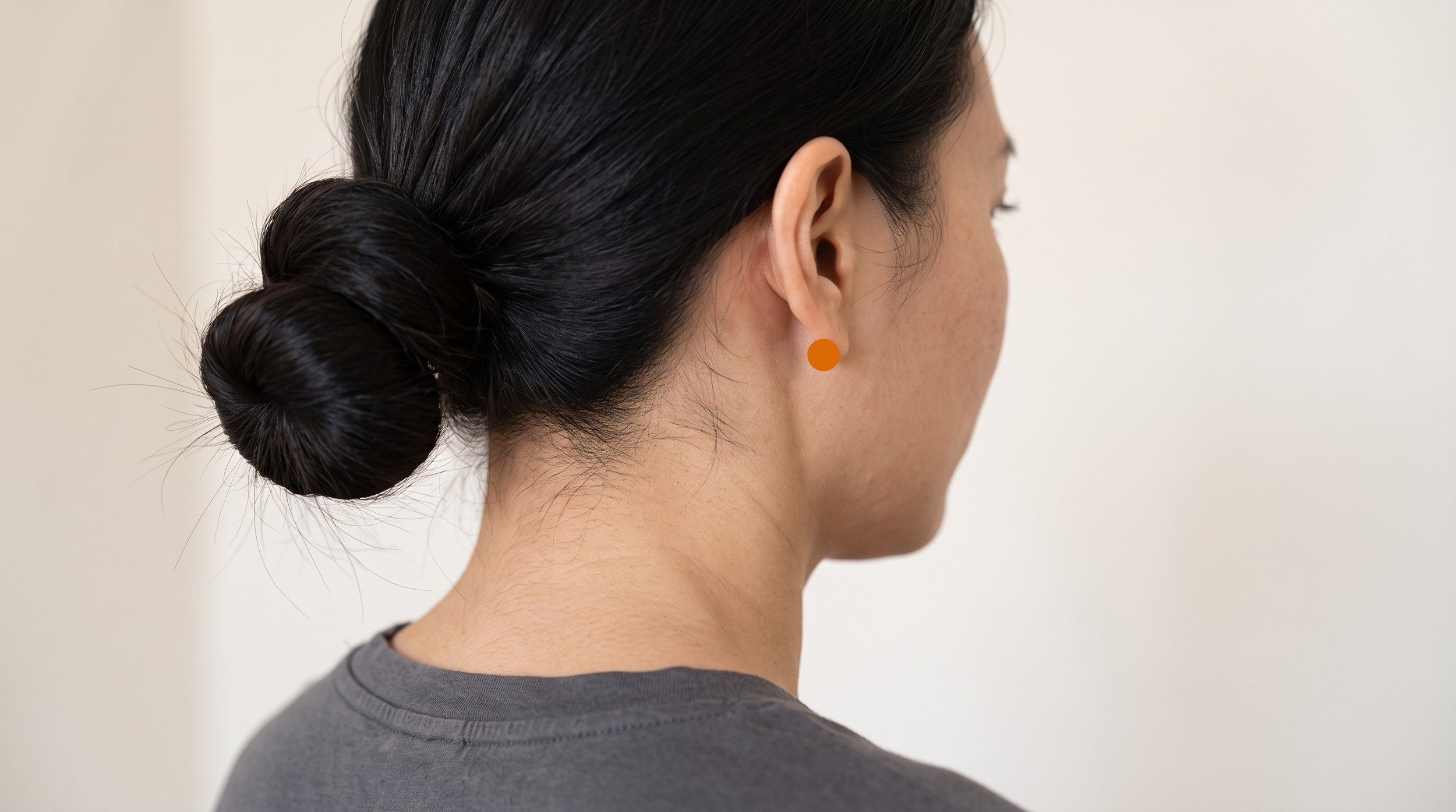
SJ17 Acupuncture Point (Yifeng)
The Wind Screen Behind the Earlobe: Anatomy, Mechanism, and Why SJ17 Anchors Ear, Facial Nerve, and Jaw Treatment
SJ17 (Yifeng, often translated as Wind Screen), also written TE17, sits in the soft hollow directly behind the earlobe, in the gap between the back edge of the jawbone and the front edge of the mastoid process. Fold the earlobe forward and the depression is easy to feel, usually tender on the affected side.
Classically it is described as a meeting point of the Triple Burner and Gall Bladder channels and as the local point for essentially every ear complaint, from tinnitus and hearing loss to earache and discharge (Deadman et al., 2007). Anatomically it is one of the most interesting points on the body, because the needle sits in the same small compartment where the facial nerve emerges from the skull, where branches of the upper cervical nerves supply the skin of the ear, and where the deep masseter, the sternocleidomastoid, and the posterior belly of the digastric all crowd together. That combination is why yifeng shows up in ear protocols, facial paralysis protocols, and jaw pain protocols alike.
- SJ17 lies behind the earlobe between the ramus of the mandible and the mastoid process, and the needle passes through skin, subcutaneous fascia, and the back border of the parotid gland before reaching the region where the facial nerve leaves the stylomastoid foramen (Cheng, 1987; Deadman et al., 2007).
- Traditional sources classify it as a crossing point of the Triple Burner and Gall Bladder channels, both of which reach the ear, and credit it with benefiting the ears, dispelling wind, clearing heat, and moving the channel locally (Deadman et al., 2007). In modern terms those actions describe strong local sensory input to a densely innervated periauricular region rather than any literal flow of energy.
- The nerve geography is the story here: the great auricular nerve (C2 to C3) supplies the skin over the point, the auriculotemporal branch of the trigeminal nerve and the auricular branch of the vagus supply neighboring ear structures, and the facial nerve trunk lies deeper. Input from all of these converges in the trigeminocervical region of the upper cervical spinal cord, which offers a plausible route by which one point may influence ear, jaw, and facial symptoms (Zhao, 2008).
- Research is mixed and mostly tests multi-point protocols. A Cochrane review of acupuncture for Bell's palsy found the trials too flawed to support conclusions (Chen et al., 2010), later meta-analyses reported benefit with substantial bias and heterogeneity (Li et al., 2015; Zhang et al., 2019), and a review of tinnitus trials found no significant change on a pain-style visual scale but improvement on tinnitus handicap measures from low quality studies (Huang et al., 2021).
- An evidence-based analysis of higher quality facial paralysis trials listed SJ17 among the acupoints most consistently selected in study protocols, alongside ST4, ST6, ST7, and LI4, which matches the classical facial grouping almost exactly (Zheng et al., 2009).
- De qi at yifeng is usually a deep, heavy, slightly spreading ache behind the ear that can travel into the ear canal, the jaw, or the throat. A brief electric flick is possible given the nearby facial nerve, and it is a signal for the clinician to withdraw slightly and redirect rather than something to push through.
Ringing, Fullness, or Pain Deep in One Ear?
Ear symptoms that come with jaw clenching, neck tension, or a recent cold often respond well to careful local work behind the ear. At Morningside Acupuncture we use SJ17 as the anchor point for these presentations, combined with gentle jaw and upper neck needling and, where appropriate, distal points such as LI4 and SJ5. Every session includes a hands-on assessment of the muscles around the ear and jaw so treatment targets what is actually tender. Schedule a visit and we can map out a realistic plan for your ear symptoms.
Schedule NowAnatomy of SJ17: Why the Notch Between the Mandible and Mastoid Is Such an Important Location
Fold the earlobe forward and slide a fingertip into the soft gap it covers. In front of that gap is the back edge of the mandibular ramus, behind it is the front edge of the mastoid process, and just below sits the transverse process of the first cervical vertebra, which can often be palpated as a firm point of resistance (Deadman et al., 2007). Under the skin and superficial fascia lies the posterior border of the parotid gland, and immediately around the mastoid are the attachments of the sternocleidomastoid and the posterior belly of the digastric.
This small compartment takes load from clenching and grinding, from forward head posture that shortens the upper cervical muscles, and from prolonged phone or headset use, which is why so many patients are surprised at how tender the spot is on first palpation.
The nerve supply explains the clinical range of this point. Skin over SJ17 is supplied by the great auricular nerve, a branch of the cervical plexus carrying C2 and C3 fibers, while the deeper structures sit alongside the trunk of the facial nerve as it leaves the stylomastoid foramen (Cheng, 1987). Nearby, the auriculotemporal branch of the trigeminal nerve serves the jaw joint and part of the ear, and the auricular branch of the vagus supplies a portion of the external canal.
Upper cervical and trigeminal afferents converge on shared second-order neurons in the trigeminocervical region of the upper cord, so a strong, well-localized needle stimulus here feeds into the same processing zone that handles ear, jaw, and temporal pain. Experimental work suggests needling recruits spinal segmental inhibition together with descending pathways from the midbrain and brainstem that use endogenous opioid and monoamine signaling (Zhao, 2008), which is a more useful frame than the older idea of wind being screened out at the ear.
Depth and direction matter more at SJ17 than at most points. The posterior auricular artery and vein run close by, the external jugular vein is superficial in the region, and deeper still are the retromandibular and pterygoid venous structures along with the parotid gland and the facial nerve trunk (Cheng, 1987). Standard practice is a perpendicular insertion aimed toward the opposite ear, 0.5 to 1 cun, with light technique rather than vigorous deep manipulation.
Angling the needle noticeably forward or backward tends to be sharply painful and can leave the jaw sore on opening and closing for a while afterward, which is a well-known caution in the classical manuals (Deadman et al., 2007). Mild bruising is the most common side effect, and any electric sensation into the face is a cue to withdraw and redirect.
Related LI4 Acupuncture Point Related Acupuncture And The Vagus NerveSJ17 (TE17) at a Glance: Classification, Location, and Clinical Use
| Category | Detail |
|---|---|
| Traditional Name | Yifeng (Wind Screen), SJ17, also written TE17 or TB-17 |
| Channel Classification | Triple Burner (Sanjiao) channel of the Hand Shaoyang, point 17 of 23 (SJ17, also written TE17 or TB17; also called the Triple Energizer, the Triple Heater or Triple Warmer) |
| Point Categories | Meeting (crossing) point of the Triple Burner and Gall Bladder channels, both of which enter the ear (Deadman et al., 2007). No five-shu, hui-meeting, or extraordinary vessel designations are attributed to this point in the classical sources. |
| Precise Location | Behind the earlobe, in the depression between the ramus of the mandible and the mastoid process, just above the palpable transverse process of C1. Folding the earlobe forward reveals the hollow. |
| Tissue Stimulated | Skin and superficial fascia supplied by the great auricular nerve, the posterior border of the parotid gland, and the fascial junction where the sternocleidomastoid and posterior digastric meet the mastoid. Deeper structures include the facial nerve trunk at the stylomastoid foramen and periauricular vessels. |
| Needle Depth / Direction | Perpendicular insertion directed toward the opposite ear, 0.5 to 1 cun. Avoid steep anterior or posterior angling, which is painful and can leave the jaw sore with opening and closing. Moxibustion is traditionally considered applicable. |
| De Qi Sensation | Deep heavy ache behind the ear, often spreading into the ear canal, jaw, or throat, sometimes with a sense of pressure or warmth. A brief electric sensation into the face means the needle should be withdrawn slightly and redirected. |
| Primary Clinical Uses | Tinnitus, hearing difficulty, earache and ear discharge, facial paralysis and Bell's palsy patterns, jaw tension and lockjaw, trigeminal neuralgia patterns, cheek swelling and toothache in the lower jaw |
| Common Point Combinations |
|
A Manual of Acupuncture (Deadman et al., 2007) presents SJ17 as a crossing point of two channels that both travel into the ear, which is the traditional rationale for calling it the essential local point for ear complaints of every description: ringing, reduced hearing, discharge, itching, redness, swelling, and pain. The name itself, Wind Screen, carries the second traditional theme.
Wind in this system is a pattern label for symptoms that arrive suddenly, move, or involve twitching and one-sided distortion, so the point is traditionally used for facial paralysis after windstroke or Bell's palsy, for trigeminal neuralgia patterns, and for spasm and lockjaw. A third traditional action, clearing heat and moving the channel, covers the older listings for mumps, scrofula, swollen cheek, and toothache of the lower jaw.
What is striking is how neatly that classical triad maps onto one piece of anatomy: a point sitting over the parotid region, beside the facial nerve, within the sensory territory of the upper cervical and trigeminal nerves. The classical authors had no anatomical model of the stylomastoid foramen, yet the indication list reads like a description of everything that structure serves.
Why SJ17 Is Used for Ear Symptoms That Have Nothing to Do With the Eardrum
Many patients who come in with ear ringing, ear fullness, or a deep ache in one ear have already been told their ear examination is normal. That result can be frustrating, but it is also informative, because a large share of these complaints track with jaw clenching, upper neck tension, or muscular irritation around the temporomandibular joint rather than with the middle or inner ear itself. The sj 17 ear point sits at the anatomical crossroads of that problem.
Sensory information from the ear canal, the jaw joint, the skin behind the ear, and the upper cervical segments all converges on shared neurons in the trigeminocervical region, so a stimulus delivered at this one location reaches a wide catchment area (Zhao, 2008). Deep masseter and sternocleidomastoid trigger points are recognized referral sources for ear pain and ear-related sensations, which is why the yifeng ear point is often needled in the same session as those muscles (Simons et al., 1999).
Beyond the local segment, needling appears to engage descending inhibitory control from the midbrain periaqueductal gray and rostral ventromedial medulla, along with endogenous opioid and monoamine signaling that reduces the gain of nociceptive transmission more broadly (Zhao, 2008). That systemic component helps explain why patients often report reduced overall head and jaw tension after treatment, not only change at the needled spot.
There is also a straightforward local vascular and autonomic effect: needling in the periauricular region produces short-term changes in local blood flow and muscle tone, which may be part of why traditional practice frequently adds warmth or moxibustion at this point for facial nerve cases.
None of this means SJ17 fixes ears on its own. Individual patient data from large chronic pain trials suggest acupuncture effects are modest, statistically real compared with sham and no-acupuncture controls, and reasonably durable over about a year (Vickers et al., 2018).
The practical takeaway is that triple burner 17 is best understood as a well-placed local anchor within a broader treatment plan that also addresses the jaw, the upper neck, sleep, and clenching habits.
What the Research Shows for SJ17 (TE17)
One note on naming before the evidence: in the research literature this point appears as TE17, the WHO standard code, and also as SJ17 or TB17 depending on the authors, so it is worth searching all three if you want to read the studies below in full.
A caution before the table: almost no trial isolates a single point, so there is no clean answer to the question of what SJ17 does by itself. What the literature offers instead is evidence about multi-point protocols for the conditions this point serves, plus protocol analyses showing how often it is selected. Read the rows below as context for a point that appears inside these protocols rather than as proof of the point's individual effect, and note that much of the facial paralysis and tinnitus literature comes from small trials with significant risk of bias.
| Study | Type | Focus | Key Finding |
|---|---|---|---|
| Chen et al., 2010 | Cochrane systematic review | Acupuncture for Bell's palsy | The review concluded that the available trials were too small and methodologically weak to determine whether acupuncture hastens recovery or reduces long-term morbidity. |
| Li et al., 2015 | Systematic review and meta-analysis | Acupuncture for Bell's palsy across 14 randomized trials | Pooled results favored acupuncture, but the authors emphasized that methodological limitations in the included trials weaken confidence in the estimate. |
| Zhang et al., 2019 | Systematic review and meta-analysis | Acupuncture compared with drug therapy for Bell's palsy in 11 trials | Acupuncture was associated with higher reported cure and effective rates, though heterogeneity between trials was substantial. |
| Zheng et al., 2009 | Evidence-based protocol analysis | Acupoint selection across higher quality peripheral facial paralysis trials | SJ17 appeared among the most frequently recommended acupoints alongside ST4, ST6, ST7, and LI4, supporting its role in standard facial protocols. |
| Huang et al., 2021 | Systematic review and meta-analysis | Acupuncture for tinnitus across eight trials | No significant difference was found on the primary visual analogue outcome, while tinnitus handicap and severity scores favored acupuncture in low quality studies. |
| La Touche et al., 2010 | Systematic review and meta-analysis | Acupuncture for pain in temporomandibular disorders | The authors described acupuncture as a reasonable adjunct for short-term analgesia in painful TMD, with results limited by bias in the included trials. |
| Di Francesco et al., 2024 | Systematic review and meta-analysis | Acupuncture and laser acupuncture for temporomandibular disorders | Pooled data suggested higher efficacy for acupuncture approaches than placebo control, with the usual caveats about trial quality. |
| Ang et al., 2023 | Systematic review and meta-analysis | Acupuncture for trigeminal neuralgia across 30 trials | Acupuncture showed positive effects on pain and attack frequency compared with carbamazepine, though the certainty of evidence was rated low. |
| Vickers et al., 2018 | Individual patient data meta-analysis | Acupuncture for chronic pain conditions including headache | Acupuncture outperformed both sham and no-acupuncture controls by modest margins, with effects largely sustained at twelve months. |
Recovering From Bell's Palsy or Facial Nerve Weakness?
Facial paralysis protocols in both classical texts and modern trials repeatedly center on the area behind the earlobe, and SJ17 is the point that sits closest to where the facial nerve exits the skull. We combine it with the traditional facial grouping (ST4, ST6, ST7, ST2, and LI4), light stimulation appropriate to the stage of recovery, and home exercises you can do between visits. Treatment is coordinated with your physician's care, not a substitute for it. Book an evaluation to start a structured course of sessions.
Schedule NowSJ17 in the Context of Trigger Point Work
At Morningside Acupuncture, the te17 acupuncture point is rarely used in isolation for ear and jaw complaints, because the muscles immediately around it are frequent contributors. The deep fibers of the masseter are a classic referral source for ear pain and ear-related sensations, the clavicular division of the sternocleidomastoid can refer deep into the ear and behind it, the temporalis refers into the teeth and temple, and the posterior belly of the digastric contributes to the upper throat and mastoid region (Simons et al., 1999).
Needling SJ17 sits at the geographic center of that group, so a typical session might pair it with dry needling of masseter and temporalis for a clenching pattern, or with sternocleidomastoid and upper trapezius work when neck posture is driving the complaint.
Practically, we palpate before we needle. The tenderness pattern at yifeng and in the surrounding muscles tells us whether we are dealing with a predominantly jaw-driven picture, a neck-driven picture, or a facial nerve recovery case that needs lighter, more conservative stimulation. Dry needling is simply acupuncture needling framed in orthopedic language, and both approaches use the same filiform needle, so combining a classically described point with modern myofascial targets in one treatment is a matter of clinical reasoning rather than mixing two different therapies.
Technique around the ear stays conservative regardless of the frame: shallow to moderate depth, controlled direction toward the opposite ear, and immediate adjustment if a patient reports anything electrical.
SJ17 Ear and Jaw Treatment at NYC's Highest-Rated Acupuncture Clinic
Morningside Acupuncture is the highest-rated acupuncture and dry needling clinic in New York City with over 500 five-star Google reviews, and we treat ear pain, tinnitus patterns, TMJ tension, and facial nerve complaints week in and week out. Our approach pairs classical point selection at SJ17 and its traditional partners with orthopedic assessment and precise dry needling of the masseter, temporalis, and sternocleidomastoid. You will leave each visit knowing what we found and what we are targeting next. Schedule your appointment on the Upper West Side today.
Schedule NowFrequently Asked Questions
Is SJ17 the same point as TE17 or TB17?
Yes. SJ17, TE17, and TB17 are all codes for the same point, Yifeng. SJ stands for San Jiao, the Chinese name of the channel. TE (Triple Energizer) is the WHO standard abbreviation and the one you will see in most Western textbooks and research papers. TB (Triple Burner) and TW (Triple Warmer) are older English renderings of the same name that still appear in many books. You will also come across it written as San Jiao 17 or Triple Energizer 17. Whichever code is used, the location and the uses are the same.
What does SJ17 feel like when needled?
Most people feel a deep, heavy, slightly expanding ache behind the earlobe that can spread into the ear canal, along the jaw, or toward the throat. It is often one of the more sensitive points on the body, particularly on the symptomatic side, so a skilled practitioner uses a fine needle and moderate stimulation rather than heavy technique. A brief electric flick is possible because the facial nerve trunk lies deeper in this region, and if that happens the needle should be withdrawn slightly and redirected. Mild tenderness or a small bruise afterward is common and usually resolves within a day or two.
Why needle behind the ear for jaw and facial symptoms rather than directly on the painful spot?
SJ17 is a local point, just not the most obvious one. It sits at a convergence zone where sensory nerves from the ear, the jaw joint, the skin over the mastoid, and the upper cervical segments all feed into shared processing in the trigeminocervical region of the upper spinal cord (Zhao, 2008). Stimulating that zone can influence symptoms across a wider area than a needle placed on the sorest square inch of cheek, and it also positions the needle near the facial nerve trunk, which is the anatomical reason it anchors facial paralysis protocols (Zheng et al., 2009). In practice we usually treat both: SJ17 plus the specific tender muscles or facial points relevant to your case.
Can I press SJ17 myself between sessions?
Yes, and it is one of the easier points to find on yourself. Fold your earlobe forward and let your fingertip drop into the hollow it covers, between the back edge of your jawbone and the front edge of the bony bump behind your ear. Press inward and slightly toward the opposite ear with moderate, steady pressure until you feel a dull ache rather than sharp pain, hold for 30 to 60 seconds, release, and repeat two or three times per side. Twice a day is plenty, and small circular pressure works as well as static holding. Stop if you get tingling or numbness into the face, if the area is swollen or infected, or if pressing makes symptoms worse, and check with your clinician first if you have a facial nerve diagnosis, recent ear surgery, or an ear infection.
Is SJ17 safe to needle?
It is safe in trained hands, but it is a point that rewards precision. The region contains the parotid gland, the posterior auricular vessels and nearby veins, and the facial nerve as it exits the skull, so depth is kept to roughly 0.5 to 1 cun with the needle directed toward the opposite ear, and heavy or deep manipulation is avoided (Cheng, 1987; Deadman et al., 2007). Poor angulation can cause sharp pain and lingering soreness on jaw movement. Licensed acupuncturists use single-use sterile needles and clean technique, and this is not a point for self-needling under any circumstances.
Where exactly is SJ17 located?
Directly behind the earlobe, in the depression between the ramus of the mandible in front and the mastoid process behind, sitting just above the transverse process of the first cervical vertebra (Deadman et al., 2007). The most reliable way to find it is to fold the earlobe forward, which uncovers the hollow, then press gently until you meet a soft spot bounded by bone on either side. On the affected side it is frequently tender, and that tenderness is often part of how practitioners confirm the location.
References
- Deadman, P., Al-Khafaji, M., & Baker, K. (2009). A manual of acupuncture. Journal of Chinese Medicine Publications.
- Cheng, X. (Ed.). (1999). Chinese acupuncture and moxibustion (Rev. ed.). Foreign Languages Press.
- Simons, D. G., Travell, J. G., & Simons, L. S. (1999). Travell & Simons' myofascial pain and dysfunction: The trigger point manual, Vol. 1: Upper half of body (2nd ed.). Williams & Wilkins.
- Chen, N., Zhou, M., He, L., Zhou, D., & Li, N. (2010). Acupuncture for Bell's palsy. Cochrane Database of Systematic Reviews, 2010(8), CD002914. https://doi.org/10.1002/14651858.CD002914.pub5
- Li, P., Qiu, T., & Qin, C. (2015). Efficacy of acupuncture for Bell's palsy: A systematic review and meta-analysis of randomized controlled trials. PLoS One, 10(5), e0121880. https://doi.org/10.1371/journal.pone.0121880
- Zhang, R., Wu, T., Wang, R., Wang, D., & Liu, Q. (2019). Compare the efficacy of acupuncture with drugs in the treatment of Bell's palsy: A systematic review and meta-analysis of RCTs. Medicine, 98(19), e15566. https://doi.org/10.1097/MD.0000000000015566
- Zheng, H., Li, Y., & Chen, M. (2009). Evidence based acupuncture practice recommendations for peripheral facial paralysis. The American Journal of Chinese Medicine, 37(1), 35-43. https://doi.org/10.1142/S0192415X09006631
- Huang, K., Liang, S., Chen, L., & Grellet, A. (2021). Acupuncture for tinnitus: A systematic review and meta-analysis of randomized controlled trials. Acupuncture in Medicine, 39(4), 264-271. https://doi.org/10.1177/0964528420938380
- La Touche, R., Goddard, G., De-la-Hoz, J. L., Wang, K., Paris-Alemany, A., Angulo-Díaz-Parreño, S., Mesa, J., & Hernández, M. (2010). Acupuncture in the treatment of pain in temporomandibular disorders: A systematic review and meta-analysis of randomized controlled trials. The Clinical Journal of Pain, 26(6), 541-550. https://doi.org/10.1097/AJP.0b013e3181e2697e
- Di Francesco, F., Minervini, G., Siurkel, Y., Cicciù, M., & Lanza, A. (2024). Efficacy of acupuncture and laser acupuncture in temporomandibular disorders: A systematic review and meta-analysis of randomized controlled trials. BMC Oral Health, 24(1), 174. https://doi.org/10.1186/s12903-023-03806-1
- Ang, L., Kim, H. J., Heo, J. W., Choi, T. Y., Lee, H. W., & Kim, J. I. (2023). Acupuncture for the treatment of trigeminal neuralgia: A systematic review and meta-analysis. Complementary Therapies in Clinical Practice, 52, 101763. https://doi.org/10.1016/j.ctcp.2023.101763
- Zhao, Z. Q. (2008). Neural mechanism underlying acupuncture analgesia. Progress in Neurobiology, 85(4), 355-375. https://doi.org/10.1016/j.pneurobio.2008.05.004
- Vickers, A. J., Vertosick, E. A., Lewith, G., MacPherson, H., Foster, N. E., Sherman, K. J., Irnich, D., Witt, C. M., & Linde, K. (2018). Acupuncture for chronic pain: Update of an individual patient data meta-analysis. Journal of Pain, 19(5), 455-474. https://doi.org/10.1016/j.jpain.2017.11.005
Disclaimer: This web site is intended for educational and informational purposes only. Reading this website does not constitute providing medical advice or any professional services. This information should not be used for diagnosing or treating any health issue or disease. Those seeking medical advice should consult with a licensed physician. Seek the advice of a medical doctor or other qualified health professional for any medical condition. If you think you have a medical emergency, call 911 or go to the emergency room. No acupuncturist-patient relationship is created by reading this website or using the information. Morningside Acupuncture PLLC and its employees and contributors do not make any express or implied representations with respect to the information on this site or its use. For any legal interpretation of scope of practice in your state, consult a licensed attorney or regulatory authority.
Read more from our blog



