GB4 Acupuncture Point (Hanyan)
Jaw Serenity in the Temporal Hairline: Anatomy, Mechanism, and Why the First Temple Point Below ST8 Belongs in Every One-Sided Headache Exam
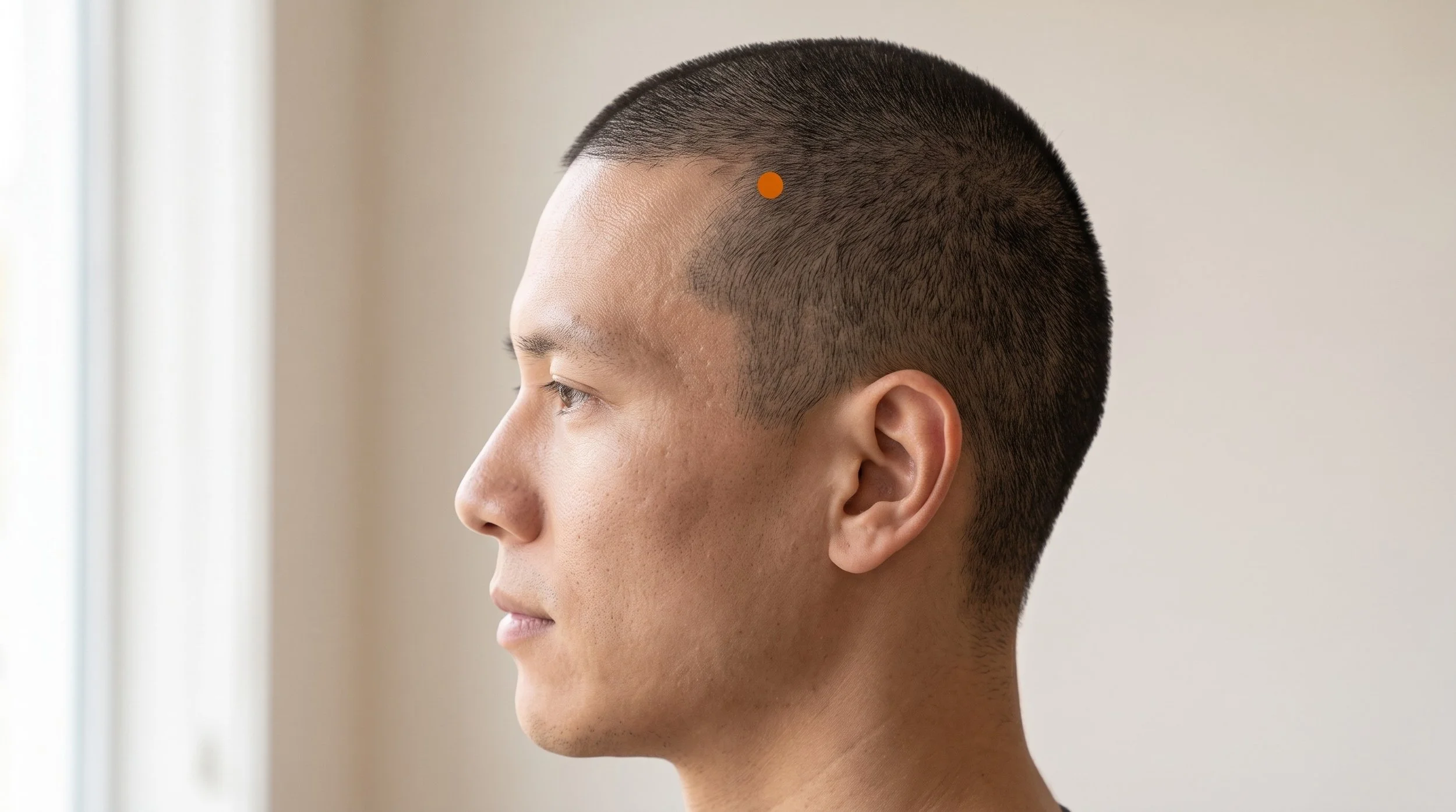
GB4 (Hanyan, often translated as Jaw Serenity) is the first of four Gallbladder points that step down the curve of the temple, sitting inside the hairline about one quarter of the way along the arc from ST8 to GB7 (Deadman et al., 2009).
In plain terms, it's roughly two fingerbreadths above and behind the outer end of the eyebrow, just inside the hairline, on the fan of the temporalis muscle that you can feel bulge under your fingertips when you clench your teeth.
Classically it's described as a meeting point of the Gallbladder, Triple Burner and Stomach channels, which is a traditional way of saying that three symptom territories (temple, ear and jaw) all converge here. For a modern clinic, the GB4 acupuncture point matters for a simpler reason: it sits directly over tissue that becomes tender and reactive in temporal headaches, jaw clenching and migraine, and it's one of the first places a careful practitioner palpates when a patient points to one side of the head.
- Location and layers: GB4 lies inside the temporal hairline, one quarter of the distance along the curve between ST8 and GB7, over skin, subcutaneous fat, temporoparietal fascia, the tough deep temporal fascia and the anterior fibers of temporalis, with a loose areolar plane sitting directly on the temporal bone (Deadman et al., 2009).
- Traditional categories, translated: the classical designation as a crossing point of the Gallbladder, Triple Burner and Stomach channels (Deadman et al., 2009) maps neatly onto modern referral anatomy, since the temple, ear and jaw share overlapping trigeminal innervation and refer pain into one another.
- Mechanism: GB4 sits largely in auriculotemporal (V3) territory, and trigeminal afferents converge with upper cervical afferents onto second order neurons in the trigeminocervical complex, a convergence that helps explain why temple, ear and neck symptoms travel together (Bartsch & Goadsby, 2002).
- Research picture: no trial has tested Hanyan alone, but Cochrane reviews of multi-point protocols report that acupuncture may reduce headache frequency in episodic migraine and in tension-type headache (Linde et al., 2016a; Linde et al., 2016b), and pooled individual patient data suggest effects on chronic pain that persist over months (Vickers et al., 2018).
- Clinical practice: Deadman advises palpating this point in every case of one-sided headache and needling it when it's tender (Deadman et al., 2009), which fits how we use it at Morningside, as a palpation-led local point rather than a routine prescription item.
- De qi: because the point is needled transversely under the skin, the sensation is usually a spreading, slightly heavy pressure across the temple, sometimes with a mild tug at the scalp or a dull ache drifting toward the eyebrow or ear rather than the sharp grab people expect from limb points.
Tired of One-Sided Headaches That Settle Behind Your Temple?
At Morningside Acupuncture we palpate the temple line (GB4 through GB7) at every headache visit and needle only what's actually tender, so treatment matches your pain map instead of a generic protocol. We pair temple points with distal Gallbladder and Liver channel points and, when the temporalis is ropey, with careful dry needling of the muscle itself. Most patients feel the temple soften within the session. Schedule a headache-focused visit and let's find out what your temple is telling us.
Schedule NowAnatomy of GB4: Why the Temporal Hairline Is Such an Important Location
Slide your fingers up from the outer end of the eyebrow into the hairline and clench your teeth, and you'll feel a broad, fan-shaped muscle rise under the skin. That's temporalis, and GB4 sits on its anterior portion, one quarter of the way along the curve from ST8 down to GB7 (Deadman et al., 2009). The layers here are thin and distinct: skin, a shallow subcutaneous layer, the mobile temporoparietal fascia that carries the superficial temporal vessels, the dense deep temporal fascia, then muscle, then a loose areolar plane directly against the temporal bone.
What loads this region is repetition rather than injury: clenching and grinding, long hours of jaw bracing at a screen, chewing habits, and the sustained low-grade contraction that comes with stress. Temporalis trigger points are known to refer pain up into the temple, along the eyebrow, and into the upper teeth (Simons et al., 1999), which is one reason patients so often describe temple headache and toothache in the same breath.
The nerve geography explains the point's classical reputation. GB4 lies in territory served by the auriculotemporal nerve, a branch of the mandibular division (V3) of the trigeminal nerve, with the zygomaticotemporal branch of V2 supplying tissue just anterior to it. Trigeminal afferents from the face, dura and temporal region converge with upper cervical afferents onto shared second order neurons in the trigeminocervical complex, and experimental work has shown that input from one territory can raise the excitability of neurons receiving input from the other (Bartsch & Goadsby, 2002).
That convergence is the plain-language reason a tender temple, an aching ear, a stiff neck and a one-sided headache so often show up together, and why needling in the temple can influence sensation that seems to be coming from somewhere else. Needle stimulation also recruits descending inhibitory pathways and endogenous opioid mechanisms that dampen nociceptive transmission more broadly (Zhao, 2008).
The structure to respect here is vascular. Branches of the superficial temporal artery run through the temporoparietal fascia across the temple, and this is a thin, well-vascularized area where bruising is easy. For that reason GB4 is needled transversely rather than perpendicularly, typically 0.5 to 1.5 cun, with the needle passed deep to the subcutaneous layer into the loose tissue adjacent to the skull rather than left shallow (Deadman et al., 2009). Direction follows symptoms: the needle can be angled toward where the headache radiates, or threaded toward neighboring temple points such as GB5 and GB6. Gentle insertion, avoidance of visible vessels, and firm post-needling pressure keep this a comfortable and low-risk point in trained hands.
Related Acupuncture For Temporalis Muscle Pain Related Dry Needling For Temporalis Trigger PointsGB4 at a Glance: Classification, Location, and Clinical Use
| Category | Detail |
|---|---|
| Traditional Name | Hanyan (Jaw Serenity), Gallbladder 4 |
| Channel Classification | Fourth point of the Gallbladder channel of Foot Shaoyang, in the temporal hairline |
| Point Categories | Meeting (crossing) point of the Gallbladder, Triple Burner (Sanjiao) and Stomach channels on the temple; no five-shu, extraordinary vessel or hui-meeting designations are attributed to this point in the classical sources |
| Precise Location | Within the hairline of the temporal region, one quarter of the distance along the curve running from ST8 down to GB7, roughly above and behind the outer end of the eyebrow |
| Tissue Stimulated | Skin, subcutaneous tissue and temporoparietal fascia of the temple, the deep temporal fascia, and the anterior fibers of the temporalis muscle, with the loose areolar plane over the temporal bone as the usual needle bed |
| Needle Depth / Direction | Transverse (subcutaneous) insertion 0.5 to 1.5 cun, passed deep to the subcutaneous layer toward the bone; angled toward the radiation of pain or threaded to adjacent temple points. Perpendicular or deep needling isn't appropriate here |
| De Qi Sensation | A spreading, heavy or pressing sensation across the temple, sometimes a mild tug at the scalp or a dull ache traveling toward the eyebrow, ear or upper teeth; sharp sensation usually means the needle is too shallow or too close to a vessel |
| Primary Clinical Uses | One-sided (temporal) headache and migraine, head wind with pain at both temples, visual dizziness with redness or discomfort at the outer canthus, tinnitus and earache, jaw and facial tension; classically also listed for toothache, facial spasm and deviation |
| Common Point Combinations |
|
Deadman's Manual of Acupuncture gathers the traditional attributions for Hanyan under two headings: eliminating wind and clearing heat, and activating the channel to relieve pain (Deadman et al., 2009). The classical indication lists group into four clusters: head pain (one-sided headache, head wind with pain at both temples, headache accompanied by heat in the body), eye and head symptoms (visual dizziness, pain and redness at the outer corner of the eye), ear symptoms (ringing and earache), and a set of facial and convulsive presentations including lockjaw, facial deviation, toothache and spasm.
Deadman also notes that a Ming dynasty commentator, Yan Zheng-shi, singled the point out specifically for head wind felt at both taiyang regions, and that the Great Compendium of Acupuncture and Moxibustion unusually lists it for wrist stiffness and for painful obstruction accompanied by sweating (Deadman et al., 2009). Those last entries are what make the classical pattern striking: a point sitting on the temple, indicated for the wrist, is a reminder that historical point use followed observed clinical response rather than tidy anatomical logic.
Why GB4 Is Used for Ear Symptoms, Jaw Tension, and Even Wrist Pain
Patients are often surprised that a needle in the temple can change how the ear or jaw feels. The reason is convergence. Sensory fibers from the temple, the outer ear, the jaw joint and the upper teeth all belong to the trigeminal system, and they synapse on shared populations of neurons in the brainstem alongside input arriving from the upper neck. Experimental recordings have shown that stimulating one of these inputs can increase the responsiveness of neurons receiving the other (Bartsch & Goadsby, 2002).
When those neurons are sensitized, ordinary signals from the temple or jaw are amplified, and pain spreads and refers in ways that don't respect tidy anatomical borders. Needling into a tender temple gives the nervous system a strong, well-localized input in that same territory, which may help settle the amplification rather than simply masking the pain.
Beyond the local segment, needle stimulation engages descending inhibitory control from the brainstem and the release of endogenous opioids, mechanisms that reduce nociceptive transmission across regions rather than only under the needle (Zhao, 2008). That broader effect is one plausible way to read the odd classical entries for this point, such as wrist stiffness and painful obstruction with sweating: a strong local stimulus with system-wide neuromodulatory consequences. We present that as an interpretation, not a proven explanation, and we don't promise wrist relief from a temple needle.
The practical translation is straightforward. If your headache is one-sided and temple-dominant, if you clench, or if ear fullness and jaw tightness travel with your head pain, the tissue at GB4 is usually part of the picture. Treatment that combines this local point with distal channel points and with neck assessment tends to be more useful than needling the temple in isolation.
What the Research Shows for GB4
It's worth being clear about what the evidence can and can't say. No randomized trial has isolated GB4, and no study has compared a protocol with and without it. What exists is research on multi-point acupuncture protocols for migraine, tension-type headache and chronic pain, in which temple and Gallbladder channel points like this one are routinely included among the needled sites, alongside separate work on dry needling of the masticatory muscles that sit under this location.
The reasonable conclusion is that Hanyan is a plausible and traditionally central component of protocols that have been tested as wholes, not an independently validated intervention.
| Study | Type | Focus | Key Finding |
|---|---|---|---|
| Linde et al., 2016a | Cochrane systematic review | Acupuncture for the prevention of episodic migraine | Acupuncture may reduce headache frequency compared with usual care and appeared at least comparable to prophylactic drug treatment, though the added benefit over sham needling was modest. |
| Linde et al., 2016b | Cochrane systematic review | Acupuncture for the prevention of tension-type headache | The review found that acupuncture may be a useful option for frequent episodic or chronic tension-type headache, with small effects relative to sham and better outcomes than routine care alone. |
| Vickers et al., 2018 | Individual patient data meta-analysis | Chronic pain including headache and migraine | Pooled patient-level data suggested acupuncture is superior to both sham and no-acupuncture controls, with effects that decreased only modestly over about twelve months. |
| Zhao et al., 2017 | Randomized clinical trial | Long-term prophylaxis in migraine without aura, using body points including temple and Gallbladder channel sites | Participants receiving true acupuncture reported a greater reduction in migraine days and attack frequency than sham and waiting-list groups over 24 weeks, though the between-group differences were small. |
| García-de la-Banda-García et al., 2023 | Single-blind randomized controlled trial | Dry needling of masticatory trigger points in myofascial temporomandibular disorder | Both dry needling and manual therapy improved pain, mouth opening and pressure pain thresholds, supporting needling of jaw musculature as one reasonable option in temple and jaw pain. |
| Bartsch & Goadsby, 2002 | Experimental neurophysiology (animal model) | Convergence and sensitization in the trigeminocervical complex | Recordings showed that many brainstem neurons receive convergent input from cranial and upper cervical territories, offering a mechanism for referral between neck, temple and head. |
Clenching, Jaw Tightness, and Temple Pressure That Won't Let Go?
Jaw clenching loads the temporalis all day, and that load shows up as tenderness right where GB4 sits. Our practitioners combine gentle transverse needling of the temple points with dry needling of the masseter and temporalis, plus neck work when the upper cervical segment is feeding the pattern. It's a targeted, low-drama approach to a very stubborn problem. Book a session and let's take the pressure off your jaw.
Schedule NowGB4 in the Context of Trigger Point Work
The GB 4 temple location sits squarely over the anterior fibers of temporalis, which makes it one of the clearest overlaps in the whole point map between a classical acupuncture site and a named myofascial target. Temporalis trigger points are described as referring pain into the temple, along the eyebrow and into the upper teeth, a pattern that reads almost like the classical indication list for Hanyan (Simons et al., 1999).
At Morningside we treat this practically: we palpate the temple line, identify taut bands and reproducible tender spots, and choose our approach based on what we find. A tender but soft point may respond well to classical transverse needling under the fascia, while a distinctly ropey band usually calls for direct dry needling of the muscle, which is simply acupuncture needling framed in myofascial rather than channel terms.
When clenching or a temporomandibular disorder is part of the picture, the temple rarely acts alone. We commonly add the masseter, the lateral and medial pterygoids where indicated and accessible, the sternocleidomastoid and the upper trapezius, all of which refer into the head and can keep a temporal headache going (Simons et al., 1999). Trials of dry needling in myofascial temporomandibular disorder have reported improvements in pain, mouth opening and pressure pain thresholds (García-de la-Banda-García et al., 2023), which supports treating the jaw muscles rather than the temple alone.
Needling in the temple is always kept superficial and transverse, with attention to the superficial temporal vessels, while the deeper myofascial work happens where the anatomy allows it safely.
GB4 Headache and Jaw Treatment at NYC's Highest-Rated Acupuncture Clinic
Morningside Acupuncture is the highest-rated acupuncture and dry needling clinic in New York City with over 500 five-star Google reviews, and headache, migraine and jaw pain are among the conditions we treat most. We blend classical point selection with orthopedic assessment and myofascial needling, so your treatment addresses both the tender temple and the muscles and neck segments driving it. Sessions are calm, precise and explained as we go. Schedule your visit today and start treating the pattern, not just the flare.
Schedule NowFrequently Asked Questions
What does GB4 feel like when needled?
Because the Hanyan headache point is needled transversely under the skin rather than straight down, most people feel a brief pinch at insertion followed by a spreading, slightly heavy pressure across the temple. Some notice a dull ache traveling toward the eyebrow, the ear or the upper teeth, which usually means the needle is engaging the exact territory that's been generating your symptoms. If the temporalis is genuinely tight, a twitch or a short cramping sensation can occur, then release. Sharp or stinging sensation isn't expected and simply means the needle should be adjusted.
Why needle the temple directly instead of using distal points for headache?
We usually do both. Distal points on the Gallbladder and Liver channels are standard for one-sided headache, and classical sources treat lower limb points as the main distal levers for this channel (Maciocia, 2006). But local temple needling adds something distal points can't: direct input into the trigeminal territory where the pain is being felt and where the temporalis is contributing. Deadman's advice to palpate this point in every one-sided headache and needle it if tender reflects the same logic (Deadman et al., 2009). If the temple is reactive on palpation, treating it usually makes the rest of the session work better.
Can I press GB4 myself between sessions?
Yes, and it's one of the easier points to self-treat. Find the outer end of your eyebrow, move up and back into the hairline about two fingerbreadths, and clench your teeth once to confirm you're on the muscle that bulges. Using the pads of two fingers, apply steady, moderate pressure in small circles or as a sustained hold for 30 to 60 seconds, breathing slowly, then release and repeat two or three times on each side, up to a few times a day. Pressure should feel like a satisfying ache, never sharp. Avoid pressing hard over a visibly pulsing vessel, skip it if you bruise easily or take blood thinners, and stop if it worsens a headache or brings on dizziness.
Is GB4 safe to needle?
In trained hands, yes. The main considerations are the superficial temporal vessels running through the temple, which is why the point is needled transversely and superficially rather than deeply, and why brief firm pressure is applied after withdrawal (Deadman et al., 2009). Minor bruising is the most common side effect and resolves on its own. Practitioners take extra care with patients on anticoagulants or with bleeding disorders, and the point is not needled through broken or inflamed skin. New or severe headache, headache with fever, neurological changes or head injury always warrants medical evaluation before acupuncture.
Where exactly is GB4 located?
Gallbladder 4 sits inside the hairline of the temporal region, one quarter of the way along the curved line running from ST8 (at the corner of the forehead hairline) down to GB7 (near the temporal hairline in front of and above the ear) (Deadman et al., 2009). Practically, that places it roughly two fingerbreadths above and slightly behind the outer end of the eyebrow, on the anterior part of the temporalis muscle. GB5, GB6 and GB7 continue down the same curve at even intervals, so once you've located Hanyan you've oriented the entire temple line.
References
- Deadman, P., Al-Khafaji, M., & Baker, K. (2009). A manual of acupuncture. Journal of Chinese Medicine Publications.
- Maciocia, G. (2006). The channels of acupuncture: Clinical use of the secondary channels and eight extraordinary vessels. Churchill Livingstone Elsevier.
- Simons, D. G., Travell, J. G., & Simons, L. S. (1999). Travell & Simons' myofascial pain and dysfunction: The trigger point manual, Vol. 1: Upper half of body (2nd ed.). Williams & Wilkins.
- Linde, K., Allais, G., Brinkhaus, B., Fei, Y., Mehring, M., Vertosick, E. A., Vickers, A., & White, A. R. (2016a). Acupuncture for the prevention of episodic migraine. Cochrane Database of Systematic Reviews, 2016(6), CD001218. https://doi.org/10.1002/14651858.CD001218.pub3
- Linde, K., Allais, G., Brinkhaus, B., Fei, Y., Mehring, M., Shin, B.-C., Vickers, A., & White, A. R. (2016b). Acupuncture for the prevention of tension-type headache. Cochrane Database of Systematic Reviews, 2016(4), CD007587. https://doi.org/10.1002/14651858.CD007587.pub2
- Vickers, A. J., Vertosick, E. A., Lewith, G., MacPherson, H., Foster, N. E., Sherman, K. J., Irnich, D., Witt, C. M., & Linde, K. (2018). Acupuncture for chronic pain: Update of an individual patient data meta-analysis. Journal of Pain, 19(5), 455-474. https://doi.org/10.1016/j.jpain.2017.11.005
- Zhao, L., Chen, J., Li, Y., Sun, X., Chang, X., Zheng, H., Gong, B., Huang, Y., Yang, M., Wu, X., Li, X., & Liang, F. (2017). The long-term effect of acupuncture for migraine prophylaxis: A randomized clinical trial. JAMA Internal Medicine, 177(4), 508-515. https://doi.org/10.1001/jamainternmed.2016.9378
- Bartsch, T., & Goadsby, P. J. (2002). Stimulation of the greater occipital nerve induces increased central excitability of dural afferent input. Brain, 125(7), 1496-1509. https://doi.org/10.1093/brain/awf166
- Zhao, Z. Q. (2008). Neural mechanism underlying acupuncture analgesia. Progress in Neurobiology, 85(4), 355-375. https://doi.org/10.1016/j.pneurobio.2008.05.004
- García-de la-Banda-García, R., Cortés-Pérez, I., Ibancos-Losada, M. D. R., López-Ruiz, M. D. C., Obrero-Gaitán, E., & Osuna-Pérez, M. C. (2023). Effectiveness of dry needling versus manual therapy in myofascial temporomandibular disorders: A single-blind randomized controlled trial. Journal of Personalized Medicine, 13(9), 1415. https://doi.org/10.3390/jpm13091415
Disclaimer: This web site is intended for educational and informational purposes only. Reading this website does not constitute providing medical advice or any professional services. This information should not be used for diagnosing or treating any health issue or disease. Those seeking medical advice should consult with a licensed physician. Seek the advice of a medical doctor or other qualified health professional for any medical condition. If you think you have a medical emergency, call 911 or go to the emergency room. No acupuncturist-patient relationship is created by reading this website or using the information. Morningside Acupuncture PLLC and its employees and contributors do not make any express or implied representations with respect to the information on this site or its use. For any legal interpretation of scope of practice in your state, consult a licensed attorney or regulatory authority.
Read more from our blog