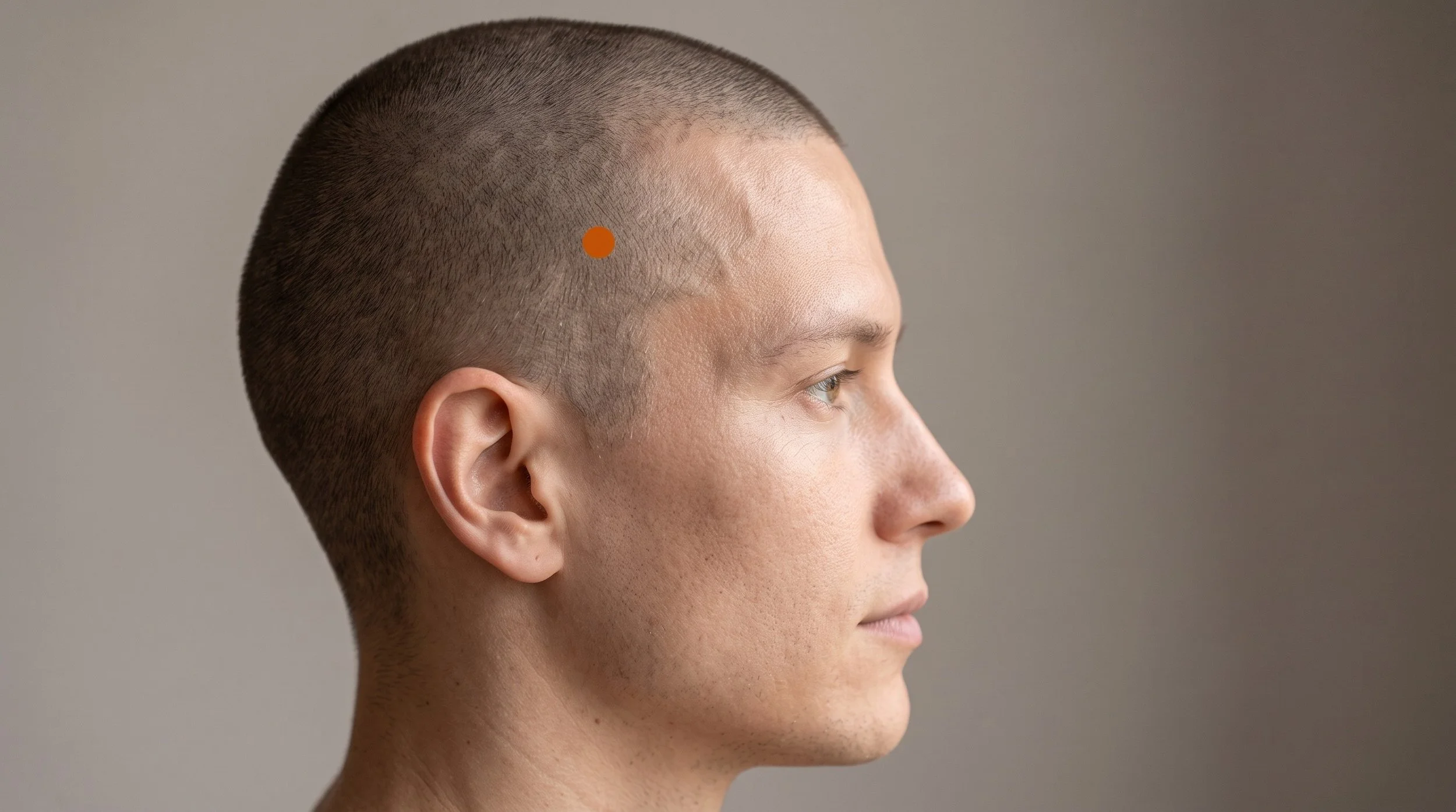
GB5 Acupuncture Point (Xuanlu)
The Suspended Skull Point on the Temple: Anatomy, Mechanism, and Why This Four Channel Meeting Point Anchors One-Sided Headache Treatment
GB5, known in Chinese as Xuanlu and usually translated as Suspended Skull, sits on the side of the head just inside the temporal hairline, halfway along the curved line that runs from ST8 at the corner of the forehead down to GB7 in front of the ear.
In plain terms, it's the middle of the temple, over the fan of the temporalis muscle, in a strip of skin that many migraine patients instinctively press when an attack builds. Classical sources list it as a meeting point of the Gallbladder, Stomach, Triple Burner (Sanjiao) and Large Intestine channels, which is a traditional way of saying that four of the body's major head and face pathways converge here.
Clinically, the GB5 acupuncture point matters because it lies in the exact territory where one-sided headache is felt, where the superficial temporal artery pulses, and where branches of the trigeminal nerve carry sensation from scalp to jaw, making it a natural local target for temple headache, migraine, and jaw-related head pain.
- GB5 (gallbladder 5, Xuanlu) is located within the temporal hairline midway between ST8 and GB7, sitting over skin, subcutaneous tissue, the superficial temporal fascia and the temporalis muscle, with the squamous temporal bone directly beneath. Because the tissue plane is thin, the point is threaded transversely along the scalp rather than needled straight in.
- Traditional texts classify GB5 as a crossing point of the Gallbladder, Stomach, Triple Burner and Large Intestine channels and attribute to it the actions of expelling wind, clearing heat, and freeing the channel to relieve pain. Read neurophysiologically, those attributions describe a point whose sensory field overlaps several facial and cranial nerve territories at once.
- The GB 5 temple region is supplied by the auriculotemporal nerve, a branch of the mandibular division of the trigeminal nerve, with nearby contributions from the zygomaticotemporal branch. Trigeminal and upper cervical afferents converge on shared second-order neurons in the trigeminocervical complex, which is the accepted explanation for why head pain spreads and refers across the temple, eye and neck (Bartsch & Goadsby, 2003).
- Needling in this territory is thought to work through segmental input to those same convergent neurons plus recruitment of descending inhibitory pathways involving endogenous opioids, serotonin and noradrenaline (Zhao, 2008). Mechanistic reviews in migraine also point to changes in neuropeptide signaling and to modulation of peripheral and central sensitization (Chen et al., 2022).
- Research on acupuncture for headache tests whole protocols rather than single points, but the picture is reasonably consistent: Cochrane reviews found that adding acupuncture may reduce migraine frequency and tension-type headache days compared with usual care alone (Linde et al., 2016a; Linde et al., 2016b), and a multicenter trial reported greater reductions in migraine days with manual acupuncture than with sham (Xu et al., 2020).
- De qi at GB5 tends to be a spreading, slightly heavy pressure that skims under the scalp rather than a sharp poke, sometimes with a faint ache drifting toward the outer corner of the eye or the ear. Patients with an active temple headache often report a familiar, recognizable tenderness when the point is located, which is usually a good sign the target is correct.
Struggling With Migraines That Always Land on One Side?
One-sided temple pain is one of the most common reasons patients come to Morningside Acupuncture, and GB5 is often part of how we treat it. We combine gentle threading along the temple with distal points and, when the temporalis is clearly involved, targeted dry needling of the muscle itself. Treatment plans are built around your headache pattern, your triggers and your schedule, not a template. Book a visit and let's map where your headaches actually live.
Schedule NowAnatomy of GB5: Why the Mid-Temple Is Such an Important Location
GB5 sits in a surprisingly thin stack of tissue. Under the hair-bearing skin is a layer of loose subcutaneous tissue, then the temporoparietal and superficial temporal fascia, then the broad fan of the temporalis muscle running down toward the coronoid process of the mandible, and finally the squamous portion of the temporal bone. What loads this area is mostly jaw work: clenching, grinding, gum chewing, long stretches of concentration with the teeth lightly together, and the low-grade bracing that comes with stress.
Temporalis fibers can develop taut bands that refer pain into the temple, the eyebrow region and even the upper teeth (Simons et al., 1999), which is exactly the distribution patients tend to circle with a finger when they describe a temple headache.
The sensory geography here is the reason GB5 earns its place in headache protocols. The scalp at the mid-temple is supplied chiefly by the auriculotemporal nerve from the mandibular division of the trigeminal nerve, with the zygomaticotemporal branch covering territory a little more anterior.
These trigeminal afferents share second-order neurons in the trigeminocervical complex with input from the upper cervical roots, and that convergence explains why pain from the neck can be felt at the temple and why irritation at the temple can feel indistinguishable from a migraine building behind the eye (Bartsch & Goadsby, 2003). Needling into this field is thought to change the input arriving at those shared neurons while also engaging descending inhibitory control from the brainstem, a system that relies on endogenous opioid, serotonergic and noradrenergic signaling (Zhao, 2008).
Mechanistic reviews in migraine add that acupuncture may influence neuropeptide release and markers of peripheral and central sensitization, though most of that work comes from animal models and imaging studies rather than from bedside outcomes (Chen et al., 2022).
The structure that dictates technique is vascular. The frontal branch of the superficial temporal artery runs through this region alongside the auriculotemporal nerve, and it's often visible or palpable in lean patients. For that reason GB5 is needled transversely, threaded along the scalp for roughly 0.5 to 1.5 cun in the classical range, with many modern Chinese texts favoring a shallower subcutaneous insertion. Practitioners palpate first and angle away from a pulsating vessel, use fine needles, and apply firm pressure on withdrawal since scalp tissue bruises readily. Moxibustion is described as applicable in several standard references, though it's used sparingly in a hair-bearing area.
Related Temporalis Muscle Explained Related Best Acupuncture Points For HeadachesGB5 at a Glance: Classification, Location, and Clinical Use
| Category | Detail |
|---|---|
| Traditional Name | Xuanlu (Suspended Skull, also translated Hanging Skull), Gallbladder 5 |
| Channel Classification | Fifth point of the Gallbladder channel of Foot Shaoyang, in the temporal region |
| Point Categories | Meeting (crossing) point of the Gallbladder, Stomach, Triple Burner (Sanjiao) and Large Intestine channels. No five-shu, extraordinary vessel or hui-meeting designation is attributed to this point in the standard references. |
| Precise Location | Within the temporal hairline, at the midpoint of the curved line connecting ST8 at the corner of the forehead with GB7 at the posterior temple, roughly level with the lower edge of the frontal bone |
| Tissue Stimulated | Scalp and subcutaneous tissue, superficial temporal fascia, and the fibers of the temporalis muscle beneath, in auriculotemporal nerve and superficial temporal artery territory |
| Needle Depth / Direction | Transverse (subcutaneous) threading along the scalp, commonly 0.5 to 1.5 cun in the classical range, with many modern texts using a shallower 0.3 to 0.5 cun; directed toward or away from adjacent temporal points and angled clear of the superficial temporal artery |
| De Qi Sensation | A dull, spreading pressure or tugging that travels under the scalp, occasionally with a mild ache toward the outer corner of the eye or the ear; sharp or pulsing sensation suggests proximity to a vessel and calls for repositioning |
| Primary Clinical Uses | One-sided headache along the temple, migraine, pain at the outer corner of the eye, temporalis-related jaw and head pain; traditionally also used for toothache, facial swelling and redness, nosebleed and nasal congestion, and feverish agitation without sweating |
| Common Point Combinations |
|
Deadman's point manual presents GB5 as a crossing point where the Gallbladder, Stomach, Triple Burner and Large Intestine channels meet on the temple, and traditionally attributes to it two functions: dispersing wind with heat, and freeing the channel so that pain settles. The classical indication list is worth reading as a pattern rather than a menu.
It clusters into three groups: one-sided head pain that reaches the outer corner of the eye, disorders of the face and nose (toothache, facial swelling and redness, nosebleed, persistent nasal discharge), and feverish states with restlessness and an absence of sweating. The manual also records a pairing with GB4 for one-sided headache drawn from the Song of the One Hundred Symptoms, and other classical texts group GB4 through GB7 as a temporal series.
What's striking is the coherence: a single spot on the temple was traditionally credited with influence over pain, facial inflammation and heat that couldn't vent, which is a remarkably good description of a region where trigeminal sensory branches, a superficial artery and the body's surface all sit within a few millimeters of one another.
Why GB5 Is Used for Migraine, Jaw Tension and Pain Behind the Eye
Patients are sometimes surprised that a point on the side of the head gets used for pain they feel behind the eye or in the upper teeth. The explanation is convergence. Sensory fibers from the temple, the eye region, the jaw, the dura and the upper neck all funnel toward overlapping populations of second-order neurons in the trigeminocervical complex, so the brain's map of where the pain is coming from is genuinely blurry (Bartsch & Goadsby, 2003).
Needling into the auriculotemporal field at GB5 feeds a controlled, novel signal into that shared relay, which may change how the surrounding input is processed for a period after treatment.
The second half of the story is top-down. Needle stimulation is thought to activate descending inhibitory pathways from the midbrain and brainstem that dampen incoming nociceptive traffic using endogenous opioids along with serotonin and noradrenaline (Zhao, 2008). This is why sessions typically include distal points as well as local ones, and why effects often build across a course of treatment rather than appearing all at once.
In migraine specifically, mechanistic reviews describe additional possible contributions including modulation of neuropeptide release and of the sensitization processes that make the scalp feel tender between attacks, though this evidence is still developing (Chen et al., 2022).
There's also a straightforward musculoskeletal layer. The temporalis lies directly under GB5, and taut bands in this muscle refer pain into the temple, the eyebrow and the teeth in patterns that closely mimic headache (Simons et al., 1999). When a patient's temple pain is reproduced by pressing the muscle, treating that tissue directly is often the fastest way to change symptoms, and the point location and the myofascial target happen to sit in the same place.
What the Research Shows for GB5
It's worth being clear about what the research can and can't tell us. No trial has isolated GB5 on its own. Headache and migraine studies test complete protocols in which temporal points like GB5, GB4 and Taiyang usually appear alongside neck points such as GB20 and distal points on the hands and feet, so any single point's contribution is inferred rather than measured. What the literature does support is that acupuncture protocols of this type may reduce headache frequency for many patients, with effects that appear modest but durable, and with a favorable safety profile in trained hands. Below is a summary of the studies most relevant to how GB5 is actually used.
| Study | Type | Focus | Key Finding |
|---|---|---|---|
| Linde et al., 2016a | Cochrane systematic review | Acupuncture for the prevention of episodic migraine (22 trials) | Adding acupuncture to usual care may reduce migraine frequency, with effects that appear at least comparable to prophylactic drug treatment, though evidence quality was rated moderate to low. |
| Linde et al., 2016b | Cochrane systematic review | Acupuncture for the prevention of tension-type headache | Acupuncture added to routine care may reduce headache frequency, with small additional benefit over sham needling in the pooled analyses. |
| Xu et al., 2020 | Multicenter randomized clinical trial (BMJ) | Manual acupuncture versus sham and usual care in episodic migraine without aura | Manual acupuncture produced greater reductions in migraine days and attacks than sham acupuncture at later follow-up timepoints, suggesting effects that accumulate over time. |
| Vickers et al., 2018 | Individual patient data meta-analysis | Acupuncture across chronic pain conditions including chronic headache | Acupuncture was associated with better pain outcomes than both sham and no-acupuncture controls, with benefits that persisted over roughly a year. |
| Chen et al., 2022 | Narrative and mechanistic review | Proposed physiological mechanisms of acupuncture in migraine | Preclinical and imaging data suggest effects on neuropeptide signaling, neuroinflammation and central sensitization, but the authors call for further verification. |
| Bartsch & Goadsby, 2003 | Physiological review | Trigeminocervical convergence in headache | Convergence and sensitization of trigeminocervical neurons provide the anatomical rationale for treating temple and upper neck territory together in headache. |
Jaw Clenching, Temple Tightness and Headaches That Blur Together?
Many New Yorkers arrive describing pressure at the temple that worsens with clenching, chewing or long screen days. Our licensed acupuncturists assess the temporalis, masseter and upper neck alongside points like GB5 and GB4 to address both the muscular and neurological sides of the problem. We also give you practical between-session strategies for jaw load and stress. Schedule an evaluation and get a clear plan.
Schedule NowGB5 in the Context of Trigger Point Work
At Morningside Acupuncture, we treat acupuncture as the use of an acupuncture needle across hundreds of styles, dry needling included, so a session for temple headache often moves fluidly between the two frameworks. GB5 gives us a classical anchor on the temporal arc, and the temporalis directly beneath it gives us a myofascial target. If palpation along the muscle reproduces the patient's familiar headache, we'll needle those taut bands specifically, since temporalis referral patterns cover the temple, the eyebrow region and the upper teeth (Simons et al., 1999). If the pain is more diffuse and vascular in quality, we lean toward the lighter threading approach along GB4, GB5, GB6 and Taiyang instead.
Head pain rarely stays in one place, so we also examine the neck and jaw. Suboccipital tightness, upper trapezius and sternocleidomastoid referral, and masseter involvement frequently travel with temple headache, and treating them addresses the cervical half of the trigeminocervical convergence story (Bartsch & Goadsby, 2003). A typical session might pair GB5 and the temporalis with GB20 at the base of the skull and a distal point or two, followed by jaw-load education, hydration and sleep guidance, and simple self-release you can do at your desk.
GB5 Headache and Migraine Treatment at NYC's Highest-Rated Acupuncture Clinic
Morningside Acupuncture is the highest-rated acupuncture and dry needling clinic in New York City with over 500 five-star Google reviews. We treat headache and migraine with an evidence-informed blend of classical point selection, trigger point dry needling and clear patient education. Whether your pain sits at the temple, behind the eye or at the base of the skull, we'll build a protocol around it. Schedule your appointment today.
Schedule NowFrequently Asked Questions
What does GB5 feel like when needled?
Because the needle is threaded almost flat under the scalp rather than pushed straight down, most people feel a brief pinch at insertion followed by a spreading tightness or dull pressure that travels along the temple. Some notice a faint ache drifting toward the outer corner of the eye or the ear, which is expected given the nerve supply here. Scalp points can feel a little odd the first time, but they shouldn't be sharp or throbbing. Tell your acupuncturist if the sensation is pulsing, since that usually means the needle is close to a vessel and needs repositioning.
Why needle a local point like GB5 when many headache protocols use distal points on the hands and feet?
Both approaches are doing different jobs. Local needling at GB5 feeds input directly into the trigeminal field where the headache is actually felt, and it lets us reach the temporalis if the muscle is part of the problem. Distal points appear to work more through descending inhibitory pathways that reduce nociceptive traffic system-wide (Zhao, 2008). Most clinical protocols use both, which is also how the trials that showed benefit for migraine were designed (Linde et al., 2016a).
Can I press GB5 myself between sessions?
Yes, and it's one of the easier points to self-treat. Find the temple just inside the hairline, roughly halfway between the corner of your forehead and the point in front of the top of your ear, then feel for the pulse of the superficial temporal artery and move a finger's width away from it before applying pressure. Use the pads of two fingers with steady, moderate pressure or small slow circles for 30 to 60 seconds, rest, then repeat two or three times per side. You can do this two or three times a day, and it's often more useful early in a headache than at peak intensity. Stop if pressure sharply worsens the pain, and don't press hard directly over a pulsing vessel.
Is GB5 safe to needle?
In trained hands, yes. The two considerations are the superficial temporal artery, which runs through this region and is avoided by palpating first and threading transversely rather than perpendicularly, and the thin scalp tissue, which is why insertion is subcutaneous and shallow. Minor bruising is the most common side effect at any temple point, and firm pressure after needle removal reduces it. Let your practitioner know if you take blood thinners, have had recent head or facial surgery, or have a vascular condition affecting the head. GB5 should be needled by a licensed acupuncturist and is not a point for self-needling.
Where exactly is GB5 located?
GB5 lies within the temporal hairline at the midpoint of the curved line running from ST8, at the corner of the forehead above the hairline, to GB7, at the posterior border of the temple level with the top of the ear. It sits roughly level with the lower edge of the frontal bone, over the temporalis muscle. Its neighbors on the same arc are GB4 above it and GB6 below it, and practitioners often locate all three at once by dividing that ST8 to GB7 line into quarters: GB4 at the first quarter, GB5 at the midpoint, GB6 at the three-quarter mark.
References
- Deadman, P., Al-Khafaji, M., & Baker, K. (2009). A manual of acupuncture. Journal of Chinese Medicine Publications.
- Cunningham, P. M. (2000). Acupuncture points: A practical guide to classical and modern usage. Odyssey Press.
- Maciocia, G. (2006). The channels of acupuncture: Clinical use of the secondary channels and eight extraordinary vessels. Churchill Livingstone Elsevier.
- Cheng, X. (Ed.). (1999). Chinese acupuncture and moxibustion (Rev. ed.). Foreign Languages Press.
- Simons, D. G., Travell, J. G., & Simons, L. S. (1999). Travell & Simons' myofascial pain and dysfunction: The trigger point manual, Vol. 1: Upper half of body (2nd ed.). Williams & Wilkins.
- Linde, K., Allais, G., Brinkhaus, B., Fei, Y., Mehring, M., Vertosick, E. A., Vickers, A., & White, A. R. (2016a). Acupuncture for the prevention of episodic migraine. Cochrane Database of Systematic Reviews, 2016(6), CD001218. https://doi.org/10.1002/14651858.CD001218.pub3
- Linde, K., Allais, G., Brinkhaus, B., Fei, Y., Mehring, M., Shin, B. C., Vickers, A., & White, A. R. (2016b). Acupuncture for the prevention of tension-type headache. Cochrane Database of Systematic Reviews, 2016(4), CD007587. https://doi.org/10.1002/14651858.CD007587.pub2
- Xu, S., Yu, L., Luo, X., Wang, M., Chen, G., Zhang, Q., Liu, W., Zhou, Z., Song, J., Jing, H., Huang, G., Liang, F., Wang, H., & Wang, W. (2020). Manual acupuncture versus sham acupuncture and usual care for prophylaxis of episodic migraine without aura: Multicentre, randomised clinical trial. BMJ, 368, m697. https://doi.org/10.1136/bmj.m697
- Vickers, A. J., Vertosick, E. A., Lewith, G., MacPherson, H., Foster, N. E., Sherman, K. J., Irnich, D., Witt, C. M., & Linde, K. (2018). Acupuncture for chronic pain: Update of an individual patient data meta-analysis. Journal of Pain, 19(5), 455-474. https://doi.org/10.1016/j.jpain.2017.11.005
- Zhao, Z. Q. (2008). Neural mechanism underlying acupuncture analgesia. Progress in Neurobiology, 85(4), 355-375. https://doi.org/10.1016/j.pneurobio.2008.05.004
- Bartsch, T., & Goadsby, P. J. (2003). The trigeminocervical complex and migraine: Current concepts and synthesis. Current Pain and Headache Reports, 7(5), 371-376. https://doi.org/10.1007/s11916-003-0036-y
- Chen, Y., Liu, Y., Song, Y., Zhao, S., Li, B., Sun, J., & Liu, L. (2022). Therapeutic applications and potential mechanisms of acupuncture in migraine: A literature review and perspectives. Frontiers in Neuroscience, 16, 1022455. https://doi.org/10.3389/fnins.2022.1022455
Disclaimer: This web site is intended for educational and informational purposes only. Reading this website does not constitute providing medical advice or any professional services. This information should not be used for diagnosing or treating any health issue or disease. Those seeking medical advice should consult with a licensed physician. Seek the advice of a medical doctor or other qualified health professional for any medical condition. If you think you have a medical emergency, call 911 or go to the emergency room. No acupuncturist-patient relationship is created by reading this website or using the information. Morningside Acupuncture PLLC and its employees and contributors do not make any express or implied representations with respect to the information on this site or its use. For any legal interpretation of scope of practice in your state, consult a licensed attorney or regulatory authority.
Read more from our blog



