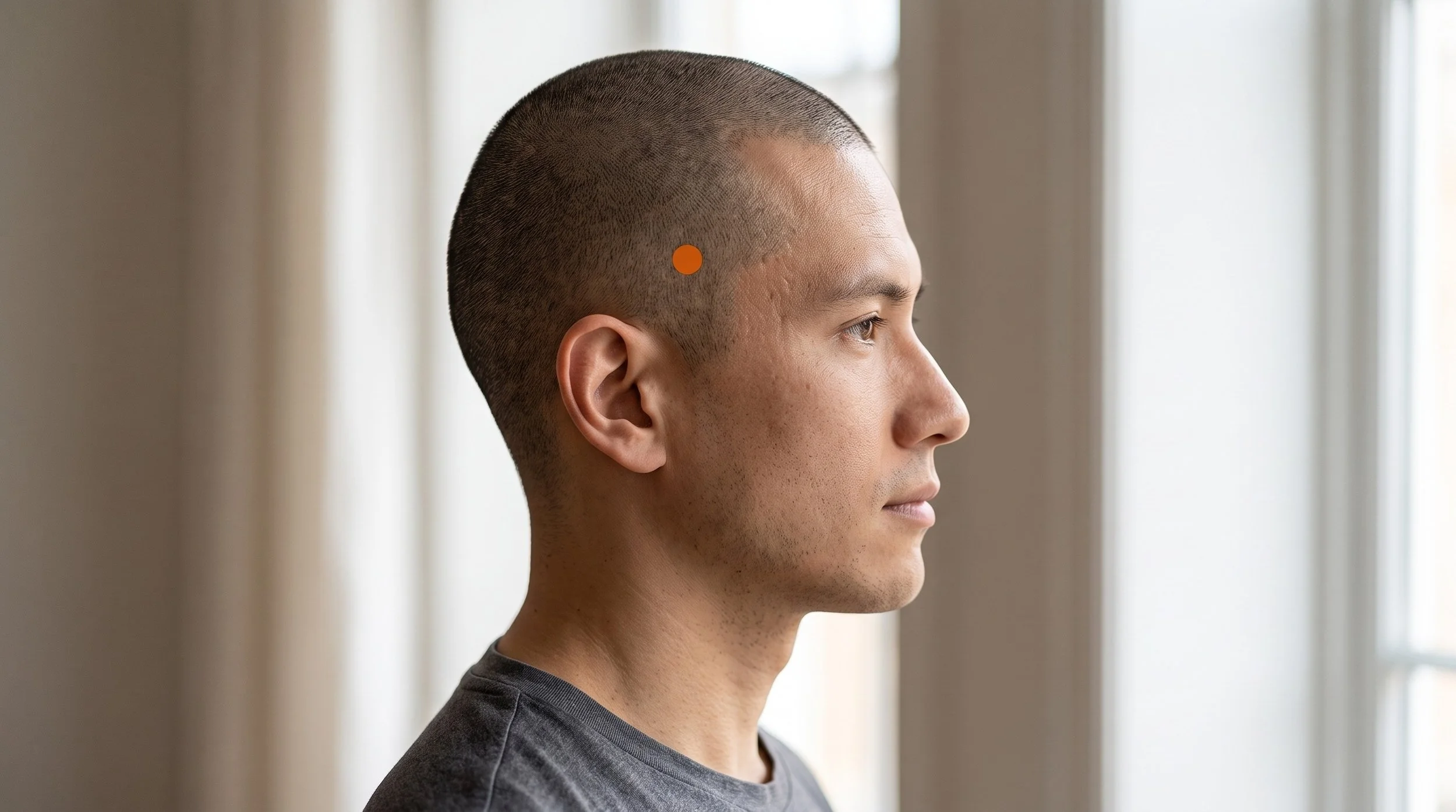
GB6 Acupuncture Point (Xuanli)
The Suspended Hair Point on the Lower Temple: Anatomy, Mechanism, and Why GB6 Belongs in One-Sided Headache Treatment
GB6, known in Chinese as Xuanli and usually translated as Suspended Hair, sits inside the hairline on the lower temple, three quarters of the way along the curved line that runs from ST8 at the corner of the forehead down to GB7 near the ear (Deadman et al., 2009). It is the third of the four temple points strung along that arc, and classical texts describe it as a meeting place of the Gallbladder, Stomach, Sanjiao (Triple Burner) and Large Intestine channels, which is a traditional way of saying that a great deal of head and face pathway converges here (Deadman et al., 2009; O'Connor & Bensky, 1981).
Anatomically the point overlies thin scalp tissue and the upper fibers of the temporalis in auriculotemporal nerve territory, which puts a needle placed here squarely in the sensory field that carries migraine and temporal headache pain. That is why the GB6 acupuncture point tends to be chosen when one-sided head pain runs forward toward the outer corner of the eye rather than sitting high on the vertex or low at the occiput.
- Location and layers: GB6 lies within the temporal hairline at three quarters of the distance from ST8 to GB7, over skin, subcutaneous fat, the superficial temporal fascia and the underlying temporalis (Deadman et al., 2009; Cheng, 1999). Because the tissue plane is shallow, standard practice is a transverse insertion of roughly 0.5 to 1.5 cun angled toward the area of pain or threaded toward a neighboring temple point (Deadman et al., 2009).
- Traditional categories, read neurophysiologically: the classical designation as a crossing point of four yang channels, and the attributed actions of expelling wind, clearing heat and freeing the channel, describe a site where several head pathways overlap and where local needling can influence a broad swath of temporal and periorbital pain (Deadman et al., 2009; Ellis et al., 1989). In modern terms this is a convergence zone, not a flow of energy.
- Nerve story: the lower temple is supplied mainly by the auriculotemporal branch of the mandibular division of the trigeminal nerve, and trigeminal afferents from this region synapse in the trigeminocervical complex, the same relay implicated in migraine pain (Liu et al., 2021). Needle input at this level may modulate second order neurons that are already sensitized during a headache cycle (Qu et al., 2020).
- Research picture: Cochrane reviews report that acupuncture protocols including local head points may reduce migraine and tension-type headache frequency compared with usual care, with smaller and less certain differences against sham needling (Linde et al., 2016a; Linde et al., 2016b). Individual patient data analyses of chronic pain, including headache trials, point in the same cautious direction (Vickers et al., 2018).
- Clinical framing: GB6 is rarely used alone. It is typically one node in a temporal cluster with GB5, GB8 and Taiyang, supported by distal points, and chosen when pain tracks from the temple toward the outer canthus (Deadman et al., 2009; Maciocia, 2005).
- De qi at GB6: because the needle stays in the subcutaneous plane, most people feel a spreading pressure, tugging or dull warmth across the temple rather than the deep ache typical of limb points, and referred sensation sometimes travels toward the eyebrow or ear (Deadman et al., 2009).
Are Your Headaches Always on One Side of the Head?
One-sided head pain that builds in the temple and drifts toward the outer corner of the eye is one of the patterns our clinicians see most often. At Morningside Acupuncture we use Xuanli acupuncture alongside neighboring temple points, distal points on the hands and feet, and dry needling of the temporalis and neck muscles that refer pain into the same region. Treatment plans are built around your headache diary, your triggers and your work setup, not a fixed template. Schedule a visit and we can map where your pain actually lives.
Schedule NowAnatomy of GB6: Why the Lower Temple Is Such an Important Location
GB6 sits inside the hairline on the lower temple, along the curved line that drops from ST8 toward GB7 in front of the ear (Deadman et al., 2009). Working from the surface inward, a needle passes through thin scalp skin, a shallow layer of subcutaneous tissue containing small vessels and nerves, the superficial temporal fascia, and then reaches the fibers of the temporalis muscle. The temporalis is a fan shaped jaw closer, and it is loaded by everything from sustained clenching and night grinding to hours of screen work with the head held forward.
That combination of thin covering tissue and a hard working muscle underneath makes this a region where tenderness accumulates quietly and where pressure often reproduces a familiar headache.
The sensory geography here matters more than the muscle bulk. The lower temple is supplied largely by the auriculotemporal nerve, a branch of the mandibular division of the trigeminal nerve, with contributions from neighboring trigeminal branches further forward. Trigeminal afferents from the scalp, dura and temporal soft tissue converge on the same second order neurons in the trigeminocervical complex, which is why deep intracranial pain can be felt on the surface of the temple and why surface input can influence that shared circuitry (Liu et al., 2021).
Experimental work in animal models suggests that electroacupuncture can suppress C-fiber evoked activity of wide dynamic range neurons in this complex, one plausible mechanism for the analgesia patients report during headache treatment (Qu et al., 2020). Broader work on acupuncture analgesia describes recruitment of descending inhibitory pathways from the periaqueductal gray and rostral ventromedial medulla, along with local release of endogenous opioids (Zhao, 2008).
The vascular structure that governs safety here is the superficial temporal artery and its branches, which run through the temple close to the surface and are easy to feel on many people. Practitioners palpate before insertion, avoid any pulsation, use fine needles, and keep the angle transverse so the needle stays in the loose subcutaneous plane rather than diving into the muscle belly (Deadman et al., 2009).
Textbooks describe subcutaneous insertion of roughly 0.3 to 0.5 cun in conservative sources, extending to 1.5 cun when the needle is threaded toward an adjacent point or aimed at the area of pain, and note that moxibustion may be applied (Cheng, 1999; Kim, 2008). Because scalp tissue is vascular, a small bruise is the most common minor side effect, and brief pressure after needle removal reduces the chance of one.
Related Best Acupuncture Points For Headaches Related Acupuncture For Temporalis Muscle PainGB6 at a Glance: Classification, Location, and Clinical Use
| Category | Detail |
|---|---|
| Traditional Name | Xuanli (Suspended Hair), GB-6 in Deadman numbering |
| Channel Classification | Gallbladder channel of Foot Shaoyang, the third of the four temple points running from ST8 toward GB7 |
| Point Categories | Meeting (crossing) point of the Gallbladder, Stomach, Sanjiao (Triple Burner) and Large Intestine channels (Deadman et al., 2009); channel texts also describe the Stomach and Sanjiao pathways intersecting the Gallbladder channel here (O'Connor & Bensky, 1981). No five-shu, extraordinary vessel or hui-meeting designation. |
| Precise Location | In the temporal region inside the hairline, three quarters of the distance along the curve from ST8 (corner of the forehead) to GB7 (in front of the ear at the level of the ear apex) |
| Tissue Stimulated | Scalp skin, subcutaneous tissue and superficial temporal fascia over the fibers of the temporalis, an area that overlaps clinically with temporalis trigger points (Simons et al., 1999) |
| Needle Depth / Direction | Transverse (subcutaneous) insertion, commonly 0.3 to 0.5 cun and up to 1.5 cun when threading, directed toward the area of pain or toward a neighboring temple point; moxibustion is described as applicable (Deadman et al., 2009; Cheng, 1999) |
| De Qi Sensation | Usually a spreading pressure, tugging or dull warmth across the temple rather than a deep ache, sometimes referring toward the eyebrow, outer eye corner or ear |
| Primary Clinical Uses | One-sided headache, especially pain extending to the outer corner of the eye, temporal and periorbital pain, tinnitus, and in classical listings febrile presentations with restlessness and poor appetite (Deadman et al., 2009; Ellis et al., 1989) |
| Common Point Combinations |
|
Deadman, Al-Khafaji and Baker record GB6 as a crossing point of four yang channels and attribute to it two traditional actions: expelling wind and clearing heat, and freeing the channel to relieve pain. The classical indication list they compile is unusually specific about direction, naming one-sided headache that extends to the outer corner of the eye, pain of the outer canthus itself, tinnitus, sneezing, and redness and swelling of the facial skin.
Alongside those local complaints sit a set of systemic entries that read very differently: fever without sweating, restlessness of the Heart with no appetite, and heat in the middle burner, along with a pairing with CV15 from the Thousand Ducat Formulas for fever accompanied by one-sided headache. Other texts echo the same core cluster of migraine, outer canthus pain, tinnitus and frequent sneezing, and one adds toothache and vexation without appetite (Ellis et al., 1989; Kim, 2008).
These are traditional attributions rather than modern outcome claims, and what is striking is that a small hairline point on the temple was asked to bridge two very different problems, a precisely mapped one-sided head pain and a whole body heat pattern with agitation.
Why GB6 Is Used for Headaches That Settle Behind the Outer Corner of the Eye
The classical pairing of temple pain with outer canthus pain looks odd until you follow the nerves. The lower temple, the skin around the outer eye and the deeper structures that generate migraine pain all send fibers into the trigeminal system, and those fibers converge on shared second order neurons in the trigeminocervical complex before pain is relayed upward (Liu et al., 2021). Convergence explains why a patient points at their temple and then traces a line to the corner of the eye, and it also explains why treating the surface can matter.
Needling into a segment that is already feeding a sensitized relay gives the nervous system new, non-threatening input to process alongside the pain signal.
Two lines of mechanism research support this framing. In migraine models, electroacupuncture reduced C-fiber evoked firing of wide dynamic range neurons in the trigeminocervical complex, consistent with an inhibitory effect at the relay itself (Qu et al., 2020). More generally, acupuncture analgesia involves activation of descending inhibitory control from the periaqueductal gray and rostral ventromedial medulla, together with segmental spinal gating and endogenous opioid release (Zhao, 2008).
Human neuroimaging reviews report that acupuncture in migraine is associated with changes in brainstem and pain network connectivity, although the field is still working out how consistent and how specific those changes are (Liu et al., 2021).
There is also a straightforward musculoskeletal reason patients respond to work in this region. The temporalis under GB6 refers pain into the temple, the eyebrow and the upper teeth when it harbors active trigger points, and that referral pattern can either mimic or amplify a primary headache (Simons et al., 1999). When palpation over gallbladder 6 reproduces the patient's usual pain, the point is doing double duty as a channel point and as access to a loaded muscle.
What the Research Shows for GB6
It is worth being clear about what the research can and cannot tell us. No trial has isolated GB6 on its own, so its role has to be inferred from studies of multi-point protocols in which temple and Gallbladder channel points are commonly included, alongside mechanism work on the trigeminal pathway that GB6 sits in. Reviews of headache acupuncture generally suggest modest benefit over usual care, with narrower and less certain advantages over sham needling, and effects that vary between individuals. Read the table below as evidence for the approach that GB6 belongs to, not as proof about a single point.
| Study | Type | Focus | Key Finding |
|---|---|---|---|
| Linde et al., 2016a | Cochrane systematic review | Acupuncture for prevention of episodic migraine | Acupuncture protocols were associated with fewer migraine days than usual care and appeared at least comparable to prophylactic drugs, though differences against sham needling were smaller. |
| Linde et al., 2016b | Cochrane systematic review | Acupuncture for prevention of tension-type headache | Review authors concluded acupuncture may help people with frequent episodic or chronic tension-type headache, while calling for further comparisons with other treatments. |
| Zhao et al., 2017 | Randomized clinical trial (n = 249) | True versus sham acupuncture and waiting list for migraine without aura | True acupuncture was associated with greater reductions in migraine frequency that persisted through 24 weeks of follow-up, in a single-country trial with the usual blinding limitations. |
| Vickers et al., 2018 | Individual patient data meta-analysis | Chronic pain conditions including headache and migraine | Acupuncture was associated with statistically significant benefits over both sham and no-acupuncture controls, with effects that persisted over time but were modest against sham. |
| Qu et al., 2020 | Animal electrophysiology study | Electroacupuncture and trigeminocervical complex neuron activity in a migraine model | Electroacupuncture reduced C-fiber evoked firing of wide dynamic range neurons, offering a plausible segmental mechanism that has not yet been confirmed in humans. |
| Liu et al., 2021 | Systematic review of neuroimaging studies | Central mechanisms of acupuncture in migraine | Studies suggest acupuncture may modulate brainstem and pain network connectivity in migraine, though imaging findings remain heterogeneous. |
| Monti-Ballano et al., 2024 | Randomized controlled trial (n = 32) | Dry needling of active trigger points in tension-type headache | Needling active trigger points in head and neck muscles, temporalis included, was associated with reduced headache intensity and fewer active trigger points in a small sample. |
Jaw Clenching, Screen Strain and Temple Tension?
Long hours at a monitor, night grinding and low grade jaw clenching all load the temporalis, and that load shows up as tightness in exactly the GB 6 temple region. Our clinicians combine gentle threading technique at gallbladder 6 with trigger point needling of the temporalis and masseter, plus practical changes to desk height, screen distance and jaw habits. Many patients notice the temple softens before the headache frequency changes. Book an appointment to have the whole chain assessed.
Schedule NowGB6 in the Context of Trigger Point Work
At Morningside, GB6 rarely appears in isolation on a treatment plan. If palpation of the temple reproduces a patient's headache, we treat the point as a doorway to the temporalis and combine gentle threading at GB6 with dry needling of active temporalis trigger points, which are known to refer pain into the temple, brow and upper teeth (Simons et al., 1999). Depending on findings, that work extends to the masseter, the upper trapezius and the suboccipital muscles, since referral from those muscles frequently overlaps the same territory.
A small randomized trial found that needling active trigger points across head and neck muscles was associated with lower headache intensity in tension-type headache, which fits what we see clinically (Monti-Ballano et al., 2024).
Technique differs between the two applications, and that difference is worth understanding. Classical needling at GB6 stays subcutaneous and is often threaded toward GB5 or toward the pain, aiming for broad, gentle sensory input across the temple (Deadman et al., 2009). Trigger point needling of the temporalis engages the muscle itself with a finer, more targeted approach, looking for a taut band and a local twitch response. Because the temporal region is vascular and thinly covered, we use fine needles, palpate for the superficial temporal artery, and apply pressure after removal to limit bruising.
Acupuncture at Morningside means the use of an acupuncture needle across hundreds of styles, and dry needling of the temporalis and channel point work at GB6 are simply two of those styles applied to the same anatomical neighborhood.
GB6 Headache Treatment at NYC's Highest-Rated Acupuncture Clinic
Morningside Acupuncture is the highest-rated acupuncture and dry needling clinic in New York City with over 500 five-star Google reviews, and headache care is one of the main reasons people come through our door. We treat GB6 as one part of a full evaluation that includes the temple, jaw, upper neck and shoulders, and we explain every step of the plan in plain language. Sessions are unhurried, hygienic and tailored to how you actually respond. Schedule your appointment today and let's build a plan around your headaches.
Schedule NowFrequently Asked Questions
What does GB6 feel like when needled?
Most people describe a spreading pressure, a tugging along the hairline, or a dull warmth across the temple rather than the deeper ache many feel at points on the arms and legs. That is largely a function of technique, since the needle is laid in transversely just under the skin instead of being driven into muscle (Deadman et al., 2009). Sensation sometimes travels toward the eyebrow, the outer corner of the eye or the ear, and patients with an active headache often notice the temple softening or the pain shifting during the session. A brief sting on insertion is common because scalp skin is sensitive, and it usually settles within a few seconds.
Why needle the temple directly instead of using only distal points on the hands and feet?
Both approaches are used, and in practice they are usually combined. Local points such as GB6 place input directly into the trigeminal territory that carries the headache, feeding a segment that converges on the trigeminocervical complex where migraine pain is relayed (Liu et al., 2021). Distal points work more through system-wide descending inhibition and brainstem modulation (Zhao, 2008). Classical practice reflects the same logic: temple points are grouped by pain location while distal Gallbladder channel points are added as support (Maciocia, 2006). If the temple is tender to palpation and pressure reproduces your headache, local needling is usually part of the plan.
Can I press GB6 myself between sessions?
Yes, and it is a reasonable self-care option for temple tension. Part the hair on the affected side and find the spot inside the hairline about three quarters of the way along the curve from the corner of the forehead down toward the front of the ear, roughly a fingerbreadth behind and below GB5. Before pressing, feel for a pulse, and if you find one, move slightly away from it. Use a fingertip with light to moderate circular pressure for 30 to 60 seconds, rest, and repeat two or three times, then do the same on the other side if both temples are involved. Clenching the jaw gently will make the temporalis bulge under your finger and help you confirm the area. Keep the pressure comfortable, stop if it sharpens the headache or makes you lightheaded, and treat this as a supplement to care rather than a substitute for evaluation.
Is GB6 safe to needle?
In trained hands it is a well tolerated point, but the temple deserves respect. The superficial temporal artery and its branches run close to the surface here, so practitioners palpate first, avoid any pulsation, use fine needles and keep the insertion transverse in the loose subcutaneous layer (Deadman et al., 2009). Scalp tissue bleeds readily, so a small bruise is the most common minor side effect, and pressure held after needle removal reduces that risk. Let your clinician know if you take blood thinners, bruise easily or have had scalp surgery or an implanted device in the area. Needling here should never be painful in a sharp, persistent way, and sensation should ease as the needle settles.
Where exactly is GB6 located?
GB6 is on the temple inside the hairline, along the gently curved line that runs from ST8 at the corner of the forehead down to GB7 in front of the ear at about the level of the ear apex. Divide that curve into quarters: GB4 sits near the top, GB5 at the midpoint, and GB6 at three quarters of the way down, closer to the ear (Deadman et al., 2009; Cheng, 1999). A practical check is to clench your teeth lightly and feel the temporalis contract under your fingers, since GB6 lies over the upper portion of that muscle. If you are palpating for treatment, look for the tender spot within that zone rather than an exact millimeter, since clinical location follows tenderness and anatomy together.
References
- Deadman, P., Al-Khafaji, M., & Baker, K. (2009). A manual of acupuncture. Journal of Chinese Medicine Publications.
- Cheng, X. (Ed.). (1999). Chinese acupuncture and moxibustion (Rev. ed.). Foreign Languages Press.
- Kim, H. (2008). Handbook of Oriental medicine (3rd ed.). Harmony & Balance Press.
- Cunningham, P. M. (2000). Acupuncture points: A practical guide to classical and modern usage. Odyssey Press.
- Maciocia, G. (2006). The channels of acupuncture: Clinical use of the secondary channels and eight extraordinary vessels. Churchill Livingstone Elsevier.
- Maciocia, G. (2005). The foundations of Chinese medicine: A comprehensive text for acupuncturists and herbalists (2nd ed.). Elsevier Churchill Livingstone.
- O'Connor, J., & Bensky, D. (Eds. & Trans.). (1981). Acupuncture: A comprehensive text. Shanghai College of Traditional Medicine. Eastland Press.
- Simons, D. G., Travell, J. G., & Simons, L. S. (1999). Travell & Simons' myofascial pain and dysfunction: The trigger point manual, Vol. 1: Upper half of body (2nd ed.). Williams & Wilkins.
- Linde, K., Allais, G., Brinkhaus, B., Fei, Y., Mehring, M., Vertosick, E. A., Vickers, A., & White, A. R. (2016a). Acupuncture for the prevention of episodic migraine. Cochrane Database of Systematic Reviews, 2016(6), CD001218. https://doi.org/10.1002/14651858.CD001218.pub3
- Linde, K., Allais, G., Brinkhaus, B., Fei, Y., Mehring, M., Shin, B. C., Vickers, A., & White, A. R. (2016b). Acupuncture for the prevention of tension-type headache. Cochrane Database of Systematic Reviews, 2016(4), CD007587. https://doi.org/10.1002/14651858.CD007587.pub2
- Zhao, L., Chen, J., Li, Y., Sun, X., Chang, X., Zheng, H., Gong, B., Huang, Y., Yang, M., Wu, X., Li, X., & Liang, F. (2017). The long-term effect of acupuncture for migraine prophylaxis: A randomized clinical trial. JAMA Internal Medicine, 177(4), 508-515. https://doi.org/10.1001/jamainternmed.2016.9378
- Vickers, A. J., Vertosick, E. A., Lewith, G., MacPherson, H., Foster, N. E., Sherman, K. J., Irnich, D., Witt, C. M., & Linde, K. (2018). Acupuncture for chronic pain: Update of an individual patient data meta-analysis. Journal of Pain, 19(5), 455-474. https://doi.org/10.1016/j.jpain.2017.11.005
- Zhao, Z. Q. (2008). Neural mechanism underlying acupuncture analgesia. Progress in Neurobiology, 85(4), 355-375. https://doi.org/10.1016/j.pneurobio.2008.05.004
- Qu, Z., Liu, L., Yang, Y., Zhao, L., Xu, X., Li, Z., Zhu, Y., Jing, X., Wang, X., Zhang, C. S., Li, B., & Wang, L. (2020). Electro-acupuncture inhibits C-fiber-evoked WDR neuronal activity of the trigeminocervical complex: Neurophysiological hypothesis of a complementary therapy for acute migraine modeled rats. Brain Research, 1730, 146670. https://doi.org/10.1016/j.brainres.2020.146670
- Liu, L., Tian, T., Li, X., Wang, Y., Xu, T., Ni, X., Li, X., He, Z., Gao, S., Sun, M., Liang, F., & Zhao, L. (2021). Revealing the neural mechanism underlying the effects of acupuncture on migraine: A systematic review. Frontiers in Neuroscience, 15, 674852. https://doi.org/10.3389/fnins.2021.674852
- Monti-Ballano, S., Marquez-Gonzalvo, S., Lucha-Lopez, M. O., Ferrandez-Laliena, L., Vicente-Pina, L., Sanchez-Rodriguez, R., Tricas-Vidal, H. J., & Tricas-Moreno, J. M. (2024). Effects of dry needling on active myofascial trigger points and pain intensity in tension-type headache: A randomized controlled study. Journal of Personalized Medicine, 14(4), 332. https://doi.org/10.3390/jpm14040332
Disclaimer: This web site is intended for educational and informational purposes only. Reading this website does not constitute providing medical advice or any professional services. This information should not be used for diagnosing or treating any health issue or disease. Those seeking medical advice should consult with a licensed physician. Seek the advice of a medical doctor or other qualified health professional for any medical condition. If you think you have a medical emergency, call 911 or go to the emergency room. No acupuncturist-patient relationship is created by reading this website or using the information. Morningside Acupuncture PLLC and its employees and contributors do not make any express or implied representations with respect to the information on this site or its use. For any legal interpretation of scope of practice in your state, consult a licensed attorney or regulatory authority.
Read more from our blog



