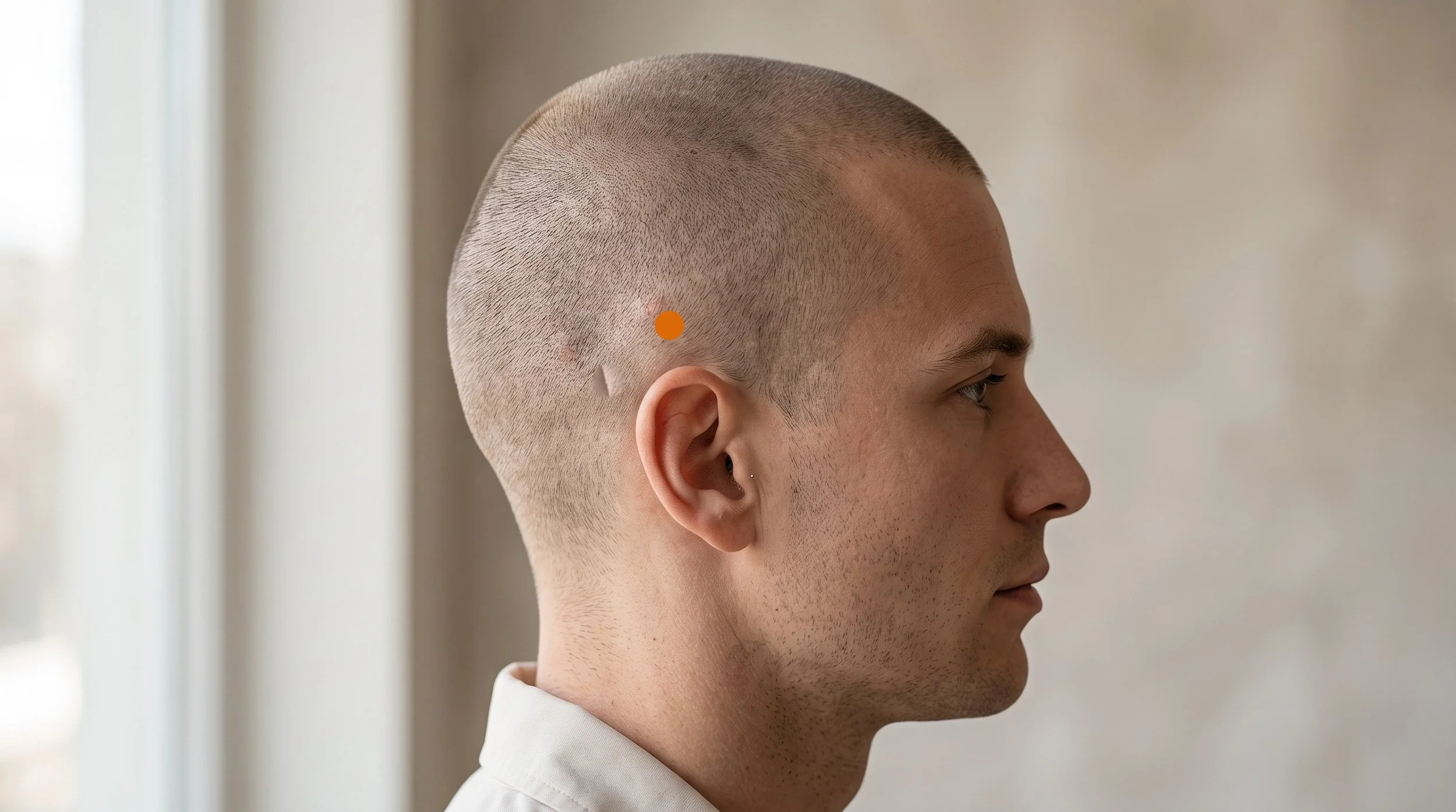
GB9 Acupuncture Point (Tianchong)
The Meeting Point Above and Behind the Ear: Anatomy, Mechanism, and Why GB9 Belongs in Temporal Headache and Calming Protocols
GB9, known in Chinese as Tianchong and usually translated as Heavenly Rushing or Celestial Hub, sits on the scalp above and slightly behind the ear, about half a cun behind GB8 in the shallow depression you can feel when your fingertips walk backward from the point directly above the ear apex. Gallbladder 9 is classified in the classical literature as a meeting point of the Gallbladder and Bladder channels, and it belongs to the arc of Gallbladder points that wraps around the ear like a hood.
Clinically it matters for two reasons that seem unrelated until you look at the anatomy: it lies over the upper border of the temporalis in territory served by the auriculotemporal and lesser occipital nerves, which makes it a practical local point for one-sided temporal head pain and ear region complaints, and the classical tradition assigned it a strongly calming role for fearfulness and fright palpitations.
This GB9 acupuncture point guide covers Tianchong point location, the tissue layers and nerve supply, how the traditional indications translate into modern pain science, and what the research on head point acupuncture actually supports.
- Location and layers: GB9 sits inside the hairline above and behind the ear, roughly 0.5 cun posterior to GB8, over skin, subcutaneous fat, the epicranial and temporoparietal fascia, the superior fibers of temporalis, and the periosteum of the skull, so the needle is threaded flat rather than driven downward.
- Traditional categories translated: classical texts list GB9 as a Gallbladder and Bladder channel meeting point that clears channel heat in the head and settles fright, which in modern terms describes a point positioned to modulate segmental input from a densely innervated cranial region and to influence arousal (Zhao, 2008).
- Nerve story: the point lies in an overlap zone of the auriculotemporal branch of the trigeminal nerve and the lesser occipital nerve from the cervical plexus, and trigeminal and upper cervical afferents converge on shared second order neurons in the trigeminocervical complex, which helps explain the referred and spreading quality of temporal head pain (Piovesan et al., 2003).
- Research picture: reviews test whole protocols rather than single points, and Cochrane reviews report that acupuncture may reduce headache days in episodic migraine and frequent tension-type headache (Linde et al., 2016a; Linde et al., 2016b), while individual patient data analysis of chronic pain trials found modest but persistent effects over sham and no acupuncture (Vickers et al., 2018).
- Clinical framing: at Morningside we use GB 9 head placement as a local point within a larger plan, typically alongside distal channel points, upper cervical work, and dry needling of temporalis when a taut band reproduces the patient's temple pain (Simons et al., 1999).
- De qi at GB9: because insertion is transverse under the scalp, the sensation is usually a spreading tightness, a dull pull, or a mild pressure that fans across the side of the head, not the deep grabbing ache people associate with points in thick limb muscle.
Stuck With One-Sided Head Pain That Sits Above Your Ear?
Temple pain that flares with stress, jaw clenching, and screen hours rarely comes from one structure alone. Our acupuncturists use GB9 and the neighboring Gallbladder points above the ear alongside upper neck and jaw treatment, so the local scalp input and the muscular drivers are addressed in the same visit. We track headache days, intensity, and triggers between sessions so you can see whether the plan is working. Schedule an evaluation and we'll map your pattern before we needle anything.
Schedule NowAnatomy of GB9: Why the Scalp Above and Behind the Ear Is Such an Important Location
From the surface down, a needle at GB9 passes through hair-bearing scalp, a firm subcutaneous layer bound tightly to the epicranial aponeurosis, then the temporoparietal fascia, and finally the upper fibers of the temporalis muscle and its tough overlying fascia before reaching the periosteum of the skull. The temporalis is a fan-shaped chewing muscle, and its superior fibers extend well up onto the side of the head, higher than most people expect.
Clenching, grinding, gum chewing, long hours at a screen with a jutted chin, and simple stress-related bracing all load this tissue repeatedly, which is one reason the region above and behind the ear so often feels tender to firm pressure in people with recurring temple headaches. The auricularis superior and posterior muscles and the mobile fascial sheet over the ear add to the local density of tissue in this small area.
The nerve geography here is the interesting part. GB9 sits in a border zone where the auriculotemporal nerve, a branch of the mandibular division of the trigeminal nerve, meets territory supplied by the lesser occipital nerve and the anastomotic reach of the greater occipital nerve from the upper cervical roots. Trigeminal and upper cervical afferents converge onto shared second order neurons in the trigeminocervical complex, and that convergence is the accepted anatomical basis for pain referring back and forth between the neck and the front and side of the head (Piovesan et al., 2003).
Needling into this territory generates a barrage of small fiber afferent input that engages spinal and brainstem inhibitory circuits, including descending pathways that release endogenous opioids, serotonin, and noradrenaline (Zhao, 2008). In plain terms, a well-placed scalp needle is a way of speaking to the same relay station that is already amplifying your temple pain.
Vascularly, the region is served by the posterior branch of the superficial temporal artery and the posterior auricular vessels, both of which run in the subcutaneous plane, and scalp vessels bleed readily because the tissue holds them open. That is why the convention at GB9 is transverse insertion of about 0.5 to 1.5 cun along the plane of the scalp rather than perpendicular needling, and why clinicians apply firm pressure with a clean cotton ball on withdrawal.
There are no deep viscera, lung apices, or great vessels at risk here, so the main practical concerns are bruising, brief bleeding, and needling comfortably above bone rather than into it. Hair makes clean palpation and clean insertion a matter of care, so the practitioner parts the hair, locates the depression by feel, and confirms landmarks against GB8 and the ear apex.
Related Gall Bladder Channel Related Dry Needling For Temporalis Trigger PointsGB9 at a Glance: Classification, Location, and Clinical Use
| Category | Detail |
|---|---|
| Traditional Name | Tianchong (Heavenly Rushing, also rendered Celestial Hub or Penetrating Heaven), Gallbladder 9 |
| Channel Classification | Gallbladder channel of Foot Shaoyang, ninth point, in the arc of Gallbladder points that wraps above and behind the ear |
| Point Categories | Meeting (crossing) point of the Gallbladder and Bladder channels. Discussed by some commentators as a candidate Window of Heaven point representing the Shaoyang channel, though it is not part of the standard five-point list. |
| Precise Location | On the temporal scalp within the hairline, in the depression 0.5 cun posterior to GB8, roughly 2 cun inside the hairline directly above the posterior border of the auricle. GB8 itself sits directly above the ear apex. |
| Tissue Stimulated | Scalp, epicranial and temporoparietal fascia, superior fibers of temporalis, auricularis superior region, and periosteum of the skull, in auriculotemporal and lesser occipital nerve territory |
| Needle Depth / Direction | Transverse (subcutaneous) insertion 0.5 to 1.5 cun along the plane of the scalp, usually angled posteriorly or toward the area of complaint. No perpendicular deep needling. |
| De Qi Sensation | A spreading tightness or dull pull under the scalp, sometimes a warm or heavy sensation across the temple and above the ear. Sharpness usually means the needle is too superficial in the dermis and should be adjusted. |
| Primary Clinical Uses | Temporal and one-sided headache, tension across the side of the head, ear region complaints including tinnitus and itching of the ear in classical use, gum swelling and toothache in classical use, and fearfulness with palpitations in classical spirit-calming use |
| Common Point Combinations |
|
In A Manual of Acupuncture, Deadman and colleagues frame GB9 as a point that traditionally clears heat from the Gallbladder channel and settles the spirit, with an indication list that runs in two directions at once. One direction is regional and physical: head pain, ringing or damp itching in the ear, toothache with swollen painful gums, and swellings of the throat region. The other is emotional and neurological: a tendency toward fear and fright, palpitations that come with startle, seizures, tetany, and mania.
The commentary also revisits an old textual puzzle. Chapter 2 of the Spiritual Pivot lists a group of points related to the five Window of Heaven points, and later commentators, including the Ming physician Ma Shi, argued that one entry attributed to the Shaoyang channel was misidentified and that GB9 belongs in that group instead, which would give each of the six yang channels a representative. These points share a traditional theme of restoring communication between head and body, treating the sense organs, and addressing emotional disturbance.
What is striking is how consistently the classical sources pair a purely local head symptom list with a fright-calming role, as if the tradition had noticed that the same spot on the head served both jobs.
Why GB9 Is Used for Fearfulness and Fright Palpitations, Not Just Headache
Start with the pain side, because it is the more concrete of the two. The tissue under GB9 is innervated by branches of the trigeminal and upper cervical systems, and those two inputs share second order neurons in the trigeminocervical complex. That shared relay is why neck problems refer pain into the temple and why temple problems can feel like they start behind the ear (Piovesan et al., 2003).
Needling into a segment that already feeds that relay adds competing non-painful and small fiber input, which is one plausible route by which a local scalp needle changes how a headache is being processed rather than simply numbing tissue.
Beyond the segment, needling recruits descending inhibitory control from the brainstem, with endogenous opioid, serotonergic, and noradrenergic mechanisms all implicated in experimental work on acupuncture analgesia (Zhao, 2008). Those same brainstem systems sit close to circuits that regulate arousal and autonomic tone, which is the most reasonable modern account of why a point traditionally described as settling fright can leave a patient feeling calmer and less reactive after a session.
Patients often report drowsiness and a slowed breathing rate during retention, and that shift is real even though the mechanism is general rather than unique to one point.
It is worth being clear about limits. There are no clinical trials that isolate GB9 for anxiety or for tinnitus, so the classical indications remain traditional attributions rather than tested claims. What the broader literature supports is that acupuncture protocols including head and neck points may reduce headache burden (Linde et al., 2016a; Linde et al., 2016b), that anxiety trials show benefit with meaningful methodological caveats (Yang et al., 2021), and that tinnitus reviews report positive signals from generally low quality evidence (Xu et al., 2022). GB9 is a sensible contributor to those protocols, not a stand-alone answer.
What the Research Shows for GB9
No trial has tested Tianchong on its own, and that is true for nearly every individual acupuncture point. Studies test protocols, usually eight to twenty sessions of a multi-point prescription delivered by trained clinicians, and GB9 appears inside such protocols as one of several local head points chosen by pain location. The reasonable way to read the table below is as evidence about the kind of treatment GB9 participates in, with the point contributing local segmental input while distal points and neck work carry other parts of the effect.
Effect sizes in this literature are modest, sham comparisons remain genuinely difficult in needling research, and quality varies widely between condition areas.
| Study | Type | Focus | Key Finding |
|---|---|---|---|
| Linde et al., 2016a | Cochrane systematic review | Acupuncture for prevention of episodic migraine | Adding acupuncture to usual care may reduce headache frequency, with effects at least comparable to prophylactic drug treatment on moderate quality evidence. |
| Linde et al., 2016b | Cochrane systematic review | Acupuncture for prevention of tension-type headache | A course of at least six sessions may be a worthwhile option for people with frequent tension-type headache, with small effects over sham. |
| Vickers et al., 2018 | Individual patient data meta-analysis | Chronic pain including chronic headache | Acupuncture was better than sham and no-acupuncture controls, with benefits that decayed only modestly over twelve months. |
| Piovesan et al., 2003 | Narrative anatomical and physiological review | Convergence of cervical and trigeminal afferents | Shared relay neurons explain why head pain spreads across trigeminal and upper cervical territories, supporting local treatment of the temporal scalp. |
| Zhao, 2008 | Mechanistic review | Neural mechanisms of acupuncture analgesia | Needling engages segmental inhibition and descending opioid, serotonergic, and noradrenergic control rather than a single local effect. |
| Xu et al., 2022 | Overview of systematic reviews | Acupuncture for tinnitus | Most included reviews reported benefit, but methodological and evidence quality were generally low, so conclusions stay tentative. |
| Yang et al., 2021 | Systematic review and meta-analysis | Acupuncture for anxiety disorder | Pooled results suggested reduced anxiety symptoms compared with controls, with the authors calling for higher quality trials. |
Feeling Wired, Startled, and Unable to Settle?
The classical texts attached GB9 to fearfulness and fright palpitations, and modern practice uses calming head points as part of a broader autonomic downshift strategy. Sessions at Morningside combine gentle scalp needling with points chosen for sleep, breathing, and muscle guarding, in a quiet room where you can actually rest for the retention time. Many patients describe the treatment itself as the most parasympathetic thirty minutes of their week. Book a visit and let's build a plan around your nervous system, not just your symptoms.
Schedule NowGB9 in the Context of Trigger Point Work
Acupuncture is defined by the tool, an acupuncture needle, and it covers hundreds of styles including dry needling. That matters at GB9 because the point sits over the upper edge of the temporalis, a muscle whose trigger points refer pain into the temple, the eyebrow, behind the eye, and into the upper teeth, a referral map that overlaps almost exactly with the classical indication list for this region (Simons et al., 1999).
When a patient's temple headache is reproduced by firm pressure on a taut band in temporalis, we treat the muscle directly with fine monofilament needling while also using GB9 and GB8 as channel-based local points along the same arc.
In a typical Morningside session for one-sided head pain we combine three layers. Locally, GB9 threaded flat under the scalp plus temporalis dry needling addresses the tissue that hurts. Regionally, suboccipital and upper trapezius needling with GB20 addresses the cervical half of the trigeminocervical convergence story. Distally, points such as LI4, LV3, or GB34 are added when the presentation calls for them.
Patients are told to expect possible post-needling soreness in the chewing muscles for a day, and we pair the needling with jaw habit coaching, since clenching will keep reloading the tissue no matter how good the treatment is.
GB9 Headache Treatment at NYC's Highest-Rated Acupuncture Clinic
Morningside Acupuncture is the highest-rated acupuncture and dry needling clinic in New York City with over 500 five-star Google reviews, and headache care is one of the things we do most. Our licensed acupuncturists blend classical point selection like GB9 and GB20 with orthopedic assessment and trigger point needling of temporalis, masseter, and the suboccipitals. You get a clear plan, measurable goals, and honest talk about what acupuncture can and cannot do. Schedule your first session and start tracking fewer headache days.
Schedule NowFrequently Asked Questions
What does GB9 feel like when needled?
Because GB9 is needled transversely under the scalp rather than straight down, most people feel a brief pinch as the needle passes the skin, then a spreading tightness or dull pull across the side of the head. Some describe warmth or a mild heaviness above the ear. If the sensation is sharp or burning, the needle is usually sitting too superficially and your acupuncturist will adjust it. Scalp needling is generally well tolerated, and many patients become drowsy during the retention period.
Why needle the scalp above the ear when my pain feels deeper inside my head?
Head pain rarely comes from where it seems to come from. The temporal scalp is supplied by the auriculotemporal and lesser occipital nerves, and those inputs converge with trigeminal afferents on shared neurons in the brainstem, which is why pain refers and spreads across the side of the head (Piovesan et al., 2003). Needling into that segment adds input to the same relay that is amplifying the pain, and it also recruits broader descending inhibition (Zhao, 2008). That is the modern reasoning behind treating locally at GB9 while also using distal points and neck work.
Can I press GB9 myself between sessions?
Yes, and it is easy to find. Part your hair above the ear, place a fingertip directly above the ear apex, then slide back about a finger's width until you feel a slight depression and, often, a tender spot. Press with the pad of your index or middle finger using steady, moderate pressure for 30 to 60 seconds, then release, and repeat two or three times on each side. Small slow circles work as well as static pressure. Two or three short rounds a day is plenty. Keep pressure firm but comfortable, stop if it makes a headache worse, and skip it entirely over broken skin, recent scalp injury, or any area you have been told not to touch by a physician.
Is GB9 safe to needle?
In trained hands it is a low-risk point. There are no organs, lung tissue, or major vessels at needling depth, and the transverse insertion convention keeps the needle in the scalp plane. The realistic risks are bruising and brief bleeding, since scalp vessels are superficial and bleed readily, so practitioners apply firm pressure on withdrawal. Tell your acupuncturist if you take blood thinners, have had recent head or scalp surgery, have a cranial implant or shunt, or have any scalp skin condition, and expect the point to be modified or skipped in those situations.
Where exactly is GB9 located?
GB9 is on the temporal scalp inside the hairline, in the depression roughly 0.5 cun behind GB8. GB8 is located directly above the apex of the ear, and GB9 sits above the posterior border of the ear, about 2 cun inside the hairline in standard descriptions. The simplest way to find Tianchong point location on yourself is to fold the ear forward, mark the highest point of the ear, move straight up into the hairline for GB8, then move back one finger width to land in the small dip that is GB9. It is usually tender to press in people with temporal headaches.
References
- Deadman, P., Al-Khafaji, M., & Baker, K. (2009). A manual of acupuncture. Journal of Chinese Medicine Publications.
- Cunningham, P. M. (2000). Acupuncture points: A practical guide to classical and modern usage. Odyssey Press.
- Maciocia, G. (2006). The channels of acupuncture: Clinical use of the secondary channels and eight extraordinary vessels. Churchill Livingstone Elsevier.
- Simons, D. G., Travell, J. G., & Simons, L. S. (1999). Travell & Simons' myofascial pain and dysfunction: The trigger point manual, Vol. 1: Upper half of body (2nd ed.). Williams & Wilkins.
- Linde, K., Allais, G., Brinkhaus, B., Fei, Y., Mehring, M., Vertosick, E. A., Vickers, A., & White, A. R. (2016a). Acupuncture for the prevention of episodic migraine. Cochrane Database of Systematic Reviews, 2016(6), CD001218. https://doi.org/10.1002/14651858.CD001218.pub3
- Linde, K., Allais, G., Brinkhaus, B., Fei, Y., Mehring, M., Shin, B. C., Vickers, A., & White, A. R. (2016b). Acupuncture for the prevention of tension-type headache. Cochrane Database of Systematic Reviews, 2016(4), CD007587. https://doi.org/10.1002/14651858.CD007587.pub2
- Vickers, A. J., Vertosick, E. A., Lewith, G., MacPherson, H., Foster, N. E., Sherman, K. J., Irnich, D., Witt, C. M., & Linde, K. (2018). Acupuncture for chronic pain: Update of an individual patient data meta-analysis. Journal of Pain, 19(5), 455-474. https://doi.org/10.1016/j.jpain.2017.11.005
- Zhao, Z. Q. (2008). Neural mechanism underlying acupuncture analgesia. Progress in Neurobiology, 85(4), 355-375. https://doi.org/10.1016/j.pneurobio.2008.05.004
- Piovesan, E. J., Kowacs, P. A., & Oshinsky, M. L. (2003). Convergence of cervical and trigeminal sensory afferents. Current Pain and Headache Reports, 7(5), 377-383. https://doi.org/10.1007/s11916-003-0037-x
- Xu, X., Xie, H., Liu, Z., Guo, T., & Zhang, Y. (2022). Effects of acupuncture on the outcome of tinnitus: An overview of systematic reviews. Frontiers in Neurology, 13, 1061431. https://doi.org/10.3389/fneur.2022.1061431
- Yang, X. Y., Yang, N. B., Huang, F. F., Ren, S., & Li, Z. J. (2021). Effectiveness of acupuncture on anxiety disorder: A systematic review and meta-analysis of randomised controlled trials. Annals of General Psychiatry, 20, 9. https://doi.org/10.1186/s12991-021-00327-5
Disclaimer: This web site is intended for educational and informational purposes only. Reading this website does not constitute providing medical advice or any professional services. This information should not be used for diagnosing or treating any health issue or disease. Those seeking medical advice should consult with a licensed physician. Seek the advice of a medical doctor or other qualified health professional for any medical condition. If you think you have a medical emergency, call 911 or go to the emergency room. No acupuncturist-patient relationship is created by reading this website or using the information. Morningside Acupuncture PLLC and its employees and contributors do not make any express or implied representations with respect to the information on this site or its use. For any legal interpretation of scope of practice in your state, consult a licensed attorney or regulatory authority.
Read more from our blog



