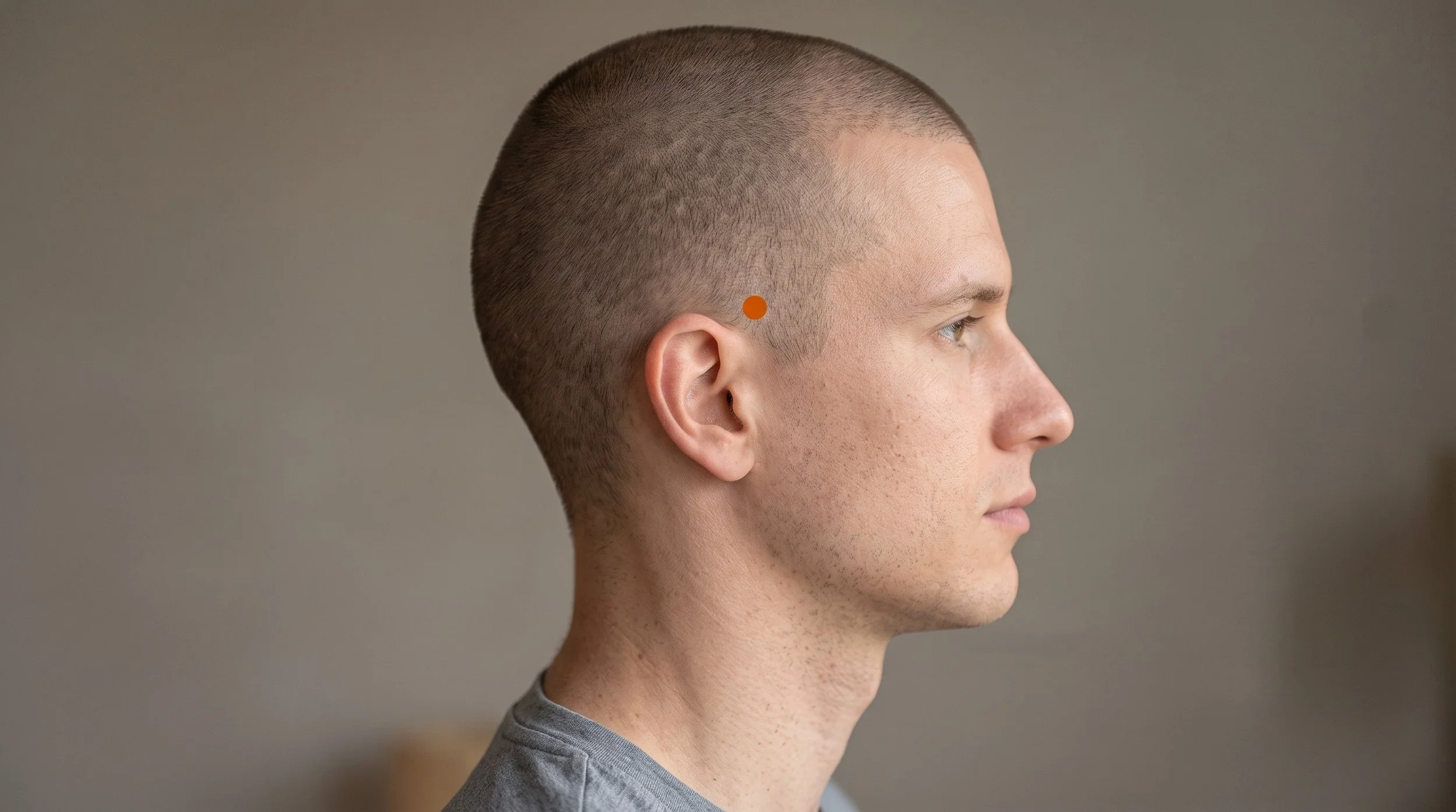
GB7 Acupuncture Point (Qubin)
The Crook of the Temple: Anatomy, Mechanism, and Why the Rearmost Temple Point Bridges Headache and Jaw Pain
GB7, known in Chinese as Qubin and usually translated as Crook of the Temple, sits in the temporal hairline just in front of the ear, roughly one finger-breadth forward of SJ20 and level with the apex of the folded ear. It is the last stop on the arc of Gallbladder points that curves across the side of the head, and it is classically listed as a meeting point of the Gallbladder and Bladder channels (Deadman et al., 2009). Clinically it matters because of where it lands: on the posterior fibers of the temporalis muscle, inside auriculotemporal nerve territory, close to the neural real estate that serves the jaw.
That combination is why the GB7 acupuncture point shows up in treatment plans for temporal headache, clenching and jaw tension, and stubborn neck stiffness that flares with head turning.
- Location and layers: Qubin sits within the temporal hairline about one finger-breadth anterior to SJ20, which itself is level with the ear apex when the ear is folded forward (Deadman et al., 2009). Under the needle are thin scalp, a mobile subcutaneous layer carrying superficial temporal vessels, the temporalis fascia, and the posterior fibers of the temporalis muscle over the squamous temporal bone.
- Traditional attribution: classical sources group GB7 as a crossing point of the Gallbladder and Bladder channels and describe its action as dispelling wind and benefiting the mouth and jaw, with indications spanning headache, cheek and submandibular swelling, lockjaw, speech loss and mouth or eye deviation (Deadman et al., 2009; Kim, 2008). Modern texts add temporal muscle spasm, toothache, stiff neck and eye complaints to the same picture (Cunningham, 2000).
- Mechanism: the point lies in trigeminal (auriculotemporal, V3) territory, so needling here feeds sensory input into the trigeminocervical complex, where facial, dural and upper cervical afferents converge, and into descending pain-modulating pathways that are well described in the acupuncture analgesia literature (Zhao, 2008).
- Research picture: no trial isolates GB 7 temple needling on its own, but Cochrane reviews report that acupuncture protocols including temporal and Gallbladder channel points may reduce migraine and tension-type headache frequency compared with usual care or sham, with modest and variable effect sizes (Linde et al., 2016a; Linde et al., 2016b).
- Jaw and facial pain evidence is mixed rather than settled: a network meta-analysis of needling for masticatory muscle pain found no clear advantage over comparators for pain, though dry needling showed short-term gains in mouth opening (Al-Moraissi et al., 2023), while a later review of acupuncture for temporomandibular disorders reported short-term relief in muscle-origin pain (Di Francesco et al., 2024).
- De qi at GB7 is usually a spreading fullness or dull pressure across the temple rather than a sharp jolt, since the needle is laid flat under the scalp; some patients notice a tug that travels toward the ear or the back teeth, and post-needling tenderness for a day is common and expected.
Temple Headaches That Start in Your Jaw?
Many of the headache patients we see on the Upper West Side describe pain that sits above and in front of the ear, worsens by late afternoon, and tracks with clenching or a stressful week. At Morningside Acupuncture we use GB7 with the neighboring temple points and dry needling of the temporalis and masseter to reduce muscle tone and calm the trigeminal input that keeps the pattern going. We also look at the neck, since upper cervical tension often drives the same headache. Schedule a visit and we will map where your headache actually starts.
Schedule NowAnatomy of GB7: Why the Temporal Hairline Is Such an Important Location
The tissue at Qubin is shallow and layered. Skin over the temple is thin and mobile, sitting on a loose subcutaneous plane that carries branches of the superficial temporal artery and vein. Beneath that lies the tough temporalis fascia and then the posterior fibers of the temporalis itself, a broad fan-shaped elevator of the mandible that arises across the temporal fossa and funnels down to the coronoid process. Because the skull sits directly under this thin muscle, there is very little depth available, which is exactly why the point is needled flat.
Anything that loads the temporalis loads GB7: sustained clenching, nocturnal bruxism, heavy chewing, long hours of jaw-forward desk posture, and the low-grade guarding that follows dental work or orthodontic changes.
Sensory supply here comes largely from the auriculotemporal nerve, a branch of the mandibular division of the trigeminal nerve, and the same mandibular division supplies the deep temporal nerves that drive the temporalis. That anatomy explains a lot of the point's classical reputation for jaw and mouth complaints.
Trigeminal afferents from the face, teeth, temporomandibular joint and cranial vasculature converge with upper cervical afferents in the trigeminocervical complex of the brainstem, which is a well recognized reason why jaw problems refer to the temple, why neck tension shows up as head pain, and why needling one region can change symptoms in another. Needle stimulation at points like GB7 recruits small-diameter afferents that engage segmental gating and descending inhibitory pathways involving endogenous opioid and monoaminergic systems (Zhao, 2008).
Trigger point work in the anterior and posterior temporalis is known to refer pain into the temple, eyebrow and upper teeth, which overlaps neatly with the classical indication list (Simons et al., 1999).
The structure to respect is vascular rather than visceral. The superficial temporal artery and its parietal branch run through the subcutaneous plane of the temple, and scalp tissue bleeds readily, so bruising is the most common minor event at this location. Standard practice is transverse insertion of 0.5 to 1.5 cun along the scalp rather than perpendicular needling (Deadman et al., 2009), with shallower subcutaneous technique of about 0.3 to 0.5 cun described in other texts (Kim, 2008).
Clean technique, palpation to avoid a visible or pulsating vessel, and firm post-needle pressure for a few seconds keep the point straightforward and safe in trained hands.
Related Acupuncture For Temporalis Muscle Pain Related Best Acupuncture Points For HeadachesGB7 at a Glance: Classification, Location, and Clinical Use
| Category | Detail |
|---|---|
| Traditional Name | Qubin (Crook of the Temple), Gallbladder 7 |
| Channel Classification | Gallbladder channel (Foot Shaoyang), seventh point, temporal region |
| Point Categories | Meeting (crossing) point of the Gallbladder and Bladder channels; grouped with GB4, GB5, GB6 and ST8 as a temporal point of the Eye System in Maciocia's channel commentary |
| Precise Location | In the temporal region within the hairline, level with and one finger-breadth anterior to SJ20, which sits level with the apex of the ear when the ear is folded forward |
| Tissue Stimulated | Scalp and subcutaneous tissue, temporalis fascia, and the posterior fibers of the temporalis muscle over the squamous temporal bone, in auriculotemporal nerve and superficial temporal artery territory |
| Needle Depth / Direction | Transverse (subcutaneous) insertion 0.5 to 1.5 cun along the scalp, angled toward the intended point of the temple arc; never perpendicular to depth |
| De Qi Sensation | Dull spreading fullness, pressure or a mild tugging across the temple, sometimes travelling toward the ear, jaw hinge or upper teeth; brief local tenderness afterward is common |
| Primary Clinical Uses | Temporal headache and migraine patterns, jaw clenching and temporomandibular tension, cheek and jaw swelling in classical use, stiff neck with difficulty turning the head, and facial imbalance patterns such as deviation of the mouth and eye in classical use |
| Common Point Combinations |
|
In Deadman, Al-Khafaji and Baker's A Manual of Acupuncture, GB7 is presented as a meeting point of the Gallbladder and Bladder channels whose traditional action is to dispel wind and benefit the mouth and jaw. The indications recorded there fall into three groups: head pain and swelling around the cheek and submandibular region, functional problems of the mouth including lockjaw, loss of speech and deviation of the mouth and eye, and a smaller cluster covering vomiting and stiff neck with inability to turn the head.
Two classical combinations are attributed to the Thousand Ducat Formulas, one pairing GB7 with ST42 for tooth decay and one grouping GB7 with SI16, SJ6, LI18 and HT4 for sudden loss of voice. What makes the pattern striking is its coherence with anatomy: a point on the temple, described centuries before nerve mapping, is credited almost entirely with problems of the jaw, teeth, mouth and voice, precisely the territory served by the mandibular division of the trigeminal nerve.
Why GB7 Is Used for Jaw Clenching, Toothache and Facial Tension
It surprises many patients that a point above the ear is chosen for symptoms in the jaw and teeth. The explanation is neurological rather than mystical. GB7 sits in auriculotemporal nerve territory, a branch of the same mandibular nerve division that supplies the temporalis muscle, the temporomandibular joint capsule and the lower teeth. Sensory information from all of those structures converges on shared second-order neurons in the trigeminocervical complex, so stimulating one part of the territory can change how the whole territory is processed.
The temporalis is also a genuine pain generator in its own right: taut bands in its fibers refer pain into the temple, the eyebrow and the upper teeth, a referral map that reads almost like the classical indication list for this point (Simons et al., 1999).
Beyond the local segment, needling recruits descending inhibitory pathways from the brainstem that dampen nociceptive transmission using endogenous opioids, serotonin and noradrenaline, which is the best characterized mechanism behind acupuncture analgesia (Zhao, 2008). There are local effects too. Needle insertion produces small axon reflex changes in blood flow and can reduce the resting tone of a guarded muscle, which matters when the temporalis has been clenching all night.
A randomized trial of scalp acupuncture in patients with temporomandibular disorders reported short-term improvements in pain and quality of life, offering some direct support for needling the temporal region in jaw complaints, though the sample was small and follow-up brief (Peixoto et al., 2021).
Clinically, we treat GB7 as one input among several rather than a stand-alone solution. It is comfortable, quick to needle, and easy to combine with neck and jaw work, which makes it a practical anchor in headache and clenching protocols. Patients who respond typically notice a softening of temple pressure and easier jaw opening across a series of sessions rather than after a single visit.
What the Research Shows for GB7
There is no trial that tests GB7 by itself, and readers should be cautious about any claim that a single point drives an outcome. What the literature offers instead is evidence about multi-point protocols for the conditions this point is used within, and mechanistic work explaining how needle stimulation modulates pain. GB7 appears inside temple-region protocols for migraine and tension-type headache, and inside needling approaches to masticatory muscle pain, so the reviews below describe the company it keeps rather than the point in isolation.
| Study | Type | Focus | Key Finding |
|---|---|---|---|
| Linde et al., 2016a | Cochrane systematic review | Acupuncture for the prevention of episodic migraine | Acupuncture added to usual care may reduce migraine frequency, with a small additional benefit over sham and effects at least comparable to prophylactic drugs in the included trials. |
| Linde et al., 2016b | Cochrane systematic review | Acupuncture for the prevention of tension-type headache | Acupuncture may reduce the frequency of frequent episodic or chronic tension-type headache, though differences from sham needling were small. |
| Vickers et al., 2018 | Individual patient data meta-analysis | Chronic pain including headache and musculoskeletal pain | Acupuncture was associated with modest but persistent improvements over both sham and no-acupuncture controls across chronic pain conditions. |
| Al-Moraissi et al., 2023 | Network meta-analysis of randomized trials | Acupuncture and dry needling for masticatory muscle pain | The analysis did not demonstrate a clear pain-reducing advantage over comparators, although dry needling showed short-term improvement in maximal mouth opening. |
| Di Francesco et al., 2024 | Systematic review and meta-analysis | Acupuncture and laser acupuncture for temporomandibular disorders | Included trials suggested short-term reduction in pain severity for muscle-origin temporomandibular disorder, with evidence quality limiting firm conclusions. |
| Peixoto et al., 2021 | Randomized clinical trial | Scalp acupuncture in temporomandibular disorders | Short-term improvements in pain and quality of life were reported, though the trial was small and follow-up was brief. |
| Zhao, 2008 | Narrative review of mechanisms | Neural mechanisms of acupuncture analgesia | Needle stimulation activates segmental spinal gating and descending inhibitory systems mediated by opioid and monoaminergic pathways. |
Jaw Clenching, Tightness, and Limited Opening?
Jaw complaints rarely live in the joint alone; the temporalis, masseter and pterygoids usually carry the load. GB7 gives us a comfortable, well tolerated entry into the posterior temporalis, and we pair it with local jaw points, cervical work, and home strategies for clenching. Treatment is gradual and cumulative rather than instant, and most patients notice change over a short series. Book a session and let us assess your jaw mechanics directly.
Schedule NowGB7 in the Context of Trigger Point Work
GB7 sits directly over the posterior fibers of the temporalis, which places it within one of the most clinically useful myofascial targets in the head. Taut bands in this muscle refer pain into the temple, above the eye and into the upper teeth, a pattern that patients often describe as a headache and a toothache at the same time (Simons et al., 1999).
At Morningside Acupuncture we frequently begin with the classical transverse GB7 insertion, then palpate the temporalis systematically from its anterior border near ST8 to its posterior fibers behind the point, needling any tender bands we reproduce symptoms in. Because the muscle is thin and lies on bone, we use shallow, precise technique and avoid vigorous manipulation over visible vessels.
Temporalis work rarely stands alone. Clenching patterns almost always involve the masseter, and jaw pain patients often have upper cervical and suboccipital involvement that keeps the trigeminocervical system sensitized, so we commonly add needling of the masseter, upper trapezius and suboccipital group along with GB20 and cervical points.
Evidence for needling masticatory muscles is encouraging but not conclusive, with reviews reporting short-term functional gains and inconsistent effects on pain (Al-Moraissi et al., 2023), so we set expectations around a short series of visits, combine needling with jaw habit retraining and sleep strategies, and measure progress by opening range and headache days rather than by a single session's response.
GB7 Headache and Jaw Treatment at NYC's Highest-Rated Acupuncture Clinic
Morningside Acupuncture is the highest-rated acupuncture and dry needling clinic in New York City with over 500 five-star Google reviews, and head, jaw and neck pain are among the most common reasons patients come to us. We combine classical point selection like GB7 with orthopedic assessment and trigger point needling of the muscles that actually reproduce your symptoms. Every plan is built around your presentation, not a template. Schedule your appointment and start with a thorough evaluation.
Schedule NowFrequently Asked Questions
What does GB7 feel like when needled?
Because the needle is laid flat under the scalp rather than pushed deep, most people feel a brief pinch at insertion, then a spreading fullness or pressure across the temple. Some notice a light tug that travels toward the ear, the jaw hinge or the upper back teeth, which usually signals that the temporalis is involved. The sensation typically eases within a minute or two. Mild tenderness at the site for a day afterward is normal, and occasional small bruises happen because scalp tissue is well supplied with blood vessels.
Why needle the temple for jaw and tooth symptoms instead of the jaw itself?
GB7 lies in auriculotemporal nerve territory, part of the mandibular division of the trigeminal nerve, which is the same division that supplies the temporalis muscle, the jaw joint and the lower teeth. Sensory input from all of those structures converges in the trigeminocervical complex of the brainstem, so a stimulus at the temple can influence how the whole region is processed (Zhao, 2008). The temporalis also refers pain directly into the teeth and temple (Simons et al., 1999). In practice we do treat the jaw as well; GB7 simply adds a comfortable access point into the same neural neighborhood.
Can I press GB7 myself between sessions?
Yes, and it is one of the easier points to self-treat. Fold your ear forward so the top of the helix folds over on itself, note the level of the ear apex, then move about one finger-breadth forward into the hairline, just above and in front of the ear. Press with a fingertip using steady, moderate pressure for 30 to 60 seconds, then make small circles for another 30 seconds, and repeat on both sides. Two or three rounds per session, once or twice a day, is plenty. Clenching your teeth lightly will make the temporalis pop up under your finger and help you find the tender spots. Stop if pressure sharply increases a headache, and skip the area entirely if the skin is broken or inflamed.
Is GB7 safe to needle?
In trained hands it is a low-risk point. The convention is transverse insertion of 0.5 to 1.5 cun along the scalp rather than perpendicular needling, which keeps the needle in the superficial layers over bone (Deadman et al., 2009). The main consideration is vascular: branches of the superficial temporal artery and vein run through the subcutaneous plane, so practitioners palpate for pulsation, avoid visible vessels, and apply pressure after withdrawal. Bruising is the most common minor effect. Patients on anticoagulants, those with local skin infection, or anyone with a recent head injury or surgical hardware in the area should tell their practitioner in advance.
Where exactly is GB7 located?
For Qubin point location, start at SJ20, which sits directly level with the apex of the ear when the ear is folded forward so that the back of the upper helix covers the front of it, taking care not to shove the whole ear forward. From SJ20, move one finger-breadth anteriorly, staying within the temporal hairline. That spot is GB7, the rearmost of the temple arc points, sitting on the posterior fibers of the temporalis. If you clench your teeth gently you should feel the muscle bulge under your fingertip, which confirms you are in the right layer.
References
- Deadman, P., Al-Khafaji, M., & Baker, K. (2009). A manual of acupuncture. Journal of Chinese Medicine Publications.
- Kim, H. (2008). Handbook of Oriental medicine (3rd ed.). Harmony & Balance Press.
- Cunningham, P. M. (2000). Acupuncture points: A practical guide to classical and modern usage. Odyssey Press.
- Maciocia, G. (2005). The foundations of Chinese medicine: A comprehensive text for acupuncturists and herbalists (2nd ed.). Elsevier Churchill Livingstone.
- Simons, D. G., Travell, J. G., & Simons, L. S. (1999). Travell & Simons' myofascial pain and dysfunction: The trigger point manual, Vol. 1: Upper half of body (2nd ed.). Williams & Wilkins.
- Linde, K., Allais, G., Brinkhaus, B., Fei, Y., Mehring, M., Vertosick, E. A., Vickers, A., & White, A. R. (2016a). Acupuncture for the prevention of episodic migraine. Cochrane Database of Systematic Reviews, 2016(6), CD001218. https://doi.org/10.1002/14651858.CD001218.pub3
- Linde, K., Allais, G., Brinkhaus, B., Fei, Y., Mehring, M., Shin, B.-C., Vickers, A., & White, A. R. (2016b). Acupuncture for the prevention of tension-type headache. Cochrane Database of Systematic Reviews, 2016(4), CD007587. https://doi.org/10.1002/14651858.CD007587.pub2
- Vickers, A. J., Vertosick, E. A., Lewith, G., MacPherson, H., Foster, N. E., Sherman, K. J., Irnich, D., Witt, C. M., & Linde, K. (2018). Acupuncture for chronic pain: Update of an individual patient data meta-analysis. Journal of Pain, 19(5), 455-474. https://doi.org/10.1016/j.jpain.2017.11.005
- Zhao, Z. Q. (2008). Neural mechanism underlying acupuncture analgesia. Progress in Neurobiology, 85(4), 355-375. https://doi.org/10.1016/j.pneurobio.2008.05.004
- Al-Moraissi, E. A., Goddard, G., & Christidis, N. (2023). Are acupuncture and dry needling effective in the management of masticatory muscle pain: A network meta-analysis of randomised clinical trials. Journal of Oral Rehabilitation, 50(1), 87-97. https://doi.org/10.1111/joor.13382
- Di Francesco, F., Minervini, G., Siurkel, Y., Cicciù, M., & Lanza, A. (2024). Efficacy of acupuncture and laser acupuncture in temporomandibular disorders: A systematic review and meta-analysis of randomized controlled trials. BMC Oral Health, 24(1), 174. https://doi.org/10.1186/s12903-023-03806-1
- Peixoto, K. O., da Silva Bezerra, A., Melo, R. A., de Resende, C. M. B. M., de Almeida, E. O., & Barbosa, G. A. S. (2021). Short-term effect of scalp acupuncture on pain, sleep disorders, and quality of life in patients with temporomandibular disorders: A randomized clinical trial. Pain Medicine, 22(4), 905-914. https://doi.org/10.1093/pm/pnab048
Disclaimer: This web site is intended for educational and informational purposes only. Reading this website does not constitute providing medical advice or any professional services. This information should not be used for diagnosing or treating any health issue or disease. Those seeking medical advice should consult with a licensed physician. Seek the advice of a medical doctor or other qualified health professional for any medical condition. If you think you have a medical emergency, call 911 or go to the emergency room. No acupuncturist-patient relationship is created by reading this website or using the information. Morningside Acupuncture PLLC and its employees and contributors do not make any express or implied representations with respect to the information on this site or its use. For any legal interpretation of scope of practice in your state, consult a licensed attorney or regulatory authority.
Read more from our blog



