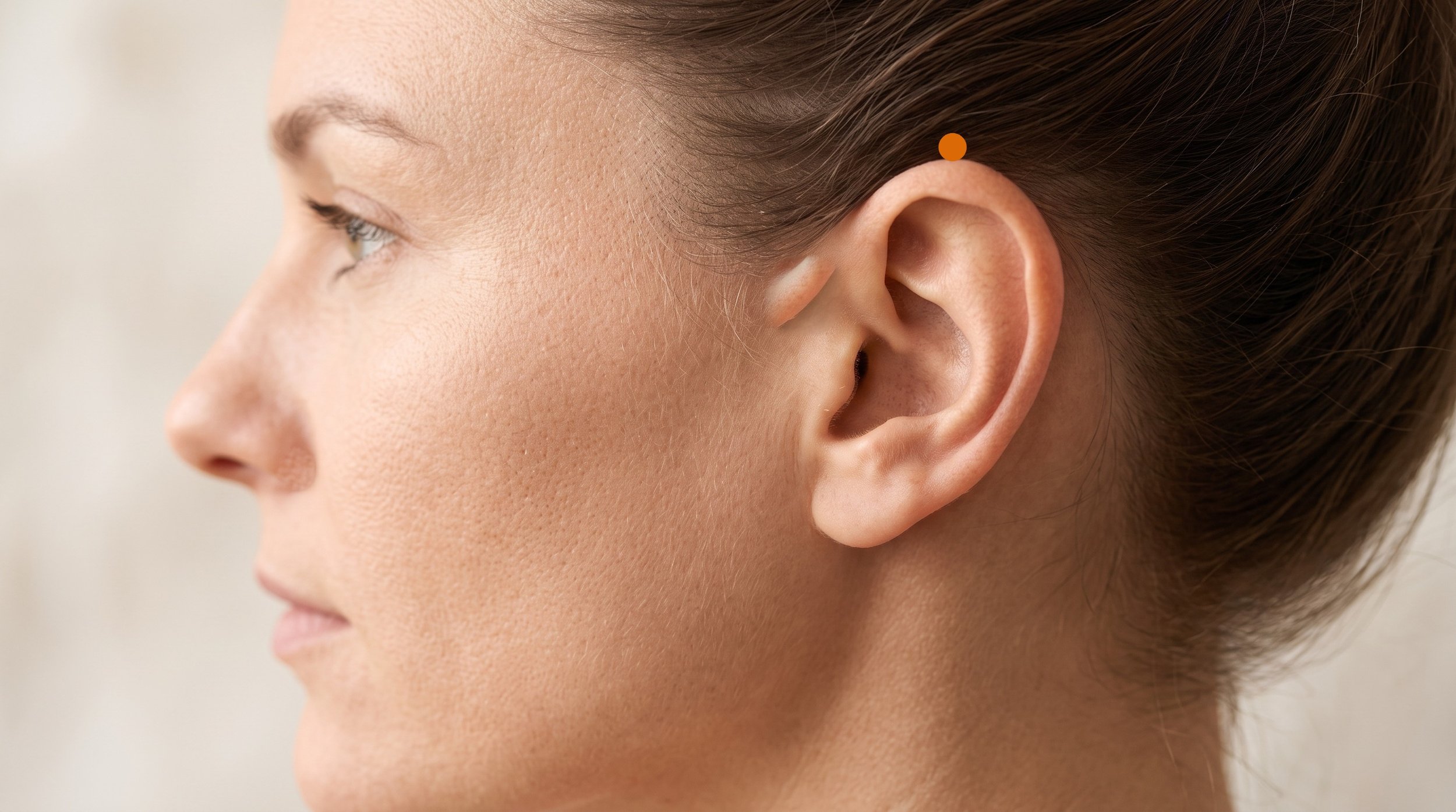
SJ20 Acupuncture Point (Jiaosun)
The Minute Angle Above the Ear: Anatomy, Mechanism, and Why This Temporal Scalp Point Belongs in Ear, Jaw, and Toothache Treatment
SJ20, known in Chinese as Jiaosun and usually translated as Minute Angle, is the twentieth point of the Triple Burner channel (you will also see it written as TE20 or TB-20). To find it, fold the ear forward against the head and mark the scalp directly level with the top of the folded ear, just inside the hairline over the temporalis muscle.
Classically it is described as a place where the Triple Burner, Small Intestine and Gallbladder channels meet, and its recorded indications cluster tightly around the same side of the head: the ear itself, the gums and teeth, the lips, and stiffness of the neck. In modern terms, the te20 acupuncture point is a superficial scalp point sitting in auriculotemporal nerve territory, which is exactly why a needle placed above the ear can be relevant to problems felt in the jaw, ear canal, and back teeth.
- SJ20 (Jiaosun) lies on the temporal scalp level with the apex of the forward folded ear, and it is needled flat within the subcutaneous layer close to the skull rather than into muscle bulk (Deadman et al., 2007).
- Traditional sources classify triple burner 20 as a meeting point of the Triple Burner, Small Intestine and Gallbladder channels, with attributed actions of benefiting the ears, benefiting the teeth, gums and lips, and clearing heat; read anatomically, those attributions describe one continuous zone of trigeminal innervation rather than a flow of energy (Deadman et al., 2007).
- The skin here is supplied by the auriculotemporal nerve, a branch of the mandibular division of the trigeminal nerve that also carries sensation from the temporomandibular joint, ear canal and eardrum, which gives a plausible convergence route for referral between scalp, ear and jaw (Zhao, 2008).
- Needling stimulates small diameter afferents that recruit spinal and brainstem gating plus descending inhibitory pathways using serotonin, noradrenaline and endogenous opioids, mechanisms that apply to any point rather than being unique to sj 20 head placement (Zhao, 2008).
- The research picture is indirect: acupuncture protocols that include temporal and jaw region points show modest benefit for tension-type headache, episodic migraine and temporomandibular disorders, though no trial has isolated this single point (Linde et al., 2016a; Linde et al., 2016b; Di Francesco et al., 2024).
- De qi at SJ20 is usually mild and spreading rather than sharp: patients describe a dull ache, a stretched or heavy feeling that travels along the scalp, and sometimes a warm sensation toward the ear or temple.
Jaw, Ear, or Temple Pain That Will Not Settle?
Pain that sits above the ear, spreads into the back teeth, or flares with chewing usually involves more than one structure, so we treat it that way. At Morningside Acupuncture we use SJ20 alongside local jaw points and dry needling of the chewing muscles, then add distal points to support broader pain modulation. Sessions are calm, precise, and built around what your symptoms are actually doing between visits. Schedule an appointment and we will map your pattern properly.
Schedule NowAnatomy of SJ20: Why the Scalp Directly Above the Ear Apex Is Such an Important Location
From the surface down, SJ20 passes through hair-bearing scalp skin, a dense subcutaneous layer packed with small vessels and cutaneous nerves, the temporoparietal fascia, the fan of the temporalis muscle and its tough overlying fascia, then periosteum and the thin squamous part of the temporal bone. This is a working piece of tissue, not just a covering. The temporalis elevates and retracts the mandible, so every clench, chew, and bout of nighttime grinding loads it, and the fascia here also absorbs tension from eyeglass arms, tight headwear, helmets, and hours of low-grade jaw bracing at a screen. Patients with jaw-driven complaints are often tender to firm palpation above the ear before anyone has touched the jaw itself.
The nerve geography explains most of what this point does. Skin at the temple and above the ear is supplied largely by the auriculotemporal nerve, a branch of the mandibular division of the trigeminal nerve, with the zygomaticotemporal branch contributing anteriorly and the lesser occipital nerve contributing behind. The same auriculotemporal nerve also carries sensory fibers from the temporomandibular joint, the external ear canal, and part of the eardrum, while neighboring trigeminal branches serve the upper and lower teeth and gums.
Because these inputs converge on shared second order neurons in the trigeminal brainstem complex and its continuation into the upper cervical cord, stimulation of skin above the ear enters the same processing territory as pain arising in the joint, ear, and teeth. Needling recruits A-delta and C fiber afferents that engage segmental gating and descending inhibitory control from the midbrain and brainstem, effects mediated in part by endogenous opioids and monoamines (Zhao, 2008).
Individual patient data pooled across chronic pain trials suggest effects that are modest but consistent, which is the realistic frame for any single point (Vickers et al., 2018).
The relevant vascular structure is the superficial temporal artery and its parietal branch, which run in the subcutaneous layer near this region along with the vein and the auriculotemporal nerve. Because the skull lies immediately deep, there is no risk of visceral or cavity penetration, but scalp tissue is vascular and can bleed or bruise more readily than most sites, so clinicians palpate for pulsation, use fine needles, and apply pressure after withdrawal.
Standard technique is transverse insertion of roughly 0.5 to 1.5 cun within the subcutaneous layer close to the bone, angled anteriorly, posteriorly, superiorly or inferiorly depending on where the patient's symptoms radiate, and shallow slanted insertions of 0.3 to 0.5 cun are also described in modern Chinese texts (Deadman et al., 2007).
Related Acupuncture For Temporalis Muscle Pain Related Dry Needling For Temporalis Trigger PointsSJ20 (TE20) at a Glance: Classification, Location, and Clinical Use
| Category | Detail |
|---|---|
| Traditional Name | Jiaosun, usually translated as Minute Angle (also rendered as Angle of Regeneration), Triple Burner 20, written SJ20, TE20 or TB-20 |
| Channel Classification | Triple Burner (Sanjiao) channel of hand shaoyang, point 20 of 23, in the ear region cluster of the channel (SJ20, also written TE20 or TB20; also called the Triple Energizer, the Triple Heater or Triple Warmer) |
| Point Categories | Meeting (crossing) point of the Triple Burner, Small Intestine and Gallbladder channels above the ear. The reference sources record no five-shu, yuan-source, luo-connecting, hui-meeting, or extraordinary vessel role for this point (Deadman et al., 2007) |
| Precise Location | On the side of the head, directly level with the apex of the ear when the ear is folded forward. Fold so the back of the upper helix covers the front of the upper helix rather than pushing the whole ear forward, then mark the scalp just above the hairline at that level |
| Tissue Stimulated | Scalp skin and subcutaneous layer over the temporoparietal fascia and the upper fibers of the temporalis muscle, in auriculotemporal nerve territory. Frequently treated in the same session as temporalis trigger points |
| Needle Depth / Direction | Transverse (subcutaneous) insertion 0.5 to 1.5 cun, kept close to the bone of the skull rather than very superficially, directed anteriorly, posteriorly, superiorly or inferiorly according to where symptoms radiate. Shallow slanted insertion of 0.3 to 0.5 cun is also described |
| De Qi Sensation | A dull, stretched, or heavy ache that spreads along the scalp, sometimes with warmth or a pressure sensation traveling toward the ear, temple, or jaw. Sharp or burning sensation means the needle should be adjusted |
| Primary Clinical Uses | Traditionally used for redness and swelling of the ear and auricle, ear discharge, tinnitus and hearing complaints, toothache and tooth decay, swollen painful gums with difficulty chewing, dry or stiff lips, and neck stiffness with difficulty turning the head. In modern practice it serves mainly as a local adjacent point for ear, temple, and jaw region pain |
| Common Point Combinations |
|
Deadman, Al-Khafaji and Baker's A Manual of Acupuncture is candid that Jiaosun is not a heavily used point in contemporary clinics, and that is part of what makes its classical record interesting. The traditional indication list is unusually specific: swollen and painful gums, inability to chew, toothache and decayed teeth, dryness and stiffness of the lips, various ear complaints including redness and swelling of the auricle and discharge, a visual obstruction, and neck stiffness with difficulty turning the head.
The commentary also notes that of the small handful of points traditionally credited with treating stiff lips, most sit in the ear region, naming SJ20 alongside SJ21, GB3 and GB17. These are presented in the sources as traditional attributions rather than tested claims, and yet the pattern is striking: classical writers repeatedly grouped a scalp point above the ear with problems of the mouth and jaw, which is precisely the territory that modern anatomy assigns to the mandibular division of the trigeminal nerve.
Why SJ20 Is Used for Toothache, Sore Gums, and Jaw Pain That Feel Nowhere Near the Scalp
The link between a point above the ear and pain in the teeth is not mysterious once you follow the nerves. Sensation from the temple scalp, the temporomandibular joint, the ear canal, and the lower teeth and gums travels along branches of the same trigeminal nerve, and those signals converge on shared neurons in the brainstem before anything reaches conscious awareness. When many inputs share the same relay, the brain can misattribute the source, which is one reason patients arrive convinced they have a dental problem when the pain is actually coming from an irritated joint or an overworked chewing muscle.
Needling into a nearby patch of skin and fascia feeds a strong, competing input into that same relay, which may temporarily reduce how loudly the painful signal is transmitted (Zhao, 2008).
Above the segmental level, needling activates descending pathways from the midbrain and brainstem that dampen incoming pain signals throughout the body, using serotonin, noradrenaline and endogenous opioid systems, and this is the mechanism usually invoked to explain why distal points help local problems (Zhao, 2008). It is also why a single point is rarely the whole treatment.
In practice, SJ20 functions as the scalp-side member of a group: local jaw and ear points address the tissue that hurts, distal points support broader modulation, and the combination is what gets tested in trials. Pooled patient level data across chronic pain conditions suggest acupuncture produces real but moderate effects that persist beyond the treatment course, which is the honest expectation to set (Vickers et al., 2018).
Classical practice arrived at something similar by observation. The Great Compendium pairing of SJ20 with SI8, and the Thousand Ducat Formulas pairing with ST6 for inability to chew, both put this scalp point next to a jaw or arm point rather than using it alone, and modern dental groupings in the point literature do the same thing when they list SJ20 with ST6, ST7 and LI4 for inflamed gums.
What the Research Shows for SJ20 (TE20)
One note on naming before the evidence: in the research literature this point appears as TE20, the WHO standard code, and also as SJ20 or TB20 depending on the authors, so it is worth searching all three if you want to read the studies below in full.
There is no trial that tests SJ20 by itself, and it would be misleading to suggest otherwise. What exists is evidence for acupuncture protocols in the conditions this point traditionally addresses, headaches, temporomandibular pain, and dental pain, and in nearly every study the intervention is a package of six to fifteen points selected by the treating clinician. That means the reasonable claim is about the approach, not the pin.
Reviews in this area also tend to note methodological limits, small samples, difficulty blinding, and short follow-up, so the findings below should be read as encouraging rather than settled.
| Study | Type | Focus | Key Finding |
|---|---|---|---|
| Linde et al., 2016a | Cochrane systematic review | Acupuncture for the prevention of tension-type headache, 12 trials with 2349 adults | The review concluded that acupuncture may reduce headache frequency in frequent or chronic tension-type headache, with effects over sham that were small and of uncertain long-term durability. |
| Linde et al., 2016b | Cochrane systematic review | Acupuncture for the prevention of episodic migraine | Acupuncture added to usual care reduced migraine frequency, with moderate quality evidence suggesting it is at least comparable to standard preventive drug treatment. |
| Di Francesco et al., 2024 | Systematic review and meta-analysis | Acupuncture and laser acupuncture for pain in temporomandibular disorders | The pooled data suggested acupuncture may help reduce TMD-related pain, though the authors highlighted risk of bias across the included trials. |
| Al-Moraissi et al., 2023 | Network meta-analysis of randomized trials | Acupuncture and dry needling for masticatory muscle pain | Needling interventions performed favorably against control conditions for muscular jaw pain, supporting their use as part of a wider management plan. |
| Müller et al., 2023 | Systematic review and meta-analysis | Acupuncture in the management of acute dental pain, 11 randomized trials | Postoperative pain scores were lower with acupuncture than with sham, but the authors cautioned that methodological shortcomings limit how far the result can be pushed. |
| Vickers et al., 2018 | Individual patient data meta-analysis | Acupuncture for chronic pain including headache, roughly 21,000 patients | Acupuncture outperformed both sham and no-acupuncture controls by modest margins, with benefit largely maintained at twelve months. |
Clenching, Grinding, and Headaches Around the Temples?
Night grinding and daytime clenching load the temporalis and masseter, and the resulting tenderness often shows up as temple headaches, ear fullness, and tooth sensitivity with no dental cause. Jiaosun acupuncture gives us a superficial scalp point directly over that loaded tissue, which pairs well with focused needling of the muscles themselves. We combine that with jaw mechanics, sleep, and stress input so the relief has a chance to hold. Book a visit and let's take the pressure off your jaw.
Schedule NowSJ20 in the Context of Trigger Point Work
SJ20 sits directly over the upper fibers of the temporalis, which makes it a natural neighbor to myofascial work rather than a competitor to it. Trigger points in the temporalis are classically described as referring pain along the temple, into the eyebrow region, and notably into the upper teeth, which is one reason patients with clenching habits sometimes seek dental opinions for pain that has a muscular origin (Simons et al., 1999).
At Morningside we often palpate the whole temporal fan first, then decide whether the session calls for a flat subcutaneous needle at the Jiaosun location, deeper needling into taut bands within the muscle, or both. Acupuncture, by our working definition, is the use of an acupuncture needle, and dry needling is one of the hundreds of styles that fall under that umbrella, so there is no contradiction in using a classical point and a trigger point in the same treatment.
A typical jaw-focused visit combines the temporal scalp with masseter, medial pterygoid and suboccipital work, since these muscles function as a group during chewing, speaking, and bracing. Masseter trigger points can refer into the molars, the eyebrow, and the ear, and suboccipital tension frequently accompanies both, which lines up neatly with the classical listing of neck stiffness alongside ear and tooth complaints for this point (Simons et al., 1999).
We usually pair the needling with practical loading advice: softer food during flares, tongue and jaw resting position, attention to sleep and stress, and a follow-up plan so we can judge whether the response is holding rather than guessing.
SJ20 Jaw and Headache Treatment at NYC's Highest-Rated Acupuncture Clinic
Morningside Acupuncture is the highest-rated acupuncture and dry needling clinic in New York City with over 500 five-star Google reviews, and head, jaw and neck pain are among the most common reasons patients come to us. We integrate classical point selection like SJ20 with trigger point dry needling and rehab-minded advice, all in one visit. You will leave knowing what we treated and why. Schedule your appointment today.
Schedule NowFrequently Asked Questions
Is SJ20 the same point as TE20 or TB20?
Yes. SJ20, TE20, and TB20 are all codes for the same point, Jiaosun. SJ stands for San Jiao, the Chinese name of the channel. TE (Triple Energizer) is the WHO standard abbreviation and the one you will see in most Western textbooks and research papers. TB (Triple Burner) and TW (Triple Warmer) are older English renderings of the same name that still appear in many books. You will also come across it written as San Jiao 20 or Triple Energizer 20. Whichever code is used, the location and the uses are the same.
What does SJ20 feel like when needled?
Because the needle is laid flat under the skin rather than driven into muscle, most people feel a brief pinch as it passes the surface, then a dull, spreading, slightly heavy sensation along the scalp. Some patients notice the feeling travel toward the ear, the temple, or the jaw, and a few describe mild warmth. It should not be sharp, burning, or electric; if it is, your clinician will withdraw slightly and change the angle. Scalp points can also feel like pressure or a pulling sensation when the needle is threaded a longer distance under the skin.
Why needle above the ear for pain in the teeth or jaw?
The skin here is supplied by the auriculotemporal nerve, a branch of the same trigeminal nerve that serves the jaw joint, the ear canal, and the teeth and gums. Those inputs converge on shared neurons in the brainstem, so stimulation at the scalp enters the same processing territory as the painful signals from the mouth and joint, which may reduce how strongly that pain is transmitted (Zhao, 2008). Classical practice reached the same grouping empirically, listing SJ20 with jaw and arm points for swollen gums and difficulty chewing long before the anatomy was described in these terms.
Can I press SJ20 myself between sessions?
Yes, and it is easy to locate. Fold your ear forward so the back of the upper rim covers the front of the upper rim, note where the top of the folded ear sits, then let the ear go and place a fingertip on the scalp at that level just inside the hairline. Press with steady, moderate pressure and make small circles for 30 to 60 seconds, rest, and repeat two or three times, up to a few times a day. You can combine it with a slow jaw release, letting the teeth part and the tongue rest lightly behind the upper front teeth while you breathe out. Keep the pressure firm but comfortable, and stop if it sharpens a headache or makes the area sore.
Is SJ20 safe to needle?
In trained hands it is a low-risk point, since the skull lies immediately beneath and the needle stays in the subcutaneous layer. The main considerations are local: scalp tissue is vascular, so minor bleeding or a small bruise can happen, and clinicians palpate to avoid the superficial temporal artery and apply pressure after withdrawal. It should not be needled through broken, infected, or inflamed skin, and anyone with an active ear infection, recent ear or scalp surgery, or a bleeding disorder or anticoagulant therapy should mention it beforehand. As with all head points, sitting or lying down helps if you are prone to feeling lightheaded.
Where exactly is SJ20 located?
SJ20 is on the side of the head, directly level with the apex of the ear when the ear is folded forward, just above the natural hairline over the temporalis muscle. The classical instruction is to fold the ear so the posterior part of the upper helix sits over the anterior part, taking care not to push the whole ear forward, because that shifts the landmark. It is the point immediately above and behind the ear-front points SJ21 and SJ22, and above the curve of points running behind the ear from SJ17 to SJ19.
References
- Deadman, P., Al-Khafaji, M., & Baker, K. (2009). A manual of acupuncture. Journal of Chinese Medicine Publications.
- Kim, H. (2008). Handbook of Oriental medicine (3rd ed.). Harmony & Balance Press.
- Cunningham, P. M. (2000). Acupuncture points: A practical guide to classical and modern usage. Odyssey Press.
- Simons, D. G., Travell, J. G., & Simons, L. S. (1999). Travell & Simons' myofascial pain and dysfunction: The trigger point manual, Vol. 1: Upper half of body (2nd ed.). Williams & Wilkins.
- Linde, K., Allais, G., Brinkhaus, B., Fei, Y., Mehring, M., Shin, B.-C., Vickers, A., & White, A. R. (2016a). Acupuncture for the prevention of tension-type headache. Cochrane Database of Systematic Reviews, 2016(4), CD007587. https://doi.org/10.1002/14651858.CD007587.pub2
- Linde, K., Allais, G., Brinkhaus, B., Fei, Y., Mehring, M., Vertosick, E. A., Vickers, A., & White, A. R. (2016b). Acupuncture for the prevention of episodic migraine. Cochrane Database of Systematic Reviews, 2016(6), CD001218. https://doi.org/10.1002/14651858.CD001218.pub3
- Di Francesco, F., Minervini, G., Siurkel, Y., Cicciù, M., & Lanza, A. (2024). Efficacy of acupuncture and laser acupuncture in temporomandibular disorders: A systematic review and meta-analysis of randomized controlled trials. BMC Oral Health, 24, 174. https://doi.org/10.1186/s12903-023-03806-1
- Al-Moraissi, E. A., Goddard, G., & Christidis, N. (2023). Are acupuncture and dry needling effective in the management of masticatory muscle pain: A network meta-analysis of randomised clinical trials. Journal of Oral Rehabilitation, 50(1), 87-97. https://doi.org/10.1111/joor.13382
- Müller, M., Schmucker, C., Naumann, J., Schlueter, N., Huber, R., & Lederer, A.-K. (2023). Acupuncture in management of acute dental pain: A systematic review and meta-analysis. Japanese Dental Science Review, 59, 114-128. https://doi.org/10.1016/j.jdsr.2023.02.005
- Vickers, A. J., Vertosick, E. A., Lewith, G., MacPherson, H., Foster, N. E., Sherman, K. J., Irnich, D., Witt, C. M., & Linde, K. (2018). Acupuncture for chronic pain: Update of an individual patient data meta-analysis. Journal of Pain, 19(5), 455-474. https://doi.org/10.1016/j.jpain.2017.11.005
- Zhao, Z. Q. (2008). Neural mechanism underlying acupuncture analgesia. Progress in Neurobiology, 85(4), 355-375. https://doi.org/10.1016/j.pneurobio.2008.05.004
Disclaimer: This web site is intended for educational and informational purposes only. Reading this website does not constitute providing medical advice or any professional services. This information should not be used for diagnosing or treating any health issue or disease. Those seeking medical advice should consult with a licensed physician. Seek the advice of a medical doctor or other qualified health professional for any medical condition. If you think you have a medical emergency, call 911 or go to the emergency room. No acupuncturist-patient relationship is created by reading this website or using the information. Morningside Acupuncture PLLC and its employees and contributors do not make any express or implied representations with respect to the information on this site or its use. For any legal interpretation of scope of practice in your state, consult a licensed attorney or regulatory authority.
Read more from our blog



