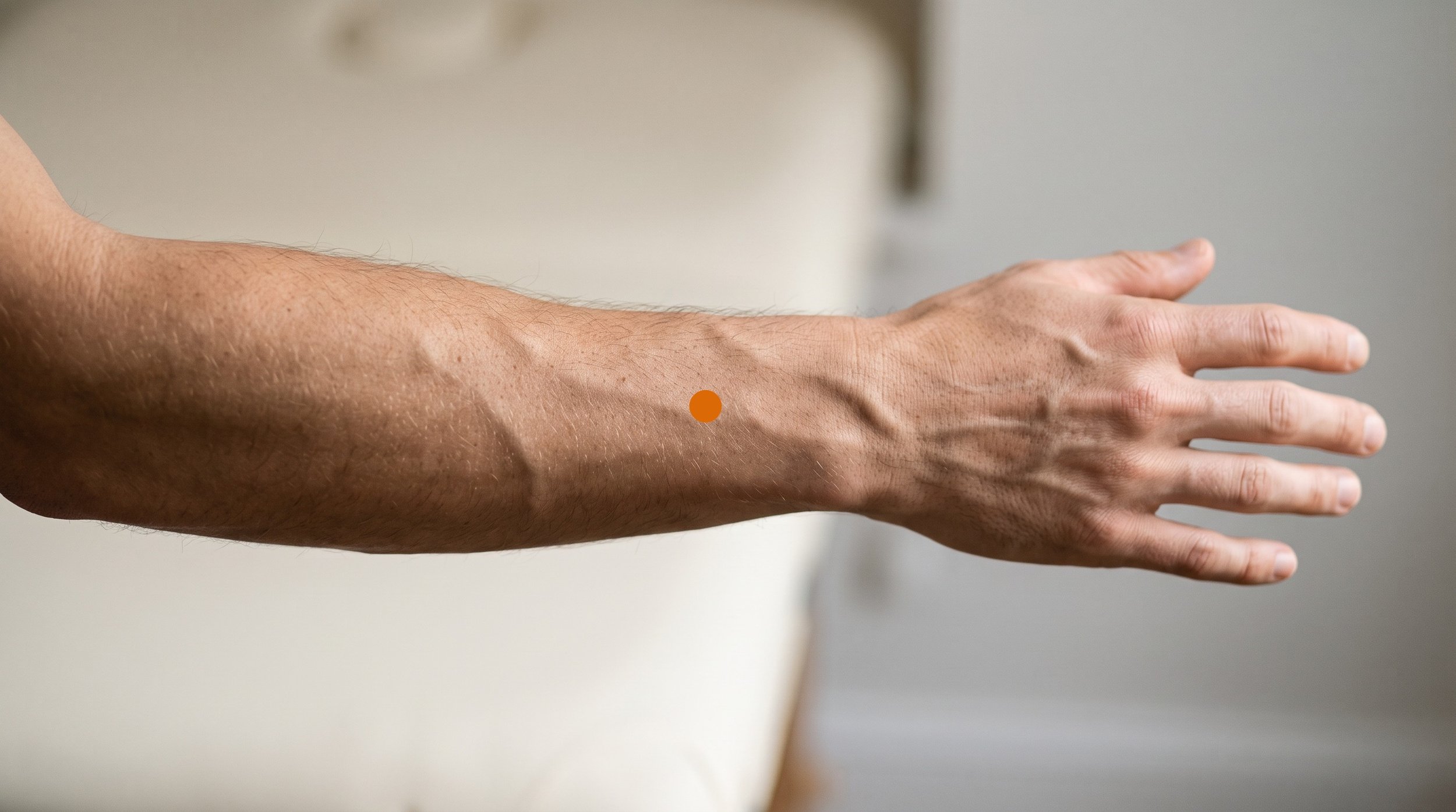
SJ6 Acupuncture Point (Zhigou)
The Branch Ditch Between the Forearm Bones: Anatomy, Mechanism, and Why a Wrist-Level Point Became the Classic Choice for Constipation and Rib-Side Pain
SJ6 (Zhigou, "Branch Ditch"), also written TE6, sits in the shallow trough between the radius and the ulna on the back of the forearm, about four finger widths above the wrist crease, on the radial edge of the extensor digitorum muscle. It's the jing-river point and the fire point of the Triple Burner channel, and in the classical literature it carries an unusual double reputation: a forearm point traditionally used for problems far from the forearm (constipation and pain under the ribs) alongside the more predictable local and channel uses for shoulder, arm and upper back pain.
Modern practitioners keep reaching for the te6 acupuncture point because it's easy to locate, comfortable to needle, safely away from the trunk, and it gives us a distal option in patients whose abdomen or rib cage is too tender, too guarded, or too inconvenient to needle directly.
- Location and layers: SJ6 lies 3 cun proximal to SJ4 in the interosseous gap of the dorsal forearm, on the radial side of extensor digitorum, with the needle passing through skin, thin subcutaneous tissue and the extensor mass toward the interosseous membrane (Deadman et al., 2007).
- Traditional categories, read neurophysiologically: as the jing-river and fire point of the Triple Burner channel it was traditionally credited with regulating qi and clearing heat across the upper, middle and lower burners, which in modern terms describes a distal point used to influence segmentally distant targets rather than any literal movement of energy (Deadman et al., 2007).
- Nerve geography drives the mechanism: needling here engages the posterior antebrachial cutaneous nerve superficially and the deep muscular tissue supplied by the posterior interosseous branch of the radial nerve, feeding C6 to C8 dorsal horn segments and recruiting the descending inhibitory systems that underlie much of acupuncture analgesia (Zhao, 2008).
- The visceral story is a reflex story: stimulation of somatic afferents can modulate autonomic outflow to the gut, and current work suggests these somato-autonomic effects vary with the site stimulated and the intensity of the stimulus rather than following a single uniform pathway (Ma, 2020).
- Research picture: the largest constipation trial to date used electroacupuncture at abdominal and leg points rather than SJ6, so the evidence supports acupuncture as a therapy for chronic constipation more than it supports this single point (Liu et al., 2016), while pain data come from multi-point protocols (Vickers et al., 2018).
- De qi at SJ6 is usually a deep, spreading ache or fullness that travels up the forearm toward the elbow or down toward the wrist, and because the forearm moves constantly we tell patients to keep the arm still so the needle doesn't bend (Deadman et al., 2007).
Struggling With Sluggish Digestion or Chronic Constipation?
At Morningside Acupuncture we treat constipation as a whole-system problem: bowel habits, stress load, hydration, medications, and abdominal tension all get reviewed before a single needle goes in. SJ6 often joins abdominal and lower-leg points in those treatments because it gives us a distal handle on gut motility when the belly itself is tender or bloated. Most patients also leave with practical between-visit steps, from acupressure to breathing drills that reduce abdominal guarding. Schedule a visit and let's build a plan that works with your gut rather than against it.
Schedule NowAnatomy of SJ6: Why the Gap Between the Radius and Ulna Is Such an Important Location
Run your thumb up the back of the forearm from the wrist and you'll feel two firm ridges of bone, the radius on the thumb side and the ulna on the little-finger side, with a softer valley between them. SJ6 sits in that valley three cun above the wrist crease, right along the radial border of the extensor digitorum muscle. The needle passes through thin skin and a shallow layer of fat, then into the extensor group that straightens the fingers and wrist, with the deeper thumb extensors and the interosseous membrane below.
This tissue works hard in anyone who types, lifts, grips a phone, carries groceries, or trains with a barbell, which is why the area is so often tender to palpation even in people who came in for something unrelated to the arm.
The superficial sensory supply here comes from the posterior antebrachial cutaneous nerve, while the deep muscular layers are innervated by the posterior interosseous branch of the radial nerve, so a needle at SJ6 recruits both cutaneous and deep afferents converging on the C6 to C8 spinal segments. Those inputs, particularly the small-diameter fibers activated by the dull ache of de qi, trigger segmental inhibition in the dorsal horn and activate descending pain-modulating pathways involving the periaqueductal gray, rostral ventromedial medulla and endogenous opioid and monoamine systems (Zhao, 2008).
That's the plausible physiology behind the traditional claim that this point relieves pain along the whole upper limb, shoulder and upper back: it isn't the local tissue doing the work so much as the spinal and brainstem circuitry those segments feed. The same afferent traffic can shift autonomic tone, which is where the digestive uses of SJ6 enter the conversation (Ma, 2020).
Deeper still lie the posterior interosseous artery and nerve running along the interosseous membrane, which is the main reason needling conventions at SJ6 favor a slightly oblique angle toward the ulnar side, or an oblique proximal or distal insertion, at depths of roughly 0.5 to 1.5 cun rather than a hard perpendicular thrust (Deadman et al., 2007).
Classical texts also describe through-needling from SJ6 to PC5 on the palmar side, a technique that demands considerable skill and isn't necessary for ordinary clinical work. The practical caution here is mechanical rather than dangerous: the forearm moves whenever the hand moves, so an arm that shifts or grips after insertion can bend the needle. We position the forearm supported and neutral, and we ask patients to let the hand rest heavy for the duration of the treatment.
Related Extensor Digitorum Trigger Points Related Twelve Primary ChannelsSJ6 (TE6) at a Glance: Classification, Location, and Clinical Use
| Category | Detail |
|---|---|
| Traditional Name | Zhigou (Branch Ditch), also known classically as Feihu (Flying Tiger); Triple Burner 6, listed as SJ6 or TB-6 in many texts |
| Channel Classification | Sixth point of the Hand Shao Yang Triple Burner (Sanjiao) channel, on the extensor surface of the forearm (SJ6, also written TE6 or TB6; also called the Triple Energizer, the Triple Heater or Triple Warmer) |
| Point Categories | Jing-river point of the Triple Burner channel; Fire point of the Triple Burner channel. No meeting, crossing, hui-meeting or extraordinary vessel designations are attributed to this point in the classical sources consulted. |
| Precise Location | On the back of the forearm, 3 cun proximal to SJ4 (Yangchi) on the line toward the tip of the olecranon, in the depression between the radius and the ulna, on the radial side of the extensor digitorum communis muscle |
| Tissue Stimulated | Skin and subcutaneous tissue of the dorsal forearm, the extensor digitorum muscle belly, with the deeper extensor pollicis longus and brevis and extensor indicis nearby and the interosseous membrane below; the neighboring extensor carpi ulnaris is often treated in the same session |
| Needle Depth / Direction | Slightly oblique toward the ulnar side, or oblique proximally toward the elbow or distally toward the wrist, 0.5 to 1.5 cun; support the forearm and keep the hand still, since arm or hand movement after insertion can bend the needle |
| De Qi Sensation | A deep, dull, spreading ache or fullness in the forearm that often travels toward the elbow or down toward the wrist and fingers; a brief electrical flick can occur if the needle nears the posterior interosseous nerve and simply means the angle should be adjusted |
| Primary Clinical Uses | Constipation of many patterns (its most celebrated traditional use), pain of the lateral costal region and ribs, shoulder, arm and upper back pain, and sudden loss of voice in classical listings |
| Common Point Combinations |
|
Deadman's A Manual of Acupuncture presents Zhigou as the principal point of the Triple Burner channel for moving qi and clearing heat across all three burners, and quotes the Song of the Primary Points of the Fourteen Channels for the traditional attribution that it drains ministerial fire from the three burners.
In the traditional framework that reach explains a very wide indication list: in the upper region, febrile presentations, sore throat, eye redness, tinnitus and deafness; in the middle region, pain and distention under the ribs, chest oppression and vomiting; in the lower region, constipation of essentially any pattern.
Deadman notes that SJ6 and SJ5 are the only points on the three arm yang channels traditionally indicated for constipation, and that SJ6 has always been regarded as the stronger of the two. Classical odes single it out repeatedly for rib-side pain, and because the Spiritual Pivot directed practitioners to use jing-river points for disorders showing in the voice, it also appears in several old formulas for sudden hoarseness or voice loss.
What's striking, viewed from a modern clinic, is the consistency: century after century, writers kept sending clinicians to one small dip between two forearm bones for problems located in the trunk.
Why SJ6 Is Used for Constipation When It Sits on the Forearm
The honest answer is that SJ6 has no direct anatomical connection to the colon. What it does have is access to somatic afferent nerves, and stimulating somatic afferents can change autonomic output to internal organs through spinal and brainstem reflex circuits. Contemporary neuroscience describes these somato-autonomic reflexes as organized rather than random, with the effect depending on which body region is stimulated and how strongly, so limb stimulation and abdominal stimulation don't necessarily produce the same visceral response (Ma, 2020).
That framework makes a distal forearm point a reasonable, if indirect, way to nudge gut function, and it fits the clinical observation that patients often report a change in abdominal comfort within a session or two rather than immediately.
For pain, the story is better established. Needling generates activity in small-diameter afferents that converge with pain signals in the dorsal horn and recruit descending inhibition from the brainstem, along with local and central release of endogenous opioids and other neurochemicals (Zhao, 2008).
That mechanism explains why a point at the C6 to C8 level can influence shoulder, arm and upper back pain sharing overlapping segmental input, and why it's a sensible distal choice for the band of pain that wraps along the lower ribs, an area classical texts assigned to this point long before anyone described a dorsal horn. Individual patient data from nearly 21,000 people show that acupuncture produces modest but persistent benefits over both sham and usual care in chronic musculoskeletal pain, with effects that don't disappear at one-year follow-up (Vickers et al., 2018).
One more clinical thread is worth mentioning. Maciocia notes that Triple Burner points are used to relieve qi stagnation, with TB-6 highlighted for the hypochondrium, flanks and breasts (Maciocia, 2015), and standard protocols for shingles pain along the lateral ribs have long included SJ6 as a distal point alongside local and paraspinal needling (Maciocia, 2006).
A systematic review of randomized trials suggests acupuncture may reduce pain scores and shorten skin healing times in herpes zoster compared with antiviral therapy, though the authors flag methodological limits across the included studies (Cui et al., 2021). We treat that as supportive context for a traditional use, not as proof that the point itself carries the effect.
What the Research Shows for SJ6 (TE6)
One note on naming before the evidence: in the research literature this point appears as TE6, the WHO standard code, and also as SJ6 or TB6 depending on the authors, so it is worth searching all three if you want to read the studies below in full.
There's an important limitation to name up front: almost no clinical trial tests SJ6 in isolation. Studies test protocols, and this point appears inside protocols for constipation, rib-side pain and upper limb pain rather than as the variable under study. The most rigorous constipation trial available actually used abdominal and lower-limb points, which means the research below supports acupuncture as a treatment approach and supports the general mechanisms that make a distal forearm point plausible, without telling us how much of any effect belongs to SJ6 specifically. Read the table as context for a clinical decision, not as validation of one needle.
| Study | Type | Focus | Key Finding |
|---|---|---|---|
| Liu et al., 2016 | Multicenter randomized sham-controlled trial (n = 1075) | Electroacupuncture for chronic severe functional constipation over 8 weeks | Electroacupuncture increased mean weekly complete spontaneous bowel movements more than sham needling, with benefit persisting through follow-up, though the protocol used abdominal and leg points rather than SJ6. |
| Ma, 2020 | Mechanistic review | Somato-autonomic reflex pathways activated by needling | Suggests that needle stimulation can drive autonomic pathways affecting functions such as gastrointestinal motility, with effects that appear to depend on the site and intensity of stimulation. |
| Zhao, 2008 | Neurophysiological review | Neural mechanisms of acupuncture analgesia | Describes segmental inhibition, descending pain control and endogenous opioid release as the core mechanisms by which needling reduces pain, which is the framework we use for distal points like SJ6. |
| Vickers et al., 2018 | Individual patient data meta-analysis | Acupuncture for chronic musculoskeletal, headache and osteoarthritis pain | Found modest but statistically significant benefits over sham and usual care that were largely maintained at one year, supporting acupuncture as a reasonable option for persistent pain. |
| Cui et al., 2021 | Systematic review and meta-analysis (21 RCTs) | Acupuncture for herpes zoster, a common cause of rib-band pain | Reported reductions in pain scores and faster skin healing compared with antiviral therapy, with the authors cautioning that trial quality was variable. |
| Zhan et al., 2023 | Systematic review and meta-analysis | Acupuncture versus rehabilitation therapy for post-stroke shoulder pain | Suggests acupuncture may compare favorably with rehabilitation for shoulder pain outcomes, though heterogeneity among the included trials limits confidence. |
Rib-Side, Shoulder or Upper Back Pain That Won't Settle?
Pain that wraps around the ribs or grabs at the shoulder blade often involves a mix of joint restriction, muscular trigger points and sensitized nerves, and it rarely responds to one technique alone. Our clinicians combine SJ6 with local needling, dry needling of the relevant muscles, and movement retraining so the relief carries over between sessions. We reassess every visit and adjust the point selection to what your body is actually doing. Book an appointment and get a clear plan for the pain instead of guesswork.
Schedule NowSJ6 in the Context of Trigger Point Work
The tissue at SJ6 is the same tissue a dry needling clinician targets for forearm extensor problems. Extensor digitorum, extensor indicis and the thumb extensors all run through this zone, and trigger points in the finger extensors can refer pain toward the lateral elbow and down the back of the hand, a pattern that overlaps with the complaints many patients label as tennis elbow or grip fatigue (Simons et al., 1999). Because the point coincides with a commonly tender band of muscle, we frequently palpate before deciding on angle and depth.
If the extensor mass is ropy and reactive, an oblique needle at SJ6 does double duty: it satisfies the classical location and it addresses a genuine myofascial finding.
In practice at Morningside, SJ6 rarely travels alone. For shoulder and upper back pain we combine it with dry needling of the infraspinatus, rhomboids, upper trapezius and levator scapulae, plus local channel points near the scapula, so the distal point supports central pain modulation while the local work addresses the taut bands driving the symptom. For forearm and grip complaints we treat extensor carpi radialis brevis, extensor carpi ulnaris and supinator alongside it.
And for digestive treatments we typically pair SJ6 with abdominal and lower-leg points, keeping the forearm needle as the quiet distal anchor of the session rather than the whole strategy.
SJ6 Constipation and Rib Pain Treatment at NYC's Highest-Rated Acupuncture Clinic
Morningside Acupuncture is the highest-rated acupuncture and dry needling clinic in New York City with over 500 five-star Google reviews, and our team blends classical point selection with modern pain science and orthopedic assessment. SJ6 is one of the points we use most often for digestive complaints and lateral rib pain, always inside a full treatment plan rather than as a standalone trick. You'll get clear explanations, gentle technique, and measurable goals from the first visit. Schedule your appointment today and see what careful, evidence-informed needling feels like.
Schedule NowFrequently Asked Questions
Is SJ6 the same point as TE6 or TB6?
Yes. SJ6, TE6, and TB6 are all codes for the same point, Zhigou. SJ stands for San Jiao, the Chinese name of the channel. TE (Triple Energizer) is the WHO standard abbreviation and the one you will see in most Western textbooks and research papers. TB (Triple Burner) and TW (Triple Warmer) are older English renderings of the same name that still appear in many books. You will also come across it written as San Jiao 6 or Triple Energizer 6. Whichever code is used, the location and the uses are the same.
What does SJ6 feel like when needled?
Most people feel a brief pinch at the skin, then a deep, dull ache or a sense of fullness spreading through the forearm. That spreading heaviness is de qi, and at SJ6 it commonly travels up toward the elbow or down toward the wrist and fingers. Some patients describe a warm or slightly buzzy quality. A sharp electrical zing isn't the goal and usually means the needle is close to a nerve branch, so tell your clinician and the angle gets adjusted right away. The forearm is a comfortable place to needle for most people, and any residual soreness typically fades within a day.
Why would a point on the forearm help constipation instead of needling the abdomen?
Both approaches get used, and abdominal points are often included in the same treatment. SJ6 earns its place for two reasons. First, traditionally it was considered the strongest constipation point on the arm yang channels, and that reputation has kept it in continuous clinical use for centuries. Second, from a modern standpoint, stimulating somatic nerves can influence autonomic output to the gut through reflex pathways, which gives us a way to work indirectly when the abdomen is bloated, tender, recently operated on, or simply not accessible in a given treatment position (Ma, 2020). It's also a practical choice for patients who prefer to stay clothed.
Can I press SJ6 myself between sessions?
Yes, and it's one of the easier points to self-treat. Rest one forearm palm-down on a table, place three fingers of the opposite hand just above the wrist crease on the back of the forearm, and let your thumb settle into the soft groove between the two forearm bones, roughly in line with the middle finger. You'll usually find a slightly tender spot. Apply steady, moderate pressure for 30 to 60 seconds, keeping the breath slow, then release and repeat three to five times per arm. Small circles work as well as static pressure. Twice a day is reasonable, and for constipation many people pair it with clockwise abdominal massage, adequate fluids and a short walk. Ease off if the area is bruised, inflamed, or genuinely painful rather than pleasantly sore.
Is SJ6 safe to needle?
It's considered a low-risk point in trained hands. There's no organ or body cavity underneath, and the main structures to respect are the posterior interosseous nerve and artery lying deep along the interosseous membrane, which is why practitioners favor oblique angles and moderate depths rather than forceful perpendicular insertion (Deadman et al., 2007). The most common practical issue is mechanical: because the forearm muscles contract whenever the hand moves, a bent needle can result if the arm shifts after insertion, so the forearm should stay supported and still. Let your clinician know if you take blood thinners, have a bleeding disorder, or have had nerve surgery or injury in the arm.
Where exactly is SJ6 located?
On the back of the forearm, 3 cun (about four finger widths) proximal to SJ4 at the wrist, along the line running from the wrist toward the tip of the elbow. Find the depression between the radius and the ulna and slide toward the radial side, where the point sits at the border of the extensor digitorum muscle close to the radius. A useful check is to halve the distance between the wrist point and the lateral epicondyle, then halve again toward the wrist. SJ7 sits at the same level but on the ulnar side, so if the spot you found is right against the ulna, move back toward the thumb side of the groove.
References
- Deadman, P., Al-Khafaji, M., & Baker, K. (2009). A manual of acupuncture. Journal of Chinese Medicine Publications.
- Maciocia, G. (2005). The foundations of Chinese medicine: A comprehensive text for acupuncturists and herbalists (2nd ed.). Elsevier Churchill Livingstone.
- Maciocia, G. (2006). The channels of acupuncture: Clinical use of the secondary channels and eight extraordinary vessels. Churchill Livingstone Elsevier.
- Simons, D. G., Travell, J. G., & Simons, L. S. (1999). Travell & Simons' myofascial pain and dysfunction: The trigger point manual, Vol. 1: Upper half of body (2nd ed.). Williams & Wilkins.
- Liu, Z., Yan, S., Wu, J., He, L., Li, N., Dong, G., Fang, J., Fu, W., Fu, L., Sun, J., Wang, L., Wang, S., Yang, J., Zhang, H., Zhang, J., Zhao, J., Zhou, W., Zhou, Z., Ai, Y., ... Liu, B. (2016). Acupuncture for chronic severe functional constipation: A randomized trial. Annals of Internal Medicine, 165(11), 761-769. https://doi.org/10.7326/M15-3118
- Ma, Q. (2020). Somato-autonomic reflexes of acupuncture. Medical Acupuncture, 32(6), 362-366. https://doi.org/10.1089/acu.2020.1488
- Zhao, Z. Q. (2008). Neural mechanism underlying acupuncture analgesia. Progress in Neurobiology, 85(4), 355-375. https://doi.org/10.1016/j.pneurobio.2008.05.004
- Vickers, A. J., Vertosick, E. A., Lewith, G., MacPherson, H., Foster, N. E., Sherman, K. J., Irnich, D., Witt, C. M., & Linde, K. (2018). Acupuncture for chronic pain: Update of an individual patient data meta-analysis. Journal of Pain, 19(5), 455-474. https://doi.org/10.1016/j.jpain.2017.11.005
- Cui, Y., Wang, F., Li, H., Zhang, X., Zhao, X., & Wang, D. (2021). Efficacy of acupuncture for herpes zoster: A systematic review and meta-analysis. Complementary Medicine Research, 28(5), 463-472. https://doi.org/10.1159/000515138
- Zhan, J., Luo, Y., Mao, W., et al. (2023). Efficacy of acupuncture versus rehabilitation therapy on post-stroke shoulder pain: A systematic review and meta-analysis of randomized controlled trials. Medicine, 102(29), e34266. https://doi.org/10.1097/MD.0000000000034266
Disclaimer: This web site is intended for educational and informational purposes only. Reading this website does not constitute providing medical advice or any professional services. This information should not be used for diagnosing or treating any health issue or disease. Those seeking medical advice should consult with a licensed physician. Seek the advice of a medical doctor or other qualified health professional for any medical condition. If you think you have a medical emergency, call 911 or go to the emergency room. No acupuncturist-patient relationship is created by reading this website or using the information. Morningside Acupuncture PLLC and its employees and contributors do not make any express or implied representations with respect to the information on this site or its use. For any legal interpretation of scope of practice in your state, consult a licensed attorney or regulatory authority.
Read more from our blog



