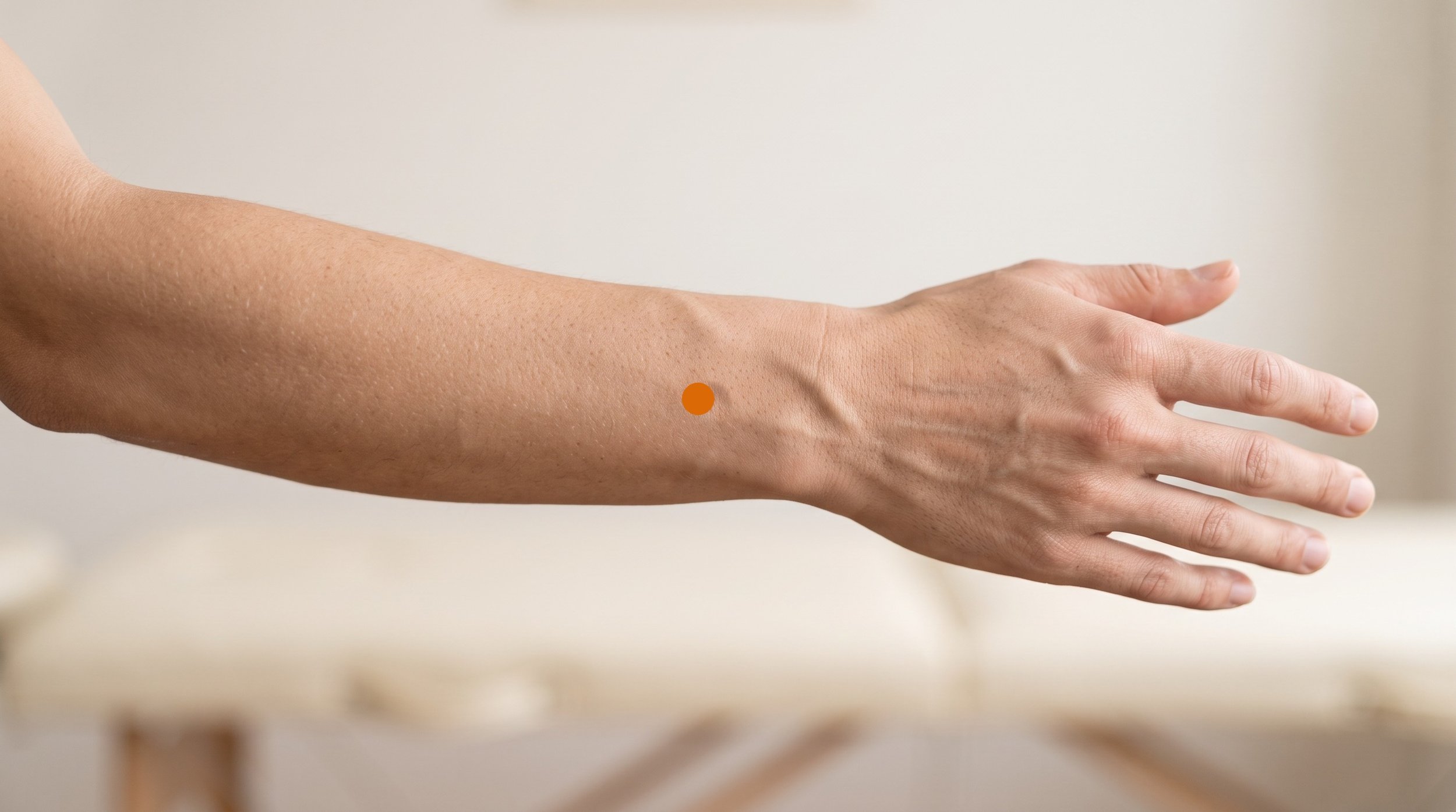
SJ5 Acupuncture Point (Waiguan)
The Outer Pass Between Radius and Ulna: Anatomy, Mechanism, and Why This Forearm Point Bridges Wrist Pain, Headache, and Ear Symptoms
SJ5, known as Waiguan (Outer Pass) and often written as TE5, is one of the most heavily used distal points on the Triple Burner (Sanjiao) channel. You will find it on the back of the forearm, roughly two finger widths (2 cun) above the wrist crease, in the soft valley between the radius and the ulna, directly opposite PC6 on the palm side.
That small window of tissue sits over the extensor compartment, the interosseous membrane, and the branching territory of the posterior interosseous nerve, which is exactly why the te5 acupuncture point shows up in treatment plans for wrist and forearm pain, repetitive strain from keyboards and phones, one sided headaches, and ear complaints such as ringing or fullness.
- Location and layers: triple burner 5 sits 2 cun proximal to the dorsal wrist crease in the interval between radius and ulna, with the needle passing through skin, thin subcutaneous tissue, the extensor digitorum and extensor pollicis longus region, and toward the interosseous membrane (Deadman et al., 2007).
- Traditional categories translated: classical texts list Waiguan as the luo-connecting point of the Sanjiao channel and the confluent point of the Yang Linking vessel, which in practical terms means it was used as a systemic distal point that could influence the head, ears, and lateral body regions rather than only the forearm (Deadman et al., 2007; Kim, 2010).
- Mechanism: needling here recruits radial and posterior interosseous nerve afferents that feed cervical segments C6 to C8, and repeated stimulation of these deep somatic afferents engages descending inhibitory pathways and endogenous opioid signaling (Zhao, 2008).
- Point-specific imaging: a randomized fMRI study of stroke patients found that needling SJ5 changed functional connectivity across sensorimotor networks differently than needling a nonacupoint, suggesting that stimulation at this site produces measurable central effects, though the clinical meaning of those signals remains uncertain (Chen et al., 2014).
- Research picture: large pooled data support acupuncture for chronic musculoskeletal pain and headache, and wrist focused trials show peripheral nerve and cortical changes, but none of these studies isolate a single point (Vickers et al., 2018; Maeda et al., 2017).
- De qi: most patients report a dull, heavy, spreading ache that can travel toward the hand or up the forearm; a brief electrical flick may occur if the needle nears the posterior interosseous nerve, and a good clinician adjusts immediately when that happens.
- Clinical framing: at Morningside we typically use the sj5 acupuncture point as a distal partner to local needling of the wrist extensors, or as a mirror pair with PC6 for circumferential wrist symptoms.
Wrist and Forearm Pain That Keeps Coming Back?
Keyboard work, lifting, racket sports, and phone use load the same extensor compartment that SJ5 sits over, and stretching alone rarely settles it. We combine needling at Waiguan with dry needling of the forearm extensors, wrist mobility work, and load advice tailored to your job. Most patients feel a change in grip comfort within a few visits. Schedule an evaluation and let's map where your symptoms are actually coming from.
Schedule NowAnatomy of SJ5: Why the Gap Between Radius and Ulna Is Such an Important Location
SJ5 lies on the dorsal forearm about 2 cun above the wrist crease, in the shallow trough between the radius and the ulna. Under the skin and a thin layer of subcutaneous tissue, the needle enters the extensor compartment, where the tendons of extensor digitorum lie alongside the oblique fibers of extensor pollicis longus and extensor indicis. Deeper still is the interosseous membrane, the tough sheet that ties the two forearm bones together and transmits load between them.
This tissue works constantly during typing, gripping, mousing, lifting bags, and holding a phone, which is why it is so often tender to palpation in desk workers and lifters even when the pain is felt at the wrist or lateral elbow.
The sensory story here is dominated by the radial nerve system. Superficially, the posterior antebrachial cutaneous nerve supplies the skin, while the posterior interosseous nerve, the deep motor and articular branch of the radial nerve, runs along the interosseous membrane below. These fibers report back to cervical segments in the C6 to C8 range, the same segmental territory that serves the wrist joint and hand extensors, so stimulation at Waiguan converges centrally with input from painful structures further down the limb.
Needling deep somatic tissue in this way activates A delta and group III afferents, which are known drivers of descending inhibitory control and endogenous opioid release in the brainstem and spinal cord (Zhao, 2008). Imaging work using this exact point found measurable shifts in sensorimotor network connectivity compared with a nonacupoint control (Chen et al., 2014).
Vascular structures are modest but worth respecting: the posterior interosseous artery and its accompanying veins travel on the membrane beneath the point, and the deep nerve branch is close by. Standard practice is perpendicular insertion of 0.5 to 1 cun, or a shallower oblique angle along the interosseous gap; some practitioners join SJ5 through toward PC6, which requires care because the median nerve and the flexor tendons occupy the palm side (Deadman et al., 2007).
Classical texts also warn that moving the arm or hand after insertion here can bend the needle, so the forearm should be supported and still for the retention period.
Related Extensor Digitorum Trigger Points Related Pain Finder Forearm HandSJ5 (TE5) at a Glance: Classification, Location, and Clinical Use
| Category | Detail |
|---|---|
| Traditional Name | Waiguan (Outer Pass), also written TE5 or Sanjiao 5 |
| Channel Classification | Triple Burner (Sanjiao) channel of the Hand Shaoyang (SJ5, also written TE5 or TB5; also called the Triple Energizer, the Triple Heater or Triple Warmer) |
| Point Categories | Luo-connecting point of the Sanjiao channel; confluent (opening) point of the Yang Linking vessel, one of the eight confluent points paired classically with GB41 |
| Precise Location | Dorsal forearm, 2 cun proximal to the wrist crease (SJ4), in the depression between the radius and the ulna, on the radial side of the extensor digitorum tendons, directly opposite PC6 |
| Tissue Stimulated | Skin and subcutaneous tissue over the extensor compartment, extensor digitorum and extensor pollicis longus, down toward the interosseous membrane; posterior antebrachial cutaneous and posterior interosseous nerve territory |
| Needle Depth / Direction | Perpendicular 0.5 to 1 cun, or oblique along the interosseous gap toward the elbow or wrist; may be joined toward PC6 with careful depth control. Support the forearm and avoid arm movement during retention |
| De Qi Sensation | Dull, heavy, spreading ache in the forearm, sometimes traveling toward the hand or proximally toward the elbow; a brief electrical sensation signals nerve proximity and calls for repositioning |
| Primary Clinical Uses | Wrist and forearm pain, repetitive strain of the hand and elbow, grip pain, one sided and temporal headache, ear symptoms including tinnitus and earache, neck stiffness, and traditionally the early stage of common cold symptoms |
| Common Point Combinations |
|
In the classical literature compiled by Deadman and colleagues, Waiguan is credited with expelling wind and releasing the exterior, benefiting the head and ears, opening the Yang Linking vessel, clearing heat, and moving the channel to relieve pain.
These are traditional attributions rather than physiological descriptions, and the indication lists that accompany them are unusually broad: early stage feverish illness with chills, many types of headache including one sided and vertex pain, ear complaints from ringing to earache, red or painful eyes, swelling in the cheeks and neck glands, and a long catalogue of arm complaints running from shoulder and elbow through wrist and fingers.
Commentators explain this range by the Yang Linking vessel's role as a connector between the yang channels and by the Sanjiao channel's course through the lateral neck and around the ear, and older sources such as the Song of Points for Miscellaneous Diseases and the Ode of the Obstructed River single the point out for exterior conditions with headache.
What is striking is that a point on a small patch of forearm accumulated indications for regions it never physically touches, which tells us the classical authors were tracking referred and distant effects long before anyone described convergence in the dorsal horn.
Why SJ5 Is Used for Headaches and Ear Symptoms That Are Nowhere Near the Forearm
Patients are often surprised that a needle in the forearm is chosen for a temporal headache or ringing in the ear. The simplest explanation is not that something travels up the arm, but that the nervous system pools information. Afferent fibers from the radial nerve system at SJ5 enter cervical segments in the C6 to C8 range, and those segments sit within a continuous network that also processes input from the upper neck and, through the trigeminocervical complex, from the head and face.
Stimulating a distant limb site can change how that network weights incoming signals, which is one reason distal points have remained standard practice for head symptoms across many acupuncture styles.
The second mechanism is descending inhibition. Sustained stimulation of deep somatic tissue activates brainstem structures including the periaqueductal gray and rostral ventromedial medulla, which then dampen nociceptive traffic at the spinal level through opioid, serotonergic, and noradrenergic pathways (Zhao, 2008). This effect is not point specific in the sense of belonging to Waiguan alone, but it explains why a needle far from the painful region can still reduce pain intensity.
Imaging using this precise point found different patterns of sensorimotor and cerebellar connectivity after real needling at SJ5 compared with a nonacupoint site, which at minimum suggests the location is not neurologically inert (Chen et al., 2014).
There is also a straightforward local rationale. In wrist and hand pain, the tissue at SJ5 is frequently part of the problem: overloaded finger extensors, an irritable interosseous region, and a forearm that has been held in mild extension for hours at a keyboard. Needling into that tissue can reduce local mechanical sensitivity while the segmental and descending effects work on the broader pain picture.
In carpal tunnel syndrome, an eight week trial found that both wrist local and distal needling improved symptoms, with verum needling producing measurable changes in median nerve conduction and cortical organization that sham did not (Maeda et al., 2017).
What the Research Shows for SJ5 (TE5)
One note on naming before the evidence: in the research literature this point appears as TE5, the WHO standard code, and also as SJ5 or TB5 depending on the authors, so it is worth searching all three if you want to read the studies below in full.
One caution before the table: almost no clinical trial tests a single acupuncture point. Reviews evaluate whole protocols, usually eight to twelve points chosen by the treating clinician, so the honest claim is that SJ5 appears within protocols that have been studied, not that SJ5 itself has been proven for any condition. The point specific evidence that does exist is mechanistic imaging work in small samples, which describes brain responses rather than clinical outcomes. Read the evidence below as context for how this point is used, not as a promise of results.
| Study | Type | Focus | Key Finding |
|---|---|---|---|
| Chen et al., 2014 | Randomized fMRI mechanistic study | Needling at SJ5 versus nonacupoint in patients with left basal ganglia ischemic stroke | Needling at Waiguan was associated with different sensorimotor and cerebellar connectivity patterns than nonacupoint needling, though the sample was small and clinical outcomes were not measured. |
| Maeda et al., 2017 | Randomized sham-controlled trial with neuroimaging | Local and distal acupuncture for carpal tunnel syndrome | Verum needling improved median nerve conduction and somatosensory cortex organization more than sham, with symptom improvement across both real needling arms. |
| Vickers et al., 2018 | Individual patient data meta-analysis | Acupuncture for chronic musculoskeletal, headache, and osteoarthritis pain | Acupuncture was superior to sham and to no-acupuncture controls with effects that persisted over twelve months, though differences from sham were modest. |
| Linde et al., 2016a | Cochrane systematic review | Acupuncture for prevention of episodic migraine | Acupuncture reduced headache frequency compared with usual care and showed a small additional benefit over sham, with evidence quality rated moderate to low. |
| Linde et al., 2016b | Cochrane systematic review | Acupuncture for prevention of tension-type headache | Adding acupuncture to routine care reduced headache frequency, with small benefits over sham needling in the pooled trials. |
| Huang et al., 2021 | Systematic review and meta-analysis | Acupuncture for tinnitus | Some outcomes favored acupuncture but pooled visual analogue scale differences were not statistically significant, and study quality limited firm conclusions. |
| Zhao, 2008 | Narrative review of mechanisms | Neural pathways underlying acupuncture analgesia | Needling deep somatic tissue engages segmental spinal inhibition and descending opioid, serotonergic, and noradrenergic control systems. |
One Sided Headaches and Ear Ringing You Cannot Shake?
Temporal headaches, jaw tension, and ear fullness often travel together, and distal points like SJ5 are traditionally paired with local needling around the temple and jaw. Our clinicians assess the neck, masseter, and temporalis before choosing any point, so the treatment matches your pattern rather than a template. Research on acupuncture for headache prevention is encouraging even if it cannot credit one point (Linde et al., 2016a). Book a visit and we'll build a plan around your specific triggers.
Schedule NowSJ5 in the Context of Trigger Point Work
The forearm tissue under Waiguan is prime trigger point territory. Extensor digitorum, extensor indicis, extensor pollicis longus, and the nearby supinator commonly develop taut bands in people who type, grip tools, play racket sports, or carry weight in one hand. Trigger points in the finger extensors classically refer pain toward the lateral elbow and down into the dorsum of the hand and fingers, a pattern that overlaps almost exactly with the complaints for which the sj5 acupuncture point is traditionally selected (Simons et al., 1999). When a patient points to the back of the wrist but is tender two inches higher, that is a useful clue.
In practice we rarely treat SJ5 in isolation. A typical Morningside session for forearm and wrist pain might include needling at Waiguan as a distal and segmental point, dry needling of extensor digitorum and extensor pollicis longus taut bands, attention to supinator if lateral elbow symptoms are present, and often PC6 or local wrist points depending on where symptoms sit. Acupuncture and dry needling use the same filiform needle, so what changes is the reasoning: one selection is guided by channel and point theory, the other by palpated muscular findings. Blending them lets us address both the irritable tissue and the wider pain network in one visit.
SJ5 Wrist and Headache Treatment at NYC's Highest-Rated Acupuncture Clinic
Morningside Acupuncture is the highest-rated acupuncture and dry needling clinic in New York City with over 500 five-star Google reviews, and we treat forearm, wrist, and headache complaints every week. Our approach blends classical point selection such as Waiguan with modern orthopedic assessment and myofascial needling. Sessions are calm, precise, and built around measurable change in your symptoms. Schedule your appointment and start with a full evaluation.
Schedule NowFrequently Asked Questions
Is SJ5 the same point as TE5 or TB5?
Yes. SJ5, TE5, and TB5 are all codes for the same point, Waiguan. SJ stands for San Jiao, the Chinese name of the channel. TE (Triple Energizer) is the WHO standard abbreviation and the one you will see in most Western textbooks and research papers. TB (Triple Burner) and TW (Triple Warmer) are older English renderings of the same name that still appear in many books. You will also come across it written as San Jiao 5 or Triple Energizer 5. Whichever code is used, the location and the uses are the same.
What does SJ5 feel like when needled?
Most people feel a dull, heavy, spreading ache in the forearm once the needle reaches depth, sometimes with a sense of pressure traveling toward the hand or up toward the elbow. That heavy quality is the classic de qi sensation and it usually settles into a warm, mildly numb feeling within a minute. A brief electric zing can occur if the needle passes close to the posterior interosseous nerve; it is not harmful, but your clinician should adjust the needle right away. Sharpness or burning is not expected and should always be reported.
Why needle the forearm for a headache or ear symptoms instead of the head itself?
Distal points like Waiguan are used because the nervous system processes limb and head input through overlapping networks, and because stimulation of deep somatic tissue activates brainstem pathways that reduce pain signaling more broadly (Zhao, 2008). Traditional sources arrived at the same practice from a different direction, listing SJ5 as the confluent point of the Yang Linking vessel and applying it to the temples and ears (Deadman et al., 2007). Practically, distal needling also lets us keep the painful area quiet, which matters when the head or jaw is already sensitive. Most treatments combine both distal and local points.
Can I press SJ5 myself between sessions?
Yes, and it is one of the easier points to self-treat. Rest the affected forearm palm down, measure about two thumb widths up from the wrist crease, and feel for the soft valley between the two forearm bones on the back of the arm. Press with the opposite thumb using firm, steady pressure until you feel a dull ache rather than sharpness, hold for thirty to sixty seconds, release, and repeat two or three times. Doing this two or three times a day, and briefly after long stretches at a keyboard, is reasonable. Stop and check in with your clinician if pressing produces tingling into the fingers or a sharp electrical sensation.
Is SJ5 safe to needle?
In trained hands it is a low-risk point. The main considerations are the posterior interosseous nerve and the interosseous vessels running deeper along the membrane, which is why depth is kept moderate at 0.5 to 1 cun and why an electrical sensation prompts immediate repositioning. When the point is joined toward PC6, extra care is needed on the palm side where the median nerve lies. Classical sources also note that moving the arm after insertion can bend the needle, so the forearm should be supported and still. Minor bruising is the most common side effect, and anyone on blood thinners should mention it beforehand.
Where exactly is SJ5 located?
On the back of the forearm, 2 cun (about two thumb widths, or three finger widths for most people) proximal to the dorsal wrist crease, in the depression between the radius and the ulna. It sits on the radial side of the extensor digitorum tendons and lies directly opposite PC6 on the palm side of the forearm, which is a reliable way to double-check placement. Flex and extend your fingers a few times and you can feel the extensor tendons move under your fingertip just ulnar to the point. Tenderness on palpation is common in people with wrist, grip, or lateral elbow complaints.
References
- Deadman, P., Al-Khafaji, M., & Baker, K. (2009). A manual of acupuncture. Journal of Chinese Medicine Publications.
- Kim, H. (2008). Handbook of Oriental medicine (3rd ed.). Harmony & Balance Press.
- Simons, D. G., Travell, J. G., & Simons, L. S. (1999). Travell & Simons' myofascial pain and dysfunction: The trigger point manual, Vol. 1: Upper half of body (2nd ed.). Williams & Wilkins.
- Chen, J., Wang, J., Huang, Y., Lai, X., Tang, C., Yang, J., Wu, J., Zeng, T., & Qu, S. (2014). Modulatory effect of acupuncture at Waiguan (TE5) on the functional connectivity of the central nervous system of patients with ischemic stroke in the left basal ganglia. PLoS ONE, 9(6), e96777. https://doi.org/10.1371/journal.pone.0096777
- Maeda, Y., Kim, H., Kettner, N., Kim, J., Cina, S., Malatesta, C., Gerber, J., McManus, C., Ong-Sutherland, R., Mezzacappa, P., Libby, A., Mawla, I., Morse, L. R., Kaptchuk, T. J., Audette, J., & Napadow, V. (2017). Rewiring the primary somatosensory cortex in carpal tunnel syndrome with acupuncture. Brain, 140(4), 914-927. https://doi.org/10.1093/brain/awx015
- Linde, K., Allais, G., Brinkhaus, B., Fei, Y., Mehring, M., Vertosick, E. A., Vickers, A., & White, A. R. (2016a). Acupuncture for the prevention of episodic migraine. Cochrane Database of Systematic Reviews, 2016(6), CD001218. https://doi.org/10.1002/14651858.CD001218.pub3
- Linde, K., Allais, G., Brinkhaus, B., Fei, Y., Mehring, M., Shin, B. C., Vickers, A., & White, A. R. (2016b). Acupuncture for the prevention of tension-type headache. Cochrane Database of Systematic Reviews, 2016(4), CD007587. https://doi.org/10.1002/14651858.CD007587.pub2
- Huang, K., Liang, S., Chen, L., & Grellet, A. (2021). Acupuncture for tinnitus: A systematic review and meta-analysis of randomized controlled trials. Acupuncture in Medicine, 39(4), 264-271. https://doi.org/10.1177/0964528420938380
- Vickers, A. J., Vertosick, E. A., Lewith, G., MacPherson, H., Foster, N. E., Sherman, K. J., Irnich, D., Witt, C. M., & Linde, K. (2018). Acupuncture for chronic pain: Update of an individual patient data meta-analysis. Journal of Pain, 19(5), 455-474. https://doi.org/10.1016/j.jpain.2017.11.005
- Zhao, Z. Q. (2008). Neural mechanism underlying acupuncture analgesia. Progress in Neurobiology, 85(4), 355-375. https://doi.org/10.1016/j.pneurobio.2008.05.004
Disclaimer: This web site is intended for educational and informational purposes only. Reading this website does not constitute providing medical advice or any professional services. This information should not be used for diagnosing or treating any health issue or disease. Those seeking medical advice should consult with a licensed physician. Seek the advice of a medical doctor or other qualified health professional for any medical condition. If you think you have a medical emergency, call 911 or go to the emergency room. No acupuncturist-patient relationship is created by reading this website or using the information. Morningside Acupuncture PLLC and its employees and contributors do not make any express or implied representations with respect to the information on this site or its use. For any legal interpretation of scope of practice in your state, consult a licensed attorney or regulatory authority.
Read more from our blog



