CV15 Acupuncture Point (Jiuwei)
The Turtledove Tail Beneath the Breastbone: Anatomy, Mechanism, and Why This Small Midline Point Sits at the Crossroads of Chest, Diaphragm, and Nervous System
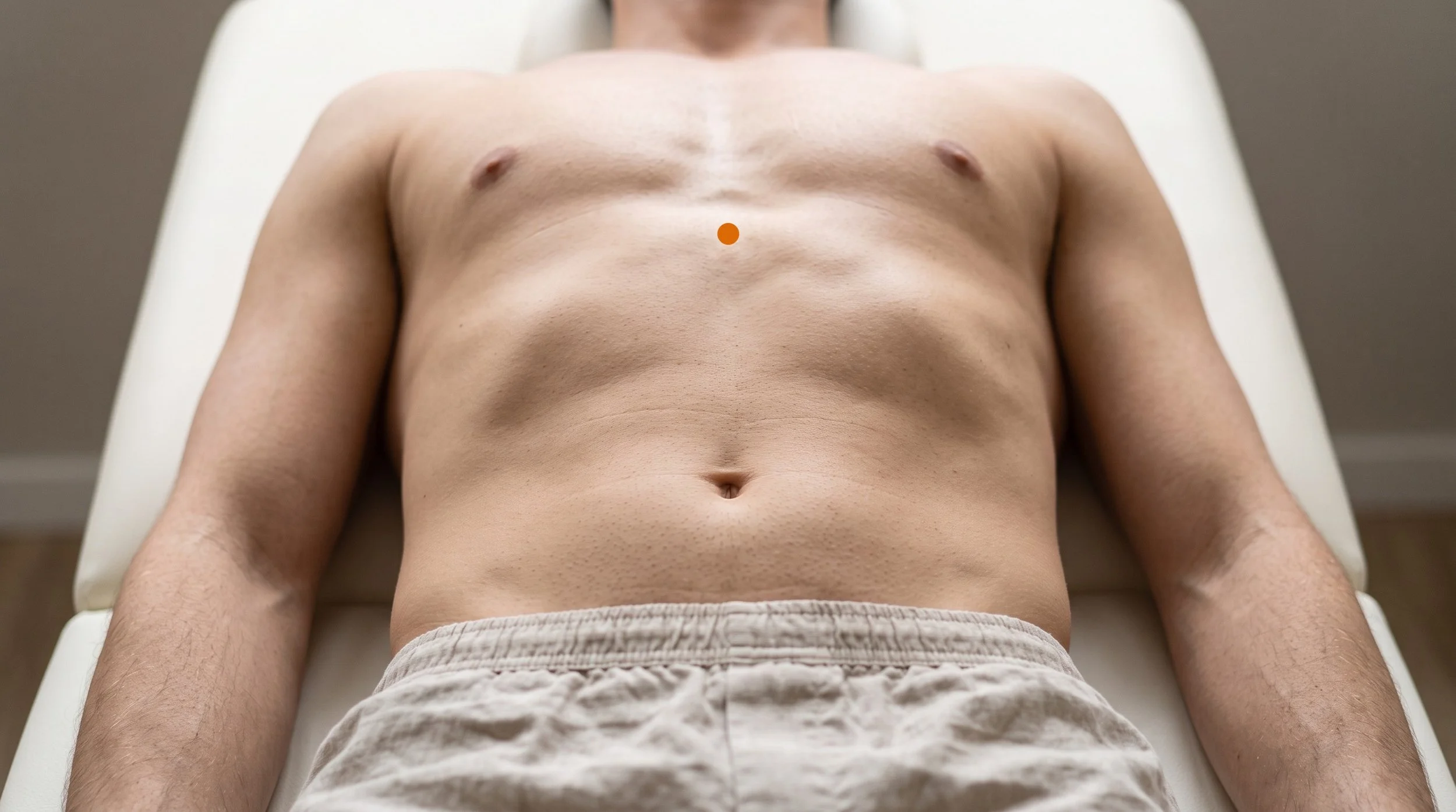
CV15 (Jiuwei, "Turtledove Tail"), also written Ren 15, is the fifteenth point of the Conception Vessel, sitting on the midline of the upper abdomen at or just below the tip of the xiphoid process, roughly 7 cun above the navel and about 1 cun below the point where the rib margins meet. The name is anatomical rather than poetic license: the xiphoid was compared to a dove's tail feather, with the lower ribs spreading out as wings.
Classically it is the luo-connecting point of the Conception Vessel, the place from which that channel's influence was said to spread over the abdominal wall, and it is traditionally used for agitation, fright palpitations, chest oppression with frequent sighing, and wheezing or cough with a full, tight chest.
Clinically the CV15 acupuncture point matters because it sits directly over the junction of the chest and the abdomen, at the segmental level where cardiac, esophageal, gastric, and diaphragmatic afferents converge with the somatic nerves of the body wall, which is exactly the region where patients tend to localize the physical sensation of stress.
- CV15 lies on the anterior midline at the xiphoid tip, and because xiphoid length varies considerably from person to person, the point may fall on the bone itself rather than below it, which is why palpation of the sternocostal angle matters more than counting cun.
- The needle passes through thin skin, superficial fascia, and the linea alba near the upper rectus sheath, with xiphoid periosteum and the sternal attachments of the diaphragm immediately deep, so this is a shallow, angled technique rather than a deep one.
- Segmentally, CV15 is supplied by anterior cutaneous branches of the lower thoracic intercostal nerves, whose dorsal horn neurons also receive visceral afferent traffic from the heart, esophagus, stomach, and diaphragm, which gives a plausible reflex route for the classical chest and epigastric indications (Uchida et al., 2017).
- Traditional actions listed in Deadman's manual (calming the spirit and unbinding the chest, and descending Lung qi) translate reasonably well into modern language as autonomic modulation and reduced protective guarding of the upper abdominal wall, with acupuncture generally shown to shift heart rate variability indices in mixed and inconsistent ways (Chung et al., 2014).
- The research picture is indirect: reviews support modest, durable effects for chronic pain (Vickers et al., 2018) and possible symptom reduction in anxiety (Li et al., 2022) and functional dyspepsia (Pang et al., 2016), while evidence for asthma remains insufficient (McCarney et al., 2004), and none of these trials isolate CV15 on its own.
- De qi at CV15 is usually a dull, heavy, spreading pressure under the breastbone rather than a sharp signal, and many patients report a spontaneous deeper breath or a sigh within a minute of insertion, a response consistent with descending modulatory and autonomic mechanisms (Zhao, 2008).
Chest Tightness, Sighing, and Stress That You Feel Under Your Breastbone?
Many patients describe a band of pressure just below the sternum that tightens with deadlines, poor sleep, or long hours at a desk. At Morningside Acupuncture we use CV15 with a shallow, downward-angled needle alongside distal points and breath work to reduce upper abdominal guarding and help the diaphragm move again. Treatment is paired with dry needling of the upper rectus abdominis and intercostals when palpation suggests myofascial involvement. Schedule a visit and we will map where the tension actually lives.
Schedule NowAnatomy of CV15: Why the Xiphoid Tip Is Such an Important Location
CV15 sits on the anterior midline where the chest wall hands off to the abdominal wall. Under the needle there is skin, a thin layer of subcutaneous fat, and the dense collagen of the linea alba flanked by the upper edges of the rectus sheath, with the xiphoid process itself sitting directly beneath or just above the point depending on how long that bone happens to be.
This junction is loaded constantly: every breath moves the sternal fibers of the diaphragm that attach to the back of the xiphoid, every cough or crunch loads the upper rectus abdominis, and prolonged desk posture keeps the whole region flexed and shortened. Because xiphoid length varies so widely, Deadman's manual notes that this point may lie on the xiphoid rather than below it, which is why we locate it by feeling for the sternocostal angle rather than by measurement alone.
Sensory supply to this patch of skin and fascia comes from the anterior cutaneous branches of the lower thoracic intercostal nerves, placing CV15 in the T6 to T7 territory. That segmental address is the interesting part. Visceral afferents from the heart, distal esophagus, stomach, and the peripheral diaphragm feed into overlapping levels of the thoracic spinal cord, so somatic input from the body wall and visceral input from the organs converge on shared dorsal horn neurons.
Animal physiology suggests that stimulation of the abdominal wall can drive segmental sympathetic reflexes that change visceral function, while limb stimulation tends to recruit vagally mediated responses (Uchida et al., 2017). Needling also engages the broader analgesic machinery described in mechanism reviews, including spinal gating and descending inhibitory pathways using serotonin, noradrenaline, and endogenous opioids (Zhao, 2008). None of this requires an appeal to energy flow: it is convergence, reflex, and modulation.
Deep to the xiphoid lie structures that demand respect, including the left lobe of the liver, the diaphragm, and the pericardium and heart just above and behind. For that reason the standard technique is oblique insertion directed inferiorly, 0.5 to 1 cun, never angled upward toward the heart.
Deadman's manual cautions specifically that deep needling in thin patients may reach an enlarged liver or heart, that oblique superior insertion is contraindicated in all cases, and that several classical texts listed this point as contraindicated to moxibustion.
In practice we needle CV15 shallowly, with the patient supine and relaxed, and we skip it entirely in anyone with an uncertain abdominal exam, recent chest or abdominal surgery, or significant organomegaly.
Related Conception Vessel Related Luo Connecting ChannelsCV15 (Ren 15) at a Glance: Classification, Location, and Clinical Use
| Category | Detail |
|---|---|
| Traditional Name | Jiuwei (Turtledove Tail), also recorded under the alternate name Weiyi (Tail Screen) |
| Channel Classification | Conception Vessel, point 15 (Ren-15) (also called the Ren Mai or Ren channel) |
| Point Categories | Luo-connecting point of the Conception Vessel, from which the channel was said to spread over the abdomen, with a longstanding classical debate over whether CV1 holds that role instead; listed in the Spiritual Pivot as the source point of the gao (the region below the heart); described in some modern texts as an unofficial front-mu point for the diaphragm |
| Precise Location | Anterior midline of the upper abdomen, 7 cun above the umbilicus and 1 cun below the sternocostal angle, at or just below the tip of the xiphoid process depending on xiphoid length |
| Tissue Stimulated | Skin and superficial fascia over the linea alba, the medial fibers of the upper rectus sheath and the abdominal obliques near the costal margin, with xiphoid periosteum and the sternal attachment of the diaphragm immediately deep |
| Needle Depth / Direction | Oblique insertion directed inferiorly, 0.5 to 1 cun; superior angulation toward the heart is contraindicated, deep insertion is avoided in thin patients, and classical texts contraindicate moxibustion here |
| De Qi Sensation | A dull, heavy, spreading pressure under the breastbone that may radiate a short distance down the upper abdomen, often followed by a spontaneous deeper breath; sharp or radiating pain means the needle should be withdrawn and repositioned |
| Primary Clinical Uses | Agitation, fright palpitations, and stress held in the chest; chest oppression with frequent sighing; wheezing, cough, and a tight, full chest; epigastric fullness and reflux-type discomfort; upper abdominal wall tenderness and guarding |
| Common Point Combinations |
|
In the traditional literature summarized in Deadman's point manual, CV15 is given two main jobs: settling the spirit and regulating the Heart, and descending Lung qi to unbind the chest. Its classical indication list is unusually dramatic for a small midline point, running from fright palpitations, oppression in the chest, and pain radiating from the heart through to the five types of epilepsy, mania, wandering and singing, and an aversion to the sound of other people talking, alongside more everyday complaints such as cough, wheezing, difficult swallowing, reflux, and pain or itching of the abdominal skin.
Those last two are the traditional excess and deficiency signs of the Conception Vessel's connecting channel as recorded in the Spiritual Pivot and repeated in modern Chinese texts, and the same sources note the historical argument over whether CV1 rather than CV15 deserves the luo designation. The Spiritual Pivot also names CV15 the source point of the gao, the area beneath the heart that features in the famous story of a disease settling so deep that it could not be reached.
What is striking is the pattern rather than any single entry: nearly every traditional attribution here concerns the space between the heart, the diaphragm, and the stomach, precisely the anatomy the needle sits over.
Why CV15 Is Used for Anxiety That Patients Feel as Chest Tightness and Sighing
Ask someone with high anxiety where they feel it and most will point at the sternum or just below it. That is not a coincidence of language. The heart, esophagus, stomach, and central diaphragm send afferent traffic into the spinal cord and brainstem, and the lower thoracic segments that supply the skin and fascia at CV15 overlap with several of those inputs. When visceral or autonomic arousal is high, the body wall over that segment often becomes tender, guarded, and stiff, and the diaphragm sits in a partially braced position that makes a full exhale difficult.
Needling into the somatic side of that shared segment gives the nervous system a competing, well-localized signal, and animal work on somatoautonomic reflexes suggests that abdominal wall stimulation can measurably alter visceral function through segmental reflex arcs (Uchida et al., 2017).
Beyond the segment, needling recruits broader modulatory systems. Mechanism reviews describe spinal gating plus descending inhibitory control from the periaqueductal gray and rostral ventromedial medulla, using serotonin, noradrenaline, and endogenous opioid transmitters to damp nociceptive traffic (Zhao, 2008). Autonomic outcomes are harder to pin down.
A systematic review with meta-analysis of heart rate variability trials found changes in low frequency power and the LF to HF ratio after needling in several populations, but the results were inconsistent across studies and subject types, so the honest summary is that acupuncture appears to influence autonomic indices without a single reliable direction (Chung et al., 2014).
Clinically, this is why we treat the Jiuwei luo point as one part of a plan rather than a switch. A typical session combines CV15 with distal calming points, breath retraining that emphasizes a longer exhale, and manual or needling work on the upper abdominal wall and lower ribs. Patients often notice a spontaneous fuller breath during the session itself, and the more durable change tends to show up over several visits as reduced daytime bracing and less awareness of the chest.
What the Research Shows for CV15 (Ren 15)
One note on naming before the evidence: in the research literature this point is almost always listed as CV15, the WHO standard code, while many textbooks and Chinese sources write Ren 15 or RN15, so it is worth searching those as well if you want to read the studies below in full.
There is no randomized trial of CV15 used alone, and it would be unusual if there were: acupuncture research almost always tests multi-point protocols chosen for a condition, so the evidence below tells us about the treatment package rather than about this single location. What the literature can reasonably support is that needling produces measurable physiological effects, that it helps some of the conditions CV15 is traditionally selected for, and that certainty ranges from moderate down to low depending on the outcome. Read the table as context for a clinical decision, not as proof of point-specific action.
| Study | Type | Focus | Key Finding |
|---|---|---|---|
| Vickers et al., 2018 | Individual patient data meta-analysis | Chronic pain across musculoskeletal, headache, and osteoarthritis populations | Acupuncture outperformed both sham and no-acupuncture controls with modest effect sizes, and benefits persisted over roughly a year. |
| Chung et al., 2014 | Systematic review with meta-analysis | Effect of acupuncture on heart rate variability | Pooled data showed shifts in low frequency power and the LF to HF ratio, though results varied by population and were not consistent across trials. |
| Uchida et al., 2017 | Narrative review of experimental physiology | Somatoautonomic reflexes underlying acupuncture effects on visceral function | Animal studies suggest somatic stimulation of the abdominal wall can drive segmental sympathetic reflexes that alter visceral activity, with the caveat that anesthetized animal responses may not transfer directly to conscious patients. |
| Li et al., 2022 | Systematic review and meta-analysis | Acupuncture for generalized anxiety disorder | Pooled results favored acupuncture for anxiety symptom scores with few adverse events, though the authors called for larger, higher quality trials before drawing firm conclusions. |
| Pang et al., 2016 | Systematic review and meta-analysis | Acupuncture for functional dyspepsia, including postprandial fullness and early satiation | Acupuncture was associated with improved dyspepsia index and quality of life scores, but most included trials were judged low quality. |
| McCarney et al., 2004 | Cochrane systematic review | Acupuncture for chronic asthma | The included trials were small, variable in method, and inconsistent in result, leaving insufficient evidence to recommend acupuncture for asthma. |
| Zhao, 2008 | Mechanism review | Neural pathways of acupuncture analgesia | Needling activates afferent fibers that engage spinal gating and descending inhibitory control involving opioid and monoamine transmitters. |
Anxious Palpitations and Shallow Breathing That Will Not Settle?
Agitation, fright palpitations, and a chest that feels braced are exactly the presentations that classical texts assigned to Jiuwei, and they are among the most common reasons New Yorkers walk into our clinic. We combine conception vessel 15 with PC6, HT7, and calming distal points, then teach simple exhale-lengthening drills to extend the effect between sessions. Sessions are quiet, unhurried, and designed to leave your nervous system in a different gear than when you arrived. Book an appointment to get started.
Schedule NowCV15 in the Context of Trigger Point Work
The upper attachments of the rectus abdominis converge on the xiphoid and adjacent costal cartilages, right where CV15 sits. Trigger points in the upper rectus abdominis are described in the myofascial literature as referring pain horizontally across the mid-back and, in some presentations, producing epigastric symptoms that patients interpret as indigestion or heartburn (Simons et al., 1999). That overlap matters clinically, because a patient reporting burning pressure under the breastbone may have a visceral driver, a myofascial driver, or both, and palpation is what separates them. When firm pressure on the upper rectus fibers reproduces the familiar sensation, myofascial treatment usually belongs in the plan.
At Morningside Acupuncture we treat the region as a unit. CV15 is needled shallowly and obliquely downward as a midline point, then we add dry needling to the upper rectus abdominis, the medial fibers of the abdominal obliques along the costal margin, and the lower intercostals when the ribs feel splinted. Because acupuncture is defined by the use of an acupuncture needle rather than by any single tradition, a point-based selection and a trigger point selection sit comfortably in the same treatment.
All abdominal needling here stays superficial and angled away from the underlying organs, and we finish with breath work so the diaphragm gets to use the range that the treatment opened up.
CV15 Chest Tension and Anxiety Treatment at NYC's Highest-Rated Acupuncture Clinic
Morningside Acupuncture is the highest-rated acupuncture and dry needling clinic in New York City with over 500 five-star Google reviews, and our licensed acupuncturists treat the Ren 15 chest region with the caution it deserves. Every treatment starts with palpation of the sternocostal angle and xiphoid so that needling is precise, shallow, and comfortable. We integrate point-based acupuncture, trigger point dry needling, cupping, and breathing retraining into one plan. Schedule your first session and we will build that plan around your presentation.
Schedule NowFrequently Asked Questions
Is CV15 the same point as Ren 15?
Yes. CV15 and Ren 15 are two codes for the same point, Jiuwei. CV stands for Conception Vessel and is the WHO standard abbreviation, the one you will see in most research papers. Ren comes from Ren Mai, the Chinese name of the vessel, and it is the form used in many textbooks and acupuncture schools. You will also come across it written as REN-15, RN15, or Conception Vessel 15. Whichever code is used, the location and the uses are the same.
What does CV15 feel like when needled?
Most people feel a dull, heavy, slightly spreading pressure under the breastbone, sometimes with a mild ache that travels a short distance down the upper abdomen. Because the needle is shallow and angled downward, the sensation is usually mild. Many patients take a spontaneous deeper breath or sigh shortly after insertion. Sharp, radiating, or hot pain is not the goal, and if it happens the acupuncturist should withdraw and reangle the needle.
Why needle a point on the abdomen for chest tightness and anxiety?
Because the tissue at CV15 shares spinal segments with visceral input from the heart, esophagus, stomach, and diaphragm, so somatic and visceral signals converge on the same dorsal horn neurons. Stimulating the body wall at that level provides a competing input into a shared circuit, and experimental work suggests abdominal stimulation can drive segmental reflexes that influence visceral function (Uchida et al., 2017). Needling also recruits descending inhibitory pathways that damp nociceptive traffic more broadly (Zhao, 2008). In plain terms, we are treating the region where the sensation lives, not chasing a sensation elsewhere.
Can I press CV15 myself between sessions?
Yes, gently. Find the notch where your rib margins meet at the bottom of your breastbone, then move about a thumb width below it onto the midline. Use one or two fingertip pads with light to moderate pressure, aiming downward toward your feet rather than pressing straight in, and hold for 30 to 60 seconds while you exhale slowly. Two or three rounds, once or twice a day, is plenty. Keep the pressure comfortable, avoid digging into the xiphoid itself since that bone is easily irritated, and stop if you feel nausea, sharp pain, or lightheadedness. Skip self-acupressure here if you are pregnant, have had recent chest or abdominal surgery, or have a known liver, heart, or abdominal wall condition, and speak with your clinician first.
Is CV15 safe to needle?
It is safe in trained hands with the standard technique, and it is one of the points where technique genuinely matters. The convention is oblique insertion directed inferiorly to a depth of 0.5 to 1 cun. Deadman's manual specifically cautions that deep insertion, particularly in thin patients, could reach an enlarged liver or heart, and that oblique insertion angled upward toward the heart is contraindicated in every case. Several classical texts also list CV15 as contraindicated to moxibustion. We avoid the point when the abdomen has not been assessed, after recent thoracic or abdominal surgery, and in anyone with known organomegaly. Licensed acupuncturists using single-use sterile needles and clean technique keep the risk profile low.
Where exactly is CV15 located?
On the anterior midline of the upper abdomen, 7 cun above the umbilicus and about 1 cun below the sternocostal angle, the V where the two rib margins meet under the breastbone. Because the xiphoid process varies a great deal in length, CV15 can land on the xiphoid itself in some people and just below it in others, so palpation beats measurement. Lying face up with the arms relaxed or raised makes the landmark easier to find. It sits one cun below CV16 territory at the sternum and above CV14, which lies further down the midline toward the stomach.
References
- Deadman, P., Al-Khafaji, M., & Baker, K. (2009). A manual of acupuncture. Journal of Chinese Medicine Publications.
- Cunningham, P. M. (2000). Acupuncture points: A practical guide to classical and modern usage. Odyssey Press.
- O'Connor, J., & Bensky, D. (Eds. & Trans.). (1981). Acupuncture: A comprehensive text. Shanghai College of Traditional Medicine. Eastland Press.
- Simons, D. G., Travell, J. G., & Simons, L. S. (1999). Travell & Simons' myofascial pain and dysfunction: The trigger point manual, Vol. 1: Upper half of body (2nd ed.). Williams & Wilkins.
- Zhao, Z. Q. (2008). Neural mechanism underlying acupuncture analgesia. Progress in Neurobiology, 85(4), 355-375. https://doi.org/10.1016/j.pneurobio.2008.05.004
- Vickers, A. J., Vertosick, E. A., Lewith, G., MacPherson, H., Foster, N. E., Sherman, K. J., Irnich, D., Witt, C. M., & Linde, K. (2018). Acupuncture for chronic pain: Update of an individual patient data meta-analysis. Journal of Pain, 19(5), 455-474. https://doi.org/10.1016/j.jpain.2017.11.005
- Chung, J. W. Y., Yan, V. C. M., & Zhang, H. (2014). Effect of acupuncture on heart rate variability: A systematic review. Evidence-Based Complementary and Alternative Medicine, 2014, 819871. https://doi.org/10.1155/2014/819871
- Uchida, S., Kagitani, F., & Sato-Suzuki, I. (2017). Somatoautonomic reflexes in acupuncture therapy: A review. Autonomic Neuroscience, 203, 1-8. https://doi.org/10.1016/j.autneu.2016.11.001
- Li, M., Liu, X., Ye, X., & Zhuang, L. (2022). Efficacy of acupuncture for generalized anxiety disorder: A PRISMA-compliant systematic review and meta-analysis. Medicine, 101(49), e30076. https://doi.org/10.1097/MD.0000000000030076
- Pang, B., Jiang, T., Du, Y. H., Li, J., Li, B., Hu, Y. C., & Cai, Q. H. (2016). Acupuncture for functional dyspepsia: What strength does it have? A systematic review and meta-analysis of randomized controlled trials. Evidence-Based Complementary and Alternative Medicine, 2016, 3862916. https://doi.org/10.1155/2016/3862916
- McCarney, R. W., Brinkhaus, B., Lasserson, T. J., & Linde, K. (2004). Acupuncture for chronic asthma. Cochrane Database of Systematic Reviews, 2004(1), CD000008. https://doi.org/10.1002/14651858.CD000008.pub2
Disclaimer: This web site is intended for educational and informational purposes only. Reading this website does not constitute providing medical advice or any professional services. This information should not be used for diagnosing or treating any health issue or disease. Those seeking medical advice should consult with a licensed physician. Seek the advice of a medical doctor or other qualified health professional for any medical condition. If you think you have a medical emergency, call 911 or go to the emergency room. No acupuncturist-patient relationship is created by reading this website or using the information. Morningside Acupuncture PLLC and its employees and contributors do not make any express or implied representations with respect to the information on this site or its use. For any legal interpretation of scope of practice in your state, consult a licensed attorney or regulatory authority.
Read more from our blog