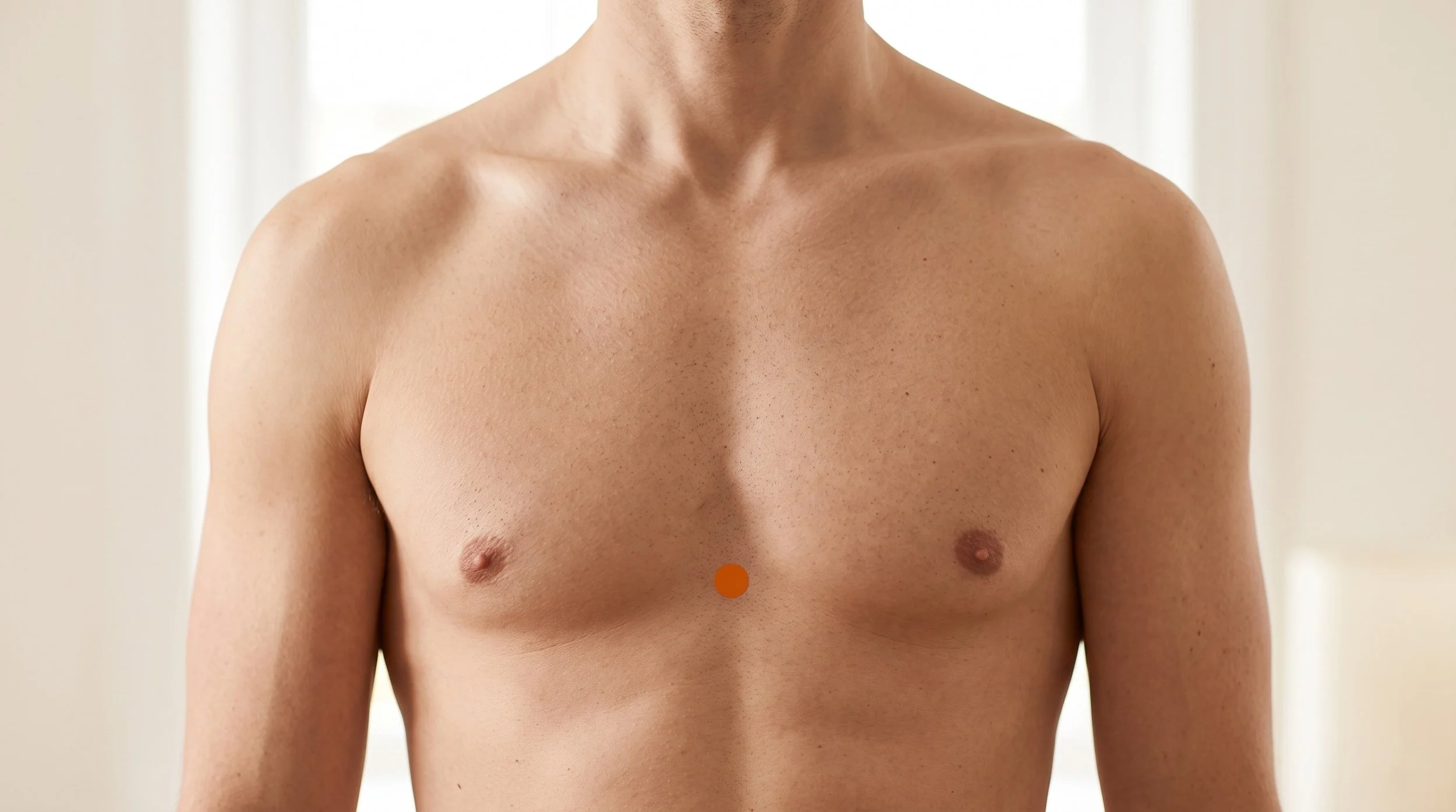
CV16 Acupuncture Point (Zhongting)
The Central Courtyard at the Base of the Sternum: Anatomy, Segmental Mechanism, and Why CV16 Belongs in Reflux, Hiccup, and Chest Tightness Treatment
CV16 (also written Ren 16), known in Chinese as Zhongting and usually translated as Central Courtyard, sits on the front midline of the body at the very bottom of the breastbone, where the lowest rib cartilages converge and the sternum meets the xiphoid process.
In plain terms, it's the tender spot you find if you run a finger down the center of your chest until the bone narrows and the soft notch of the upper abdomen begins. Classically it belongs to the Conception vessel, and the older texts group it with complaints that patients describe as pressure behind the breastbone, food that seems to catch on the way down, belching, hiccups, and vomiting shortly after eating.
Modern clinicians keep using this conception vessel 16 location for a simpler reason: the skin and periosteum here share spinal segments with the lower esophagus, diaphragm, and stomach, which makes the sternal base a useful surface access point for people whose upper digestive symptoms come bundled with a tight, guarded chest.
- CV16 is a superficial, bone-backed point. The needle passes through thin skin and subcutaneous tissue onto the periosteum of the xiphisternal junction, so treatment here is transverse and shallow rather than deep, and the surrounding tissue that actually loads the area is the costal cartilage ring and the fascial attachments of the diaphragm and intercostals (Simons et al., 1999).
- Traditional sources attribute two actions to this point: unbinding or opening the chest, and regulating the Stomach so that rebellious qi descends. Translated into physiological language, those are descriptions of reduced chest wall guarding and improved coordination of upper gastrointestinal function rather than statements about a substance moving through the body.
- The lower sternum is supplied by anterior cutaneous branches of the intercostal nerves around the sixth thoracic level, the same segmental neighborhood that carries visceral afferents from the distal esophagus, diaphragm, and stomach. Convergence of somatic and visceral input at these dorsal horn segments is the most plausible explanation for both the tenderness patients report over CV16 and the modulation that follows needling (Li et al., 2007).
- Experimental work supports the idea that acupoint stimulation can change upper gut behavior. Electrical stimulation at a classical antiemetic point reduced the frequency of transient lower esophageal sphincter relaxations in healthy volunteers (Zou et al., 2005), and animal studies show that segmental and distal points drive gastric motility in opposite directions through sympathetic and vagal pathways (Li et al., 2007).
- Clinical trial evidence is condition-level rather than point-level. Reviews of acupuncture for functional dyspepsia and for reflux report modest, low-certainty benefit within multi-point protocols (Lan et al., 2014; Zhu et al., 2017), and reviews of acupuncture for hiccups after stroke suggest possible benefit while flagging weak methodology (Yue et al., 2017).
- De qi at CV16 is quiet compared with limb points. Most patients feel a dull spreading pressure or a warm ache across the base of the sternum, occasionally with a sense of the chest loosening on the next breath, and a strong sharp sensation usually means the angle is too steep and should be corrected.
Does Food Feel Like It Catches Behind Your Breastbone?
That sensation of tightness or holdup at the lower sternum is one of the oldest recorded uses of CV16, and it's still one of the most common reasons we palpate this point. At Morningside Acupuncture we check the sternal base for tenderness, then combine gentle transverse needling here with distal points that influence gastric and esophageal function. Treatment is paired with practical guidance on meal timing, breathing mechanics, and posture, because chest wall tension and upper digestive symptoms tend to travel together. Schedule a visit and we'll assess the whole pattern rather than a single symptom.
Schedule NowAnatomy of CV16: Why the Sternocostal Angle Is Such an Important Location
CV16 lies on the anterior midline at the sternocostal angle, level with the fifth intercostal space, right at the junction between the body of the sternum and the xiphoid process. The tissue stack here is short: skin, a thin subcutaneous layer, and then fibrous periosteum over bone and cartilage. What loads this small area is everything that pulls on the lower rib cage.
The diaphragm takes origin from the back of the xiphoid and the inner surface of the lower costal cartilages, the rectus abdominis inserts onto the fifth through seventh cartilages and the xiphoid, and the sternal fibers of pectoralis major pull across the front. Chronic bracing, shallow upper chest breathing, chronic cough, and long hours hunched at a desk all concentrate mechanical stress at this convergence, which is why the point is so often tender to firm palpation.
The nerve supply of the point is straightforward and clinically useful. The overlying skin is innervated by the medial part of the anterior cutaneous branch of the sixth intercostal nerve, so CV16 sits in the T6 band. Visceral afferents from the distal esophagus, the diaphragm's costal margin, and the stomach travel back into roughly the same mid-thoracic segments, and when somatic and visceral inputs converge on shared dorsal horn neurons the result is both referred tenderness at the sternal base and a route for peripheral stimulation to influence visceral reflexes (Li et al., 2007).
Needle stimulation also recruits A-delta and C fiber afferents that engage descending inhibitory pathways from the brainstem, dampening the amplification that keeps a guarded, sensitive chest wall guarded (Zhao, 2008). This is the same broad mechanism that underlies acupuncture's measurable effects in chronic musculoskeletal pain (Vickers et al., 2018).
Directly deep to the point are the sternum and xiphoid, and beneath those the anterior mediastinum, pericardium, and the central tendon region of the diaphragm. The relevant vessels are the anterior perforating branches of the internal thoracic artery and vein, which emerge near the sternal border. Two safety facts drive the needling convention.
First, the bone is thin here. Second, a congenital sternal foramen, a small hole in the lower sternum, is present in a minority of people and cannot be detected by palpation. For both reasons, CV16 is needled transversely and superficially, insertion of about 0.5 cun directed either up or down along the midline, staying above the periosteum. Perpendicular or deep insertion at this Ren 16 chest location is not appropriate, and moxibustion or firm sustained pressure are reasonable alternatives when the tissue is very thin.
Related Conception Vessel Related Diaphragm Trigger PointsCV16 (Ren 16) at a Glance: Classification, Location, and Clinical Use
| Category | Detail |
|---|---|
| Traditional Name | Zhongting (Central Courtyard), CV16, also written REN-16 |
| Channel Classification | Conception vessel, the anterior midline vessel of the chest and abdomen (CV16, also written REN16; also called the Ren Mai or Ren channel) |
| Point Categories | No five-shu, hui-meeting, front-mu, or extraordinary vessel intersection status is assigned to this point in the standard reference texts. It is classified simply as a Conception vessel point of the lower sternum, with traditional actions given as unbinding the chest and regulating the Stomach to descend rebellion. |
| Precise Location | On the anterior midline of the sternum at the sternocostal angle, at the xiphisternal junction, level with the fifth intercostal space |
| Tissue Stimulated | Skin, thin subcutaneous tissue, and the periosteum of the xiphisternal junction, adjacent to the costal cartilage convergence and the fascial attachments of the diaphragm and the intercostal muscles |
| Needle Depth / Direction | Transverse, subcutaneous insertion along the midline directed superiorly or inferiorly, approximately 0.5 cun. Perpendicular or deep needling is avoided because of the thin sternum and the possibility of a sternal foramen. Moxibustion is traditionally considered suitable. |
| De Qi Sensation | A dull, spreading pressure or warm ache across the base of the sternum, sometimes with a subtle sense of the chest opening on inhalation. Sharp or bright pain suggests the needle is too steep and should be redirected. |
| Primary Clinical Uses | Fullness and tightness of the chest and rib sides, esophageal constriction with difficult swallowing, vomiting after eating, hiccups, belching and acid regurgitation, and in classical listings the vomiting of milk by infants (addressed with massage rather than needling) |
| Common Point Combinations |
|
The Deadman manual, A Manual of Acupuncture, presents CV16 as a point that traditionally unbinds the chest and regulates the Stomach so that rebellious qi descends, and its indication list is unusually consistent for a small midline point: fullness through the chest and rib sides, constriction at the gullet with difficulty getting food down, vomiting after meals, infants bringing up breast milk, and cold pain around the navel. The classical combinations follow the same theme.
Supplementing Life pairs it with KD27 and BL49 for vomiting, while the Thousand Ducat Formulas pairs it with LU1 for esophageal constriction with difficult ingestion, and groups it with CV19 and BL19 when swallowing is the main problem. Other texts add hiccups, sour belching, acid regurgitation, and chest pain to the picture, and recommend palpating the sternal base for tenderness before treating.
What's striking is how narrow and consistent the classical pattern is: a point sitting on bone at the front of the chest, credited almost entirely with complaints felt one layer deeper, along the tube that runs from throat to stomach.
Why CV16 Is Used for Reflux, Hiccups, and the Feeling of Food Catching Behind the Sternum
The link between a spot on the breastbone and symptoms felt in the esophagus is less mysterious than it sounds. Sensory nerves from the skin over the lower sternum enter the spinal cord around the sixth thoracic segment, and visceral afferents from the lower esophagus, the diaphragm's rim, and the stomach arrive in the same mid-thoracic neighborhood. Because these inputs converge on shared spinal neurons, irritation in the gut can register as tenderness on the chest wall, and stimulation of the chest wall can feed back into the reflex circuits that control the gut.
Animal work has mapped part of this two-way street, showing that stimulation at points sharing segments with the stomach tends to act through sympathetic pathways while distal limb points tend to act through vagal ones, with the direction of the motility change depending on which pathway dominates (Li et al., 2007).
There is also a direct physiological signal in humans. In a controlled study of healthy volunteers, electrical stimulation at a classical upper gastrointestinal acupoint reduced the frequency of transient lower esophageal sphincter relaxations, the inappropriate sphincter openings that account for most reflux episodes (Zou et al., 2005). That study used a wrist point rather than CV16, so it can't be read as evidence for this point specifically, but it establishes that acupoint stimulation can shift a measurable upper gut reflex rather than only altering how symptoms are reported.
A second mechanism matters for the chest tightness half of the picture. Needle stimulation activates small-diameter afferents that engage descending inhibitory systems in the brainstem and spinal cord, which reduces the sensitization that keeps a tender chest wall tender (Zhao, 2008). Patients with long-running reflux or persistent hiccups often hold the lower rib cage rigid, breathe high into the chest, and flinch when the sternal base is pressed.
Softening that guarding does not treat the underlying condition, but it frequently makes the chest feel less oppressive and breathing feel easier, which is what the classical language about unbinding the chest was describing in its own vocabulary.
What the Research Shows for CV16 (Ren 16)
One note on naming before the evidence: in the research literature this point is almost always listed as CV16, the WHO standard code, while many textbooks and Chinese sources write Ren 16 or RN16, so it is worth searching those as well if you want to read the studies below in full.
Very little research isolates single points, and CV16 is no exception. There is no randomized trial testing this point alone, so the honest framing is that CV16 appears inside multi-point protocols for upper digestive complaints, and the evidence below tests those protocols rather than the point. The reviews that exist for functional dyspepsia and reflux report modest benefit with low certainty, largely because of small samples and uneven methodology, while the physiological studies show that acupoint stimulation can move objective measures of esophageal and gastric function.
Read together, the picture supports acupuncture as a reasonable adjunct that may reduce symptom burden for some patients, not as a replacement for medical evaluation of swallowing difficulty, persistent vomiting, or chest pain.
| Study | Type | Focus | Key Finding |
|---|---|---|---|
| Lan et al., 2014 | Cochrane systematic review | Manual acupuncture and electroacupuncture for functional dyspepsia | The review found some evidence of symptom improvement but judged the trials at meaningful risk of bias, so the results should be treated as preliminary. |
| Zhu et al., 2017 | Systematic review and meta-analysis | Acupuncture for gastro-oesophageal reflux disease, alone or added to standard medication | Pooled results favored acupuncture as an add-on for global symptom improvement, though the authors cautioned that small samples and poor methodological quality limit confidence. |
| Zou et al., 2005 | Controlled human physiological study | Electrical acupoint stimulation and transient lower esophageal sphincter relaxations in healthy volunteers | Stimulation reduced the frequency of these sphincter relaxations compared with a sham point, indicating a real effect on an upper gut reflex. |
| Li et al., 2007 | Animal neurophysiology study | How stimulation at segmental versus distal points changes gastric motility | Points sharing spinal segments with the stomach and distal limb points produced opposite motility responses, mediated by sympathetic and vagal pathways respectively. |
| Yue et al., 2017 | Systematic review and meta-analysis | Acupuncture for hiccups following stroke | Included trials suggested benefit over conventional treatment, but the evidence base was small and methodologically weak, so conclusions remain tentative. |
| Vickers et al., 2018 | Individual patient data meta-analysis | Acupuncture for chronic pain across roughly 20,000 patients | Acupuncture outperformed both sham and usual care with effects persisting over time, supporting the general analgesic framework applied to chest wall pain. |
| Zhao, 2008 | Narrative review of mechanisms | Neural pathways of acupuncture analgesia | Describes how needle stimulation recruits spinal and supraspinal inhibitory systems, the framework used here to explain reduced chest wall sensitivity. |
Chest Tightness, Belching, and Hiccups That Won't Settle?
Persistent hiccups, frequent belching, and a band of pressure across the lower chest often respond better to a combined approach than to any one point. Our clinicians use Zhongting acupuncture alongside diaphragm and intercostal work, breathing retraining, and points chosen for autonomic effect. Sessions are calm, precise, and built around what your exam actually shows. Book an appointment to get a clear plan instead of guesswork.
Schedule NowCV16 in the Context of Trigger Point Work
The base of the sternum is crowded with myofascial referral. Trigger points in the sternalis muscle, a small variable sheet lying over the sternum, are described as producing a deep substernal ache that patients often mistake for cardiac or esophageal pain, and trigger points in the upper fibers of rectus abdominis near the xiphoid can refer across the epigastrium and mimic heartburn (Simons et al., 1999). Intercostal and diaphragm involvement adds a band of tightness around the lower rib cage that makes a full breath feel blocked.
Because CV16 sits exactly where these referral zones overlap, tenderness at the point is not automatically visceral in origin, and part of the clinical work is sorting out which layer is driving the complaint.
At Morningside Acupuncture we treat this region as a unit. CV16 is needled transversely and superficially, then combined with dry needling of the tender intercostal interspaces, the costal margin attachments of the diaphragm, and the sternal fibers of pectoralis major when they are shortened. Acupuncture, by our definition, is the use of an acupuncture needle across hundreds of styles, and dry needling of these muscles sits comfortably inside that definition.
Distal points such as PC6 and ST36 are usually added for their autonomic effect on the upper gut, and patients leave with breathing and mobility work aimed at keeping the lower rib cage from resetting into the same guarded pattern.
CV16 Reflux and Chest Tension Treatment at NYC's Highest-Rated Acupuncture Clinic
Morningside Acupuncture is the highest-rated acupuncture and dry needling clinic in New York City with over 500 five-star Google reviews. We treat upper digestive complaints, chest wall tightness, and rib pain with a blend of traditional point selection and modern trigger point needling, always explained in plain language. Every plan includes measurable goals so you know whether treatment is working. Schedule your first session and let's get started.
Schedule NowFrequently Asked Questions
Is CV16 the same point as Ren 16?
Yes. CV16 and Ren 16 are two codes for the same point, Zhongting. CV stands for Conception Vessel and is the WHO standard abbreviation, the one you will see in most research papers. Ren comes from Ren Mai, the Chinese name of the vessel, and it is the form used in many textbooks and acupuncture schools. You will also come across it written as REN-16, RN16, or Conception Vessel 16. Whichever code is used, the location and the uses are the same.
What does CV16 feel like when needled?
Most people feel a small pinch at the skin, then a dull, spreading pressure or a warm ache across the base of the breastbone. Because the needle lies flat under the skin over bone, the sensation stays local and mild rather than radiating down the body. Some patients notice their chest feels looser on the next few breaths. Sharp, bright, or stinging pain is not expected and usually means the needle angle needs adjusting, so tell your clinician right away if you feel it.
Why needle the sternum instead of treating the stomach or esophagus directly?
The esophagus, diaphragm, and stomach send sensory information into roughly the same mid-thoracic spinal segments that supply the skin over the lower sternum. That shared wiring is why upper digestive irritation often shows up as tenderness at this exact spot, and why stimulating the surface can feed into the reflex circuits controlling the gut below (Li et al., 2007). Practically, the sternal base is safe, easy to palpate, and easy to reach, whereas the structures it relates to are not accessible to a needle. Distal points such as PC6 are usually added because limb stimulation tends to engage different autonomic pathways than points on the trunk.
Can I press CV16 myself between sessions?
Yes, and it's one of the easier points to self-treat because it sits on bone. Run a finger down the center of your chest until the breastbone narrows and you feel the small notch at the top of your upper abdomen, then move just slightly upward onto the bone itself. Press with the pad of your thumb or index finger using steady, moderate pressure, enough to feel a dull ache but not enough to make you tense up or hold your breath. Hold for 30 to 60 seconds, breathing slowly out through your mouth, then rest and repeat two or three times, up to a few times a day. Small slow circles work as well as static pressure. Stop if you feel sharp pain, if the area is bruised or recently injured, or if you have any chest pain that is new, severe, or accompanied by shortness of breath, sweating, or arm or jaw discomfort, which requires urgent medical care rather than acupressure.
Is CV16 safe to needle?
In trained hands, yes, provided the standard technique is followed. The point is needled transversely and superficially along the midline, roughly 0.5 cun, staying above the periosteum and never angled perpendicular into the bone. This matters because the lower sternum is thin and a small percentage of people have a congenital sternal foramen, an opening that cannot be found by touch and that makes deep perpendicular needling at this level genuinely hazardous. Mild local tenderness or a small bruise are the usual side effects. Anyone with a pacemaker or implanted device, recent sternal surgery, a chest wall fracture, or a bleeding disorder should tell their clinician, and new or unexplained chest pain, difficulty swallowing, persistent vomiting, or unintended weight loss should be evaluated medically before being treated as a functional complaint.
Where exactly is CV16 located?
CV16 is on the anterior midline of the body at the sternocostal angle, the point where the sternum narrows and the lower costal cartilages converge at the xiphisternal junction. It sits level with the fifth intercostal space measured along the nipple line, roughly 1.6 cun below CV17 at the center of the sternum. To find it, place a finger at the notch at the top of your breastbone and slide straight down to where the flat bone ends and the softer xiphoid begins, then stay just on the bone above that transition. Tenderness on firm pressure often confirms the spot in people with upper digestive or chest tension complaints.
References
- Deadman, P., Al-Khafaji, M., & Baker, K. (2009). A manual of acupuncture. Journal of Chinese Medicine Publications.
- Cunningham, P. M. (2000). Acupuncture points: A practical guide to classical and modern usage. Odyssey Press.
- Cheng, X. (Ed.). (1999). Chinese acupuncture and moxibustion (Rev. ed.). Foreign Languages Press.
- O'Connor, J., & Bensky, D. (Eds. & Trans.). (1981). Acupuncture: A comprehensive text. Shanghai College of Traditional Medicine. Eastland Press.
- Simons, D. G., Travell, J. G., & Simons, L. S. (1999). Travell & Simons' myofascial pain and dysfunction: The trigger point manual, Vol. 1: Upper half of body (2nd ed.). Williams & Wilkins.
- Lan, L., Zeng, F., Liu, G. J., Ying, L., Wu, X., Liu, M., & Liang, F. R. (2014). Acupuncture for functional dyspepsia. Cochrane Database of Systematic Reviews, 2014(10), CD008487. https://doi.org/10.1002/14651858.CD008487.pub2
- Zhu, J., Guo, Y., Liu, S., Su, X., Li, Y., Yang, Y., Hou, L., Wang, G., Zhang, J., Chen, J. D. Z., Wang, Q., Wei, R., & Wei, W. (2017). Acupuncture for the treatment of gastro-oesophageal reflux disease: A systematic review and meta-analysis. Acupuncture in Medicine, 35(5), 316-323. https://doi.org/10.1136/acupmed-2016-011205
- Zou, D., Chen, W. H., Iwakiri, K., Rigda, R., Tippett, M., & Holloway, R. H. (2005). Inhibition of transient lower esophageal sphincter relaxations by electrical acupoint stimulation. American Journal of Physiology-Gastrointestinal and Liver Physiology, 289(2), G197-G201. https://doi.org/10.1152/ajpgi.00023.2005
- Li, Y. Q., Zhu, B., Rong, P. J., Ben, H., & Li, Y. H. (2007). Neural mechanism of acupuncture-modulated gastric motility. World Journal of Gastroenterology, 13(5), 709-716. https://doi.org/10.3748/wjg.v13.i5.709
- Yue, J., Liu, M., Li, J., Wang, Y., Hung, E. S., Tong, X., Sun, Z., Zhang, Q., & Golianu, B. (2017). Acupuncture for the treatment of hiccups following stroke: A systematic review and meta-analysis. Acupuncture in Medicine, 35(1), 2-8. https://doi.org/10.1136/acupmed-2015-011024
- Vickers, A. J., Vertosick, E. A., Lewith, G., MacPherson, H., Foster, N. E., Sherman, K. J., Irnich, D., Witt, C. M., & Linde, K. (2018). Acupuncture for chronic pain: Update of an individual patient data meta-analysis. Journal of Pain, 19(5), 455-474. https://doi.org/10.1016/j.jpain.2017.11.005
- Zhao, Z. Q. (2008). Neural mechanism underlying acupuncture analgesia. Progress in Neurobiology, 85(4), 355-375. https://doi.org/10.1016/j.pneurobio.2008.05.004
Disclaimer: This web site is intended for educational and informational purposes only. Reading this website does not constitute providing medical advice or any professional services. This information should not be used for diagnosing or treating any health issue or disease. Those seeking medical advice should consult with a licensed physician. Seek the advice of a medical doctor or other qualified health professional for any medical condition. If you think you have a medical emergency, call 911 or go to the emergency room. No acupuncturist-patient relationship is created by reading this website or using the information. Morningside Acupuncture PLLC and its employees and contributors do not make any express or implied representations with respect to the information on this site or its use. For any legal interpretation of scope of practice in your state, consult a licensed attorney or regulatory authority.
Read more from our blog



