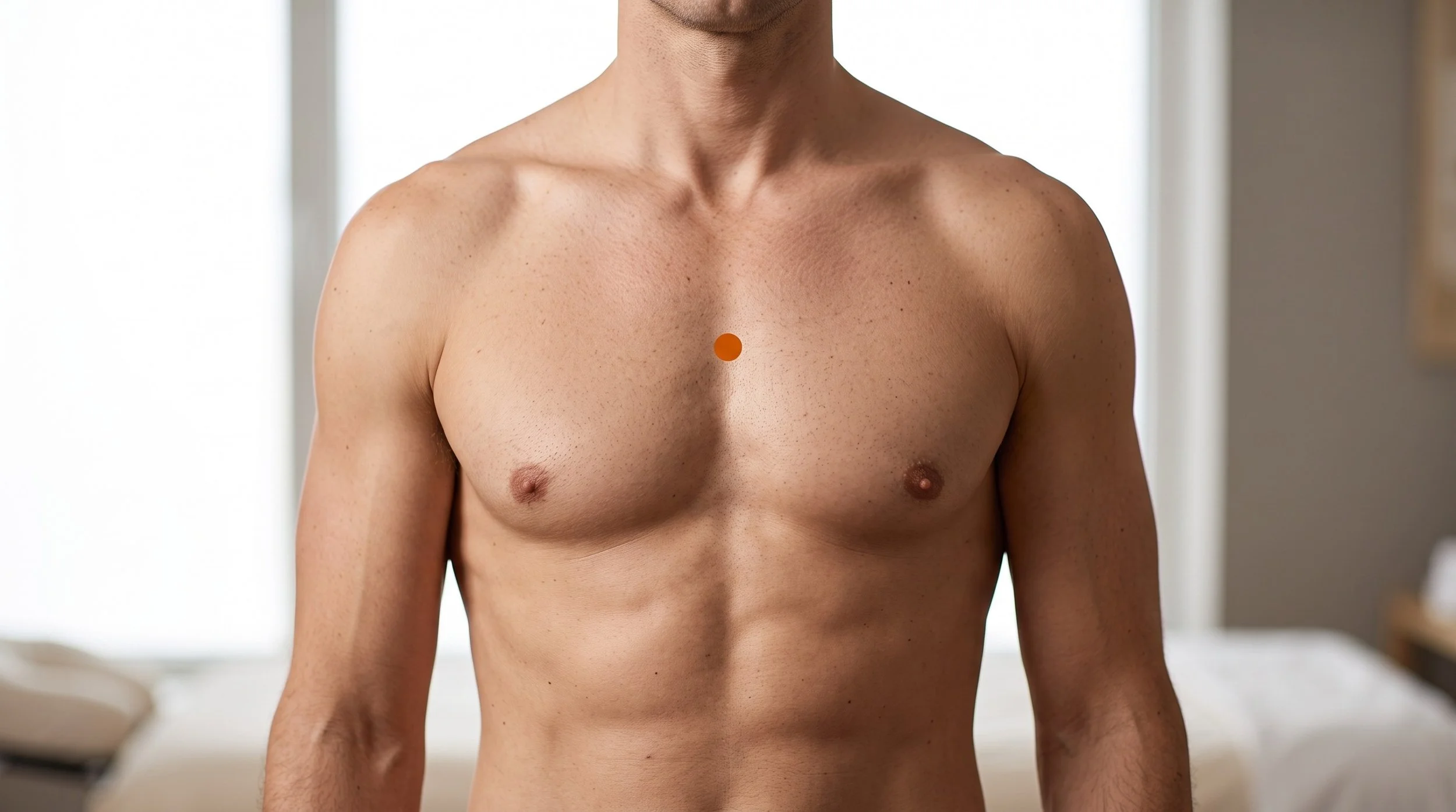
CV19 Acupuncture Point (Zigong)
The Purple Palace on the Breastbone: Anatomy, Mechanism, and Why This Sternal Midline Point Belongs in Chest, Cough, and Breathing Treatment
CV19 (Zigong, "Purple Palace"), also written Ren 19, sits on the front midline of the breastbone, level with the second intercostal space, roughly a thumb's width below the bony ridge of the sternal angle. It belongs to the row of Conception vessel points that march up the sternum from CV16 to CV21, and like its neighbors it is needled flat against bone rather than into it.
Clinicians reach for the CV19 acupuncture point when the complaint sits behind the breastbone itself: aching or pressure over the sternum, a cough that produces thick sticky phlegm, and the tight, guarded, high-in-the-chest breathing pattern that shows up with stress and with chronic respiratory conditions. Its usefulness is easy to explain in plain anatomical terms, because the skin over the sternum is supplied by the same upper thoracic nerve roots that carry sensation from the heart, the airways, and the esophagus.
- Location and layers: CV19 lies on the anterior midline over the body of the sternum at the level of the second intercostal space, with almost nothing between skin and periosteum except thin subcutaneous fat and fascia, so the needle is always laid flat along the surface rather than driven inward.
- Traditional categories translated: classical sources place CV19 among the chest-unbinding points of the Conception vessel and describe it as regulating and descending qi, language that maps neatly onto a modern description of reducing chest wall guarding and downshifting an over-revved autonomic state (Hamvas et al., 2023).
- Nerve story: the point sits in the T2 territory of the anterior cutaneous branch of the second intercostal nerve, a segment that also receives afferent traffic from the heart, great vessels, and upper airways, which is the convergence that makes a superficial sternal point clinically relevant to deep chest symptoms (Zhao, 2008).
- Research picture: no trial has isolated CV19 on its own, but chest and back point protocols have been tested for respiratory symptoms, with a systematic review of 30 randomized trials suggesting added benefit for chronic cough severity and cough-related quality of life at moderate certainty (Lee et al., 2025), and a placebo-controlled trial reporting reduced exertional breathlessness in COPD (Suzuki et al., 2012).
- Clinical framing: CV19 is a supporting player rather than a primary driver, usually added to CV17 or CV18 and to distal points, in the same way that multi-point protocols rather than single needles have produced the pain benefits seen in large individual patient data analyses (Vickers et al., 2018).
- De qi at this point is distinctive: patients typically report a flat, spreading dull ache or a warm, heavy pressure that travels a short distance up or down the breastbone, not the deep grabbing sensation of a muscular point, and sharpness or bone-tapping pain means the angle needs correcting.
Is Tightness Behind Your Breastbone Making It Hard To Take A Full Breath?
That band of pressure across the upper chest is often a mix of chest wall tension, breathing pattern habits, and an autonomic system stuck in a high gear. At Morningside Acupuncture we combine sternal midline points like CV19 and CV17 with dry needling of the pectoralis, intercostal, and scalene muscles that keep the rib cage locked in an inhaled position. Most patients notice the breath drops lower and the chest feels less braced within the first few visits. Schedule a session and let us assess how your rib cage is actually moving.
Schedule NowAnatomy of CV19: Why the Sternal Body at the Second Intercostal Level Is Such an Important Location
CV19 sits directly over the body of the sternum on the anterior midline, level with the second intercostal space. The practical way to find it is to run a finger down the front of the neck into the jugular notch, drop onto the manubrium, and feel for the transverse ridge of the sternal angle where the second costal cartilages attach, then slide just below that ridge and stay on the midline. The tissue stack here is short: skin, a thin layer of subcutaneous fat, the fascia of the pectoral region as it crosses the midline, and then periosteum over bone.
Some people have a sternalis muscle, a common anatomical variant lying vertically over the sternum, which can be tender and can refer discomfort across the front of the chest. What loads this region is not lifting or twisting so much as breathing itself: chronic upper chest breathing, prolonged coughing, forward head and rounded shoulder posture, and the reflexive bracing that comes with anxiety all keep the sternocostal joints and the pectoral fascia under sustained tension.
The sensory supply at CV19 comes from the anterior cutaneous branch of the second intercostal nerve, which places the point squarely in the T2 segment. That detail matters more than it sounds. Upper thoracic segments (roughly T1 through T5) also receive visceral afferent input from the heart, the great vessels, the trachea and bronchi, and the esophagus, and those visceral and somatic inputs converge on shared second-order neurons in the dorsal horn.
This is the standard explanation for why cardiac pain is felt in the chest wall and arm, and it also runs in the other direction: sustained somatic input from the chest wall can modulate how that shared segment processes visceral signals (Zhao, 2008). Needling stimulates A-delta and C fibers in skin and fascia, which recruits segmental inhibition locally and triggers descending inhibitory pathways from the brainstem along with endogenous opioid release, the same mechanisms that underlie the analgesic effects documented across chronic pain conditions (Zhao, 2008; Vickers et al., 2018).
Autonomic effects are part of the picture too, with meta-analytic data suggesting real needling shifts heart rate variability toward greater parasympathetic tone compared with placebo procedures, though the authors urge caution given study quality (Hamvas et al., 2023).
Behind the sternum lies the anterior mediastinum, and a short distance lateral to each sternal border run the internal thoracic arteries. This is why needling convention at CV19 is non-negotiable: insertion is transverse (subcutaneous), directed either superiorly or inferiorly along the channel, to a depth of roughly 0.5 to 1 cun, with some texts favoring an even shallower 0.3 to 0.5 inch. A perpendicular needle has no place here.
A meaningful minority of people have a congenital sternal foramen, an unossified gap in the sternal body that a deep perpendicular needle could pass through, and that gap is not detectable by palpation. Keeping the shaft flat against the periosteum eliminates the concern entirely. Moxibustion is traditionally applied at this point, and cupping or gentle manual work over the sternum can substitute when a patient prefers not to be needled on the chest.
Related Conception Vessel Related Intercostal Muscles Trigger PointsCV19 (Ren 19) at a Glance: Classification, Location, and Clinical Use
| Category | Detail |
|---|---|
| Traditional Name | Zigong (Purple Palace), Conception vessel 19, listed as REN-19 in A Manual of Acupuncture |
| Channel Classification | Conception vessel (Ren mai), nineteenth point of the channel, part of the sternal midline row running from CV16 to CV21 (CV19, also written REN19) |
| Point Categories | No five-shu, back-shu, front-mu, luo, xi-cleft, or hui-meeting designation and no listed extraordinary vessel crossing in the reference sources. It is classified functionally as a chest-unbinding point of the Conception vessel, with traditional actions given as unbinding the chest and regulating and descending qi. Note that it shares its pinyin name with the extra point Zigong (M-CA-18) on the lower abdomen, which is an entirely different point used for gynecological complaints. |
| Precise Location | On the anterior midline of the sternum, level with the junction of the second intercostal space and the breastbone. Locate the costal cartilage of the second rib at the sternal angle, then drop into the space just below it and come back to the midline. |
| Tissue Stimulated | Skin and subcutaneous fascia over the body of the sternum, sternal periosteum, and the pectoral fascia crossing the midline, with the variable sternalis muscle in some individuals. Frequently paired with needling of the intercostal muscles and serratus anterior when chest wall pain is myofascial. |
| Needle Depth / Direction | Transverse (subcutaneous) insertion directed superiorly or inferiorly along the channel, 0.5 to 1 cun; some texts use 0.3 to 0.5 inch. The needle stays flat against the sternum. Perpendicular or deep insertion is not used. Moxibustion is traditionally applicable. |
| De Qi Sensation | A flat, spreading dull ache or warm heaviness over the breastbone that may travel a short distance up or down the midline. Sharp pain, a bone-tapping sensation, or stinging means the angle is too steep and should be corrected. |
| Primary Clinical Uses | Chest and sternal pain, chest oppression and tightness, cough with difficult sticky phlegm, wheezy or effortful breathing, and the guarded upper chest breathing pattern that accompanies stress and agitation. Classical texts add vomiting with upward-rushing qi, difficult swallowing, painful obstruction, and bone pain. |
| Common Point Combinations |
|
In Deadman, Al-Khafaji and Baker's A Manual of Acupuncture, CV19 is credited with two traditional actions: unbinding the chest and regulating and descending qi. The indications attributed to it fall into four loose groups.
There are chest wall complaints (pain of the chest and pain of the sternum), respiratory complaints (cough, coughing of blood, and a distinctive description of sputum so thick it resembles white glue), complaints of upward movement in the digestive tract (vomiting with uprising qi and difficulty getting food down), and states of the mind and body more broadly (agitation, painful obstruction, and bone pain). Chinese Acupuncture and Moxibustion keeps a narrower list of chest pain, cough, and asthma, and confirms the shallow subcutaneous needling with moxibustion permitted.
The classical combinations preserved here are worth noting for their consistency: the Thousand Ducat Formulas pair CV19 with its immediate neighbor CV18 and the distal kidney point KD3 for cough with rebellious qi and agitation, and pair it with CV16 and BL19 for difficult ingestion, while Supplementing Life groups CV19 with CV18 and BL17 for bone pain.
What makes the traditional pattern striking is how tightly the indications cluster around a single idea: things that ought to move downward (breath, food, emotional agitation) are instead pushing up through the midline, and a point on the breastbone is being used to turn that traffic around.
Why CV19 Is Used for Breathlessness, Chest Tightness, and Cough That Will Not Settle
The most useful way to understand CV19 is through segmental convergence. The skin over the sternum at the second intercostal level is supplied by the anterior cutaneous branch of the second intercostal nerve, which enters the spinal cord at T2. That same neighborhood of upper thoracic segments receives sensory input from the heart, the great vessels, the trachea and bronchi, and the esophagus.
Because visceral and somatic afferents converge onto shared neurons in the dorsal horn, the nervous system cannot always tell precisely where an upper chest signal originated, which is why heart and airway problems are felt as chest wall discomfort. Needling a superficial point in that dermatome feeds a strong, well-localized somatic signal into the same segment, which may change how the pool of neurons weights the whole input (Zhao, 2008). This is also the honest explanation for why classical texts grouped cough, chest pain, vomiting, and difficulty swallowing under one sternal point. They are all upper thoracic problems.
Beyond the segment, needling recruits descending inhibitory control from the periaqueductal gray and rostral ventromedial medulla and drives endogenous opioid release, mechanisms that have been characterized in detail in laboratory work and that plausibly account for a share of the clinical pain effect seen in large pooled analyses of chronic pain trials (Zhao, 2008; Vickers et al., 2018). For chest complaints there is an autonomic layer as well.
Meta-analytic data comparing real needling with placebo procedures suggest a shift in heart rate variability toward parasympathetic dominance after treatment, which is the physiological version of what patients describe as the chest letting go, though the authors are careful to note heterogeneity and modest study quality (Hamvas et al., 2023).
The clinical payoff is practical. Patients who breathe high in the chest hold the sternum, upper ribs, and neck accessory muscles in a state of low-grade contraction all day, which makes the chest wall tender, restricts rib excursion, and makes every breath feel incomplete. CV19 is one of several points used to interrupt that loop from the front, while dry needling of the muscles that actually generate the restriction addresses it from the sides. Neither substitutes for medical evaluation. Any new, exertional, radiating, or unexplained chest pain needs a physician first, and acupuncture is added afterward, not instead.
What the Research Shows for CV19 (Ren 19)
One note on naming before the evidence: in the research literature this point is almost always listed as CV19, the WHO standard code, while many textbooks and Chinese sources write Ren 19 or RN19, so it is worth searching those as well if you want to read the studies below in full.
There is no clinical trial of CV19 by itself, and there almost certainly never will be, because acupuncture research tests protocols rather than single needles. What the literature can tell us is whether the kinds of protocols that typically include sternal and upper chest points produce measurable change in the conditions CV19 is traditionally used for. The picture there is cautiously encouraging for cough and breathlessness as add-on care and reasonably robust for pain in general, with the usual caveats about blinding, sham design, and the fact that most respiratory trials come from a single geographic region. Read the table below as evidence about the company CV19 keeps, not about the point in isolation.
| Study | Type | Focus | Key Finding |
|---|---|---|---|
| Lee et al., 2025 | Systematic review and meta-analysis (30 RCTs, 2,835 participants) | Acupuncture and related acupoint therapies for chronic cough | Added to conventional treatment, acupoint-based therapy was associated with improved cough severity and cough-related quality of life without more adverse events, with certainty of evidence generally rated moderate because of risk of bias. |
| Suzuki et al., 2012 | Randomized placebo-controlled trial | Acupuncture for dyspnea on exertion in COPD alongside standard medication | Real needling was associated with greater improvement in exertional breathlessness than placebo needling, suggesting a possible adjunctive role, though blinding in acupuncture trials of this kind has been debated in published correspondence. |
| Zhao et al., 2019 | Four-arm randomized clinical trial (404 participants) | Acupuncture as an add-on to antianginal medication for chronic stable angina | Points selected on the disease-affected channel were associated with a greater reduction in angina attack frequency than non-affected channel points, sham, or wait list, which is relevant to how upper chest points are chosen rather than proof that any single point works. |
| Hamvas et al., 2023 | Systematic review and meta-analysis (9 RCTs) | Manual acupuncture and heart rate variability compared with placebo procedures | Real needling was associated with post-treatment shifts in high frequency power and the LF/HF ratio consistent with increased parasympathetic tone, with results the authors advise interpreting cautiously. |
| Vickers et al., 2018 | Individual patient data meta-analysis (about 21,000 patients) | Acupuncture for chronic musculoskeletal, headache, and osteoarthritis pain | Acupuncture outperformed both sham and no-acupuncture controls with effects that persisted over time, supporting the analgesic component of protocols that include chest wall points. |
Still Coughing Weeks After The Infection Cleared?
A cough that lingers with thick, hard to clear phlegm is exactly the pattern classical texts assigned to CV19, and it is also one of the better studied uses of acupuncture as an add-on to standard care. We use CV19 alongside upper back points, LU and LI channel points, and hands-on work for the chest wall muscles that get sore and reactive after weeks of coughing. Treatment is gentle, superficial, and coordinated with whatever your physician has already prescribed. Book an appointment to see whether acupuncture belongs in your recovery plan.
Schedule NowCV19 in the Context of Trigger Point Work
Pain felt over the breastbone is frequently myofascial rather than sternal. The sternal division of pectoralis major, the sternalis when present, the upper intercostals, the scalenes, and even sternocleidomastoid can all refer sensation into the front of the chest, and trigger point referral maps have documented these patterns in detail (Simons et al., 1999).
At Morningside we palpate before we needle, and if pressing a taut band in the pectoralis reproduces the patient's exact sternal ache, that muscle gets treated directly with dry needling rather than treating only the midline. CV19 then functions as a segmental anchor in the same T2 territory, added flat along the sternum while the actual pain generators are addressed laterally.
The overlap is worth naming plainly, because it is often misunderstood. Acupuncture means the use of an acupuncture needle, and that includes hundreds of styles, dry needling among them. A filiform needle laid transversely at CV19 and the same needle placed into a taut band in the intercostals are two applications of one tool, chosen for different targets.
In practice a chest treatment might combine transverse needling at CV19 and CV17, precise trigger point work in pectoralis major, intercostals, and serratus anterior, manual release of the sternocostal junctions, and coaching in diaphragmatic breathing so the pattern that created the tension does not simply rebuild it between visits.
CV19 Chest Tightness and Cough Treatment at NYC's Highest-Rated Acupuncture Clinic
Morningside Acupuncture is the highest-rated acupuncture and dry needling clinic in New York City with over 500 five-star Google reviews, and our approach blends classical point selection with modern pain science and myofascial work. For chest and breathing complaints we build treatments around sternal points such as CV19, targeted needling of the chest wall and neck accessory muscles, and breathing retraining you can use at home. Every plan is individualized, evidence informed, and coordinated with your medical care. Schedule your visit today.
Schedule NowFrequently Asked Questions
Is CV19 the same point as Ren 19?
Yes. CV19 and Ren 19 are two codes for the same point, Zigong. CV stands for Conception Vessel and is the WHO standard abbreviation, the one you will see in most research papers. Ren comes from Ren Mai, the Chinese name of the vessel, and it is the form used in many textbooks and acupuncture schools. You will also come across it written as REN-19, RN19, or Conception Vessel 19. Whichever code is used, the location and the uses are the same.
What does CV19 feel like when needled?
Because the needle is laid flat under the skin rather than inserted downward, CV19 usually feels mild. Most patients describe a brief pinch at insertion followed by a flat, spreading dull ache or a warm, heavy pressure over the breastbone that may travel an inch or two up or down the midline. Some people feel a pleasant sense of the chest opening or a spontaneous deeper breath. What you should not feel is sharp pain, a hard tapping sensation against bone, or stinging, and telling your acupuncturist immediately lets them adjust the angle in a second or two.
Why needle the breastbone for a cough or for breathing problems instead of the lungs or the back?
Two reasons, one modern and one traditional. Anatomically, the skin over the sternum at this level is supplied by the second intercostal nerve and shares its spinal segment with sensory input from the airways, heart, and esophagus, so a strong somatic signal delivered there feeds into the same processing pool that handles chest symptoms (Zhao, 2008). Traditionally, CV19 belongs to a row of sternal points described as unbinding the chest and directing qi downward, which is the classical framing for the same clinical target. In practice CV19 is rarely used alone anyway, and most chest treatments also include upper back points, forearm points, and hands-on work for the rib cage.
Can I press CV19 myself between sessions?
Yes, and it is one of the easier points to self-treat because you can reach it comfortably. Find the bony ridge across your upper breastbone (the sternal angle), slide your finger just below it, and stay on the midline. Use the pad of your thumb or two fingers and press straight back into the bone with moderate, steady pressure, enough to feel a firm ache but not enough to make you tense up. Hold for 30 to 60 seconds while breathing out slowly, release for a few seconds, and repeat three to five times. Small circular pressure works too. Two or three rounds a day is plenty. Pair it with slow nasal breathing where the exhale is longer than the inhale, since the point of the exercise is to unlock the chest, not to bruise it. Stop and see a physician if pressing reproduces a pain that also radiates, occurs with exertion, or comes with shortness of breath, sweating, or nausea.
Is CV19 safe to needle?
In trained hands, yes, provided the technique is correct. The safety rule at CV19 is that the needle runs transversely along the surface of the sternum and never perpendicular, because a small percentage of people have a congenital sternal foramen, an unossified gap in the bone that palpation cannot detect. Kept flat and shallow at 0.5 to 1 cun, the needle stays in skin and superficial fascia and comes nowhere near anything in the chest. Additional considerations include a history of keloid or hypertrophic scarring over the sternum, recent sternotomy or chest surgery, fragile skin or radiation changes, and any implanted device in the area. Always mention new or unexplained chest pain to a physician before treating it as a musculoskeletal complaint.
Where exactly is CV19 located?
CV19 is on the anterior midline of the sternum, level with the second intercostal space. To find it, place a finger in the hollow at the base of your throat, move straight down onto the breastbone, and feel for the transverse bony ridge about two inches down where the manubrium meets the sternal body. That ridge is the sternal angle, and it lines up with the second rib. Slide your finger below the second rib's cartilage into the space beneath it, then return to the exact midline of the bone. That spot is Ren 19 on the sternum. Its immediate neighbors are CV18 below and CV20 above, each roughly one intercostal space apart. Do not confuse purple palace point with the extra point of the same pinyin name, Zigong (M-CA-18), which lies on the lower abdomen and is used for entirely different complaints.
References
- Deadman, P., Al-Khafaji, M., & Baker, K. (2009). A manual of acupuncture. Journal of Chinese Medicine Publications.
- Cheng, X. (Ed.). (1999). Chinese acupuncture and moxibustion (Rev. ed.). Foreign Languages Press.
- Simons, D. G., Travell, J. G., & Simons, L. S. (1999). Travell & Simons' myofascial pain and dysfunction: The trigger point manual, Vol. 1: Upper half of body (2nd ed.). Williams & Wilkins.
- Lee, B., Kwon, C.-Y., Jeong, Y. K., Ha, N.-Y., Kim, K.-I., Lee, B.-J., & Lee, J.-H. (2025). Acupuncture-related therapy for chronic cough: A systematic review and meta-analysis. Integrative Medicine Research, 14(1), 101121. https://doi.org/10.1016/j.imr.2025.101121
- Suzuki, M., Muro, S., Ando, Y., Omori, T., Shiota, T., Endo, K., Sato, S., Aihara, K., Matsumoto, M., Suzuki, S., Itotani, R., Ishitoko, M., Hara, Y., Takemura, M., Ueda, T., Kagioka, H., Hirabayashi, M., Fukui, M., & Mishima, M. (2012). A randomized, placebo-controlled trial of acupuncture in patients with chronic obstructive pulmonary disease (COPD): The COPD-acupuncture trial (CAT). Archives of Internal Medicine, 172(11), 878-886. https://doi.org/10.1001/archinternmed.2012.1233
- Zhao, L., Li, D., Zheng, H., Chang, X., Cui, J., Wang, R., Shi, J., Fan, H., Li, Y., Sun, X., Zhang, F., Wu, X., & Liang, F. (2019). Acupuncture as adjunctive therapy for chronic stable angina: A randomized clinical trial. JAMA Internal Medicine, 179(10), 1388-1397. https://doi.org/10.1001/jamainternmed.2019.2407
- Hamvas, S., Hegyi, P., Kiss, S., Lohner, S., McQueen, D., & Havasi, M. (2023). Acupuncture increases parasympathetic tone, modulating HRV: Systematic review and meta-analysis. Complementary Therapies in Medicine, 72, 102905. https://doi.org/10.1016/j.ctim.2022.102905
- Zhao, Z. Q. (2008). Neural mechanism underlying acupuncture analgesia. Progress in Neurobiology, 85(4), 355-375. https://doi.org/10.1016/j.pneurobio.2008.05.004
- Vickers, A. J., Vertosick, E. A., Lewith, G., MacPherson, H., Foster, N. E., Sherman, K. J., Irnich, D., Witt, C. M., & Linde, K. (2018). Acupuncture for chronic pain: Update of an individual patient data meta-analysis. Journal of Pain, 19(5), 455-474. https://doi.org/10.1016/j.jpain.2017.11.005
Disclaimer: This web site is intended for educational and informational purposes only. Reading this website does not constitute providing medical advice or any professional services. This information should not be used for diagnosing or treating any health issue or disease. Those seeking medical advice should consult with a licensed physician. Seek the advice of a medical doctor or other qualified health professional for any medical condition. If you think you have a medical emergency, call 911 or go to the emergency room. No acupuncturist-patient relationship is created by reading this website or using the information. Morningside Acupuncture PLLC and its employees and contributors do not make any express or implied representations with respect to the information on this site or its use. For any legal interpretation of scope of practice in your state, consult a licensed attorney or regulatory authority.
Read more from our blog



