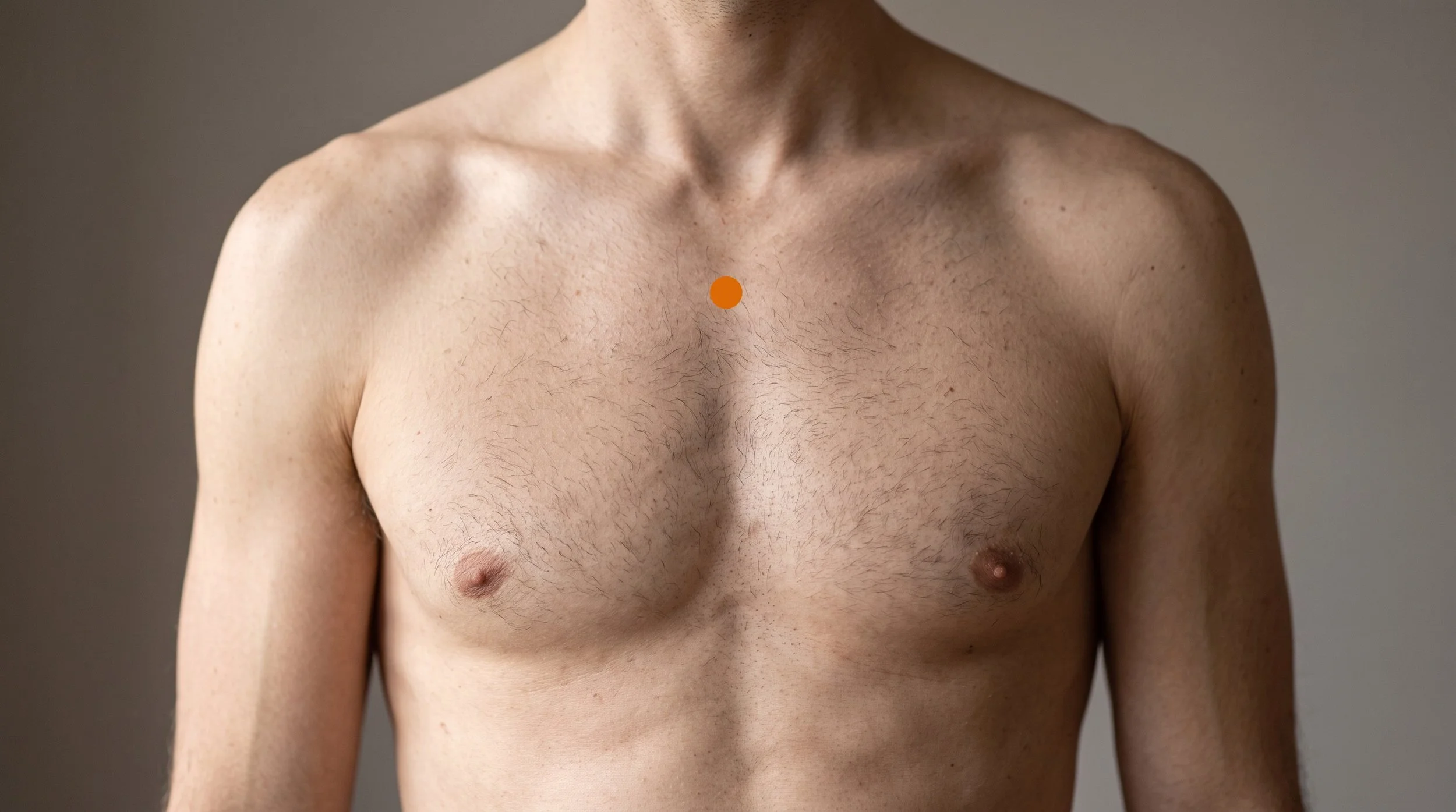
CV20 Acupuncture Point (Huagai)
The Magnificent Canopy on the Upper Sternum: Anatomy, Mechanism, and Why This Quiet Chest Point Belongs in Cough and Breathing Work
CV20 (Huagai), also written Ren 20, often translated as Magnificent Canopy or the emperor's umbrella, sits on the midline of the upper sternum at the level of the first intercostal space, roughly a finger's width or two below the notch at the top of the breastbone and above the more famous chest point CV17. The name points to the classical image of the Lungs as a canopy spread over the heart, and the historical record for this conception vessel 20 point is unusually consistent: nearly every listed indication involves the chest and the breath.
In modern practice the CV20 acupuncture point is a shallow, over-bone location that clinicians use as a local anchor for cough, wheezing patterns, upper chest tightness, and the guarded, shallow breathing that so often accompanies them, always alongside standard medical care rather than instead of it.
- Location and layers: CV20 lies on the body of the sternum on the anterior midline, level with the junction of the first intercostal space and the sternum, so the needle passes through thin skin and subcutaneous tissue onto periosteum rather than into muscle (Deadman et al., 2009).
- Traditional categories, translated: classical texts describe this point as unbinding the chest and descending rebellious qi (Deadman et al., 2009), language that maps clinically onto reducing the sensation of chest constriction and calming the upward-driving pattern of cough and breathlessness.
- Mechanism: needling here recruits anterior cutaneous branches of the upper intercostal nerves in the T1 and T2 range, segments that share dorsal horn territory with visceral afferents from the airways and mediastinum, and needle-evoked afferent traffic is known to engage segmental and descending inhibitory pathways (Zhao, 2008).
- The research picture is modest and indirect: Cochrane found the asthma trial evidence inconsistent and insufficient (McCarney et al., 2004), while more recent syntheses in chronic cough and COPD suggest possible symptom and quality-of-life benefit when acupuncture is added to conventional care (Lee et al., 2025; Hsieh et al., 2019).
- Clinical framing: CV20 is almost never used alone, and reviews test whole protocols rather than single points, so it is best understood as one local element in a chest and breathing prescription that also includes distal and back-shu points (Chun et al., 2021).
- De qi at CV20 is subtle by design. Because the insertion is transverse and shallow over bone, most people report a mild spreading ache, warmth, or a sense of the upper chest opening rather than the deep grabbing sensation felt at limb points.
Feeling Tight in the Upper Chest When You Breathe?
Chest tightness rarely comes from one tissue, and we treat it that way. At Morningside Acupuncture we combine gentle needling at points like CV20 and CV17 with dry needling of the pectoral, intercostal, and accessory breathing muscles, plus breathing retraining you can use at home. Sessions are calm, precise, and built around what your body is actually doing when you inhale. Book an evaluation and let's map it out together.
Schedule NowAnatomy of CV20: Why the Upper Sternum Is Such an Important Location
CV20 sits on the anterior midline of the sternum at the level of the first intercostal space, just below the sternal angle landmark used to find the second rib (Deadman et al., 2009). The tissue stack here is short: skin, a thin layer of subcutaneous fat and superficial fascia, then the dense periosteum of the sternum itself. There is essentially no muscle belly directly under the midline, though the sternal fibers of pectoralis major fan away to either side, and a minority of people have a sternalis muscle running vertically across this region.
What loads this area is not heavy lifting but breathing mechanics: a forward head and rounded shoulder posture, weeks of coughing, chronic upper chest breathing, and habitual bracing all keep the anterior chest wall short, stiff, and tender to palpation.
The sensory supply to this patch of skin comes from the anterior cutaneous branches of the upper intercostal nerves, principally the first and second, which emerge near the sternal border. Those nerves enter the spinal cord at upper thoracic segments that also receive afferent input from the airways, the mediastinum, and the heart.
That anatomical overlap is the practical basis for a segmental effect: stimulating somatic afferents in a dermatome can influence processing of input arriving in the same and neighboring cord segments, and needle stimulation more broadly recruits A-delta and C fiber traffic that engages spinal gating and descending inhibitory control from the brainstem (Zhao, 2008).
It also explains why anterior chest wall pain is so often myofascial in origin, since pectoralis major, sternalis, and the intercostals can all refer pain across the front of the chest in patterns that patients describe as deep or cardiac-sounding (Simons et al., 1999).
Deep to CV20 is bone, which is exactly why the point is considered safe to needle when technique is respected. The lungs and great vessels are shielded by the sternum, and the internal thoracic vessels run lateral to the sternal border rather than under the midline. Two cautions still apply. A small percentage of people have a congenital sternal foramen, a gap in the bone that is invisible from the surface, and for that reason experienced practitioners do not needle sternal midline points perpendicularly or deeply.
Standard technique is transverse insertion along the channel, directed either superiorly or inferiorly, to a depth of about 0.5 to 1 cun (Deadman et al., 2009), with shallow subcutaneous needling and moxibustion also described in standard Chinese textbook accounts.
Related Intercostal Muscles Trigger Points Related Conception VesselCV20 (Ren 20) at a Glance: Classification, Location, and Clinical Use
| Category | Detail |
|---|---|
| Traditional Name | Huagai, translated as Magnificent Canopy or the emperor's umbrella, referring to the Lungs as a canopy spread over the Heart |
| Channel Classification | Conception Vessel (Ren Mai), point 20 of 24, on the anterior midline of the upper sternum (CV20, also written REN20) |
| Point Categories | A regular conception vessel point. The source texts assign no five-shu, hui-meeting, back-shu, or extraordinary vessel confluence status to CV20. Its classical actions are given as unbinding the chest and regulating and descending qi (Deadman et al., 2009), with modern point manuals adding clearing the Lungs, easing cough, and expanding the chest. |
| Precise Location | On the anterior midline of the sternum, level with the junction of the first intercostal space and the sternum. Find the sternal angle and the second costal cartilage first, then move up to the first intercostal space and drop to the midline. |
| Tissue Stimulated | Skin, superficial fascia, and sternal periosteum on the midline, with the sternal fibers of pectoralis major and the upper intercostal muscles immediately lateral |
| Needle Depth / Direction | Transverse (subcutaneous) insertion directed superiorly or inferiorly along the channel, 0.5 to 1 cun. Perpendicular or deep needling is not used at sternal midline points. Moxibustion is described as applicable. |
| De Qi Sensation | Mild and diffuse: a spreading ache, warmth, or a sense of pressure easing across the upper chest, sometimes with a light heaviness. Sharp or radiating pain is not expected and should prompt repositioning. |
| Primary Clinical Uses | Traditionally used for cough, wheezing and asthma patterns, breathlessness including the classical description of dyspnea with inability to speak, and pain or fullness of the chest and rib-sides. Modern clinical use centers on chest tightness, cough support alongside medical care, and upper chest breathing patterns. |
| Common Point Combinations |
|
In Deadman, Al-Khafaji, and Baker's A Manual of Acupuncture, the traditional attributions for Huagai are compact and pointed: the actions given are unbinding the chest and regulating and descending qi, and the indication list runs almost entirely through respiratory territory, covering wheezing and asthma patterns, cough, rebellious qi, breathlessness so severe that speech becomes difficult, and pain or fullness spanning the chest and lateral costal region, with difficult ingestion as the single outlier.
The listed combinations reinforce the same theme, pairing CV20 with CV17 for breathlessness with loss of speech in the Thousand Ducat Formulas, and with ST13 for long-standing rib-side pain in the Song of the Hundred Symptoms. Cunningham's point text preserves the imagery behind the name, describing the umbrella held over the emperor and the Lungs as the canopy that shelters the Heart, and notes the point's traditional association with the throat as well. What stands out is the narrowness of the record.
Many points accumulate sprawling indication lists across centuries, while this one stayed almost exclusively about the breath, which suggests the classical authors thought of it as a location rather than a general-purpose tool.
Why CV20 Is Used for Anxious, Shallow Upper Chest Breathing
Patients often arrive describing a band of tightness high in the chest that gets worse under stress, after a respiratory infection, or during a long stretch at a desk. Their breathing has migrated upward: the diaphragm does less, the scalenes and upper chest do more, and the anterior chest wall becomes stiff and tender. CV20 sits at the geographic center of that pattern.
Because the skin here is supplied by anterior cutaneous branches of the upper intercostal nerves, needling delivers input to upper thoracic spinal segments that also receive afferents from the chest wall and thoracic viscera, and that convergence is the mechanistic reason a superficial sternal point can influence how tight the whole region feels rather than just the square inch under the needle (Zhao, 2008).
Beyond the segment, needling engages more general pain-modulating machinery. Afferent input from acupuncture needling activates descending inhibitory pathways from the periaqueductal gray and rostral ventromedial medulla, releasing endogenous opioids, serotonin, and noradrenaline at the spinal level, which reduces the gain on incoming nociceptive signals (Zhao, 2008).
There is also a plausible autonomic component. A systematic review and meta-analysis of heart rate variability studies found that needling was associated with shifts in HRV indices consistent with increased parasympathetic tone, though the trials were few and heterogeneous, so the finding should be read as suggestive rather than settled (Hamvas et al., 2023). Clinically, the practical version of this is what patients report on the table: the exhale lengthens, the shoulders drop, and the upper chest stops working so hard.
None of this makes CV20 a treatment for asthma, COPD, or any respiratory disease in its own right, and it should never displace prescribed medication or a proper diagnostic workup. What it may do, as part of a well-constructed session, is reduce the muscular guarding and heightened sensitivity that ride on top of a respiratory problem and make it feel worse than it needs to.
What the Research Shows for CV20 (Ren 20)
One note on naming before the evidence: in the research literature this point is almost always listed as CV20, the WHO standard code, while many textbooks and Chinese sources write Ren 20 or RN20, so it is worth searching those as well if you want to read the studies below in full.
Almost no clinical trial isolates a single acupuncture point, and CV20 is no exception. The respiratory literature tests multi-point protocols that typically combine chest points, back-shu points such as BL13, and distal lung channel points, so the honest framing is that CV20 appears inside prescriptions rather than being tested on its own. The evidence in this area is also uneven in quality, with much of it coming from small trials with methodological limitations. Read the table below as a picture of the field the point sits in, not as proof of what one needle in the upper sternum does.
| Study | Type | Focus | Key Finding |
|---|---|---|---|
| McCarney et al., 2004 | Cochrane systematic review | Acupuncture for chronic asthma | Trial quality varied and results were inconsistent, and the reviewers concluded there was insufficient evidence to make recommendations about acupuncture for asthma. |
| Lee et al., 2025 | Systematic review and meta-analysis (30 RCTs, 2,835 participants) | Acupuncture-related therapy for chronic cough of various causes | Adding acupuncture-related therapy to conventional treatment was associated with improvements in cough severity and cough-related quality of life without more adverse events, with certainty of evidence generally rated moderate. |
| Hsieh et al., 2019 | Systematic review and meta-analysis | Acupuncture and health-related quality of life in COPD | Body acupuncture added to usual management was associated with better health-related quality of life scores, though trial heterogeneity limits how far the result generalizes. |
| Chun et al., 2021 | Overview of systematic reviews | Role of acupuncture across COPD outcomes | Reviews report possible benefit for symptoms and quality of life, but the authors note that consistent, high-certainty evidence is not yet available. |
| Hamvas et al., 2023 | Systematic review and meta-analysis | Needle acupuncture and heart rate variability | Changes in HRV indices after real needling suggested a shift toward parasympathetic predominance, based on a small number of trials. |
| Vickers et al., 2018 | Individual patient data meta-analysis (~20,800 patients) | Acupuncture for chronic pain conditions | Acupuncture was associated with modest but statistically significant benefit over both sham and no-acupuncture controls, with effects persisting over time, which supports its use for the musculoskeletal component of chest wall pain. |
Lingering Cough or Wheezing That Won't Settle?
If your medical workup is done and the cough or wheeze is still hanging around, acupuncture may be a reasonable adjunct alongside your prescribed care. We use Huagai acupuncture at CV20 with distal points and upper back needling, and we track your symptoms week to week so you can see whether it is helping. Nothing we do replaces your inhaler, antihistamine, or pulmonologist. Schedule a visit and we'll build a plan that fits around your existing treatment.
Schedule NowCV20 in the Context of Trigger Point Work
At Morningside we rarely treat the Ren 20 chest region in isolation. When someone presents with anterior chest tightness, a nagging post-viral cough, or breathing that has crept up into the shoulders, the sternal points are the anchor and the surrounding muscles are the work. Pectoralis major, especially its sternal division, along with the sternalis variant and the upper intercostal muscles, can all generate anterior chest pain that patients describe as deep, pressing, or worryingly cardiac in character once cardiac causes have been ruled out (Simons et al., 1999).
Dry needling those muscles is acupuncture by another name, since both use an acupuncture needle, and pairing them with CV20 lets us address the tender midline and the tissues that pull on it in the same visit.
There is real overlap between the point location and the myofascial map. CV20 sits at the medial edge of where the pectoral fibers attach along the sternum, and tenderness at this spot frequently coexists with taut bands in the pectorals, scalenes, and sternocleidomastoid, the accessory breathing muscles that overwork when the diaphragm underperforms.
A typical session might use shallow transverse needling at CV20 and CV17, precise dry needling of pectoralis major and the intercostal spaces where indicated, distal points to broaden the effect, and then diaphragmatic breathing drills so the pattern has somewhere better to go. Chest wall needling is always done with care for depth and angle, and we screen for red flags before treating any anterior chest complaint.
CV20 Chest and Breathing Treatment at NYC's Highest-Rated Acupuncture Clinic
Morningside Acupuncture is the highest-rated acupuncture and dry needling clinic in New York City with over 500 five-star Google reviews, and our approach blends classical point selection with sports medicine style trigger point work. For chest and breathing complaints, that means CV20 in context: local sternal points, myofascial release of the muscles that pull your ribcage into a guarded position, and practical breathing homework. You'll always know why each needle is where it is. Book your appointment and get started.
Schedule NowFrequently Asked Questions
Is CV20 the same point as Ren 20?
Yes. CV20 and Ren 20 are two codes for the same point, Huagai. CV stands for Conception Vessel and is the WHO standard abbreviation, the one you will see in most research papers. Ren comes from Ren Mai, the Chinese name of the vessel, and it is the form used in many textbooks and acupuncture schools. You will also come across it written as REN-20, RN20, or Conception Vessel 20. Whichever code is used, the location and the uses are the same.
What does CV20 feel like when needled?
Milder than most people expect. The needle goes in transversely just under the skin over the breastbone, so there is no muscle to grip and no deep aching grab. Most patients feel a brief pinch, then a light spreading warmth or dull pressure across the upper chest, and many report that the area feels less tight within a minute or two. Because the sternal skin is thin and well innervated, insertion can be momentarily sharper than at fleshier points. Tell your practitioner if the sensation is genuinely painful or radiates, since a small change in angle usually fixes it.
Why needle a point on the breastbone for cough or breathlessness instead of the lungs or throat?
Because the nervous system does not organize itself around organs, it organizes itself around segments. The skin over the upper sternum is supplied by the anterior cutaneous branches of the upper intercostal nerves, which enter the spinal cord at levels that also receive input from the chest wall and thoracic viscera, so needling here delivers signals into the same processing neighborhood (Zhao, 2008). Practically, CV20 is also right on top of the tissue that gets stiff and tender when someone has been coughing for weeks or breathing high in the chest. Practitioners generally pair it with distal points such as LU7 and back points such as BL13 rather than relying on it alone.
Can I press CV20 myself between sessions?
Yes, and it is one of the easier points to self-treat because it is right on the midline. Find the notch at the top of your breastbone, slide down about two to three finger widths until you reach the bony ridge where the sternum angles slightly, then move just above that ridge and stay on the midline. Rest a flat fingertip or thumb pad there and apply gentle, steady pressure, roughly a three or four out of ten, for 30 to 60 seconds while you breathe out slowly. Repeat two or three rounds, and consider combining it with three to five minutes of slow breathing where the exhale is longer than the inhale. Skip it over broken skin, recent sternal surgery or fracture, or any undiagnosed chest pain, and stop if pressure makes symptoms worse.
Is CV20 safe to needle?
In trained hands, yes. The point lies directly over the sternum, so the bone shields the lungs and mediastinal structures, and standard technique is a shallow transverse insertion along the midline rather than a perpendicular one (Deadman et al., 2009). The reason practitioners never needle sternal points deeply or perpendicularly is that a minority of people have a congenital sternal foramen, a small gap in the bone that cannot be detected by looking or feeling. Expected side effects are minor: brief soreness or a small bruise. Anyone with new, severe, or exertional chest pain, or with breathlessness that is worsening, needs urgent medical evaluation first, not acupuncture.
Where exactly is CV20 located?
On the anterior midline of the sternum, level with the junction of the first intercostal space and the sternum (Deadman et al., 2009). The reliable way to find it is to locate the sternal angle, the slight horizontal ridge partway down the breastbone where the manubrium meets the body of the sternum, and identify the second costal cartilage at that level. The first intercostal space is the gap directly above the second rib, and CV20 is where that level crosses the midline. For orientation, CV21 sits above it on the manubrium, CV22 is in the hollow at the base of the throat, and CV17 is lower down between the nipples.
References
- Deadman, P., Al-Khafaji, M., & Baker, K. (2009). A manual of acupuncture. Journal of Chinese Medicine Publications.
- Cheng, X. (Ed.). (1999). Chinese acupuncture and moxibustion (Rev. ed.). Foreign Languages Press.
- Cunningham, P. M. (2000). Acupuncture points: A practical guide to classical and modern usage. Odyssey Press.
- Simons, D. G., Travell, J. G., & Simons, L. S. (1999). Travell & Simons' myofascial pain and dysfunction: The trigger point manual, Vol. 1: Upper half of body (2nd ed.). Williams & Wilkins.
- McCarney, R. W., Brinkhaus, B., Lasserson, T. J., & Linde, K. (2004). Acupuncture for chronic asthma. Cochrane Database of Systematic Reviews, 2004(1), CD000008. https://doi.org/10.1002/14651858.CD000008.pub2
- Lee, B., Kwon, C. Y., Jeong, Y. K., Ha, N. Y., Kim, K. I., Lee, B. J., & Lee, J. H. (2025). Acupuncture-related therapy for chronic cough: A systematic review and meta-analysis. Integrative Medicine Research, 14(1), 101121. https://doi.org/10.1016/j.imr.2025.101121
- Hsieh, P. C., Yang, M. C., Wu, Y. K., Chen, H. Y., Tzeng, I. S., Hsu, P. S., Lee, C. T., Chen, C. L., & Lan, C. C. (2019). Acupuncture therapy improves health-related quality of life in patients with chronic obstructive pulmonary disease: A systematic review and meta-analysis. Complementary Therapies in Clinical Practice, 35, 208-218. https://doi.org/10.1016/j.ctcp.2019.02.016
- Chun, L., Li, X., Feng, Z., Xie, Y., & Li, J. (2021). Role of acupuncture in the treatment of COPD: An overview of systematic reviews. International Journal of General Medicine, 14, 1079-1092. https://doi.org/10.2147/IJGM.S300270
- Hamvas, S., Hegyi, P., Kiss, S., Lohner, S., McQueen, D., & Havasi, M. (2023). Acupuncture increases parasympathetic tone, modulating HRV: Systematic review and meta-analysis. Complementary Therapies in Medicine, 72, 102905. https://doi.org/10.1016/j.ctim.2022.102905
- Zhao, Z. Q. (2008). Neural mechanism underlying acupuncture analgesia. Progress in Neurobiology, 85(4), 355-375. https://doi.org/10.1016/j.pneurobio.2008.05.004
- Vickers, A. J., Vertosick, E. A., Lewith, G., MacPherson, H., Foster, N. E., Sherman, K. J., Irnich, D., Witt, C. M., & Linde, K. (2018). Acupuncture for chronic pain: Update of an individual patient data meta-analysis. Journal of Pain, 19(5), 455-474. https://doi.org/10.1016/j.jpain.2017.11.005
Disclaimer: This web site is intended for educational and informational purposes only. Reading this website does not constitute providing medical advice or any professional services. This information should not be used for diagnosing or treating any health issue or disease. Those seeking medical advice should consult with a licensed physician. Seek the advice of a medical doctor or other qualified health professional for any medical condition. If you think you have a medical emergency, call 911 or go to the emergency room. No acupuncturist-patient relationship is created by reading this website or using the information. Morningside Acupuncture PLLC and its employees and contributors do not make any express or implied representations with respect to the information on this site or its use. For any legal interpretation of scope of practice in your state, consult a licensed attorney or regulatory authority.
Read more from our blog



