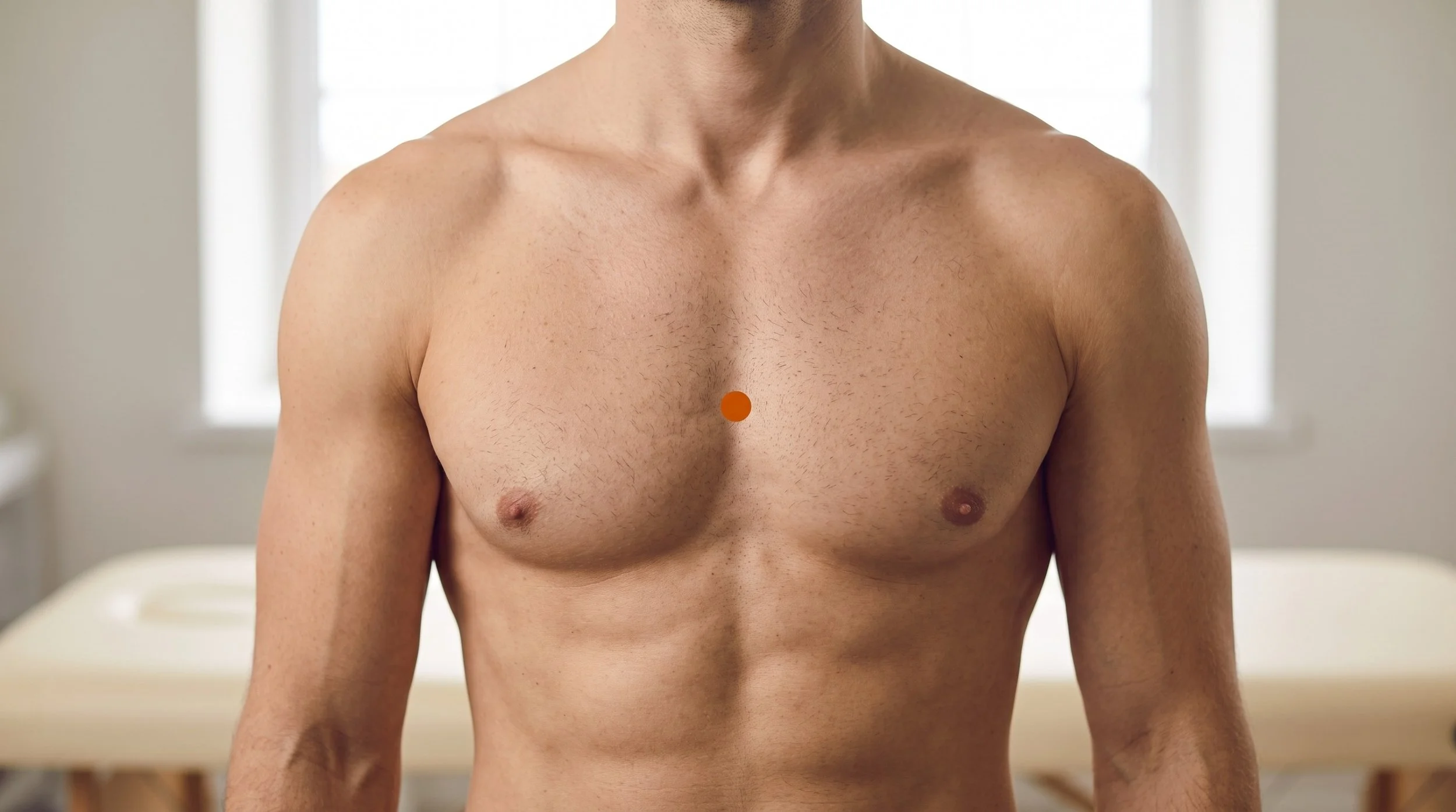
CV18 Acupuncture Point (Yutang)
Jade Hall on the Breastbone: Anatomy, Mechanism, and Why This Sternal Midline Point Belongs in Chest Tightness and Breathing Pattern Treatment
CV18 (Yutang, translated as Jade Hall), also written Ren 18, is the eighteenth point of the Conception vessel, sitting on the midline of the breastbone at the level where the third intercostal space meets the sternum, roughly one finger space above the more familiar CV17.
It belongs to the vertical row of sternal points (CV16 through CV21) that classical texts grouped together for the chest, and in modern practice the Ren 18 sternum location is one of the most accessible places to needle when a patient describes a band of pressure across the front of the chest, a cough that will not settle, or breathing that never seems to reach the bottom of the lungs.
Because the point lies over bone with very little soft tissue above it, the CV18 acupuncture point is needled flat and shallow, which makes it a low-risk site that can be combined easily with distal points and with dry needling of the surrounding chest wall muscles.
- Location and layers: conception vessel 18 sits on the sternal midline level with the third intercostal space, with only skin, thin subcutaneous tissue, occasional sternalis muscle fibers, and periosteum between the needle and the body of the sternum (Deadman et al., 2009).
- Traditional categories translated: classical sources attribute to Yutang the actions of unbinding the chest and regulating and descending qi, language that maps clinically onto reduced chest wall guarding, easier exhalation, and less upward-driven cough and reflux sensation (Deadman et al., 2009; Cunningham, 2000).
- Mechanism: needling here stimulates the anterior cutaneous branches of the upper intercostal nerves in the T2 to T4 segments, the same spinal levels that receive cardiac and pulmonary visceral afferents, so segmental convergence plus descending inhibition offers a plausible route for changes in chest discomfort and perceived tightness (Zhao, 2008).
- Research picture: no trial has isolated CV18, but reviews of acupuncture for chronic asthma remain inconclusive (McCarney et al., 2004), a placebo-controlled trial found improved dyspnea on exertion in COPD (Suzuki et al., 2012), and meta-analyses suggest modest shifts toward parasympathetic dominance in heart rate variability (Hamvas et al., 2023).
- Clinical framing: we use the jade hall point as a local, low-yield-of-risk addition to a broader prescription rather than a stand-alone treatment, usually alongside distal points and manual work on the chest wall for patients whose breathing pattern has become shallow and apical.
- De qi at CV18: expect a dull, spreading, slightly heavy ache that stays close to the surface of the breastbone, sometimes with a sensation of warmth or of the sternum softening; periosteal contact can be sharp, so the needle is kept flat and superficial.
Does Your Chest Feel Tight Even When Your Tests Are Normal?
Many New Yorkers arrive at our clinic after cardiac and pulmonary workups have come back clear, still carrying a band of pressure across the breastbone that worsens with deadlines. At Morningside Acupuncture we treat that pattern as a chest wall and nervous system problem, combining sternal points such as CV18 with distal needling and hands-on release of the intercostals and pectorals. Most patients notice their breath dropping lower into the ribcage within the first few visits. Schedule a visit and let us assess what is driving your chest tightness.
Schedule NowAnatomy of CV18: Why the Sternal Midline at the Third Intercostal Level Is Such an Important Location
CV18 lies directly over the body of the sternum, and the tissue stack there is unusually thin: skin, a shallow layer of subcutaneous fat and fascia, occasionally the fibers of a sternalis muscle (a common anatomical variant present in a minority of people), and then periosteum over bone. Immediately lateral, the sternal head of pectoralis major and the anterior intercostal muscles attach along the costal cartilages of the third and fourth ribs.
This region gets loaded by everything that pulls the chest into flexion and holds it there: long hours at a laptop, rounded shoulders, chronic coughing, heavy upper-chest breathing during stress, and post-surgical or post-injury guarding. Patients often describe the resulting sensation as pressure rather than pain, and they frequently point to the exact spot with one fingertip.
The nerve geography explains a good deal of the point's traditional reputation. The skin and periosteum here are supplied by anterior cutaneous branches of the upper intercostal nerves, whose territories overlap across the midline, so a needle at conception vessel 18 feeds afferent input into roughly the T2 to T4 spinal segments. Those same segments receive visceral afferents from the heart, great vessels, and airways, which is why chest wall referral and visceral chest symptoms can be difficult to tell apart clinically.
Needling activates small-diameter A-delta and C fibers, which recruit spinal and supraspinal inhibitory circuits and release endogenous opioids and monoamines that dampen dorsal horn transmission (Zhao, 2008). Layered on top of that, needle stimulation appears to shift autonomic balance modestly toward parasympathetic activity in heart rate variability studies, which may be part of why patients report a settling, slower-breathing response after sternal needling (Hamvas et al., 2023; Chung et al., 2014).
Below the sternum lie the mediastinal structures, including the heart and great vessels, which is precisely why the needling convention at this point is non-negotiable. Insertion is transverse, angled either up or down along the midline and kept flat against the bone, typically 0.5 to 1 cun (Deadman et al., 2009). Perpendicular deep needling over the sternum is avoided because a congenital sternal foramen (an incompletely fused opening in the bone) is present in a small percentage of people and cannot be detected by palpation.
The same caution applies to anyone with a history of sternotomy, chest radiation, or significant osteoporosis. Needling in the intercostal spaces lateral to the midline requires its own oblique or transverse technique to respect the pleura.
Related Conception Vessel Related Deep Breathing And The Vagus NerveCV18 (Ren 18) at a Glance: Classification, Location, and Clinical Use
| Category | Detail |
|---|---|
| Traditional Name | Yutang (Jade Hall), Ren 18 in the Deadman numbering; some translations render the name as Jade Palace |
| Channel Classification | Conception vessel (Ren mai), the anterior midline extraordinary vessel; CV18 is one of the sternal points between CV17 below and CV19 above (CV18, also written REN18) |
| Point Categories | No five-shu, hui-meeting, or crossing-point designations are attributed to CV18 in the reference sources; it is classified simply as a Conception vessel point of the sternal chest row, grouped in classical practice with CV17, CV19, CV20, and CV21 for chest complaints |
| Precise Location | On the anterior midline of the sternum, level with the junction of the third intercostal space and the sternum. Locate the sternal angle (level with the second costal cartilage), find the second intercostal space beneath it, then count down one more space |
| Tissue Stimulated | Skin, superficial fascia, occasional sternalis muscle fibers, and sternal periosteum, with functional overlap into the adjacent intercostal muscles and, in broader chest wall work, the serratus anterior |
| Needle Depth / Direction | Transverse insertion along the channel, directed superiorly or inferiorly, 0.5 to 1 cun, kept flat against the sternum. Perpendicular or deep insertion is not used |
| De Qi Sensation | A dull, spreading, faintly heavy ache along the breastbone, sometimes with warmth or a sense of the chest opening; sharpness usually means the needle has touched periosteum and the angle needs adjusting |
| Primary Clinical Uses | Chest and sternal pain, chest oppression with difficult breathing, cough and wheezing patterns in classical use, throat discomfort, and sternal-region tension in modern breathing-pattern and stress work |
| Common Point Combinations |
|
In A Manual of Acupuncture, Deadman and colleagues list Yutang under the traditional actions of unbinding the chest and regulating and descending qi, and the indication list clusters tightly around one theme: things that feel stuck or pushing upward in the chest. Pain of the chest and sternum, fullness with difficult breathing, agitation accompanying cough, wheezing, cold phlegm, and vomiting with difficulty swallowing all appear together, and several texts add throat obstruction, breast swelling, and lateral costal pain to that group.
Cunningham's Chinese Medicine Point Manual frames the point's functions in similar terms, adding that it expands the chest, calms wheezing, and benefits the throat, and notes the image behind the name: jade as a reference to the Heart, and hall as the entrance to it.
These are traditional attributions rather than physiological claims, but what makes the classical pattern striking is how consistently it pairs a respiratory complaint with an emotional one, describing agitation and cough as a single presentation rather than two separate problems, which is very close to how contemporary patients describe stress-related chest tightness.
Why CV18 Is Used for Stress-Driven Chest Tightness and Shallow Breathing
The most common reason we reach for the CV18 acupuncture point has nothing to do with lung disease. It is the patient whose breathing has migrated upward into the chest, whose ribs barely move, and who describes a constant band of pressure over the breastbone that intensifies during stressful weeks. The upper sternal region shares spinal segments with the heart and airways, so afferent traffic from a needle placed here converges in the same dorsal horn neurons that process visceral sensation from the chest.
That convergence is the standard explanation for why local input can change how the whole region feels, and why treating the chest wall often changes the perception of chest tightness even when nothing structural has been altered (Zhao, 2008).
Beyond the segmental story, needling recruits descending pain-modulating pathways from the brainstem that release endogenous opioids, serotonin, and noradrenaline into the spinal cord, reducing the amplification that keeps a sensitized region uncomfortable (Zhao, 2008). Large pooled analyses of individual patient data confirm that acupuncture produces effects on chronic pain that exceed sham needling by a modest but consistent margin and persist over time (Vickers et al., 2018).
For the breathing side of the picture, systematic reviews of heart rate variability suggest that needling can nudge autonomic balance toward parasympathetic activity, though the primary studies are heterogeneous and the authors urge caution (Hamvas et al., 2023; Chung et al., 2014). Clinically, that combination shows up as a slower, deeper exhale on the table.
Cardiac and respiratory symptoms always need medical evaluation first. New chest pain, exertional chest pressure, or worsening breathlessness belongs with a physician, not with a needle. What acupuncture can reasonably contribute, once serious causes have been ruled out or are being managed, is symptom-side support: an adjunctive role that has been formally tested in chronic stable angina, where acupuncture added to standard care reduced the frequency of anginal episodes in a randomized trial (Zhao et al., 2019).
What the Research Shows for CV18 (Ren 18)
One note on naming before the evidence: in the research literature this point is almost always listed as CV18, the WHO standard code, while many textbooks and Chinese sources write Ren 18 or RN18, so it is worth searching those as well if you want to read the studies below in full.
There is no clinical trial of CV18 on its own, and it would be misleading to suggest otherwise. Point-specific research is rare in acupuncture because trials test whole protocols, and CV18 typically appears as one component in a chest and lung prescription that also includes back shu points, arm points, and leg points. The studies below therefore describe the neighborhoods this point works in (respiratory symptoms, chest discomfort, autonomic regulation, and chronic pain) rather than the point itself, and several of them are explicitly inconclusive. We include them so you can see the honest state of the evidence.
| Study | Type | Focus | Key Finding |
|---|---|---|---|
| McCarney et al., 2004 | Cochrane systematic review | Acupuncture for chronic asthma | Trial quality varied and results were inconsistent, leaving insufficient evidence to recommend acupuncture for asthma. |
| Suzuki et al., 2012 | Randomized placebo-controlled trial | Dyspnea on exertion in COPD (the COPD-Acupuncture Trial) | Real needling was associated with greater improvement in exertional breathlessness than placebo needling, though the sample was small and single-region. |
| Hamvas et al., 2023 | Systematic review and meta-analysis | Acupuncture and heart rate variability | Pooled data suggested real acupuncture increased parasympathetic indices compared with placebo, with the authors advising cautious interpretation. |
| Chung et al., 2014 | Systematic review with meta-analysis | Effect of acupuncture on heart rate variability | Findings partially supported an effect on low-frequency HRV components, but results across studies were mixed. |
| Zhao et al., 2019 | Randomized clinical trial | Acupuncture as adjunctive therapy for chronic stable angina | Adding acupuncture to standard antianginal care reduced angina episode frequency compared with control groups over the study period. |
| Vickers et al., 2018 | Individual patient data meta-analysis | Acupuncture for chronic pain across conditions | Acupuncture outperformed both sham and no-acupuncture controls by modest margins, with effects largely maintained at one year. |
Struggling With A Cough Or Breathing Pattern That Will Not Settle?
Lingering post-viral cough, allergy-driven throat irritation, and stress-related breath holding all tend to lock the front of the chest into a braced position. We use CV18 with points on the arms and legs to reduce that guarding, then coach diaphragmatic breathing so the change holds between sessions. Acupuncture is not a replacement for pulmonary or allergy care, and we are happy to work alongside your physician. Book an appointment to build a plan that fits your case.
Schedule NowCV18 in the Context of Trigger Point Work
Acupuncture, in our definition, is the use of an acupuncture needle, and that single tool covers hundreds of styles including trigger point dry needling. That framing matters at CV18, because the point sits in the middle of a region with well-documented myofascial referral patterns. Trigger points in the sternalis and in the sternal division of pectoralis major can project a deep, aching pressure over the breastbone that patients commonly mistake for cardiac pain, and intercostal trigger points add a sharper, band-like discomfort along the ribs (Simons et al., 1999). When we palpate someone reporting sternal pressure, we are often finding taut, tender tissue at or immediately around the Yutang location itself.
In practice we treat CV18 flat and shallow along the midline, then work laterally with dry needling into the intercostal muscles, the pectoralis major, and where relevant the serratus anterior, always with oblique or tangential angles over the ribcage to respect the pleura. Manual therapy and breathing retraining follow, because a chest wall that has been released will re-tighten within days if the underlying breathing pattern and desk posture stay unchanged. Patients who spend long hours at a screen usually get a short list of setup and movement adjustments as part of the plan.
CV18 Chest Tightness Treatment at NYC's Highest-Rated Acupuncture Clinic
Morningside Acupuncture is the highest-rated acupuncture and dry needling clinic in New York City with over 500 five-star Google reviews, and our Upper West Side practice sees a steady stream of patients with chest wall pain, rib tension, and stress-driven shallow breathing. Treatments blend classical points such as Yutang with orthopedic dry needling of the intercostals, pectorals, and serratus anterior. Every session includes clear explanation of what we are treating and why. Schedule your visit today.
Schedule NowFrequently Asked Questions
Is CV18 the same point as Ren 18?
Yes. CV18 and Ren 18 are two codes for the same point, Yutang. CV stands for Conception Vessel and is the WHO standard abbreviation, the one you will see in most research papers. Ren comes from Ren Mai, the Chinese name of the vessel, and it is the form used in many textbooks and acupuncture schools. You will also come across it written as REN-18, RN18, or Conception Vessel 18. Whichever code is used, the location and the uses are the same.
What does CV18 feel like when needled?
Because the needle runs flat along the surface of the breastbone, most people feel a brief pinch as it passes through the skin and then a dull, spreading heaviness or warmth that stays local to the sternum. Some patients describe a distinct sense of the chest loosening or of the breath dropping lower. Sharp or bright pain usually means the needle tip has met periosteum, and a small change in angle resolves it immediately. The sensation is generally mild compared with needling into thick muscle.
Why needle the sternum instead of the lungs or the ribs themselves?
The sternum is the safest access point to the anterior chest. It is a broad shield of bone, so a flat needle placed along it cannot reach the pleura, while the intercostal spaces on either side require far more care. It also sits in the T2 to T4 segmental territory shared by cardiac and pulmonary afferents, so input from this narrow strip of skin and periosteum reaches the same spinal levels that process chest sensation (Zhao, 2008). In other words, the midline gives us segmental access to the chest without the risk that comes with needling between the ribs.
Can I press CV18 myself between sessions?
Yes, and it is one of the easier points to self-treat because it is on bone and easy to find. Locate the sternal angle (the small ridge where the manubrium meets the body of the sternum, level with the second rib), find the space just below it, then move down one more intercostal level and stay on the midline. Rest a flat fingertip or thumb pad there with light to moderate pressure, not a dig, and hold for 30 to 60 seconds while breathing out slowly through the mouth. Repeat for two or three rounds, once or twice a day. Pairing the pressure with a longer exhale is the part that matters most. Skip it over broken skin, recent surgery, or any acute unexplained chest pain, which needs medical attention rather than acupressure.
Is CV18 safe to needle?
In trained hands, yes. The technique convention is transverse insertion of 0.5 to 1 cun along the midline, kept flat against the bone, and never perpendicular or deep (Deadman et al., 2009). The reason is that a small proportion of people have a congenital sternal foramen, an opening in the bone that cannot be felt through the skin, and deep perpendicular needling over the sternum is therefore avoided by convention. We also modify or skip the point in patients with prior sternotomy, chest wall implants, chest radiation history, significant osteoporosis, or fragile skin. Expected side effects are minor: brief tenderness or a small bruise.
Where exactly is CV18 located?
On the anterior midline of the sternum, level with the point where the third intercostal space meets the breastbone. The reliable way to find it is to slide a finger down from the top of the sternum until you feel the sternal angle, which lines up with the second costal cartilage. The space just below that is the second intercostal space; count down one more and you are at the third. Bring your finger back to the midline at that level and you have Yutang, roughly one rib space above CV17, which sits between the nipples in most anatomy references.
References
- Deadman, P., Al-Khafaji, M., & Baker, K. (2009). A manual of acupuncture. Journal of Chinese Medicine Publications.
- Cunningham, P. M. (2000). Acupuncture points: A practical guide to classical and modern usage. Odyssey Press.
- O'Connor, J., & Bensky, D. (Eds. & Trans.). (1981). Acupuncture: A comprehensive text. Shanghai College of Traditional Medicine. Eastland Press.
- Cheng, X. (Ed.). (1999). Chinese acupuncture and moxibustion (Rev. ed.). Foreign Languages Press.
- Simons, D. G., Travell, J. G., & Simons, L. S. (1999). Travell & Simons' myofascial pain and dysfunction: The trigger point manual, Vol. 1: Upper half of body (2nd ed.). Williams & Wilkins.
- Zhao, Z. Q. (2008). Neural mechanism underlying acupuncture analgesia. Progress in Neurobiology, 85(4), 355-375. https://doi.org/10.1016/j.pneurobio.2008.05.004
- Vickers, A. J., Vertosick, E. A., Lewith, G., MacPherson, H., Foster, N. E., Sherman, K. J., Irnich, D., Witt, C. M., & Linde, K. (2018). Acupuncture for chronic pain: Update of an individual patient data meta-analysis. Journal of Pain, 19(5), 455-474. https://doi.org/10.1016/j.jpain.2017.11.005
- McCarney, R. W., Brinkhaus, B., Lasserson, T. J., & Linde, K. (2004). Acupuncture for chronic asthma. Cochrane Database of Systematic Reviews, 2004(1), CD000008. https://doi.org/10.1002/14651858.CD000008.pub2
- Suzuki, M., Muro, S., Ando, Y., Omori, T., Shiota, T., Endo, K., Sato, S., Aihara, K., Matsumoto, M., Suzuki, S., Itotani, R., Ishitoko, M., Hara, Y., Takemura, M., Ueda, T., Kagioka, H., Hirabayashi, M., Fukui, M., & Mishima, M. (2012). A randomized, placebo-controlled trial of acupuncture in patients with chronic obstructive pulmonary disease (COPD): The COPD-acupuncture trial (CAT). Archives of Internal Medicine, 172(11), 878-886. https://doi.org/10.1001/archinternmed.2012.1233
- Hamvas, S., Hegyi, P., Kiss, S., Lohner, S., McQueen, D., & Havasi, M. (2023). Acupuncture increases parasympathetic tone, modulating HRV: Systematic review and meta-analysis. Complementary Therapies in Medicine, 72, 102905. https://doi.org/10.1016/j.ctim.2022.102905
- Chung, J. W. Y., Yan, V. C. M., & Zhang, H. (2014). Effect of acupuncture on heart rate variability: A systematic review. Evidence-Based Complementary and Alternative Medicine, 2014, 819871. https://doi.org/10.1155/2014/819871
- Zhao, L., Li, D., Zheng, H., Chang, X., Cui, J., Wang, R., Shi, J., Fan, H., Li, Y., Sun, X., Zhang, F., Wu, X., & Liang, F. (2019). Acupuncture as adjunctive therapy for chronic stable angina: A randomized clinical trial. JAMA Internal Medicine, 179(10), 1388-1397. https://doi.org/10.1001/jamainternmed.2019.2407
Disclaimer: This web site is intended for educational and informational purposes only. Reading this website does not constitute providing medical advice or any professional services. This information should not be used for diagnosing or treating any health issue or disease. Those seeking medical advice should consult with a licensed physician. Seek the advice of a medical doctor or other qualified health professional for any medical condition. If you think you have a medical emergency, call 911 or go to the emergency room. No acupuncturist-patient relationship is created by reading this website or using the information. Morningside Acupuncture PLLC and its employees and contributors do not make any express or implied representations with respect to the information on this site or its use. For any legal interpretation of scope of practice in your state, consult a licensed attorney or regulatory authority.
Read more from our blog



