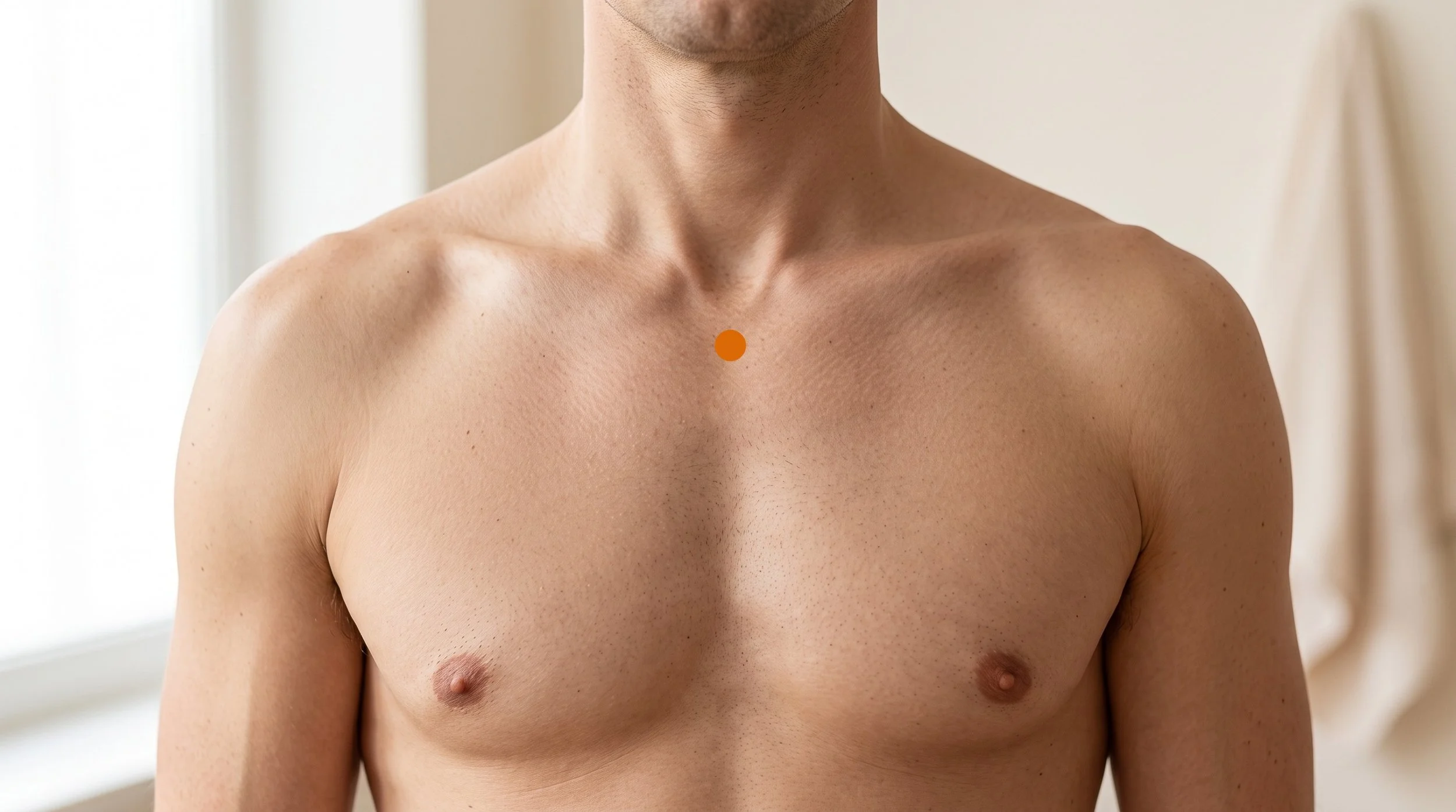
CV21 Acupuncture Point (Xuanji)
The Jade Pivot on the Breastbone: Anatomy, Mechanism, and Why a Point Over the Manubrium Was Classically Paired With ST36 for Indigestion
CV21 (Xuanji, often translated as Jade Pivot), also written Ren 21, sits on the midline of the manubrium, the broad upper block of the breastbone, roughly a thumb's width below the hollow at the base of the throat and midway between CV20 and CV22. It's one of the quieter points on the Conception Vessel, a shallow point needled almost flat against bone, and it rarely headlines a treatment plan.
What makes the CV21 acupuncture point worth knowing is the odd company it keeps in the classical record: a chest point repeatedly paired with ST36 for food stuck in the stomach, and listed at the same time for cough, wheezing, chest and rib-side fullness, and throat tightness. That combination of upper chest and upper digestive complaints maps surprisingly well onto what we now understand about how upper thoracic and lower cervical nerve segments, the vagus, and the muscles of the front chest wall interact.
- Location and layers: CV21 lies on the anterior midline in the center of the manubrium, midway between CV20 and CV22 (Deadman et al., 2009). The tissue under the needle is thin: skin, a shallow layer of subcutaneous fat and fascia, sometimes a few fibers of the variable sternalis muscle, then periosteum over solid bone.
- Traditional attributions: classical texts credit Xuanji with descending stomach qi and dispersing food accumulation, unbinding the chest and directing lung qi downward, and benefiting the throat, with indications for difficult ingestion, chest and rib-side fullness, cough, wheezing, and throat obstruction (Deadman et al., 2009; Cunningham, 2000). These are traditional categories, not physiological claims.
- Nerve geography: the region is supplied by anterior branches of the supraclavicular nerves (C3 to C4) and the anterior cutaneous branch of the first intercostal nerve, with perforating branches of the internal thoracic vessels nearby (O'Connor & Bensky, 1981; Cheng, 1999). Those segments share dorsal horn territory with visceral afferents from the trachea, esophagus, heart, and upper stomach, which is the plausible basis for a chest point influencing upper digestive sensation (Zhao, 2008).
- Mechanism story: needling recruits A-delta and C fiber input that engages segmental inhibition and descending pain control from the periaqueductal gray and rostral ventromedial medulla (Zhao, 2008), while acupuncture stimulation has measurably shifted vagal activity and gastric emptying in controlled physiological work (Ouyang et al., 2002; Guo et al., 2020).
- Research picture: no trial isolates CV21. Reviews test multi-point protocols for functional dyspepsia, asthma, and breathlessness, with modest and often low-certainty results (Lan et al., 2014; McCarney et al., 2004; von Trott et al., 2020), and the largest pain dataset supports acupuncture's effects for chronic pain conditions generally (Vickers et al., 2018).
- De qi and practice: because the needle is threaded transversely and inferiorly 0.5 to 1 cun over bone, sensation is typically a mild local heaviness, warmth, or distension spreading down the sternum rather than a strong grabbing ache (O'Connor & Bensky, 1981). Perpendicular deep needling here is never appropriate.
Chest Tightness, Shallow Breathing, or a Lump-in-the-Throat Feeling?
Upper chest tension often has more than one driver: guarded breathing mechanics, forward head and shoulder posture, reflux irritation, and stress-linked autonomic tone. At Morningside Acupuncture we use CV21 as a gentle midline anchor alongside chest-opening and diaphragm-focused work, then add breathing retraining you can carry between visits. If your chest feels held rather than injured, that pattern is worth assessing. Schedule an evaluation and let's map what's actually driving it.
Schedule NowAnatomy of CV21: Why the Manubrium Is Such an Important Location
CV21 sits on the anterior midline over the manubrium, the wide upper segment of the sternum that articulates with the clavicles and the first ribs. The tissue stack here is unusually thin: skin, a shallow fascial and fatty layer, occasional fibers of the sternalis (a muscle present in a minority of people), and then periosteum directly over bone. What loads this area is rarely the bone itself.
It's the surrounding sternal attachments of pectoralis major, the sternocleidomastoid heads just above, the sternocostal joints to either side, and the accessory breathing pattern that keeps the upper chest lifted and the ribcage splinted. Patients who breathe high and shallow, sit at a screen with a forward head, or brace through the chest under stress often describe a dull, held quality right along this strip of bone.
Innervation of the area comes from anterior branches of the supraclavicular nerves, carrying C3 and C4 fibers down over the upper sternum, together with the anterior cutaneous branch of the first intercostal nerve (O'Connor & Bensky, 1981; Cheng, 1999). That places CV21 at a genuinely interesting crossroads. Upper thoracic segments receive visceral afferent traffic from the trachea, esophagus, heart, and upper abdominal viscera, and cervical segments in the C3 to C5 range share territory with the phrenic nerve and diaphragm.
When afferents from skin, muscle, and viscera converge on the same dorsal horn neurons, somatic stimulation can modulate how visceral signals are processed and how strongly they're perceived, alongside the broader descending inhibitory systems that acupuncture recruits (Zhao, 2008). This is the most defensible way to explain why a point on the breastbone was traditionally used for symptoms felt in the throat, chest, and stomach.
Behind the manubrium sit structures nobody wants a needle near: the brachiocephalic vein, the aortic arch and its branches, and the trachea. In practice the bone is protective, and the needling convention exists precisely because of what lies deep. Standard technique is transverse insertion directed inferiorly, 0.5 to 1 cun, staying subcutaneous and following the line of the sternum (Deadman et al., 2009; O'Connor & Bensky, 1981).
Perpendicular deep needling of the sternum is avoided as a rule, in part because congenital sternal foramina (small openings in the bone) are not rare and cannot be detected by palpation. We also take extra care with recent sternal fracture or sternotomy, significant osteoporosis, local skin lesions, and anticoagulation, and we avoid running electroacupuncture across the chest in patients with implanted cardiac devices.
Related Conception Vessel Related ST36 Acupuncture PointCV21 (Ren 21) at a Glance: Classification, Location, and Clinical Use
| Category | Detail |
|---|---|
| Traditional Name | Xuanji (Jade Pivot); the name also refers to an old astronomical device and to stars of the Big Dipper, an image that echoes the hollow shape of the upper sternum (Cunningham, 2000) |
| Channel Classification | Conception Vessel 21, an upper chest point of the anterior midline (CV21, also written REN21; also called the Ren Mai or Ren channel) |
| Point Categories | No five-shu, hui-meeting, or extraordinary vessel crossing designation is recorded for this point in the classical sources consulted. It's grouped with the chest and respiratory points of the anterior midline, and the Ode to Elucidate Mysteries places it as the 'man' position between DU20 above and KD1 below. |
| Precise Location | On the anterior midline, in the center of the manubrium of the sternum, midway between CV20 and CV22 and roughly 1 cun below the suprasternal notch |
| Tissue Stimulated | Skin and superficial fascia over the manubrium, occasional sternalis fibers, and sternal periosteum; adjacent sternal attachments of pectoralis major and the sternal heads of sternocleidomastoid are common companion targets |
| Needle Depth / Direction | Transverse insertion directed inferiorly, 0.5 to 1 cun, threaded subcutaneously along the sternum; never perpendicular and deep |
| De Qi Sensation | Mild local distension, soreness, or warmth that may spread downward along the breastbone; usually subtle because the needle stays superficial over bone |
| Primary Clinical Uses | Traditionally used for food accumulation and difficult ingestion, chest and rib-side fullness, cough, wheezing and breathlessness, and throat tightness or obstruction; clinically used today for upper chest tension, guarded breathing, and stress-linked upper digestive discomfort |
| Common Point Combinations |
|
Deadman, Al-Khafaji and Baker's A Manual of Acupuncture assigns Xuanji three traditional actions: descending stomach qi and dispersing accumulated food, unbinding the chest and directing lung qi downward, and benefiting the throat. Their commentary highlights how consistently the classical literature ties this point to ST36 for food stuck in the stomach, a pairing that shows up in Miscellaneous Diseases, the Ode of Xi-hong, and the Heavenly Star Points list.
They also relay the image from the Ode to Elucidate Mysteries, in which DU20 corresponds to heaven, CV21 to man, and KD1 to earth, with the middle position read as the middle burner and therefore the stomach.
Presented as traditional attribution rather than physiology, what's striking is the internal logic: a point at the geographic center of the trunk's upper structures was assigned a strongly downward-directing role for both the lungs above and the stomach below, and the classical indication lists (difficult ingestion alongside cough, wheezing, and throat obstruction) hold that dual identity together without apology.
Why CV21 Is Used for Indigestion Even Though It Sits on the Breastbone
The first part of the answer is segmental. Sensory information from the skin over the manubrium travels in supraclavicular branches from C3 and C4 and in the anterior cutaneous branch of the first intercostal nerve (O'Connor & Bensky, 1981; Cheng, 1999). Visceral afferents from the esophagus, trachea, and upper abdominal organs enter the cord at overlapping upper thoracic levels, and they converge with somatic afferents on shared dorsal horn neurons.
That convergence is exactly why heartburn can be felt behind the breastbone and why cardiac pain can radiate to the jaw and arm. Needling into a segment that shares wiring with an irritated viscus gives the nervous system a competing, well-localized input, and both segmental inhibition and descending control from brainstem structures can dampen how loudly the visceral signal is registered (Zhao, 2008).
The second part is autonomic. Acupuncture stimulation has been shown to alter gastric function through neural routes rather than through anything mystical. In controlled physiological work, electroacupuncture accelerated gastric emptying alongside measurable changes in vagal activity (Ouyang et al., 2002), and a systematic review of mechanism studies in functional dyspepsia describes effects on gastric accommodation, motility, and central processing of visceral sensation (Guo et al., 2020).
Points on the trunk and points on the limbs don't necessarily push in the same direction, and the response often depends on the baseline state of the stomach, which is one reason single-point claims should stay modest.
The third part is mechanical and behavioral, and it may be the most relevant in clinic. Upper chest tension, accessory breathing, and a splinted ribcage change diaphragm excursion, and diaphragm mechanics interact with both esophageal function and the subjective sense of fullness. Needling at the upper sternum, especially when combined with slow exhalation-focused breathing, is a practical way to interrupt that guarding pattern. Patients often report the chest feeling less held before they report any change in digestion, and that sequence is worth naming honestly rather than overselling.
What the Research Shows for CV21 (Ren 21)
One note on naming before the evidence: in the research literature this point is almost always listed as CV21, the WHO standard code, while many textbooks and Chinese sources write Ren 21 or RN21, so it is worth searching those as well if you want to read the studies below in full.
No randomized trial has tested CV21 on its own, and it would be misleading to suggest otherwise. Like most points, it appears inside multi-point protocols where the contribution of any single needle can't be separated out. The reasonable question is whether acupuncture protocols that plausibly include upper chest and Conception Vessel points help with the conditions CV21 was traditionally used for, and here the evidence is mixed: encouraging in functional dyspepsia and breathlessness, weak and dated in asthma, and strongest overall in the chronic pain literature. Certainty of evidence in most of these reviews is low, and results are best read as reasons for cautious optimism rather than proof.
| Study | Type | Focus | Key Finding |
|---|---|---|---|
| Lan et al., 2014 | Cochrane systematic review | Manual acupuncture and electroacupuncture for functional dyspepsia | Included trials suggested possible symptom and quality of life benefits versus sham or medication, but the authors judged the evidence insufficient to draw firm conclusions. |
| Guo et al., 2020 | Systematic review of clinical and mechanism studies | Effects and mechanisms of acupuncture and electroacupuncture in functional dyspepsia | Reported effects on gastric accommodation, motility, and central processing of visceral sensation, with autonomic pathways proposed as a main route. |
| Ouyang et al., 2002 | Controlled animal physiology study | Electroacupuncture, gastric emptying, and vagal activity | Electroacupuncture accelerated gastric emptying in association with measurable changes in vagal activity, supporting a neural mechanism. |
| von Trott et al., 2020 | Systematic review and meta-analysis | Acupuncture and acupressure for breathlessness in advanced disease | Pooled results favored acupuncture for breathlessness severity, though the number of trials was small and heterogeneity was considerable. |
| McCarney et al., 2004 | Cochrane systematic review | Acupuncture for chronic asthma | Trials were small and methodologically limited, and the review found no reliable evidence of benefit for asthma outcomes. |
| Vickers et al., 2018 | Individual patient data meta-analysis | Acupuncture for chronic pain across roughly 20,000 patients | Acupuncture outperformed both sham and no-acupuncture controls with effects persisting over time, supporting more than expectation alone. |
| Zhao, 2008 | Narrative review of neurophysiology | Neural mechanisms of acupuncture analgesia | Describes segmental inhibition, descending control, and endogenous opioid involvement as core mechanisms of needle-induced modulation. |
Bloating, Fullness After Meals, and Slow Digestion?
The classical pairing of Xuanji with ST36 for food accumulation lines up with modern work showing acupuncture can shift vagal tone and gastric motility. We combine upper midline points like CV21 with abdominal and lower limb points, and we look at meal timing, stress load, and breathing patterns as part of the picture. Acupuncture is not a substitute for a gastroenterology workup when red flags exist. Book a session and we'll coordinate care sensibly.
Schedule NowCV21 in the Context of Trigger Point Work
CV21 doesn't sit in a muscle belly, so it isn't a dry needling target in the usual sense. It's a periosteal midline point, and its clinical value in orthopedic work comes from what surrounds it. Referred pain to the front of the chest and upper sternum is well described from pectoralis major, the sternal division of sternocleidomastoid, the scalenes, and the sternalis when present, and sternal region pain patterns are classic entries in the myofascial literature (Simons et al., 1999).
When a patient points to the upper breastbone and says the area feels tight or bruised without a clear injury, we examine those muscles first, because treating only the spot that hurts tends to under-deliver.
In a typical Morningside session, we might needle CV21 transversely as a light midline point while dry needling pectoralis major near its sternal attachments, the anterior and middle scalenes, and the upper sternocleidomastoid, matched to exam findings and always with careful attention to depth and angle over the thorax. Manual therapy for the sternocostal joints, thoracic mobility work, and exhalation-biased breathing drills usually follow.
Any chest wall pain that is new, exertional, or accompanied by shortness of breath, sweating, or radiation into the arm or jaw needs medical evaluation before manual or needling care, and we make that call quickly rather than cautiously.
CV21 Chest and Digestive Treatment at NYC's Highest-Rated Acupuncture Clinic
Morningside Acupuncture is the highest-rated acupuncture and dry needling clinic in New York City with over 500 five-star Google reviews, and our approach blends classical point selection with orthopedic and neurophysiological reasoning. For chest tightness, breathing restriction, and stress-linked upper digestive symptoms, we combine points such as Ren 21 chest work with dry needling of the pectoral, scalene, and sternocleidomastoid regions when the exam supports it. Every plan is built around your exam findings, not a template. Schedule a visit at our Upper West Side office to get started.
Schedule NowFrequently Asked Questions
Is CV21 the same point as Ren 21?
Yes. CV21 and Ren 21 are two codes for the same point, Xuanji. CV stands for Conception Vessel and is the WHO standard abbreviation, the one you will see in most research papers. Ren comes from Ren Mai, the Chinese name of the vessel, and it is the form used in many textbooks and acupuncture schools. You will also come across it written as REN-21, RN21, or Conception Vessel 21. Whichever code is used, the location and the uses are the same.
What does CV21 feel like when needled?
Most people feel very little at insertion because the needle is threaded flat under the skin rather than pushed in. Once it's placed, the typical de qi sensation is a mild heaviness, warmth, or distension over the breastbone that can spread downward a few centimeters (O'Connor & Bensky, 1981). It shouldn't be sharp, and it shouldn't produce pressure into the chest. Because the point sits over bone with thin overlying tissue, sensation here is usually gentler than at fleshy points like ST36.
Why would a point on the breastbone help with digestion instead of a point on the abdomen?
Two reasons, one traditional and one physiological. Classically, Xuanji was credited with a strong downward-directing action on both lung and stomach qi, which is why it appears with ST36 in several classical formulas for food accumulation (Deadman et al., 2009). Neurophysiologically, the skin over the manubrium is served by nerve segments that share dorsal horn territory with visceral afferents from the esophagus, trachea, and upper gut, so stimulation there can modulate how those visceral signals are processed (Zhao, 2008). Acupuncture stimulation has also been shown to shift vagal activity and gastric emptying in controlled studies (Ouyang et al., 2002). In practice we usually use CV21 alongside abdominal and lower limb points rather than instead of them.
Can I press CV21 myself between sessions?
Yes, and it's one of the easier points to self-treat because you can find it without a mirror. Locate the notch at the base of your throat, drop about one thumb's width straight down onto the flat bone, and rest two fingertips there on the midline. Apply steady, moderate pressure (firm enough to feel a dull ache, never sharp) for 30 to 60 seconds while breathing out slowly through pursed lips, then release for 20 seconds and repeat three to five times. Once or twice daily is plenty, and pairing it with slow exhalation is what makes it useful for chest tightness. Stop if the area is bruised or tender to light touch, and skip it entirely after sternal surgery, fracture, or if you have unexplained chest pain that hasn't been evaluated.
Is CV21 safe to needle?
In trained hands, yes, with clear technical boundaries. The standard is transverse insertion directed inferiorly, 0.5 to 1 cun, keeping the needle superficial along the sternum (Deadman et al., 2009). Deep perpendicular needling into the sternum is avoided because congenital sternal foramina exist and cannot be identified by palpation, and the structures behind the manubrium include large vessels and the trachea. We also modify or skip the point with recent sternal fracture or sternotomy, marked osteoporosis, local skin breakdown, or significant bleeding risk, and we avoid electroacupuncture across the chest in patients with pacemakers or implanted defibrillators. This is a point where technique, not enthusiasm, keeps things safe.
Where exactly is CV21 located?
On the anterior midline, in the center of the manubrium of the sternum, midway between CV20 and CV22, which places it roughly 1 cun below the suprasternal notch (Deadman et al., 2009; Cheng, 1999). To find conception vessel 21 on yourself, feel the soft hollow at the base of the throat between the collarbones, then slide your finger straight down onto firm bone; the point is on that bone, level with the space between the first rib attachments on either side. Xuanji acupuncture at this location is always done over bone, never into the hollow above it, which belongs to CV22 and requires an entirely different technique.
References
- Deadman, P., Al-Khafaji, M., & Baker, K. (2009). A manual of acupuncture. Journal of Chinese Medicine Publications.
- O'Connor, J., & Bensky, D. (Eds. & Trans.). (1981). Acupuncture: A comprehensive text. Shanghai College of Traditional Medicine. Eastland Press.
- Cheng, X. (Ed.). (1999). Chinese acupuncture and moxibustion (Rev. ed.). Foreign Languages Press.
- Cunningham, P. M. (2000). Acupuncture points: A practical guide to classical and modern usage. Odyssey Press.
- Simons, D. G., Travell, J. G., & Simons, L. S. (1999). Travell & Simons' myofascial pain and dysfunction: The trigger point manual, Vol. 1: Upper half of body (2nd ed.). Williams & Wilkins.
- Lan, L., Zeng, F., Liu, G. J., Ying, L., Wu, X., Liu, M., & Liang, F. R. (2014). Acupuncture for functional dyspepsia. Cochrane Database of Systematic Reviews, 2014(10), CD008487. https://doi.org/10.1002/14651858.CD008487.pub2
- Guo, Y., Wei, W., & Chen, J. D. (2020). Effects and mechanisms of acupuncture and electroacupuncture for functional dyspepsia: A systematic review. World Journal of Gastroenterology, 26(19), 2440-2457. https://doi.org/10.3748/wjg.v26.i19.2440
- Ouyang, H., Yin, J., Wang, Z., Pasricha, P. J., & Chen, J. D. (2002). Electroacupuncture accelerates gastric emptying in association with changes in vagal activity. American Journal of Physiology: Gastrointestinal and Liver Physiology, 282(2), G390-G396. https://doi.org/10.1152/ajpgi.00272.2001
- von Trott, P., Oei, S. L., & Ramsenthaler, C. (2020). Acupuncture for breathlessness in advanced diseases: A systematic review and meta-analysis. Journal of Pain and Symptom Management, 59(2), 327-338.e3. https://doi.org/10.1016/j.jpainsymman.2019.09.007
- McCarney, R. W., Brinkhaus, B., Lasserson, T. J., & Linde, K. (2004). Acupuncture for chronic asthma. Cochrane Database of Systematic Reviews, 2004(1), CD000008. https://doi.org/10.1002/14651858.CD000008.pub2
- Vickers, A. J., Vertosick, E. A., Lewith, G., MacPherson, H., Foster, N. E., Sherman, K. J., Irnich, D., Witt, C. M., & Linde, K. (2018). Acupuncture for chronic pain: Update of an individual patient data meta-analysis. Journal of Pain, 19(5), 455-474. https://doi.org/10.1016/j.jpain.2017.11.005
- Zhao, Z. Q. (2008). Neural mechanism underlying acupuncture analgesia. Progress in Neurobiology, 85(4), 355-375. https://doi.org/10.1016/j.pneurobio.2008.05.004
Disclaimer: This web site is intended for educational and informational purposes only. Reading this website does not constitute providing medical advice or any professional services. This information should not be used for diagnosing or treating any health issue or disease. Those seeking medical advice should consult with a licensed physician. Seek the advice of a medical doctor or other qualified health professional for any medical condition. If you think you have a medical emergency, call 911 or go to the emergency room. No acupuncturist-patient relationship is created by reading this website or using the information. Morningside Acupuncture PLLC and its employees and contributors do not make any express or implied representations with respect to the information on this site or its use. For any legal interpretation of scope of practice in your state, consult a licensed attorney or regulatory authority.
Read more from our blog



