KI25 Acupuncture Point (Shencang)
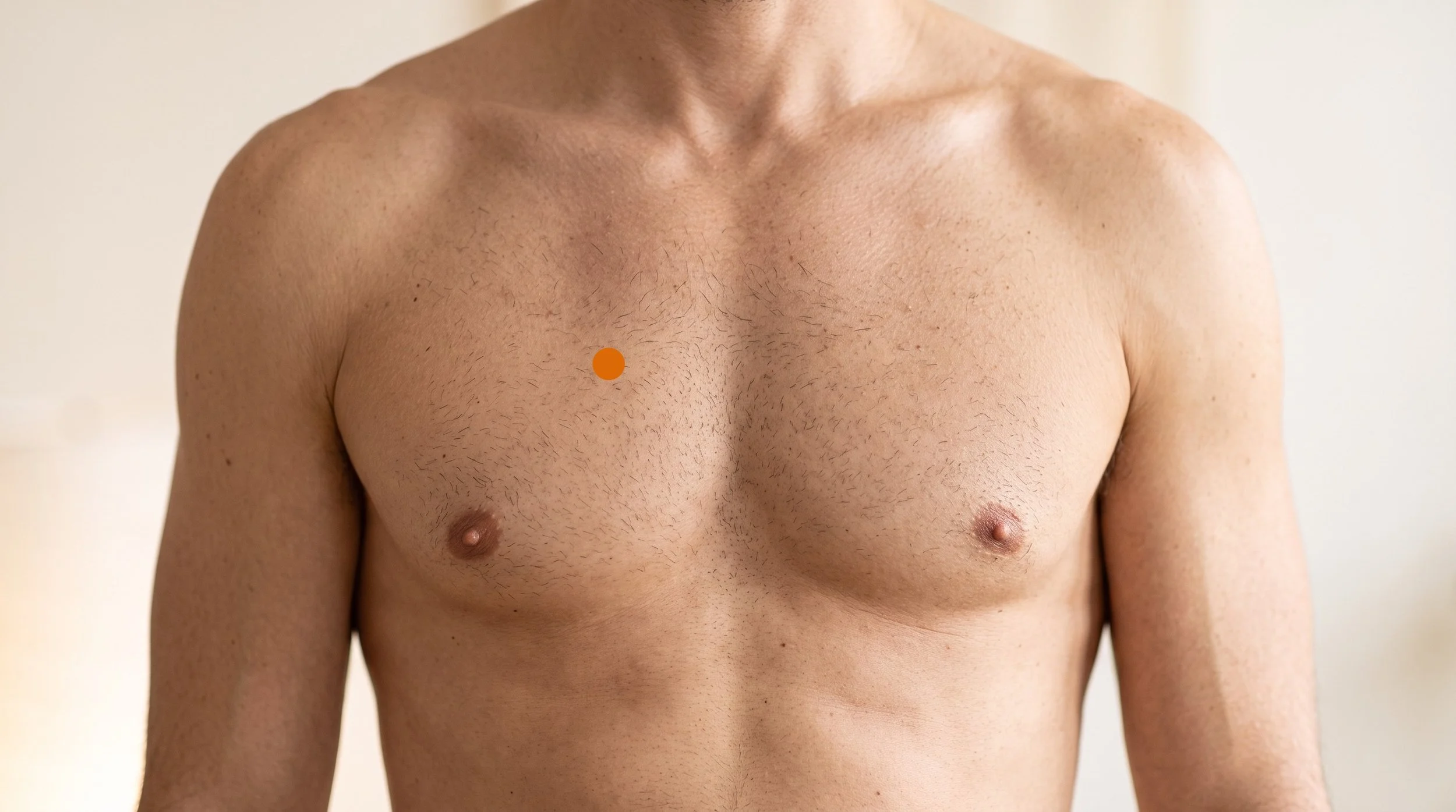
KI25 Acupuncture Point (Shencang)
The Spirit Storehouse in the Second Intercostal Space: Anatomy, Mechanism, and Why This Upper Chest Point Anchors Cough, Breathlessness, and Chest Tightness Treatment
KI25 (Shencang, often translated as Spirit Storehouse or Mind Storage) is the Kidney channel point that sits in the second intercostal space, 2 cun lateral to the midline of the sternum, roughly midway between the breastbone and the nipple line.
In plain terms, it's the rib space just below the second rib, which you can find by first locating the sternal angle (the small ridge where the manubrium meets the body of the sternum) and sliding a fingertip laterally and down.
Clinically, the ki25 acupuncture point matters for three reasons: it lies directly over chest wall tissue that becomes tight, guarded, and tender in people who breathe shallowly; it sits in an upper thoracic segment that shares spinal cord territory with cardiac and pulmonary afferents; and it's the anatomical anchor from which the other Kidney chest points are counted, so locating it accurately makes the whole cluster reliable.
- Location and layers: kidney 25 sits in the second intercostal space, 2 cun lateral to the anterior midline, with the needle passing through skin and superficial fascia, into the sternal fibers of pectoralis major, and toward the external and internal intercostal muscles, with pleura and lung immediately deep (Deadman et al., 2001).
- Traditional categories, translated: classical texts credit KI25 with unbinding the chest and directing rebellious Lung and Stomach qi downward (Deadman et al., 2001). Read neurophysiologically, that's a description of reduced chest wall guarding, easier rib excursion, and modulation of upper thoracic autonomic reflexes rather than any literal flow of energy.
- Nerve story: the ki 25 chest location is innervated segmentally by the second intercostal nerve, with pectoralis major supplied by the pectoral nerves, and it sits in a segment where somatic afferents converge with visceral afferents from the heart and airways, which is the plausible basis for chest wall needling influencing perceived chest tightness (Zhao, 2008).
- Research picture: reviews of acupuncture for breathing conditions are mixed and mostly test multi-point protocols. Cochrane found the asthma evidence too inconsistent to support recommendations (McCarney et al., 2004), while a placebo-controlled trial in COPD reported meaningful improvement in exertional breathlessness (Suzuki et al., 2012), and a chest-focused adjunctive protocol reduced angina attack frequency in a large randomized trial (Zhao et al., 2019).
- Clinical framing: we use shencang acupuncture as a local chest point inside a broader plan, usually alongside distal points and manual or breathing work, not as a standalone treatment for any respiratory or cardiac diagnosis, and never as a substitute for medical evaluation of chest symptoms.
- De qi and technique: needling is transverse-oblique along the rib space, 0.5 to 1 cun, and the sensation is typically a mild spreading heaviness or dull ache that tracks laterally along the intercostal space, sometimes with a sense of the chest loosening on the next inhale (Deadman et al., 2001).
Chest Tightness, Shallow Breathing, or a Cough That Won't Settle?
At Morningside Acupuncture we treat the chest wall as a mechanical structure, not just a symptom location, and KI25 is one of the points we use to reduce guarding across the upper ribs. We combine it with distal points, careful breathing retraining, and dry needling of the pectoral and intercostal muscles when those tissues are reproducing your symptoms. Every chest treatment starts with a screening conversation so that anything requiring medical workup gets referred appropriately. Schedule a visit and let's map out what's driving your chest tightness.
Schedule NowAnatomy of KI25: Why the Second Intercostal Space Is Such an Important Location
Working from the surface inward, KI25 passes through thin skin and superficial fascia, then into the sternal and clavicular fibers of pectoralis major, and then toward the external and internal intercostal muscles bridging the second and third ribs. In most people this is not a thick region, and in lean patients the rib space can be palpated within a few millimeters of the skin.
What loads this tissue is ordinary modern life: sustained forward-shoulder posture, upper chest breathing under stress, heavy horizontal pressing, and the protective bracing pattern people adopt after a cough illness, a rib injury, or a period of anxiety.
The result is a chest wall that resists expansion, which patients usually describe as tightness or an inability to get a satisfying breath rather than as pain.
The nerve geography here is straightforward and clinically useful. Cutaneous and muscular innervation of the second intercostal space comes from the second intercostal nerve, while pectoralis major is supplied by the medial and lateral pectoral nerves. That places KI25 in the upper thoracic segments, the same region where afferent traffic from the heart, great vessels, and airways enters the spinal cord.
Convergence of somatic and visceral input in these segments is the standard explanation for why chest wall structures can refer pain in cardiac-looking patterns and why stimulating chest wall tissue can shift how the nervous system weighs signals from the region. Needling also recruits well-described central mechanisms: A-delta and C fiber input from the needled tissue engages descending inhibitory pathways involving the periaqueductal gray and rostral ventromedial medulla, alongside local release of adenosine and other mediators (Zhao, 2008). Segmentally, this is also why chest points get combined with distal points rather than used alone.
Deep to the intercostal muscles lie the parietal pleura and lung, which is the entire reason for the needling convention at this point. Standard texts specify transverse or transverse-oblique insertion directed laterally along the rib space, 0.5 to 1 cun, and explicitly warn that deep perpendicular or oblique needling may puncture the lung (Deadman et al., 2001; Cunningham, 2015). The internal thoracic artery runs close to the sternal border, so the 2 cun position keeps the needle lateral to it, though shallow angulation remains the rule.
Pneumothorax is consistently identified as one of the most frequently reported serious adverse events in the acupuncture safety literature, which is a strong argument for chest points being needled only by clinicians trained in thoracic surface anatomy (He et al., 2012).
Related Pectoralis Major Trigger Points Related Intercostal Muscles Trigger PointsKI25 at a Glance: Classification, Location, and Clinical Use
| Category | Detail |
|---|---|
| Traditional Name | Shencang (Spirit Storehouse, also translated as Mind Storage or Spirit Storage) |
| Channel Classification | Kidney channel of the foot Shaoyin, KID-25 in the Deadman numbering |
| Point Categories | No five-shu, luo-connecting, xi-cleft, or hui-meeting designation and no listed extraordinary vessel intersection. Classified among the Kidney chest points that run through the intercostal spaces from KI22 up to KI27, and used as the reference space from which the neighboring chest points are counted. Deadman lists its traditional actions as unbinding the chest and lowering rebellious Lung and Stomach qi, presented here as traditional attributions. |
| Precise Location | On the anterior chest, in the second intercostal space, 2 cun lateral to the anterior midline, roughly midway between the midline and the nipple line. Locate the sternal angle, identify the second costal cartilage at that level, then drop into the rib space just below it. In men the nipple typically sits in the fourth intercostal space, which gives a useful cross-check. |
| Tissue Stimulated | Skin and superficial fascia of the upper anterior chest, sternal and clavicular fibers of pectoralis major, the external and internal intercostal muscles of the second space, with pectoralis minor lying deeper and more lateral. Parietal pleura and lung sit immediately deep to the rib space. |
| Needle Depth / Direction | Transverse or transverse-oblique insertion directed laterally along the intercostal space, 0.5 to 1 cun. Perpendicular and deep oblique insertion are avoided because the lung lies directly beneath. Moxibustion is described as applicable in some texts, with the usual care around breast tissue and thin skin. |
| De Qi Sensation | Usually a mild, spreading heaviness or dull ache that travels laterally along the rib space, sometimes with a warm or loosening feeling across the upper chest on the following breath. Sharp, electric, or radiating-down-the-arm sensations mean the needle should be adjusted, and any cough, sudden shortness of breath, or pleuritic pain during needling is a stop-and-assess signal. |
| Primary Clinical Uses | Traditionally used for cough, wheezing, and breathlessness; chest pain, oppression, and fullness extending to the lateral costal region; and fullness of the chest with vomiting, agitation, or poor appetite (Deadman et al., 2001). In modern practice it's used as a local chest wall point for anterior rib restriction, upper chest bracing, intercostal and pectoral muscle pain, and stress-driven shallow breathing. |
| Common Point Combinations |
|
In A Manual of Acupuncture, Deadman, Al-Khafaji, and Baker present Shencang with two traditional actions, unbinding the chest and directing rebellious Lung and Stomach qi downward, and an indication list that clusters into three groups: breathing complaints such as cough, wheezing, and labored breath; chest and lateral costal fullness, oppression, and pain; and upper digestive symptoms including vomiting, agitation, and loss of appetite when the chest feels blocked.
Classical combinations follow the same logic. The Song of the One Hundred Symptoms pairs it with CV21 when chest fullness comes with a stiff neck, the Thousand Ducat Formulas group it with KI27, KI24, and CV14 for vomiting with chest fullness, and later sources add LU3 and KI27 for breath that can't be caught.
What makes the traditional pattern striking is that one small rib space on the upper chest was credited with governing both breathing and upward-moving stomach symptoms, an observation that maps surprisingly well onto what we now understand about shared upper thoracic and vagal territory serving the airways, esophagus, and stomach.
Why KI25 Is Used for Stress-Driven Shallow Breathing and Chest Tightness That Isn't Cardiac
A large number of patients who come in describing chest tightness have already been cleared cardiologically, and what remains is a chest wall that has stopped moving well. Months of upper chest breathing under stress, forward-shoulder desk posture, and protective bracing after an illness or injury leave the pectoral and intercostal tissues short and irritable. KI25 sits directly in that tissue, in the second intercostal space, and needling there provides dense segmental input into the upper thoracic cord.
Because somatic afferents from the chest wall converge with visceral afferents from the heart and airways in these same segments, altering the somatic signal can change how the whole region is perceived, which is often reported as the chest feeling less braced rather than as pain simply disappearing (Zhao, 2008).
Beyond the segment, needling engages descending inhibitory control from the brainstem and produces measurable local vascular and autonomic changes, mechanisms that have been characterized in detail in the analgesia literature (Zhao, 2008). Individual patient data from nearly 21,000 patients in chronic pain trials show acupuncture outperforming both sham and no-acupuncture controls, with effects that persist over time, which supports the general plausibility of these mechanisms even though those trials studied musculoskeletal pain rather than chest symptoms specifically (Vickers et al., 2018).
For symptoms tied to breathing itself, the evidence is more cautious and more interesting. A placebo-controlled trial in COPD found that a twelve-week acupuncture protocol improved exertional breathlessness on the Borg scale compared with placebo needling (Suzuki et al., 2012), and a systematic review of acupuncture techniques in COPD catalogued a growing but methodologically uneven literature (Fernández-Jané et al., 2020). None of this tests KI25 in isolation, and none of it should be read as evidence that acupuncture treats lung disease.
What it does support is the more modest clinical claim: chest-region needling may reduce the effort and discomfort associated with breathing in some people, which is exactly how we frame shencang acupuncture with patients.
What the Research Shows for KI25
A note on what the research can and can't tell us about this point. No trial has isolated KI25, and essentially none of the respiratory or cardiac acupuncture literature reports point-by-point effects. What the reviews test are multi-point protocols delivered over weeks, in which chest points like KI25 typically appear alongside back shu points, distal limb points, and midline conception vessel points.
The honest reading is that this point is one component of protocols with mixed evidence, stronger for symptom-level outcomes such as breathlessness and chest discomfort, weaker and less consistent for objective lung function. Chest symptoms always warrant medical evaluation first.
| Study | Type | Focus | Key Finding |
|---|---|---|---|
| McCarney et al., 2004 | Cochrane systematic review | Acupuncture for chronic asthma across randomized and quasi-randomized trials | The authors concluded there was insufficient evidence to make recommendations, with variable trial quality and inconsistent results. |
| Suzuki et al., 2012 | Randomized placebo-controlled trial | Twelve weeks of acupuncture versus placebo needling for dyspnea on exertion in COPD | The acupuncture group showed greater improvement in Borg breathlessness scores after a six-minute walk test, though the sample was small and confirmation in larger trials was called for. |
| Fernández-Jané et al., 2020 | Systematic review | Acupuncture techniques and point selection used in COPD trials | The review mapped a growing literature with substantial variation in technique and reporting, suggesting benefit is plausible but not yet firmly established. |
| Zhao et al., 2019 | Randomized clinical trial (404 participants) | Acupuncture as adjunctive therapy to standard antianginal treatment in chronic stable angina | Adding acupuncture on channel-relevant points reduced angina attack frequency compared with sham and wait-list groups over 20 weeks, supporting adjunctive use rather than replacement of medical care. |
| Vickers et al., 2018 | Individual patient data meta-analysis | Acupuncture across chronic pain conditions in high-quality randomized trials | Acupuncture was superior to both sham and no-acupuncture controls with effects largely sustained at one year, supporting mechanisms beyond expectation alone. |
| He et al., 2012 | Systematic review of adverse event reports | Acupuncture-related adverse events reported in the Chinese literature from 1956 to 2010 | Pneumothorax was among the most frequently reported serious events, underscoring why chest points require shallow, tangential technique by trained practitioners. |
Rib Cage Restriction From Desk Work, Stress, or Old Training Habits?
Long hours at a keyboard, chronic stress breathing, and heavy pressing in the gym all leave the anterior chest short and stiff, and the second intercostal space is one of the first places patients notice it. We use the ki25 acupuncture point along with pectoralis major and pectoralis minor work to restore rib excursion and reduce the tender, braced feeling across the upper chest. Sessions pair needling with mobility and breathing homework you can do in a few minutes a day. Book an appointment to get your ribs moving again.
Schedule NowKI25 in the Context of Trigger Point Work
KI25 sits squarely within territory that trigger point clinicians already know well. The sternal fibers of pectoralis major overlie this rib space, and taut bands in that muscle refer pain across the anterior chest, into the medial arm, and occasionally in patterns patients and clinicians alike mistake for cardiac pain (Simons et al., 1999). The intercostal muscles of the upper spaces can also become locally irritable after coughing illnesses, rib trauma, or prolonged bracing, producing sharp, breath-linked chest wall pain.
Because acupuncture is defined by the use of an acupuncture needle rather than by any single explanatory framework, the same filiform needle used at Shencang in a channel-based treatment is used for trigger point dry needling in a myofascial one, with the difference lying in target selection and technique.
In practice at Morningside we palpate before we needle. If the chest wall reproduces the patient's symptom on palpation, we'll needle KI25 along the rib space and add dry needling to pectoralis major, pectoralis minor, and the involved intercostals, always with shallow, tangential angles and flat-hand tissue control over the rib rather than the interspace. That local work often pairs with scalene, upper trapezius, and thoracic paraspinal treatment when the neck and upper back are contributing, and with distal points to support the broader downregulation piece.
Anyone with unexplained chest pain, new shortness of breath, or cardiac risk factors gets referred for medical evaluation before we treat the chest wall, without exception.
KI25 Chest Tightness Treatment at NYC's Highest-Rated Acupuncture Clinic
Morningside Acupuncture is the highest-rated acupuncture and dry needling clinic in New York City with over 500 five-star Google reviews, and our Midtown practice sees a steady stream of patients with chest wall pain, rib restriction, and stress-driven shallow breathing. Shencang is one tool inside a structured, anatomy-first plan that includes trigger point dry needling, manual therapy, and practical breathing work. We're clear about what acupuncture may help with and equally clear about when a referral is the right call. Schedule your first session and we'll build the plan together.
Schedule NowFrequently Asked Questions
What does KI25 feel like when needled?
Most people feel a light pinch at insertion and then a mild, spreading heaviness or dull ache that travels laterally along the rib space. Some describe a warm, loosening sensation across the upper chest, and it's common to notice the next breath feeling slightly easier or deeper. Because the needle is inserted almost flat along the intercostal space rather than straight in, the sensation stays superficial. Sharp pain, an electric feeling shooting down the arm, sudden coughing, or any breathlessness are all reasons to speak up immediately so the practitioner can withdraw and reassess.
Why needle a point on the chest for breathing and chest tightness instead of a distal point?
Both approaches get used, and they do different jobs. Distal points on the arms and legs recruit widespread descending inhibition and autonomic effects, while a local chest point like KI25 delivers input into the exact spinal segments serving the chest wall, heart, and airways (Zhao, 2008). That segmental specificity is useful when the tissue itself is short, guarded, and tender, which is common in people who breathe high in the chest. Classical practice reflects the same reasoning: Shencang appears in formulas paired with midline chest points for local effect and with arm points such as LU3 for the broader breath pattern (Deadman et al., 2001). We typically use both in one treatment.
Can I press KI25 myself between sessions?
Yes, acupressure at this point is safe and simple because pressure can't do what a needle can. Find the sternal angle, the small horizontal ridge partway down the breastbone, then move about two thumb-widths out to the side and drop into the rib space just below the second rib. Use a fingertip with light to moderate pressure, no more than a comfortable four or five out of ten, and hold for 30 to 60 seconds while you breathe slowly through the nose. Repeat two or three times per side, ideally paired with a slow exhale that's longer than the inhale, and do the whole sequence once or twice a day. Skip it over breast tissue, over any area of unexplained pain, or if pressing reproduces symptoms you haven't had evaluated. Acupressure here should feel like a release, not a workout.
Is KI25 safe to needle?
It's safe in trained hands and genuinely risky in untrained ones. The lung lies directly beneath the second intercostal space, so standard texts specify transverse or transverse-oblique insertion of 0.5 to 1 cun directed laterally along the rib space and explicitly caution against deep perpendicular or oblique needling (Deadman et al., 2001; Cunningham, 2015). Pneumothorax is repeatedly identified as one of the most commonly reported serious adverse events in acupuncture safety reviews, almost always following deep needling over the thorax (He et al., 2012). A licensed acupuncturist who knows thoracic surface anatomy uses shallow angulation, short needles, and careful patient positioning. Tell your practitioner about a history of lung disease, emphysema, prior pneumothorax, chest surgery, pacemakers or implanted devices, or bleeding disorders, and this point may be avoided altogether if there's any concern.
Where exactly is KI25 located?
KI25 is on the anterior chest in the second intercostal space, 2 cun lateral to the anterior midline, which places it about midway between the sternum and the nipple line. The reliable way to find it is to run a finger down the breastbone from the top until you feel the sternal angle, the slight ridge where the manubrium meets the sternal body. The second costal cartilage attaches right there, so the rib space immediately below is the second intercostal space. Move laterally about 2 cun and you're at Shencang. As a cross-check, in men the nipple usually sits in the fourth intercostal space, two spaces below KI25. This point is also the anatomical starting reference for locating the rest of the Kidney chest points.
References
- Deadman, P., Al-Khafaji, M., & Baker, K. (2009). A manual of acupuncture. Journal of Chinese Medicine Publications.
- Cunningham, P. M. (2000). Acupuncture points: A practical guide to classical and modern usage. Odyssey Press.
- Maciocia, G. (2005). The foundations of Chinese medicine: A comprehensive text for acupuncturists and herbalists (2nd ed.). Elsevier Churchill Livingstone.
- O'Connor, J., & Bensky, D. (Eds. & Trans.). (1981). Acupuncture: A comprehensive text. Shanghai College of Traditional Medicine. Eastland Press.
- Simons, D. G., Travell, J. G., & Simons, L. S. (1999). Travell & Simons' myofascial pain and dysfunction: The trigger point manual, Vol. 1: Upper half of body (2nd ed.). Williams & Wilkins.
- McCarney, R. W., Brinkhaus, B., Lasserson, T. J., & Linde, K. (2004). Acupuncture for chronic asthma. Cochrane Database of Systematic Reviews, 2003(1), CD000008. https://doi.org/10.1002/14651858.CD000008.pub2 [VERIFY BEFORE PUBLISHING]
- Suzuki, M., Muro, S., Ando, Y., Omori, T., Shiota, T., Endo, K., Sato, S., Aihara, K., Matsumoto, M., Suzuki, S., Itotani, R., Ishitoko, M., Hara, Y., Takemura, M., Ueda, T., Kagioka, H., Hirabayashi, M., Fukui, M., & Mishima, M. (2012). A randomized, placebo-controlled trial of acupuncture in patients with chronic obstructive pulmonary disease (COPD): The COPD-acupuncture trial (CAT). Archives of Internal Medicine, 172(11), 878-886. https://doi.org/10.1001/archinternmed.2012.1233
- Fernández-Jané, C., Vilaró, J., Fei, Y., Wang, C., Liu, J., Huang, N., Xia, R., Tian, X., Hu, R., Wen, Q., Yu, M., & Mist, S. (2020). Acupuncture techniques for COPD: A systematic review. BMC Complementary Medicine and Therapies, 20(1), 138. https://doi.org/10.1186/s12906-020-02899-3
- Zhao, L., Li, D., Zheng, H., Chang, X., Cui, J., Wang, R., Shi, J., Fan, H., Li, Y., Sun, X., Zhang, F., Wu, X., & Liang, F. (2019). Acupuncture as adjunctive therapy for chronic stable angina: A randomized clinical trial. JAMA Internal Medicine, 179(10), 1388-1397. https://doi.org/10.1001/jamainternmed.2019.2407
- He, W., Zhao, X., Li, Y., Xi, Q., & Guo, Y. (2012). Adverse events following acupuncture: A systematic review of the Chinese literature for the years 1956-2010. The Journal of Alternative and Complementary Medicine, 18(10), 892-901. https://doi.org/10.1089/acm.2011.0825
- Zhao, Z. Q. (2008). Neural mechanism underlying acupuncture analgesia. Progress in Neurobiology, 85(4), 355-375. https://doi.org/10.1016/j.pneurobio.2008.05.004
- Vickers, A. J., Vertosick, E. A., Lewith, G., MacPherson, H., Foster, N. E., Sherman, K. J., Irnich, D., Witt, C. M., & Linde, K. (2018). Acupuncture for chronic pain: Update of an individual patient data meta-analysis. Journal of Pain, 19(5), 455-474. https://doi.org/10.1016/j.jpain.2017.11.005
Disclaimer: This web site is intended for educational and informational purposes only. Reading this website does not constitute providing medical advice or any professional services. This information should not be used for diagnosing or treating any health issue or disease. Those seeking medical advice should consult with a licensed physician. Seek the advice of a medical doctor or other qualified health professional for any medical condition. If you think you have a medical emergency, call 911 or go to the emergency room. No acupuncturist-patient relationship is created by reading this website or using the information. Morningside Acupuncture PLLC and its employees and contributors do not make any express or implied representations with respect to the information on this site or its use. For any legal interpretation of scope of practice in your state, consult a licensed attorney or regulatory authority.
Read more from our blog



