KI24 Acupuncture Point (Lingxu)
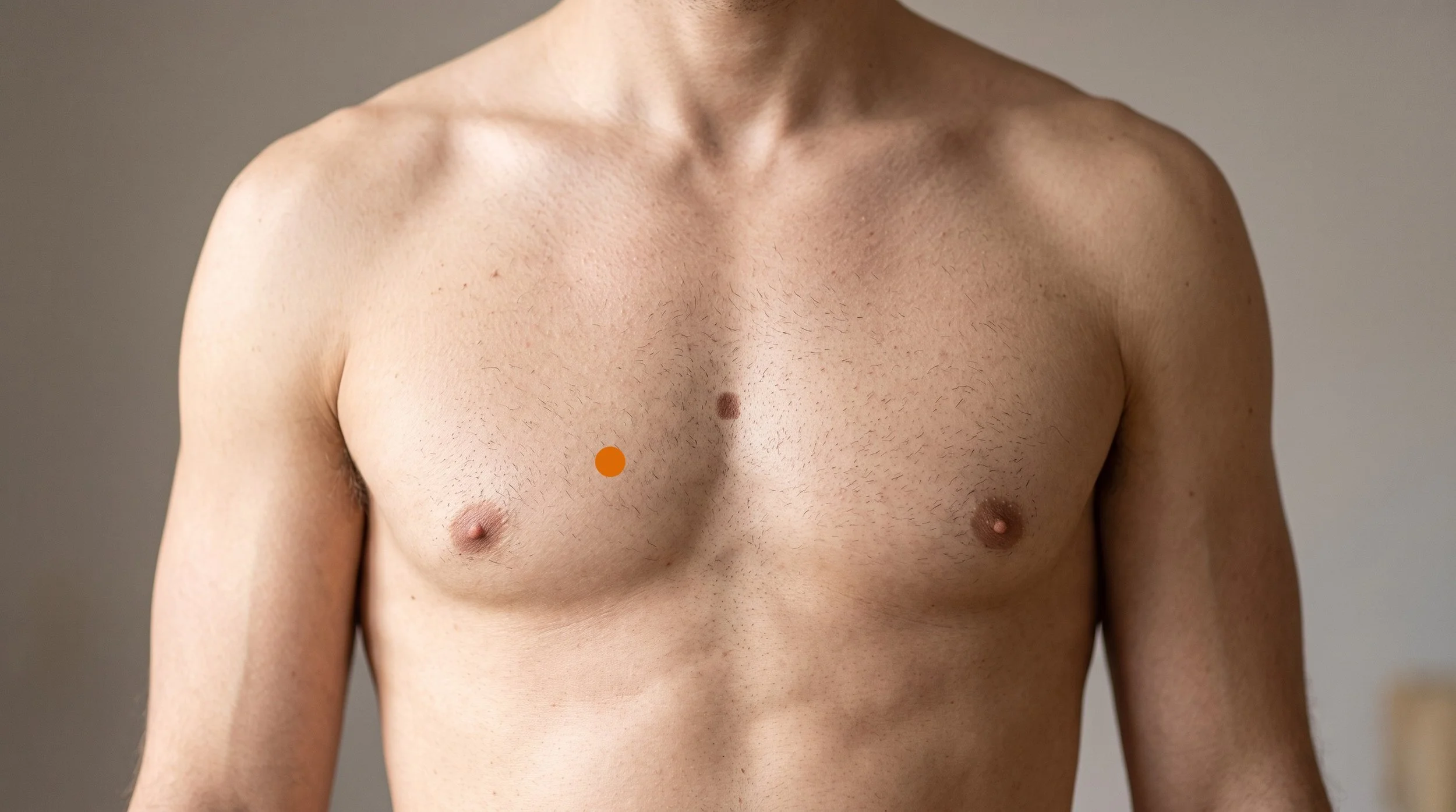
KI24 Acupuncture Point (Lingxu)
Spirit Ruin in the Third Intercostal Space: Anatomy, Mechanism, and Why This Kidney Chest Point Belongs in Breathing, Chest Tightness, and Upper Digestive Treatment
KI24, known in Chinese as Lingxu and usually translated as Spirit Ruin or Spirit Burial Ground, sits on the front of the chest in the third intercostal space, two cun out from the midline, roughly halfway between the breastbone and the nipple line. It belongs to the short row of Kidney channel points (KI22 through KI27) that climb the upper chest, and classical sources group these together as points that open a tight chest, settle upward-surging Lung and Stomach symptoms, and address the breast region (Deadman et al., 2007).
For a modern clinician, the ki24 acupuncture point is interesting for a simpler reason: it lies directly over a shallow, richly innervated slice of chest wall (pectoralis major fibers, the third intercostal space, and the anterior branches of the third intercostal nerve) that shares spinal segments with the heart, lungs, and upper esophagus. That anatomical overlap, not any literal movement of energy, is why kidney 24 shows up in treatment plans for cough, chest tightness, guarded breathing, and chest wall pain, and it's also why the point demands careful, angled needling rather than depth.
- Location and layers: KI24 is found in the third intercostal space, two cun lateral to the anterior midline, level with CV18 (Deadman et al., 2007). From surface to depth the needle passes skin, subcutaneous fat, upper fibers of pectoralis major, then the external and internal intercostal muscles, with pleura and lung immediately beyond, which is why insertion stays transverse-oblique along the rib space.
- Traditional attributions, translated: classical texts credit KI24 with unbinding the chest, lowering rebellious Lung and Stomach qi, and benefiting the breasts, with listed indications spanning cough, wheezing, chest and rib distention, difficulty breathing, vomiting, and poor appetite (Deadman et al., 2007; Kim, 2013). In neurophysiological language, these are the symptom clusters that map onto upper thoracic segments T2 to T5, where chest wall, airway, cardiac, and upper gut afferents converge.
- Mechanism: needling a thoracic wall point recruits A-delta and C fibers that enter the dorsal horn alongside visceral afferents, engaging segmental gating and descending inhibitory pathways from the brainstem, which is the best-supported model for how acupuncture modulates pain and referred discomfort (Zhao, 2008).
- Autonomic angle: needle stimulation has been associated with shifts in heart rate variability toward greater parasympathetic tone in pooled trial data, though the authors urge caution because study quality varies (Hamvas et al., 2023). This may help explain the settled, slower breathing many patients report after chest point work.
- Research picture: reviews of acupuncture for asthma found the evidence too inconsistent to support firm recommendations (McCarney et al., 2004), while a more recent meta-analysis of chronic cough reported improvements when acupuncture-related therapy was added to usual care, at moderate certainty (Lee et al., 2025). Neither body of work isolates KI24 itself.
- De qi and practice framing: patients usually describe a dull, spreading heaviness that travels a short distance along the rib space rather than a sharp jab, and the point is nearly always used as one element in a protocol that includes distal points and, where relevant, dry needling of the chest wall muscles.
Feeling Tight in the Chest Every Time You Take a Deep Breath?
Chest tightness that shows up with stress, after a long respiratory illness, or during hours at a desk often has a treatable chest wall component. At Morningside Acupuncture we assess the third and fourth intercostal spaces, pectoralis major, and the sternal border, then use points like KI24 with careful angled needling alongside distal points that calm the nervous system. Treatment is paired with breathing retraining and posture work so results hold between visits. Schedule an evaluation and let's find out what's actually driving the tightness.
Schedule NowAnatomy of KI24: Why the Third Intercostal Space Is Such an Important Location
KI24 sits on a thin, mobile stretch of chest wall. Under the skin and a modest layer of subcutaneous fat lie the upper fibers of pectoralis major, which run from the sternum and clavicle toward the humerus and are loaded every time you push, carry, hold a phone at chest height, or round forward at a keyboard. Beneath pectoralis major are the external and internal intercostal muscles bridging the third and fourth ribs, small muscles that work with every breath and stiffen quickly after a bout of coughing, a rib injury, or weeks of shallow upper chest breathing.
Because the two cun line falls midway between the midline and the nipple line, KI24 lands medial to most bulk and lateral to the sternal border, which is precisely the zone patients point to when they say the tightness is under the breastbone but not quite on it.
The nerve supply here is the third intercostal nerve, whose anterior cutaneous and muscular branches serve the skin, pectoral fibers, and rib space. Those afferents enter the spinal cord at upper thoracic levels shared by cardiac, pulmonary, and esophageal afferents. When several inputs converge on the same dorsal horn neurons, the brain can localize sensation imprecisely, which is how chest wall irritation comes to feel like something deeper, and how needling a superficial chest point can influence how deep chest sensations are processed.
Needle stimulation at this level recruits small-diameter fibers and engages segmental inhibition plus descending control from the periaqueductal gray and rostral ventromedial medulla (Zhao, 2008). Individual patient data from large chronic pain trials show modest but persistent effects of acupuncture over sham and no-acupuncture controls, a reasonable frame for expectations at any single point (Vickers et al., 2018).
Depth is the safety issue. Below the intercostal muscles sit the parietal pleura and lung, and perforating branches of the internal thoracic artery run near the sternal border, so the standard convention is transverse-oblique insertion directed laterally along the rib space, 0.5 to 1 cun, never perpendicular and never deep (Deadman et al., 2007). Classical Chinese texts and modern manuals both flag the same caution in blunt terms: deep needling at the Kidney chest points can puncture the lung (Shanghai College of Traditional Chinese Medicine, 1981).
Large prospective safety data show acupuncture is generally well tolerated, with minor bruising and transient soreness dominating adverse event reports and serious events rare (Witt et al., 2009), but that safety record depends on clinicians respecting thoracic technique rules exactly as written.
Related Pectoralis Major Trigger Points Related Intercostal Muscles Trigger PointsKI24 at a Glance: Classification, Location, and Clinical Use
| Category | Detail |
|---|---|
| Traditional Name | Lingxu (Spirit Ruin, also translated Spirit Burial Ground or Soul Mound) |
| Channel Classification | Kidney channel of Foot Shaoyin, twenty-fourth point, one of the chest points KI22 to KI27 |
| Point Categories | No five-shu, xi-cleft, luo-connecting, or hui-meeting designation is recorded for this point in the standard references, and no extraordinary vessel intersection is listed. It's classed simply as one of the Kidney chest points of the intercostal spaces, grouped by function rather than by category (Deadman et al., 2007; Kim, 2013). |
| Precise Location | On the anterior chest, in the third intercostal space, 2 cun lateral to the anterior midline, level with CV18 and midway between the midline and the nipple line. In men the nipple sits in the fourth intercostal space, one space below KI24. |
| Tissue Stimulated | Skin and subcutaneous tissue, upper fibers of pectoralis major, and the external and internal intercostal muscles of the third space, innervated by the third intercostal nerve |
| Needle Depth / Direction | Transverse-oblique insertion directed laterally along the intercostal space, 0.5 to 1 cun. Perpendicular or deep oblique needling is contraindicated because of the underlying lung. Moxibustion is traditionally permitted. |
| De Qi Sensation | A dull, warm heaviness or mild ache that spreads a short distance along the rib space, sometimes with a sense of the chest softening on the next inhale. Sharp, electric, or radiating pain means the needle should be adjusted or withdrawn. |
| Primary Clinical Uses | Traditionally used for cough and wheezing with chest and rib distention, difficulty breathing, vomiting with poor appetite, palpitations with agitation and fullness, and breast disorders (Deadman et al., 2007). In modern practice it's most often used for anterior chest wall tightness, intercostal discomfort, and guarded breathing patterns. |
| Common Point Combinations |
|
In the classical literature summarized by Deadman, Al-Khafaji, and Baker in A Manual of Acupuncture, KI24 is credited with three traditional actions: unbinding a constrained chest, directing rebellious Lung and Stomach qi downward, and benefiting the breasts.
The indications recorded under those headings cluster into three recognizable groups, respiratory (cough, asthma, wheezing, difficulty breathing, distention and pain across the chest and ribs), upper digestive (vomiting, inability to eat or drink, loss of pleasure in eating), and chest-and-spirit (palpitations with agitation and a sense of fullness), along with breast abscess.
The Thousand Ducat Formulas preserve a grouping that treats vomiting with chest fullness using KI24 together with the neighboring Kidney chest points and a point on the midline over the epigastrium, which tells you how the old clinicians conceptualized the problem: one continuous upward pressure from stomach to throat that needed to be turned back down.
What's striking about this classical pattern is that a single spot on the upper chest was expected to influence breathing, swallowing, and heartbeat all at once, which is exactly what you'd predict from a point sitting over the upper thoracic segments where those three systems share their afferent traffic.
Why KI24 Is Used for Breathlessness That Feels More Like Anxiety Than Lung Disease
Plenty of people arrive at the clinic describing a chest that won't fully open. Their lung function has been checked and is fine, but breaths feel short, the upper chest does all the work, and the sensation intensifies under stress. On exam, the anterior chest wall is often tender along the sternal border and the upper rib spaces, and pectoralis major is short and irritable. KI24 sits in the middle of that territory.
Needling here stimulates third intercostal nerve afferents that enter the cord in the same upper thoracic segments as cardiac and pulmonary afferents, and this convergence is a plausible route by which chest wall input changes how deep chest sensations are interpreted (Zhao, 2008). In practical terms, reducing the local guarding often makes the ribs move more freely, and easier rib motion tends to reduce the feeling of restriction.
There's a second layer. Needling appears to shift autonomic balance, with pooled randomized data suggesting an increase in parasympathetic markers of heart rate variability compared with placebo, although the reviewers stress the modest quality of the underlying trials (Hamvas et al., 2023). A slightly more parasympathetic state is associated with slower, lower, more diaphragmatic breathing, which is the opposite of the fast upper chest pattern these patients arrive with.
Broader chronic pain data also show that acupuncture's effects are real but moderate and persist beyond the treatment session (Vickers et al., 2018), so the honest framing is incremental improvement rather than a switch being flipped.
None of this means KI24 treats lung disease. Asthma, COPD, and any new or worsening shortness of breath belong with a physician, and reviews of acupuncture for chronic asthma have not produced evidence strong enough to support recommendations (McCarney et al., 2004). What the point may reasonably offer is help with the musculoskeletal and autonomic layer that sits on top of a respiratory or anxiety picture: a tight chest wall, a stuck breathing pattern, and a nervous system that's slow to downshift.
What the Research Shows for KI24
There's no clinical trial that isolates KI24, and it would be misleading to imply otherwise. Almost all acupuncture research tests multi-point protocols selected by pattern or by condition, so the fair question isn't whether Lingxu works on its own but whether protocols that include chest and Kidney channel points show benefit for the conditions this point is traditionally used for.
The picture below is mixed by design: respiratory evidence is inconsistent, cough evidence is more encouraging but of moderate certainty and largely from one region, autonomic findings are suggestive but based on small trials, and safety data are large and reassuring so long as thoracic technique rules are followed.
| Study | Type | Focus | Key Finding |
|---|---|---|---|
| McCarney et al., 2004 | Cochrane systematic review | Acupuncture for chronic asthma | The reviewers concluded there wasn't sufficient evidence to make recommendations about acupuncture for asthma, largely because of variable trial quality and inconsistent results. |
| Lee et al., 2025 | Systematic review and meta-analysis (30 RCTs, 2,835 participants) | Acupuncture-related therapy for chronic cough | Adding acupuncture-related therapy to conventional care was associated with improved cough severity and cough-related quality of life at generally moderate certainty, with no increase in adverse events. |
| Hamvas et al., 2023 | Systematic review and meta-analysis of randomized trials | Acupuncture and heart rate variability | Real acupuncture was associated with greater parasympathetic tone than placebo needling, though the authors advise cautious interpretation given study quality and heterogeneity. |
| Vickers et al., 2018 | Individual patient data meta-analysis | Acupuncture for chronic pain across conditions | Effects were superior to both sham and no-acupuncture controls and persisted over time, supporting modest but genuine treatment effects rather than placebo alone. |
| Witt et al., 2009 | Prospective observational safety study (229,230 patients) | Adverse effects of acupuncture in routine care | Most reported adverse effects were minor, such as bleeding or bruising and needling pain, with serious events rare in this large sample. |
| Zhao, 2008 | Narrative review of neurophysiology | Mechanisms of acupuncture analgesia | Analgesic effects are attributed to afferent fiber activation, segmental spinal modulation, and descending inhibitory control rather than to any channel-specific pathway. |
Lingering Cough, Wheeze, or Guarded Breathing After Illness?
When a cough hangs on past the infection, the chest wall muscles and rib spaces are often locked in a protective pattern that keeps the cough reflex irritable. Lingxu acupuncture, used as part of a broader plan with points on the arms, legs, and upper back, may reduce that guarding and make full breaths feel easier. We coordinate with your physician's plan rather than replacing it. Book a session and get an assessment of your breathing mechanics.
Schedule NowKI24 in the Context of Trigger Point Work
The anterior chest is one of the places where classical point locations and myofascial targets sit almost on top of each other. KI24 lies over the sternal portion of pectoralis major, a muscle whose trigger points are documented to refer pain across the front of the chest, into the anterior shoulder, and down the medial arm, sometimes closely imitating cardiac symptoms (Simons et al., 1999). The intercostal muscles of the third and fourth spaces are a second target, and they become tender and restricted after prolonged coughing, rib strain, or thoracic surgery.
At Morningside, when the exam reproduces a patient's familiar chest tightness on palpation of these tissues, we treat them directly with dry needling, which uses an acupuncture needle in a myofascial-first framework, and we position KI24 within that same treatment rather than as a separate ritual.
Technique stays conservative regardless of which framework the practitioner is thinking in. Over the rib space the needle is angled along the intercostal groove or aimed tangentially into the pectoral fibers, never perpendicular toward the pleura, and pincer palpation is used for the pectoralis where the tissue can be lifted away from the chest wall. Distal and regional points are usually added, often PC6 for chest oppression, plus scapular and cervical work when the shoulders are pulled forward, because releasing the front without addressing the back tends not to hold.
Patients are told what to expect afterward: mild soreness in the chest wall for a day, easier deep breathing, and a clear instruction to contact us or seek urgent care for any new shortness of breath or sharp pleuritic pain.
KI24 Chest Tightness and Breathing Treatment at NYC's Highest-Rated Acupuncture Clinic
Morningside Acupuncture is the highest-rated acupuncture and dry needling clinic in New York City with over 500 five-star Google reviews, and our practitioners are trained in both classical point work and orthopedic needling of the chest wall. We use the ki 24 chest point conservatively and precisely, always angled along the rib space, and combine it with pectoralis and intercostal treatment when the exam supports it. Every plan includes hands-on care and home strategies you can actually keep up. Schedule your first visit and start breathing more comfortably.
Schedule NowFrequently Asked Questions
What does KI24 feel like when needled?
Because the needle is laid nearly flat and slid along the rib space, most people feel a light pinch at the skin followed by a dull, warm heaviness that spreads a couple of centimeters along the chest. Some patients notice the chest wall soften and report that the next breath goes in more easily. What you shouldn't feel is sharp, electric, stabbing, or radiating pain, or any sensation of catching your breath. Tell your practitioner right away if you do, since the needle can be adjusted or removed in seconds.
Why treat a point on the chest instead of only using distal points on the arms and legs?
Local and distal points do different jobs. Distal points like PC6 or ST36 recruit long-loop and descending pain modulation pathways, while a local point like KI24 addresses the tissue and the spinal segment where the symptom actually lives, the third intercostal space and the upper thoracic dorsal horn (Zhao, 2008). When the chest wall itself is guarded, tender, and restricting rib motion, treating only the extremities leaves that layer untouched. Most protocols use both, and the classical combinations from the Thousand Ducat Formulas paired chest points with each other for exactly this reason (Deadman et al., 2007).
Can I press KI24 myself between sessions?
Yes, acupressure at this location is safe when you use finger pressure only, and it's a reasonable self-care habit between visits. Find the third intercostal space by locating the nipple line (in men the nipple sits in the fourth space) and moving up one rib space, then slide your fingertip to a point about two finger-widths out from the center of your breastbone. Press with the pad of one or two fingers using firm but comfortable pressure, around a 4 or 5 out of 10, and hold for 30 to 60 seconds while exhaling slowly. You can repeat on both sides for two or three rounds, once or twice a day, and gentle circular massage along the rib space and across the pectoral fibers works well too. Skip it over broken skin, rashes, recent surgical sites, or any painful lump in the breast, and stop entirely if pressing brings on shortness of breath, dizziness, or chest pain that's new to you.
Is KI24 safe to needle?
It's safe in trained hands and unsafe in careless ones, and the difference is entirely about angle and depth. The lung lies directly beneath this point, so the standard is transverse-oblique insertion along the intercostal space to a depth of 0.5 to 1 cun, with deep perpendicular or oblique needling explicitly cautioned against because of pneumothorax risk (Deadman et al., 2007). Large prospective safety data show that acupuncture in routine care produces mainly minor effects such as bruising and short-lived soreness, with serious events uncommon (Witt et al., 2009). Tell your practitioner about anything that changes chest wall anatomy or bleeding risk, including emphysema, prior chest surgery, breast implants, a pacemaker, pregnancy, or anticoagulant use, and seek medical care promptly for sudden breathlessness or sharp chest pain after any thoracic needling.
Where exactly is KI24 located?
KI24 is on the front of the chest in the third intercostal space, two cun lateral to the anterior midline, which places it midway between the midline and the nipple line and level with the Conception vessel point CV18. The most reliable way to find it is to count rib spaces: the nipple in men sits in the fourth intercostal space, so KI24 is one space above that, and the Kidney chest points continue upward at one point per space (KI25 in the second space, KI26 in the first). It sits above KI23 and below KI25, all in the same vertical line two cun out from the sternum. Practitioners typically palpate the space for tenderness before needling, since tender points in this row are the ones classically selected for wheezing, chest pain, and breathlessness.
References
- Deadman, P., Al-Khafaji, M., & Baker, K. (2009). A manual of acupuncture. Journal of Chinese Medicine Publications.
- Kim, H. (2008). Handbook of Oriental medicine (3rd ed.). Harmony & Balance Press.
- O'Connor, J., & Bensky, D. (Eds. & Trans.). (1981). Acupuncture: A comprehensive text. Shanghai College of Traditional Medicine. Eastland Press.
- Cunningham, P. M. (2000). Acupuncture points: A practical guide to classical and modern usage. Odyssey Press.
- Simons, D. G., Travell, J. G., & Simons, L. S. (1999). Travell & Simons' myofascial pain and dysfunction: The trigger point manual, Vol. 1: Upper half of body (2nd ed.). Williams & Wilkins.
- McCarney, R. W., Brinkhaus, B., Lasserson, T. J., & Linde, K. (2004). Acupuncture for chronic asthma. Cochrane Database of Systematic Reviews, 2004(1), CD000008. https://doi.org/10.1002/14651858.CD000008.pub2 [VERIFY BEFORE PUBLISHING]
- Lee, B., Kwon, C.-Y., Jeong, Y. K., Ha, N.-Y., Kim, K.-I., Lee, B.-J., & Lee, J.-H. (2025). Acupuncture-related therapy for chronic cough: A systematic review and meta-analysis. Integrative Medicine Research, 14(1), 101121. https://doi.org/10.1016/j.imr.2025.101121
- Hamvas, S., Hegyi, P., Kiss, S., Lohner, S., McQueen, D., & Havasi, M. (2023). Acupuncture increases parasympathetic tone, modulating HRV: Systematic review and meta-analysis. Complementary Therapies in Medicine, 72, 102905. https://doi.org/10.1016/j.ctim.2022.102905
- Witt, C. M., Pach, D., Brinkhaus, B., Wruck, K., Tag, B., Mank, S., & Willich, S. N. (2009). Safety of acupuncture: Results of a prospective observational study with 229,230 patients and introduction of a medical information and consent form. Forschende Komplementärmedizin, 16(2), 91-97. https://doi.org/10.1159/000209315
- Lee, A., Chan, S. K., & Fan, L. T. (2015). Stimulation of the wrist acupuncture point PC6 for preventing postoperative nausea and vomiting. Cochrane Database of Systematic Reviews, 2015(11), CD003281. https://doi.org/10.1002/14651858.CD003281.pub4
- Zhao, Z. Q. (2008). Neural mechanism underlying acupuncture analgesia. Progress in Neurobiology, 85(4), 355-375. https://doi.org/10.1016/j.pneurobio.2008.05.004
- Vickers, A. J., Vertosick, E. A., Lewith, G., MacPherson, H., Foster, N. E., Sherman, K. J., Irnich, D., Witt, C. M., & Linde, K. (2018). Acupuncture for chronic pain: Update of an individual patient data meta-analysis. Journal of Pain, 19(5), 455-474. https://doi.org/10.1016/j.jpain.2017.11.005
Disclaimer: This web site is intended for educational and informational purposes only. Reading this website does not constitute providing medical advice or any professional services. This information should not be used for diagnosing or treating any health issue or disease. Those seeking medical advice should consult with a licensed physician. Seek the advice of a medical doctor or other qualified health professional for any medical condition. If you think you have a medical emergency, call 911 or go to the emergency room. No acupuncturist-patient relationship is created by reading this website or using the information. Morningside Acupuncture PLLC and its employees and contributors do not make any express or implied representations with respect to the information on this site or its use. For any legal interpretation of scope of practice in your state, consult a licensed attorney or regulatory authority.
Read more from our blog



