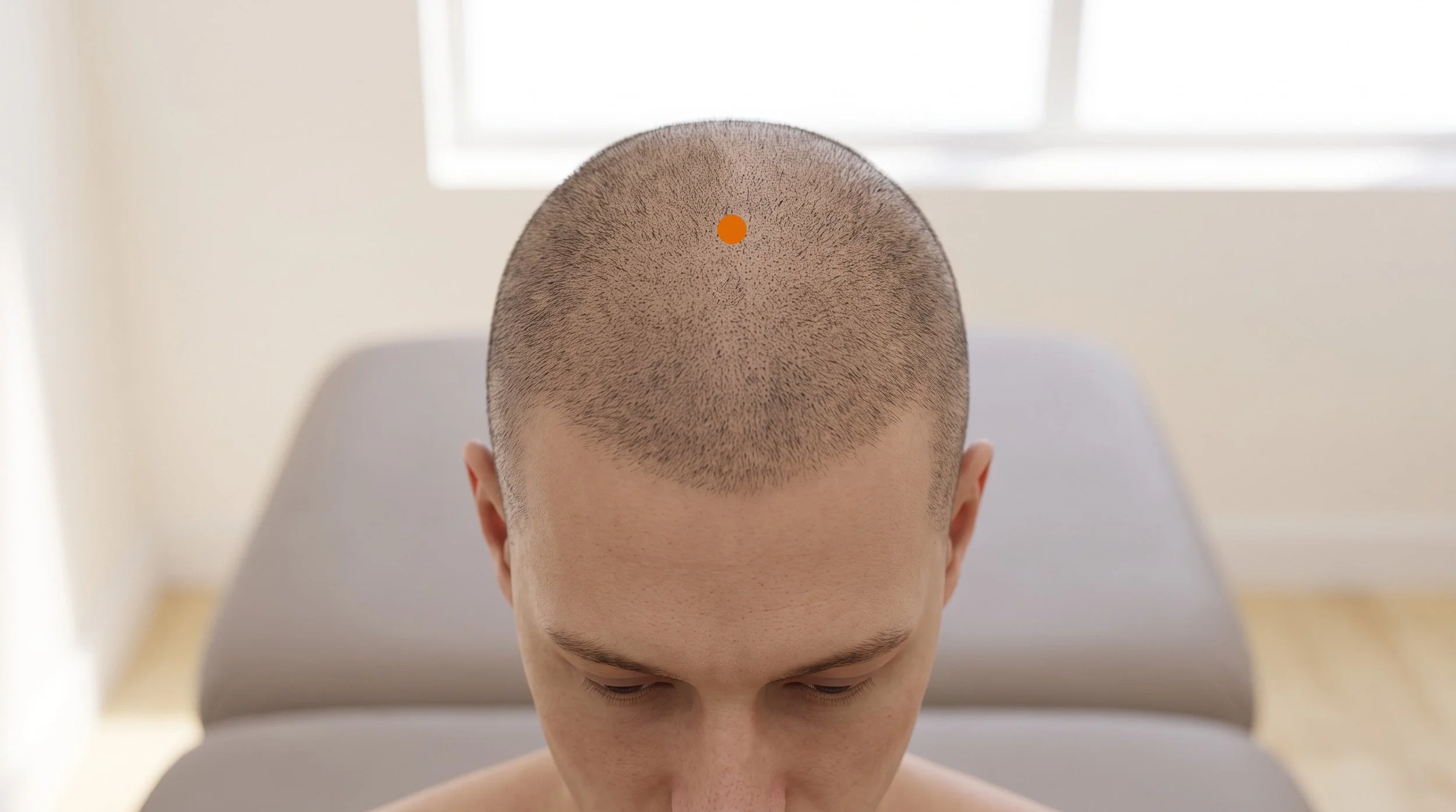
DU21 Acupuncture Point (Qianding)
The Point Just Ahead of the Crown: Anatomy, Mechanism, and Why DU21 Earns a Place in Vertex Headache, Dizziness, and Nasal Congestion Treatment
DU21 (also written GV21), known in Chinese as Qianding and usually translated as In Front of the Crown, sits on the midline of the scalp a little forward of the highest point of the head. In plain terms, if you run a finger up the center of the skull to the very top and then slide it about an inch and a half toward the forehead, you are on it: 1.5 cun anterior to DU20 and 3.5 cun behind the front hairline.
Governing vessel 21 matters clinically because that small patch of scalp sits where the sensory territories of the trigeminal nerve and the upper cervical nerves fade into one another, which is exactly the neural neighborhood implicated in migraine, tension-type headache, and the vague pressure-in-the-crown complaints that patients struggle to describe. Classical sources treat the DU 21 head region as a place to settle wind in the head, and modern practitioners use Qianding acupuncture as a quiet, low-stimulation scalp point that pairs well with stronger distal and cervical needling.
- Location and layers: DU21 lies on the scalp midline, 1.5 cun in front of DU20 and 3.5 cun behind the anterior hairline. Needles pass through skin, a dense fibrofatty subcutaneous layer full of small vessels and nerve endings, and the galea aponeurotica, all of which sit over the sagittal region of the skull rather than over muscle bellies.
- Traditional attributions: the classical literature credits this point with eliminating wind, calming convulsions, and benefiting the head, with later texts adding clearing the head and eyes and opening the nose. Read neurophysiologically, those categories describe pain, dizziness, and congestion complaints in a shared trigeminal and upper cervical field, not a substance moving through the scalp.
- Mechanism: needling here recruits small-diameter afferents in the supraorbital, supratrochlear, and greater occipital distributions, which converge with intracranial afferents in the trigeminocervical complex and engage descending inhibitory pathways from the periaqueductal gray and rostral ventromedial medulla (Zhao, 2008).
- Research picture: no trial isolates DU21 by itself, but Cochrane reviews of the multi-point protocols it usually belongs to found acupuncture reduced headache frequency in episodic migraine and frequent tension-type headache (Linde et al., 2016a; Linde et al., 2016b), and individual patient data pooling supports persistent effects in chronic pain including headache (Vickers et al., 2018).
- Clinical framing: at Morningside we rarely use governing vessel 21 as a stand-alone point. It usually joins cervical and cranial work, distal points, and dry needling of the neck and scalp muscles that refer pain into the vertex (Simons et al., 1999).
- De qi at this point is subtle: because the needle runs flat under the scalp, most people report spreading heaviness, a dull tug, or mild warmth across the crown rather than the deep grabbing ache typical of thick muscle.
Headaches That Sit On Top of Your Head?
Vertex pressure, a heavy crown, and headaches that worsen with screen time and clenched jaws respond well to a plan that treats the neck, the scalp, and the nervous system together. Our licensed acupuncturists use DU21 alongside cervical points, cranial points, and dry needling of the upper neck extensors to address both the referral pattern and the sensitized pathways behind it. Every plan starts with a full intake and orthopedic screen, not a template. Schedule a visit and let's map where your headache actually comes from.
Schedule NowAnatomy of DU21: Why the Midline Just Forward of the Vertex Is Such an Important Location
The scalp at DU21 is a laminated structure and not a muscular one. Under the skin sits a tough, fatty subcutaneous layer densely packed with small arteries, veins, and free nerve endings, and beneath that lies the galea aponeurotica, the broad tendinous sheet that links the frontal and occipital bellies of the occipitofrontalis muscle. Because the galea is under constant tension from those two muscle bellies and from the temporalis and cervical muscles that anchor around it, sustained jaw clenching, forehead bracing, and forward head posture all load this tissue. Patients often describe the result as tightness across the crown rather than as a discrete point of pain.
The nerve geography here is the interesting part. The front of the scalp is supplied by the supraorbital and supratrochlear branches of the ophthalmic division of the trigeminal nerve, while the back of the scalp is supplied by the greater occipital nerve from the C2 root, and their territories meet around the vertex. Those trigeminal and upper cervical afferents converge on shared second-order neurons in the trigeminocervical complex, which is one reason neck problems can present as forehead or crown pain and why a scalp point can influence a headache that feels intracranial.
Needle stimulation of small-diameter afferents in this field also engages descending inhibitory control through midbrain and brainstem circuits along with endogenous opioid and monoaminergic signaling, which is the best-supported general account of acupuncture analgesia (Zhao, 2008). Local effects matter too: needling changes microcirculation and axon reflex activity in a richly vascularized layer, which may be part of why scalp points are used for congestive and vascular complaints (Wang et al., 2014).
Safety drives technique here. The superior sagittal sinus and the underlying brain sit beneath the midline of the skull, so DU21 is needled transversely, flat under the scalp, at roughly 0.5 to 1 cun, and never as a deep perpendicular insertion. The classic caution recorded in the point manuals is absolute: this point is not needled in infants whose anterior fontanelle has not yet closed, and Kim's text extends the same caution to people with hydrocephalus.
Because the subcutaneous layer is vascular, brief bleeding or a small bump after withdrawal is not unusual, and practitioners apply firm pressure on removal to prevent it.
Related Best Acupuncture Points For Headaches Related Pain Finder Head NeckDU21 (GV21) at a Glance: Classification, Location, and Clinical Use
| Category | Detail |
|---|---|
| Traditional Name | Qianding (In Front of the Crown), also translated Before the Vertex or Anterior Vertex |
| Channel Classification | Governing Vessel (Du mai), point 21, on the scalp midline (DU21, also written GV21) |
| Point Categories | A regular Governing Vessel point. The reference texts list no five-shu, hui-meeting, luo, or extraordinary vessel intersection designation for DU21. Maciocia groups it with DU20, Sishencong, and BL7 as the cluster of vertex Governing Vessel points associated with the Eye System, and Deadman classifies its traditional actions as eliminating wind, treating convulsions, and benefiting the head. |
| Precise Location | On the midline at the top of the head, 1.5 cun anterior to DU20 and 3.5 cun posterior to the anterior hairline. If the hairline is indistinct, locate the point using the measurement from DU20, which sits 5 cun behind the hairline and 3 cun above the glabella. |
| Tissue Stimulated | Scalp skin, vascular subcutaneous layer, and the galea aponeurotica overlying the sagittal region of the skull. Related muscular referral into this zone comes from the upper neck and jaw muscles rather than from the point site itself (see our Pain Finder Head Neck guide). |
| Needle Depth / Direction | Transverse (subcutaneous) insertion 0.5 to 1 cun, angled either forward or backward along the midline. Some texts use a shallower 0.3 to 0.5 cun. Never needled perpendicular or deep. Not needled in infants with an open fontanelle. |
| De Qi Sensation | Usually mild: spreading heaviness, a dull tug or stretch under the scalp, sometimes local soreness or warmth. Sharp or electric sensations are not expected and mean the needle should be adjusted. |
| Primary Clinical Uses | Vertex and generalized headache, migraine-type head pain, dizziness and visual dizziness, nasal congestion and clear nasal discharge, facial puffiness, and as an adjunct scalp point in stress-related head tension. Classical listings also record convulsive and childhood fright wind patterns. |
| Common Point Combinations |
|
Deadman's point manual assigns DU21 two traditional actions: eliminating wind while settling convulsions, and benefiting the head. The indications gathered there fall into two broad families. One is neurological and convulsive: head wind, visual dizziness, wind epilepsy, acute and chronic childhood fright wind, and clonic spasm. The other is congestive and facial: pain and swelling at the crown, red and swollen face, edema, aversion to wind and cold, and copious clear nasal discharge.
Cunningham's compendium adds descriptions such as subduing ascendant Liver yang, clearing the head and eyes, opening the nose, and calming the spirit, while Kim's manual lists epilepsy, dizziness, blurred vision, vertex headache, and rhinorrhea. These are traditional attributions rather than physiological claims, but the striking thing is how tightly the list clusters around a single anatomical region: everything named is happening in the head, face, or nose, in tissue served by the same trigeminal and upper cervical supply that surrounds the point.
Why DU21 Is Used for Dizziness and Nasal Congestion, Not Just Vertex Headache
The first reason is convergence. Sensory information from the scalp, the face, the nasal mucosa, the dura, and the upper cervical joints all funnels into overlapping pools of neurons in the brainstem and upper cord. When one of those inputs is chronically irritated, neighboring territories can become sensitized, so a patient with neck stiffness may feel crown pressure, and a patient with chronic nasal congestion may feel a heavy forehead.
Needling in the trigeminal and upper cervical field gives the nervous system a competing, well-localized input in that same shared pool, which is a plausible route by which a scalp point influences symptoms that are not strictly muscular (Zhao, 2008).
The second reason is descending control and autonomic tone. Needle stimulation reliably activates midbrain and brainstem circuits that dampen pain transmission and shift the balance between sympathetic and parasympathetic activity, and those changes can outlast the session (Zhao, 2008). Autonomic shifts are directly relevant to nasal symptoms, since congestion and watery discharge are driven substantially by vascular and secretory control of the nasal mucosa.
Network meta-analysis of trials in allergic rhinitis found that acupuncture methods outperformed sham on nasal symptom scores and quality of life, though the evidence base has notable limitations (Yin et al., 2020).
The third reason is regional physiology at the scalp itself. Preclinical work on vertex scalp needling, most of it built around DU20 and its immediate neighbors, reports changes in cerebral perfusion, infarct size, and neurological scores in animal stroke models, which is at least consistent with the idea that stimulation here influences cranial blood flow rather than acting purely as a local skin stimulus (Wang et al., 2014). This is animal evidence and should not be over-read, but it offers a mechanism-level reason why classical sources kept returning to the crown for dizziness and head symptoms.
What the Research Shows for DU21 (GV21)
One note on naming before the evidence: in the research literature this point is almost always listed as GV21, the WHO standard code, so GV21 is the term to search if you want to read the studies below in full.
A realistic caveat first: there are no clinical trials of DU21 on its own, and there almost certainly never will be. Acupuncture research tests protocols, and this point appears inside multi-point headache and head-region prescriptions rather than as an isolated intervention. What the literature can tell us is whether the protocols DU21 belongs to outperform sham, usual care, or drug comparators, and what mechanisms plausibly explain those effects. The table below summarizes the most relevant reviews, with the understanding that any effect attributed to a protocol cannot be assigned to a single point within it.
| Study | Type | Focus | Key Finding |
|---|---|---|---|
| Linde et al., 2016a | Cochrane systematic review | Acupuncture for prevention of episodic migraine, including scalp and head-region point protocols | Acupuncture added to usual care reduced headache frequency compared with usual care alone, with small additional benefit over sham and evidence of at least non-inferiority to prophylactic drugs, at moderate to low certainty. |
| Linde et al., 2016b | Cochrane systematic review | Acupuncture for prevention of frequent episodic or chronic tension-type headache | Acupuncture appeared effective for reducing headache frequency, though certainty was downgraded for blinding limitations and variable effect sizes. |
| Vickers et al., 2018 | Individual patient data meta-analysis | Chronic pain conditions including chronic headache, roughly 21,000 patients | Acupuncture outperformed both sham and no-acupuncture controls, and treatment effects persisted over about a year with only modest decay. |
| Wang et al., 2014 | Preclinical systematic review and meta-analysis | DU20-based vertex scalp acupuncture in animal models of focal cerebral ischemia | Pooled animal data suggested improved infarct volume and neurological function scores, a mechanistic signal only and not evidence of clinical benefit in people. |
| Yin et al., 2020 | Bayesian network meta-analysis | Acupuncture methods for allergic rhinitis, relevant to the nasal indications listed for this point | All acupuncture types studied were superior to sham on total nasal symptom score and rhinoconjunctivitis quality of life, with the usual caveats about trial quality. |
| Zhao, 2008 | Narrative mechanism review | Neural mechanisms of acupuncture analgesia | Analgesic effects are best explained by afferent stimulation engaging spinal and supraspinal inhibitory circuits and endogenous opioid and monoaminergic signaling. |
Dizziness, Head Fog, and Stubborn Nasal Congestion?
Qianding has been used for centuries for wind dizziness, facial puffiness, and copious clear nasal discharge, and modern practice reframes those patterns as autonomic and vascular reactivity in the head and face. We combine scalp points like DU21 with nasal and facial points, distal regulation, and gentle cervical release to calm that reactivity over a course of care. Results vary and we track them session by session. Book an evaluation and we'll tell you honestly whether acupuncture is a good fit.
Schedule NowDU21 in the Context of Trigger Point Work
DU21 does not sit over a muscle belly, so it is never a trigger point target itself. What makes it clinically useful is that several muscles refer pain directly into the patch of scalp it occupies. The Travell and Simons manual documents referral to the top of the head from splenius capitis, and referral into the vertex and forehead from the sternal division of sternocleidomastoid, with semispinalis capitis, suboccipitals, upper trapezius, and temporalis all capable of producing a diffuse cap-like or band-like head pain (Simons et al., 1999). When a patient points to the crown and says the pressure sits there, the generator is frequently in the neck and jaw.
That is how we sequence it at Morningside. We assess and, when indicated, dry needle the upper cervical extensors, sternocleidomastoid, temporalis, and upper trapezius to address the referral source, then use DU21 with neighboring scalp and cervical points as a lower-intensity input over the symptomatic zone. Both are acupuncture in the sense that matters clinically, the insertion of a filiform acupuncture needle, and the two approaches complement each other: dry needling targets the mechanical contributor, while the scalp and distal points work on the sensitized pathway that keeps reproducing the headache.
DU21 Headache Treatment at NYC's Highest-Rated Acupuncture Clinic
Morningside Acupuncture is the highest-rated acupuncture and dry needling clinic in New York City with over 500 five-star Google reviews, and headache care is one of the things we do most. Our approach blends classical point selection, including scalp points like DU21, with orthopedic assessment and trigger point dry needling of the neck and jaw. You get clear reasoning, measurable goals, and a treatment plan you can understand. Schedule your first session and start working on the pattern instead of chasing the pain.
Schedule NowFrequently Asked Questions
Is DU21 the same point as GV21?
Yes. DU21 and GV21 are two codes for the same point, Qianding. DU comes from Du Mai, the Chinese name of the Governing Vessel, and it is the code used in most Chinese texts and many acupuncture schools. GV is the WHO standard abbreviation and the one you will see in most Western textbooks and research papers. You will also come across it written as Du 21, GV-21, or Governing Vessel 21. Whichever code is used, the location and the uses are the same.
What does DU21 feel like when needled?
Mild, in most cases. The needle is laid flat under the scalp rather than pushed straight in, so people typically feel a brief pinch at the skin, then a spreading heaviness, a dull tugging, or a light ache across the crown. Some describe warmth or a faint pressure that fades within a minute. It should never feel sharp, burning, or electric, and if it does, your practitioner will withdraw and redirect the needle.
Why needle the top of my head when my headache feels behind my eyes or in my neck?
Because those regions share neural real estate. Trigeminal afferents from the forehead and face and cervical afferents from C1 to C3 converge on the same second-order neurons in the trigeminocervical complex, which is why irritation in one area is often felt in another (Zhao, 2008). Stimulating within that shared field can influence how the whole territory processes pain, so a crown point can be relevant to frontal, retro-orbital, or occipital symptoms. Classical sources arrived at the same regional grouping empirically, treating the vertex points as head-and-face points.
Can I press DU21 myself between sessions?
Yes, acupressure on this point is safe for most adults. Find the top of your head by tracing a line up from the tips of both ears to the midline, then move your fingertip about one and a half inches forward toward the forehead. Use the pad of your middle finger or the pad of your thumb and apply steady, moderate pressure into the scalp for 30 to 60 seconds, then add small circular motions for another 30 seconds. Repeat two or three times per session, one to three times a day, and pause if you feel lightheaded. Small circles with the fingertips over the whole crown, plus gentle pressure at the base of the skull, often help more than working the single spot. Skip acupressure over any area of broken skin, recent head injury, or surgical hardware, and never press firmly on an infant's head.
Is DU21 safe to needle?
In trained hands, yes, with specific rules. The point is needled transversely under the scalp only, typically 0.5 to 1 cun, because the skull, the superior sagittal sinus, and the brain lie beneath the midline. The classical manuals state clearly that it must not be needled in infants whose fontanelle has not closed, and Kim's text adds the same caution for people with hydrocephalus. Practitioners also take care with anyone on anticoagulants or with a history of scalp surgery or cranial hardware, since the scalp bleeds readily. The most common side effect is a small bruise or brief bleeding at withdrawal, which firm pressure usually prevents.
Where exactly is DU21 located?
On the midline at the top of the head, 1.5 cun in front of DU20 and 3.5 cun behind the front hairline. A practical way to find it: divide the distance from DU20 to the anterior hairline into thirds, and DU21 sits just behind the junction of the first and middle thirds. If your hairline is receded or indistinct, use the fixed landmarks instead, since DU20 lies 5 cun behind the hairline and the hairline itself is measured 3 cun above the glabella between the eyebrows.
References
- Deadman, P., Al-Khafaji, M., & Baker, K. (2009). A manual of acupuncture. Journal of Chinese Medicine Publications.
- Cunningham, P. M. (2000). Acupuncture points: A practical guide to classical and modern usage. Odyssey Press.
- Kim, H. (2008). Handbook of Oriental medicine (3rd ed.). Harmony & Balance Press.
- Maciocia, G. (2005). The foundations of Chinese medicine: A comprehensive text for acupuncturists and herbalists (2nd ed.). Elsevier Churchill Livingstone.
- O'Connor, J., & Bensky, D. (Eds. & Trans.). (1981). Acupuncture: A comprehensive text. Shanghai College of Traditional Medicine. Eastland Press.
- Simons, D. G., Travell, J. G., & Simons, L. S. (1999). Travell & Simons' myofascial pain and dysfunction: The trigger point manual, Vol. 1: Upper half of body (2nd ed.). Williams & Wilkins.
- Linde, K., Allais, G., Brinkhaus, B., Fei, Y., Mehring, M., Vertosick, E. A., Vickers, A., & White, A. R. (2016a). Acupuncture for the prevention of episodic migraine. Cochrane Database of Systematic Reviews, 2016(6), CD001218. https://doi.org/10.1002/14651858.CD001218.pub3
- Linde, K., Allais, G., Brinkhaus, B., Fei, Y., Mehring, M., Shin, B. C., Vickers, A., & White, A. R. (2016b). Acupuncture for the prevention of tension-type headache. Cochrane Database of Systematic Reviews, 2016(4), CD007587. https://doi.org/10.1002/14651858.CD007587.pub2
- Vickers, A. J., Vertosick, E. A., Lewith, G., MacPherson, H., Foster, N. E., Sherman, K. J., Irnich, D., Witt, C. M., & Linde, K. (2018). Acupuncture for chronic pain: Update of an individual patient data meta-analysis. Journal of Pain, 19(5), 455-474. https://doi.org/10.1016/j.jpain.2017.11.005
- Wang, W. W., Xie, C. L., Lu, L., & Zheng, G. Q. (2014). A systematic review and meta-analysis of Baihui (GV20)-based scalp acupuncture in experimental ischemic stroke. Scientific Reports, 4, 3981. https://doi.org/10.1038/srep03981
- Yin, Z., Geng, G., Xu, G., Zhao, L., & Liang, F. (2020). Acupuncture methods for allergic rhinitis: A systematic review and bayesian meta-analysis of randomized controlled trials. Chinese Medicine, 15, 109. https://doi.org/10.1186/s13020-020-00389-9
- Zhao, Z. Q. (2008). Neural mechanism underlying acupuncture analgesia. Progress in Neurobiology, 85(4), 355-375. https://doi.org/10.1016/j.pneurobio.2008.05.004
Disclaimer: This web site is intended for educational and informational purposes only. Reading this website does not constitute providing medical advice or any professional services. This information should not be used for diagnosing or treating any health issue or disease. Those seeking medical advice should consult with a licensed physician. Seek the advice of a medical doctor or other qualified health professional for any medical condition. If you think you have a medical emergency, call 911 or go to the emergency room. No acupuncturist-patient relationship is created by reading this website or using the information. Morningside Acupuncture PLLC and its employees and contributors do not make any express or implied representations with respect to the information on this site or its use. For any legal interpretation of scope of practice in your state, consult a licensed attorney or regulatory authority.
Read more from our blog



