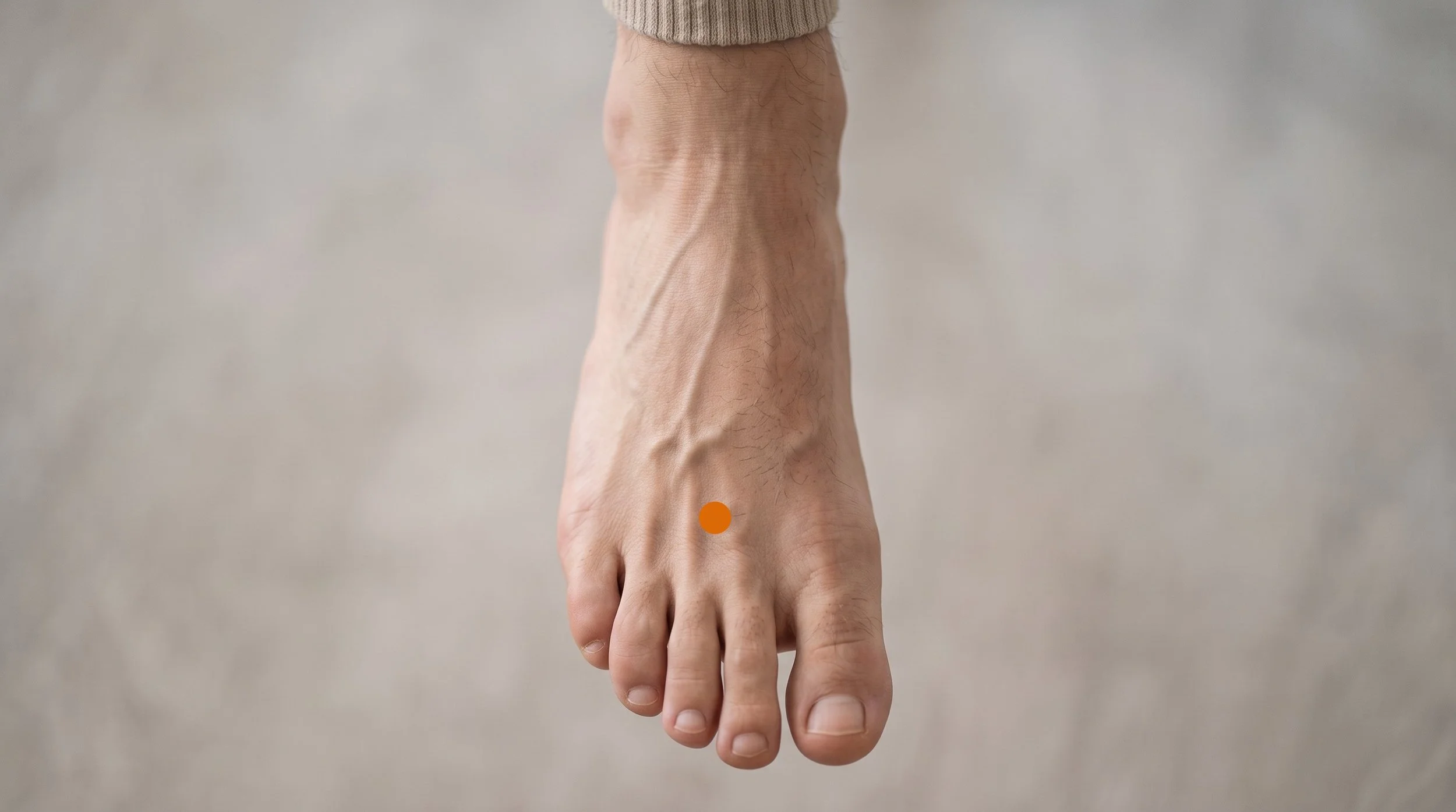
ST43 Acupuncture Point (Xiangu)
The Sunken Valley on the Top of the Foot: Anatomy, Mechanism, and Why This Shu-Stream Point Bridges Forefoot Pain and Digestive Complaints
ST43 (Xiangu, often translated as Sunken Valley) sits in the soft hollow on the top of the foot between the second and third metatarsal bones, roughly a thumb's width behind the web margin where ST44 is found. It is the shu-stream and Wood point of the Stomach channel, which in classical terms places it among the points chosen for joint pain that worsens with damp, heavy, swollen conditions, and its classical reputation extends past the foot to facial puffiness, fluid retention, and abdominal distention with rumbling.
Clinically the st43 acupuncture point matters for two reasons: it lands in a genuinely useful piece of anatomy (the second intermetatarsal space, in deep fibular nerve territory, beside the interosseous muscles that so often become tender in forefoot pain), and it functions as a distal Stomach channel point that clinicians reach for when the foot, the face, and the gut all seem to belong to the same complaint.
- Location and layers: stomach 43 lies in the depression between the second and third metatarsal shafts, about 1 cun proximal to ST44, with skin and the dorsal venous network superficially, the long and short toe extensor tendons alongside, and the dorsal interosseous muscle filling the space beneath.
- Traditional categories, translated: the classical texts list ST43 as the shu-stream and Wood point of the Stomach channel and traditionally attribute to it the regulation of fluid accumulation and of the stomach and intestines. In modern language, that maps onto a segmentally relevant forefoot point with documented somato-autonomic connections rather than to any literal movement of fluid (Liu et al., 2021).
- Nerve story: the second interspace sits in deep fibular nerve territory, with superficial fibular cutaneous branches above, drawing on L4 to S1 spinal segments. Needling here recruits A-delta and C fiber afferents that engage spinal and brainstem circuits associated with descending inhibition and diffuse noxious inhibitory control (Zhao, 2008).
- Research picture: no trial isolates the sunken valley point on its own, but needling therapies applied to the foot and ankle region have been associated with improvements in pain, proprioception, balance, and self-reported function in chronic ankle instability, with the authors themselves calling for better trials (Luan et al., 2023).
- Clinical framing: at Morningside we use ST 43 foot needling most often for top-of-foot pain, stiff or achy toe extension, and forefoot swelling after overuse, and as a distal Stomach channel point alongside abdominal and lower leg points when digestion is part of the picture (Vickers et al., 2018; Yang et al., 2020).
- De qi at this point tends to be a spreading, slightly heavy ache between the metatarsals that may travel toward the second and third toes. It is usually mild, and the needle is kept shallow because the region is thin and vascular.
Sore, Swollen Top of the Foot That Will Not Settle?
Dorsal foot pain rarely comes from one structure, and it often involves the interossei, the toe extensors, and an irritable deep fibular nerve all at once. We combine ST43 with careful dry needling of the intrinsic foot muscles, manual therapy, and load advice so the foot tolerates walking in the city again. Most patients notice something within the first two or three visits. Schedule an evaluation and we will map exactly what is driving your foot pain.
Schedule NowAnatomy of ST43: Why the Second Intermetatarsal Space Is Such an Important Location
Run a fingertip up from the web between the second and third toes and you drop into a narrow trough between two metatarsal shafts. That trough is ST43. The skin here is thin and mobile, crossed by the dorsal venous network, and just beneath it lie the tendons of extensor digitorum longus heading for the second and third toes, with extensor digitorum brevis slanting across from the outer side of the foot. Deeper still, filling the gap between the bones, sits the second dorsal interosseous muscle.
This little bundle of tissue takes a beating from narrow shoes, long walking days on hard pavement, forefoot-heavy running, and the gripping pattern many people adopt after an ankle sprain, which is why the space so often feels tender and slightly full before anything shows up on imaging.
The nerve geography is what makes this location clinically interesting. The interspace sits in the sensory field of the deep fibular nerve, with medial dorsal cutaneous branches of the superficial fibular nerve supplying the skin above, and the whole region drawing on the L4 to S1 spinal segments. Needling into that space activates small-diameter A-delta and C fiber afferents whose input converges in the dorsal horn with signals from the surrounding joints, tendons, and skin, and that convergence is one plausible route by which local needling changes how the forefoot feels (Zhao, 2008).
The same afferent traffic engages descending inhibitory pathways from the midbrain and brainstem that damp nociceptive transmission more broadly, which helps explain why patients often report the whole foot feeling less irritable rather than just the needled spot. Work in animals also shows that hindlimb needling can recruit specific autonomic reflex pathways not accessible from abdominal sites, which offers a mechanistic frame for why distal leg and foot points have long been used for problems felt elsewhere in the body (Liu et al., 2021).
The safety consideration here is vascular rather than visceral. Branches of the dorsalis pedis artery and the dorsal metatarsal vessels run through the top of the foot, and ST42 just proximal is defined by the palpable pulse, so practitioners palpate before inserting and avoid needling directly onto a pulsating vessel. Standard conventions described in the point manuals are perpendicular or slightly oblique insertion of about 0.5 to 1 cun, with several texts using a shallower 0.3 to 0.5 cun range, angling into the interspace rather than toward bone. Fine needles, gentle technique, and brief pressure on withdrawal keep bruising to a minimum in an area where superficial veins are easy to nick.
Related Pain Finder Leg Ankle Foot Related Stomach ChannelST43 at a Glance: Classification, Location, and Clinical Use
| Category | Detail |
|---|---|
| Traditional Name | Xiangu, commonly translated as Sunken Valley or Sinking Valley |
| Channel Classification | Stomach channel of the foot, yangming |
| Point Categories | Shu-stream point of the Stomach channel; Wood point of the Stomach channel in the five transporting (five shu) system |
| Precise Location | On the top of the foot, in the depression between the second and third metatarsal bones, approximately 1 cun proximal to ST44 at the toe web |
| Tissue Stimulated | Skin and dorsal venous network, extensor tendons to the second and third toes including the extensor digitorum longus and extensor digitorum brevis, and the second dorsal interosseous muscle deep in the interspace |
| Needle Depth / Direction | Perpendicular or oblique insertion into the interspace, commonly 0.5 to 1 cun, with shallower 0.3 to 0.5 cun depths used in several texts; palpate and avoid dorsal vessels |
| De Qi Sensation | A dull, spreading ache or fullness between the metatarsals, sometimes travelling toward the second and third toes; occasionally a brief sharpness as the needle passes the thin dorsal skin |
| Primary Clinical Uses | Swelling and pain on the top of the foot, difficulty flexing and extending the toes, forefoot overuse pain, and traditionally facial puffiness, fluid retention, abdominal distention with rumbling, and heat patterns of the Stomach channel |
| Common Point Combinations |
|
Deadman, Al-Khafaji and Baker's A Manual of Acupuncture presents ST43 as the shu-stream and Wood point of the Stomach channel and traditionally attributes to it two actions: settling fluid accumulation, particularly around the face and eyes, and harmonizing the stomach and intestines.
The classical indication lists gather into a few recognizable clusters: puffiness of the face and swelling around the eyes, abdominal fullness with distention and rumbling, belching and chest or rib-side congestion, fever without sweating with chills, and local complaints of a painful swollen foot with toes that will not bend or straighten comfortably.
The commentary notes that the point's name evokes a low place where water collects, which classical authors read as a clue to its traditional use, and that the yangming channel's course over the face supplied the reasoning for treating facial swelling from a point on the foot. What makes the pattern striking is its internal consistency: a single small hollow between two metatarsal bones was assigned responsibility for the foot underneath it, the belly it never touches, and the face at the far end of the same channel, and that three-part logic held across texts written centuries apart.
Why ST43 Is Used for Facial Puffiness and Belly Bloating, Not Just Sore Feet
The local part is straightforward. Pain on the top of the foot usually involves the interosseous muscles, the toe extensor tendons, and sometimes an irritated deep fibular nerve, and all of those structures share spinal segments with the skin at ST43. Sensory input from the needle converges in the dorsal horn with input from those deeper tissues, which can change how strongly the region signals and how tolerant it feels to pressure and push-off (Zhao, 2008). Patients often describe the foot as looser and less bruised-feeling after treatment, even when the needle went nowhere near the worst spot.
The distant uses need a different explanation. The stomach is not innervated from L5, so nothing about ST43 involves a direct segmental link to the gut. What research does support is a somato-autonomic route: stimulating certain hindlimb sites recruits specific sensory neuron populations that drive autonomic output, and that effect is site dependent rather than uniform across the body (Liu et al., 2021).
Clinical trials in functional dyspepsia, which typically combine lower leg Stomach channel points with abdominal points, have reported reductions in postprandial fullness and related symptoms compared with sham needling, though effect sizes are modest and protocols vary (Yang et al., 2020; Pang et al., 2016). That is the honest version of the classical claim: not fluid being drained from the face by a point on the foot, but a nervous system that can be nudged from the periphery in ways that show up centrally.
For swelling itself, we set expectations carefully. Acupuncture is not a treatment for edema caused by heart, kidney, liver, or lymphatic disease, and anyone with new or persistent swelling needs a medical workup first. What ST43 may reasonably contribute is local circulatory and autonomic modulation around a puffy, stiff, painful forefoot, plus a channel-based rationale for including it when the classical pattern of heaviness, distention, and facial fullness matches what the patient describes.
What the Research Shows for ST43
There is no clinical trial of ST43 by itself, and it would be misleading to suggest otherwise. Acupuncture research almost always tests multi-point protocols, so the fair question is whether the protocols that include foot and lower leg Stomach channel points produce measurable benefit, and how confident the reviews are. The table below summarizes the studies that bear most directly on how we use this point, spanning chronic pain broadly, foot and ankle function, digestive symptoms, and the basic physiology of needling at hindlimb sites.
| Study | Type | Focus | Key Finding |
|---|---|---|---|
| Vickers et al., 2018 | Individual patient data meta-analysis | Chronic musculoskeletal pain, headache, and osteoarthritis across 39 trials | Acupuncture produced modest but persistent benefits over sham and no-acupuncture controls, supporting referral for chronic pain while leaving individual point contributions unresolved. |
| Luan et al., 2023 | Systematic review and meta-analysis | Acupuncture and similar needling therapies in chronic ankle instability | Pooled results from twelve trials suggested improvements in pain, joint position sense, balance, and self-reported function, though heterogeneity was high and the authors called for better designed trials. |
| Yang et al., 2020 | Randomized clinical trial | Acupuncture for postprandial distress syndrome, a functional dyspepsia subtype | Participants receiving acupuncture reported greater symptom improvement than those receiving sham needling, indicating that Stomach channel protocols may reduce fullness after meals. |
| Pang et al., 2016 | Systematic review and meta-analysis | Acupuncture for functional dyspepsia | Reviewed trials generally favored acupuncture for symptom relief and quality of life, but methodological limitations meant the authors framed the evidence as suggestive rather than definitive. |
| Liu et al., 2021 | Preclinical neuroscience study | Sensory neuron populations underlying electroacupuncture effects at hindlimb sites in mice | Specific deep-tissue sensory neurons were required for hindlimb stimulation to drive autonomic output, providing a plausible anatomical basis for site-dependent distal effects. |
| Zhao, 2008 | Narrative review of mechanisms | Neural pathways of acupuncture analgesia | Needling activates small-diameter afferents that engage segmental gating and descending inhibitory systems, the framework we use to explain local forefoot responses. |
Digestion Off, Bloating After Meals, and Nothing Structural on Testing?
When workups come back clean but meals still feel heavy, we treat with distal Stomach channel points such as ST43 and ST36 together with abdominal points and breathing work aimed at the parasympathetic side of the nervous system. Studies suggest acupuncture may reduce postprandial fullness and related symptoms in functional dyspepsia, though results vary by person. Sessions are calm, brief, and easy to build into a week. Book a consultation and we will design a course of care around your symptoms.
Schedule NowST43 in the Context of Trigger Point Work
ST43 sits directly over the second dorsal interosseous muscle, which is a named myofascial target in Travell and Simons' trigger point manual and a frequent source of aching, poorly localized forefoot pain that patients describe as being inside the foot rather than on it. Because the point and the muscle occupy the same interspace, needling ST43 with a slightly deeper, more angled approach is functionally the same procedure as dry needling that interosseous, which is one of the clearest examples of how classical point locations and myofascial targets overlap. We treat the two frameworks as one intervention: an acupuncture needle in a specific piece of tissue, chosen for a specific reason.
In practice we rarely needle the interspace alone. A typical forefoot session at Morningside might include ST43 and ST44 in the second interspace, dry needling of extensor digitorum brevis on the outer dorsum and extensor digitorum longus in the lower leg, and attention to tibialis anterior and the deep intrinsic foot muscles if toe control is poor. Patients who came in after an ankle sprain often need calf and peroneal work as well, since guarded gait loads the forefoot in ways it was not built for.
Treatment is paired with simple loading, toe splay drills, and footwear advice, because needling reduces sensitivity while the exercise is what changes tolerance.
ST43 Foot Pain and Digestive Treatment at NYC's Highest-Rated Acupuncture Clinic
Morningside Acupuncture is the highest-rated acupuncture and dry needling clinic in New York City with over 500 five-star Google reviews, and our practitioners treat forefoot pain and digestive complaints every week. We use ST43 as part of a full plan that includes trigger point dry needling, movement guidance, and follow-up so progress holds. You will always know what we are needling and why. Schedule your visit today and let's get your feet and your digestion working together.
Schedule NowFrequently Asked Questions
What does ST43 feel like when needled?
Most people feel a brief pinch as the needle passes the thin skin on top of the foot, then a dull, spreading fullness or ache in the space between the second and third metatarsals. That heavy, slightly expanding sensation is de qi, and it may travel toward the toes or up the front of the foot. It usually fades within a minute or two and settles into a warm, slightly numb feeling for the rest of the session. Sharp or electric sensations are not the goal, and we adjust the needle immediately if you feel one.
Why needle a point on the foot for bloating or facial puffiness?
Two reasons, one traditional and one physiological. Traditionally, ST43 belongs to the Stomach channel, which classical texts describe as running across the face and through the abdomen, so a point at the far end of that channel was used for problems along its whole course. Physiologically, the honest explanation is that stimulating hindlimb sites can recruit autonomic reflex pathways in a site-dependent way (Liu et al., 2021), and trials of Stomach channel protocols have reported reductions in symptoms such as postprandial fullness (Yang et al., 2020). We use ST43 as one component of such a protocol, not as a standalone remedy for swelling, and any new or unexplained swelling should be evaluated medically first.
Can I press ST43 myself between sessions?
Yes, and it is an easy point to find on yourself. Sit with the foot resting on the opposite knee, slide a fingertip up from the web between the second and third toes until it drops into the soft hollow between the two metatarsal bones, about a thumb's width back from the web. Press straight down with your thumb or index finger at a firmness that feels like a satisfying ache rather than a bright pain, hold for 30 to 60 seconds, release, and repeat two or three times per foot. Small circular pressure for a minute or two also works well. Once or twice daily is plenty, and you can pair it with toe spreading and gentle toe extension. Stop if you feel any sharp, shooting, or electric sensation, which suggests you are on a nerve or vessel rather than the muscle.
Is ST43 safe to needle?
In trained hands it is a low-risk point. The main considerations are the superficial veins and the dorsal arterial branches on the top of the foot, so practitioners palpate the area first and avoid needling onto a pulse, and depths are kept modest, commonly 0.5 to 1 cun and often shallower. Because the dorsal skin is thin and vascular, a small bruise is the most common side effect, and brief pressure after needle removal reduces the chance of one. We take extra care in people on blood thinners, with diabetic neuropathy or poor circulation in the feet, with any active skin infection or wound on the dorsum, or with significant unexplained swelling that has not yet been evaluated.
Where exactly is ST43 located?
On the top of the foot, in the depression between the second and third metatarsal bones, roughly 1 cun proximal to ST44 at the web margin between the second and third toes. A practical way to locate it is to slide your finger back from the toe web along the groove between the two bones until it settles into a distinct hollow, usually just before you feel the bones widen toward the midfoot. Extending and flexing the second and third toes makes the extensor tendons stand up on either side, which helps confirm you are in the interspace and not on top of a tendon.
References
- Deadman, P., Al-Khafaji, M., & Baker, K. (2009). A manual of acupuncture. Journal of Chinese Medicine Publications.
- Cheng, X. (Ed.). (1999). Chinese acupuncture and moxibustion (Rev. ed.). Foreign Languages Press.
- Kim, H. (2008). Handbook of Oriental medicine (3rd ed.). Harmony & Balance Press.
- Maciocia, G. (2006). The channels of acupuncture: Clinical use of the secondary channels and eight extraordinary vessels. Churchill Livingstone Elsevier.
- Simons, D. G., Travell, J. G., & Simons, L. S. (1999). Travell & Simons' myofascial pain and dysfunction: The trigger point manual, Vol. 1: Upper half of body (2nd ed.). Williams & Wilkins.
- Vickers, A. J., Vertosick, E. A., Lewith, G., MacPherson, H., Foster, N. E., Sherman, K. J., Irnich, D., Witt, C. M., & Linde, K. (2018). Acupuncture for chronic pain: Update of an individual patient data meta-analysis. Journal of Pain, 19(5), 455-474. https://doi.org/10.1016/j.jpain.2017.11.005
- Zhao, Z. Q. (2008). Neural mechanism underlying acupuncture analgesia. Progress in Neurobiology, 85(4), 355-375. https://doi.org/10.1016/j.pneurobio.2008.05.004
- Luan, L., Zhu, M., Adams, R., Witchalls, J., Pranata, A., & Han, J. (2023). Effects of acupuncture or similar needling therapy on pain, proprioception, balance, and self-reported function in individuals with chronic ankle instability: A systematic review and meta-analysis. Complementary Therapies in Medicine, 77, 102983. https://doi.org/10.1016/j.ctim.2023.102983
- Liu, S., Wang, Z., Su, Y., Qi, L., Yang, W., Fu, M., Jing, X., Wang, Y., & Ma, Q. (2021). A neuroanatomical basis for electroacupuncture to drive the vagal-adrenal axis. Nature, 598(7882), 641-645. https://doi.org/10.1038/s41586-021-04001-4
- Yang, J. W., Wang, L. Q., Zou, X., Yan, S. Y., Wang, Y., Zhao, J. J., Tu, J. F., Wang, J., He, L. Y., Shi, G. X., Li, H., & Liu, C. Z. (2020). Effect of acupuncture for postprandial distress syndrome: A randomized clinical trial. Annals of Internal Medicine, 172(12), 777-785. https://doi.org/10.7326/M19-2880
- Pang, B., Jiang, T., Du, Y. H., Li, J., Li, B., Hu, Y. C., & Cai, Q. H. (2016). Acupuncture for functional dyspepsia: What strength does it have? A systematic review and meta-analysis of randomized controlled trials. Evidence-Based Complementary and Alternative Medicine, 2016, 3862916. https://doi.org/10.1155/2016/3862916
Disclaimer: This web site is intended for educational and informational purposes only. Reading this website does not constitute providing medical advice or any professional services. This information should not be used for diagnosing or treating any health issue or disease. Those seeking medical advice should consult with a licensed physician. Seek the advice of a medical doctor or other qualified health professional for any medical condition. If you think you have a medical emergency, call 911 or go to the emergency room. No acupuncturist-patient relationship is created by reading this website or using the information. Morningside Acupuncture PLLC and its employees and contributors do not make any express or implied representations with respect to the information on this site or its use. For any legal interpretation of scope of practice in your state, consult a licensed attorney or regulatory authority.
Read more from our blog



