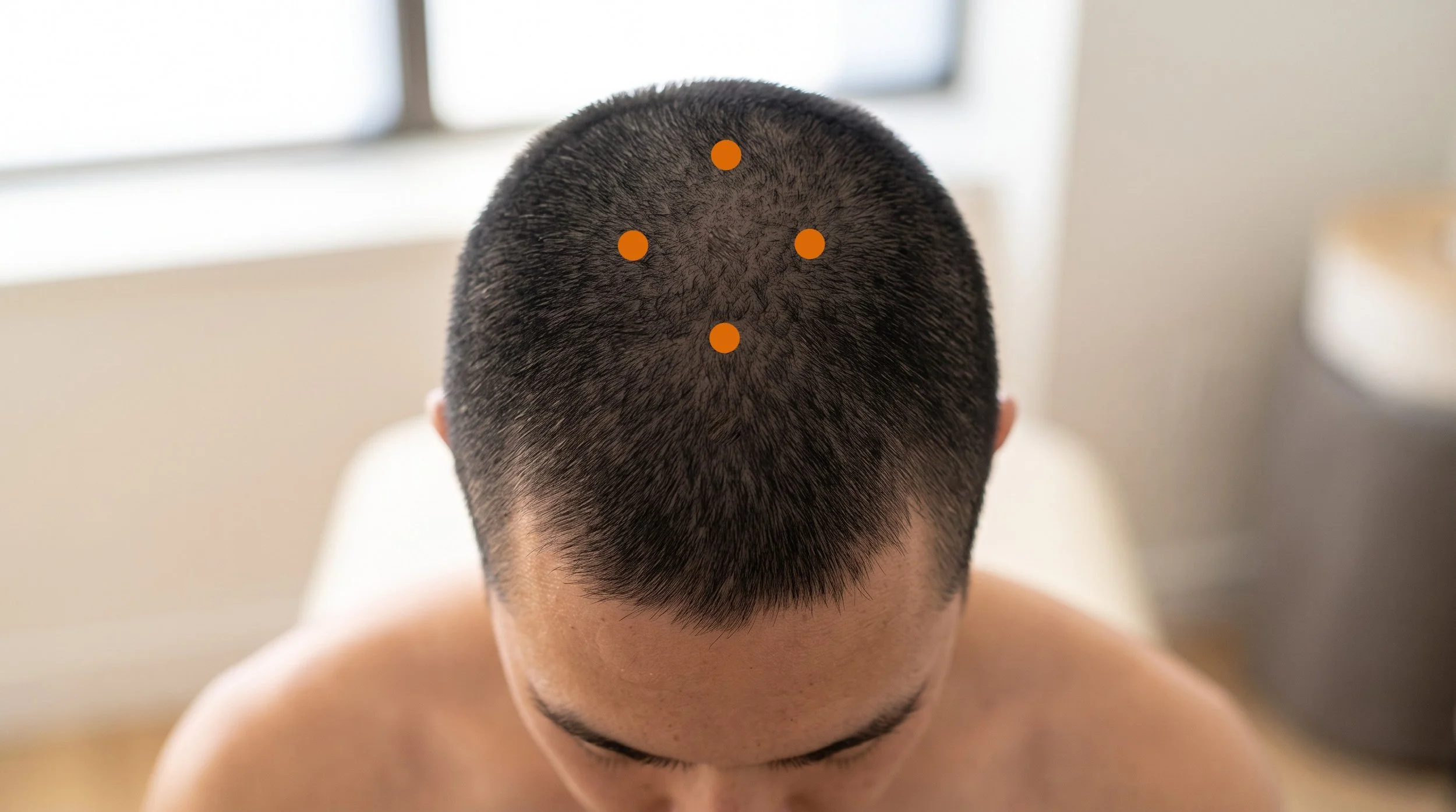
Sishencong Acupuncture Point (M-HN-1)
The Four Alert Spirit Points at the Crown: Anatomy, Mechanism, and Why This Extra Point Group Anchors Modern Sleep and Memory Protocols
Sishencong (M-HN-1, also written EX-HN1) is an extra point group whose name is usually translated as Four Alert Spirit. It is not one point but four, arranged like the points of a compass around the crown of the head: one an inch in front of GV20, one an inch behind it, and one an inch to each side. Because the group has no channel of its own, it is defined entirely by its relationship to Baihui GV20 at the vertex, and in practice the four needles are used together as a set or threaded outward from GV20 at their centre.
Clinically, the sishencong acupuncture point group has become one of the most heavily used scalp prescriptions in modern practice for insomnia, foggy thinking and poor memory, vertex headache and dizziness, and it appears in the point formulas of a large share of published sleep and cognition trials.
- Sishencong sits on the scalp at the vertex, where the needle passes through skin, a dense fibrous subcutaneous layer packed with vessels and nerves, and into or just above the galea aponeurotica, the tough sheet linking the frontal and occipital bellies of occipitofrontalis; needling is transverse, 0.5 to 1.5 cun, never deep and perpendicular (Deadman & Al-Khafaji, 2007).
- The traditional attributions recorded for M-HN-1 are calming the spirit, pacifying interior wind, and benefiting the eyes and ears, with classical listings for windstroke, epilepsy, mania-depression, insomnia, poor memory, one-sided and generalised headache, dizziness and deafness; read through a modern lens these describe a point set aimed at arousal, sleep and head pain rather than at any single tissue (Deadman & Al-Khafaji, 2007).
- The crown is a convergence zone. Terminal branches of the supraorbital nerve (trigeminal V1) reach back over the vertex, the greater occipital nerve (C2) reaches forward, and auriculotemporal branches supply the sides, so a single group of needles engages both trigeminal and upper cervical afferents that already share second-order neurons in the trigeminocervical complex, a plausible substrate for the point's headache reputation (Zhao, 2008; Linde et al., 2016).
- Sishencong is one of the few extra points with a point-specific physiological signal: needling here has been reported to raise the high frequency band of heart rate variability and lower sympathetic indices in healthy volunteers, a pattern consistent with a shift toward parasympathetic dominance (Wang et al., 2002), and this finding was part of the rationale for including the group in placebo-controlled insomnia trials (Yeung et al., 2009).
- The research picture is encouraging but unsettled. A Cochrane review concluded the insomnia evidence was not rigorous enough to support or refute acupuncture (Cheuk et al., 2012), while a controlled trial using Sishencong within its protocol found better sleep efficiency by diary and actigraphy than placebo needling, with no difference on the primary severity index (Yeung et al., 2009).
- De qi at the vertex is different from de qi in a limb: patients usually describe a tight, dull, spreading pressure or a mild ache under a needle that lies almost flat beneath the skin, sometimes with warmth, and many report heavy eyelids or drowsiness within a few minutes of retention.
Lying Awake at 3 A.M. With a Mind That Will Not Switch Off?
At Morningside Acupuncture we treat insomnia as a nervous system problem, not a willpower problem, and Sishencong is one of the first tools we reach for when patients describe a racing, over-alert head at bedtime. The four crown needles are typically combined with HT7, SP6 and Anmian, along with hands-on work for the neck and jaw tension that so often travels with poor sleep. Most patients also leave with a short acupressure routine to use in the hour before bed. Schedule a visit and let's build a sleep plan around your actual pattern.
Schedule NowAnatomy of SISHENCONG: Why the Vertex of the Scalp Is Such an Important Location
The scalp at the crown is a layered structure that behaves nothing like the soft tissue of a limb. Beneath thick hair-bearing skin lies a dense subcutaneous layer of fibrous septa that tether the skin to the galea aponeurotica, the broad tendinous sheet that connects the frontal and occipital bellies of occipitofrontalis. Blood vessels and cutaneous nerves run within that fibrous layer rather than in loose fat, which is why the scalp bleeds readily and why a needle laid transversely under the skin sits in a firm, well-supplied plane.
Below the galea is a loose areolar layer that lets the whole sheet glide over the pericranium and skull. Sustained frowning, jaw clenching, forward-head posture at a desk and chronic upper cervical guarding all load this galeal system from front and back at once, which is one reason patients describe a band or cap of pressure rather than a discrete sore spot.
Nerve geography is what makes the vertex clinically interesting. The supraorbital nerve, a terminal branch of the ophthalmic division of the trigeminal nerve, sweeps back across the forehead and reaches the crown; the greater occipital nerve, a C2 dorsal ramus branch, ascends from the suboccipital region and reaches forward toward the same territory; auriculotemporal branches cover the lateral aspects.
Trigeminal and upper cervical afferents converge on shared second-order neurons in the trigeminocervical complex, which helps explain why neck-driven pain is felt over the top of the head and why a group of points ringing the vertex can influence both inputs at once. Needling in this territory recruits A-delta and C fibre afferents that engage spinal and brainstem gating and descending inhibitory pathways involving the periaqueductal grey and endogenous opioid systems (Zhao, 2008), the same broad machinery credited with the modest but real effects seen in pooled chronic pain data (Vickers et al., 2018).
Safety is governed by what lies deeper. The four points straddle the sagittal region, with the superior sagittal sinus running in the midline beneath the skull, so needling convention is strictly transverse and shallow, 0.5 to 1.5 cun, angled toward or away from GV20 rather than driven into the bone (Deadman & Al-Khafaji, 2007). In an intact adult skull the bone itself protects the intracranial contents, but the technique is non-negotiable in anyone with a skull defect, a craniotomy, a shunt or, in infants, an unfused fontanelle.
Because scalp vessels are held open by fibrous septa, brief firm pressure on withdrawal is routine practice, and clinicians usually seat or recline patients comfortably since a small number feel lightheaded during head needling.
Related Best Acupuncture Points For Sleep Related Acupuncture And Chinese Medicine For InsomniaSISHENCONG at a Glance: Classification, Location, and Clinical Use
| Category | Detail |
|---|---|
| Traditional Name | Sishencong (Four Alert Spirit), also translated Four Mind Alertness or Four Spirits Cleverness |
| Channel Classification | Extra point, M-HN-1 (EX-HN1), grouped around Baihui GV20 on the Governing Vessel |
| Point Categories | Not a channel point and therefore carries no five-shu, yuan, luo, xi-cleft, mu or hui-meeting designation; it is a four-point extra group whose only formal relationship is positional, ringing GV20 at the vertex, a point of the Sea of Marrow. Traditional actions recorded for the group are calming the spirit, pacifying wind, and benefiting the eyes and ears. |
| Precise Location | Four points at the vertex, each 1 cun anterior, posterior, and lateral to GV20. GV20 itself lies 5 cun behind the anterior hairline on the midline, or 8 cun above the glabella when the hairline is indistinct. |
| Tissue Stimulated | Hair-bearing scalp, fibrous subcutaneous layer, and the galea aponeurotica linking the frontal and occipital bellies of occipitofrontalis; functionally related to myofascial input from the suboccipitals, splenius capitis, semispinalis capitis and upper trapezius territory |
| Needle Depth / Direction | Transverse (subcutaneous) insertion 0.5 to 1.5 cun, angled toward or away from GV20; commonly all four are needled as a set, or a single needle is threaded outward from GV20 into each position. Never perpendicular and deep. |
| De Qi Sensation | A tight, dull, spreading pressure or ache beneath the skin, sometimes with warmth or a sense of the scalp being drawn; drowsiness during retention is common and expected |
| Primary Clinical Uses | Insomnia and difficulty settling at night; poor memory, mental dullness and cognitive fog; vertex and generalised headache; dizziness; classical listings for windstroke and epilepsy |
| Common Point Combinations |
|
The four points were first recorded in the tenth-century Sagelike Prescriptions from the Taiping Era, and Deadman and Al-Khafaji note that the group's name, Four Alert Spirit, reads almost as a summary of its traditional job description.
In the classical framework these points were said to settle the spirit and to subdue interior wind rising to disturb the head and brain, and the recorded indications follow that logic closely: windstroke, epilepsy and mania-depression at one end of the severity range, insomnia and poor memory at the other, with one-sided and generalised headache, dizziness, deafness and eye disorders filling in the middle. Presented as traditional attribution rather than physiology, this is a point set organised around states of arousal and consciousness rather than around a body part.
What makes the classical pattern striking is that a group named for mental clarity and defined only by its distance from another point has survived a thousand years of practice and now shows up, essentially unchanged, in the methods sections of modern randomised trials of sleep and cognition.
Why SISHENCONG Is Used for Racing-Mind Insomnia and Stress Reactivity, Not Just Head Pain
Patients are often surprised that points on top of the head are chosen for sleep. The starting point is convergence: the vertex receives overlapping input from trigeminal branches travelling backward and upper cervical branches travelling forward, and those afferents share processing with the same brainstem regions that participate in arousal, autonomic control and pain modulation. Stimulating a ring of four points recruits a broad swath of that territory at once instead of a single narrow nerve field, which is one reason the group is used together rather than as individual points (Deadman & Al-Khafaji, 2007).
Beyond the segmental story, needling engages descending inhibitory pathways that run from the midbrain and brainstem to the spinal cord, with opioid, serotonergic and noradrenergic components (Zhao, 2008). Sishencong is unusual among extra points in having a specific autonomic finding attached to it: human recordings have shown an increase in the high frequency component of heart rate variability and a fall in sympathetic indices after needling this group, changes that did not occur with control point needling (Wang et al., 2002).
That sympathoinhibitory signal was explicitly cited as part of the reasoning for putting Sishencong in the protocol of a placebo-controlled primary insomnia trial (Yeung et al., 2009).
For patients, the practical translation is simple. If your sleep problem is less about physical discomfort and more about a nervous system that stays switched on, points that shift autonomic balance toward the parasympathetic side make sense as part of a plan. Studies suggest this may help, but the effect is a nudge rather than a switch, and it works best alongside consistent sleep timing, light management and treatment of any pain or breathing problem that is fragmenting the night.
What the Research Shows for SISHENCONG
Almost no trial isolates a single point, and Sishencong is no exception: it nearly always appears inside a multi-point protocol alongside GV20, Yintang, Anmian, HT7 or SP6, so the fairest reading is that the evidence tests the protocols this group belongs to rather than the group by itself. Two features make Sishencong better documented than most extra points. It is one of a small number of points with human autonomic data attached to it, and it appears so consistently in sleep and cognition trials that reviewers list it among the most frequently selected acupoints in those literatures.
The overall picture is cautiously positive with real methodological limits, and the honest summary is that acupuncture protocols containing this group may improve sleep and cognitive measures, with effect sizes that are modest and inconsistently separated from sham.
| Study | Type | Focus | Key Finding |
|---|---|---|---|
| Cheuk et al., 2012 | Cochrane systematic review | Acupuncture for insomnia, all forms | Reviewers concluded that the available evidence was not rigorous enough to either support or refute acupuncture for insomnia, largely because of small trials and high risk of bias. |
| Yeung et al., 2009 | Randomised placebo-controlled trial | Electroacupuncture at Sishencong, GV20, Yintang and ear Shenmen for primary insomnia | Sleep efficiency measured by diary and actigraphy improved more with real electroacupuncture than with placebo needling, though the primary insomnia severity outcome did not separate between groups. |
| Wang et al., 2002 | Controlled human physiological study | Heart rate variability after needling Sishencong versus control points | Needling the group was associated with increased vagal and reduced sympathetic indices, a change not seen at control points, suggesting a point-related autonomic effect. |
| Deng & Wang, 2016 | Meta-analysis of randomised trials | Acupuncture for amnestic mild cognitive impairment, protocols commonly including Sishencong and GV20 | Pooled results favoured acupuncture on cognitive scores compared with medication controls, but the authors cautioned that included trial quality was generally low. |
| Linde et al., 2016 | Cochrane systematic review | Acupuncture for prevention of tension-type headache | Acupuncture reduced headache frequency compared with usual care and showed a small additional benefit over sham, supporting its use as a preventive option. |
| Vickers et al., 2018 | Individual patient data meta-analysis | Acupuncture for chronic pain including chronic headache | Acupuncture was superior to both sham and no-acupuncture controls, with effects that persisted over twelve months, indicating the benefit is not explained by placebo alone. |
| Tseng et al., 2014 | Case report | Scalp acupuncture including Sishencong for phantom limb pain and sensation | Sustained symptom improvement was described in a single patient, which is hypothesis-generating only and cannot establish effectiveness. |
Brain Fog, Vertex Pressure and Headaches That Sit On Top of Your Head?
Pressure at the crown, dull thinking and a headache that feels like a cap is a familiar pattern in a screen-heavy city, and it usually involves both scalp tension and upper cervical input. We use Sishencong with GV20 and GV24, then add dry needling to the suboccipitals, splenius capitis and upper trapezius when palpation reproduces your symptoms. The goal is fewer headache days and a clearer head, tracked visit to visit rather than guessed at. Book an evaluation and we'll map where your head pain is actually coming from.
Schedule NowSISHENCONG in the Context of Trigger Point Work
Vertex symptoms are frequently referred rather than local. Splenius capitis is the classic example, with trigger points that project a concentrated ache to the top of the head, while semispinalis capitis, the suboccipital group and upper trapezius contribute a cap-like or band-like distribution around the same region (Simons et al., 1999).
At Morningside we palpate these muscles before deciding how much of a patient's crown pressure is scalp and how much is neck. When pressing a taut band in splenius capitis or the suboccipitals reproduces the familiar symptom, dry needling those muscles usually does more for the headache than needling the scalp alone, and Sishencong then functions as the calming and central component of the session rather than the main event.
In practice the two approaches are layered within one visit. We typically place the four crown needles first with light transverse technique so the patient settles, then work segmentally with dry needling of the cervical extensors, upper trapezius and, when jaw clenching is part of the picture, the masticatory muscles including the [lateral pterygoid](https://www.morningsideacupuncturenyc.com/lateral-pterygoid-trigger-points).
This combination reflects how we think about the point: acupuncture is defined by the use of an acupuncture needle across hundreds of styles, including dry needling, so choosing between a classical extra point group and a myofascial target is a clinical decision rather than a philosophical one.
For patients whose symptoms track with desk hours, we also address workstation setup, since sustained forward-head posture keeps reloading the same tissues between sessions.
SISHENCONG Insomnia Treatment at NYC's Highest-Rated Acupuncture Clinic
Morningside Acupuncture is the highest-rated acupuncture and dry needling clinic in New York City with over 500 five-star Google reviews, and sleep is one of the most common reasons patients find us. Every session is one-on-one with a licensed acupuncturist who explains the reasoning behind each needle, including why four points ring the crown instead of one. We combine classical point selection with trigger point needling and practical sleep coaching so results carry over between visits. Schedule your first appointment today.
Schedule NowFrequently Asked Questions
What does SISHENCONG feel like when needled?
The initial touch on the scalp can be sharper than on the arm or leg because the skin here is richly innervated, but it is brief. Once the needle is lying flat beneath the skin, most people feel a tight, dull, spreading pressure or a mild ache, sometimes with warmth or a sensation of the scalp being gently pulled. Because four needles are used together, patients often describe a ring or cap sensation rather than four separate points. Drowsiness during the twenty to thirty minute retention is very common and is usually a welcome sign rather than a problem.
Why treat the top of the head for insomnia instead of points near the neck or on the legs?
In most sessions we do both, but the crown has a specific advantage. The vertex receives overlapping trigeminal and upper cervical input, and stimulating that whole zone engages brainstem regions involved in arousal and autonomic regulation, not only pain. Human recordings after needling this group have shown a shift in heart rate variability toward vagal dominance, a pattern that fits the clinical picture of a patient who cannot settle at night (Wang et al., 2002). Distal points such as HT7 and SP6 are still used alongside it, since combined protocols are what the sleep trials actually tested (Yeung et al., 2009).
Can I press SISHENCONG myself between sessions?
Yes, and it is one of the easier point groups to self-treat because you cannot get lost: find the highest point of your head roughly on a line between the tops of your ears and on the midline, then work about a thumb's width forward, backward, and to each side. Use fingertip pads with moderate steady pressure or small circular movements, about 30 to 60 seconds per position, and cycle through all four two or three times, for a total of five to eight minutes. Doing this seated with slow nasal breathing in the hour before bed works better than doing it in bed. Pressure should feel like a satisfying ache, never sharp, and stop if you feel lightheaded or if a headache intensifies.
Is SISHENCONG safe to needle?
In trained hands it is a low-risk group. The technique is always transverse and shallow, 0.5 to 1.5 cun beneath the skin, which keeps needles well away from bone and from the midline venous sinus lying beneath the skull (Deadman & Al-Khafaji, 2007). The main practical issue is bleeding or a small bruise, because scalp vessels sit in a fibrous layer that holds them open, so your practitioner will press briefly on withdrawal. Tell your clinician if you have had a craniotomy, have a shunt or a skull defect, or are taking anticoagulants, and note that head needling makes a small number of people feel lightheaded, which is why we position patients comfortably reclined.
Where exactly is SISHENCONG located?
Sishencong is four points at the crown, each 1 cun from GV20 in the anterior, posterior, left and right directions. GV20 is found on the midline 5 cun behind the anterior hairline, or 8 cun above the glabella when the hairline is receded or indistinct, and it usually falls close to the level of the ear apices. A quick way to picture the sishencong insomnia points is a small diamond centred on the highest point of the skull, with one point pointing toward the forehead, one toward the back of the head, and one over each side.
References
- Deadman, P., Al-Khafaji, M., & Baker, K. (2009). A manual of acupuncture. Journal of Chinese Medicine Publications.
- Cheng, X. (Ed.). (1999). Chinese acupuncture and moxibustion (Rev. ed.). Foreign Languages Press.
- Maciocia, G. (2005). The foundations of Chinese medicine: A comprehensive text for acupuncturists and herbalists (2nd ed.). Elsevier Churchill Livingstone.
- Filshie, J., White, A., & Cummings, M. (Eds.). (2016). Medical acupuncture: A Western scientific approach (2nd ed.). Elsevier.
- Kim, H. (2008). Handbook of Oriental medicine (3rd ed.). Harmony & Balance Press.
- Cunningham, P. M. (2000). Acupuncture points: A practical guide to classical and modern usage. Odyssey Press.
- Simons, D. G., Travell, J. G., & Simons, L. S. (1999). Travell & Simons' myofascial pain and dysfunction: The trigger point manual, Vol. 1: Upper half of body (2nd ed.). Williams & Wilkins.
- Cheuk, D. K. L., Yeung, W. F., Chung, K. F., & Wong, V. (2012). Acupuncture for insomnia. Cochrane Database of Systematic Reviews, 2012(9), CD005472. https://doi.org/10.1002/14651858.CD005472.pub3
- Yeung, W. F., Chung, K. F., Zhang, S. P., Yap, T. G., & Law, A. C. K. (2009). Electroacupuncture for primary insomnia: A randomized controlled trial. Sleep, 32(8), 1039-1047. https://doi.org/10.1093/sleep/32.8.1039
- Wang, J. D., Kuo, T. B. J., & Yang, C. C. H. (2002). An alternative method to enhance vagal activities and suppress sympathetic activities in humans. Autonomic Neuroscience, 100(1-2), 90-95. https://doi.org/10.1016/S1566-0702(02)00150-9
- Deng, M., & Wang, X. F. (2016). Acupuncture for amnestic mild cognitive impairment: A meta-analysis of randomised controlled trials. Acupuncture in Medicine, 34(5), 342-348. https://doi.org/10.1136/acupmed-2015-010989
- Linde, K., Allais, G., Brinkhaus, B., Fei, Y., Mehring, M., Shin, B. C., Vickers, A., & White, A. R. (2016). Acupuncture for the prevention of tension-type headache. Cochrane Database of Systematic Reviews, 2016(4), CD007587. https://doi.org/10.1002/14651858.CD007587.pub2
- Tseng, C. C., Chen, P. Y., & Lee, Y. C. (2014). Successful treatment of phantom limb pain and phantom limb sensation in the traumatic amputee using scalp acupuncture. Acupuncture in Medicine, 32(4), 356-358. https://doi.org/10.1136/acupmed-2014-010556
- Zhao, Z. Q. (2008). Neural mechanism underlying acupuncture analgesia. Progress in Neurobiology, 85(4), 355-375. https://doi.org/10.1016/j.pneurobio.2008.05.004
- Vickers, A. J., Vertosick, E. A., Lewith, G., MacPherson, H., Foster, N. E., Sherman, K. J., Irnich, D., Witt, C. M., & Linde, K. (2018). Acupuncture for chronic pain: Update of an individual patient data meta-analysis. Journal of Pain, 19(5), 455-474. https://doi.org/10.1016/j.jpain.2017.11.005
Disclaimer: This web site is intended for educational and informational purposes only. Reading this website does not constitute providing medical advice or any professional services. This information should not be used for diagnosing or treating any health issue or disease. Those seeking medical advice should consult with a licensed physician. Seek the advice of a medical doctor or other qualified health professional for any medical condition. If you think you have a medical emergency, call 911 or go to the emergency room. No acupuncturist-patient relationship is created by reading this website or using the information. Morningside Acupuncture PLLC and its employees and contributors do not make any express or implied representations with respect to the information on this site or its use. For any legal interpretation of scope of practice in your state, consult a licensed attorney or regulatory authority.
Read more from our blog



