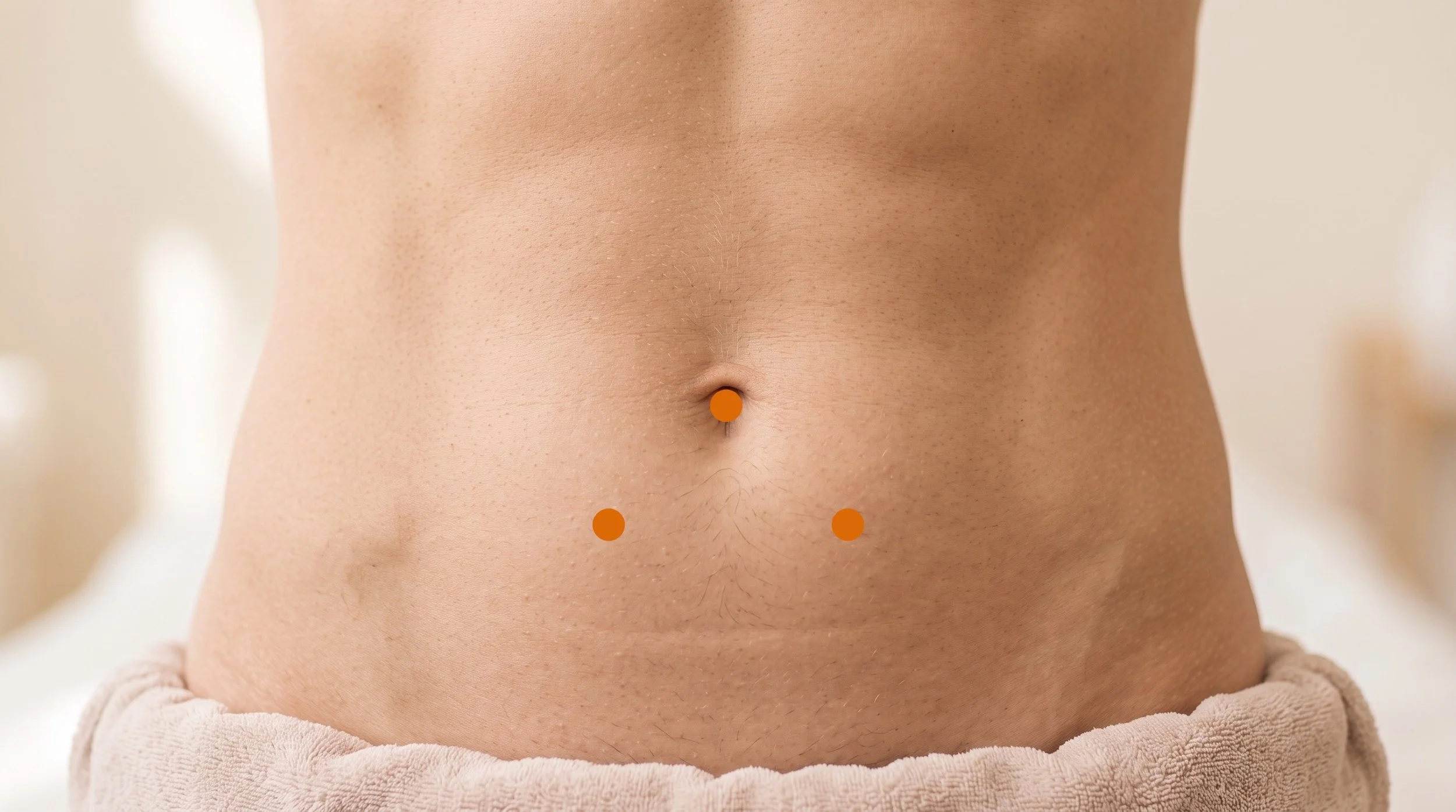
Sanjiaojiu Acupuncture Point (M-CA-23)
The Triangle of Moxa Below the Navel: Anatomy, Thermal Mechanism, and Why a Point Group Measured by the Patient's Own Smile Is Still Used for Chronic Diarrhea and Abdominal Pain
Sanjiaojiu (M-CA-23), whose name translates as Triangle Moxibustion, is one of the more unusual entries in the extra point literature: it is not a single location but a set of three, arranged as an equilateral triangle on the lower abdomen with the umbilicus at the apex, and the sides of that triangle are measured against the width of the patient's own smile. Just as unusual, the sanjiaojiu acupuncture point group is described in the classical sources as a moxibustion target rather than a needling target, warmed with cones or with moxa mediated by a slice of ginger, crushed garlic, or an aconite cake.
Traditionally it was used for chronic diarrhea, pain in and around the navel, the classical category of shan disorder, and the surging abdominal sensation the old texts called running piglet qi. In a modern clinic, the interest is more concrete: this is warm, low-intensity stimulation delivered directly over the T10 to T12 dermatomes that share spinal segments with the small intestine and colon, which is a reasonable place to influence gut sensitivity and motility.
- Sanjiaojiu (M-CA-23) is a three-point group on the lower abdominal wall: build an equilateral triangle whose apex sits at the umbilicus (Shenque CV8) and whose sides equal the length of the patient's smile, then treat the three corners (Deadman et al., 2007). The tissue involved is thin: skin, superficial fascia, and the rectus sheath or oblique aponeuroses beneath.
- The traditional actions attributed to this group are regulating qi to relieve pain and stopping diarrhea, with classical indications clustering around chronic diarrhea, periumbilical and abdominal pain, shan disorder, and running piglet qi (Deadman et al., 2007). Later Chinese texts list a similar cluster in biomedical language: chronic enteritis, colic, gastric spasm, and abdominal pain.
- These points are treated by moxibustion only, whether indirect, mediated by sliced ginger, garlic, or aconite cake, or by cones placed on the skin (Deadman et al., 2007). That makes the sanjiaojiu moxa point group a thermal intervention, and moxibustion research suggests the effect depends heavily on reaching and holding an adequate skin temperature (Deng & Shen, 2013).
- Mechanistically, the lower abdominal wall is supplied by anterior cutaneous branches of the T10 to T12 thoracoabdominal nerves, which enter the same spinal segments as visceral afferents from the small and large intestine. Classic animal work showed that stimulation of abdominal skin reflexly inhibits gastric motility through the splanchnic sympathetic pathway, while limb stimulation tends to do the opposite (Kametani et al., 1979).
- The research picture is modest and should be framed that way. Systematic reviews of moxibustion for irritable bowel syndrome and for diarrhea-predominant IBS report symptom improvement relative to pharmacological comparators, but both note substantial risk of bias in the included trials (Park et al., 2013; Tang et al., 2016), and the Cochrane review of acupuncture for IBS found no benefit over sham (Manheimer et al., 2012).
- Because nothing is inserted, there is no needle de qi at M-CA-23. Patients describe a slow build of deep, comfortable warmth over roughly 30 to 60 seconds that spreads toward the midline or down into the pelvis; a sharp, stinging, or biting heat means the moxa is too close or too hot and the practitioner should adjust immediately (Xu et al., 2014).
Struggling With Chronic Diarrhea, Bloating, or Cramping That Keeps Coming Back?
At Morningside Acupuncture we treat digestive complaints as a whole-system problem, combining abdominal points like the Sanjiaojiu triangle with distal points on the legs and forearms and, where appropriate, gentle moxibustion over the lower abdomen. Warm, low-intensity stimulation over the periumbilical region is traditionally used for chronic diarrhea and cramping, and it pairs well with the dietary and stress-side conversation your gastroenterologist may not have time for.
We'll assess whether your symptoms are primarily visceral, primarily abdominal wall, or a mix of both before we plan anything. Schedule a visit and let's map out what's actually driving your symptoms.
Schedule NowAnatomy of SANJIAOJIU: Why the Periumbilical Abdominal Wall Is Such an Important Location
The three corners of the Sanjiaojiu triangle sit on the lower abdominal wall inferior and lateral to the navel, and the tissue there is remarkably thin compared with most treatment sites. Moving from the surface inward, you pass through skin, the fatty and membranous layers of superficial fascia, then either the anterior rectus sheath and rectus abdominis if the point falls medially or the aponeuroses of external oblique, internal oblique, and transversus abdominis if it falls more laterally.
Beneath that lie the transversalis fascia, a layer of preperitoneal fat, and the parietal peritoneum. What loads this region is not heavy mechanical work but sustained postural flexion, chronic bracing and breath-holding, guarding after abdominal surgery, and the low-grade tension that follows months of visceral discomfort.
The nerve geography is the reason this location matters. The skin and muscle of the periumbilical and infraumbilical wall are supplied by the anterior cutaneous branches of the thoracoabdominal nerves, roughly T10 through T12, with the iliohypogastric nerve (L1) contributing lower down. Those same segments receive visceral afferent traffic from the small intestine and much of the colon, so somatic and visceral inputs converge on shared dorsal horn neurons.
That convergence works in both directions: it explains why gut irritation can be felt as a diffuse ache around the navel, and it provides a plausible route by which surface stimulation may modulate visceral signaling. In anesthetized animals, stimulation of the abdominal skin produced reflex inhibition of gastric motility that disappeared when the splanchnic nerves were cut, identifying a segmental sympathetic pathway rather than a vagal one (Kametani et al., 1979).
Repeated stimulation may also recruit descending inhibitory control from the brainstem, the same broad system implicated in acupuncture analgesia more generally (Zhao, 2008).
Deep to the wall sit structures worth naming: the inferior epigastric vessels running behind the rectus, the small bowel, and the bladder when it is full. This is precisely why the classical sources kept Sanjiaojiu as a moxibustion group and never as a needling group. Nothing is inserted, so the depth question is replaced by a temperature question. Conventional technique is indirect moxa, moxa on a slice of ginger, crushed garlic, or an aconite cake, or small cones placed on the skin, with the practitioner controlling distance and duration and removing the heat before it becomes noxious (Deadman et al., 2007).
Reported adverse events from moxibustion are dominated by burns, blistering, and local allergic reactions, and their frequency appears to track practitioner technique, distance, and duration (Xu et al., 2014).
Related Pain Finder Lower Torso Related External Abdominal Oblique Trigger PointsSANJIAOJIU at a Glance: Classification, Location, and Clinical Use
| Category | Detail |
|---|---|
| Traditional Name | Sanjiaojiu (Triangle Moxibustion), also recorded as Qipang, meaning beside the umbilicus |
| Channel Classification | Extra point of the abdomen, M-CA-23, not assigned to any of the twelve regular channels |
| Point Categories | Extraordinary (extra) point group rather than a channel point, so it carries no five-shu, front-mu, luo-connecting, or extraordinary vessel intersection designations; classified in the sources as a moxibustion-only group of three points, with the apex of its triangle falling on Shenque CV8 |
| Precise Location | Lower abdomen. Construct an equilateral triangle whose apex is the umbilicus and whose side length equals the width of the patient's smile; the three points lie at the corners of that triangle |
| Tissue Stimulated | Skin and superficial fascia of the lower abdominal wall overlying the rectus sheath medially and the aponeuroses of the abdominal obliques and external abdominal oblique laterally; innervation from anterior cutaneous branches of T10 to T12 |
| Needle Depth / Direction | Not needled. Treated by moxibustion only: indirect moxa, moxa mediated by sliced ginger, crushed garlic, or aconite cake, or small cones placed on the skin |
| De Qi Sensation | No needle de qi. Patients report a gradual, penetrating warmth that spreads toward the midline or downward into the pelvis, often with a softening of abdominal guarding; sharp or stinging heat is a signal to lift the moxa immediately |
| Primary Clinical Uses | Traditionally used for chronic diarrhea, abdominal and periumbilical pain, classical shan disorder, and running piglet qi arising from the umbilicus; later texts list chronic enteritis, colic, and gastric spasm |
| Common Point Combinations |
|
The Deadman text records that this group, also known as Qipang or Beside the Umbilicus, first appears in the Ming dynasty Great Compendium of Acupuncture and Moxibustion, which recommended it for shan disorder with a specific and rather surprising instruction: treat the lower corner on the side opposite the complaint, so a right-sided disorder is moxa'd at the bottom left corner and a left-sided disorder at the bottom right. All three corners were treated together when the problem was chronic diarrhea.
The traditional actions attributed to the group are regulating qi to relieve pain and stopping diarrhea, and its classical indication list stays tightly clustered around the lower abdomen: chronic diarrhea, pain in and around the navel, shan disorder (a broad classical category covering groin, genital, and lower abdominal pain, including hernia-like presentations), and running piglet qi, described as a surging sensation rising from the umbilicus.
What makes the classical pattern striking is that a text otherwise obsessed with needle technique deliberately set this group aside as heat-only, and then made contralateral side selection part of the prescription rather than an afterthought.
Why SANJIAOJIU Is Used for Chronic Diarrhea and Cramping That Has Not Responded to Diet Changes
The short answer is segmental. The skin over the lower abdomen and the gut beneath it report to overlapping spinal levels, roughly T10 through T12, so afferent traffic from a warmed patch of abdominal skin arrives at dorsal horn neurons that are also receiving signals from the intestine. In sensitized patients, those shared neurons can be firing more readily than they should, which is part of why functional gut complaints so often come with a diffuse, hard-to-localize ache around the navel.
Adding a steady, non-threatening thermal input at the same segments may change what those neurons do with visceral traffic. Animal work in this area is fairly specific: mechanical stimulation of abdominal skin reflexly inhibited gastric motility, and cutting the splanchnic nerves abolished the response, which located the effect in a segmental sympathetic loop rather than a vagal one (Kametani et al., 1979).
There is a second layer above the spinal cord. Repeated somatic stimulation recruits descending pathways from the periaqueductal gray and rostral ventromedial medulla that dampen nociceptive transmission at the dorsal horn, a system studied extensively in the context of acupuncture analgesia (Zhao, 2008). This is likely why patients often describe a general settling rather than a purely local effect after abdominal moxa.
Moxibustion in particular appears to depend on temperature: reviews of its mechanism emphasize the thermal and radiant components of burning moxa and the activation of heat-sensitive receptors in the skin, which is a practical argument for warming the area properly rather than waving a moxa stick from a comfortable distance (Deng & Shen, 2013).
None of this proves that a specific triangle below the navel outperforms a different set of coordinates on the same abdominal wall. What it does support is the general logic: treating within the symptomatic segments, using warmth as the stimulus, in a population whose symptoms often improve with heat and worsen with cold and stress. That is a modest and honest claim, and it's the one we make with patients.
What the Research Shows for SANJIAOJIU
It's worth setting expectations carefully here. No trial has tested the Sanjiaojiu triangle on its own; there is no point-specific literature for M-CA-23. What exists instead is evidence for moxibustion and acupuncture applied to multi-point abdominal and distal protocols in functional bowel disorders, usually involving points like CV8, CV6, CV4, and ST25 that sit in the same region as this triangle.
Those reviews are also limited by small trials, inconsistent sham controls, and frequently high risk of bias, so the fairest reading is that abdominal moxibustion is a plausible, low-risk adjunct with encouraging but unconfirmed evidence, not an established treatment.
| Study | Type | Focus | Key Finding |
|---|---|---|---|
| Manheimer et al., 2012 | Cochrane systematic review | Acupuncture for irritable bowel syndrome | Acupuncture did not outperform sham acupuncture for IBS symptom severity, although it performed better than some pharmacological comparators in trials without sham control. |
| Park et al., 2013 | Systematic review and meta-analysis (20 RCTs, n = 1625) | Moxibustion for global IBS symptom improvement | Moxibustion was associated with greater global symptom improvement than pharmacological medication, but the authors emphasized that risk of bias across included trials was generally high. |
| Tang et al., 2016 | Systematic review and meta-analysis (7 RCTs, n = 568) | Moxibustion for diarrhea-predominant IBS | Moxibustion appeared more effective than pharmacological medication for overall symptom scores, with no serious adverse events reported, though the authors called for larger and more rigorous trials. |
| Kametani et al., 1979 | Animal neurophysiology study | Reflex effects of skin stimulation on gastric motility in rats | Abdominal skin stimulation reflexly inhibited gastric motility through splanchnic sympathetic nerves, while limb stimulation tended to facilitate it, supporting a segmental basis for abdominal point selection. |
| Deng & Shen, 2013 | Mechanistic review | Traditional theory and modern research on how moxibustion works | The review frames moxibustion's effects as driven largely by controlled thermal and radiant stimulation of the skin, which suggests adequate temperature matters more than exact point coordinates. |
| Xu et al., 2014 | Systematic review of case reports | Safety and adverse events of moxibustion | Reported adverse events were dominated by burns, allergic reactions, and infections, and appeared strongly related to practitioner technique, distance, and duration. |
Curious Whether Moxibustion Belongs in Your Treatment Plan?
Moxibustion is a distinct tool, not a substitute for needling, and it's especially relevant when patients describe symptoms that feel worse with cold, better with a heating pad, and accompanied by fatigue and loose stools. Our practitioners use ginger-mediated and indirect moxa over points like Sanjiaojiu (M-CA-23), CV8, and CV6, with careful attention to temperature and skin response so there's no risk of blistering. We'll also tell you honestly when moxa is not the right choice, including during pregnancy or over compromised skin. Book a consultation to find out whether it fits your case.
Schedule NowSANJIAOJIU in the Context of Trigger Point Work
A meaningful fraction of patients who arrive convinced they have a visceral problem turn out to have an abdominal wall problem, or both at once. Trigger points in the rectus abdominis and the external and internal obliques can refer pain across the belly in patterns that convincingly imitate colic, gastric spasm, and periumbilical ache, and rectus abdominis referral in particular can produce bloating-type discomfort and a sense of abdominal fullness (Simons et al., 1999).
A simple bedside discriminator is the tension test: if pain increases when the patient tenses the abdominal wall against resistance, an abdominal wall source moves up the list. At Morningside we screen for this before assuming the gut is the whole story.
When the picture is mixed, the two approaches sit together comfortably. We may dry needle taut bands in the obliques and rectus abdominis using shallow, tangential technique appropriate to the region, then use gentle indirect moxa over the Sanjiaojiu triangle and CV8 to leave the area warm and relaxed at the end of the session. Because M-CA-23 is a moxibustion-only group, there is no conflict between the two: the needling targets specific myofascial bands, while the moxa provides broad, low-intensity thermal input across the same segmental territory. Distal points such as ST36 and SP6 are usually added to round out the treatment.
SANJIAOJIU Digestive Treatment at NYC's Highest-Rated Acupuncture Clinic
Morningside Acupuncture is the highest-rated acupuncture and dry needling clinic in New York City with over 500 five-star Google reviews, and our Upper West Side practice treats digestive complaints alongside pain, stress, and sports injuries. We combine classical point selection, including moxibustion-only groups like Sanjiaojiu, with modern trigger point needling of the abdominal wall when the pain generator turns out to be muscular rather than visceral. Every plan is built around your history, your imaging or workup if you have one, and what you actually want to change. Schedule your first session and let's get started.
Schedule NowFrequently Asked Questions
What does SANJIAOJIU feel like, given that it isn't needled?
Because Sanjiaojiu (M-CA-23) is treated with moxibustion only, there is no needle de qi to describe. What patients feel is a warmth that builds gradually over about half a minute to a minute and then radiates inward, often toward the midline or down into the pelvis. Many people notice their abdominal wall soften and their breathing drop lower in the torso. The heat should stay comfortable and penetrating; if it becomes sharp, stinging, or biting, that's the moment to lift the moxa away, and your practitioner should be watching the skin continuously for exactly that reason.
Why treat three points in a triangle instead of one point on the midline?
Two reasons, one classical and one anatomical. Classically, the Great Compendium described this as a group, with all three corners treated together for chronic diarrhea and a single lower corner selected, on the side opposite the complaint, for shan disorder (Deadman et al., 2007). Anatomically, spreading the stimulus over three sites covers more of the T10 to T12 dermatomal territory that shares spinal segments with the intestine, and moxibustion research suggests the treated surface area contributes to the overall thermal dose delivered (Deng & Shen, 2013). A wider, warmer field of low-intensity input is a sensible way to reach a diffuse visceral problem.
Can I press SANJIAOJIU myself between sessions?
Yes, with the caveat that you'd be doing acupressure and heat, not moxibustion, and you should never burn moxa on yourself without training. To find the points, place a fingertip in your navel, note the width of your own smile, and mark the two lower corners of an equilateral triangle of that side length, both sitting below and to either side of the navel. Lie down with your knees bent so the abdominal wall is slack, then use flat finger pads (not fingertips digging in) to press with slow, moderate pressure for 30 to 60 seconds per point, breathing out as you press. Repeat two or three rounds per point, once or twice daily. A covered heating pad or warm compress over the lower abdomen for 10 to 15 minutes achieves something closer to the traditional intent. Stop and check in with a clinician if you have new, severe, or localized pain, fever, blood in the stool, or unexplained weight loss.
Is SANJIAOJIU safe to treat?
In trained hands, yes, and the fact that it's never needled removes any risk of visceral puncture. The relevant risk is thermal. Systematic reviews of moxibustion adverse events find that burns, blistering, and local allergic reactions dominate the reports, and that their occurrence tracks distance, duration, and practitioner skill (Xu et al., 2014). Moxa should not be applied over broken, numb, scarred, or recently irradiated skin, and patients with reduced abdominal sensation or impaired circulation need extra caution. We do not use lower abdominal moxibustion during pregnancy. Anyone with undiagnosed abdominal pain, especially if it's acute, severe, or accompanied by red flags, needs a medical workup first; acupuncture and moxibustion are adjuncts, not a substitute for diagnosis.
Where exactly is SANJIAOJIU located?
On the lower abdomen. Measure the width of the patient's smile, then construct an equilateral triangle with sides of that length and its apex at the umbilicus (Shenque CV8), pointing upward so the triangle extends downward across the infraumbilical abdomen. The three points are the corners of that triangle: the apex at the navel itself and two lower corners set symmetrically to either side of the midline. Because the measurement scales to the individual patient's face, the exact spacing differs from person to person, which is entirely consistent with how classical proportional measurement worked.
References
- Deadman, P., Al-Khafaji, M., & Baker, K. (2009). A manual of acupuncture. Journal of Chinese Medicine Publications.
- O'Connor, J., & Bensky, D. (Eds. & Trans.). (1981). Acupuncture: A comprehensive text. Shanghai College of Traditional Medicine. Eastland Press.
- Simons, D. G., Travell, J. G., & Simons, L. S. (1999). Travell & Simons' myofascial pain and dysfunction: The trigger point manual, Vol. 1: Upper half of body (2nd ed.). Williams & Wilkins.
- Manheimer, E., Cheng, K., Wieland, L. S., Min, L. S., Shen, X., Berman, B. M., & Lao, L. (2012). Acupuncture for treatment of irritable bowel syndrome. Cochrane Database of Systematic Reviews, 2012(5), CD005111. https://doi.org/10.1002/14651858.CD005111.pub3
- Park, J. W., Lee, B. H., & Lee, H. (2013). Moxibustion in the management of irritable bowel syndrome: Systematic review and meta-analysis. BMC Complementary and Alternative Medicine, 13, 247. https://doi.org/10.1186/1472-6882-13-247
- Tang, B., Zhang, J., Yang, Z., Lu, Y., Xu, Q., Chen, X., & Lin, J. (2016). Moxibustion for diarrhea-predominant irritable bowel syndrome: A systematic review and meta-analysis of randomized controlled trials. Evidence-Based Complementary and Alternative Medicine, 2016, 5105108. https://doi.org/10.1155/2016/5105108
- Kametani, H., Sato, A., Sato, Y., & Simpson, A. (1979). Neural mechanisms of reflex facilitation and inhibition of gastric motility to stimulation of various skin areas in rats. The Journal of Physiology, 294, 407-418. https://doi.org/10.1113/jphysiol.1979.sp012937
- Deng, H., & Shen, X. (2013). The mechanism of moxibustion: Ancient theory and modern research. Evidence-Based Complementary and Alternative Medicine, 2013, 379291. https://doi.org/10.1155/2013/379291
- Xu, J., Deng, H., & Shen, X. (2014). Safety of moxibustion: A systematic review of case reports. Evidence-Based Complementary and Alternative Medicine, 2014, 783704. https://doi.org/10.1155/2014/783704
- Zhao, Z. Q. (2008). Neural mechanism underlying acupuncture analgesia. Progress in Neurobiology, 85(4), 355-375. https://doi.org/10.1016/j.pneurobio.2008.05.004
Disclaimer: This web site is intended for educational and informational purposes only. Reading this website does not constitute providing medical advice or any professional services. This information should not be used for diagnosing or treating any health issue or disease. Those seeking medical advice should consult with a licensed physician. Seek the advice of a medical doctor or other qualified health professional for any medical condition. If you think you have a medical emergency, call 911 or go to the emergency room. No acupuncturist-patient relationship is created by reading this website or using the information. Morningside Acupuncture PLLC and its employees and contributors do not make any express or implied representations with respect to the information on this site or its use. For any legal interpretation of scope of practice in your state, consult a licensed attorney or regulatory authority.
Read more from our blog



