Qiuhou Acupuncture Point (M-HN-8)
Behind the Ball at the Floor of the Orbit: Anatomy, Mechanism, and Why This Modern Extra Point Sits at the Center of Acupuncture Eye Protocols
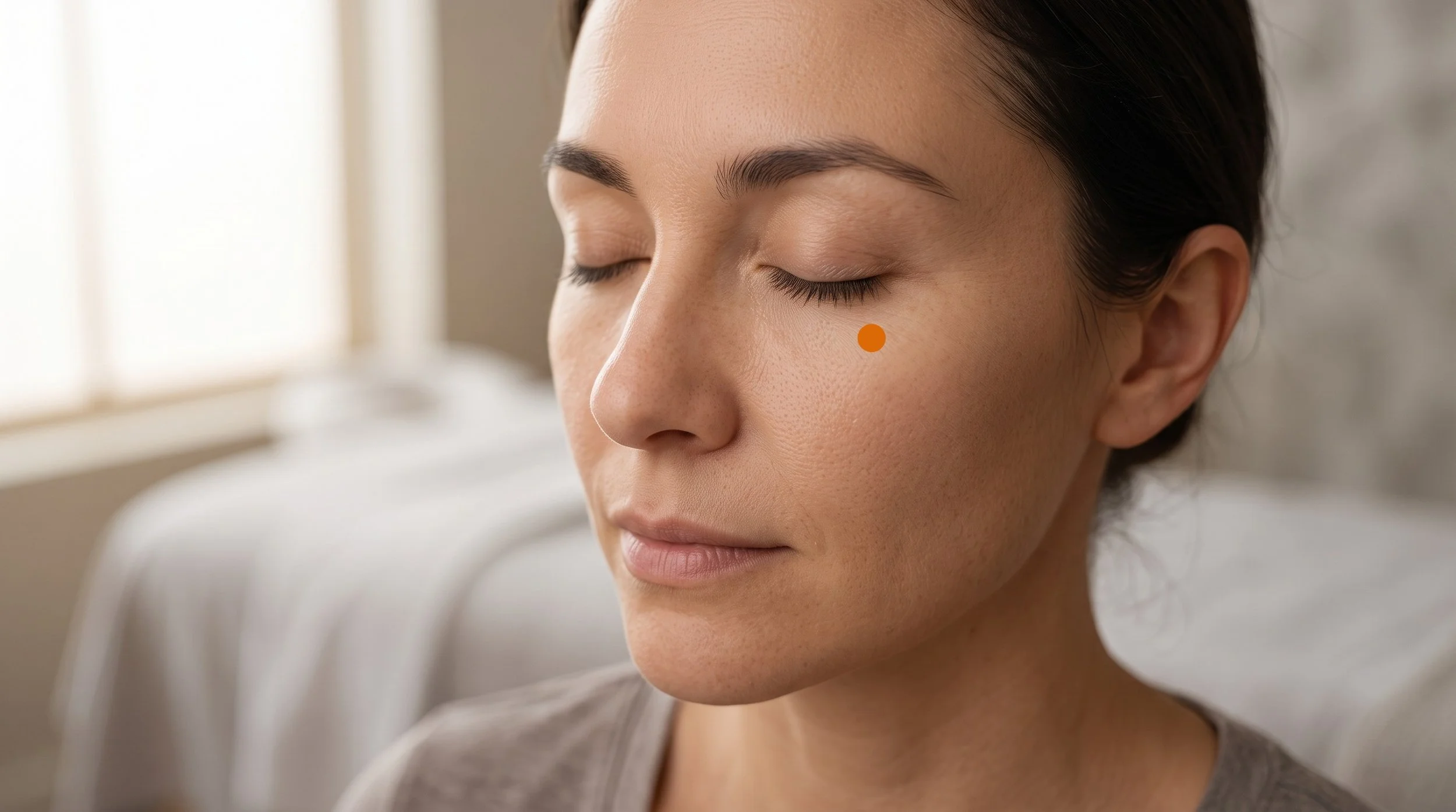
QIUHOU (Qiuhou, M-HN-8, also numbered EX-HN 7) translates as Behind the Ball, and the name is a literal description of where the needle goes: into the narrow space between the underside of the eyeball and the bony floor of the orbit.
In plain terms, you find it on the lower rim of the eye socket, at the point where the outer quarter of that rim meets the inner three quarters, roughly below the outer third of the iris when you look straight ahead (Deadman & Al-Khafaji, 2001). Unlike most points in this series, the qiuhou acupuncture point has no classical pedigree stretching back to the Han dynasty.
It's a twentieth century addition to the extra point catalogue, developed inside Chinese hospital ophthalmology departments, and it carries one traditional action and one indication: it benefits the eyes, and it's used for eye disease broadly (Deadman & Al-Khafaji, 2001). That narrowness is exactly what makes it interesting, and it's also why deep needling here belongs only to clinicians with specific orbital training.
- Location and layers: QIUHOU sits along the infraorbital margin at the junction of the lateral quarter and medial three quarters, and the classic technique passes through skin and orbicularis oculi into the orbital fat between the globe and the orbital floor to a depth of 0.5 to 1 cun (Deadman & Al-Khafaji, 2001).
- Traditional attribution: the point is credited with a single action, benefiting the eyes, and Chinese sources apply it across short-sightedness, optic nerve inflammation and atrophy, glaucoma, retinitis pigmentosa and convergent strabismus (Deadman & Al-Khafaji, 2001). Read neurophysiologically, that list describes stimulation of orbital tissue sharing segmental innervation with the eye itself.
- Mechanism: the infraorbital rim is served by the infraorbital branch of the maxillary division of the trigeminal nerve, and orbital contents receive dense autonomic supply, so needling here recruits trigeminal afferents that converge with ophthalmic input in the brainstem and can drive descending inhibitory and autonomic responses (Zhao, 2008).
- Circulatory story: color Doppler work shows acupuncture can change retrobulbar hemodynamics, with reduced vascular resistance in the short posterior ciliary artery after needling in healthy volunteers and in medicated open-angle glaucoma patients (Takayama et al., 2011; Takayama et al., 2012). This is the most plausible physiological account of periocular eye protocols.
- Research picture: Cochrane reviews of acupuncture for glaucoma and for slowing myopia progression in children both concluded the trials were too few and too flawed to support recommendations (Law et al., 2020; Wei et al., 2011), while trials in amblyopia and retinitis pigmentosa have produced more encouraging but still preliminary signals (Zhao et al., 2010; Bittner et al., 2018).
- Practice framing and safety: orbital bleeding is difficult to avoid even in experienced hands, and reported acupuncture eye injuries have involved BL1, ST1 and QIUHOU, which is why guidance restricts intraorbital needling to specialists (Filshie et al., 2016). De qi here is a slow, spreading distension felt behind and around the eyeball rather than a sharp grab, because the needle is advanced without lifting, thrusting or rotating (Deadman & Al-Khafaji, 2001).
Struggling With Eye Strain, Headaches, and Screen Fatigue in NYC?
Long hours on screens load the small muscles around the eyes, the jaw, and the upper neck, and that combination shows up in our treatment rooms every week. At Morningside Acupuncture we build periocular and distal treatments around the anatomy QIUHOU represents, using safer rim and neck points along with GB20 and LI4 rather than deep orbital insertion. Treatment is paired with practical screen ergonomics and jaw and neck work so the change holds between visits. Schedule a session and we'll map out a plan for your eyes, head, and neck together.
Schedule NowAnatomy of QIUHOU: Why the Inferolateral Orbital Rim Is Such an Important Location
Run a fingertip along the bony ridge under your eye and you're tracing the infraorbital margin, formed by the maxilla medially and the zygomatic bone laterally. QIUHOU sits on that ridge where the outer quarter meets the inner three quarters (Deadman & Al-Khafaji, 2001). The first layer under the skin here is thin subcutaneous tissue and the palpebral portion of orbicularis oculi, the sphincter-like muscle that closes the eyelid.
Deep to that lies the orbital septum, then the fat pad that cushions the globe, and then the inferior rectus and inferior oblique muscles that pull the eye downward and rotate it (O'Connor & Bensky, 1981). What loads this region isn't mechanical strain in the way a shoulder gets loaded. It's sustained near-focus, squinting, dry ocular surface, and the low-grade tonic contraction of orbicularis and the surrounding facial muscles that comes with hours of concentrated screen work.
The nerve geography is the reason this location matters clinically. Sensation over the lower orbital rim and cheek comes from the infraorbital nerve, a terminal branch of the maxillary division of the trigeminal nerve, while the eye itself is supplied largely through the ophthalmic division of the same nerve. Both divisions project to the trigeminal brainstem nuclear complex, where inputs from skin, muscle, dura, and ocular structures converge onto shared second-order neurons.
That convergence is the mechanistic basis for treating an eye complaint from the tissue immediately around it, and it's also why orbital and periorbital pain is so often reported diffusely rather than pinpointed. Needle stimulation of these afferents activates spinal and supraspinal circuits that release endogenous opioids and monoamines and engage descending inhibition from the periaqueductal gray and rostral ventromedial medulla (Zhao, 2008). Autonomic reflex arcs are recruited in parallel, which is where the vascular effects come in.
The deep structures are the reason for the caution. Behind the globe sits a crowded compartment of extraocular muscles, orbital fat, the ophthalmic artery and its branches including the short posterior ciliary arteries, the central retinal artery, and the optic nerve itself. The orbit is highly vascular, so bruising after periocular needling is common even with good technique, and deeper misdirection can injure the oculomotor nerve, the retina, or neighboring tissue (Filshie et al., 2016; O'Connor & Bensky, 1981).
The conventional method reflects this: eyes closed and turned upward, the globe gently supported away from the needle path, slow insertion between the eyeball and the orbital floor to 0.5 to 1 cun, absolutely no lifting, thrusting, or rotating, and firm pressure with a cotton ball for a full minute on withdrawal to limit hematoma. Deadman is explicit that this technique should not be attempted without appropriate clinical supervision (Deadman & Al-Khafaji, 2001).
Related Liver Channel Related LV3 Acupuncture PointQIUHOU at a Glance: Classification, Location, and Clinical Use
| Category | Detail |
|---|---|
| Traditional Name | Qiuhou (Behind the Ball), the behind the ball point |
| Channel Classification | Extra point (M-HN-8, also catalogued as EX-HN 7); not located on any of the twelve primary channels |
| Point Categories | Extra (miscellaneous) point only. Deadman classes QIUHOU as a modern addition to the extra point catalogue, with no five-shu status, no hui-meeting role, no extraordinary vessel confluence, and no meeting or crossing designations. Its single listed traditional action is benefiting the eyes. |
| Precise Location | On the inferior border of the orbit, at the junction of the lateral one quarter and the medial three quarters of the infraorbital margin, level with the lower eyelid margin |
| Tissue Stimulated | Skin and the palpebral fibers of orbicularis oculi, then orbital septum, orbital fat, and the space between the globe and the orbital floor near the inferior rectus and inferior oblique. Jaw and neck muscles that refer pain into and around the orbit are addressed separately, including Lateral Pterygoid Trigger Points and Medial Pterygoid Trigger Points. |
| Needle Depth / Direction | Specialist orbital technique only: eyes closed and looking upward, the globe gently supported upward, needle inserted slightly inferiorly then perpendicularly between the eyeball and the orbital floor, 0.5 to 1 cun, with no lifting, thrusting, or rotation, followed by a full minute of firm pressure on withdrawal. Should not be performed without specific supervised training. |
| De Qi Sensation | A slow, heavy distension and soreness that spreads behind and around the eyeball, sometimes described as pressure deep in the socket. There's no sharp grab, because the needle isn't manipulated. |
| Primary Clinical Uses | Eye disorders broadly as adjunctive care alongside ophthalmology; short-sightedness and weak vision, optic nerve inflammation and atrophy, glaucoma, retinitis pigmentosa, and convergent strabismus in modern Chinese protocols |
| Common Point Combinations |
|
Deadman and Al-Khafaji's A Manual of Acupuncture treats QIUHOU very differently from the classical points that fill the rest of the text. There's no source citation from the Great Compendium or the Classic of the Jade Dragon, no layered list of functions, and no accumulated commentary from successive dynasties.
The entry records that this is a modern addition to the extra points, gives it one traditional action, benefiting the eyes, and one indication, all eye diseases, then notes its use in Chinese practice for short-sightedness, optic nerve inflammation and atrophy, glaucoma, retinitis pigmentosa, and convergent strabismus (Deadman & Al-Khafaji, 2001).
Chinese textbooks of the same era place it in a tight cluster of periocular points alongside BL1, ST1, GB1, and Waiming, and list it inside combination formulas for cataract, corneal opacity, and glaucoma (O'Connor & Bensky, 1981), while standard clinical curricula include it in prescriptions for optic atrophy with GB20, BL1, and GB37 (Cheng, 1987).
What's striking is the inversion of the usual pattern: most points in this series accumulated indications over centuries and later acquired an anatomical explanation, whereas QIUHOU started from the anatomy and has never developed the symbolic layering that surrounds its older neighbors.
Why QIUHOU Is Used for Optic Nerve and Retinal Conditions Rather Than Surface Eye Irritation
Most facial points earn their reputation through skin and muscle. QIUHOU is unusual because the target tissue is the orbital compartment itself, and that changes which conditions practitioners have historically aimed it at. The trigeminal nerve supplies both the periorbital rim, through the infraorbital branch, and the internal structures of the eye, through the ophthalmic division.
Those inputs converge in the brainstem, so afferent traffic generated at the orbital floor lands in the same neural neighborhood that processes signals from the globe, and the reflex responses it triggers include local vasomotor and autonomic changes as well as pain modulation (Zhao, 2008). That's a very different rationale from treating dry, gritty eyelids, and it explains why the classical indication lists for this point skew toward the optic nerve, the retina, and refractive complaints rather than surface irritation.
The circulation evidence gives that reasoning a measurable footing. Using ultrasound color Doppler imaging, Japanese investigators found that acupuncture reduced vascular resistance in the short posterior ciliary arteries, the vessels feeding the choroid and optic nerve head, without shifting blood pressure or heart rate, and they interpreted the effect as a somato-autonomic reflex rather than a systemic hemodynamic change (Takayama et al., 2012).
In a companion study of eleven patients with open-angle glaucoma already stabilized on topical medication, a single bilateral session reduced resistive index in the short posterior ciliary artery and lowered intraocular pressure compared with resting control measurements (Takayama et al., 2011). Neither study proves clinical benefit over time, and both are small, but they make the mechanism concrete: needling around the eye can shift ocular perfusion.
For patients, the practical translation is modest and worth stating plainly. Acupuncture around the orbit may influence blood flow, pain processing, and autonomic tone in ways that make it a reasonable adjunct to ophthalmological care, particularly where circulation and chronic strain play a part. It doesn't restore lost retinal cells, doesn't substitute for pressure-lowering treatment in glaucoma, and shouldn't delay surgical care when surgery is indicated (Filshie et al., 2016). We treat alongside your eye doctor, not instead of them.
What the Research Shows for QIUHOU
One caution before the table. No study has tested QIUHOU on its own, and no study realistically could, because ophthalmic acupuncture protocols always combine several periocular points with distal points such as GB20, GB37, LI4, ST36, and LV3. What the literature evaluates is whole protocols in which QIUHOU is frequently one component. Reviews in this field also draw heavily on small Chinese-language trials with methodological limits, so conclusions are cautious across the board. Read the evidence below as a picture of the protocols this point belongs to, not as a verdict on the point itself.
| Study | Type | Focus | Key Finding |
|---|---|---|---|
| Law, Wang & Li, 2020 | Cochrane systematic review | Acupuncture for glaucoma | The reviewers found too few adequately conducted trials to determine whether acupuncture helps people with glaucoma, and recommended against drawing conclusions either way. |
| Wei, Liu, Li & Liu, 2011 | Cochrane systematic review | Acupuncture for slowing myopia progression in children and adolescents | Only two small trials qualified, and they didn't provide evidence that acupuncture or acupressure slows myopia progression, so no recommendation could be made. |
| Na, Jung, Park, Song & Song, 2021 | Systematic review and meta-analysis | Acupuncture versus artificial tears in typical dry eye | Pooled results suggested improvements in tear film measures and symptom scores, though the authors flagged heterogeneity and risk of bias in the included trials. |
| Takayama et al., 2011 | Controlled clinical study with color Doppler imaging | Retrobulbar circulation and intraocular pressure in medicated open-angle glaucoma | A single acupuncture session reduced short posterior ciliary artery resistance and intraocular pressure relative to control measurements, without systemic hemodynamic change. |
| Takayama et al., 2012 | Physiological study in healthy volunteers | Peripheral, mesenteric, and retrobulbar blood flow responses to point-specific needling | Needling at LR3 lowered vascular resistance in the short posterior ciliary artery while ST36 affected mesenteric flow, suggesting point-specific autonomic reflex effects. |
| Zhao et al., 2010 | Randomized controlled trial | Acupuncture versus daily patching for anisometropic amblyopia in children aged 7 to 12 | Visual acuity gains in the acupuncture group were at least comparable to patching over 15 weeks, though the trial design and setting drew substantial published criticism. |
| Bittner et al., 2018 | Randomized controlled trial | Electroacupuncture and transcorneal electrical stimulation in retinitis pigmentosa | Central retinal artery flow velocity improved in the active groups compared with sham, but the sample was very small and visual function changes were limited. |
Working With an Ophthalmologist and Curious About Adjunctive Acupuncture?
Acupuncture doesn't replace ophthalmological care, and we say so plainly to every patient who asks about vision conditions. What we can do is provide adjunctive treatment alongside your eye doctor's plan, focused on periorbital circulation, autonomic regulation, and the headache and neck patterns that often accompany chronic eye complaints. We'll be direct about what the evidence supports and what it doesn't. Book a consultation and bring your current eye care plan so we can coordinate sensibly.
Schedule NowQIUHOU in the Context of Trigger Point Work
Patients who come in describing eye ache, pressure behind the eye, or blurring with fatigue often turn out to have a significant myofascial component, and that's where our treatment usually starts. Referred pain patterns from the sternocleidomastoid, upper trapezius, temporalis, and suboccipital muscles all project into the orbit, brow, and temple, and the lateral and medial pterygoids contribute deep facial and periorbital aching that patients frequently interpret as an eye problem (Simons et al., 1999).
Dry needling those muscles is a fundamentally different procedure from orbital needling: the targets are palpable taut bands in accessible muscle, the anatomy is forgiving, and the response is usually immediate. At Morningside we work the cervical and jaw musculature first, then reassess how much of the eye symptom remains.
QIUHOU itself has no myofascial trigger point equivalent, since orbicularis oculi and the extraocular muscles aren't standard dry needling targets and the orbit is a compartment we treat with real caution.
In practice, we use the anatomical logic QIUHOU represents while working from safer ground: periorbital rim points and brow points where indicated, GB20 and the suboccipital region for the neck contribution, LI4 and LV3 distally, and dry needling of the jaw and neck muscles that are actually generating referred load. That combination gives us most of the trigeminal and cervical afferent input the classical protocol was reaching for, with a far better safety profile (Filshie et al., 2016).
QIUHOU Eye Strain and Headache Treatment at NYC's Highest-Rated Acupuncture Clinic
Morningside Acupuncture is the highest-rated acupuncture and dry needling clinic in New York City with over 500 five-star Google reviews, and patients come to us specifically for careful, anatomy-first facial and head treatment. Our licensed acupuncturists combine periocular points, cervical and jaw dry needling, and distal points into one focused session. You'll always know exactly where a needle is going and why. Schedule your visit and let's get to work on the eye strain, tension, and headaches you've been carrying.
Schedule NowFrequently Asked Questions
What does QIUHOU feel like when needled?
When performed by a trained specialist, the sensation is a slow, spreading heaviness or distension felt deep in the socket, often described as pressure behind and around the eyeball rather than a sharp sensation at the skin (Deadman & Al-Khafaji, 2001; O'Connor & Bensky, 1981). Because the needle is advanced slowly and never lifted, thrust, or rotated, there's none of the grabbing or twisting feeling you might associate with points in the limbs. Most people also notice a brief moment of watering. Some bruising afterward is common given how vascular the orbit is, which is why firm pressure is applied for a full minute after the needle comes out.
Why needle the orbital rim for a problem inside the eye instead of a distal point?
Both approaches get used, and good protocols use them together. Local stimulation at the orbital floor recruits trigeminal afferents that converge in the brainstem with input from the eye itself, and it engages local autonomic and vasomotor reflexes that can influence ocular perfusion (Zhao, 2008; Takayama et al., 2012). Distal points like GB20, GB37, LV3, and LI4 work through different segmental and supraspinal routes and are far safer to needle, which is why they anchor most treatment plans. Traditional theory frames the distal pairing differently, describing the Liver as opening into the eyes, but the practical reason for combining near and far points is that they contribute different mechanisms.
Can I press QIUHOU myself between sessions?
You can use gentle acupressure on the bony rim, and that's meaningfully different from needling. Close your eyes, find the hard ridge under the eye, and place a fingertip on the bone at the junction of the outer quarter and inner three quarters, roughly below the outer edge of the iris. Press downward and slightly outward against the bone itself with light to moderate pressure for 30 to 60 seconds, breathing slowly, then release. Repeat two or three times per side, once or twice a day. Never press inward toward the eyeball, never press hard enough to feel pressure on the globe, and skip it entirely if you've had recent eye surgery, an eye injury, an infection, or if you have glaucoma or retinal disease without clearing it with your ophthalmologist first. Many people find that adding pressure at GB20 at the base of the skull and a minute of eyes-closed rest gives more relief than the rim point alone.
Is QIUHOU safe to needle?
Not in general hands, and we want to be direct about that. The orbit is a vascular, crowded compartment, bleeding after periocular needling is difficult to avoid even for experienced acupuncturists, and published case reports of acupuncture eye injuries including orbital hemorrhage, oculomotor nerve injury, traumatic cataract, and retinal puncture have involved BL1, ST1, and QIUHOU (Filshie et al., 2016). Safety guidance holds that intraorbital needling should be undertaken only by clinicians with specific eye specialist training, and Deadman states the technique shouldn't be attempted without appropriate clinical supervision (Deadman & Al-Khafaji, 2001). At Morningside we work the periorbital rim, cervical, and distal points rather than performing deep retrobulbar insertion, and we coordinate with your ophthalmologist for any vision-related condition.
Where exactly is QIUHOU located?
Look straight ahead with a relaxed face and trace the bony rim of the lower eye socket from the inner corner outward. Divide that rim into four parts. QIUHOU sits where the outer quarter meets the inner three quarters, which lands roughly below the outer edge of the iris and slightly lateral to ST1, the point directly under the pupil (Deadman & Al-Khafaji, 2001). It's a bony landmark, not a soft spot, and the qiuhou eye point is always located on the rim rather than in the cheek below it. For orientation, BL1 sits at the inner corner near the nose, and the two are the pair of specialist orbital points in modern eye protocols.
References
- Deadman, P., Al-Khafaji, M., & Baker, K. (2009). A manual of acupuncture. Journal of Chinese Medicine Publications.
- O'Connor, J., & Bensky, D. (Eds. & Trans.). (1981). Acupuncture: A comprehensive text. Shanghai College of Traditional Medicine. Eastland Press.
- Cheng, X. (Ed.). (1999). Chinese acupuncture and moxibustion (Rev. ed.). Foreign Languages Press.
- Filshie, J., White, A., & Cummings, M. (Eds.). (2016). Medical acupuncture: A Western scientific approach (2nd ed.). Elsevier.
- Simons, D. G., Travell, J. G., & Simons, L. S. (1999). Travell & Simons' myofascial pain and dysfunction: The trigger point manual, Vol. 1: Upper half of body (2nd ed.). Williams & Wilkins.
- Law, S. K., Wang, L., & Li, T. (2020). Acupuncture for glaucoma. Cochrane Database of Systematic Reviews, 2020(2), CD006030. https://doi.org/10.1002/14651858.CD006030.pub4
- Wei, M. L., Liu, J. P., Li, N., & Liu, M. (2011). Acupuncture for slowing the progression of myopia in children and adolescents. Cochrane Database of Systematic Reviews, 2011(9), CD007842. https://doi.org/10.1002/14651858.CD007842.pub2
- Na, J. H., Jung, J. H., Park, J. G., Song, P. H., & Song, C. H. (2021). Therapeutic effects of acupuncture in typical dry eye: A systematic review and meta-analysis. Acta Ophthalmologica, 99(5), 489-498. https://doi.org/10.1111/aos.14651
- Takayama, S., Seki, T., Nakazawa, T., Aizawa, N., Takahashi, S., Watanabe, M., Izumi, M., Kaneko, S., Kamiya, T., Matsuda, A., Kikuchi, A., Yambe, T., Yoshizawa, M., Nitta, S., & Yaegashi, N. (2011). Short-term effects of acupuncture on open-angle glaucoma in retrobulbar circulation: Additional therapy to standard medication. Evidence-Based Complementary and Alternative Medicine, 2011, 157090. https://doi.org/10.1155/2011/157090
- Takayama, S., Seki, T., Watanabe, M., Monma, Y., Yang, S. Y., Sugita, N., Konno, S., Saijo, Y., Yambe, T., Yaegashi, N., & Nitta, S. (2012). Evaluation of the effects of acupuncture on blood flow in humans with ultrasound color Doppler imaging. Evidence-Based Complementary and Alternative Medicine, 2012, 513638. https://doi.org/10.1155/2012/513638
- Zhao, J., Lam, D. S. C., Chen, L. J., Wang, Y., Zheng, C., Lin, Q., Rao, S. K., Fan, D. S. P., Zhang, M., Leung, P. C., & Ritch, R. (2010). Randomized controlled trial of patching vs acupuncture for anisometropic amblyopia in children aged 7 to 12 years. Archives of Ophthalmology, 128(12), 1510-1517. https://doi.org/10.1001/archophthalmol.2010.306
- Bittner, A. K., Seger, K., Salveson, R., Kayser, S., Morrison, N., Vargas, P., Mendelsohn, D., Han, J., Bi, H., Dagnelie, G., Benavente, A., & Ramella-Roman, J. (2018). Randomized controlled trial of electro-stimulation therapies to modulate retinal blood flow and visual function in retinitis pigmentosa. Acta Ophthalmologica, 96(3), e366-e376. https://doi.org/10.1111/aos.13581
- Zhao, Z. Q. (2008). Neural mechanism underlying acupuncture analgesia. Progress in Neurobiology, 85(4), 355-375. https://doi.org/10.1016/j.pneurobio.2008.05.004
Disclaimer: This web site is intended for educational and informational purposes only. Reading this website does not constitute providing medical advice or any professional services. This information should not be used for diagnosing or treating any health issue or disease. Those seeking medical advice should consult with a licensed physician. Seek the advice of a medical doctor or other qualified health professional for any medical condition. If you think you have a medical emergency, call 911 or go to the emergency room. No acupuncturist-patient relationship is created by reading this website or using the information. Morningside Acupuncture PLLC and its employees and contributors do not make any express or implied representations with respect to the information on this site or its use. For any legal interpretation of scope of practice in your state, consult a licensed attorney or regulatory authority.
Read more from our blog



