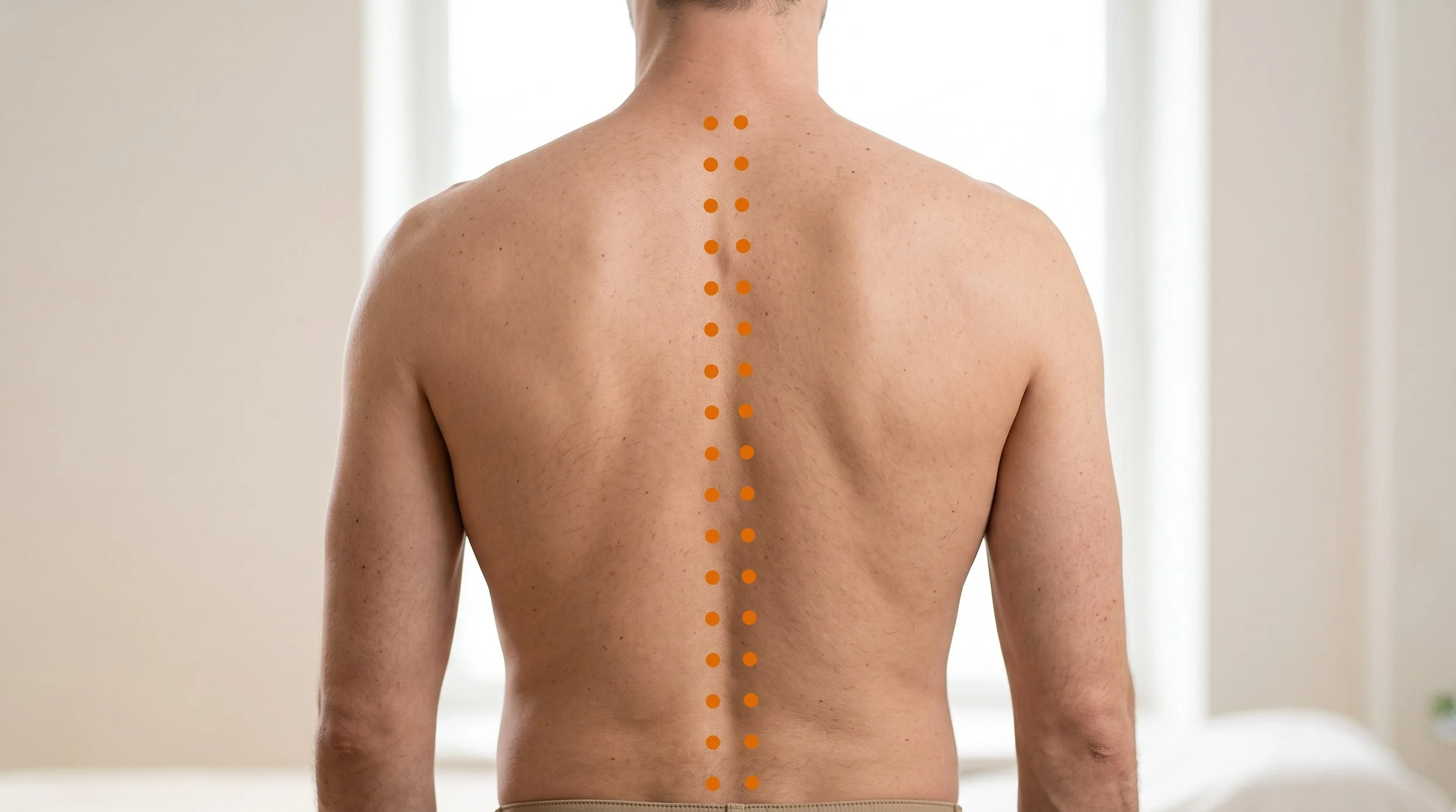
Huatuojiaji Acupuncture Point (M-BW-35)
Hua Tuo's Paravertebral Points: Anatomy, Segmental Mechanism, and Why These Two Rows Beside the Spine Anchor Back, Neck, and Nerve Pain Treatment
HUATUOJIAJI (M-BW-35), often written hua tuo jiaji and translated as Hua Tuo's Paravertebral Points, isn't a single acupuncture point at all. It's a pair of point rows running the length of the spine, each point sitting about 0.5 to 1 cun lateral to the depression below a spinous process, so that every vertebral level has its own point on the left and on the right. Most Chinese sources count 34 points in 17 pairs from T1 to L5, and modern clinicians add seven cervical pairs from C1-C2 down to C7-T1.
Because each pair sits directly over the paraspinal muscles and the dorsal ramus of one spinal nerve, the huatuojiaji acupuncture points let a clinician address a single body segment: the facet joint, the deep spinal muscles, the skin, and the nerve that all share that level. That segmental precision is why these paravertebral acupuncture points appear in nearly every serious protocol for spinal pain, radiating limb pain, and shingles pain that tracks a dermatome.
- Location and layers: each huatuojiaji point sits 0.5 to 1 cun off the midline below a spinous process, over thoracolumbar fascia, erector spinae, and the deeper multifidus and rotatores that fill the groove beside the lamina. Needles are angled toward the spine rather than driven straight in, which keeps the tip in muscle and away from the pleura and neuraxis (White and Cummings).
- Traditional category: the classical literature treats M-BW-35 as an extra point outside the fourteen channels, credited with regulating and harmonising the five zang and six fu, with levels mapping onto organ function much as the back-shu points do. Deadman's point manual attributes their popularity to the Han dynasty physician Hua Tuo, who was said to favour them over the shu points themselves.
- Mechanism in modern terms: needling here recruits the dorsal ramus of a specific spinal nerve, and the resulting input converges in the dorsal horn with afferents from the facet joint, disc, deep muscle, and the skin of that dermatome, which is the segmental basis of acupuncture analgesia described in neurophysiological reviews (Zhao, 2008).
- Autonomic and organ-level effects are plausible but region dependent: animal work shows that stimulation drives distinct autonomic pathways depending on where on the body it's applied and how strongly, which offers a modern reading of why the classical texts assigned different jiaji levels to different organs (Liu et al., 2020).
- Research picture: reviews test whole protocols rather than single points, and lumbar jiaji points sit inside most back pain prescriptions studied. Cochrane evidence for chronic nonspecific low back pain is mixed and downgraded for bias and imprecision (Mu et al., 2020), while individual patient data pooling supports modest but persistent benefits for chronic musculoskeletal pain (Vickers et al., 2018).
- De qi at these points is usually a deep, heavy, spreading ache close to the bone, sometimes with a band of sensation travelling around the ribs or down the limb along that segment. That travelling quality is often taken as a sign the correct level has been engaged, and it typically settles within seconds.
Is Your Back Pain Coming From One Stubborn Spinal Level?
Low back pain that keeps returning to the same spot often has a segmental driver: a cranky facet joint, a guarded multifidus, and an irritable nerve root all sharing one level. At Morningside Acupuncture we palpate level by level, then needle the matching huatuojiaji points with the back-shu points and distal segments of the same nerve supply. Many patients also do well with electroacupuncture across two lumbar levels for a longer lasting effect. Schedule a visit and let's find the level that's actually driving your pain.
Schedule NowAnatomy of HUATUOJIAJI: Why the Paraspinal Gutter Beside Each Vertebra Is Such an Important Location
Run your thumb down the bumps of your spine and then slide it a fingerbreadth to one side and you'll drop into a soft trough. That trough is the target. Under the skin sits the thoracolumbar fascia, then the long superficial columns of erector spinae (iliocostalis laterally, longissimus more medially), and beneath those, tucked right against the lamina, the short deep stabilizers: multifidus and rotatores. These deep muscles span only one to three segments, so they respond to what's happening at a single joint.
Prolonged sitting, repeated lifting, a long flight, or a facet joint that has become irritable will all leave this gutter thickened, ropey, and tender at one or two levels while the levels above and below feel unremarkable. That level-by-level variability is exactly what makes palpation so useful here.
The nerve geography is the whole point. As each spinal nerve leaves the intervertebral foramen it splits, and the dorsal ramus turns backward to supply the facet joint capsule, the multifidus, and a strip of overlying skin at that level. A needle placed in the paraspinal gutter and angled toward the spine lands squarely in that territory.
Because the dorsal ramus, the ventral ramus feeding the limb, the facet joint, and the disc all report to the same dorsal horn segment, input from one of them can modulate the others, a convergence effect that underpins much of what's known about acupuncture analgesia (Zhao, 2008). Repeated stimulation also recruits descending inhibitory pathways from the brainstem and endogenous opioid systems, which helps explain effects that outlast the needling session itself (Zhao, 2008).
Preclinical work adds an intriguing layer: the autonomic pathway an acupuncture stimulus drives depends on where on the body it's delivered and how intense it is, which is a modern parallel to the classical claim that different jiaji levels influence different organs (Liu et al., 2020).
Depth discipline matters more here than at almost any other point group. In the thoracic region the pleura and lung lie a short distance deep and lateral to the paraspinal muscles, and in the lumbar region the kidney sits deep to the same corridor. The spinal cord itself is roughly 25 to 45 mm below the surface in the thoracic spine and deeper in the low lumbar region, and Western medical acupuncture texts advise directing paravertebral needles medially and slightly caudally rather than laterally or steeply (White and Cummings).
The classical instruction happens to agree: insert perpendicular to oblique, angled toward the spine, 0.5 to 1 cun, with the intent of stimulating the spinal nerve of that segment rather than chasing depth. The precise distance off the midline is chosen to suit the angle the practitioner needs for that patient's build.
Related Acupuncture For Low Back Pain Related Best Acupuncture Points For Back PainHUATUOJIAJI at a Glance: Classification, Location, and Clinical Use
| Category | Detail |
|---|---|
| Traditional Name | Huatuojiaji, Hua Tuo's Paravertebral Points (jia means beside, ji means spine) |
| Channel Classification | Extra point, M-BW-35 (also numbered EX-B2), outside the fourteen channels |
| Point Categories | Extraordinary paravertebral point rows, not a five-shu, luo, xi-cleft, hui-meeting, or extraordinary vessel intersection point. Traditionally credited with regulating and harmonising the five zang and six fu and benefiting the spine, with segmental levels that mirror the back-shu point correspondences. |
| Precise Location | 0.5 to 1 cun lateral to the depression below the spinous process of each vertebra from T1 to L5, giving 17 pairs (34 points). Seven additional cervical pairs, C1-C2 through C7-T1, are used as huatuojiaji points in modern practice. |
| Tissue Stimulated | Thoracolumbar fascia, erector spinae (iliocostalis and longissimus), multifidus and rotatores in the laminar groove, and the dorsal ramus of the segmental spinal nerve. Thoracic levels sit adjacent to the intercostal muscles, and lumbar levels overlap common muscular sources of low back pain. |
| Needle Depth / Direction | Perpendicular to oblique, angled medially toward the spine and slightly caudally, 0.5 to 1 cun (0.3 to 1.0 cun in some texts). Never angled laterally or driven deep in the thoracic region. |
| De Qi Sensation | Deep, heavy, spreading ache close to the bone, often with a dull pressure that travels around the ribs, into the flank, or down the limb along that segment. |
| Primary Clinical Uses | Pain and stiffness at the treated spinal level, radiating limb pain approached through its segment, herpes zoster pain at the affected dermatome alongside standard medical care, and traditionally the regulation of organ function at levels corresponding to the back-shu points. |
| Common Point Combinations |
|
Deadman's point manual records that these points were first named in the classical text Song to Keep Up Your Sleeve, and that tradition credits their discovery to Hua Tuo, the celebrated Han dynasty physician who is said to have preferred them to the back-shu points. Other reference works, including Cunningham's point text, trace an earlier mention of paravertebral needling to the Su Wen and describe Hua Tuo as the physician who popularised the approach rather than invented it.
The traditional action assigned to the whole group is broad: regulating and harmonising the five zang and six fu while benefiting the spine. What makes the classical pattern striking is how orderly it is. The upper thoracic levels were assigned to the Lung and upper limb, the mid thoracic to the Heart, the lower thoracic to Liver, Gallbladder, Spleen and Stomach, the upper lumbar to the Kidneys, and the lower lumbar to Bladder, Intestines, uterus and lower limbs.
Read as traditional attribution rather than literal anatomy, that sequence still maps remarkably closely onto the segmental innervation of the viscera as it's understood today.
Why HUATUOJIAJI Is Used for Shingles Pain and Limb Symptoms Far From the Spine
Patients are often puzzled when we needle beside the spine for pain that they feel in a rib, a hand, or a calf. The logic is segmental. A spinal nerve doesn't serve just one structure, it serves a whole slice of the body: a strip of skin, a group of muscles, a joint, and a share of visceral supply. All of that traffic arrives at the same segment of the dorsal horn, where it converges onto shared neurons.
Stimulating the paraspinal tissue at that level feeds strong, well-controlled input into precisely the segment that has become sensitised, which can dampen the way that segment processes pain from everywhere else in its territory (Zhao, 2008). This is why shingles protocols in Chinese hospitals pair local encircling needles around the rash with jiaji points at the affected dermatome and distal points on the involved channels: the adjacent points target the nerve segment, not just the skin.
The second mechanism is top down. Sustained needle stimulation, particularly with electroacupuncture, recruits descending inhibitory pathways from the periaqueductal grey and rostral ventromedial medulla and engages endogenous opioid and monoamine systems, producing analgesia that spreads beyond the treated segment and can outlast the session (Zhao, 2008). There's also a segment-specific autonomic story emerging from preclinical research: stimulation drives different autonomic circuits depending on the body region stimulated and the intensity used (Liu et al., 2020).
That work was done in animals and at other point locations, so it isn't proof that a T7 jiaji point regulates the liver. It does, however, give a testable modern framework for the classical claim that different levels influence different organ systems.
Clinically, the practical value is that jiaji points give us a dial rather than a switch. If a patient's leg pain is coming from L5, we can treat L4-L5 and L5-S1 specifically instead of needling the whole low back indiscriminately. If someone's rib pain follows T6, we treat T6. Add gentle electrical stimulation across two adjacent levels and you get a steady, well-tolerated input into one spinal segment for twenty to thirty minutes, which is a reasonable definition of a targeted acupuncture dose.
What the Research Shows for HUATUOJIAJI
A caveat before the table: almost no clinical trial isolates huatuojiaji points on their own. Reviews test whole protocols, and jiaji points typically appear inside them alongside Bladder channel points, Governing vessel points, and tender points, often with electroacupuncture. So the fair reading is that these points sit within protocols with reasonable evidence for spinal pain, not that any single needle beside the spine has been proven in isolation. Much of the point-specific literature is Chinese language, small, and methodologically limited, and the summaries below reflect that.
| Study | Type | Focus | Key Finding |
|---|---|---|---|
| Mu et al., 2020 | Cochrane systematic review | Acupuncture for chronic nonspecific low back pain, 33 studies with 8,270 participants | Reviewers found low-certainty evidence of immediate pain relief compared with sham and moderate-certainty evidence of clinically meaningful pain and function benefit versus no treatment, with the overall evidence downgraded for risk of bias and imprecision. |
| Vickers et al., 2018 | Individual patient data meta-analysis | Chronic musculoskeletal pain, including back and neck pain | Pooled patient-level data suggest acupuncture produces modest benefits over both sham and no-acupuncture controls, with effects that persist over time rather than fading immediately after treatment. |
| Hong et al., 2015 | Systematic review of jiaji point literature | Acupuncture and moxibustion at Jiaji (EX-B 2) points for intervertebral disc herniation | Disc herniation emerged as the dominant modern indication for jiaji needling in the published literature, though the authors noted methodological limitations and called for better designed studies. |
| Cui et al., 2021 | Systematic review and meta-analysis | Acupuncture for herpes zoster, 21 randomised controlled trials | Compared with antiviral therapy alone, acupuncture was associated with lower pain scores, faster crusting and healing, and a lower reported incidence of postherpetic neuralgia, with substantial heterogeneity that warrants caution. |
| Liu et al., 2020 | Preclinical neuroscience study | Somatotopic organisation of autonomic responses to electroacupuncture in mice | Stimulation drove distinct sympathetic and vagal pathways depending on body region and intensity, offering a possible neuroanatomical framework for segment-specific effects that still needs human validation. |
| Zhao, 2008 | Narrative review of mechanisms | Neural mechanisms of acupuncture analgesia | Segmental spinal inhibition, descending pain control from the brainstem, and endogenous opioid release are described as the principal mechanisms behind needling-induced analgesia. |
Neck Pain, Arm Tingling, or Shingles Pain Along One Band?
Symptoms that follow a stripe of skin or a single arm pathway are usually segmental, and that's exactly what the cervical and thoracic jiaji rows are built for. We combine those levels with local needling, GB20, and distal points, and we coordinate with your physician when shingles or radicular symptoms are involved. Treatment is gentle, precise, and aimed at the segment your symptoms actually come from. Book an evaluation and we'll map it out together.
Schedule NowHUATUOJIAJI in the Context of Trigger Point Work
The huatuojiaji corridor and the myofascial map overlap almost perfectly. The deep multifidus and rotatores that fill the laminar groove are classic sites for segmental taut bands, and the Travell and Simons manual describes deep paraspinal trigger points referring pain locally, around the trunk, and downward toward the buttock, patterns patients often report as a band or a stripe rather than a spot (Simons et al., 1999).
When we palpate level by level and find one segment that's thicker and more reactive than its neighbours, we're usually looking at the same target the classical texts described, arrived at from a different direction.
In practice we treat the two frameworks as one. A typical low back session at Morningside might combine lumbar jiaji points at the reactive levels with dry needling of multifidus, iliocostalis, and quadratus lumborum, plus BL23 and BL25 and a distal point such as BL40. For neck and upper back complaints we pair cervical and upper thoracic jiaji levels with dry needling of the [muscles that commonly refer pain into the neck](https://www.morningsideacupuncturenyc.com/blog/muscles-that-cause-neck-pain), including the deep cervical paraspinals and levator scapulae.
Dry needling and acupuncture aren't different tools here, they're different reasoning styles applied through the same filiform needle, and the segmental logic of M-BW-35 is what ties them together.
HUATUOJIAJI Back and Neck Pain Treatment at NYC's Highest-Rated Acupuncture Clinic
Morningside Acupuncture is the highest-rated acupuncture and dry needling clinic in New York City with over 500 five-star Google reviews, and segmental spinal work is one of the things we do most. Our licensed acupuncturists use huatuojiaji acupuncture points alongside trigger point dry needling of the paraspinals, quadratus lumborum, and scalenes, plus movement guidance you can carry between sessions. Every plan is built around your exam findings rather than a template. Schedule your appointment on the Upper West Side and get started.
Schedule NowFrequently Asked Questions
What does HUATUOJIAJI feel like when needled?
Most people describe a deep, heavy ache close to the bone, sometimes with a spreading pressure that travels around the ribcage, into the flank, or down the leg or arm along that segment. It's usually more of a dull, satisfying soreness than a sharp sensation, and it typically eases within seconds while the needle stays in place. If electroacupuncture is added across two adjacent levels you'll feel a rhythmic tapping or pulsing that we set to a comfortable intensity. Mild soreness at the site for a day afterward is common and not a problem.
Why treat my spine when my pain is in my leg, hand, or a band across my ribs?
Because symptoms that follow a stripe or a limb pathway are usually segmental. One spinal nerve supplies a strip of skin, a set of muscles, a facet joint, and part of the viscera at that level, and all of that input converges on the same segment of the spinal cord (Zhao, 2008). Needling beside the spine at that level delivers strong, controlled input right into the segment that has become sensitised, which can reduce pain felt anywhere in its territory. It's also why herpes zoster protocols pair jiaji points at the affected dermatome with local needling around the rash.
Can I press HUATUOJIAJI myself between sessions?
Yes, acupressure here is straightforward and safe when done with pressure rather than anything sharp. Find the bumps of your spine, slide about a thumb's width to one side into the soft trough, and press inward and slightly toward the spine with your thumb, knuckle, or a tennis or lacrosse ball against a wall. Hold steady, moderate pressure at each tender level for 30 to 60 seconds, breathing slowly, then move up or down one level and repeat, covering three or four levels on each side. Two or three rounds a day is plenty. Aim for a satisfying ache rather than pain, and stop immediately if you feel any electric, shooting, or numbing sensation into a limb.
Is HUATUOJIAJI safe to needle?
In trained hands, yes, but it's a point group that demands respect for depth and angle. The pleura and lung lie deep and lateral in the thoracic region, the kidney lies deep in the lumbar region, and the spinal cord sits roughly 25 to 45 mm below the surface in the mid back, which is why texts on safe needling advise directing paravertebral needles medially and slightly caudally rather than laterally or steeply (White and Cummings). The classical instruction of 0.5 to 1 cun angled toward the spine keeps the needle in muscle. A licensed acupuncturist trained in anatomy will adjust angle and depth for your body type, and you should always report any sharp, electric, or breathless sensation right away.
Where exactly is HUATUOJIAJI located?
Each point sits 0.5 to 1 cun lateral to the depression just below the spinous process of a vertebra, in the soft trough of paraspinal muscle. The standard set runs from T1 to L5, giving 17 pairs and 34 points total, and modern practice adds seven cervical pairs from C1-C2 through C7-T1. One useful way to gauge 0.5 cun on yourself: the distance from the posterior midline to the medial border of the scapula at the root of the scapular spine is 3 cun, so a sixth of that distance is your measure. In real clinical work we palpate rather than measure, because the reactive levels announce themselves as thicker, tighter, and more tender than their neighbours.
References
- Deadman, P., Al-Khafaji, M., & Baker, K. (2009). A manual of acupuncture. Journal of Chinese Medicine Publications.
- Cunningham, P. M. (2000). Acupuncture points: A practical guide to classical and modern usage. Odyssey Press.
- Maciocia, G. (2006). The channels of acupuncture: Clinical use of the secondary channels and eight extraordinary vessels. Churchill Livingstone Elsevier.
- O'Connor, J., & Bensky, D. (Eds. & Trans.). (1981). Acupuncture: A comprehensive text. Shanghai College of Traditional Medicine. Eastland Press.
- White, A., Cummings, M., & Filshie, J. (2008). An introduction to Western medical acupuncture. Churchill Livingstone Elsevier.
- Filshie, J., White, A., & Cummings, M. (Eds.). (2016). Medical acupuncture: A Western scientific approach (2nd ed.). Elsevier.
- Simons, D. G., Travell, J. G., & Simons, L. S. (1999). Travell & Simons' myofascial pain and dysfunction: The trigger point manual, Vol. 1: Upper half of body (2nd ed.). Williams & Wilkins.
- Mu, J., Furlan, A. D., Lam, W. Y., Hsu, M. Y., Ning, Z., & Lao, L. (2020). Acupuncture for chronic nonspecific low back pain. Cochrane Database of Systematic Reviews, 2020(12), CD013814. https://doi.org/10.1002/14651858.CD013814
- Vickers, A. J., Vertosick, E. A., Lewith, G., MacPherson, H., Foster, N. E., Sherman, K. J., Irnich, D., Witt, C. M., & Linde, K. (2018). Acupuncture for chronic pain: Update of an individual patient data meta-analysis. Journal of Pain, 19(5), 455-474. https://doi.org/10.1016/j.jpain.2017.11.005
- Zhao, Z. Q. (2008). Neural mechanism underlying acupuncture analgesia. Progress in Neurobiology, 85(4), 355-375. https://doi.org/10.1016/j.pneurobio.2008.05.004
- Cui, Y., Wang, F., Li, H., Zhang, X., Zhao, X., & Wang, D. (2021). Efficacy of acupuncture for herpes zoster: A systematic review and meta-analysis. Complementary Medicine Research, 28(5), 463-472. https://doi.org/10.1159/000515138
- Hong, J., Liu, J., & Zhang, C. (2015). Acupuncture-moxibustion at Jiaji (EX-B 2) points for intervertebral disc herniation: A systematic review. Journal of Acupuncture and Tuina Science, 13(4), 217-221. https://doi.org/10.1007/s11726-015-0856-4
- Liu, S., Wang, Z. F., Su, Y. S., Ray, R. S., Jing, X. H., Wang, Y. Q., & Ma, Q. (2020). Somatotopic organization and intensity dependence in driving distinct NPY-expressing sympathetic pathways by electroacupuncture. Neuron, 108(3), 436-450.e7. https://doi.org/10.1016/j.neuron.2020.07.015
Disclaimer: This web site is intended for educational and informational purposes only. Reading this website does not constitute providing medical advice or any professional services. This information should not be used for diagnosing or treating any health issue or disease. Those seeking medical advice should consult with a licensed physician. Seek the advice of a medical doctor or other qualified health professional for any medical condition. If you think you have a medical emergency, call 911 or go to the emergency room. No acupuncturist-patient relationship is created by reading this website or using the information. Morningside Acupuncture PLLC and its employees and contributors do not make any express or implied representations with respect to the information on this site or its use. For any legal interpretation of scope of practice in your state, consult a licensed attorney or regulatory authority.
Read more from our blog



