Dannangxue Acupuncture Point (M-LE-23)
The Gallbladder Point Below GB34: Anatomy, Somatoautonomic Mechanism, and Why This Right-Leg Extra Point Earns Its Place in Biliary Care
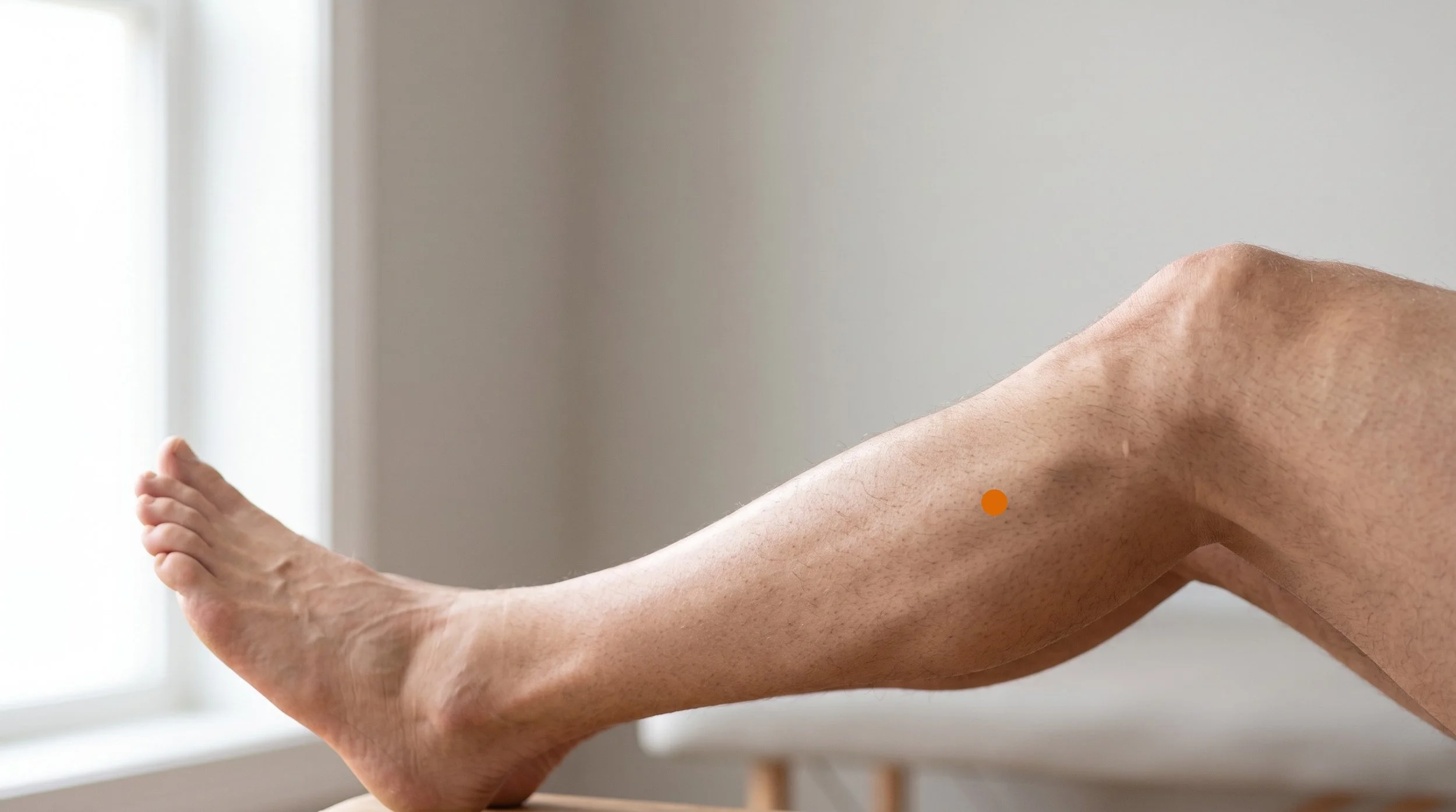
Dannangxue (M-LE-23), the Gallbladder Point, is a modern extra point found on the outside of the right lower leg, roughly one to two finger-widths (1 to 2 cun) below GB34 Yanglingquan, at whatever spot feels most tender under careful thumb pressure. It's unusual on two counts: it isn't on any of the fourteen channels, and and, almost uniquely among acupuncture points, it is found on the right leg only, matching the right-sided position of the gallbladder itself. Older Chinese texts number it as Extra 39, and current international numbering often lists it as EX-LE-6, but the clinical identity is the same.
Clinicians reach for the dannangxue acupuncture point in gallbladder-related presentations (rib-side fullness and pain, gallstone and cholecystitis patterns) strictly alongside standard medical care, and they also press it as a quick screening maneuver, because tenderness here often shows up when the gallbladder is inflamed.
- Location and layers: the point sits over the fibularis (peroneal) muscle group on the lateral right lower leg, one to two cun distal to GB34, and it's found by palpation rather than measurement, since the target is the most tender spot in that small zone (Deadman et al., 2001; Cunningham, 2013).
- Traditional attribution: classical and modern Chinese sources credit the point with clearing heat and draining damp, and list it for acute and chronic cholecystitis, gallstone disease, bile duct disorders, biliary ascariasis, rib-side distention and pain, plus numbness and weakness of the leg (Deadman et al., 2001; Maciocia, 2015).
- Mechanism in plain physiology: needling a limb point can shift visceral activity through somatoautonomic reflexes, which for distal leg points appear to be organized largely at supraspinal rather than local spinal levels (Uchida et al., 2017).
- Point-specific physiology: electroacupuncture at neighboring GB34 produced reversible relaxation of the sphincter of Oddi in patients undergoing manometry, with changes in circulating cholecystokinin (Lee et al., 2001), and animal work suggests acupuncture can influence gallbladder pressure and sphincter activity in both directions depending on the point chosen (Zhao et al., 2017).
- Research picture: the point is used inside multi-point protocols, and current biliary colic research is still catching up, with published systematic review and trial protocols specifically comparing GB34 and Dannangxue (Sun et al., 2021a; Sun et al., 2021b; Zhou et al., 2023).
- De qi and clinical framing: patients usually feel a heavy, aching, distending sensation that can travel down toward the ankle, and in gallbladder presentations the point may be sharply tender before needling, which is exactly why palpation guides the placement (Deadman et al., 2001).
Struggling With Right Rib-Side Pain and Sluggish Digestion?
Right-sided upper abdominal and rib-cage discomfort deserves a proper workup first, and then a plan for the muscular, autonomic and stress-related layers that medical imaging doesn't address. At Morningside Acupuncture we palpate Dannangxue and its neighbors, treat the rib-side and abdominal wall directly, and use calming distal points to support digestive comfort between medical visits. Sessions are unhurried, and we coordinate with your physician rather than around them. Schedule a visit and let's map out what's driving your symptoms.
Schedule NowAnatomy of DANNANGXUE: Why the Peroneal Region Below the Fibular Head Is Such an Important Location
Run your fingers down the outside of the right knee and you'll find the fibular head, a firm knob of bone. GB34 sits just in front of and below it, and Dannangxue lies one to two cun further down, in the muscle mass of the fibularis (peroneus) longus and brevis. Under the skin and thin subcutaneous fascia, the needle passes into a compartment that everts the foot and stabilizes the ankle during walking, so this tissue is loaded constantly by uneven pavement, worn shoes, running and long days on your feet.
That's part of why the area can be tender for purely musculoskeletal reasons, and why the exam matters: the reference texts define the point as the spot of maximum tenderness in that zone, not a fixed measurement (Deadman et al., 2001; Cunningham, 2013).
The neural neighborhood is what makes this location interesting. The common fibular nerve wraps the fibular neck just above the point, then divides, with the superficial fibular nerve running down through the peroneal compartment and the lateral sural cutaneous nerve supplying the overlying skin.
Needling here recruits A-delta and C fiber afferents in skin, fascia and muscle, and that afferent barrage is the entry point for the two mechanisms clinicians care about: pain modulation through spinal and descending controls (Zhao, 2008), and reflex adjustment of visceral function through somatoautonomic pathways that, for distal limb points, seem to be organized mainly at brainstem and supraspinal levels rather than in the local spinal segment (Uchida et al., 2017).
Human manometry work at neighboring GB34 showed reversible relaxation of the sphincter of Oddi with electroacupuncture, alongside changes in cholecystokinin (Lee et al., 2001), which is a concrete example of a leg point influencing biliary smooth muscle.
Deep to the muscle lies the fibula itself, with the peroneal vessels traveling on the posterior aspect and the anterior tibial vessels well anterior in a separate compartment. Standard technique is a perpendicular insertion of about 1 to 1.5 cun, which keeps the needle within the peroneal muscle belly and away from the nerve trunk as it curves around the fibular neck (Deadman et al., 2001). Clinicians angle away from bone, avoid heavy stimulation if the patient reports an electric shot down the outer leg, and reduce intensity when the point is exquisitely sore, which it often is when the gallbladder is irritated. As with any leg point, we needle clean skin, avoid varicosities and open lesions, and stop if sensation is anything other than the expected ache.
Related GB34 Acupuncture Point Related Pain Finder Leg Ankle FootDANNANGXUE at a Glance: Classification, Location, and Clinical Use
| Category | Detail |
|---|---|
| Traditional Name | Dannangxue, Gallbladder Point (also numbered Extra 39 in older Chinese texts and EX-LE-6 in current international listings) |
| Channel Classification | Extra point (M-LE-23), not part of the fourteen channels, located over the Gall Bladder channel pathway on the right lower leg only |
| Point Categories | Modern extraordinary (extra) point with no five-shu, meeting, crossing, front-mu or hui-meeting designation; a palpation-defined reactive point that texts credit with clearing heat and draining damp; one of the very few points described as existing on one side of the body only, and one of the few used secondarily as a diagnostic sign |
| Precise Location | Right lower leg only, 1 to 2 cun distal to GB34 Yanglingquan (which sits in the tender depression roughly 1 cun anterior and inferior to the fibular head), at the point of maximum tenderness located by careful palpation |
| Tissue Stimulated | Skin and superficial fascia of the lateral leg, the fibularis (peroneus) longus and brevis muscle bellies, and their investing fascia; branches of the superficial fibular and lateral sural cutaneous nerves lie in the region, with the common fibular nerve wrapping the fibular neck just proximal. See Acupuncture For Tight Muscles And Trigger Points for how we treat this tissue layer. |
| Needle Depth / Direction | Perpendicular insertion 1 to 1.5 cun into the peroneal muscle belly, angled away from the fibula; some clinical sources describe an oblique angle against the direction of channel flow with strong stimulation in acute biliary pain, always within patient tolerance |
| De Qi Sensation | A deep, heavy, distending ache at the point, frequently spreading down the outer leg toward the ankle or foot; the point is often notably sore to pressure before needling in gallbladder presentations, so stimulation is titrated accordingly |
| Primary Clinical Uses | Adjunctive care in gallbladder inflammation and gallstone pain patterns alongside standard medical management, right rib-side distention and pain, tenderness here as a diagnostic pointer, and, in classical listings, numbness and weakness of the lower limb |
| Common Point Combinations |
|
Deadman, Al-Khafaji and Baker's chapter on the extra points presents Dannangxue as a point that made its name through twentieth century hospital practice rather than through the classics, and they frame its traditional action as clearing heat and draining damp, the pattern language Chinese medicine uses for hot, inflamed, congested conditions in the biliary system.
Their indication list runs through acute and chronic cholecystitis, gallstone disease, bile duct disorders and biliary ascariasis, then adds rib-side distention and pain along with numbness and weakness of the leg, the last a reminder that a point can be used both for the organ it references and for the limb it sits on. The same authors note that the point tends to become tender when the gallbladder is inflamed, which is why it doubles as a rough diagnostic sign, and that it exists only on the right, a rarity in a system built almost entirely on bilateral symmetry.
Cunningham traces its documented debut to a 1959 Chinese surgical journal report on biliary tract disease, and Maciocia keeps it in the standard damp-heat gallbladder formula, so within a few decades a palpated tender spot became a fixture of textbook point selection. What's striking about the classical pattern here is that the point's asymmetry is the whole argument: traditional theory made room for a point that follows an organ's actual anatomical position rather than the tidy left-right logic of the channels.
Why DANNANGXUE Is Used for Right Rib-Side Pain That Has Nothing Anatomically to Do With the Leg
The first question patients ask is fair: how can a point on the outside of the right calf matter to an organ sitting under the ribs? The honest answer is that it isn't a same-segment connection. Sensation from the gallbladder travels with sympathetic fibers into the mid-thoracic spinal cord and, when the diaphragm gets involved, up the phrenic nerve toward the neck segments, which is why gallbladder pain classically refers to the right upper abdomen, the back of the right shoulder blade and the shoulder tip.
The lower leg belongs to lumbar and sacral segments entirely. So the leg point isn't converging with gallbladder afferents in the same spinal neighborhood. Instead, the working explanation is a reflex loop that runs up to the brainstem and back down: stimulate somatic afferents in the limb, and autonomic outflow to the viscera shifts, a pathway described in detail in the somatoautonomic reflex literature, where limb stimulation acts largely through supraspinal circuitry rather than local spinal reflexes (Uchida et al., 2017).
Two lines of physiological work make that story more than theoretical. In patients undergoing sphincter of Oddi manometry, electroacupuncture at GB34 (a thumb's width or so above Dannangxue) produced reversible inhibition of sphincter contraction that a nearby non-point did not, with the authors pointing toward neurohormonal mediation including cholecystokinin release (Lee et al., 2001).
In anesthetized guinea pigs, acupuncture at different points moved gallbladder pressure and sphincter myoelectric activity in opposite directions, and blocking muscarinic transmission abolished much of the effect, which the investigators attributed to autonomic reflex and somatovisceral interaction (Zhao et al., 2017). Together they suggest that leg points in this region can nudge biliary smooth muscle tone, which is a plausible route to easing the cramping quality of biliary pain, though neither study tested Dannangxue itself in a definitive clinical trial.
There's a second, simpler reason the point earns its keep: pain relief. Needling engages spinal gating and descending inhibitory pathways involving endogenous opioids, serotonin and noradrenaline, mechanisms mapped in detail across decades of acupuncture analgesia research (Zhao, 2008), and individual patient data from chronic pain trials support modest but real effects beyond sham controls (Vickers et al., 2018).
For a patient with lingering right rib-side soreness after a gallbladder attack or after cholecystectomy, or with abdominal wall and intercostal guarding that outlasts the original problem, that analgesic and muscle-relaxing effect is often the most useful thing acupuncture offers. None of it replaces surgical or medical management of an inflamed or obstructed gallbladder.
What the Research Shows for DANNANGXUE
Setting expectations honestly matters here. There is no high-quality randomized trial testing the dannangxue acupuncture point on its own, and the biliary colic literature is dominated by small Chinese-language studies plus a growing set of registered protocols rather than completed, well-blinded trials. What we do have is human physiological evidence at the adjacent point GB34, animal work on biliary motility, broad meta-analytic support for acupuncture's analgesic effect in chronic pain, and study designs now explicitly comparing GB34 with Dannangxue.
Read the table below as a picture of a field in progress: the point is used inside multi-point protocols, so no study isolates its individual contribution, and nothing here supports acupuncture as a stand-alone treatment for gallstones or cholecystitis.
| Study | Type | Focus | Key Finding |
|---|---|---|---|
| Lee et al., 2001 | Human physiological study with manometry | Electroacupuncture at GB34, immediately proximal to Dannangxue, during sphincter of Oddi manometry in patients with biliary disorders | Stimulation produced reversible inhibition of sphincter contraction that a nearby control point did not, with the authors suggesting neurohormonal mediation including cholecystokinin. |
| Zhao et al., 2017 | Controlled animal experiment | Manual and electroacupuncture at ST25, LR14, GB34 and an auricular point in guinea pigs, monitoring gallbladder pressure and sphincter myoelectric activity | Effects on biliary motility ran in opposite directions depending on the point stimulated and were largely blocked by atropine, which the authors interpreted as autonomic reflex and somatovisceral interaction. |
| Uchida et al., 2017 | Narrative review of physiology | Somatoautonomic reflexes underlying acupuncture effects on visceral function | Reviews evidence that limb stimulation modulates visceral activity mainly through supraspinal reflex circuitry, while cautioning that anesthetized animal findings don't map neatly onto conscious patients. |
| Sun et al., 2021a | Randomized controlled task-fMRI trial protocol | Planned comparison of acupuncture at GB34 versus Dannangxue (EX-LE-6) versus a non-point in gallbladder stone disease | Describes the design for testing whether the two gallbladder-specific points differ in central effects; results were not yet reported at the time of publication. |
| Sun et al., 2021b | Systematic review and meta-analysis protocol | Planned synthesis of randomized trials of acupuncture for biliary colic across nine databases | Frames the existing trial base as scattered and methodologically limited, which is the main reason firm conclusions about acupuncture for biliary colic aren't yet available. |
| Zhou et al., 2023 | Sham-controlled randomized trial protocol | Single 30-minute acupuncture treatment at GB34 for immediate pain relief and pain-related anxiety in emergency department biliary colic patients | Acknowledges that prior trials had control, randomization and blinding limitations, and sets out to test immediate analgesia under sham-controlled conditions. |
| Vickers et al., 2018 | Individual patient data meta-analysis | Nearly 21,000 patients across chronic pain conditions comparing acupuncture with sham and no-acupuncture controls | Found effects superior to both sham and usual care that persisted over time, supporting a genuine analgesic contribution beyond expectation alone. |
| Zhao, 2008 | Mechanistic review | Neural pathways of acupuncture analgesia | Summarizes evidence that needling activates spinal gating and descending inhibitory systems involving endogenous opioids and monoamines. |
Want a Treatment Plan That Respects Both Medicine and Acupuncture?
Gallbladder symptoms are one of those areas where the right answer is often both: standard medical evaluation for the organ, acupuncture for pain modulation, nausea, muscle guarding and autonomic tone. We use the dannangxue leg point alongside GB34, LV14, LI4 and LV3 in patterns described for centuries, while watching your red flags carefully. If pain escalates or you develop fever or jaundice, we'll tell you to go to the ER, not to book another session. Book an appointment to get a clear, honest plan.
Schedule NowDANNANGXUE in the Context of Trigger Point Work
Because acupuncture at Morningside means using an acupuncture needle across many styles, including dry needling, we treat Dannangxue as both a classical extra point and an anatomical target. The tender spot below GB34 sits squarely in the fibularis longus, a muscle with well-described trigger points that refer pain along the outer leg toward the ankle and lateral foot, and that often harbors taut bands in runners, court-sport athletes and anyone with a history of ankle sprains (Simons et al., 1999).
Part of the clinical skill here is telling the two situations apart. If pressing the spot reproduces familiar outer-leg or ankle pain, we're dealing with myofascial tissue and we needle it accordingly, sometimes seeking a local twitch response. If the tenderness is disproportionate, new, and accompanies right upper abdominal symptoms, that's a different conversation and a reason for medical evaluation.
When the presentation is rib-side pain and abdominal guarding rather than leg pain, the leg point rarely works alone. We commonly pair it with careful needling of the right intercostal muscles, the external oblique and the upper rectus abdominis, all of which can develop trigger points that mimic or amplify upper abdominal and flank pain, and all of which tighten protectively after a genuine gallbladder episode or after laparoscopic surgery (Simons et al., 1999). Add gentle diaphragmatic breathing work and the picture often changes over a few sessions.
Needling near the ribs is done with shallow, tangential technique by clinicians trained in that anatomy, never perpendicular over the intercostal spaces.
DANNANGXUE Digestive Support Treatment at NYC's Highest-Rated Acupuncture Clinic
Morningside Acupuncture is the highest-rated acupuncture and dry needling clinic in New York City with over 500 five-star Google reviews, and our approach blends classical point selection with modern pain science. For digestive and rib-side complaints we combine gentle needling at Dannangxue and ST36 with abdominal wall and intercostal work when the exam supports it. You'll get a clear explanation of what we're treating and why at every step. Schedule your first session and see how thorough acupuncture care can feel.
Schedule NowFrequently Asked Questions
What does DANNANGXUE feel like when needled?
Most people feel a deep, heavy, spreading ache once the needle reaches the peroneal muscle, sometimes with a warm or distending sensation that travels down the outside of the leg toward the ankle. It's usually described as strong but tolerable, and it fades into a dull background pressure after a minute or two. If the gallbladder is irritated, the point can be sore before the needle even goes in, so we start light and build. A brief electric flick down the leg means the needle is close to a nerve branch, and we adjust immediately if that happens.
Why treat a point on the leg for a problem under the right ribs?
Distal points work through the nervous system rather than through any direct anatomical channel to the organ. Stimulating muscle and fascial afferents in the lower leg triggers reflex adjustments in autonomic outflow that can influence visceral smooth muscle, a pathway that appears to be organized mainly at brainstem levels for limb points (Uchida et al., 2017), and human manometry work at neighboring GB34 showed measurable relaxation of the sphincter of Oddi during electroacupuncture (Lee et al., 2001). On top of that, needling recruits descending pain-inhibiting systems that reduce pain wherever it's felt (Zhao, 2008). It's also simply practical: the leg is easy to access while the abdomen is guarded and tender.
Can I press DANNANGXUE myself between sessions?
Yes, and it's a reasonable self-care option if you've already had a medical workup. Sit with your right foot flat, find the bony bump of the fibular head on the outside of your knee, drop about two to three finger-widths below and slightly forward, then explore with your thumb until you find the sorest spot in the muscle. Apply steady pressure at an intensity you'd rate about 5 out of 10, hold for 30 to 60 seconds, release, and repeat two or three times, up to twice a day. Slow circular pressure for 2 to 3 minutes total works just as well, and you can add LV3 on the top of the foot and LI4 in the webbing of the hand for a broader calming effect. Stop if pressure sharply worsens your abdominal pain, and never use acupressure to ride out an acute attack with fever, vomiting, jaundice or pain lasting more than a few hours.
Is DANNANGXUE safe to needle?
In trained hands it's a low-risk point. The needle stays in the peroneal muscle belly at about 1 to 1.5 cun, below the level where the common fibular nerve wraps the fibular neck, and there are no organs or large vessels in the immediate path (Deadman et al., 2001). Practitioners avoid heavy stimulation if a patient reports electric sensation down the leg, and use single-use sterile needles on clean skin, skipping areas with varicose veins, infection or broken skin. The bigger safety issue isn't the needle, it's the context: acupuncture is adjunctive here and should never delay evaluation of suspected acute cholecystitis, obstruction or peritonitis. Severe right upper abdominal pain with fever, yellowing of the eyes or skin, persistent vomiting or pain lasting more than several hours is an emergency room visit, not a clinic visit.
Where exactly is DANNANGXUE located?
On the right leg only. Start at GB34, which sits in the tender hollow roughly one cun anterior and inferior to the head of the fibula on the outside of the knee. From there, move one to two cun (about one to two thumb-widths) straight down along the peroneal muscles and palpate carefully. The gallbladder extra point is defined as the spot of maximum tenderness in that small zone, so the exact millimeter varies between people and even between visits. There's no equivalent point on the left leg, which reflects the gallbladder's own right-sided position.
References
- Deadman, P., Al-Khafaji, M., & Baker, K. (2009). A manual of acupuncture. Journal of Chinese Medicine Publications.
- Cheng, X. (Ed.). (1999). Chinese acupuncture and moxibustion (Rev. ed.). Foreign Languages Press.
- Maciocia, G. (2005). The foundations of Chinese medicine: A comprehensive text for acupuncturists and herbalists (2nd ed.). Elsevier Churchill Livingstone.
- O'Connor, J., & Bensky, D. (Eds. & Trans.). (1981). Acupuncture: A comprehensive text. Shanghai College of Traditional Medicine. Eastland Press.
- Maciocia, G. (2006). The channels of acupuncture: Clinical use of the secondary channels and eight extraordinary vessels. Churchill Livingstone Elsevier.
- Cunningham, P. M. (2000). Acupuncture points: A practical guide to classical and modern usage. Odyssey Press.
- Simons, D. G., Travell, J. G., & Simons, L. S. (1999). Travell & Simons' myofascial pain and dysfunction: The trigger point manual, Vol. 1: Upper half of body (2nd ed.). Williams & Wilkins.
- Lee, S. K., Kim, M. H., Kim, H. J., Seo, D. W., Yoo, K. S., Joo, Y. H., Min, Y. I., Kim, J. H., & Min, B. I. (2001). Electroacupuncture may relax the sphincter of Oddi in humans. Gastrointestinal Endoscopy, 53(2), 211-216. https://doi.org/10.1067/mge.2001.112180
- Zhao, J., Yu, Y., Luo, M., Li, L., & Rong, P. (2017). Bi-directional regulation of acupuncture on extrahepatic biliary system: An approach in guinea pigs. Scientific Reports, 7(1), 14066. https://doi.org/10.1038/s41598-017-14482-x
- Uchida, S., Kagitani, F., & Sato-Suzuki, I. (2017). Somatoautonomic reflexes in acupuncture therapy: A review. Autonomic Neuroscience, 203, 1-8. https://doi.org/10.1016/j.autneu.2016.11.001
- Sun, N., Zhou, Y., Zhou, J., Zuo, W., Ye, X., Deng, X., Li, Z., Cheng, S., Qu, Y., Liang, F., & Sun, R. (2021a). The cerebral mechanism underlying the acupoints with specific effect for gallbladder stone disease: Protocol for a randomized controlled task-fMRI trial. Trials, 22(1), 399. https://doi.org/10.1186/s13063-021-05356-9
- Sun, N., Zuo, W., Zhou, Y., Cheng, Y., Cheng, S., Zhou, J., Xu, G., Huang, L., Liang, F., & Sun, R. (2021b). Acupuncture for biliary colic: A systematic review protocol. BMJ Open, 11(1), e041931. https://doi.org/10.1136/bmjopen-2020-041931
- Zhou, Y., Shen, Y., Ye, X., He, D., Sun, N., Zhang, Y., Zhang, Y., Long, C., Ding, S., Deng, L., Deng, Y., Liang, F., Gong, X., & Sun, R. (2023). Acupuncture on GB34 for immediate analgesia and regulating pain-related anxiety for patients with biliary colic: A protocol of randomized controlled trial. BMC Complementary Medicine and Therapies, 23(1), 224. https://doi.org/10.1186/s12906-023-04030-8
- Zhao, Z. Q. (2008). Neural mechanism underlying acupuncture analgesia. Progress in Neurobiology, 85(4), 355-375. https://doi.org/10.1016/j.pneurobio.2008.05.004
- Vickers, A. J., Vertosick, E. A., Lewith, G., MacPherson, H., Foster, N. E., Sherman, K. J., Irnich, D., Witt, C. M., & Linde, K. (2018). Acupuncture for chronic pain: Update of an individual patient data meta-analysis. Journal of Pain, 19(5), 455-474. https://doi.org/10.1016/j.jpain.2017.11.005
Disclaimer: This web site is intended for educational and informational purposes only. Reading this website does not constitute providing medical advice or any professional services. This information should not be used for diagnosing or treating any health issue or disease. Those seeking medical advice should consult with a licensed physician. Seek the advice of a medical doctor or other qualified health professional for any medical condition. If you think you have a medical emergency, call 911 or go to the emergency room. No acupuncturist-patient relationship is created by reading this website or using the information. Morningside Acupuncture PLLC and its employees and contributors do not make any express or implied representations with respect to the information on this site or its use. For any legal interpretation of scope of practice in your state, consult a licensed attorney or regulatory authority.
Read more from our blog