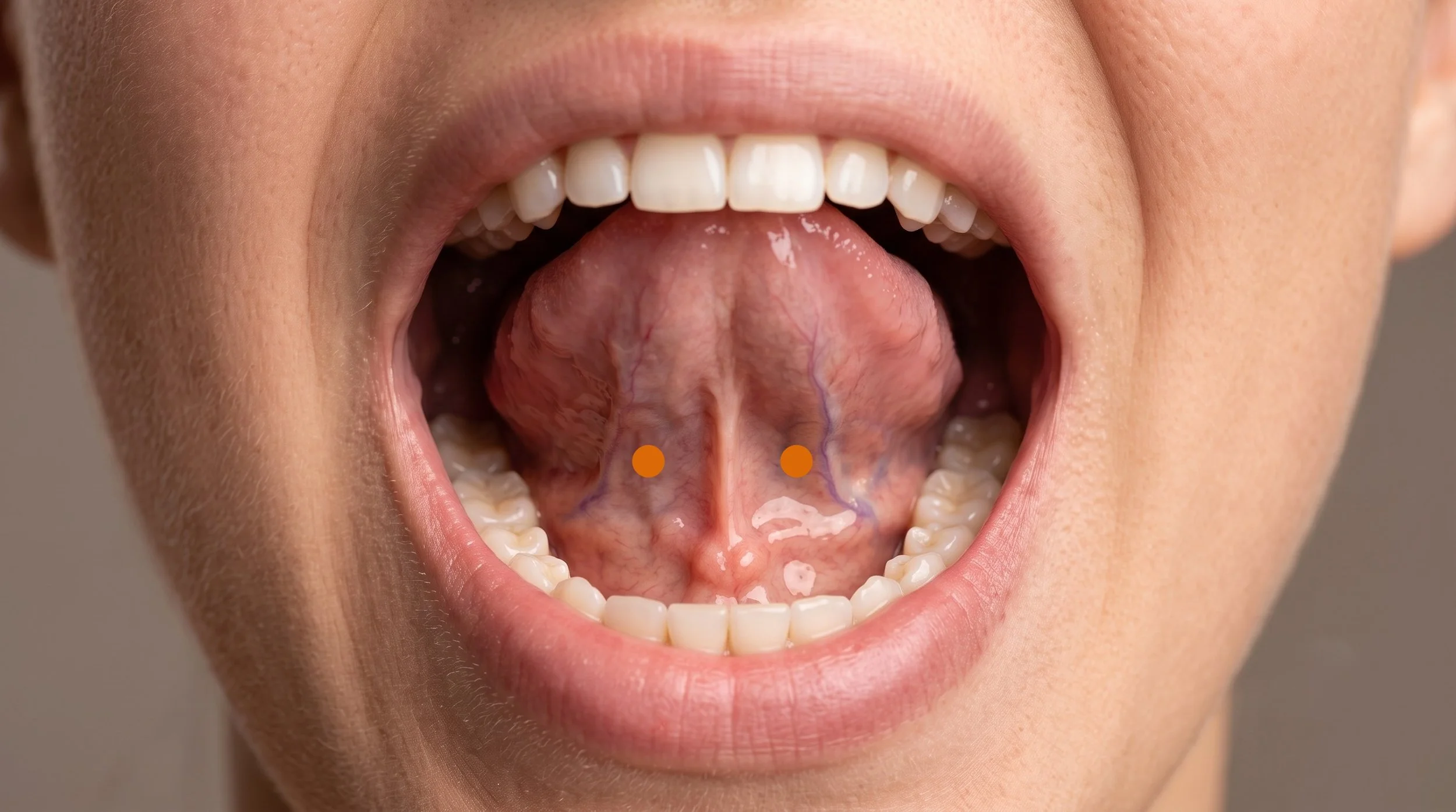
Jinjin Yuye Acupuncture Point (M-HN-20)
Golden Liquid and Jade Fluid Beneath the Tongue: Anatomy, Mechanism, and Why These Paired Sublingual Points Belong to Emergency and Post-Stroke Practice
Jinjin Yuye (M-HN-20), translated as Golden Liquid and Jade Fluid, is a pair of extra points sitting on the two visible veins that run either side of the frenulum on the underside of the tongue, Jinjin on the left and Yuye on the right. To find them the practitioner rolls the tongue back, usually with a gauze swab, and works with the floor of the mouth in full view.
These are among the few points in the acupuncture repertoire that are treated only by a quick prick to release a few drops of blood, never by retained needling, and their traditional reputation sits almost entirely in the mouth and tongue: swelling, ulceration, loss of voice, stiff or immobile tongue after windstroke, and the parched mouth of classical wasting and thirsting disorder. The jinjin yuye acupuncture points are used rarely, deliberately, and by experienced hands, which is exactly what makes them interesting to explain properly.
- Location and layers: the points lie on the paired deep lingual (ranine) veins flanking the tongue's frenulum, under thin sublingual mucosa, with the sublingual glands, the openings of the submandibular ducts, and the genioglossus and geniohyoid muscles immediately deep. The Deadman and Al-Khafaji point manual describes rolling the tongue back with a gauze swab or spatula to expose them.
- Traditional categories, read neurophysiologically: classical sources group Jinjin Yuye under clearing heat, reducing swelling, and generating fluids. In modern terms that maps onto local venous decongestion of an inflamed, engorged tongue and reflex modulation of salivary secretion, not to any literal movement of energy.
- Nerve geography drives the effect: the anterior tongue and floor of mouth are supplied by the lingual branch of the mandibular nerve (V3), which carries chorda tympani fibers to the submandibular ganglion and the sublingual and submandibular glands, while the hypoglossal nerve supplies tongue movement. Trigeminal afferents converge in the spinal trigeminal nucleus, the same brainstem territory that receives upper cervical input and is subject to descending inhibitory control (Zhao, 2008).
- Research picture: no trial has isolated M-HN-20 on its own, so the evidence comes from multi-point protocols. Reviews of acupuncture for post-stroke dysphagia and aphasia report improvements in swallowing and communication measures but flag low methodological quality (Lu et al., 2021; Zhang et al., 2019; Tian et al., 2019), while the broader Cochrane swallowing therapy review did not find clear benefit on swallowing ability (Bath et al., 2018).
- Fluid and saliva angle: the classical claim that these points generate fluids parallels a modern literature in which acupuncture has been tested for dry mouth, with a large multicenter trial reporting reduced xerostomia symptoms after radiotherapy (Cohen et al., 2024) and earlier work documenting measurable changes in salivary flow (Blom et al., 1996).
- Sensation and practice framing: no de qi is sought here. Patients feel a brief sharp prick and a small release of dark venous blood, the whole contact lasting seconds, and the points are avoided entirely in anyone with a bleeding disorder or on anticoagulants.
Struggling With Tongue Stiffness, Speech Changes, or Persistent Mouth Discomfort?
At Morningside Acupuncture we treat oral, jaw, and speech complaints with a full picture in mind, combining channel points around the throat and tongue root with dry needling of the jaw and suprahyoid muscles that support swallowing. Points like Jinjin Yuye are reserved for specific severe presentations, and we will always tell you plainly when a complaint belongs to your physician, dentist, or speech pathologist first. Most patients get more mileage from a well planned series than from any single point. Schedule a visit and we will map out a sensible plan.
Schedule NowAnatomy of Jinjin Yuye: Why the Veins Beneath the Tongue Are Such an Important Location
Lift your tongue to the roof of your mouth in front of a mirror and the anatomy declares itself. A midline fold, the frenulum, tethers the tongue to the floor of the mouth, and on either side of it two bluish cords run forward toward the tip. Those are the deep lingual veins, and they are the target. The tissue over them is thin, non-keratinized sublingual mucosa with very little submucosa, which is why the veins show through so clearly. Just lateral and deep sit the sublingual glands, and at the base of the frenulum are the small caruncles where the submandibular ducts empty saliva into the mouth.
Deeper still lie the genioglossus and geniohyoid muscles that protrude the tongue and stabilize the hyoid during swallowing. Nothing here is loaded mechanically the way a shoulder or a hip is loaded. What loads this region is swelling: infection, allergic reaction, trauma, post-radiation change, or the altered tone and reduced clearance that follow a stroke.
The nerve supply explains why classical practice attached so much to such a small area. Sensation over the anterior two-thirds of the tongue and the floor of the mouth travels in the lingual nerve, a branch of the mandibular division of the trigeminal nerve (V3), and traveling with it are chorda tympani fibers from the facial nerve that relay in the submandibular ganglion and drive secretion from the submandibular and sublingual glands. Motor control of the tongue runs in the hypoglossal nerve, and the posterior third of the tongue reports to the glossopharyngeal nerve.
Trigeminal afferents from this territory terminate in the spinal trigeminal nucleus, a column that blends into the upper cervical dorsal horn and shares space with the brainstem circuitry for swallowing, salivation, and gagging. Needle stimulation anywhere in a segmentally related field can recruit inhibitory interneurons and engage descending pathways from the periaqueductal gray and rostral ventromedial medulla that damp nociceptive traffic (Zhao, 2008).
In other words, a point on the underside of the tongue is not a mystical portal, it is a densely innervated mucosal surface wired directly into brainstem control of the mouth.
The vascular anatomy is also the safety story. The deep lingual vein is superficial and thin walled, so it bleeds readily, and the lingual artery runs deeper and more laterally within the tongue substance. That combination means the conventional technique is a swift, shallow prick with a lancet or three-edged needle, a few drops released, then firm pressure with sterile gauze. Needles are never retained here, moxa is not used, and the deep midline is avoided because a hematoma in the floor of the mouth is a genuinely serious problem in a space that shares real estate with the airway.
Practitioners skip these points entirely in patients on anticoagulants or antiplatelet drugs, in anyone with a clotting disorder, and in anyone who cannot cooperate with having the tongue held back. For nearly every complaint in the classical indication list, safer points around the throat and jaw are tried first.
Related Deep Breathing And The Vagus Nerve Related Acupuncture For Pain Stress ReliefJINJINYUYE at a Glance: Classification, Location, and Clinical Use
| Category | Detail |
|---|---|
| Traditional Name | Jinjin Yuye (Golden Liquid and Jade Fluid), a name that points at saliva itself |
| Channel Classification | Paired extra point, not on a primary channel; catalogued as M-HN-20 in the Deadman numbering and often listed elsewhere as EX-HN-12 (Jinjin, left) and EX-HN-13 (Yuye, right) |
| Point Categories | No five-shu, luo, xi-cleft, hui-meeting, or extraordinary vessel designations apply, since these are extra points outside the channel system. Traditional texts classify them by action only: clearing heat and reducing swelling, generating fluids, and benefiting the tongue. They belong to the small group of points treated exclusively by pricking to bleed. |
| Precise Location | Under the tongue, on the two visible veins running either side of the frenulum, with Jinjin on the left and Yuye on the right. The tongue is rolled back and held with a gauze swab or wooden spatula to expose them. |
| Tissue Stimulated | Sublingual mucosa and the superficial wall of the deep lingual (ranine) vein, within lingual nerve (V3) and hypoglossal territory, overlying the sublingual gland and the genioglossus and geniohyoid. There is no myofascial trigger point at this site; related swallowing and jaw muscles are addressed separately with dry needling, in the same way we approach regional muscle pain elsewhere in the body (see Best Acupuncture Points For Neck Pain). |
| Needle Depth / Direction | Prick to bleed only, a swift shallow puncture of the vein with a lancet or three-edged needle, releasing a few drops. No retained needling, no deep insertion, no moxibustion, and the midline is avoided. |
| De Qi Sensation | De qi is not sought. Patients report a brief sharp prick and a metallic taste from the small amount of blood, with the contact lasting only seconds. Any sense of relief tends to be immediate rather than gradual. |
| Primary Clinical Uses | Traditionally used for pain and swelling of the tongue, mouth ulcers, throat obstruction and loss of voice, stiff tongue and speech loss after windstroke, parched mouth in wasting and thirsting disorder, and stubborn nausea and vomiting. In contemporary practice, reserved for severe or recalcitrant tongue presentations rather than routine care. |
| Common Point Combinations |
|
The Deadman and Al-Khafaji extra points chapter traces Jinjin Yuye back to the Essential Questions, with the most vivid instruction arriving centuries later in Sun Si-miao's Thousand Ducat Prescriptions, which described a tongue swelling so abruptly that it blocked breathing and directed the practitioner to prick the two large vessels flanking the frenulum without delay.
The traditional actions attributed to the pair are clearing heat, reducing swelling, and generating fluids, and the classical indication lists cluster into three groups: acute hot swellings of the tongue and throat with ulceration or lost voice, stiff tongue and inability to speak after windstroke, and fluid-depletion states including the parched mouth of wasting and thirsting disorder along with severe nausea and vomiting. The same manual is candid that these points are seldom used in day to day practice because of where they sit, and reserves them for severe and stubborn tongue disorders.
What is striking is the internal consistency of the classical pattern: a point named after saliva, sitting where the salivary ducts open, credited with both draining a swollen tongue and restoring moisture to a dry mouth.
Why Jinjin Yuye Is Used for Post-Stroke Speech and Swallowing Problems
The tongue is unusually well represented in the brainstem. Sensory information from the front of the tongue and the floor of the mouth arrives through the lingual nerve into the spinal trigeminal nucleus, taste and secretory signals travel with the chorda tympani, and the posterior tongue and pharynx report through the glossopharyngeal and vagus nerves into the nucleus of the solitary tract. Those nuclei sit next door to the pattern generator that sequences swallowing and to the motor pools of the hypoglossal nerve and nucleus ambiguus.
Because of that convergence, sensory stimulation inside the mouth is not a distant intervention when the problem is a stiff tongue or an unreliable swallow, it is input delivered directly into the circuit that has been disrupted. That is the plainest modern account of why classical practitioners went after tongue disorders through the tongue itself.
Layered on top of that segmental story is the general analgesic and modulatory machinery that acupuncture research has described for decades: needle stimulation recruits spinal and supraspinal inhibition, engages descending pathways, and alters the gain on incoming nociceptive traffic (Zhao, 2008). Applied to the mouth, the practical claims are more modest than the classical ones. Bleeding an engorged sublingual vein plausibly relieves local venous congestion in a swollen tongue and produces a quick change in comfort.
It does not repair a damaged cortex, and it does not substitute for speech and language therapy, which remains the backbone of aphasia and dysphagia rehabilitation.
The fluid-generating claim has the most interesting modern parallel. Salivary output is under parasympathetic control through the chorda tympani and submandibular ganglion, and trials of acupuncture for dry mouth have measured both symptom scores and salivary flow rates.
A large multicenter randomized trial in head and neck cancer survivors found reduced xerostomia symptoms with true acupuncture compared with sham and standard oral care (Cohen et al., 2024), and earlier controlled work reported increased salivary flow in irradiated patients after treatment, though gains appeared in both study arms (Blom et al., 1996). Those studies used body and facial points rather than M-HN-20, so they support the mechanism in principle without validating this particular point. It is a reasonable inference, not a proven one.
What the Research Shows for JINJINYUYE
There is no trial that tests Jinjin Yuye by itself, and it would be misleading to imply otherwise. What exists is a body of research on multi-point protocols for post-stroke dysphagia, aphasia, and dry mouth, in which the sublingual points sometimes appear as one element among a dozen. Chinese language trials frequently list Jinjin and Yuye bloodletting inside larger scalp, neck, and body acupuncture packages, which means any effect attributed to them is entangled with everything else in the prescription.
The reviews below should be read as evidence about acupuncture protocols that may include these points, not evidence about the points themselves, and several of those reviews are explicit that the underlying trials are small and at high risk of bias.
| Study | Type | Focus | Key Finding |
|---|---|---|---|
| Bath et al., 2018 | Cochrane systematic review | Swallowing therapy, including acupuncture, for dysphagia in acute and subacute stroke | Pooled analysis did not demonstrate a clear effect on death or dependency, and evidence for individual therapies including acupuncture was judged insufficient. |
| Lu et al., 2021 | Systematic review and meta-analysis | Acupuncture for post-stroke dysphagia across 39 randomized controlled trials | Reported higher effective rates with acupuncture, with the authors cautioning that the underlying trials were methodologically weak. |
| Tian et al., 2019 | Overview of systematic reviews | Quality appraisal of reviews on acupuncture for post-acute stroke dysphagia | Concluded that the available evidence is of low quality and that larger, better designed trials are needed. |
| Zhang et al., 2019 | Systematic review and meta-analysis | Acupuncture for functional communication and language function in post-stroke aphasia | Suggested improvement in communication measures, with results limited by heterogeneity and trial quality. |
| Cohen et al., 2024 | Multicenter randomized clinical trial | Acupuncture versus sham acupuncture and standard oral care for chronic radiation-induced xerostomia | True acupuncture was associated with greater reduction in dry mouth symptom scores than the comparison conditions. |
| Blom et al., 1996 | Randomized controlled trial | Classical versus superficial placebo acupuncture for radiation-induced xerostomia | Salivary flow rates rose significantly in both groups, indicating benefit but leaving the specific contribution of point selection unclear. |
| Vickers et al., 2018 | Individual patient data meta-analysis | Acupuncture for chronic pain across roughly 20,000 patients | Found modest but persistent effects over sham and no-acupuncture controls, supporting acupuncture as a plausible option for chronic pain generally. |
Dry Mouth, Reduced Saliva, or Oral Side Effects After Cancer Treatment?
Dry mouth after head and neck radiotherapy, or from medication, is one of the areas where acupuncture has been studied most carefully, and results suggest symptom scores may improve for some patients. We work alongside your oncology and dental team rather than in place of them, using body and facial points that studies have tested rather than improvising. Sessions are gentle and we track symptoms visit to visit. Book a consultation to see whether this is a reasonable addition to your care.
Schedule NowJinjin Yuye in the Context of Trigger Point Work
Jinjin Yuye is not a myofascial target. There is no taut band under the tongue to release and nothing about the point resembles conventional dry needling, which is why we describe it as bleeding technique rather than needling technique.
That said, patients who arrive with tongue, throat, or swallowing complaints very often have muscular findings nearby. The digastric, mylohyoid, and geniohyoid form the floor of the mouth and elevate the hyoid during swallowing, and the masseter, medial pterygoid, and sternocleidomastoid refer pain into the jaw, ear, and throat in patterns catalogued in the Travell and Simons trigger point manual (Simons et al., 1999). When a patient describes a sore tongue or a lump-in-throat sensation, checking those muscles is often more productive than reaching for a rare sublingual point.
Our practical approach at Morningside is layered. We start with the muscles we can palpate and treat safely, using dry needling of the masseter, digastric, and suprahyoid group along with the upper cervical extensors that share brainstem territory with trigeminal input, then add classical points at the throat and tongue root such as CV23 and CV22. Because dry needling is simply one of the many styles that use an acupuncture needle, these approaches sit comfortably in the same treatment.
The sublingual points stay in reserve for the narrow set of severe, stubborn tongue presentations where the classical literature actually points there, and only when bleeding technique is appropriate for that individual patient.
Jinjin Yuye Tongue and Speech Treatment at NYC's Highest-Rated Acupuncture Clinic
Morningside Acupuncture is the highest-rated acupuncture and dry needling clinic in New York City with over 500 five-star Google reviews, and our Upper West Side practice sees patients with post-stroke speech and swallowing difficulty, jaw pain, and oral discomfort every week. We explain what each point is for, what the evidence does and does not show, and where the limits of acupuncture sit. Rare points such as M-HN-20 are used only when the clinical picture genuinely calls for them. Schedule your appointment and let's talk through your case.
Schedule NowFrequently Asked Questions
What does Jinjin Yuye feel like when needled?
It feels different from ordinary acupuncture because it is not ordinary needling. The practitioner rolls your tongue back with gauze, pricks the vein quickly with a lancet or three-edged needle, and lets a few drops of blood out. You feel a brief sharp sting, then usually a metallic taste, and the whole thing is over in seconds. No needle is left in place, so there is no dull, spreading de qi ache. Any change in a swollen or uncomfortable tongue tends to be felt right away rather than building over the session.
Why treat the underside of the tongue instead of points on the arms or legs?
Because the mouth has its own dense line into the brainstem. The lingual nerve carries sensation from the front of the tongue into the spinal trigeminal nucleus, and the neighboring nuclei organize swallowing, salivation, and tongue movement, so local stimulation lands directly in the relevant circuit rather than reaching it indirectly. Classical practice arrived at the same place empirically, treating swollen and stiff tongues at the tongue. In everyday care we still start with safer distal and neck points, and only consider the sublingual points when the presentation is severe and has not responded.
Can I press Jinjin Yuye myself between sessions?
No, and this is one of the few points where we ask patients not to improvise. The site is a thin walled vein in the floor of the mouth, self-treatment risks bleeding and infection, and there is no meaningful acupressure version because the technique is bloodletting rather than pressure. If you want something to do at home for oral or throat discomfort, work distally instead: hold LI4 in the web of the thumb for 30 to 60 seconds per side, two or three rounds, and add ST36 below the knee for 60 seconds per side. For dry mouth, gentle circular pressure over the masseter and in front of the ear for one to two minutes per side, twice daily, is safe and comfortable. Stop with any of these if pressure increases your symptoms, and always tell your clinician what you are doing at home.
Is Jinjin Yuye safe to needle?
In trained hands, with strict sterile technique and a clear indication, it can be performed safely, but it carries more caution than almost any point we write about. The concerns are bleeding, hematoma in the floor of the mouth, and infection in a space adjacent to the airway. It is avoided in anyone taking anticoagulant or antiplatelet medication, in bleeding disorders, in immunocompromised patients, and in anyone who cannot tolerate having the tongue held. Needles are never retained here and the deep midline is not punctured. Most importantly, sudden tongue or throat swelling that affects breathing or swallowing is an emergency that belongs in an emergency department, not in a treatment room.
Where exactly is Jinjin Yuye located?
Lift your tongue toward the roof of your mouth and look underneath. You will see a central fold, the frenulum, running from the floor of the mouth to the tongue, with a bluish vein on each side of it. Jinjin is the point on the left vein and Yuye the point on the right, which is why the pair is catalogued under a single code, M-HN-20 (also written as EX-HN-12 and EX-HN-13). In clinic the tongue is rolled back and steadied with a gauze swab so both veins are clearly visible before anything is done.
References
- Deadman, P., Al-Khafaji, M., & Baker, K. (2009). A manual of acupuncture. Journal of Chinese Medicine Publications.
- O'Connor, J., & Bensky, D. (Eds. & Trans.). (1981). Acupuncture: A comprehensive text. Shanghai College of Traditional Medicine. Eastland Press.
- Cunningham, P. M. (2000). Acupuncture points: A practical guide to classical and modern usage. Odyssey Press.
- Simons, D. G., Travell, J. G., & Simons, L. S. (1999). Travell & Simons' myofascial pain and dysfunction: The trigger point manual, Vol. 1: Upper half of body (2nd ed.). Williams & Wilkins.
- Bath, P. M., Lee, H. S., & Everton, L. F. (2018). Swallowing therapy for dysphagia in acute and subacute stroke. Cochrane Database of Systematic Reviews, 2018(10), CD000323. https://doi.org/10.1002/14651858.CD000323.pub3
- Lu, Y., Chen, Y., Huang, D., & Li, J. (2021). Efficacy of acupuncture for dysphagia after stroke: A systematic review and meta-analysis. Annals of Palliative Medicine, 10(3), 3410-3422. https://doi.org/10.21037/apm-21-499
- Tian, Z. Y., Liao, X., Gao, Y., Liang, S. B., Zhang, C. Y., Xu, D. H., Liu, J. P., & Robinson, N. (2019). An overview of systematic reviews and meta-analyses on acupuncture for post-acute stroke dysphagia. Geriatrics, 4(4), 68. https://doi.org/10.3390/geriatrics4040068
- Zhang, B., Han, Y., Huang, X., & Liu, Z. (2019). Acupuncture is effective in improving functional communication in post-stroke aphasia: A systematic review and meta-analysis of randomized controlled trials. Wiener klinische Wochenschrift, 131(9-10), 221-232. https://doi.org/10.1007/s00508-019-1478-5
- Cohen, L., Danhauer, S. C., Garcia, M. K., Dressler, E. V., Rosenthal, D. I., Chambers, M. S., Cusimano, A., Brown, W. M., Ochoa, J. M., Yang, P., Chiang, J. S., Gordon, O., Crutcher, R., Kim, J. K., Russin, M. P., Lukenbill, J., Porosnicu, M., Yost, K. J., Weaver, K. E., & Lesser, G. J. (2024). Acupuncture for chronic radiation-induced xerostomia in head and neck cancer: A multicenter randomized clinical trial. JAMA Network Open, 7(5), e2410421. https://doi.org/10.1001/jamanetworkopen.2024.10421
- Blom, M., Dawidson, I., Fernberg, J. O., Johnson, G., & Angmar-Månsson, B. (1996). Acupuncture treatment of patients with radiation-induced xerostomia. European Journal of Cancer Part B: Oral Oncology, 32B(3), 182-190. https://doi.org/10.1016/0964-1955(95)00085-2
- Zhao, Z. Q. (2008). Neural mechanism underlying acupuncture analgesia. Progress in Neurobiology, 85(4), 355-375. https://doi.org/10.1016/j.pneurobio.2008.05.004
- Vickers, A. J., Vertosick, E. A., Lewith, G., MacPherson, H., Foster, N. E., Sherman, K. J., Irnich, D., Witt, C. M., & Linde, K. (2018). Acupuncture for chronic pain: Update of an individual patient data meta-analysis. Journal of Pain, 19(5), 455-474. https://doi.org/10.1016/j.jpain.2017.11.005
Disclaimer: This web site is intended for educational and informational purposes only. Reading this website does not constitute providing medical advice or any professional services. This information should not be used for diagnosing or treating any health issue or disease. Those seeking medical advice should consult with a licensed physician. Seek the advice of a medical doctor or other qualified health professional for any medical condition. If you think you have a medical emergency, call 911 or go to the emergency room. No acupuncturist-patient relationship is created by reading this website or using the information. Morningside Acupuncture PLLC and its employees and contributors do not make any express or implied representations with respect to the information on this site or its use. For any legal interpretation of scope of practice in your state, consult a licensed attorney or regulatory authority.
Read more from our blog



