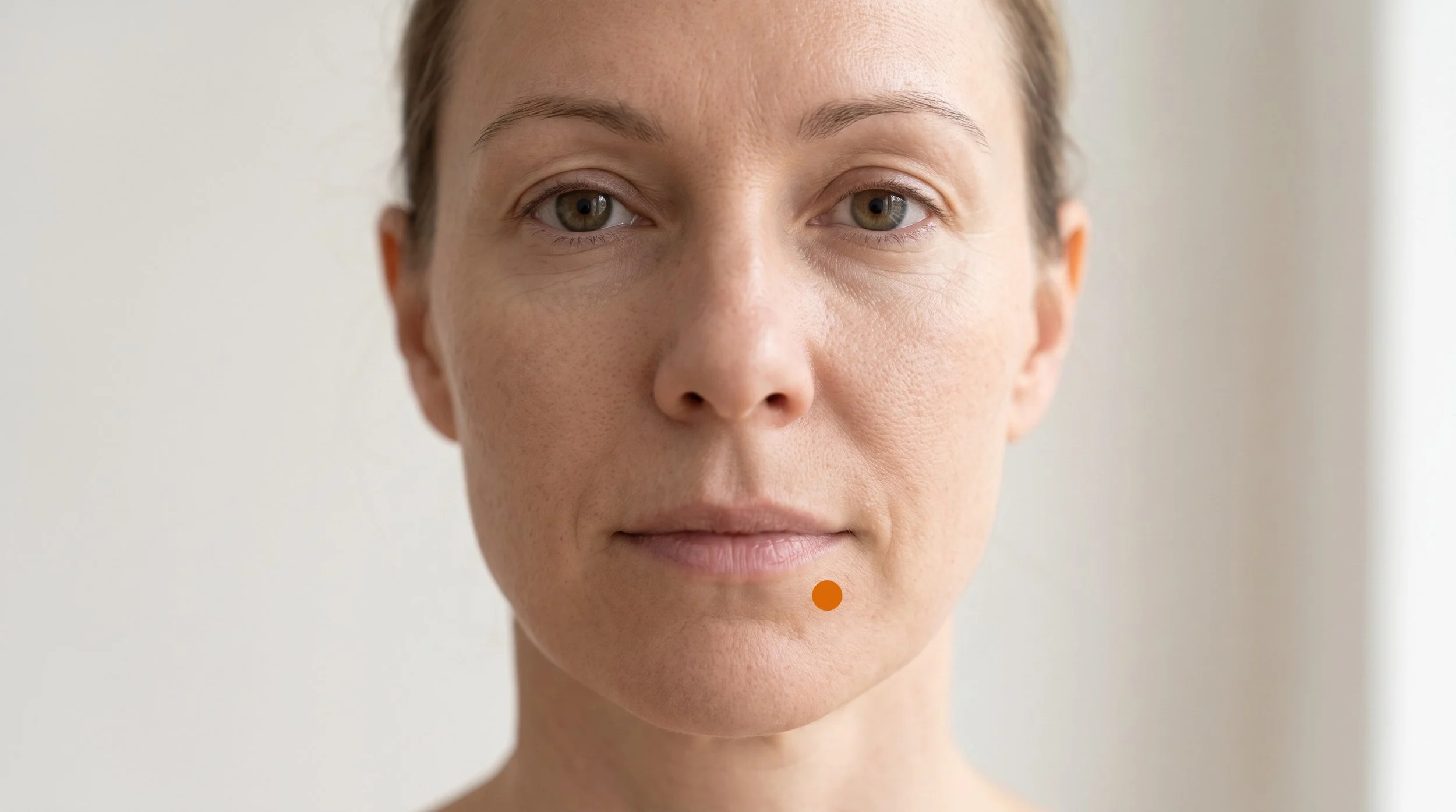
Jiachengjiang Acupuncture Point (M-HN-18)
The Chin Point Over the Mental Foramen: Anatomy, Mechanism, and Why This Small Extra Point Anchors Lower Face Pain and Facial Paralysis Treatment
Jiachengjiang (M-HN-18), whose name is usually translated as Adjacent to Container of Fluids, is an extra point on the chin located one cun lateral to CV24, roughly a thumb's width out from the midline groove below the lower lip. What makes the jiachengjiang acupuncture point clinically interesting is not its position on any channel, because it belongs to none, but what sits directly beneath it: the mental foramen, the small bony opening in the mandible where the mental nerve emerges to supply the lower lip, chin, and gum.
Very few points on the body sit this precisely over a named nerve exit, and that anatomy explains why the jiachengjiang chin point shows up so consistently in modern protocols for facial paralysis, mandibular trigeminal pain, toothache, and jaw problems that patients describe as coming from the teeth even when dental exams are clear.
- Jiachengjiang sits 1 cun lateral to CV24 over the mental foramen, in a thin layer of skin and subcutaneous tissue above the orbicularis oris and the depressor labii inferioris, with the mandible immediately deep. Cadaveric and stimulation work mapping facial acupoints against the trigeminal nerve found that many classical facial points overlie the points where trigeminal branches emerge and divide (Meltz et al., 2020).
- Traditionally, m-hn-18 is described as eliminating wind, activating the channel, and alleviating pain, with classical indications that cluster around deviation of the mouth and eye, facial pain, toothache, and swelling of the gums. Read neurophysiologically, that list is a description of trigeminal sensory pain and facial nerve motor dysfunction in the lower third of the face.
- The mental nerve is the terminal branch of the inferior alveolar nerve, itself a branch of the mandibular division of the trigeminal nerve, so needling here delivers input straight into the V3 territory that converges in the trigeminocervical complex of the brainstem (Meltz et al., 2020; Zhao, 2008).
- Beyond that segmental story, needling appears to recruit descending inhibitory pathways and endogenous opioid mechanisms that dampen pain signalling more broadly, which is one reason distal points are usually added to local facial work (Zhao, 2008; Vickers et al., 2018).
- The research picture is mixed and honest reporting matters: a Cochrane review of acupuncture for Bell's palsy could not reach firm conclusions because of trial quality (Chen et al., 2010), while later meta-analyses of facial palsy and trigeminal neuralgia report favourable results with low certainty evidence (Li et al., 2015; Ang et al., 2023; He et al., 2024).
- De qi at this point is distinctive. Superficial or transverse insertion gives local distension and a dull ache, while a needle angled medially and inferiorly toward the foramen may produce a brief electric or numb sensation spreading into the lower lip, which practitioners take as a sign the mental nerve has been engaged.
Struggling With Facial Pain, Jaw Pain, or a Face That Will Not Move Right?
Lower face problems are frustrating because they interfere with eating, speaking, and how you look to other people. At Morningside Acupuncture, we use Jiachengjiang alongside points such as ST4, ST6, ST7, and LI4 in carefully staged treatment plans for facial paralysis patterns, mandibular facial pain, and jaw tension. Treatment is gentle, needles are very fine, and we adjust depth and stimulation to what your face tolerates on the day. Schedule a visit and we will map out a realistic plan and timeline with you.
Schedule NowAnatomy of JIACHENGJIANG: Why the Mental Foramen Is Such an Important Location
The tissue at Jiachengjiang is shallow and layered simply. Under thin, mobile chin skin sits a thin layer of subcutaneous fat, then the interlacing fibres of orbicularis oris and depressor labii inferioris, muscles that work constantly during speech, chewing, drinking, and expression. Below those fibres is the front surface of the mandible, and the point is defined by the small opening in that bone. Because the muscles here are small and highly active, and because the bone is close, the point tolerates only light, precise technique rather than heavy manipulation.
The nerve geography is the reason this point exists in the way it does. The mental nerve emerges from the mental foramen as the terminal continuation of the inferior alveolar nerve, part of the mandibular division of the trigeminal nerve, and it carries sensation from the lower lip, chin, and adjacent gum.
Anatomical mapping of facial acupoints against trigeminal branches has shown that traditional point locations correspond closely to where these branches surface (Meltz et al., 2020), and a companion cadaveric study found similar specificity between facial points and branches of the facial nerve, which supplies the motor function of the same region (Chiang & Martins, 2022).
Sensory input from this territory converges in the trigeminal nucleus caudalis, a brainstem relay that also receives upper cervical input, which is the segmental basis for treating jaw, tooth, and facial pain from points on the face and neck. Needling is also thought to engage descending inhibitory control and opioid-mediated modulation rather than acting only at the local tissue (Zhao, 2008).
Deep to the point, the mental artery and vein accompany the nerve out of the foramen, and facial vessels run nearby in the subcutaneous plane, so bruising is the most common minor event here. Standard conventions reflect that: perpendicular to oblique insertion directed medially and inferiorly into the foramen at about 0.3 to 0.5 cun, or transverse insertion of 0.5 to 1.5 cun when threading along the chin, as described in the Deadman point manual and in the Shanghai College text.
Practitioners avoid forceful thrusting once a nerve sensation appears, keep the needle fine, and apply firm pressure after withdrawal to limit bruising in this vascular area.
Related Lateral Pterygoid Trigger Points Related LI4 Acupuncture PointJIACHENGJIANG at a Glance: Classification, Location, and Clinical Use
| Category | Detail |
|---|---|
| Traditional Name | Jiachengjiang (Adjacent to Container of Fluids), M-HN-18 |
| Channel Classification | Extra point of the head and neck group, not assigned to any of the twelve channels or the eight extraordinary vessels |
| Point Categories | Extraordinary (extra) point, coded M-HN-18. Because it is not a channel point, it carries no five-shu, luo-connecting, xi-cleft, or hui-meeting designation and no listed crossing point status. Its identity is positional: it lies immediately lateral to Chengjiang CV24 on the Conception vessel, and directly below Dicang ST4 in the Shanghai College description. |
| Precise Location | On the chin, 1 cun lateral to CV24, directly over the mental foramen of the mandible, which can often be felt as a slight give or tenderness under fingertip pressure |
| Tissue Stimulated | Chin skin and subcutaneous tissue, fibres of orbicularis oris and depressor labii inferioris (quadratus labii inferioris), and the mental nerve and vessels at the mental foramen; often combined with dry needling of nearby jaw muscles including the masseter, temporalis, and lateral pterygoid trigger points |
| Needle Depth / Direction | Perpendicular to oblique insertion angled medially and inferiorly toward the mental foramen, 0.3 to 0.5 cun, or transverse insertion along the chin 0.5 to 1.5 cun for threading techniques |
| De Qi Sensation | Local distension, soreness, and a dull ache with shallow or transverse needling; a brief electric or numb sensation radiating into the lower lip when the needle engages the mental nerve at the foramen |
| Primary Clinical Uses | Facial paralysis patterns affecting the mouth and chin, trigeminal neuralgia patterns in the mandibular division, facial spasm, pain of the face, toothache and swollen gums of the lower jaw, and jaw pain as part of TMJ-related treatment |
| Common Point Combinations |
|
According to the commentary in the Deadman point manual, Jiachengjiang first appears in the Thousand Ducat Prescriptions, the seventh century compendium associated with Sun Simiao, and it has been carried forward in the extra point literature ever since. Traditionally the point is credited with eliminating wind, activating the channel, and alleviating pain, and its classical indication list gathers deviation of the mouth and eye, pain of the face, toothache, swelling of the gums, and, curiously, jaundice.
The Deadman text notes that modern clinical use has narrowed sharply to facial paralysis and trigeminal neuralgia, and the Shanghai College text lists essentially the same two conditions plus facial spasm.
What is striking about the classical pattern is how tightly the traditional indications track a single nerve territory: almost everything on the list falls within the mandibular sensory field or the motor field of the lower face, which is not what you would expect from a point named simply for being next to another point.
Why JIACHENGJIANG Is Used for Chin Numbness, Lower Tooth Pain, and Jaw Symptoms That Feel Dental but Are Not
Patients often arrive having already been to a dentist. The pain sits in the lower teeth, the chin, or the lower lip, it can be sharp and shock-like or a constant ache, and imaging has shown nothing that explains it. The reason a chin point helps here is convergence. The mental nerve carries sensation from exactly that region into the mandibular division of the trigeminal nerve, and all of that input funnels into the trigeminal nucleus caudalis in the brainstem, which also receives fibres from the upper cervical segments.
Anatomical mapping studies confirm that facial acupoints, including those on the chin and jaw, sit at or very near the points where these branches emerge onto the face (Meltz et al., 2020; Chiang & Martins, 2022). Stimulating a nerve at its exit point is a direct way to change the input arriving at that shared relay.
On top of the segmental effect, needling appears to activate descending pain control pathways from the midbrain and brainstem that reduce transmission at the level of the dorsal horn and its trigeminal equivalent, with opioid and monoamine mechanisms both implicated (Zhao, 2008). This is why treatment rarely uses Jiachengjiang alone. Adding a distal point such as LI4 recruits the systemic side of the response, and pooled individual patient data across chronic pain conditions suggest that acupuncture's effects on pain are modest but persistent rather than purely momentary (Vickers et al., 2018).
For facial paralysis, the reasoning is a little different. Here the target is motor recovery in the muscles around the mouth and chin, and the point provides sensory and mechanical input into a region whose muscles are not receiving normal drive. Cadaveric work on facial nerve branches and acupoint locations supports the idea that these points sit in anatomically meaningful territory (Chiang & Martins, 2022), though it is worth saying plainly that acupuncture does not repair a damaged nerve. The realistic goal is supporting function, comfort, and muscle activity while the nerve recovers on its own timeline.
What the Research Shows for JIACHENGJIANG
There is no trial that isolates Jiachengjiang and tests it against a control, and there almost certainly never will be, because facial conditions are treated with multi-point protocols. What the literature offers instead is evidence about acupuncture protocols in which this point is a routine component. That evidence is genuinely mixed: a Cochrane review of Bell's palsy could not draw conclusions, several later meta-analyses report positive pooled results, and overviews of those meta-analyses consistently flag low methodological quality.
The reasonable reading is that acupuncture may help with facial pain and facial palsy symptoms, that the size of that help is uncertain, and that Jiachengjiang is one anatomically sensible piece of a larger treatment plan rather than the active ingredient on its own.
| Study | Type | Focus | Key Finding |
|---|---|---|---|
| Chen et al., 2010 | Cochrane systematic review | Acupuncture for Bell's palsy | The reviewers were unable to draw firm conclusions about efficacy because the available trials had significant methodological limitations. |
| Li et al., 2015 | Systematic review and meta-analysis | Acupuncture for Bell's palsy, 14 randomised trials in 1,541 participants | Pooled results favoured acupuncture, though the authors cautioned that trial quality limits how much weight the finding can carry. |
| Ang et al., 2023 | Systematic review and meta-analysis | Acupuncture for trigeminal neuralgia, 30 randomised trials in 2,295 patients | Acupuncture was associated with reduced pain and attack frequency compared with carbamazepine and appeared relatively safe, but the certainty of evidence was rated low. |
| He et al., 2024 | Overview of systematic reviews | Quality appraisal of existing reviews on acupuncture for primary trigeminal neuralgia | Reviews generally report benefit, but the overview concluded that methodological and evidence quality across those reviews is limited. |
| Meltz et al., 2020 | Anatomical study with cadaver dissection and nerve stimulation | Relationship between facial acupoints and the trigeminal nerve | Facial points corresponded closely to trigeminal branches at their emergence and bifurcation, supporting a neuroanatomical rationale for point location. |
| Chiang & Martins, 2022 | Cadaveric study with electrostimulation | Specificity between acupoints and branches of the facial nerve | Point locations mapped closely onto the facial nerve trajectory, which is relevant to protocols used for facial paralysis. |
| Vickers et al., 2018 | Individual patient data meta-analysis | Acupuncture across chronic pain conditions | Acupuncture was better than sham and no-acupuncture controls for chronic pain, with effects that persisted over time rather than fading immediately. |
Is Your Tooth Pain Actually Coming From Your Jaw Muscles?
Persistent pain in the lower teeth and chin sometimes turns out to be muscular or neural rather than dental, especially when your dentist has found nothing structural. Our licensed acupuncturists assess the masseter, temporalis, and pterygoid muscles along with the trigeminal distribution, then combine local points like Jiachengjiang with dry needling of the muscles that refer pain into the lower jaw. That combination may reduce both the sharp facial pain and the background clenching that keeps feeding it. Book an evaluation and let us sort out what is driving the pain.
Schedule NowJIACHENGJIANG in the Context of Trigger Point Work
Jiachengjiang is not itself a muscular trigger point, since the tissue under it is thin and the target is a nerve exit rather than a taut band. Its usefulness in trigger point practice comes from the company it keeps. Myofascial trigger points in the masseter and the anterior temporalis are described as referring pain into the lower teeth, jaw, and chin, and points in the digastric and pterygoid muscles contribute to jaw ache and difficulty with opening (Simons et al., 1999).
When a patient reports lower tooth pain with no dental cause, those muscles are usually where the pain is actually generated, and Jiachengjiang addresses the sensory territory where the pain is felt.
In practice at Morningside, that means a combined treatment. We may dry needle the masseter and temporalis, assess the lateral pterygoid when jaw deviation or clicking is part of the picture, then add Jiachengjiang and CV24 on the chin along with ST6, ST7, and a distal point such as LI4. Since acupuncture is defined by the use of an acupuncture needle and covers hundreds of styles including dry needling, there is nothing inconsistent about mixing a classical extra point with myofascial needling in the same session. The muscle work addresses the source of referral and the facial points address the nerve territory where the symptom lives.
JIACHENGJIANG Facial Pain Treatment at NYC's Highest-Rated Acupuncture Clinic
Morningside Acupuncture is the highest-rated acupuncture and dry needling clinic in New York City with over 500 five-star Google reviews, and facial pain, TMJ symptoms, and post-palsy recovery are among the conditions we treat most often. We combine classical point selection with modern neuroanatomy, so a point like Jiachengjiang is chosen for what lies under it rather than out of habit. Every plan includes home care, jaw self-massage, and acupressure you can use between visits. Schedule your first session and start working on it this week.
Schedule NowFrequently Asked Questions
What does JIACHENGJIANG feel like when needled?
Most people feel a localised ache, pressure, or spreading distension in the chin, which is the usual de qi sensation. If the needle is angled into the mental foramen, you may feel a brief electric or numb flicker travelling into the lower lip. That sensation should last a second or two and then settle. It is not sharp, ongoing pain, and if it is, the practitioner will adjust or remove the needle. The chin is a sensitive area, so we typically use very fine needles and light stimulation here.
Why needle a chin point for pain that is in my teeth or jaw joint?
Because the pain and the point share a nerve. The mental nerve exiting under Jiachengjiang belongs to the mandibular division of the trigeminal nerve, the same division that supplies the lower teeth, gums, jaw, and the tissues around the temporomandibular joint. All of that sensory traffic converges in the same brainstem relay, so input at the nerve exit can influence how pain from the wider territory is processed (Meltz et al., 2020; Zhao, 2008). That said, we rarely use this point alone. It is usually combined with jaw points, muscle work, and a distal point to bring in the broader pain-modulating response (Zhao, 2008).
Can I press JIACHENGJIANG myself between sessions?
Yes, and it is easy to find. Place a fingertip in the small groove between your lower lip and chin, then move out to the side by about the width of your thumb, staying on the fleshy part of the chin. Feel for a spot that is slightly more tender or has a small give under the fingertip. Use light to moderate pressure with your index or middle finger, not a fingernail, and hold for 30 to 60 seconds while breathing slowly. Repeat on the other side if symptoms are bilateral, and do two or three rounds per session, up to a few times a day. Stop if you get sharp shooting pain into the lip, which means you are compressing the nerve too firmly rather than gently stimulating the area. Acupressure here pairs well with gentle circular massage of the masseter just in front of the ear.
Is JIACHENGJIANG safe to needle?
In trained hands, yes. The main considerations are local. The mental nerve and its accompanying vessels sit right at the foramen, so bruising is the most common minor effect and firm pressure after needle removal reduces it. Needling is kept shallow, generally around 0.3 to 0.5 cun into the foramen or transverse along the chin, and forceful thrusting is avoided once a nerve sensation appears. People taking blood thinners, or those with active skin infection, dental abscess, or recent oral surgery in the area, should mention it so the plan can be adjusted. Facial pain that is new, progressive, or accompanied by numbness, weakness, or other neurological signs needs medical assessment first, since acupuncture is used alongside proper diagnosis rather than instead of it.
Where exactly is JIACHENGJIANG located?
On the chin, one cun lateral to CV24, over the mental foramen. Practically, find CV24 in the depression in the midline just below the lower lip, then measure one thumb-width straight out to the side. In the Shanghai College description the point sits directly below ST4 at the corner of the mouth, which gives a useful vertical check. The mental foramen itself is usually palpable as a subtle softness or a tender spot in the bone, and most anatomical studies place it in the region below the first or second lower premolar, with meaningful variation between individuals. Practitioners palpate for the foramen rather than relying only on measurement, and needle the side that matches your symptoms.
References
- Deadman, P., Al-Khafaji, M., & Baker, K. (2009). A manual of acupuncture. Journal of Chinese Medicine Publications.
- O'Connor, J., & Bensky, D. (Eds. & Trans.). (1981). Acupuncture: A comprehensive text. Shanghai College of Traditional Medicine. Eastland Press.
- Cheng, X. (Ed.). (1999). Chinese acupuncture and moxibustion (Rev. ed.). Foreign Languages Press.
- Simons, D. G., Travell, J. G., & Simons, L. S. (1999). Travell & Simons' myofascial pain and dysfunction: The trigger point manual, Vol. 1: Upper half of body (2nd ed.). Williams & Wilkins.
- Chen, N., Zhou, M., He, L., Zhou, D., & Li, N. (2010). Acupuncture for Bell's palsy. Cochrane Database of Systematic Reviews, 2010(8), CD002914. https://doi.org/10.1002/14651858.CD002914.pub5
- Li, P., Qiu, T., & Qin, C. (2015). Efficacy of acupuncture for Bell's palsy: A systematic review and meta-analysis of randomized controlled trials. PLOS ONE, 10(5), e0121880. https://doi.org/10.1371/journal.pone.0121880
- Ang, L., Kim, H. J., Heo, J. W., Choi, T. Y., Lee, H. W., Kim, J. I., & Lee, M. S. (2023). Acupuncture for the treatment of trigeminal neuralgia: A systematic review and meta-analysis. Complementary Therapies in Clinical Practice, 52, 101763. https://doi.org/10.1016/j.ctcp.2023.101763
- He, H. X., Li, Y. X., Xiao, Y. S., Fan, W. H., & Xue, H. (2024). The efficacy of acupuncture for trigeminal neuralgia: An overview of systematic reviews. Frontiers in Neurology, 15, 1375587. https://doi.org/10.3389/fneur.2024.1375587
- Meltz, L., Ortiz, D., & Chiang, P. (2020). The anatomical relationship between acupoints of the face and the trigeminal nerve. Medical Acupuncture, 32(4), 181-193. https://doi.org/10.1089/acu.2020.1413
- Chiang, P., & Martins, M. R. (2022). The anatomical specificity between acupoints and the facial nerve: A cadaveric study. Medical Acupuncture, 34(6), 391-399. https://doi.org/10.1089/acu.2022.0030
- Zhao, Z. Q. (2008). Neural mechanism underlying acupuncture analgesia. Progress in Neurobiology, 85(4), 355-375. https://doi.org/10.1016/j.pneurobio.2008.05.004
- Vickers, A. J., Vertosick, E. A., Lewith, G., MacPherson, H., Foster, N. E., Sherman, K. J., Irnich, D., Witt, C. M., & Linde, K. (2018). Acupuncture for chronic pain: Update of an individual patient data meta-analysis. Journal of Pain, 19(5), 455-474. https://doi.org/10.1016/j.jpain.2017.11.005
Disclaimer: This web site is intended for educational and informational purposes only. Reading this website does not constitute providing medical advice or any professional services. This information should not be used for diagnosing or treating any health issue or disease. Those seeking medical advice should consult with a licensed physician. Seek the advice of a medical doctor or other qualified health professional for any medical condition. If you think you have a medical emergency, call 911 or go to the emergency room. No acupuncturist-patient relationship is created by reading this website or using the information. Morningside Acupuncture PLLC and its employees and contributors do not make any express or implied representations with respect to the information on this site or its use. For any legal interpretation of scope of practice in your state, consult a licensed attorney or regulatory authority.
Read more from our blog



